
Perception Sisman LHHS Psychology The Eye The Eye
- Slides: 5
Perception Sisman LHHS Psychology
The Eye
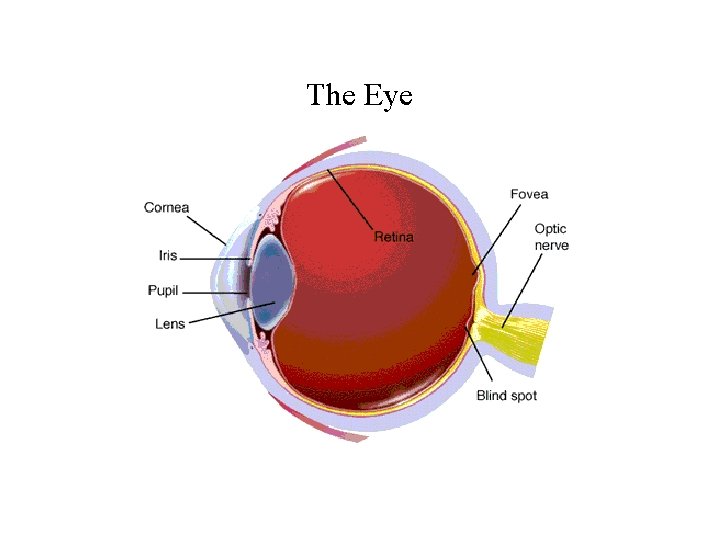
The Eye • The structures of the eye from the diagram are as follows: – lens: focuses the image onto the retina – pupil: regulates the amount of light entering the eye; full dark adaptation takes about 30 minutes and light adaptation about 1 mintue – iris: the colored part of the eye – cornea: the soft, outer, protective covering of the eye – retina: contains photoreceptor cells, rods (which detect brightness contrasts) and cones (which detect color) – fovea: an area of the retina that contains all cones and no rods – optic nerve: relays visual information to the brain – blind spot: where the optic nerve connects to the back of the eye
Color Perception • There are two main theories of color perception: – trichromatic (or Young-Helmholtz) theory: all color perception derives from three different color receptors in the retina (usually red, blue and green); while this theory can physically recreate the spectrum of colors, much like your TV set does, it cannot explain color blindness or negative afterimages – opponent process theory: three sets of color receptors (blue-yellow, redgreen, black-white) respond to determine the color you experience; explains both color blindness (which tends to be either blue-yellow, redgreen, or full color blindness) and negative afterimages
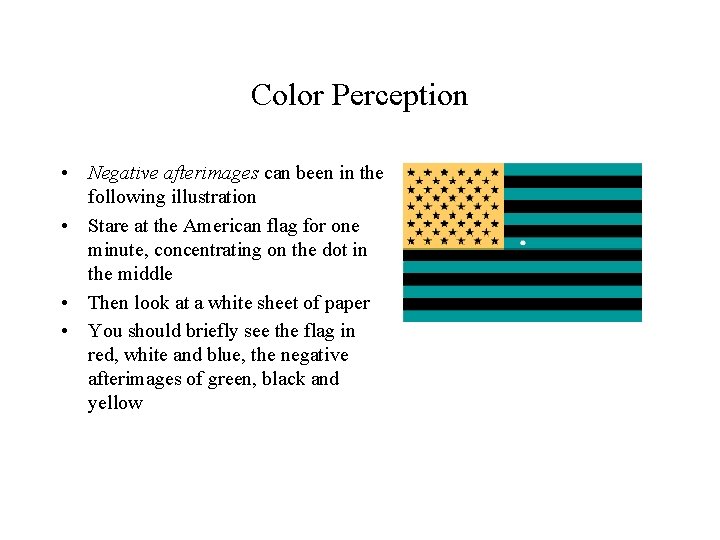
Color Perception • Negative afterimages can been in the following illustration • Stare at the American flag for one minute, concentrating on the dot in the middle • Then look at a white sheet of paper • You should briefly see the flag in red, white and blue, the negative afterimages of green, black and yellow