
Perception Part 2 Change Blindness What does this
Perception- Part 2
Change Blindness
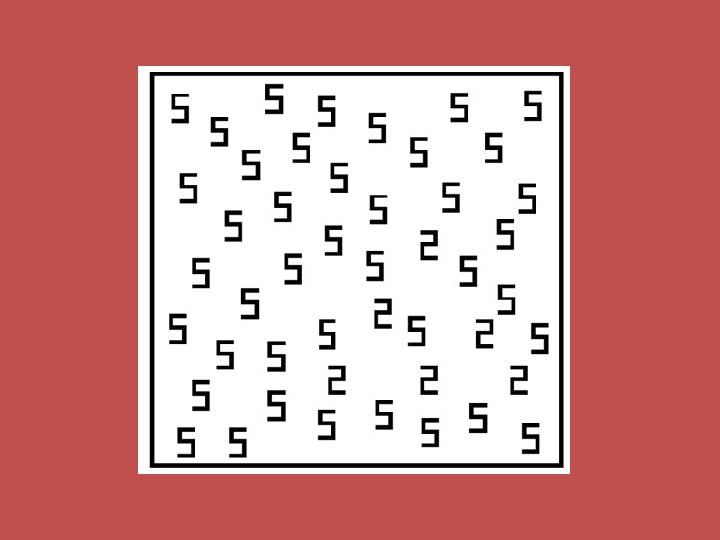
What does this say?

Call me…. 703 -855 -78 S 2
Top-Down vs. Bottom Up
Re-Cap of Perspective: Perceptual Constancy • Perceptual Constancy- Tendency for perceptions of objects to remain relatively unchanged in spite of changes in raw sensations – Brightness Constancy: piece of white paper does not change when it moves from am dimly lit room to a brightly lit room – Color constancy: colors do not seem to change much in spite of different conditions of light – Size constancy: dollar bill from 1 foot and 10 feet with seem different in size, however we do not perceive it as different because familiar objects do not change in perceived size as different distances – Shape constancy- a penny seen straight on is circular, from an angle it’s oval however we continue to perceive it as circular
Perceptual Organization: Gestalt § Visual Capture § tendency for vision to dominate the other senses § Gestalt--an organized whole § tendency to integrate pieces of information into meaningful wholes
Perceptual Organization: Gestalt § Grouping § the perceptual tendency to organize stimuli into coherent groups § Grouping Principles § § § proximity--group nearby figures together similarity--group figures that are similar continuity--perceive continuous patterns closure--fill in gaps connectedness--spots, lines, and areas are seen as unit when connected
Re-Cap: Depth Perception • Texture Gradient- texture of objects more severe up close • Linear Perspective- images cast smaller images on retina when they are more distant, parallel lines appear to grow closer further away • Superposition- Closer objects tend to be partially in front of distant objects • Shadowing- shadow suggest depth of object • Speed of movement- objects further away move across the field vision slower • Aerial Perspective- distant objects look hazy • Accommodation- shape of lens of eye changes to focus on visual images
Philosophers have debated the origin of our perceptual abilities: Is it nature or nurture? What do you think?
Beliefs • German philosopher Immanuel Kantknowledge comes from our inborn ways of organizing sensory experience • British philosopher John Locke- through our experiences we also learn to perceive the world
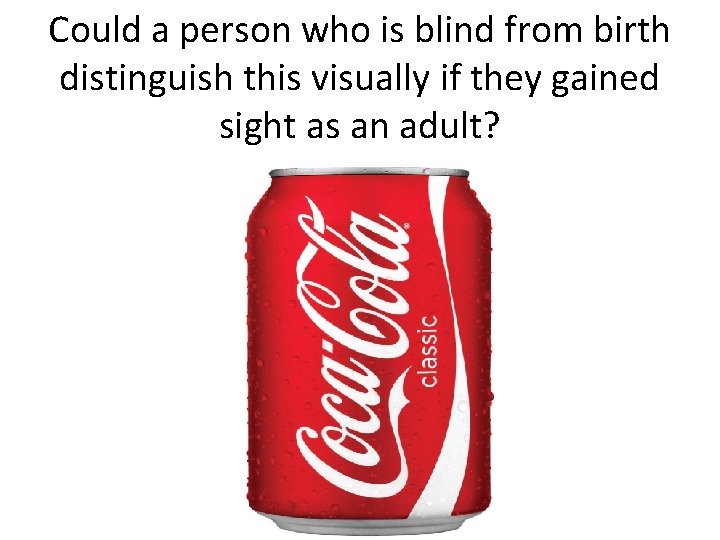
Could a person who is blind from birth distinguish this visually if they gained sight as an adult?
Critical Period • Critical period of vision is at birth through infancy of humans, cats, monkeys
Cataracts • Definition: an eye disease in which the lens becomes covered in an opaque film that affects sight, eventually causing total loss of sight.
Perceptual Adaption • With vision, the ability to adjust to an artificially displaced or even inverted visual field – Example: wearing a new pair of glasses (may be fuzzy at first, a few hours or days, eyes will adjust)
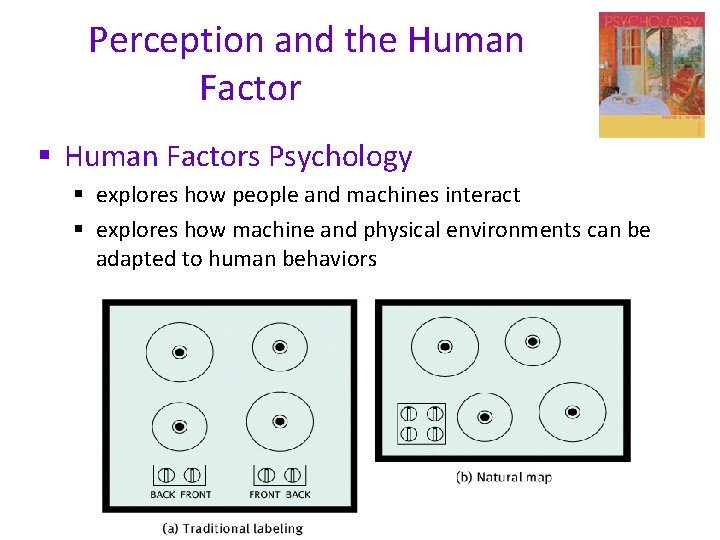
Perception and the Human Factor § Human Factors Psychology § explores how people and machines interact § explores how machine and physical environments can be adapted to human behaviors
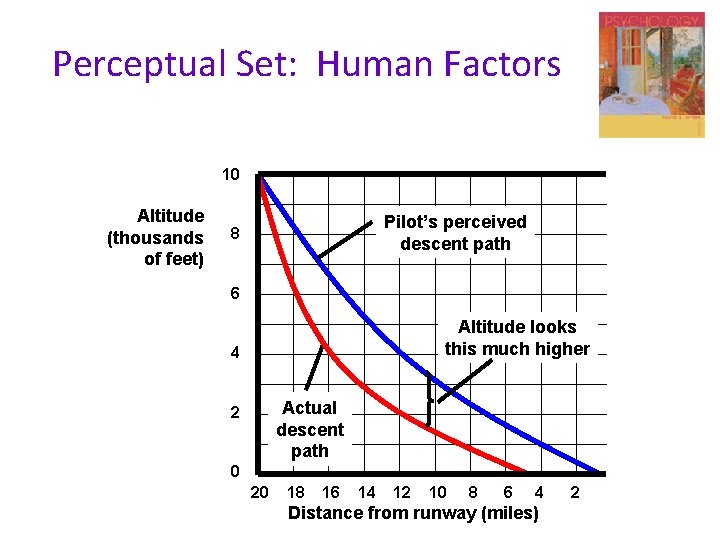
Perceptual Set: Human Factors 10 Altitude (thousands of feet) Pilot’s perceived descent path 8 6 Altitude looks this much higher 4 Actual descent path 2 0 20 18 16 14 12 10 8 6 4 Distance from runway (miles) 2
Is it really possible?
Is There Extrasensory Perception? § Extrasensory Perception § controversial claim that perception can occur apart from sensory input § telepathy § clairvoyance § precognition § Parapsychology § the study of paranormal phenomena § ESP § psychokinesis
Claims of paranormal phenomena include astrological predictions, psychic healing, communication with the dead, and out-of-body experiences
ESP Three types of ESP: 1. Telepathy- mind to mind communication 2. Clairvoyance- perceiving events as they are taking place 3. Precognition- perceiving future events Also associated with ESP, psychokinesis (“mind over matter”
• http: //viscog. beckman. illinois. edu/djs_lab/de mos. html • www. grand-illusions. com • http: //www. mindhacks. com/ • http: //psych. hanover. edu/Krantz/tutor. html • http: //users. skynet. be/J. Beever/pave. htm
• http: //philomel. com/musical_illusions/ • http: //www. audiodesignline. com/204300429
Activity • Take out a piece of paper and something to write with • On that piece of paper you are going to write a paragraph about someone you know -You may not choose a family member - You may not use their name or how you know them - Identify how they have helped you learn a life lesson
- Slides: 25