
Perception Chapter 3 The Perception Process Selection Organization






- Slides: 58
Perception Chapter 3
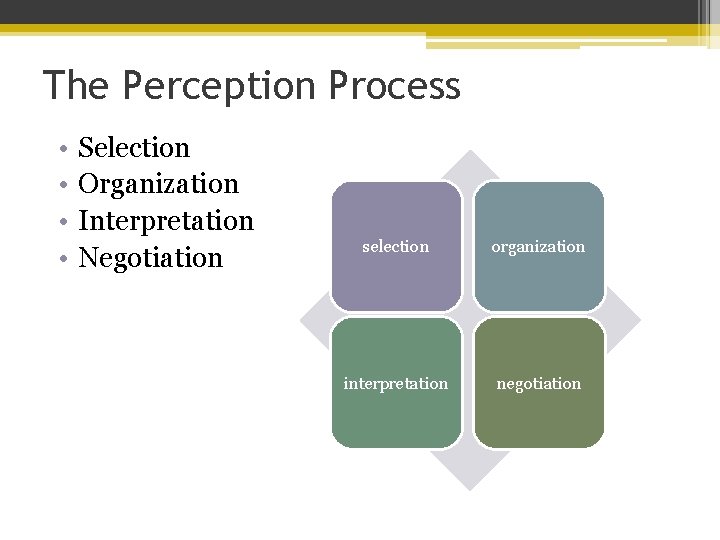
The Perception Process • • Selection Organization Interpretation Negotiation selection organization interpretation negotiation
Selection • Because we can’t respond to everything, stimuli that are intense often stand out. �Short people �Tall people �Obnoxious laughs �Bad smells �Repetitive events �Contrasting or changing events �Motives ▫ being hungry makes you more likely to notice restaurants, food commercials, etc.
Organization • Brain Tricks - This Is How Your Brain Works
Perceptual Schema • A structured internal representation of an object or image acquired through perception. 1. Fit into an existing schema 2. Force into an existing schema 3. Create a new schema • The Price is Right- Plinko
Organization
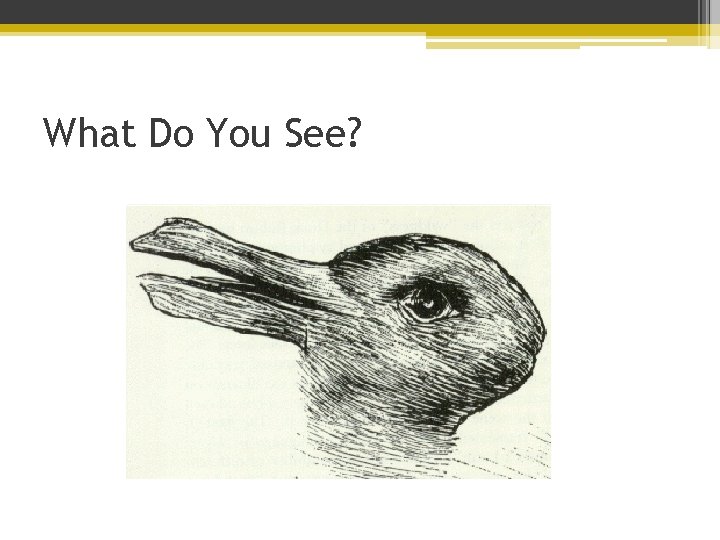
What Do You See?
Sheep Mountain, Wyoming
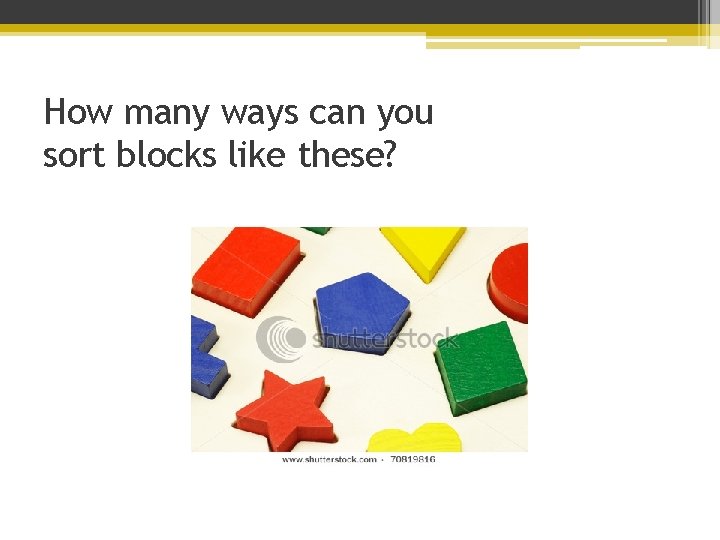
How many ways can you sort blocks like these?
Organization • We classify other communicators in a variety of ways (perceptual schema): �Appearance ▫ gender, age, height, beauty, weight �Social roles ▫ student, attorney, wife, pastor �Interaction style ▫ helpful, friendly, sarcastic �Psychological traits ▫ curious, nervous, insecure �Membership ▫ Democrat/Republican, immigrant, Christian, sophomore • The way we think about others shapes how we communicate with them.
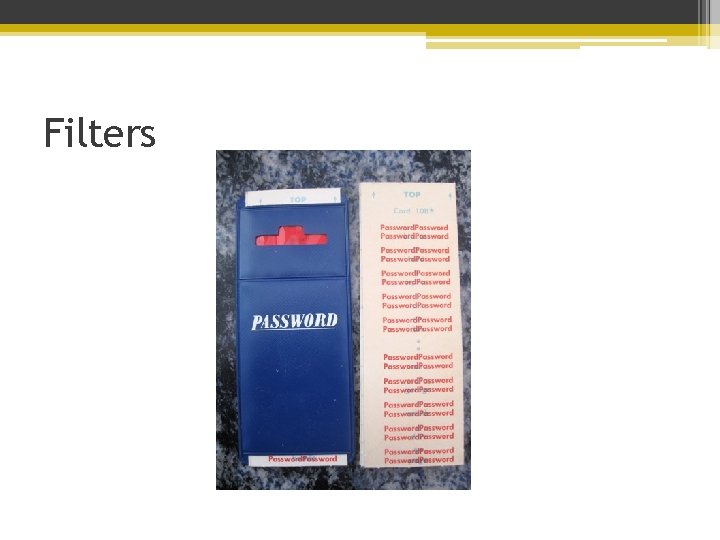
Filters
Discussion: Perceptual Filters 1. Identify the perceptual schema that you would use to classify people in each of the following contexts: � � spending time with a new acquaintance at a party Socializing with fellow workers on the job Choosing teammates for an important class project Offering help to a stranded motorist Describe both the general type (“physical” or “membership”) and the specific trait (“attractive” or “same age as me”) 2. Consider: � � � What other schema might I use in each context? What are the consequences of using the schema you originally chose versus the alternative you just identified? How might your relationships change if you used different constructs?
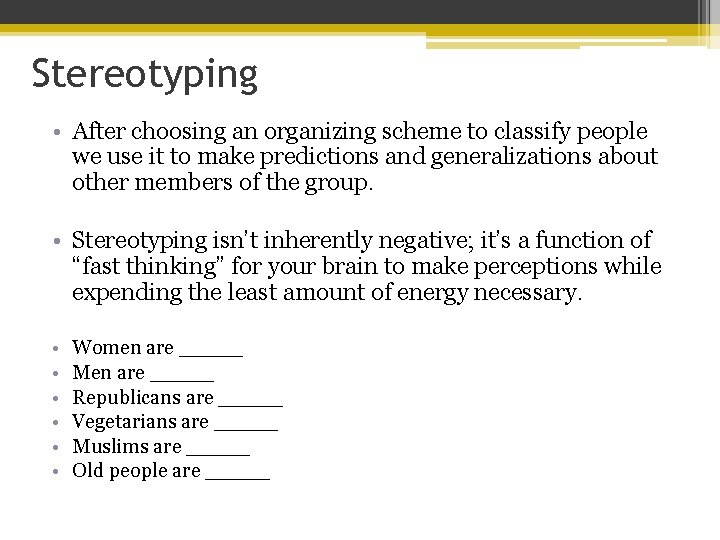
Stereotyping • After choosing an organizing scheme to classify people we use it to make predictions and generalizations about other members of the group. • Stereotyping isn’t inherently negative; it’s a function of “fast thinking” for your brain to make perceptions while expending the least amount of energy necessary. • • • Women are _____ Men are _____ Republicans are _____ Vegetarians are _____ Muslims are _____ Old people are _____
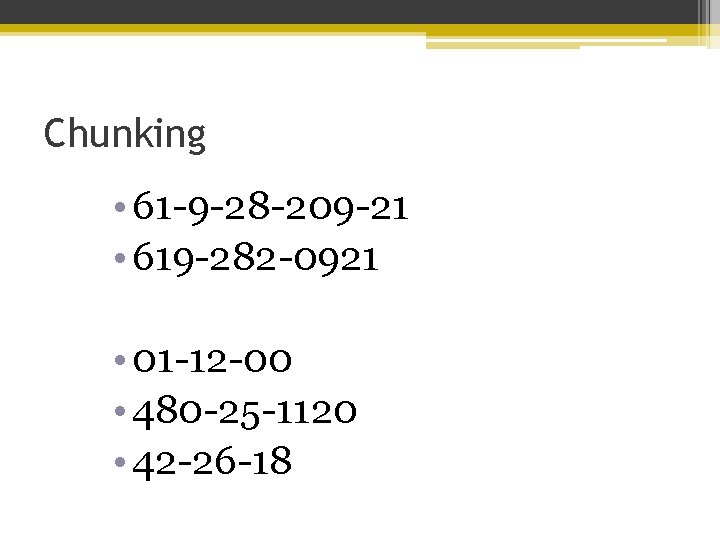
Chunking • 61 -9 -28 -209 -21 • 619 -282 -0921 • 01 -12 -00 • 480 -25 -1120 • 42 -26 -18
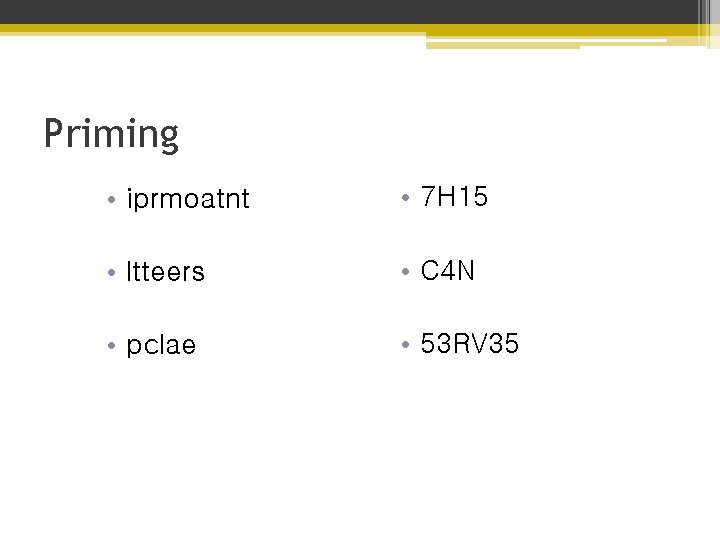
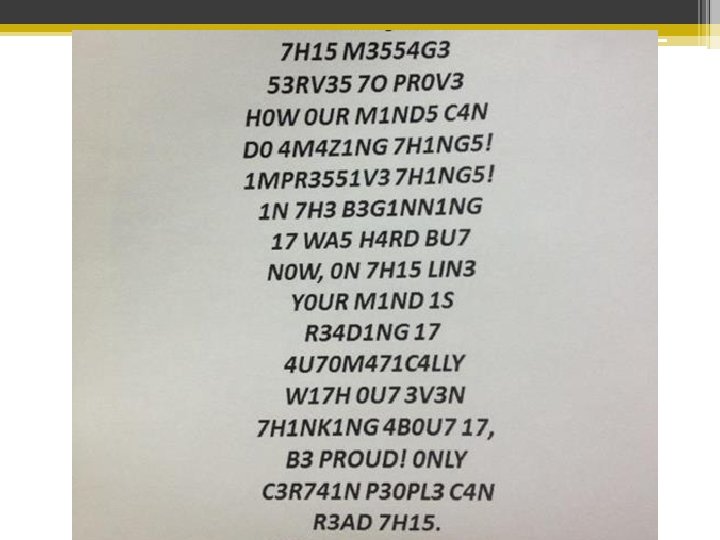
Priming • iprmoatnt • 7 H 15 • ltteers • C 4 N • pclae • 53 RV 35
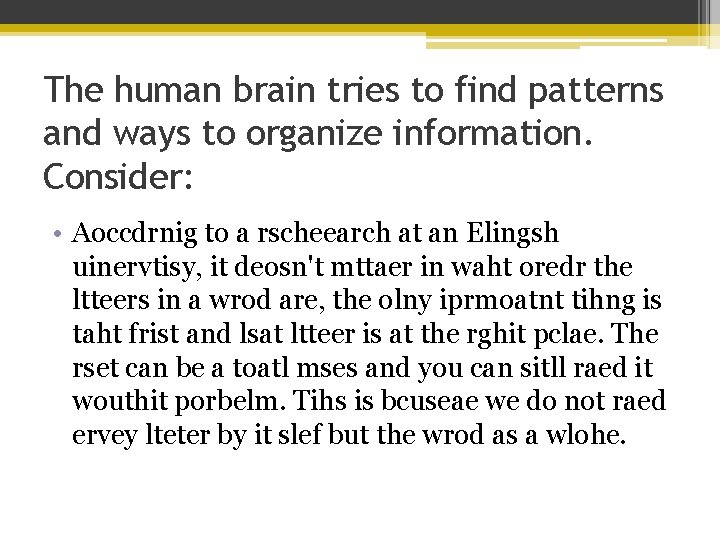
The human brain tries to find patterns and ways to organize information. Consider: • Aoccdrnig to a rscheearch at an Elingsh uinervtisy, it deosn't mttaer in waht oredr the ltteers in a wrod are, the olny iprmoatnt tihng is taht frist and lsat ltteer is at the rghit pclae. The rset can be a toatl mses and you can sitll raed it wouthit porbelm. Tihs is bcuseae we do not raed ervey lteter by it slef but the wrod as a wlohe.
Or this: • Backmasking Collection • And just for fun: • What song is this? • Yvan Eht Nioj
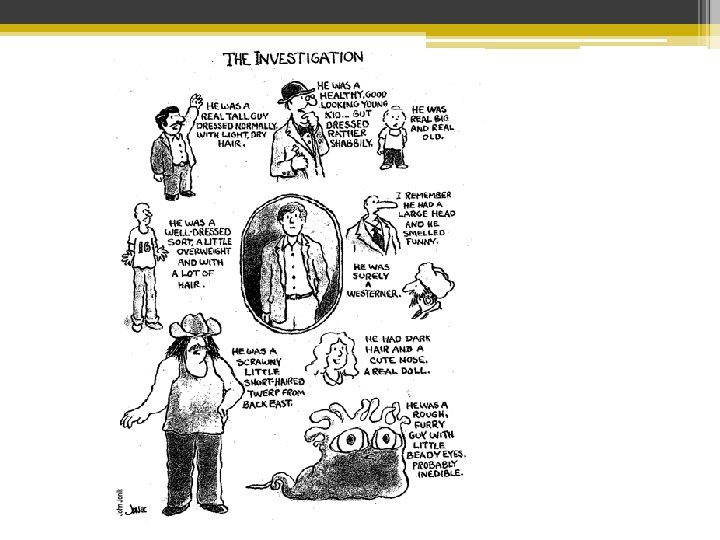
Interpretation • Several factors cause us to interpret a situation one way or another: �Degree of involvement with the other person �Personal experience �Assumptions about human behavior �Attitudes �Expectations �Knowledge �Self-concept �Relational satisfaction “We don’t see things as they are. We see things as we are. ” - Anaïs Nin
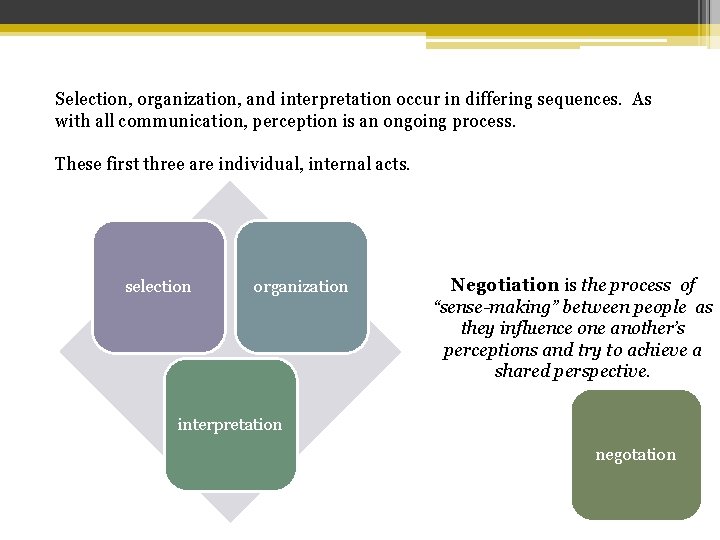
Selection, organization, and interpretation occur in differing sequences. As with all communication, perception is an ongoing process. These first three are individual, internal acts. selection organization Negotiation is the process of “sense-making” between people as they influence one another’s perceptions and try to achieve a shared perspective. interpretation negotation
Narrative “There are two sides to every story, and the truth is somewhere in the middle. ” A narrative is the story we use to describe our personal world Shared narratives provide the best chance for smooth communication. Discussion: Shared narratives don’t have to be accurate to be powerful. Why is this true? Think about Santa Claus, Pearl Harbor, or the origin of the Earth.
Physiological Influences on Perception • The senses �That music is too loud/quiet �It’s too hot/cold in here �Why are you driving so recklessly? • Biological cycles �“morning person” or “night owl” • Psychological challenges �ADHD, bipolar disorder • Age • Health and fatigue • Hunger
Physiological Influences • "Not Much To See": How the Blind Enjoy Movies
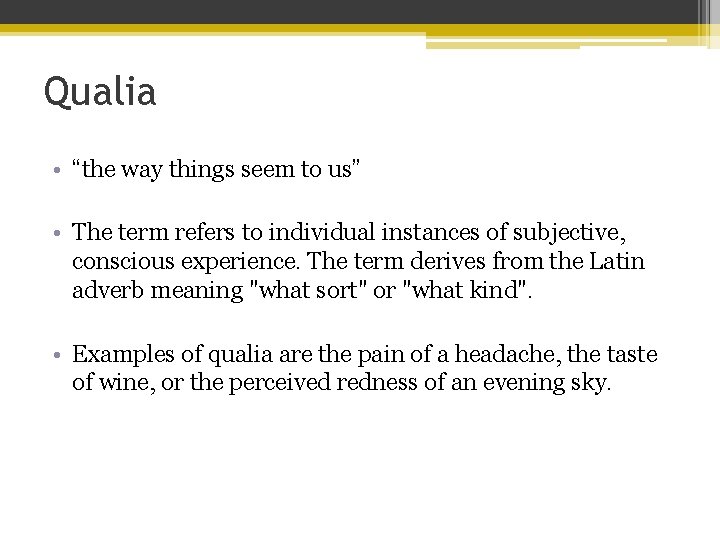
Qualia • “the way things seem to us” • The term refers to individual instances of subjective, conscious experience. The term derives from the Latin adverb meaning "what sort" or "what kind". • Examples of qualia are the pain of a headache, the taste of wine, or the perceived redness of an evening sky.
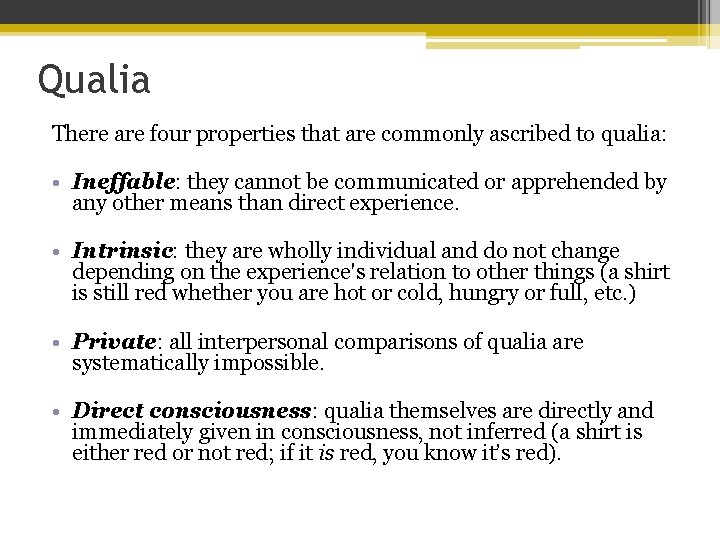
Qualia There are four properties that are commonly ascribed to qualia: • Ineffable: they cannot be communicated or apprehended by any other means than direct experience. • Intrinsic: they are wholly individual and do not change depending on the experience's relation to other things (a shirt is still red whether you are hot or cold, hungry or full, etc. ) • Private: all interpersonal comparisons of qualia are systematically impossible. • Direct consciousness: qualia themselves are directly and immediately given in consciousness, not inferred (a shirt is either red or not red; if it is red, you know it’s red).
Perception - Sight • Is Your Red The Same as My Red? • What is it like to be color blind? • How Good Is Your Eyesight? • Can You Trust Your Eyes?
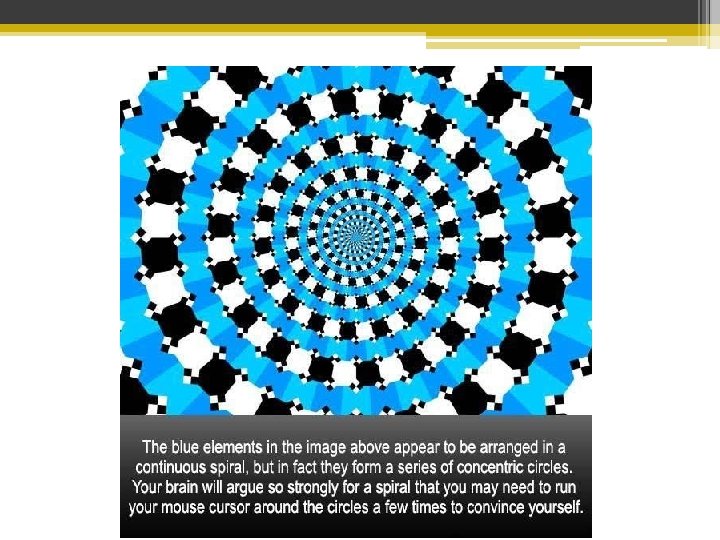
Perception - Sight • color optical illusion
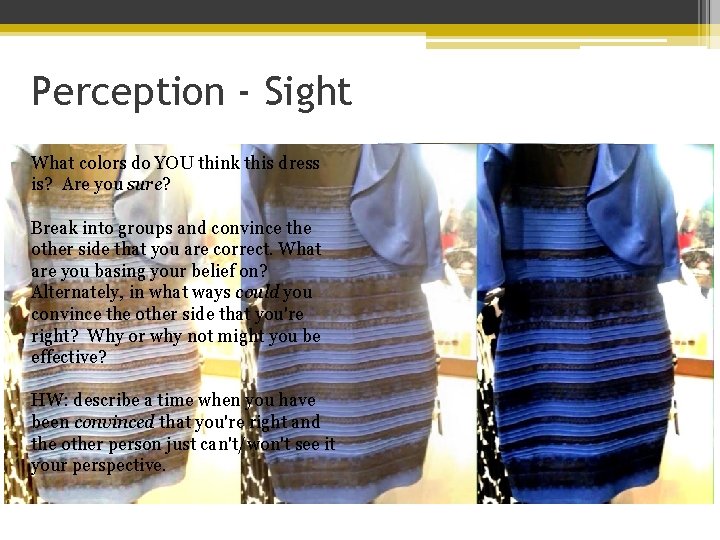
Perception - Sight What colors do YOU think this dress is? Are you sure? Break into groups and convince the other side that you are correct. What are you basing your belief on? Alternately, in what ways could you convince the other side that you're right? Why or why not might you be effective? HW: describe a time when you have been convinced that you're right and the other person just can't/won't see it your perspective.
Perception – Smell • http: //mentalfloss. com/article/60363/inside-top-secretfactory-where-scent-made • Creating a fragrance, I learn, is more than hard science: It’s also about psychological and emotional manipulation. Your sense of smell is different from the other physical senses. While the eyes and ears take information and route it through the thalamus before it goes to the parts of the brain that process and interpret it, the nose sends signals directly to the olfactory receptors, which lie in the limbic system, the part of the brain that processes emotions and memory. This is why the faintest whiff of a fragrance can teleport you instantly back to a specific time or place and trigger powerful emotions—like that indelible memory of my childhood crush.
Perception - Taste
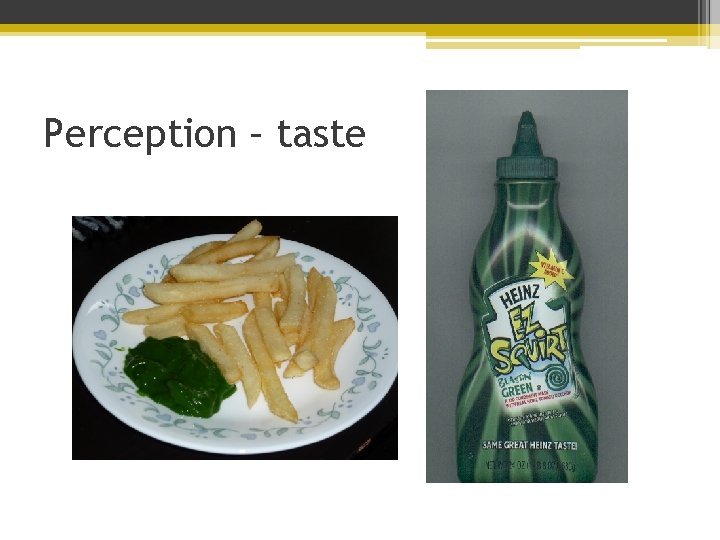
Perception – taste
Perception - sound • Can You Trust Your Ears? • How Well Can You Hear?
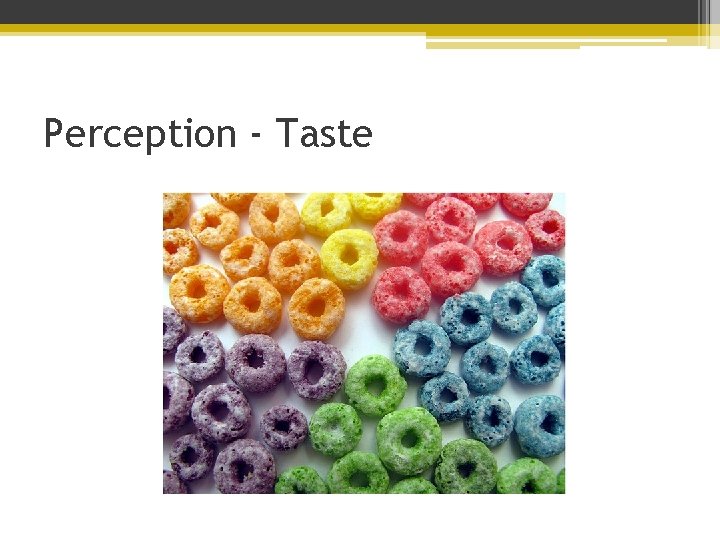
Activity - Perception and Taste • Choose (or create) a food where sight and taste perceptions don’t match �green or purple ketchup �Skittles Riddles �Froot Loops �put food coloring in mashed potatoes, milk , etc.
That’s all very interesting Mr. Stephens (and we’ve had fun watching videos), but why does this matter? ! • Discussion: what role does perception play in communication? Brainstorm both problems and solutions.
Activity: New Body, New Perspective 1. Choose one of the following situations: �An evening at a singles bar �A volleyball game �A doctor’s physical examination 2. How would the event be different if: � � � Your eyesight were much better (or worse) You had hearing loss You were eight inches shorter (or taller) You were coming down with a serious cold You were a member of the opposite gender You were ten years younger (or older)
Cultural Influences on Perception • Ethnocentrism: the attitude that one’s own culture is superior to others. �In Middle Eastern countries, people routinely breathe on each other as an important part of interpersonal relationships. �Asian cultures value silence. A talkative person is often considered a show-off or insincere. �A Latina woman would avoid eye contact with a male police officer, not as a sign of avoidance or guilt but as a cultural sign of respect. �A person from the southern US with a typically talkative, hightouch style might be viewed as pushy and aggressive in the north.
Culture & Perception • 10 Japanese Travel Tips for Visiting America • 25 Unusual Foreign Travel Warnings for Visiting the US
Social Roles and Perception • Gender roles �Socially approved ways that men and women are expected to behave • Occupational roles �Examine how five people view a park differently ▫ ▫ ▫ a botanist is fascinated by variety of plants a zoologist looks for interesting animals a meteorologist watches the sky for changes in the weather a psychologist observes the interaction among people a pickpocket takes advantage of their distraction to steal their wallets • Relational roles �Roles like “parent, ” “student, ” or “boyfriend” affect how you perceive communication
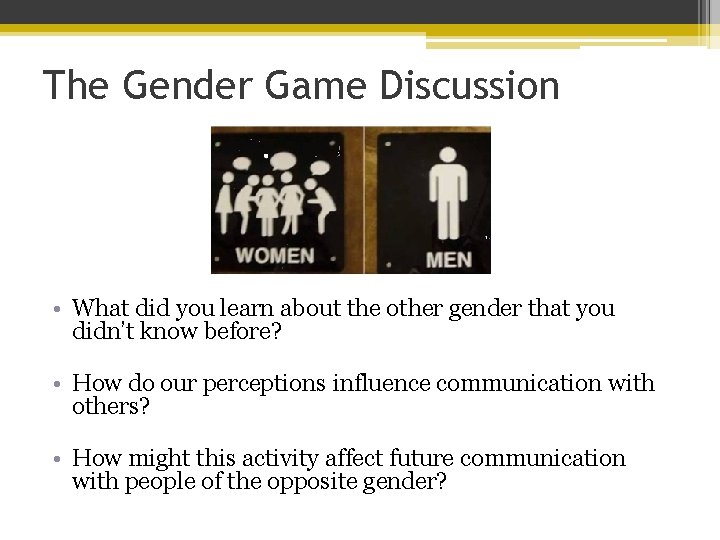
The Gender Game • Divide into two groups: men and women • Write 5 -10 questions your group has always wanted to know about the other group but have never asked. �You may not ask a question that you are unwilling to answer yourself �You may not ask questions that are offensive, insulting, or generalize about all members of the group (“why are women such bad drivers? ”) • Groups will alternate asking/answering questions.
The Gender Game Discussion • What did you learn about the other gender that you didn’t know before? • How do our perceptions influence communication with others? • How might this activity affect future communication with people of the opposite gender?
Common Tendencies in Perception • • We judge ourselves more charitably than others We cling to first impressions We assume that others are similar to us We are influenced by the obvious
Perception Checking • Like most people, you have probably jumped to a conclusion about reasons for behavior. • “Why are you mad at me” �Who said I was mad? • “What’s the matter with you? ” �Who said anything was wrong? • “Come on, tell the truth!” �Why are you accusing me of lying?
Perception Checking • A complete perception check has three parts A. a description of the behavior you noticed B. At least two possible interpretations of the behavior C. A request for clarification about how to interpret the behavior • “When you stomped out of the bathroom and slammed the door (behavior) I wasn’t sure if you were mad at me (first interpretation) or just in a hurry (second interpretation). How did you feel? (request for clarification)
Graded Activity 3. 3: Perception Checking
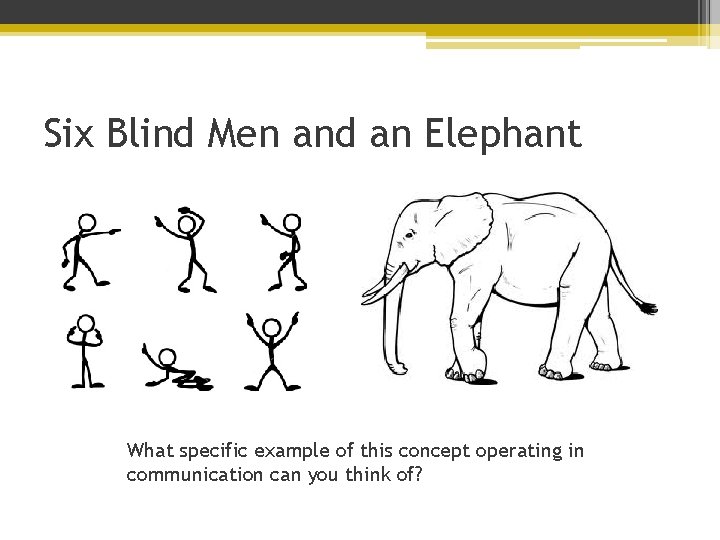
Six Blind Men and an Elephant What specific example of this concept operating in communication can you think of?
Empathy and Sympathy • Empathy is the ability to re-create another person’s perspective, to experience the world from the other’s point of view. em- (before) + pathos (emotion) • Sympathy is the ability to view another person’s situation from your point of view (the difference between feeling for someone or feeling with someone. sym- (with, together) + pathos (emotion) • Discussion: which approach makes for clearer understanding in communication, and why?
Empathy and the “Golden Rule” • Read the ETHICAL CHALLENGE handout and discuss the idea of a Golden Rule as it relates to communication.
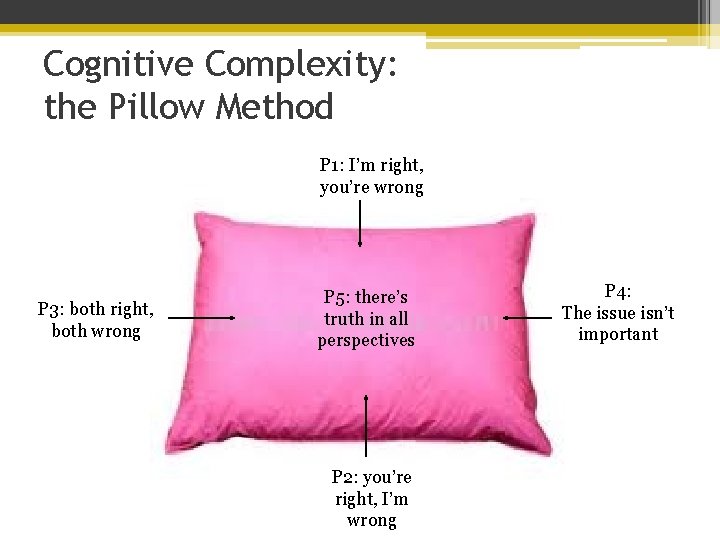
Cognitive Complexity: the Pillow Method P 1: I’m right, you’re wrong P 3: both right, both wrong P 5: there’s truth in all perspectives P 2: you’re right, I’m wrong P 4: The issue isn’t important
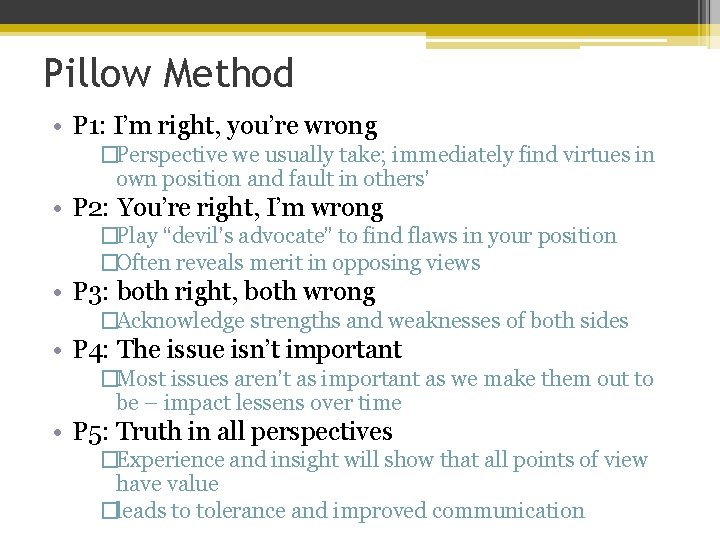
Pillow Method • P 1: I’m right, you’re wrong �Perspective we usually take; immediately find virtues in own position and fault in others’ • P 2: You’re right, I’m wrong �Play “devil’s advocate” to find flaws in your position �Often reveals merit in opposing views • P 3: both right, both wrong �Acknowledge strengths and weaknesses of both sides • P 4: The issue isn’t important �Most issues aren’t as important as we make them out to be – impact lessens over time • P 5: Truth in all perspectives �Experience and insight will show that all points of view have value �leads to tolerance and improved communication
Activity: Ambiguity of Expression Feelings
Homework Activity 3. 2: The Pillow Method in Action (example handout and activity)