
Perceived job insecurity and its effects on employees

Perceived job insecurity and its effects on employees Lecture September 24 th, 2014, Prof. Saija Mauno saija. mauno@jyu. fi
Lecture content - Defining job insecurity in I/O psychology - Predictors of job insecurity - Brief summary on most typical predictors - Health and motivation outcomes of job insecurity - Individual, organizational and family levels Few study examples (Jyväskylä-Tampere research group) - - Global and multi-dimensional perspectives How to cope with job insecurity? - Buffering resources against job insecurity Few study examples (Jyväskylä-Tampere research group)

Defining job insecurity and its prevalence in Finland & Europe
What is job insecurity from psychological approach? l a Psychological definitions emphasize – Job insecurity is subjectively experienced and is based on a person’s appraisal of his/her current work situation (Lazarus & Folkman, 1984). – Job insecurity is a severe, often also chronic, job stressor, resulting in negative health & motivation outcomes. – Scope is in future, making coping often difficult -> Shall I lose my job, and if so, when?
Is job insecurity one- or multidimensional construct? 1. Fear of job loss (see Vander Elst et al. , 2013) Affective dimension of job insecurity ”I am worried about keeping my job” ”I am worried about losing my job” 2. Probability to lose one’s job Cognitive dimension of job insecurity ”I am secure/certain that I can keep my job” (recode) l l When health outcomes are considered, fear is more important dimension (stronger associations have been found). Job is insecure: ”when a person considers that the probability to lose one’s job is severe and when (s)he feels powerlessness to resist or manage this threat” (Greenhalgh & Rosenblatt, 1984).

More about multiple facets of job insecurity l l Insecurity about continuity of one’s job – Threat of unemployment or job loss – Global definition, which has been most often used in JI research Insecurity about other job-related changes – Career prospects, job content (losing job control), salary cut etc. – Other changes in job contract; layoff, part -timing, transfer etc.
Prevalence of job insecurity Finland: ”I am worried about losing my job” l 1977 16 % l 1984 11 % l 1990 12 % l 1997 19 % (depression of the 1990 s’) l 2003 17 % l 2008 12 % l 2013 (figures not yet available) - Statistics Finland: Quality of Working Life survey. - In Finnish Youth Barometer (2013), 50 % perceived that ’secure job would be hard to get in future’. l Europe: - 14 -42 %, 2004 -06; Laszlo et al. 2010 in + 50 workers: 23 %; Hank & Erlinghagen, 2011

Predictors of job insecurity
Small group discussion l l l What do you consider as major predictors/causes of job insecurity? Try to focus on different levels: individual, organization and society Are there any specific factors in your country that are likely to cause/increase job insecurity? – About 10 min. discussion (3 -4 persons/group)
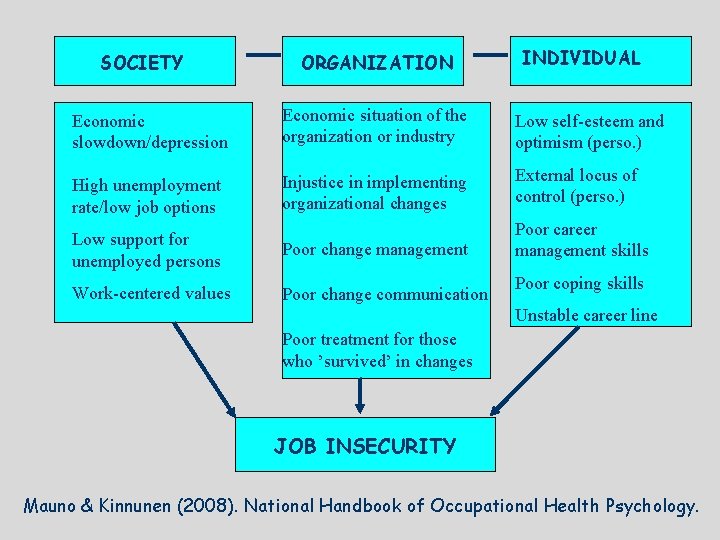
SOCIETY ORGANIZATION INDIVIDUAL Economic slowdown/depression Economic situation of the organization or industry Low self-esteem and optimism (perso. ) High unemployment rate/low job options Injustice in implementing organizational changes External locus of control (perso. ) Low support for unemployed persons Poor change management Poor career management skills Work-centered values Poor change communication Poor coping skills Unstable career line Poor treatment for those who ’survived’ in changes JOB INSECURITY Mauno & Kinnunen (2008). National Handbook of Occupational Health Psychology.
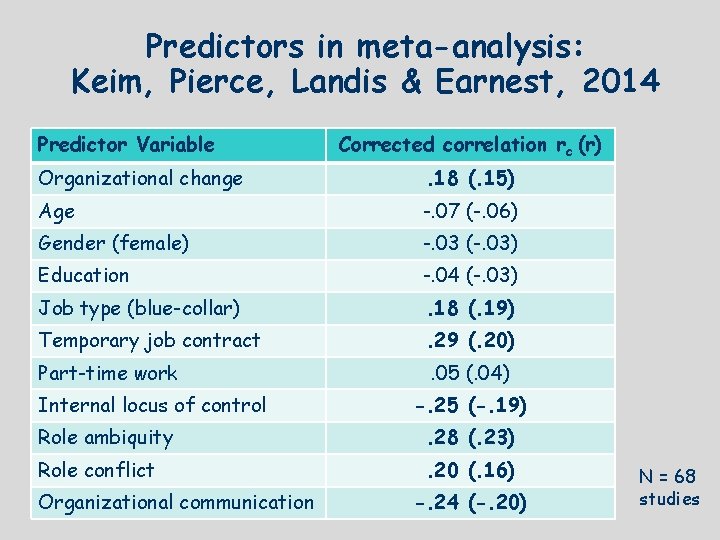
Predictors in meta-analysis: Keim, Pierce, Landis & Earnest, 2014 Predictor Variable Corrected correlation rc (r) Organizational change . 18 (. 15) Age -. 07 (-. 06) Gender (female) -. 03 (-. 03) Education -. 04 (-. 03) Job type (blue-collar) . 18 (. 19) Temporary job contract . 29 (. 20) Part-time work . 05 (. 04) Internal locus of control -. 25 (-. 19) Role ambiquity . 28 (. 23) Role conflict . 20 (. 16) Organizational communication -. 24 (-. 20) N = 68 studies

Job insecurity and health and motivation effects
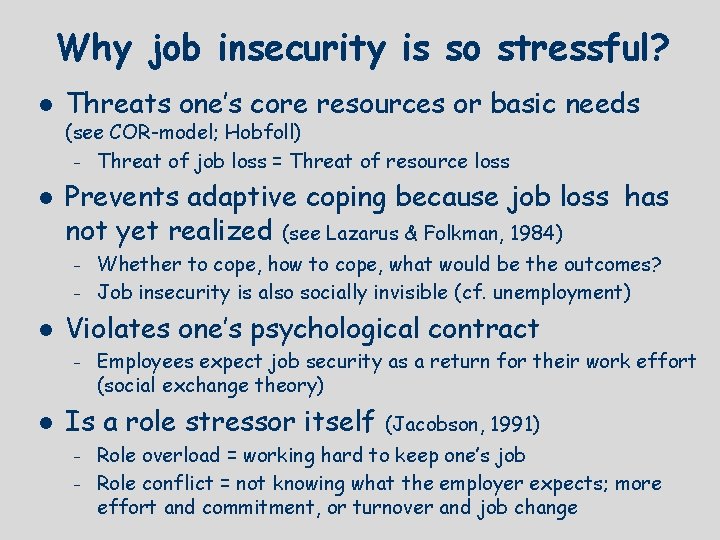
Why job insecurity is so stressful? l l Threats one’s core resources or basic needs (see COR-model; Hobfoll) – Threat of job loss = Threat of resource loss Prevents adaptive coping because job loss has not yet realized (see Lazarus & Folkman, 1984) – – l Violates one’s psychological contract – l Whether to cope, how to cope, what would be the outcomes? Job insecurity is also socially invisible (cf. unemployment) Employees expect job security as a return for their work effort (social exchange theory) Is a role stressor itself – – (Jacobson, 1991) Role overload = working hard to keep one’s job Role conflict = not knowing what the employer expects; more effort and commitment, or turnover and job change
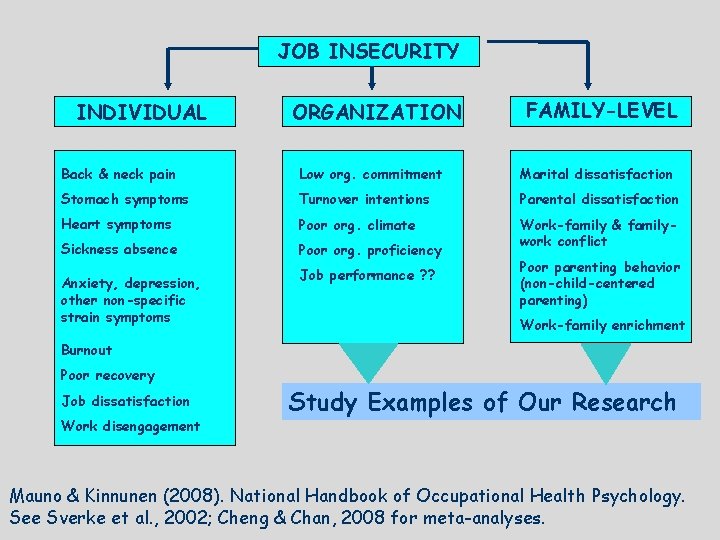
JOB INSECURITY INDIVIDUAL ORGANIZATION FAMILY-LEVEL Back & neck pain Low org. commitment Marital dissatisfaction Stomach symptoms Turnover intentions Parental dissatisfaction Heart symptoms Poor org. climate Sickness absence Poor org. proficiency Work-family & familywork conflict Anxiety, depression, other non-specific strain symptoms Job performance ? ? Poor parenting behavior (non-child-centered parenting) Work-family enrichment Burnout Poor recovery Job dissatisfaction Work disengagement Study Examples of Our Research Mauno & Kinnunen (2008). National Handbook of Occupational Health Psychology. See Sverke et al. , 2002; Cheng & Chan, 2008 for meta-analyses.
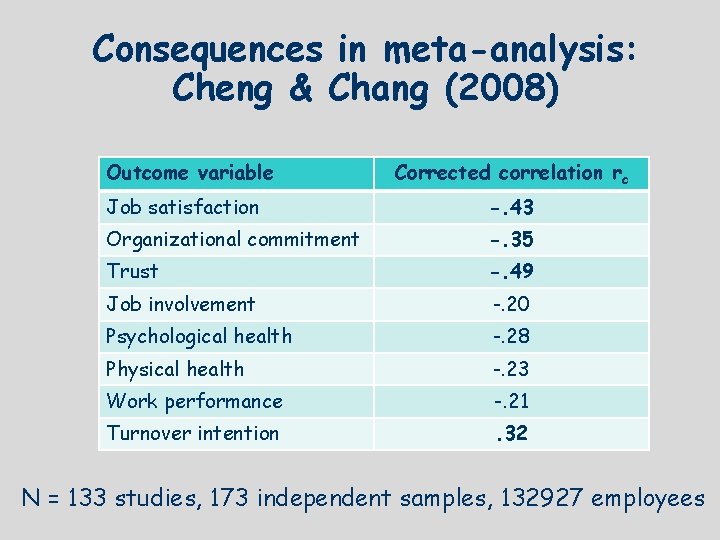
Consequences in meta-analysis: Cheng & Chang (2008) Outcome variable Corrected correlation rc Job satisfaction -. 43 Organizational commitment -. 35 Trust -. 49 Job involvement -. 20 Psychological health -. 28 Physical health -. 23 Work performance -. 21 Turnover intention . 32 N = 133 studies, 173 independent samples, 132927 employees
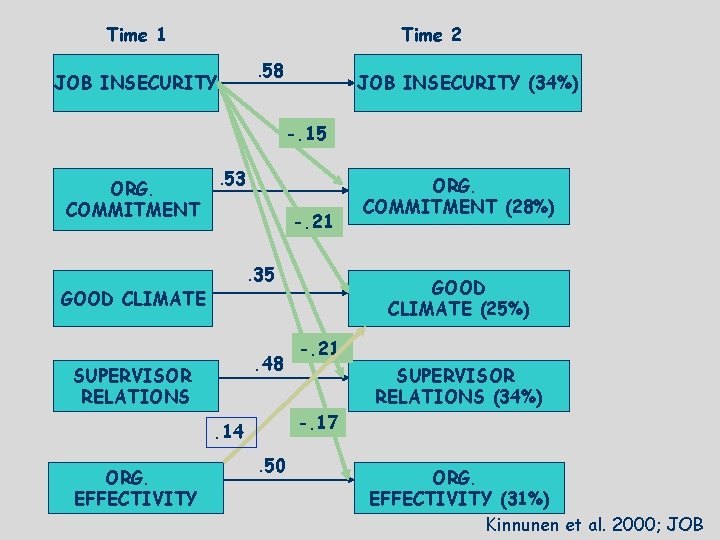
Time 1 Time 2. 58 JOB INSECURITY (34%) -. 15 ORG. COMMITMENT . 53 -. 21. 35 GOOD CLIMATE . 48 SUPERVISOR RELATIONS GOOD CLIMATE (25%) -. 21 SUPERVISOR RELATIONS (34%) -. 17 . 14 ORG. EFFECTIVITY ORG. COMMITMENT (28%) . 50 ORG. EFFECTIVITY (31%) Kinnunen et al. 2000; JOB
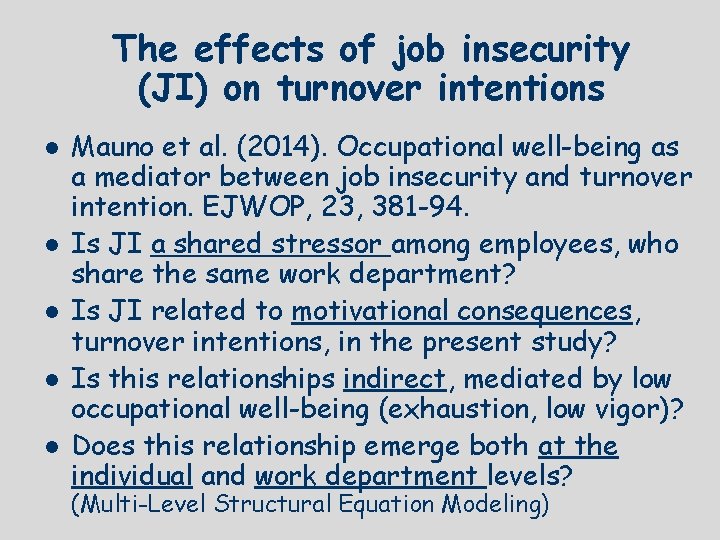
The effects of job insecurity (JI) on turnover intentions l l l Mauno et al. (2014). Occupational well-being as a mediator between job insecurity and turnover intention. EJWOP, 23, 381 -94. Is JI a shared stressor among employees, who share the same work department? Is JI related to motivational consequences, turnover intentions, in the present study? Is this relationships indirect, mediated by low occupational well-being (exhaustion, low vigor)? Does this relationship emerge both at the individual and work department levels? (Multi-Level Structural Equation Modeling)
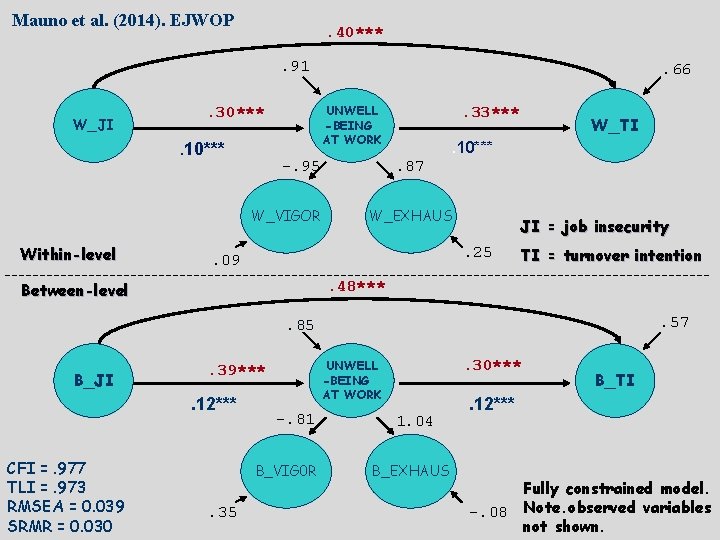
Mauno et al. (2014). EJWOP . 40***. 91 W_JI UNWELL -BEING AT WORK . 30***. 10*** -. 95 W_VIGOR Within-level . 66. 33*** W_TI . 10***. 87 W_EXHAUS JI = job insecurity. 25 . 09 TI = turnover intention . 48*** Between-level . 57 . 85 B_JI . 12*** CFI =. 977 TLI =. 973 RMSEA = 0. 039 SRMR = 0. 030 -. 81 B_VIG 0 R . 35 . 30*** UNWELL -BEING AT WORK . 39*** 1. 04 B_EXHAUS B_TI . 12*** Fully constrained model. -. 08 Note. observed variables not shown.
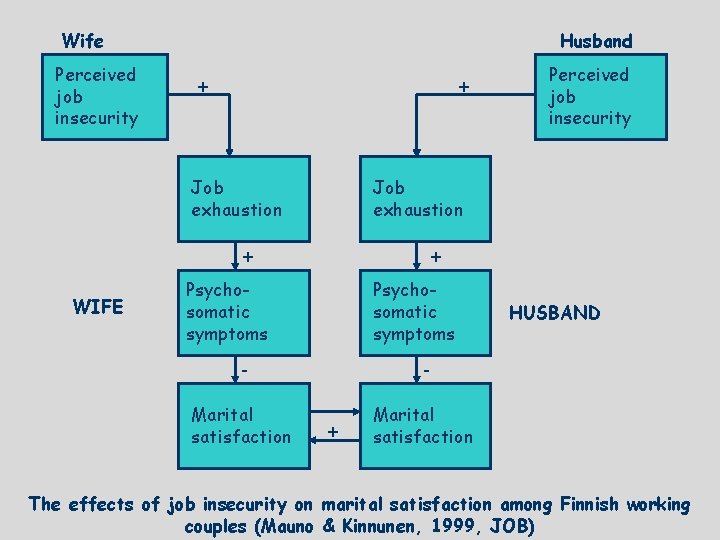
Wife Perceived job insecurity Husband + + Job exhaustion + WIFE Perceived job insecurity + Psychosomatic symptoms - - Marital satisfaction + HUSBAND The effects of job insecurity on marital satisfaction among Finnish working couples (Mauno & Kinnunen, 1999, JOB)
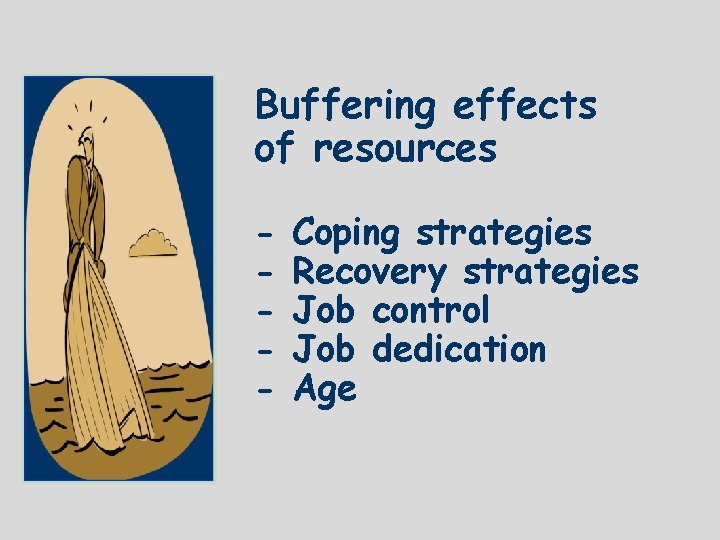
Buffering effects of resources - Coping strategies Recovery strategies Job control Job dedication Age
Why buffers would matter? l l Job insecurity seems to be a very common and persistent job stressor today and in future. Different psychosocial resources can act as stress buffers against job insecurity: – – – l Certain personality factors (self-esteem, CSEs, optimism etc. ) Coping strategies and skills, recovery strategies Social and instrumental support from different contexts Job control and decision latitude at work/organization Attitudes, aspirations, goals, values (i. e. motivational factors) Simple Fact: If we cannot avoid/remove job insecurity, we need to reconsider how we can manage and cope with job insecurity -> implications for health and motivation.
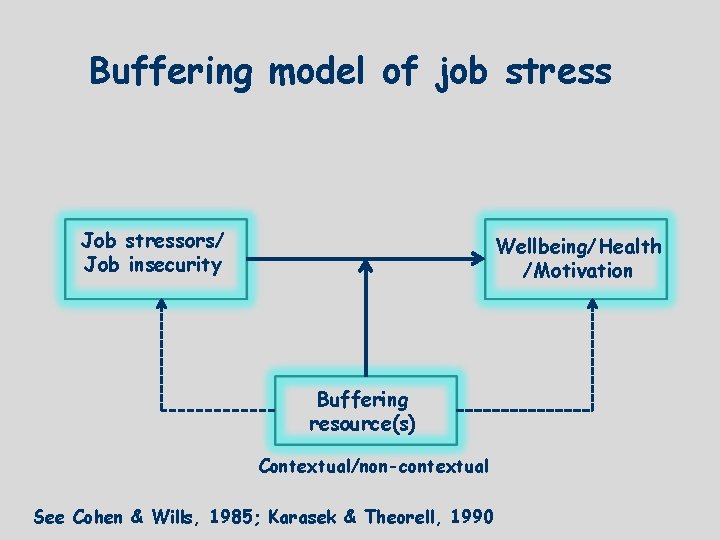
Buffering model of job stress Job stressors/ Job insecurity Wellbeing/Health /Motivation Buffering resource(s) Contextual/non-contextual See Cohen & Wills, 1985; Karasek & Theorell, 1990
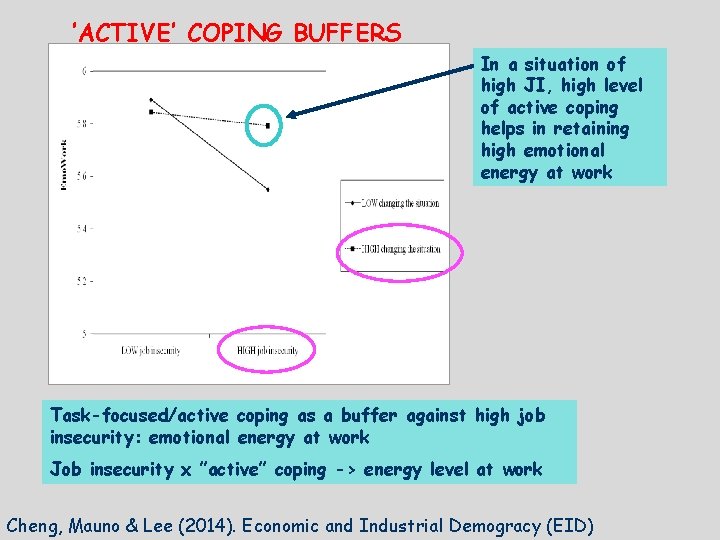
’ACTIVE’ COPING BUFFERS In a situation of high JI, high level of active coping helps in retaining high emotional energy at work Task-focused/active coping as a buffer against high job insecurity: emotional energy at work Job insecurity x ”active” coping -> energy level at work Cheng, Mauno & Lee (2014). Economic and Industrial Demogracy (EID)
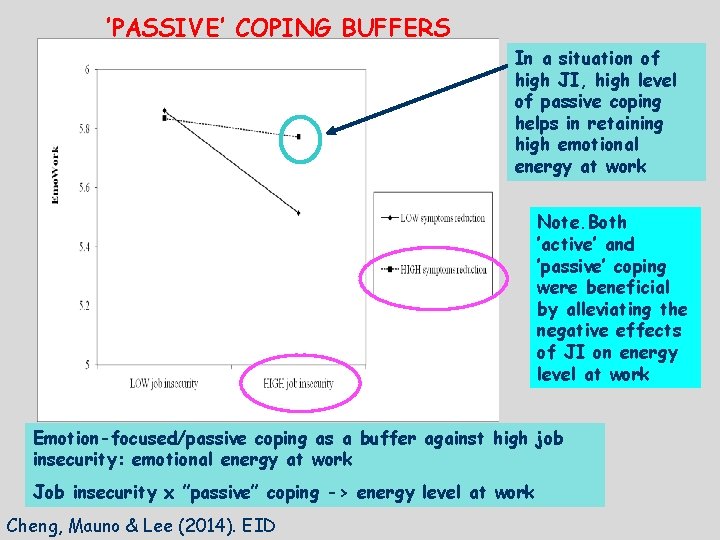
’PASSIVE’ COPING BUFFERS In a situation of high JI, high level of passive coping helps in retaining high emotional energy at work Note. Both ’active’ and ’passive’ coping were beneficial by alleviating the negative effects of JI on energy level at work Emotion-focused/passive coping as a buffer against high job insecurity: emotional energy at work Job insecurity x ”passive” coping -> energy level at work Cheng, Mauno & Lee (2014). EID
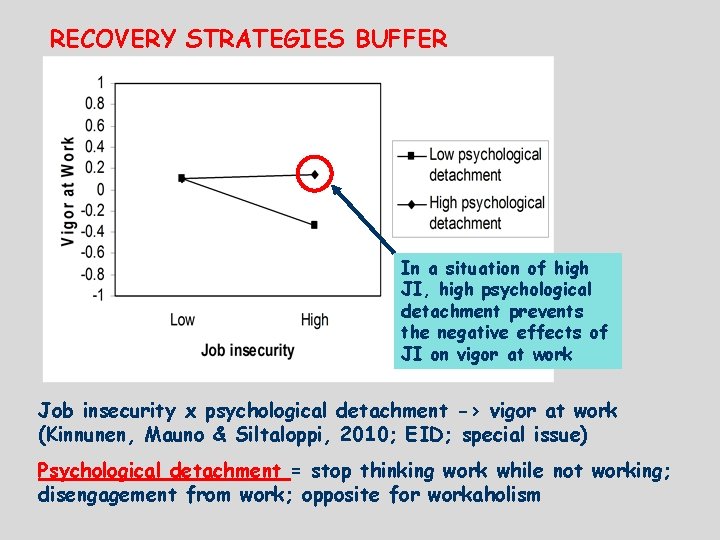
RECOVERY STRATEGIES BUFFER In a situation of high JI, high psychological detachment prevents the negative effects of JI on vigor at work Job insecurity x psychological detachment -> vigor at work (Kinnunen, Mauno & Siltaloppi, 2010; EID; special issue) Psychological detachment = stop thinking work while not working; disengagement from work; opposite for workaholism
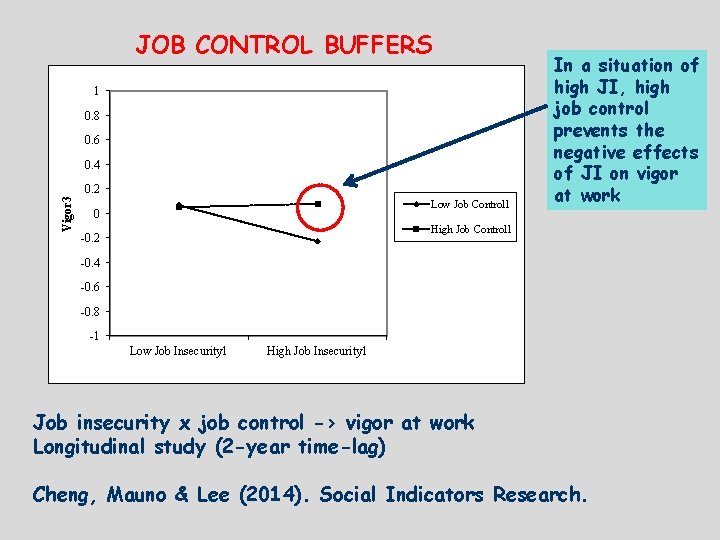
JOB CONTROL BUFFERS 1 0. 8 0. 6 0. 4 Vigor 3 0. 2 Low Job Control 1 0 In a situation of high JI, high job control prevents the negative effects of JI on vigor at work High Job Control 1 -0. 2 -0. 4 -0. 6 -0. 8 -1 Low Job Insecurity 1 High Job Insecurity 1 Job insecurity x job control -> vigor at work Longitudinal study (2 -year time-lag) Cheng, Mauno & Lee (2014). Social Indicators Research.
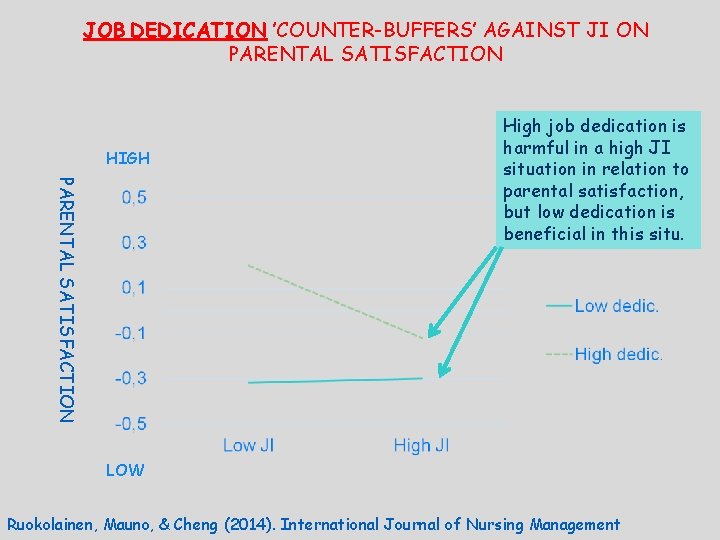
JOB DEDICATION ’COUNTER-BUFFERS’ AGAINST JI ON PARENTAL SATISFACTION HIGH PARENTAL SATISFACTION High job dedication is harmful in a high JI situation in relation to parental satisfaction, but low dedication is beneficial in this situ. LOW Ruokolainen, Mauno, & Cheng (2014). International Journal of Nursing Management
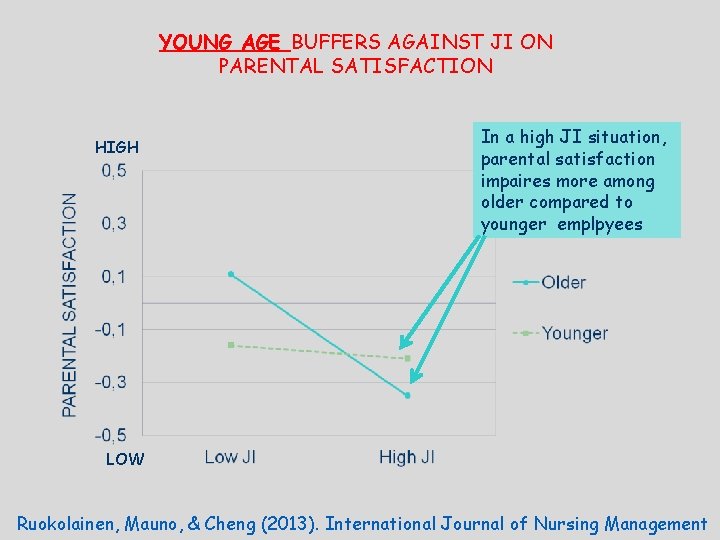
YOUNG AGE BUFFERS AGAINST JI ON PARENTAL SATISFACTION HIGH In a high JI situation, parental satisfaction impaires more among older compared to younger emplpyees LOW Ruokolainen, Mauno, & Cheng (2013). International Journal of Nursing Management
Take home messages! l l l Job insecurity may relate to job (dis)continuity or some other relevant job characteristics. Job insecurity is a severe stressor, resulting in ill-health and lowered motivation but also family- related consequences. Many psychosocial buffers/resources mitigate the negative effects of job insecurity on employee outcomes. – – l Job control, coping and recovery strategies, low(er) job dedication but also younger age (as shown in this lecture) Social support, good communication, ethical management practices, career management skills/employability. . . Orgnizations need to increase their employees’ resources/stress buffers against job insecurity.
Small groups discussion (if time) l l In practice, how you would increase resources in organizations to make job insecurity ’more sustainable’ for employees? Try to focus on different resources: individual, organizational, society levels. Try to provide very practical ideas! 3 -4 persons/group, about 10 minutes or after lecture discussion with your costudents.

KIITOS HUOMIOSTANNE JA HYVÄÄ PÄIVÄN JATKOA! THANK YOU FOR YOUR ATTENTION AND HAVE A PLEASANT DAY!

Literature tips l l l l l Greenhalgh, L. & Rosenblatt, Z. (1984). Job insecurity: towards conceptual clarity. Academy of Management Review, 9, 438 -448. Cheng, D. & Chang, D. (2008). Who suffers from job insecurity? A meta-analytic review. Applied Psychology: An international journal, 57, 272 -303. Sverke, M. et al. (2002). No security: A meta-analysis and review of job insecurity and its consequences. Journal of Occupational Health Psychology, 7, 242 -264. Our recent publications on job insecurity: Mauno, S. , Leskinen, E. , & Kinnunen, U. (2003). Applying multi-wave, multi-variable models in evaluating the stability of job insecurity, and job and family involvement: A three-wave longitudinal study in Finland. In F. Columbus, (Eds. ), Advances in Psychology Research, vol 25, pp. 81 -112. USA: Nova. Science. Mauno, S. , De. Cuyper, N. , Tolvanen, A. , Kinnunen, U. , & Mäkikangas, A. (2014). Occupational well-being as a mediator between job insecurity and turnover intention. European Journal of Work and Organizational Psychology, 23, 381 -394. Selenko, E. , Mäkikangas, A. , Mauno, S. , & Kinnunen, U. (2013). How does job insecurity relate to selfrated job performance? Analysing associations in a longitudinal sample. Journal of Occupational and Organizational Psychology, 86, 522 -542. Cheng, T. , Mauno, S. , & Lee, C. (2014). Do job control, support, and optimism help job insecure employees? A-three wave study of buffering effects on job satisfaction, vigor at work and workfamily enrichment. Social Indicators Research. Cheng, T. , Mauno, S. , & Lee, C. (2014). The buffering effect of coping strategies in the relationship between job insecurity and employee well-being. Economic and Industrial Democracy, 35, 71 -94. De. Cuyper, N. , Mäkikangas, A. , Kinnunen, U. , Mauno, S. , & De. Witte, H. (2012). Cross-lagged associations between perceived external employability, job insecurity and exhaustion. Journal of Organizational Behavior, 33, 770 -788. Special Issue on job insecurity. Kinnunen, U. Mauno, S. & Siltaloppi, M. (2010). Job insecurity, recovery and well-being at work: recovery experiences as moderators. Economic and Industrial Demogracy, 3, 179 -194. A special issue on job insecurity.
- Slides: 32