
Peracetic Acid Gas Plasma Sterilisation 16 th WFHSS
![Analysis of Plasma Components by Emission Spectroscopy (Sterilisation Process) Emission intensity [a. u. ]](https://slidetodoc.com/presentation_image/2c4e1cd54a1ad76d49895a491a2c47c1/image-26.jpg "Analysis of Plasma Components by Emission Spectroscopy (Sterilisation Process) Emission intensity [a. u. ]")

![Emission Intensity of Carbon Radicals Emission intensity [a. u. ] 14000 12000 Decomposition process](https://slidetodoc.com/presentation_image/2c4e1cd54a1ad76d49895a491a2c47c1/image-31.jpg "Emission Intensity of Carbon Radicals Emission intensity [a. u. ] 14000 12000 Decomposition process")

- Slides: 42
Peracetic Acid Gas Plasma Sterilisation 16 th WFHSS in Lille 9 th Oct. 2015 14: 15 -14: 40 Tokyo Healthcare University Postgraduate School Kobayashi H, Yoshida R, Endo H, Yoshida Y, Nakamura E Conflict of interest statement HK is consultant for Yoshida Pharm. , Saraya and Sakura, and HE, YY and EN are employees of Saraya. Funding sources None
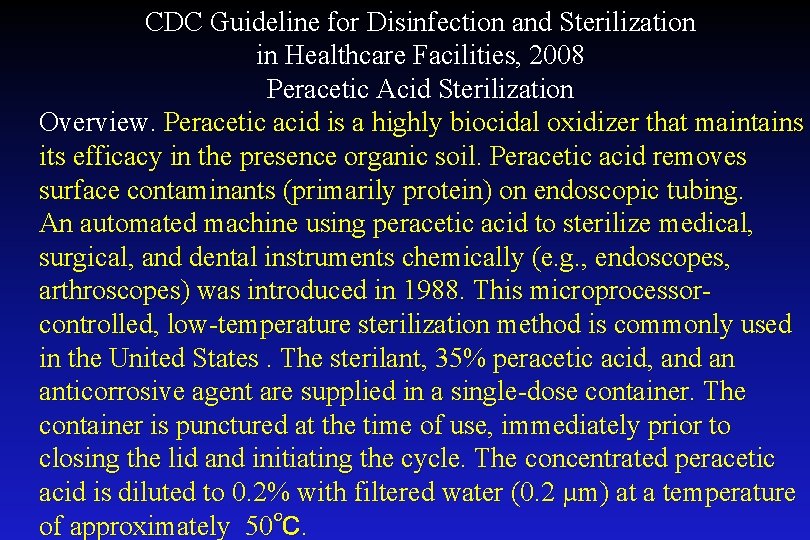
CDC Guideline for Disinfection and Sterilization in Healthcare Facilities, 2008 Peracetic Acid Sterilization Overview. Peracetic acid is a highly biocidal oxidizer that maintains its efficacy in the presence organic soil. Peracetic acid removes surface contaminants (primarily protein) on endoscopic tubing. An automated machine using peracetic acid to sterilize medical, surgical, and dental instruments chemically (e. g. , endoscopes, arthroscopes) was introduced in 1988. This microprocessorcontrolled, low-temperature sterilization method is commonly used in the United States. The sterilant, 35% peracetic acid, and an anticorrosive agent are supplied in a single-dose container. The container is punctured at the time of use, immediately prior to closing the lid and initiating the cycle. The concentrated peracetic acid is diluted to 0. 2% with filtered water (0. 2 µm) at a temperature of approximately 50℃.
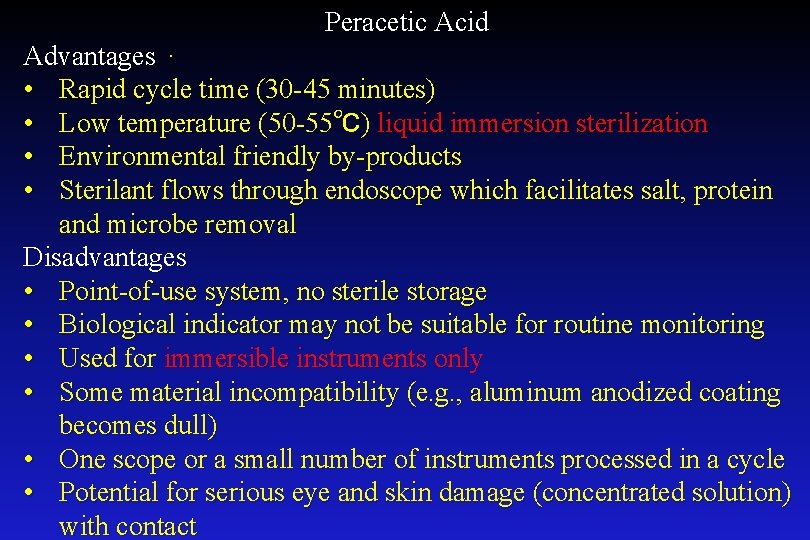
Peracetic Acid Advantages · • Rapid cycle time (30 -45 minutes) • Low temperature (50 -55℃) liquid immersion sterilization • Environmental friendly by-products • Sterilant flows through endoscope which facilitates salt, protein and microbe removal Disadvantages • Point-of-use system, no sterile storage • Biological indicator may not be suitable for routine monitoring • Used for immersible instruments only • Some material incompatibility (e. g. , aluminum anodized coating becomes dull) • One scope or a small number of instruments processed in a cycle • Potential for serious eye and skin damage (concentrated solution) with contact
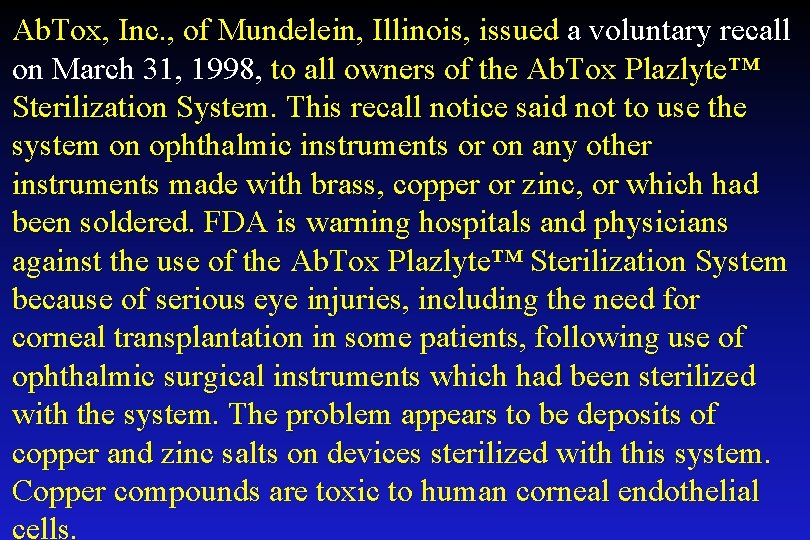
FDA Safety Alert: Warning Regarding the Use of the Ab. Tox Plazlyte™ Sterilization System (You are encouraged to copy and distribute this alert. ) April 13, 1998 To: Users of the Ab. Tox Plazlyte™ Sterilization System FDA is alerting the health care community not to use the Ab. Tox Plazlyte™ Sterilization System for ophthalmic instruments, and is providing clarification regarding the recall of this device and recommending options for alternative sterilization.
Ab. Tox, Inc. , of Mundelein, Illinois, issued a voluntary recall on March 31, 1998, to all owners of the Ab. Tox Plazlyte™ Sterilization System. This recall notice said not to use the system on ophthalmic instruments or on any other instruments made with brass, copper or zinc, or which had been soldered. FDA is warning hospitals and physicians against the use of the Ab. Tox Plazlyte™ Sterilization System because of serious eye injuries, including the need for corneal transplantation in some patients, following use of ophthalmic surgical instruments which had been sterilized with the system. The problem appears to be deposits of copper and zinc salts on devices sterilized with this system. Copper compounds are toxic to human corneal endothelial cells.
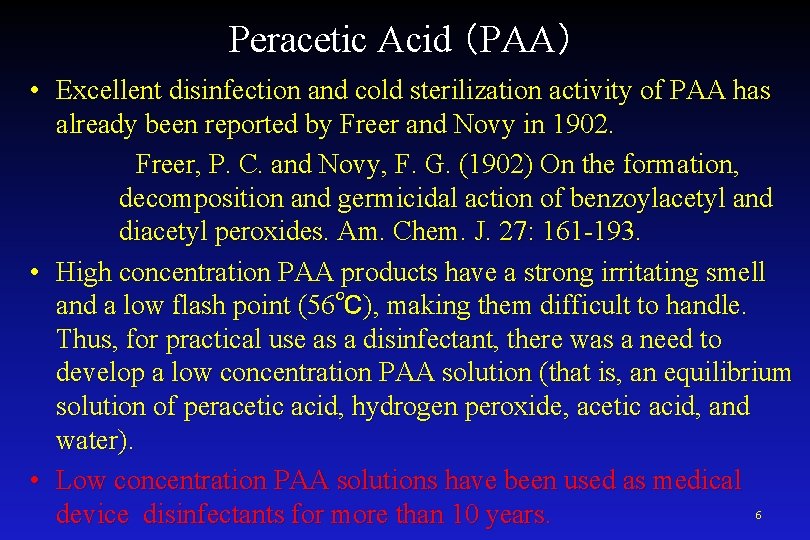
Peracetic Acid (PAA) • Excellent disinfection and cold sterilization activity of PAA has already been reported by Freer and Novy in 1902. Freer, P. C. and Novy, F. G. (1902) On the formation, decomposition and germicidal action of benzoylacetyl and diacetyl peroxides. Am. Chem. J. 27: 161 -193. • High concentration PAA products have a strong irritating smell and a low flash point (56℃), making them difficult to handle. Thus, for practical use as a disinfectant, there was a need to develop a low concentration PAA solution (that is, an equilibrium solution of peracetic acid, hydrogen peroxide, acetic acid, and water). • Low concentration PAA solutions have been used as medical 6 device disinfectants for more than 10 years.
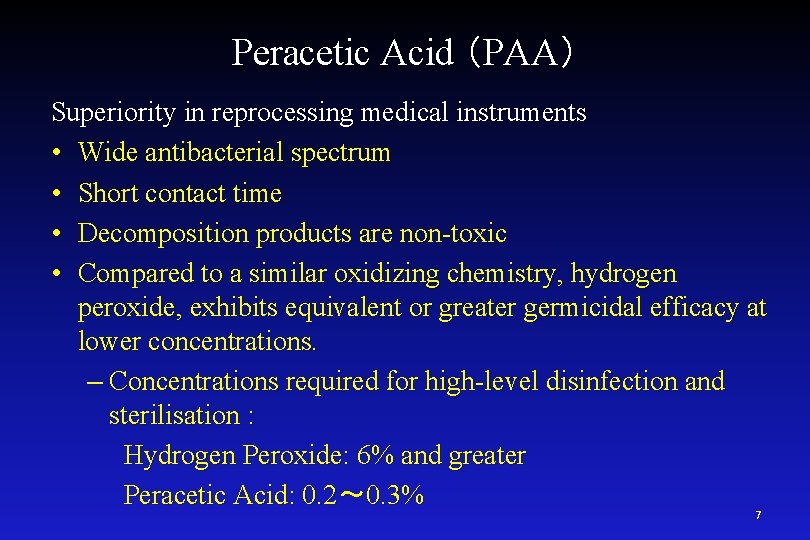
Peracetic Acid (PAA) Superiority in reprocessing medical instruments • Wide antibacterial spectrum • Short contact time • Decomposition products are non-toxic • Compared to a similar oxidizing chemistry, hydrogen peroxide, exhibits equivalent or greater germicidal efficacy at lower concentrations. – Concentrations required for high-level disinfection and sterilisation : Hydrogen Peroxide: 6% and greater Peracetic Acid: 0. 2~ 0. 3% 7
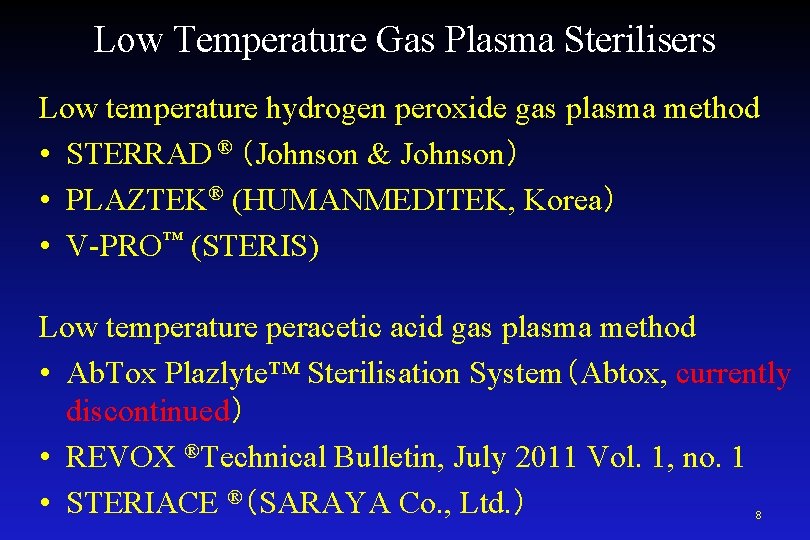
Low Temperature Gas Plasma Sterilisers Low temperature hydrogen peroxide gas plasma method • STERRAD ® (Johnson & Johnson) • PLAZTEK® (HUMANMEDITEK, Korea) • V-PRO™ (STERIS) Low temperature peracetic acid gas plasma method • Ab. Tox Plazlyte™ Sterilisation System(Abtox, currently discontinued) • REVOX ®Technical Bulletin, July 2011 Vol. 1, no. 1 • STERIACE ®(SARAYA Co. , Ltd. ) 8
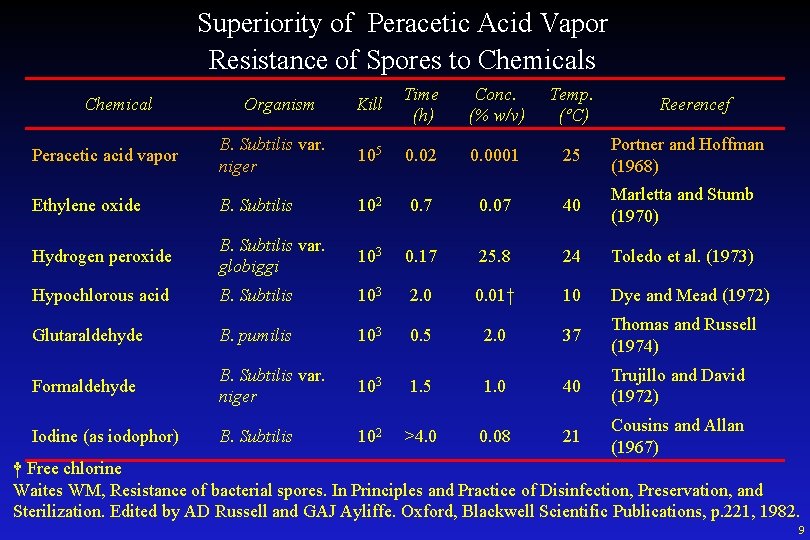
Superiority of Peracetic Acid Vapor Resistance of Spores to Chemicals Chemical Organism Kill Time (h) Conc. (% w/v) Temp. (ºC) Reerencef Peracetic acid vapor B. Subtilis var. niger 105 0. 02 0. 0001 25 Portner and Hoffman (1968) Ethylene oxide B. Subtilis 102 0. 7 0. 07 40 Marletta and Stumb (1970) Hydrogen peroxide B. Subtilis var. globiggi 103 0. 17 25. 8 24 Toledo et al. (1973) Hypochlorous acid B. Subtilis 103 2. 0 0. 01† 10 Dye and Mead (1972) Glutaraldehyde B. pumilis 103 0. 5 2. 0 37 Thomas and Russell (1974) Formaldehyde B. Subtilis var. niger 103 1. 5 1. 0 40 Trujillo and David (1972) Iodine (as iodophor) B. Subtilis 102 >4. 0 0. 08 21 Cousins and Allan (1967) † Free chlorine Waites WM, Resistance of bacterial spores. In Principles and Practice of Disinfection, Preservation, and Sterilization. Edited by AD Russell and GAJ Ayliffe. Oxford, Blackwell Scientific Publications, p. 221, 1982. 9
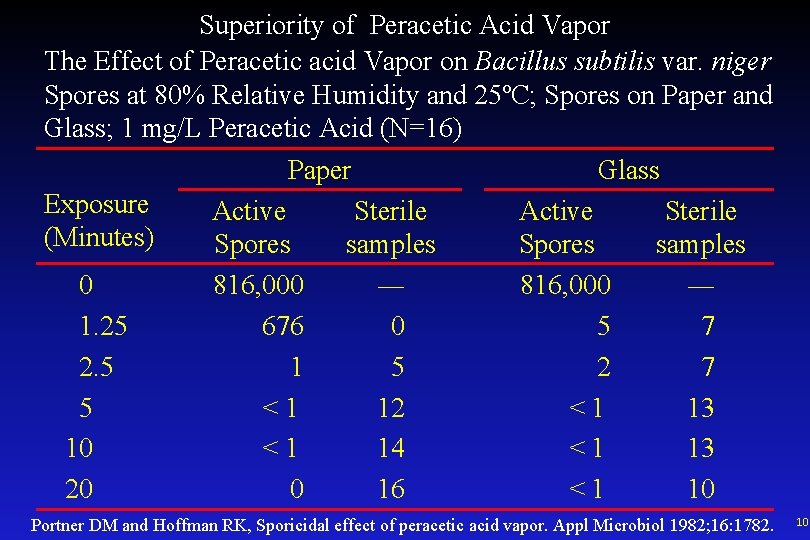
Superiority of Peracetic Acid Vapor The Effect of Peracetic acid Vapor on Bacillus subtilis var. niger Spores at 80% Relative Humidity and 25ºC; Spores on Paper and Glass; 1 mg/L Peracetic Acid (N=16) Paper Glass Exposure Active Sterile (Minutes) Spores samples 0 816, 000 ― 1. 25 676 0 5 7 2. 5 1 5 2 7 5 <1 12 <1 13 10 <1 14 <1 13 20 0 16 <1 10 Portner DM and Hoffman RK, Sporicidal effect of peracetic acid vapor. Appl Microbiol 1982; 16: 1782. 10
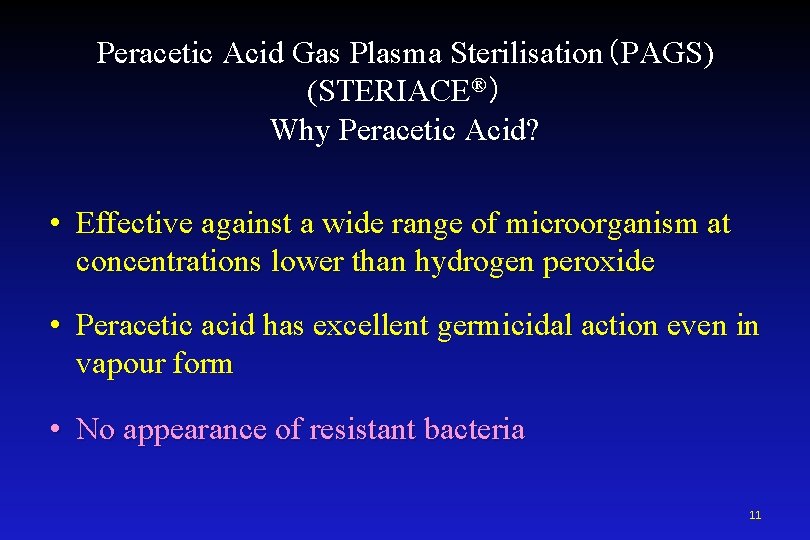
Peracetic Acid Gas Plasma Sterilisation(PAGS) (STERIACE®) Why Peracetic Acid? • Effective against a wide range of microorganism at concentrations lower than hydrogen peroxide • Peracetic acid has excellent germicidal action even in vapour form • No appearance of resistant bacteria 11
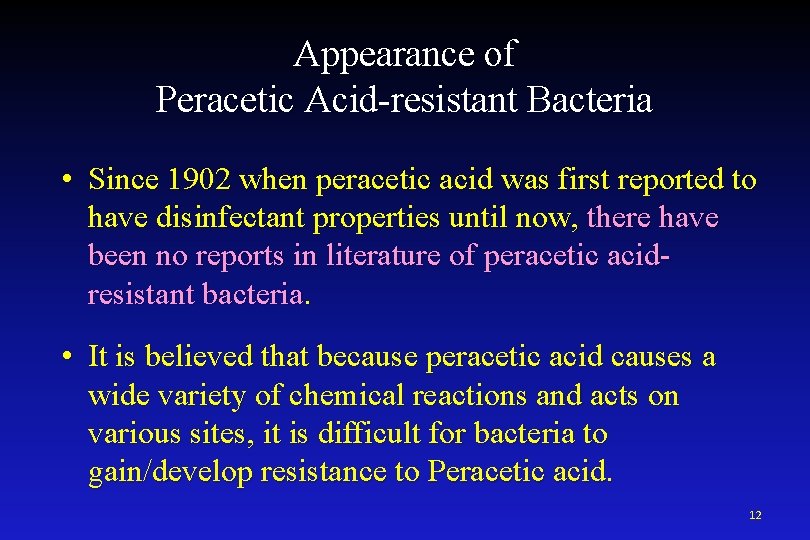
Appearance of Peracetic Acid-resistant Bacteria • Since 1902 when peracetic acid was first reported to have disinfectant properties until now, there have been no reports in literature of peracetic acidresistant bacteria. • It is believed that because peracetic acid causes a wide variety of chemical reactions and acts on various sites, it is difficult for bacteria to gain/develop resistance to Peracetic acid. 12
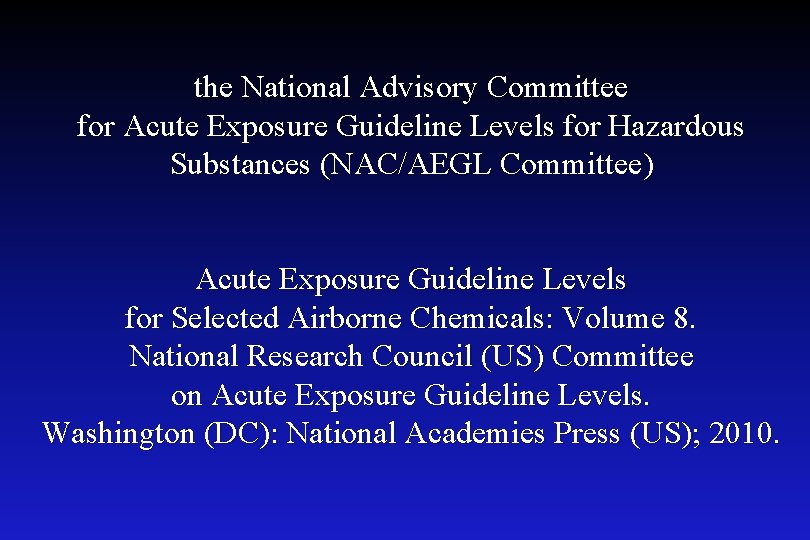
the National Advisory Committee for Acute Exposure Guideline Levels for Hazardous Substances (NAC/AEGL Committee) Acute Exposure Guideline Levels for Selected Airborne Chemicals: Volume 8. National Research Council (US) Committee on Acute Exposure Guideline Levels. Washington (DC): National Academies Press (US); 2010.
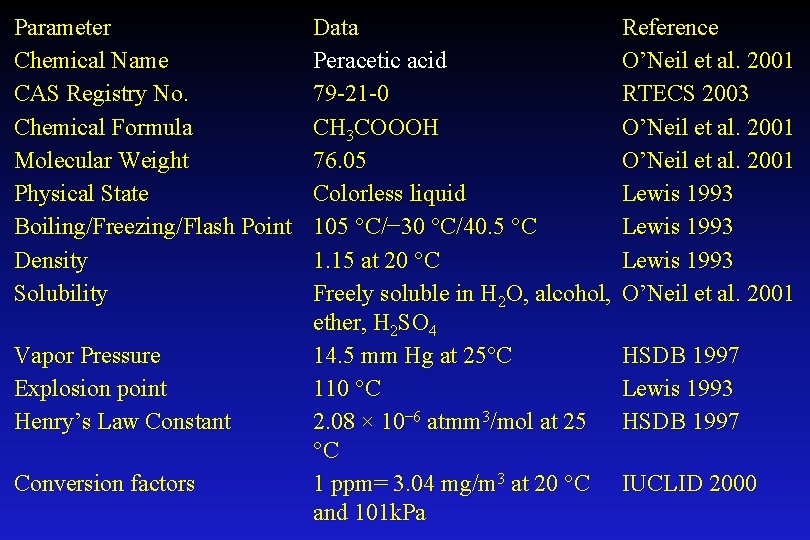
Parameter Chemical Name CAS Registry No. Chemical Formula Molecular Weight Physical State Boiling/Freezing/Flash Point Density Solubility Vapor Pressure Explosion point Henry’s Law Constant Conversion factors Data Peracetic acid 79 -21 -0 CH 3 COOOH 76. 05 Colorless liquid 105 °C/− 30 °C/40. 5 °C 1. 15 at 20 °C Freely soluble in H 2 O, alcohol, ether, H 2 SO 4 14. 5 mm Hg at 25°C 110 °C 2. 08 × 10− 6 atmm 3/mol at 25 °C 1 ppm= 3. 04 mg/m 3 at 20 °C and 101 k. Pa Reference O’Neil et al. 2001 RTECS 2003 O’Neil et al. 2001 Lewis 1993 O’Neil et al. 2001 HSDB 1997 Lewis 1993 HSDB 1997 IUCLID 2000
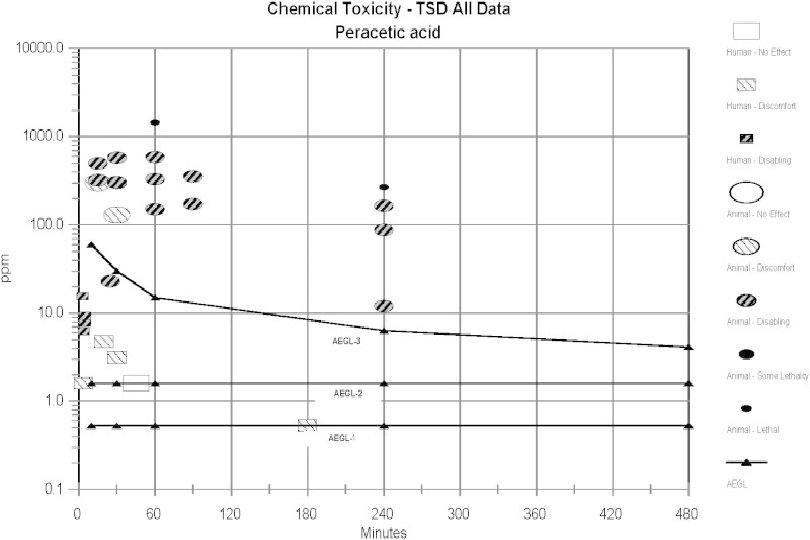
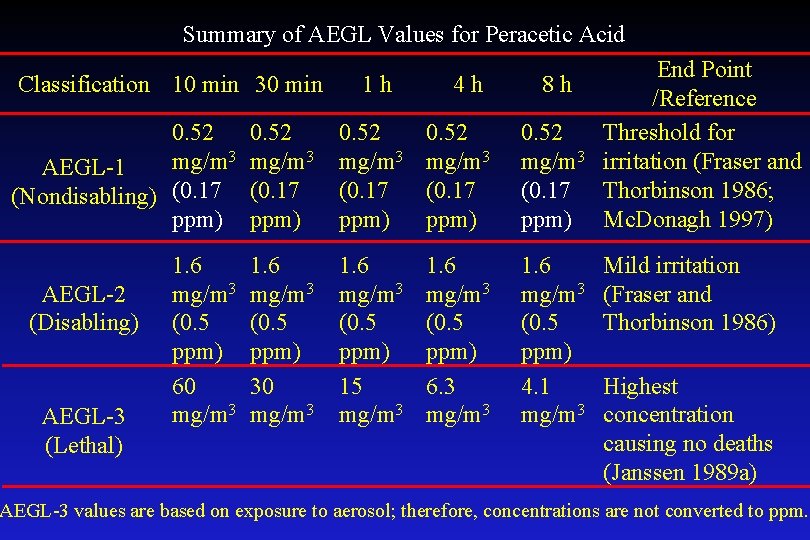
Summary of AEGL Values for Peracetic Acid Classification 10 min 30 min 1 h 4 h 8 h 0. 52 mg/m 3 AEGL-1 (Nondisabling) (0. 17 ppm) 0. 52 mg/m 3 (0. 17 ppm) 1. 6 mg/m 3 (0. 5 ppm) 60 mg/m 3 1. 6 mg/m 3 (0. 5 ppm) 30 mg/m 3 1. 6 mg/m 3 (0. 5 ppm) 15 mg/m 3 1. 6 mg/m 3 (0. 5 ppm) 6. 3 mg/m 3 1. 6 mg/m 3 (0. 5 ppm) 4. 1 mg/m 3 AEGL-2 (Disabling) AEGL-3 (Lethal) End Point /Reference Threshold for irritation (Fraser and Thorbinson 1986; Mc. Donagh 1997) Mild irritation (Fraser and Thorbinson 1986) Highest concentration causing no deaths (Janssen 1989 a) AEGL-3 values are based on exposure to aerosol; therefore, concentrations are not converted to ppm.
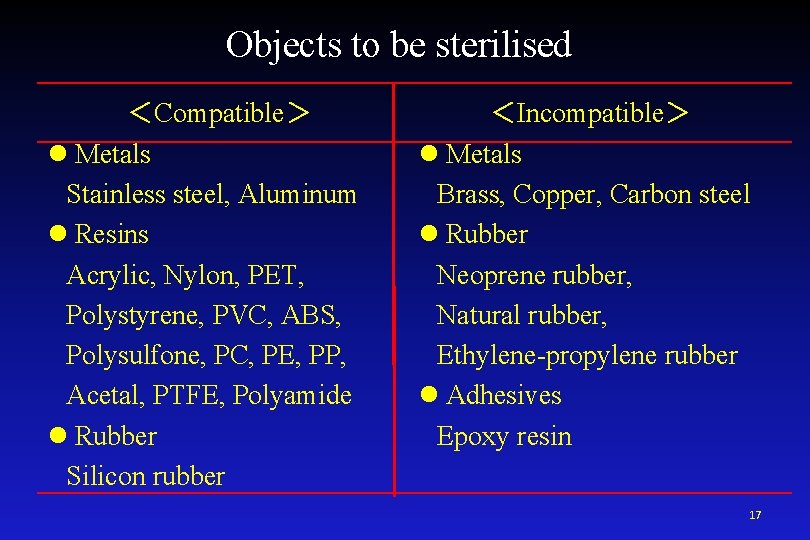
Objects to be sterilised <Compatible> l Metals Stainless steel, Aluminum l Resins Acrylic, Nylon, PET, Polystyrene, PVC, ABS, Polysulfone, PC, PE, PP, Acetal, PTFE, Polyamide l Rubber Silicon rubber <Incompatible> l Metals Brass, Copper, Carbon steel l Rubber Neoprene rubber, Natural rubber, Ethylene-propylene rubber l Adhesives Epoxy resin 17
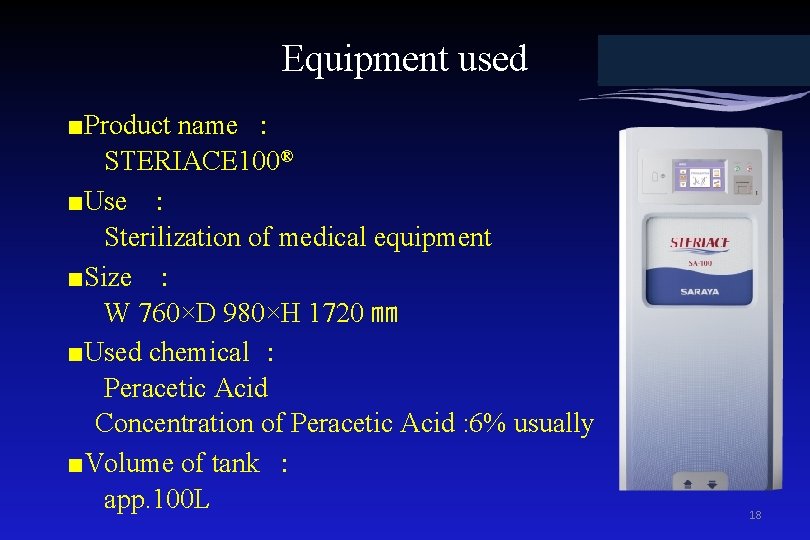
Equipment used ■Product name : STERIACE 100® ■Use : Sterilization of medical equipment ■Size : W 760×D 980×H 1720 ㎜ ■Used chemical : Peracetic Acid Concentration of Peracetic Acid : 6% usually ■Volume of tank : app. 100 L 18
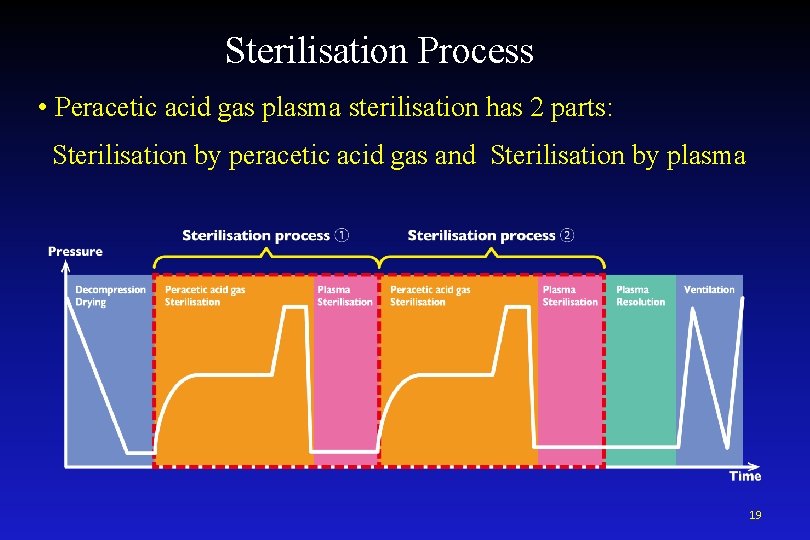
Sterilisation Process • Peracetic acid gas plasma sterilisation has 2 parts: Sterilisation by peracetic acid gas and Sterilisation by plasma 19
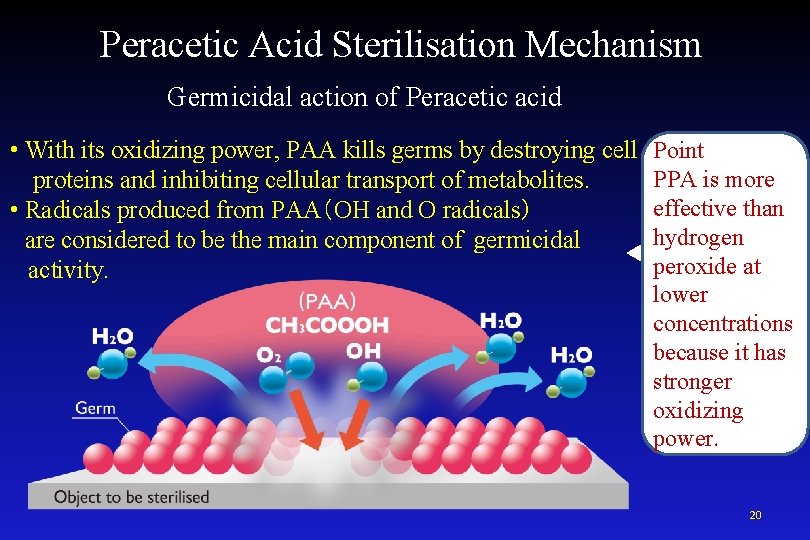
Peracetic Acid Sterilisation Mechanism Germicidal action of Peracetic acid • With its oxidizing power, PAA kills germs by destroying cell proteins and inhibiting cellular transport of metabolites. • Radicals produced from PAA(OH and O radicals) are considered to be the main component of germicidal activity. Point PPA is more effective than hydrogen peroxide at lower concentrations because it has stronger oxidizing power. 20
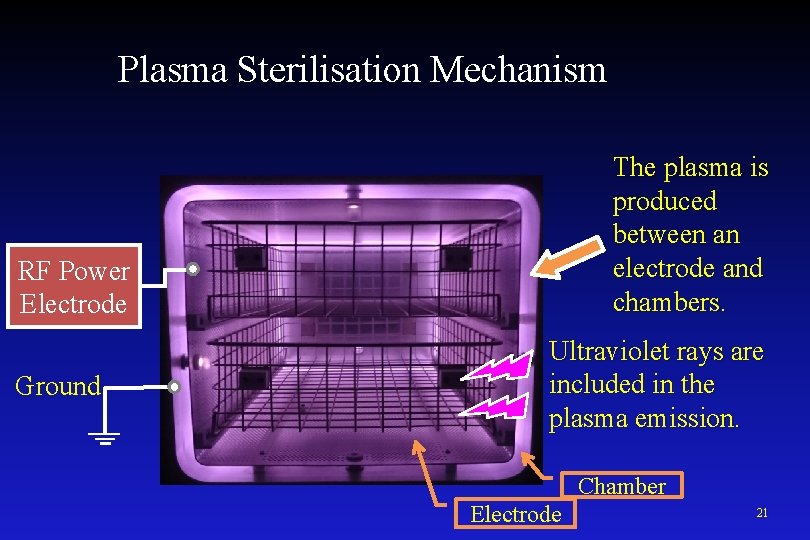
Plasma Sterilisation Mechanism The plasma is produced between an electrode and chambers. RF Power Electrode Ground Ultraviolet rays are included in the plasma emission. Chamber Electrode 21
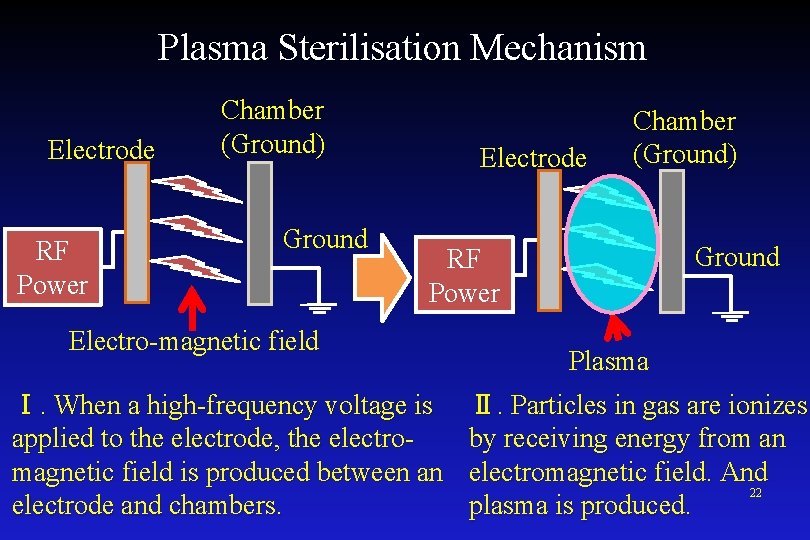
Plasma Sterilisation Mechanism Electrode RF Power Chamber (Ground) Ground Electrode Chamber (Ground) Ground RF Power Electro-magnetic field Ⅰ. When a high-frequency voltage is applied to the electrode, the electromagnetic field is produced between an electrode and chambers. Plasma Ⅱ. Particles in gas are ionizes by receiving energy from an electromagnetic field. And 22 plasma is produced.
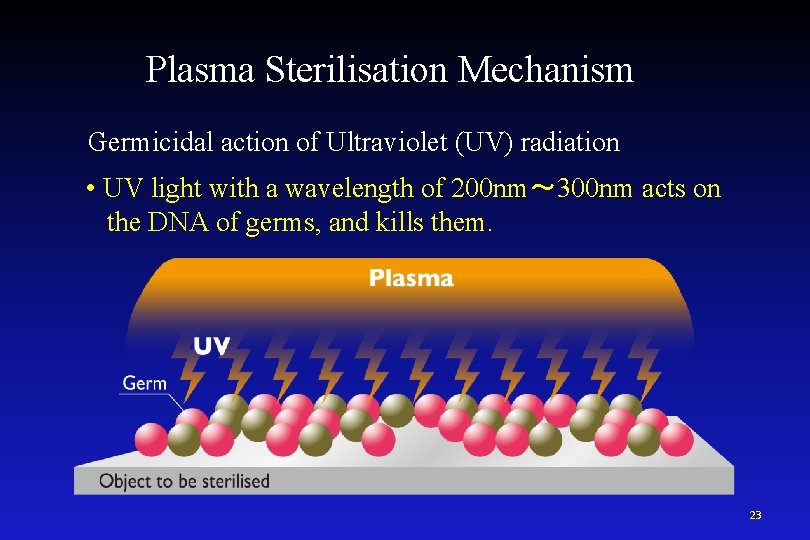
Plasma Sterilisation Mechanism Germicidal action of Ultraviolet (UV) radiation • UV light with a wavelength of 200 nm~ 300 nm acts on the DNA of germs, and kills them. 23
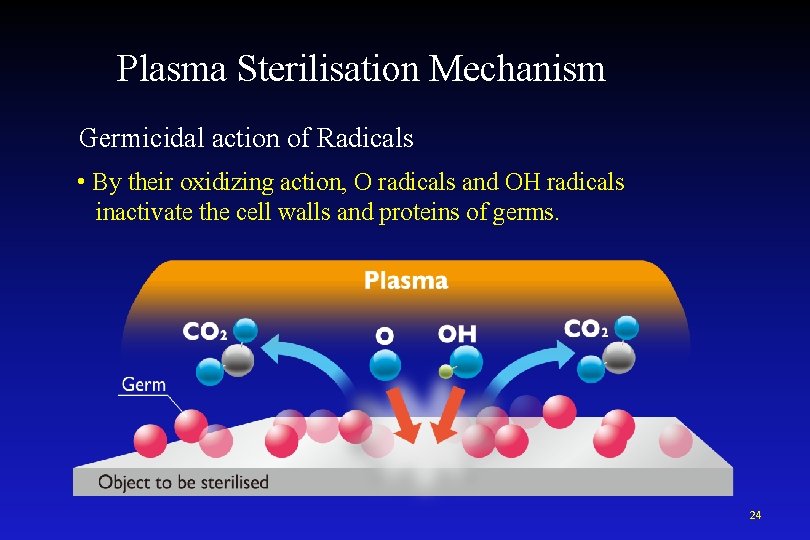
Plasma Sterilisation Mechanism Germicidal action of Radicals • By their oxidizing action, O radicals and OH radicals inactivate the cell walls and proteins of germs. 24
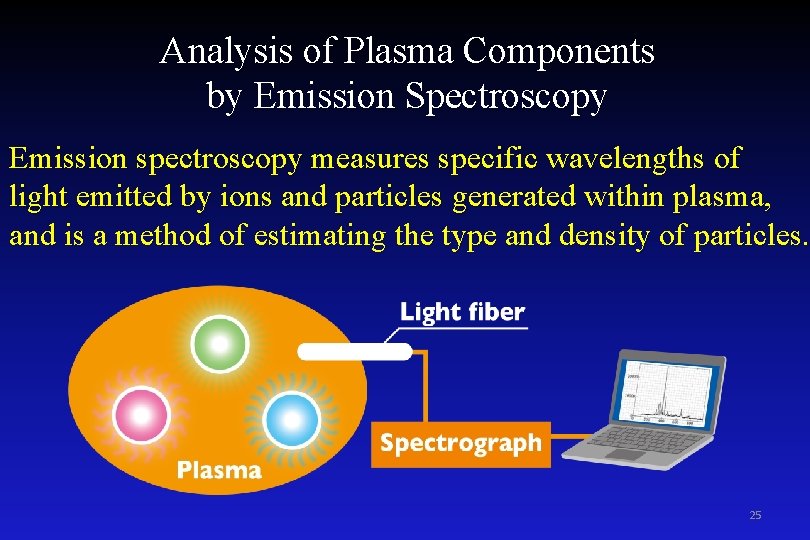
Analysis of Plasma Components by Emission Spectroscopy Emission spectroscopy measures specific wavelengths of light emitted by ions and particles generated within plasma, and is a method of estimating the type and density of particles. 25
Analysis of Plasma Components by Emission Spectroscopy (Sterilisation Process) Emission intensity [a. u. ] < Emission spectrum of air plasma> N, N 2, etc. Hα Wavelength[nm] Emission intensity [a. u. ] <Emission spectrum of PAA plasma (10 second irradiaion)> N, N 2, etc. Hα Wavelength[nm] O radical 26
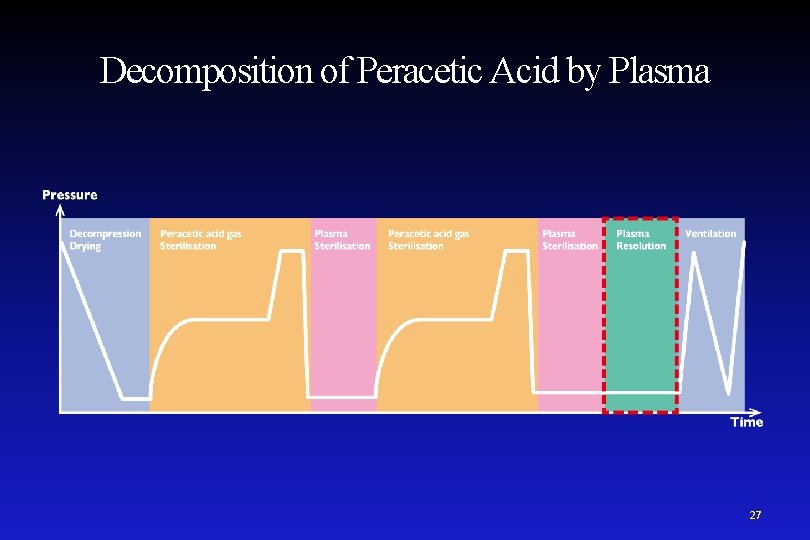
Decomposition of Peracetic Acid by Plasma 27
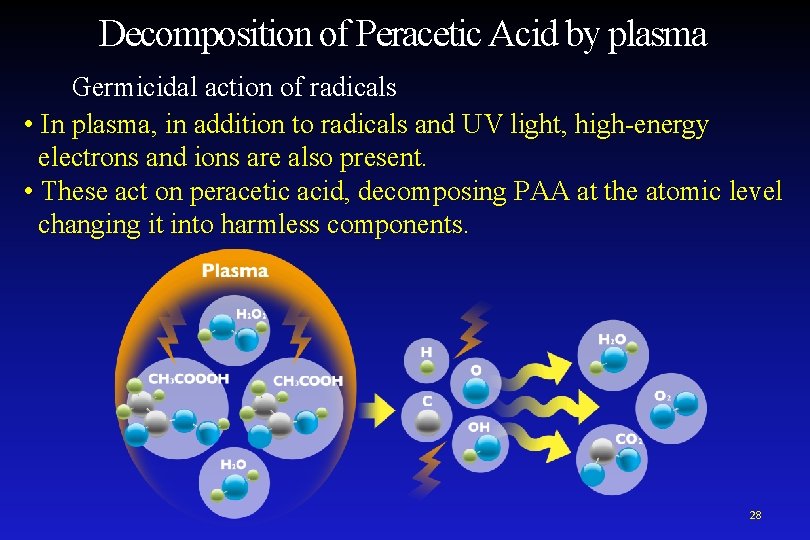
Decomposition of Peracetic Acid by plasma Germicidal action of radicals • In plasma, in addition to radicals and UV light, high-energy electrons and ions are also present. • These act on peracetic acid, decomposing PAA at the atomic level changing it into harmless components. 28
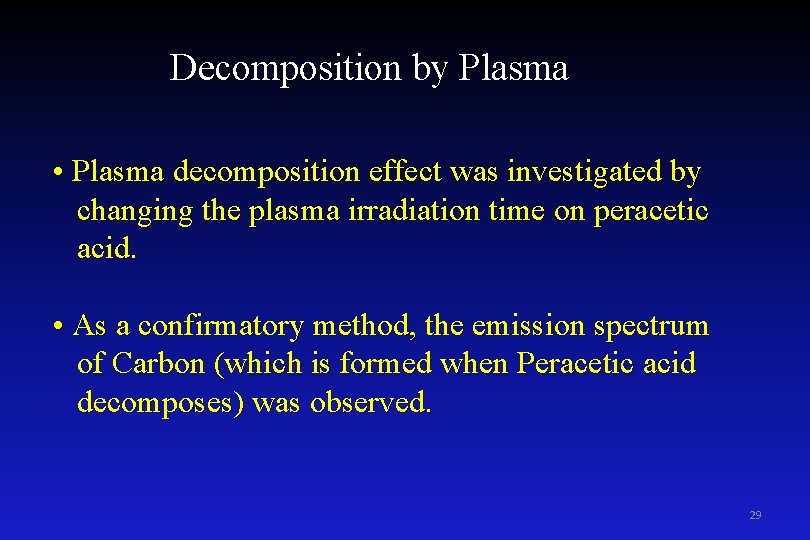
Decomposition by Plasma • Plasma decomposition effect was investigated by changing the plasma irradiation time on peracetic acid. • As a confirmatory method, the emission spectrum of Carbon (which is formed when Peracetic acid decomposes) was observed. 29
Analysis of Plasma Components by Emission Spectroscopy (Decomposition Process) Emission intensity [a. u. ](arbitrary units) <Emission spectrum (1 minute process time) of PAA plasma> N, N 2, etc. 2020/10/31 C radical Hα Wavelength[nm] Emission intensity [a. u. ] <Emission spectrum (5 minute process time) of PAA plasma > 2020/10/31 N, N 2 , etc. C radical Wavelength[nm] Hα 30
Emission Intensity of Carbon Radicals Emission intensity [a. u. ] 14000 12000 Decomposition process 10000 8000 6000 4000 Emission intensity of C radical(517 nm) 2000 0 0: 01 0: 02 0: 03 Treatment Time[min] 0: 04 0: 05 31
Decomposition by Plasma • From the measurement results, it can be seen that as the plasma irradiation time is increased, the emission intensity of the carbon emission spectrum (517 nm) also increases. • From this fact, it can be seen that peracetic acid is decomposed at the atomic level by plasma. 32
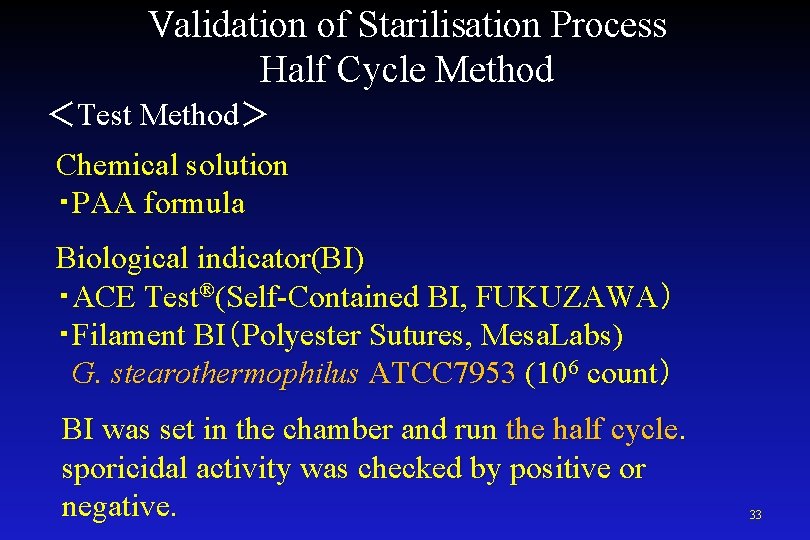
Validation of Starilisation Process Half Cycle Method <Test Method> Chemical solution ・PAA formula Biological indicator(BI) ・ACE Test®(Self-Contained BI, FUKUZAWA) ・Filament BI(Polyester Sutures, Mesa. Labs) G. stearothermophilus ATCC 7953 (106 count) BI was set in the chamber and run the half cycle. sporicidal activity was checked by positive or negative. 33
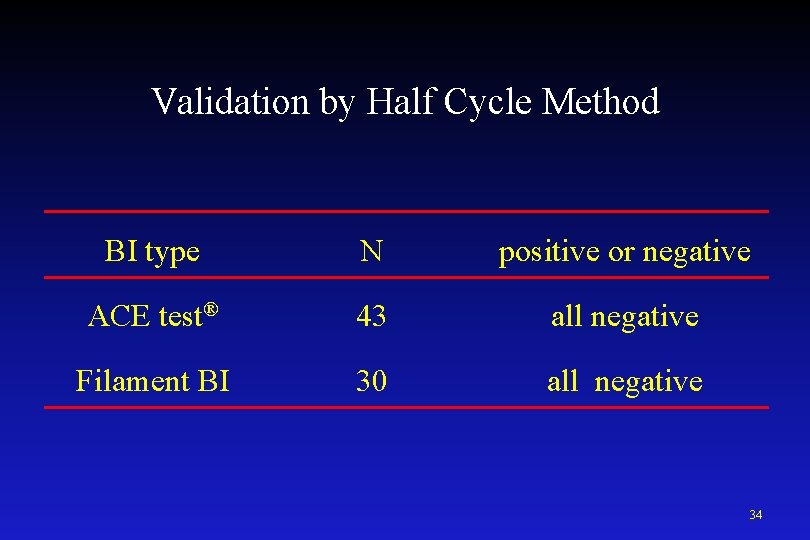
Validation by Half Cycle Method BI type N positive or negative ACE test® 43 all negative Filament BI 30 all negative 34
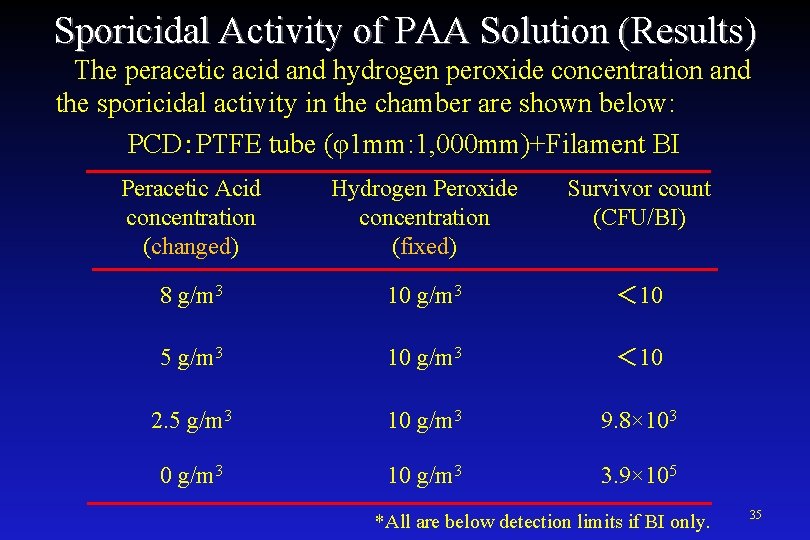
Sporicidal Activity of PAA Solution (Results) The peracetic acid and hydrogen peroxide concentration and the sporicidal activity in the chamber are shown below: PCD:PTFE tube (φ1 mm: 1, 000 mm)+Filament BI Peracetic Acid concentration (changed) Hydrogen Peroxide concentration (fixed) Survivor count (CFU/BI) 8 g/m 3 10 g/m 3 < 10 5 g/m 3 10 g/m 3 < 10 2. 5 g/m 3 10 g/m 3 9. 8× 10³ 0 g/m 3 10 g/m 3 3. 9× 10⁵ *All are below detection limits if BI only. 35
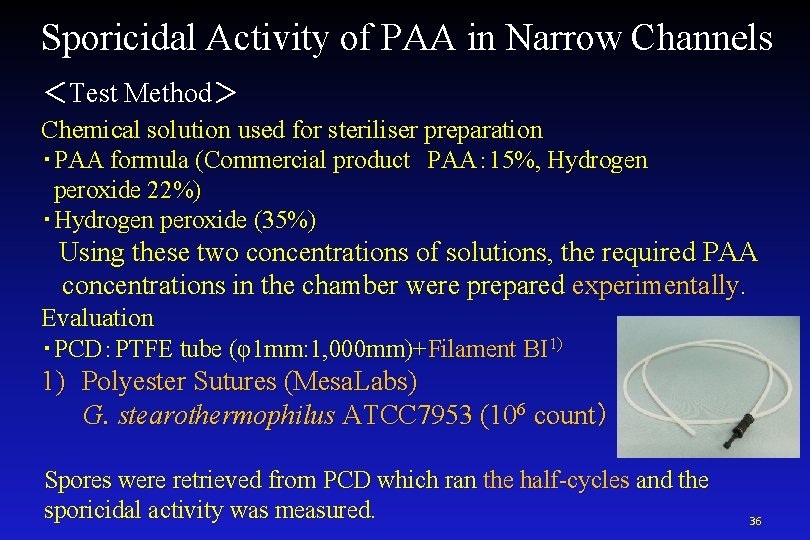
Sporicidal Activity of PAA in Narrow Channels <Test Method> Chemical solution used for steriliser preparation ・PAA formula (Commercial product PAA: 15%, Hydrogen peroxide 22%) ・Hydrogen peroxide (35%) Using these two concentrations of solutions, the required PAA concentrations in the chamber were prepared experimentally. Evaluation ・PCD:PTFE tube (φ1 mm: 1, 000 mm)+Filament BI 1) 1) Polyester Sutures (Mesa. Labs) G. stearothermophilus ATCC 7953 (106 count) Spores were retrieved from PCD which ran the half-cycles and the sporicidal activity was measured. 36
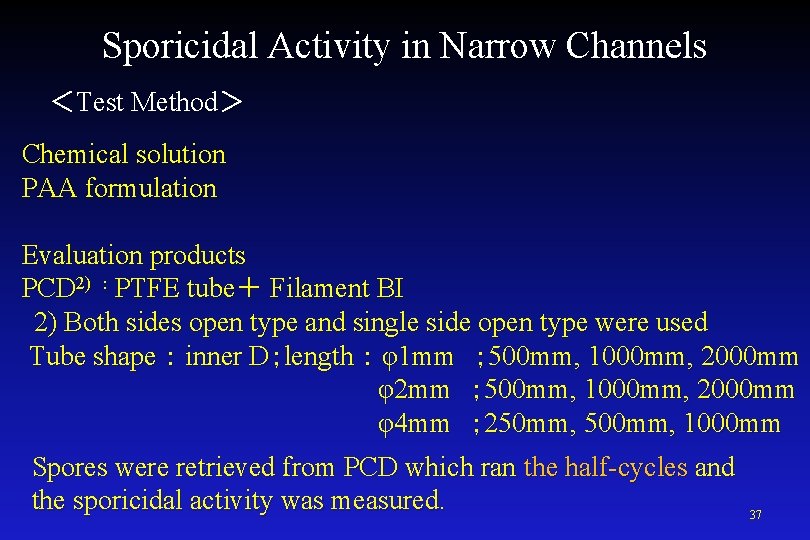
Sporicidal Activity in Narrow Channels <Test Method> Chemical solution PAA formulation Evaluation products PCD 2) : PTFE tube+ Filament BI 2) Both sides open type and single side open type were used Tube shape : inner D;length : φ1 mm ; 500 mm, 1000 mm, 2000 mm φ2 mm ; 500 mm, 1000 mm, 2000 mm φ4 mm ; 250 mm, 500 mm, 1000 mm Spores were retrieved from PCD which ran the half-cycles and the sporicidal activity was measured. 37
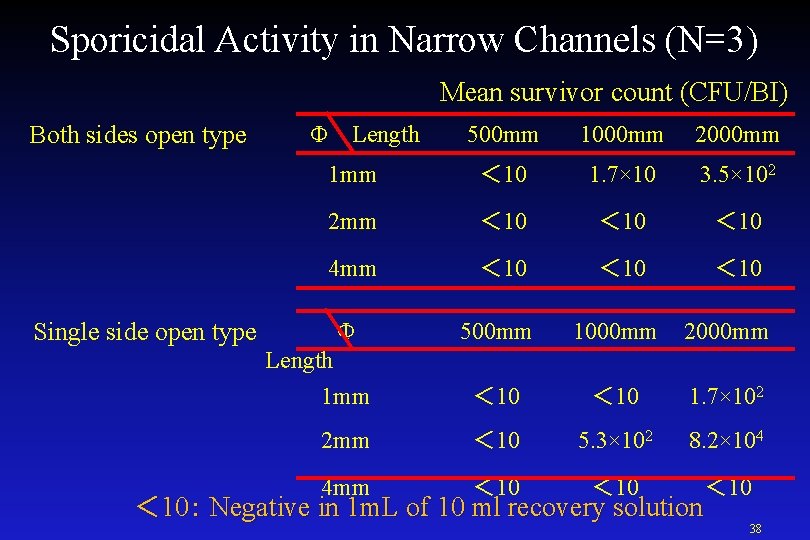
Sporicidal Activity in Narrow Channels (N=3) Mean survivor count (CFU/BI) Both sides open type Φ Length 500 mm 1000 mm 2000 mm 1 mm < 10 1. 7× 10 3. 5× 10² 2 mm < 10 4 mm < 10 Single side open type Φ 500 mm 1000 mm 2000 mm 1 mm < 10 1. 7× 10² 2 mm < 10 5. 3× 10² 8. 2× 10⁴ 4 mm < 10 Length < 10: Negative in 1 m. L of 10 ml recovery solution 38
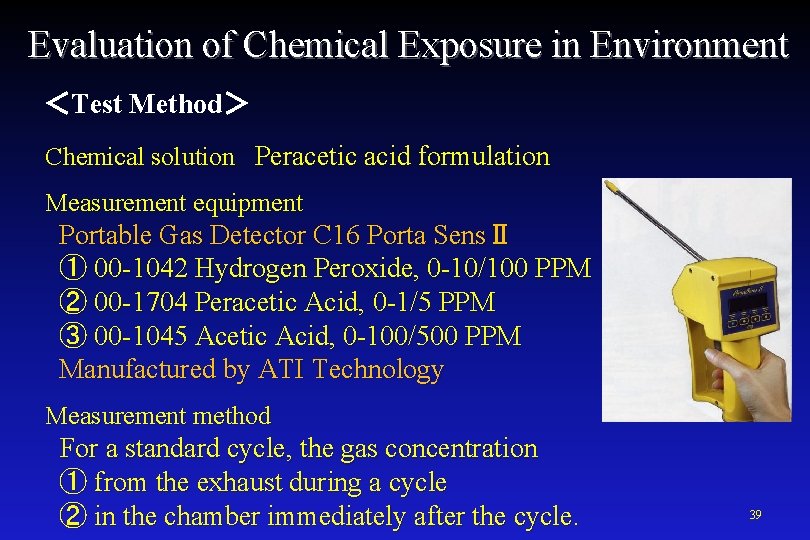
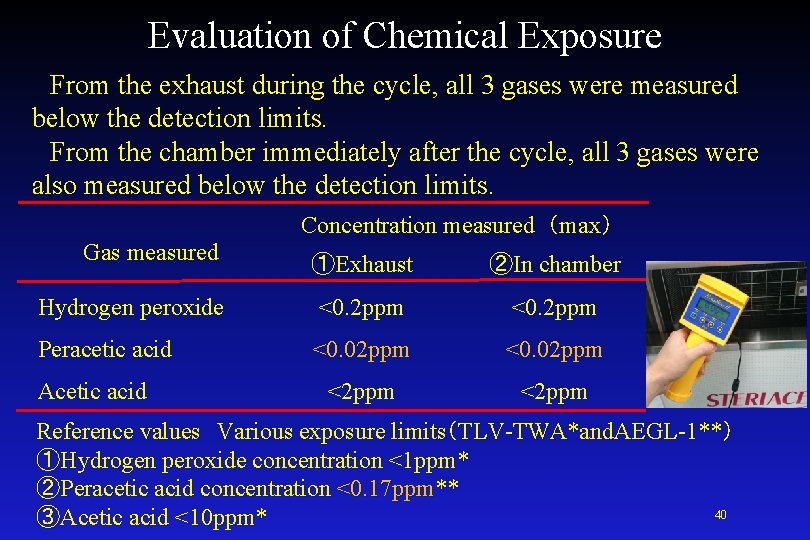
Evaluation of Chemical Exposure in Environment <Test Method> Chemical solution Peracetic acid formulation Measurement equipment Portable Gas Detector C 16 Porta SensⅡ ① 00 -1042 Hydrogen Peroxide, 0 -10/100 PPM ② 00 -1704 Peracetic Acid, 0 -1/5 PPM ③ 00 -1045 Acetic Acid, 0 -100/500 PPM Manufactured by ATI Technology Measurement method For a standard cycle, the gas concentration ① from the exhaust during a cycle ② in the chamber immediately after the cycle. 39
Evaluation of Chemical Exposure From the exhaust during the cycle, all 3 gases were measured below the detection limits. From the chamber immediately after the cycle, all 3 gases were also measured below the detection limits. Concentration measured(max) Gas measured ①Exhaust ②In chamber Hydrogen peroxide <0. 2 ppm Peracetic acid <0. 02 ppm <2 ppm Acetic acid Reference values Various exposure limits(TLV-TWA*and. AEGL-1**) ①Hydrogen peroxide concentration <1 ppm* ②Peracetic acid concentration <0. 17 ppm** 40 ③Acetic acid <10 ppm*
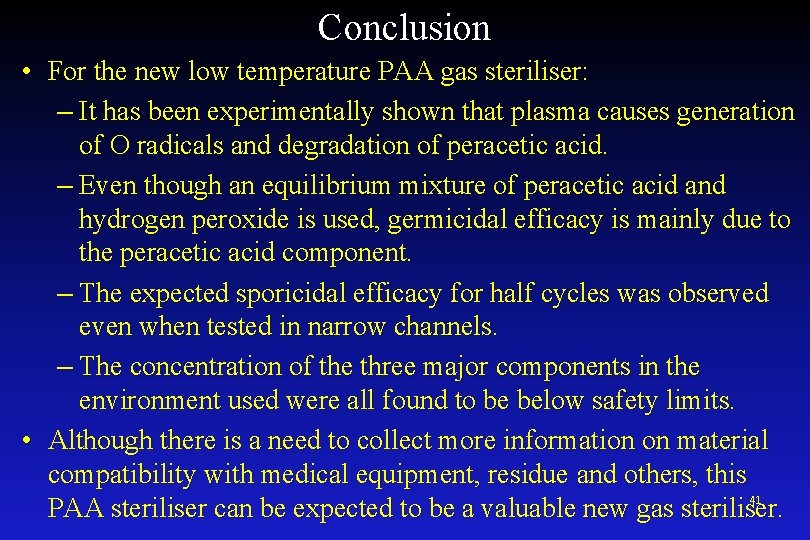
Conclusion • For the new low temperature PAA gas steriliser: – It has been experimentally shown that plasma causes generation of O radicals and degradation of peracetic acid. – Even though an equilibrium mixture of peracetic acid and hydrogen peroxide is used, germicidal efficacy is mainly due to the peracetic acid component. – The expected sporicidal efficacy for half cycles was observed even when tested in narrow channels. – The concentration of the three major components in the environment used were all found to be below safety limits. • Although there is a need to collect more information on material compatibility with medical equipment, residue and others, this 41 PAA steriliser can be expected to be a valuable new gas steriliser.
Thank you very much for your kind attention