
Per Student Allocation Formulas From Principles to Coefficients
- Slides: 37
Per Student Allocation Formulas: From Principles to Coefficients Jan Herczyński Baku, April 21, 2014
Structure of the presentation • • „Money follows the student” Top down and bottom up formulas Formulas for schools and for municipalities Objective and non-objective factors How to set the coefficients? Buffers Assessing the formula Jan Herczyński 2
„Money follows students” • In public finance, it is essential to focus financing on functions, not on facilities • However, usually supporting the beneficiary requires supporting the service provider • In education, this is a distinction of financing teaching process or teachers • But good education requires taking good care of teachers Jan Herczyński 3
„Money follows students” 2 • The best although imperfect measure of education tasks is the number of students (or full time equivallent students) • In theory, this gives the financing system flexibility when student numbers change • In practice, the flexibility requires good education governance Jan Herczyński 4
„Money follows students” 3 • Individual students usually do not have specific costs, while individual teachers do • This creates tension between allocation of funds per student and spending of funds per teacher • The resolution of this tension is a difficult and politically sensitive task Jan Herczyński 5
„Money follows students” 4 • This tension is due to the fact that the main driver of per student costs is class size • Procedure based on „Money follows students” must allocate more funds to schools/municipalities with smaller class sizes • Inclusion of the impact of class size in per student formula is a major challenge Jan Herczyński 6
„Money follows students” 5 Different countries use different factors to reflect class size in the formula: • Rural/mountain location (Poland, Georgia) • School size (Lithuania) • Population density (Macedonia) Jan Herczyński 7
„Money follows students” 6 • Money may follow the student to the paying agency (eg. local government) or to the school itself (depending on the form of education decentralization) • The principle „money follows students” assumes that some procedure (formula) will determine how much money follows which type of student Jan Herczyński 8
Top down – bottom up Two basic types of formulas: • Top down formula starts with the funds allocated in the national (regional) budget for education and attempts to distribute those funds fairly and adequately • Bottom up formula starts with expenditures associated with teaching one student and attempts to assess school needs Jan Herczyński 9
Top down – bottom up 2 Top down formula: • The simplest top down formula allocates the same amount of funds to each student, • Student voucher is equal to total available funds divided by the number of students • In practice formulas always use some coefficients to recognize different costs of teaching different groups of students Jan Herczyński 10
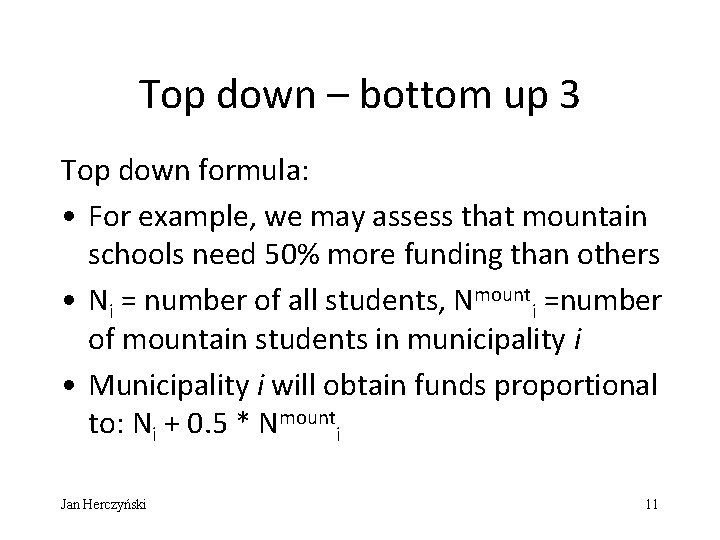
Top down – bottom up 3 Top down formula: • For example, we may assess that mountain schools need 50% more funding than others • Ni = number of all students, Nmounti =number of mountain students in municipality i • Municipality i will obtain funds proportional to: Ni + 0. 5 * Nmounti Jan Herczyński 11
Top down – bottom up 4 Top down formula: • Top down formulas are in principle simple but with many coefficients may become confusing • Polish national allocation formula is top down, but number of coefficients grew from 21 in 2000 to over 40 now Jan Herczyński 12
Top down – bottom up 5 Bottom up formula: • Bottom up formulas are never simple • Calculation of costs of educating one student is based on current norms (programs etc. ) and input costs (teacher salaries, energy prices) • Calculation also always assumes some conditions in the school, such as class sizes Jan Herczyński 13
Top down – bottom up 6 Bottom up formula: • CNFIPS in Romania has calculated 27 different per student norms for different types and locations of schools (not implemented) • Lithuania has introduced many per student norms based on school size (implemented) • Those calculations are usually complicated Janand Herczyński prohibit understanding and dialogue 14
To schools – to local governments • We discussed in previous session two models of education decentralization, • The formula should allocate the funds to the institution actually responsible for budgets (principle of subsidiarity) • So we have two types of formulas, to schools and to local governments Jan Herczyński 15
To schools – to local governments 2 Formula to schools: • Need to reflect many specific factors and conditions of individual schools • Should cover: (a) basic teaching costs, (b) support for students in need, (c) support for strong students, (d) maintenance of buildings • Some advanced countries use separate formulas for each component (UK, Australia) Jan Herczyński 16
To schools – to local governments 3 Formula to schools: • Paradoxically, implemented formulas to schools in post communist countries are usually very simple, • Georgia uses simple vouchers, Armenia uses vouchers with lump sum • This unavoidably leads to implementation problems Jan Herczyński 17
To schools – to local governments 4 Formula to local governments: • As most local governments have at least a few schools, their specific financial needs may be averaged • Formulas may use factors not applicable to schools, but applicable to larger units, such as population density or relative wealth of the municipality Jan Herczyński 18
To schools – to local governments 5 Formula to local governments: • In practice, formulas typically use school characteristics – But Macedonia uses population density • If local governments are very small (Armenia), no difference between the two approaches outside of large cities Jan Herczyński 19
Factors used in formulas • A formula is usually a mathematical expression defining the allocatin of funds to a school or to a local government • Formulas take into account some factors which reflect different costs of providing education • Numbers defining the impact of different factors are weights or coefficients Jan Herczyński 20
Factors used in formulas 2 • Choice of factors to be used in the formula is a key policy decision of the Ministry • Factors which may be influenced or changed by the local agent (school or municipality) should not be used in the allocation formula • Factors which are independent of the local agent are objective factors Jan Herczyński 21
Factors used in formulas 3 • If there are few factors in the formula, their strategic meaning is clear, but the formula may be inadequately flexible • If the number of factors is excessive, their impact on the final allocation becomes difficult to understand analyze • Typically, introduction of new coefficients is the price paid for compromise Jan Herczyński 22
Setting coefficients • There are no objective scientific truths which uniquely determine the values of allocation coefficients • Coefficients influence the allocation of public funds to institutions or to levels of local governments • Coefficients express policy preferences and are subject to debate and compromise Jan Herczyński 23
Setting coefficients 2 • Nevertheless, coefficients need to correspond to financial needs of schools or municipalities • Therefore setting the coefficients usually proceeds in two steps: – empirical averages or econometric regressions provide initial values for discussions – compromise with education stakeholders sets the values for implementation Jan Herczyński 24
Setting coefficients 3 • A rural factor in the formula reflects relatively smaller classes in rural schools • If it is very high, the motivation of rural municipalities to rationalize school network will decrease • If it is too low, some rural municipalities may find themselves unable to maintain schools Jan Herczyński 25
Setting coefficients 4 • Coefficients need to be universal, that is should apply to all the schools or local governments in the same way • Correction coefficients for specific institutions put favoritism in place of policy • Correction coefficients for specific institutions undermine budget discipline Jan Herczyński 26
Buffers • Buffers or hold harmless clauses limit the impact of new formulas by keeping the allocation close to historical allocation • Buffers are almost always necessary when a formula is being introduced for the first time • Buffers protect schools from sudden decrease of budget allocation Jan Herczyński 27
Buffers 2 • Narrow buffers limit the impact of new formula but provide strong protection against adjustment shock • Wide buffers means the new formula has stronger impact but schools may experience greater shocks Jan Herczyński 28
Buffers 3 • Poland had strong buffers from 1996 till 2000 • In 2000 the buffers were made weaker (per student buffers) • Since 2004 the buffers are no longer applied • Local education systems had time to adjust to formula funding Jan Herczyński 29
Assessing the formula • Ministry need to be able to assess the formula along several dimensions: – Winners and losers, – Horizontal and vertical equity, – Efficiency, – Treatment of politically sensitive groups Jan Herczyński 30
Assessing the formula 2 Winners and losers: • It is extremely important to identify which schools/local governments will win and lose most under the formula, • This could be individual schools, types of schools, regions or municipalities, • Especially important when the formula is being introduced or seriously changed Jan Herczyński 31
Assessing the formula 3 Dealing with winners and losers: • If schools lose because they were historically overfunded, buffers may be sufficient • If schools lose because the formula does not recognize their speficity, the Ministry may consider revising the formula • Ministry may want to adjust coefficients to minimize the number of losers Jan Herczyński 32
Assessing the formula 4 Horizontal equity: • Horizontal equity means students in similar conditions and schools should be funded more or less at the same level, • Systematic breaking of horizontal equity indicates a weakness of the formula • Example: Poland rural coefficient applies to local governments close to large cities Jan Herczyński 33
Assessing the formula 5 Vertical equity: • Vertical equity means that different treatment of schools of different level is justified on policy grounds • Ministry needs to monitor relative funding of different education sub-sectors • Excessive funding of a sub-sector indicates a weakness of the formula Jan Herczyński 34
Assessing the formula 6 Efficiency: • Allocation formula is efficient if the funds allocated to municipalities and schools are adequate but not excessive • Excessive allocation to specific schools or municipalities means that others do not get enough, leading to inefficient use of funds Jan Herczyński 35
Assessing the formula 7 Sensitive groups: • Ministry always needs to take into account politically sensitive groups and ensure that the formula does not discriminate against them • Those groups may include: national minorities, special needs students, Jan Herczyński 36
Assessing the formula 8 Simulations: • Assessment of the formulas should always include nationwide simulations of its effects under various scenarios (coefficient values) • Review of the simulation allows the ministry to assess proposed allocation • Simulations based on a sample of schools or municipalities are not enough Jan Herczyński 37