
Peptide Sequencing by Mass Spectrometry Alex Ramos 5

Peptide Sequencing by Mass Spectrometry Alex Ramos 5 April 2005
Edman degradation
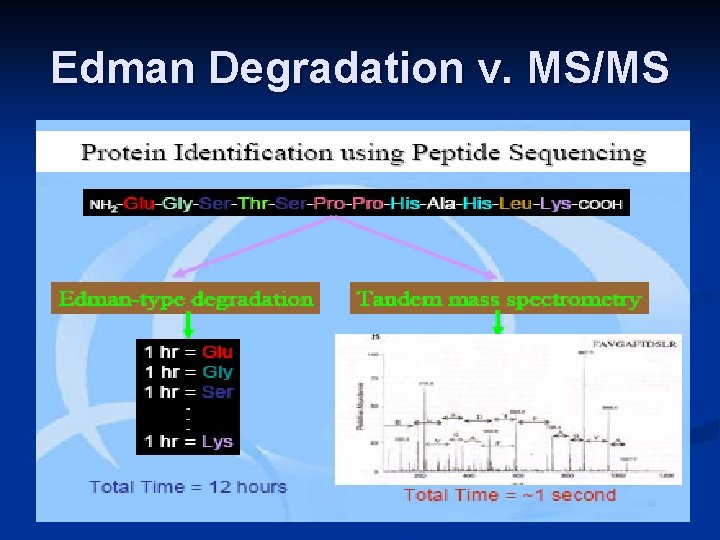
Edman Degradation v. MS/MS
Why study proteins? machines that make cells function n RNA levels do not always accurately predict protein levels n targets of drugs n

Peptide Analysis n n Edman Degradation MS n n More sensitive Can fragment peptides faster Does not require proteins or peptides to be purified to homogeneity Has no problem identifying blocked or modified proteins

Introduction n MS/MS plays important role in protein identification (fast and sensitive) Derivation of peptide sequence an important task in proteomics Derivation without help from a protein database (“de novo sequencing”), especially important in identification of unknown protein
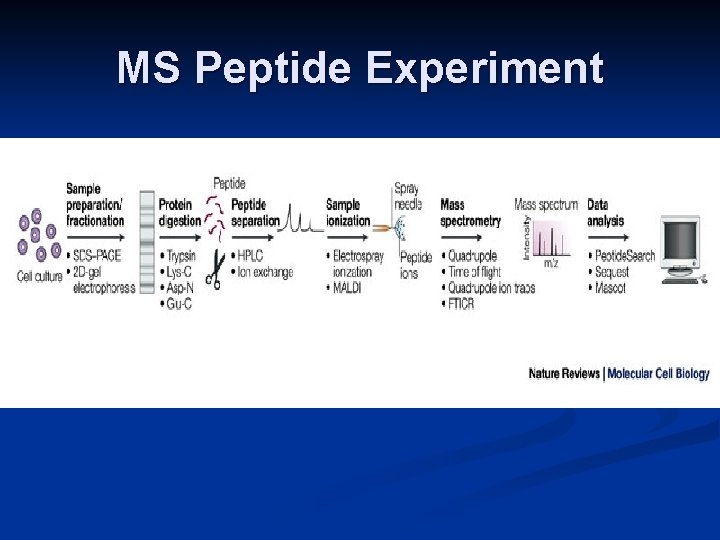
Basic lab experimental steps 1. Proteins digested w/ an enzyme to produce peptides 2. Peptides charged (ionized) and separated according to their different m/z ratios 3. Each peptide fragmented into ions and m/z values of fragment ions are measured n Steps 2 and 3 performed within a tandem mass spectrometer.
Mass spectrum Proteins consist of 20 different types of a. a. with different masses (except for one pair Leu and Ile) n Different peptides produce different spectra n Use the spectrum of a peptide to determine its sequence n
Objectives Describe the steps of a typical peptide analysis by MS (proteomic experiment) n Explain peptide ionization, fragmentation, identification n
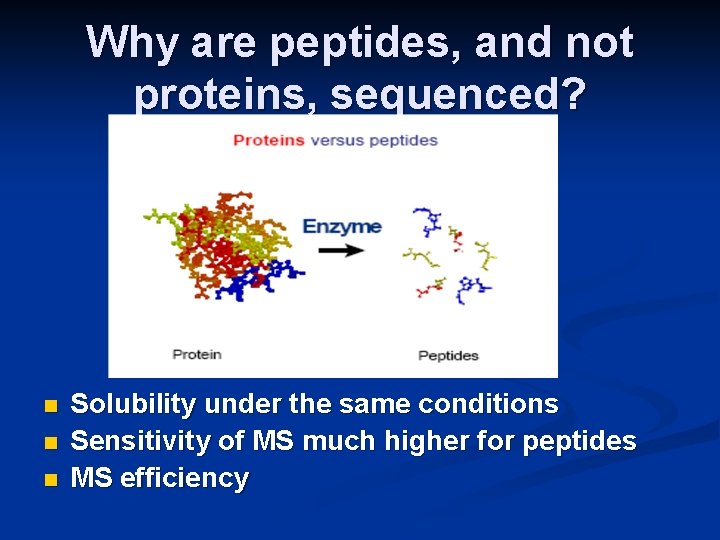
Why are peptides, and not proteins, sequenced? n n n Solubility under the same conditions Sensitivity of MS much higher for peptides MS efficiency
MS Peptide Experiment
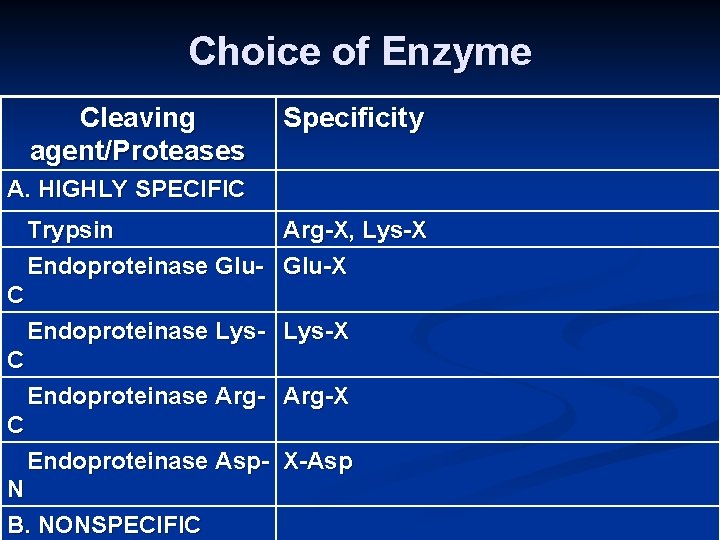
Choice of Enzyme Cleaving agent/Proteases Specificity A. HIGHLY SPECIFIC Trypsin Arg-X, Lys-X Endoproteinase Glu-X C Endoproteinase Lys-X C Endoproteinase Arg-X C Endoproteinase Asp- X-Asp N B. NONSPECIFIC
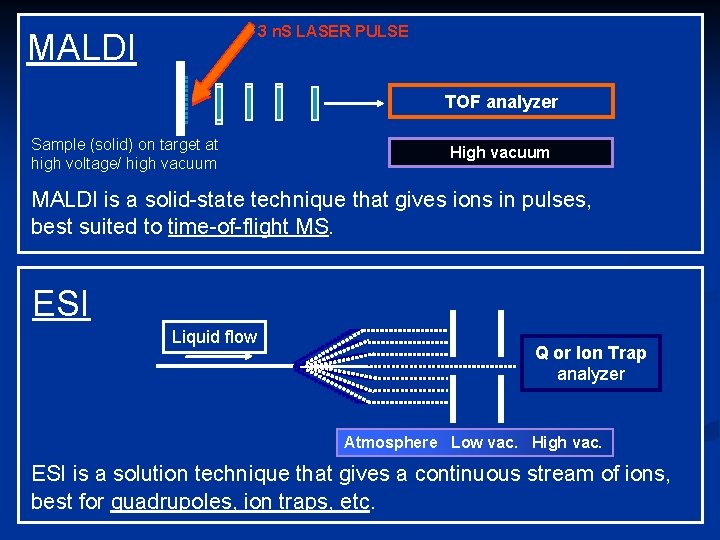
3 n. S LASER PULSE MALDI +++ + + ++ + + ++ Sample (solid) on target at high voltage/ high vacuum + + ++ ++ + + + ++ ++ ++ + +++ +++ + +++ + + TOF analyzer High vacuum MALDI is a solid-state technique that gives ions in pulses, best suited to time-of-flight MS. ESI Liquid flow Q or Ion Trap analyzer Atmosphere Low vac. High vac. ESI is a solution technique that gives a continuous stream of ions, best for quadrupoles, ion traps, etc.


…. MALDI or Electrospray ? MALDI is limited to solid state, ESI to liquid ESI is better for the analysis of complex mixture as it is directly interfaced to a separation techniques (i. e. HPLC or CE) MALDI is more “flexible” (MW from 200 to 400, 000 Da)
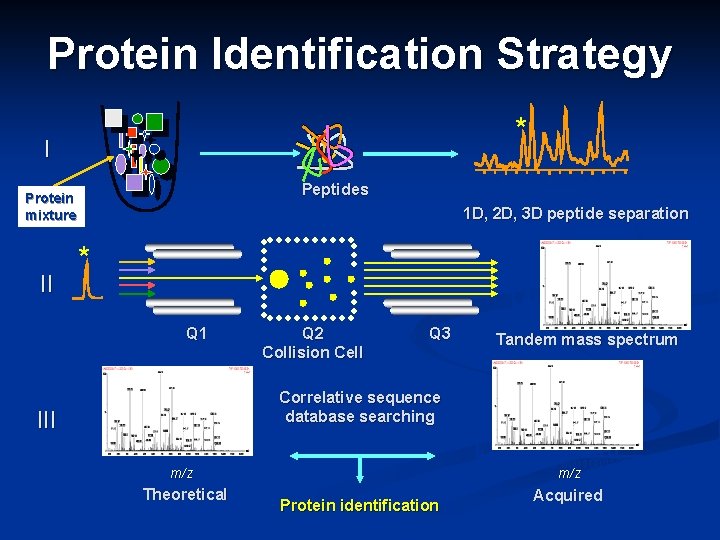
Protein Identification Strategy * I Protein mixture II 12 Peptides 14 Time (min) 16 1 D, 2 D, 3 D peptide separation * 200 400 600 80010001200 Q 1 Q 2 Collision Cell Q 3 m/z Tandem mass spectrum Correlative sequence database searching III 200 400 600 80010001200 m/z Theoretical m/z Protein identification Acquired
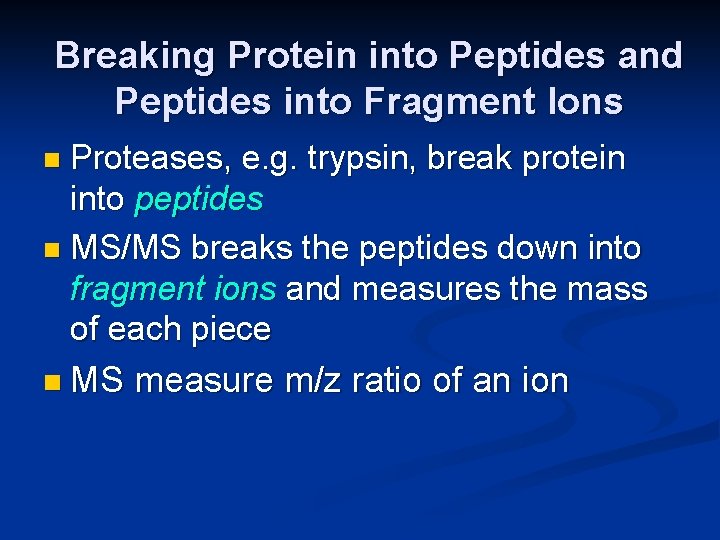
Breaking Protein into Peptides and Peptides into Fragment Ions Proteases, e. g. trypsin, break protein into peptides n MS/MS breaks the peptides down into fragment ions and measures the mass of each piece n n MS measure m/z ratio of an ion

Peptide fragmentation Amino acids differ in their side chains Weakest bonds Predomina nt fragmentati on
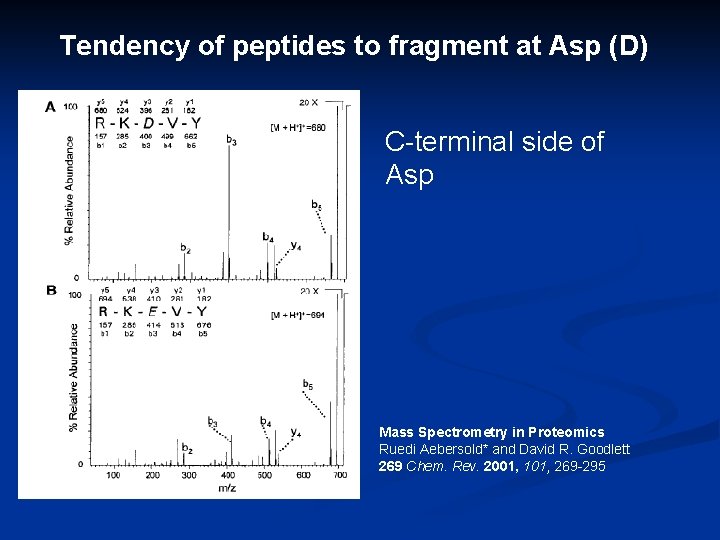
Tendency of peptides to fragment at Asp (D) C-terminal side of Asp Mass Spectrometry in Proteomics Ruedi Aebersold* and David R. Goodlett 269 Chem. Rev. 2001, 101, 269 -295

Large-scale Analysis of in Vivo Phosphorylated Membrane Proteins by Immobilized Metal Ion Affinity Chromatography and Mass Spectrometry, Molecular & Cellular Proteomics, 2003, 2. 11, 1234, Thomas S. Nuhse, Allan Stensballe, Ole N. Jensen, and Scott C. Peck

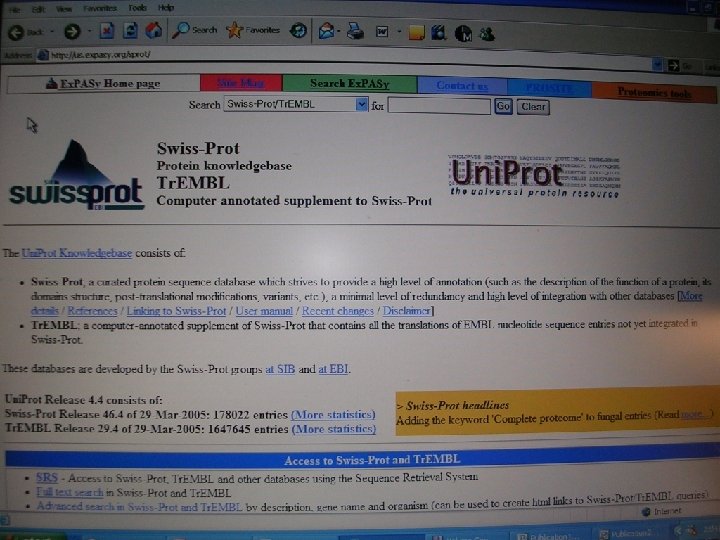
What you need for peptide mass mapping n Peptide mass spectrum n Protein Database n n Gen. Bank, Swiss-Prot, db. EST, etc. Search engines n Mas. Cot, Prospector, Sequest, etc.
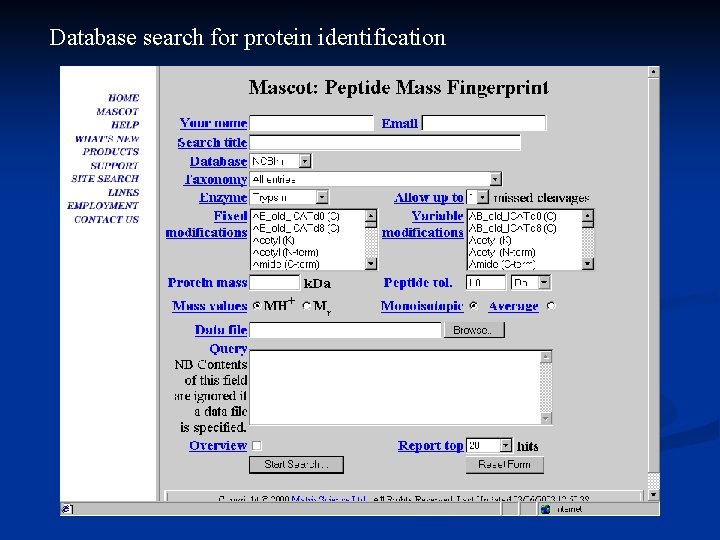
Database search for protein identification
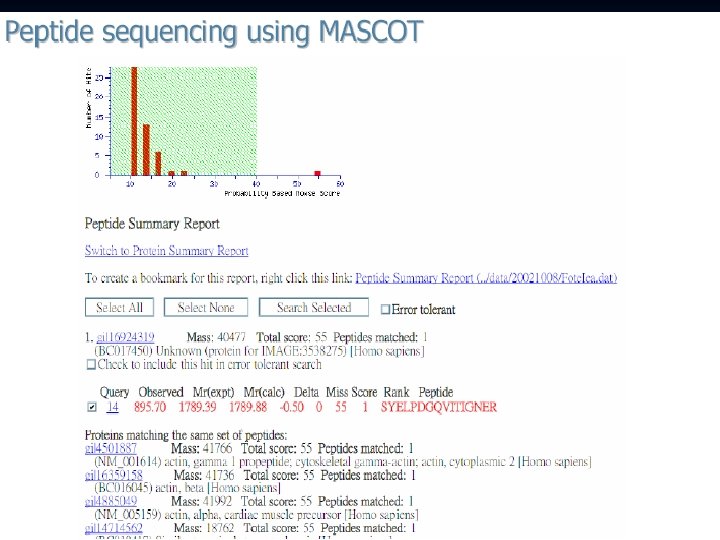
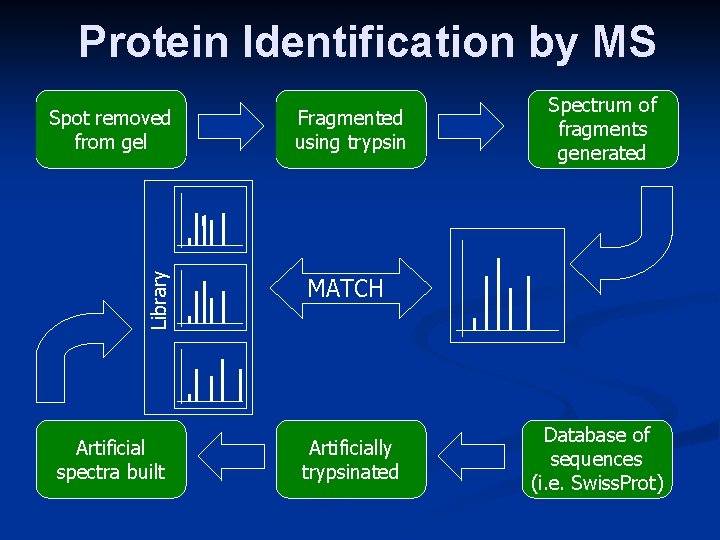
Protein Identification by MS Library Spot removed from gel Artificial spectra built Fragmented using trypsin Spectrum of fragments generated MATCH Artificially trypsinated Database of sequences (i. e. Swiss. Prot)
Conclusions MS of peptides enables high throughput identification and characterization of proteins in biological systems n “de novo sequencing” can be used to identify unknown proteins not found in protein databases n
References H. Steen and M. Mann. “The ABC’s (and XYZ’s) of Peptide Sequencing” Molecular Cell Biology, Nature Reviews. 2004, 5, 699. T. S. Nuhse, A. Stensballe, O. Jensen, and S. Peck. “Large-scale Analysis of in Vivo Phosphorylated Membrane Proteins by Immobilized Metal Ion Affinity Chromatography and Mass Spectrometry” Molecular & Cellular Proteomics, 2003, 2. 11, 1234. R. Aebersold and D. Goodlett. “Mass Spectrometry in Proteomics” Chem. Rev. , 2001, 101, 269.
- Slides: 27