
Peptide Prophet Explained Brian C Searle Proteome Software
Peptide. Prophet Explained Brian C. Searle Proteome Software Inc. www. proteomesoftware. com 1336 SW Bertha Blvd, Portland OR 97219 (503) 244 -6027 An explanation of the Peptide Prophet algorithm developed by Keller, A. , Nesvizhskii, A. I. , Kolker, E. , and Aebersold, R. (2002) Anal. Chem. 74, 5383 – 5392
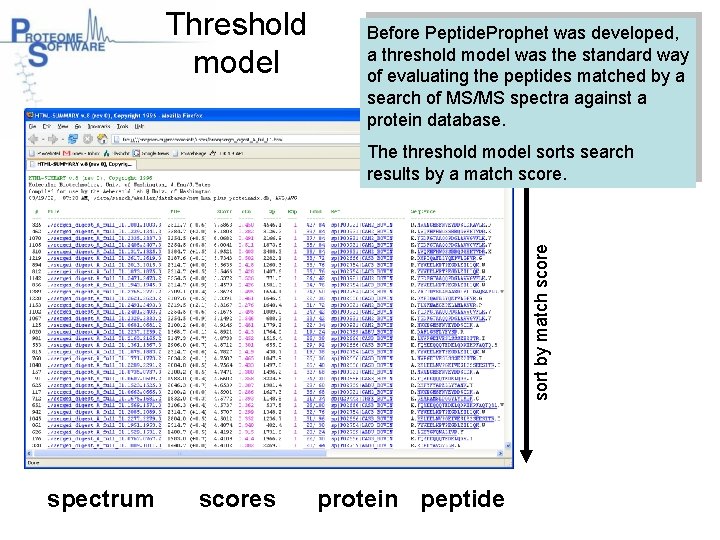
Threshold model Before Peptide. Prophet was developed, a threshold model was the standard way of evaluating the peptides matched by a search of MS/MS spectra against a protein database. sort by match score The threshold model sorts search results by a match score. spectrum scores protein peptide
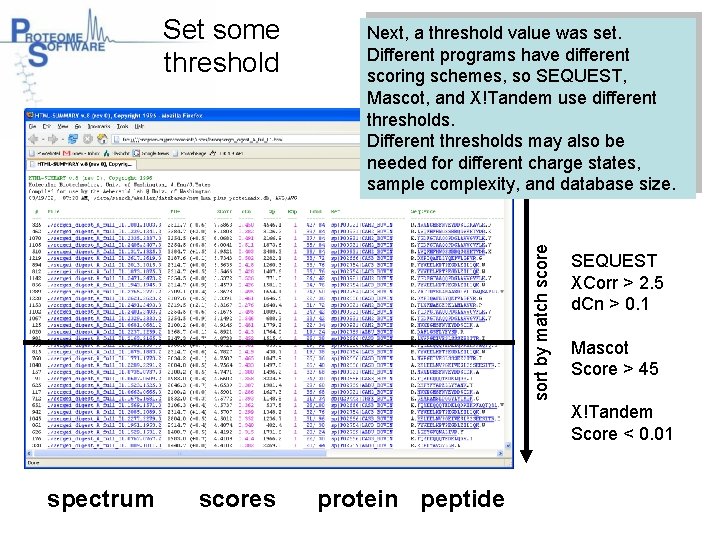
Next, a threshold value was set. Different programs have different scoring schemes, so SEQUEST, Mascot, and X!Tandem use different thresholds. Different thresholds may also be needed for different charge states, sample complexity, and database size. sort by match score Set some threshold SEQUEST XCorr > 2. 5 d. Cn > 0. 1 Mascot Score > 45 X!Tandem Score < 0. 01 spectrum scores protein peptide
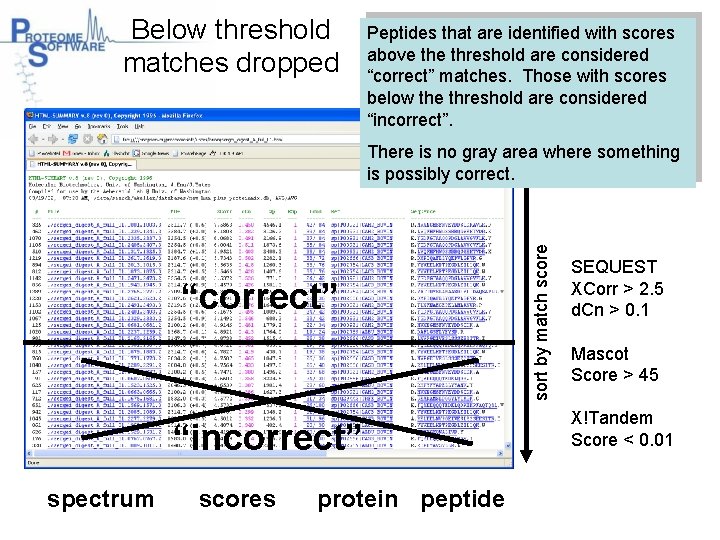
Below threshold matches dropped Peptides that are identified with scores above threshold are considered “correct” matches. Those with scores below the threshold are considered “incorrect”. “correct” “incorrect” spectrum scores protein peptide sort by match score There is no gray area where something is possibly correct. SEQUEST XCorr > 2. 5 d. Cn > 0. 1 Mascot Score > 45 X!Tandem Score < 0. 01
There has to be a better way The threshold model has these problems, which Peptide. Prophet tries to solve: • Poor sensitivity/specificity trade-off, unless you consider multiple scores simultaneously. • No way to choose an error rate (p=0. 05). • Need to have different thresholds for: – – different instruments (QTOF, TOF-TOF, Ion. Trap) ionization sources (electrospray vs MALDI) sample complexities (2 D gel spot vs Mud. PIT) different databases (Swiss. Prot vs NR) • Impossible to compare results from different search algorithms, multiple instruments, and so on.
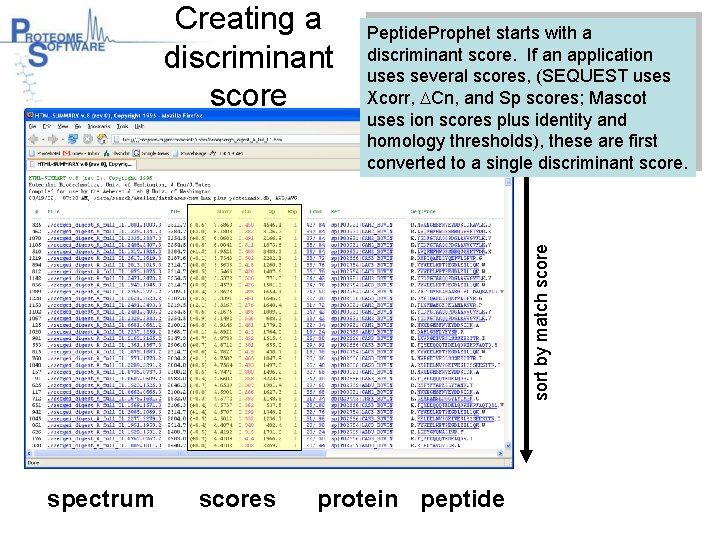
Peptide. Prophet starts with a discriminant score. If an application uses several scores, (SEQUEST uses Xcorr, DCn, and Sp scores; Mascot uses ion scores plus identity and homology thresholds), these are first converted to a single discriminant score. sort by match score Creating a discriminant score spectrum scores protein peptide
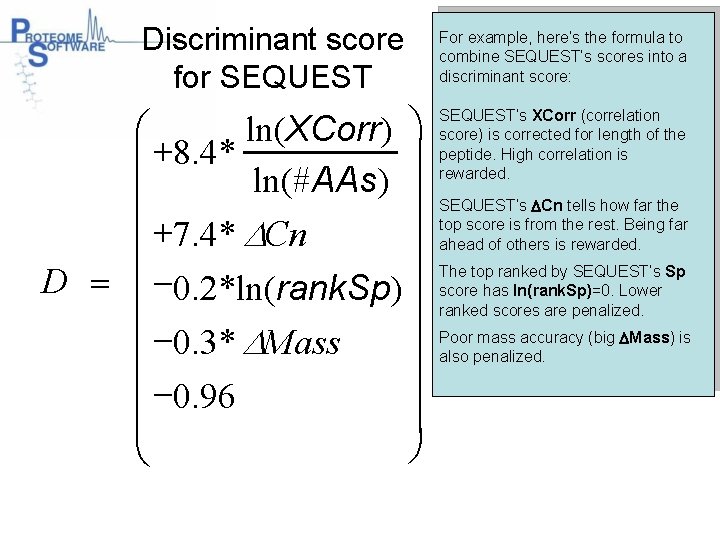
Discriminant score for SEQUEST æ ln(XCorr) ö ç +8. 4* ln(#AAs) ç ç +7. 4* DCn ç D = -0. 2*ln(rank. Sp) ç ç -0. 3* DMass ç ç -0. 96 ç ø è For example, here’s the formula to combine SEQUEST’s scores into a discriminant score: SEQUEST’s XCorr (correlation score) is corrected for length of the peptide. High correlation is rewarded. SEQUEST’s DCn tells how far the top score is from the rest. Being far ahead of others is rewarded. The top ranked by SEQUEST’s Sp score has ln(rank. Sp)=0. Lower ranked scores are penalized. Poor mass accuracy (big DMass) is also penalized.
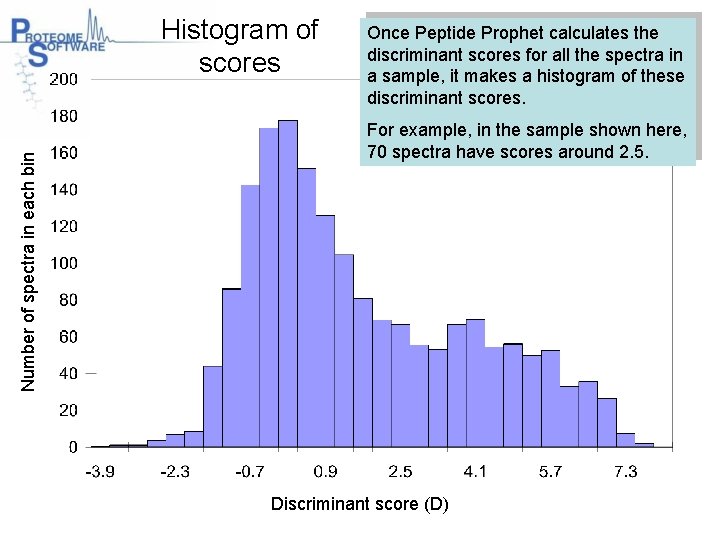
Number of spectra in each bin Histogram of scores Once Peptide Prophet calculates the discriminant scores for all the spectra in a sample, it makes a histogram of these discriminant scores. For example, in the sample shown here, 70 spectra have scores around 2. 5. Discriminant score (D)
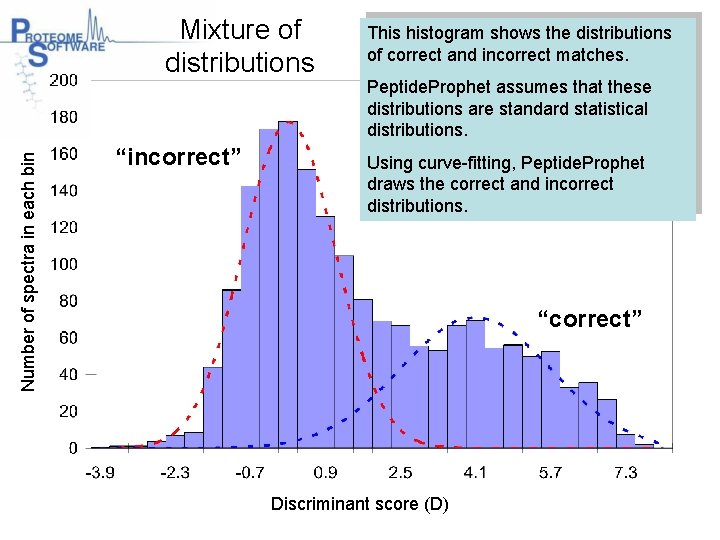
Number of spectra in each bin Mixture of distributions “incorrect” This histogram shows the distributions of correct and incorrect matches. Peptide. Prophet assumes that these distributions are standard statistical distributions. Using curve-fitting, Peptide. Prophet draws the correct and incorrect distributions. “correct” Discriminant score (D)
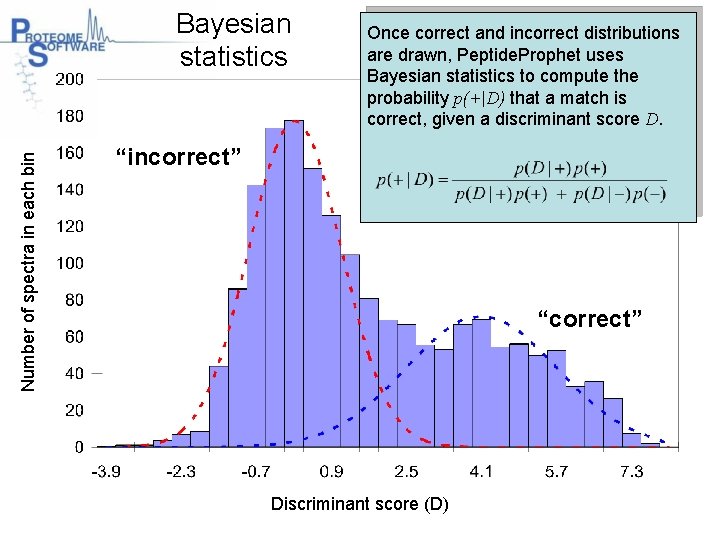
Number of spectra in each bin Bayesian statistics Once correct and incorrect distributions are drawn, Peptide. Prophet uses Bayesian statistics to compute the probability p(+|D) that a match is correct, given a discriminant score D. “incorrect” “correct” Discriminant score (D)

Number of spectra in each bin Probability of a correct match The statistical formula looks fierce, but relating it to the histogram shows that the prob of a score of 2. 5 being correct is “incorrect” “correct” Discriminant score (D)
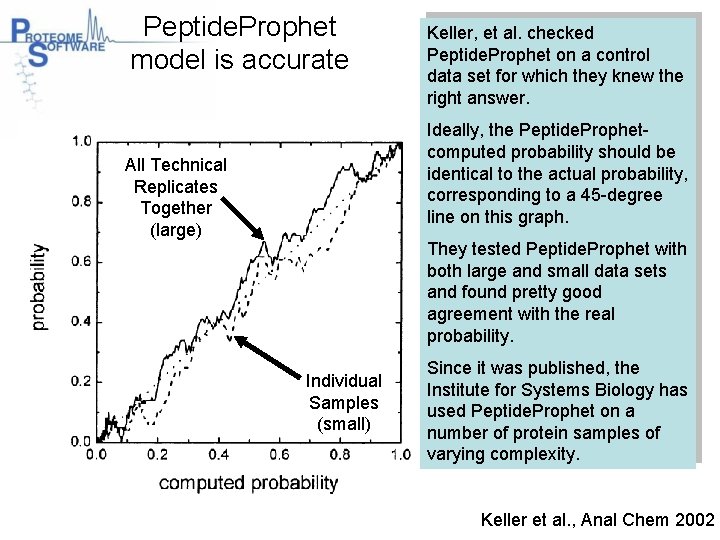
Peptide. Prophet model is accurate Keller, et al. checked Peptide. Prophet on a control data set for which they knew the right answer. Ideally, the Peptide. Prophetcomputed probability should be identical to the actual probability, corresponding to a 45 -degree line on this graph. All Technical Replicates Together (large) They tested Peptide. Prophet with both large and small data sets and found pretty good agreement with the real probability. Individual Samples (small) Since it was published, the Institute for Systems Biology has used Peptide. Prophet on a number of protein samples of varying complexity. Keller et al. , Anal Chem 2002
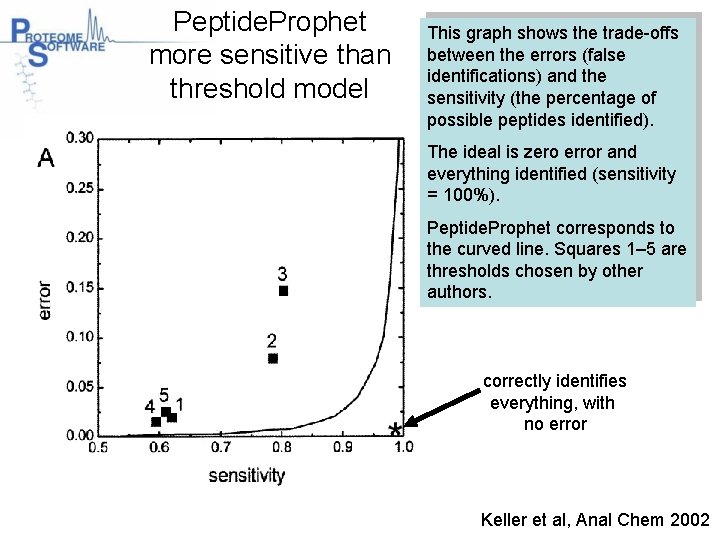
Peptide. Prophet more sensitive than threshold model This graph shows the trade-offs between the errors (false identifications) and the sensitivity (the percentage of possible peptides identified). The ideal is zero error and everything identified (sensitivity = 100%). Peptide. Prophet corresponds to the curved line. Squares 1– 5 are thresholds chosen by other authors. correctly identifies everything, with no error Keller et al, Anal Chem 2002
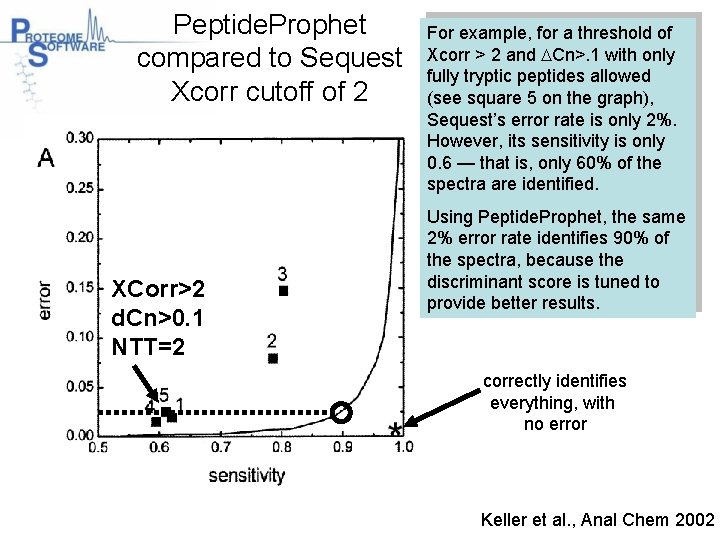
Peptide. Prophet compared to Sequest Xcorr cutoff of 2 XCorr>2 d. Cn>0. 1 NTT=2 For example, for a threshold of Xcorr > 2 and DCn>. 1 with only fully tryptic peptides allowed (see square 5 on the graph), Sequest’s error rate is only 2%. However, its sensitivity is only 0. 6 — that is, only 60% of the spectra are identified. Using Peptide. Prophet, the same 2% error rate identifies 90% of the spectra, because the discriminant score is tuned to provide better results. correctly identifies everything, with no error Keller et al. , Anal Chem 2002
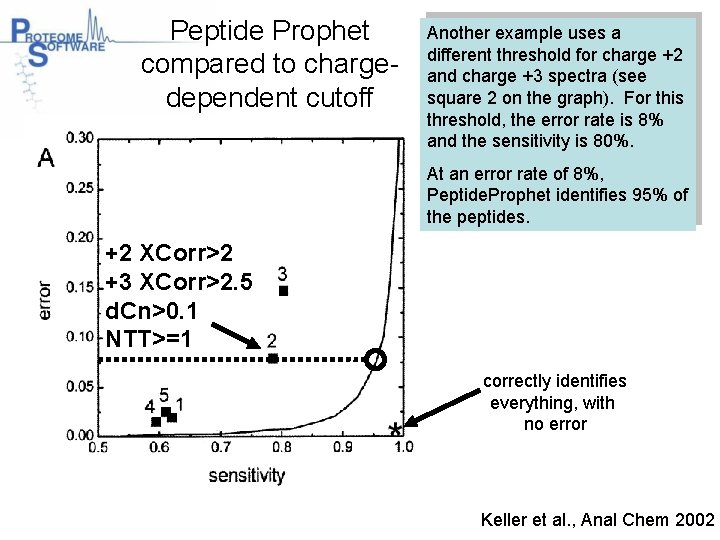
Peptide Prophet compared to chargedependent cutoff Another example uses a different threshold for charge +2 and charge +3 spectra (see square 2 on the graph). For this threshold, the error rate is 8% and the sensitivity is 80%. At an error rate of 8%, Peptide. Prophet identifies 95% of the peptides. +2 XCorr>2 +3 XCorr>2. 5 d. Cn>0. 1 NTT>=1 correctly identifies everything, with no error Keller et al. , Anal Chem 2002
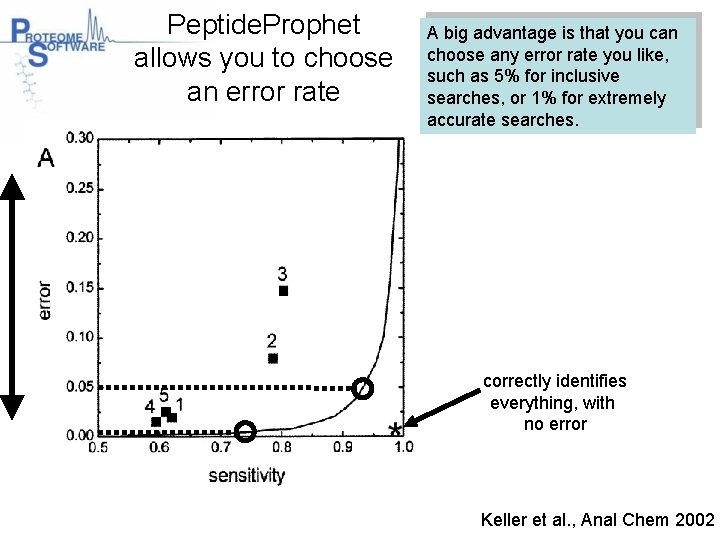
Peptide. Prophet allows you to choose an error rate A big advantage is that you can choose any error rate you like, such as 5% for inclusive searches, or 1% for extremely accurate searches. correctly identifies everything, with no error Keller et al. , Anal Chem 2002
There has to be a better way Recall the problems that Peptide. Prophet was designed to fix. How well did it do? • Poor sensitivity/specificity trade-off unless you consider multiple scores simultaneously. • No way to choose an error rate (p=0. 05). • Need to have different thresholds for: – – different instruments (QTOF, TOF-TOF, Ion. Trap) ionization sources (electrospray vs MALDI) sample complexities (2 D gel spot vs Mud. PIT) different databases (Swiss. Prot vs NR) • Impossible to compare results from different search algorithms, multiple instruments, and so on.
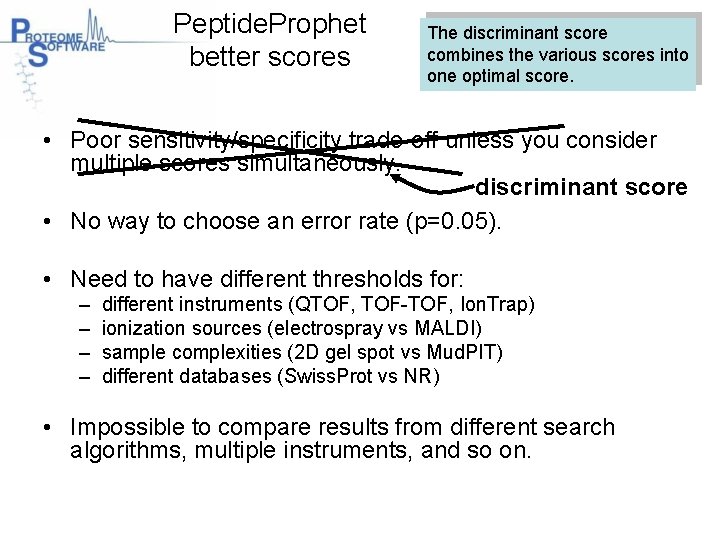
Peptide. Prophet better scores The discriminant score combines the various scores into one optimal score. • Poor sensitivity/specificity trade-off unless you consider multiple scores simultaneously. discriminant score • No way to choose an error rate (p=0. 05). • Need to have different thresholds for: – – different instruments (QTOF, TOF-TOF, Ion. Trap) ionization sources (electrospray vs MALDI) sample complexities (2 D gel spot vs Mud. PIT) different databases (Swiss. Prot vs NR) • Impossible to compare results from different search algorithms, multiple instruments, and so on.
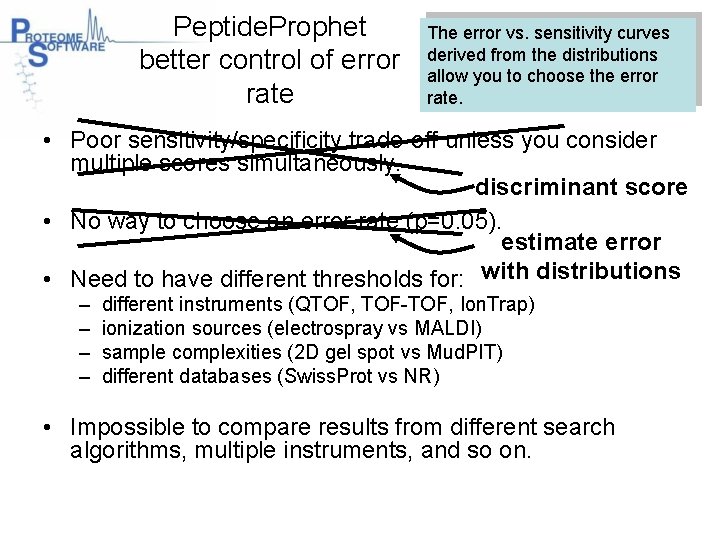
Peptide. Prophet better control of error rate The error vs. sensitivity curves derived from the distributions allow you to choose the error rate. • Poor sensitivity/specificity trade-off unless you consider multiple scores simultaneously. discriminant score • No way to choose an error rate (p=0. 05). estimate error • Need to have different thresholds for: with distributions – – different instruments (QTOF, TOF-TOF, Ion. Trap) ionization sources (electrospray vs MALDI) sample complexities (2 D gel spot vs Mud. PIT) different databases (Swiss. Prot vs NR) • Impossible to compare results from different search algorithms, multiple instruments, and so on.
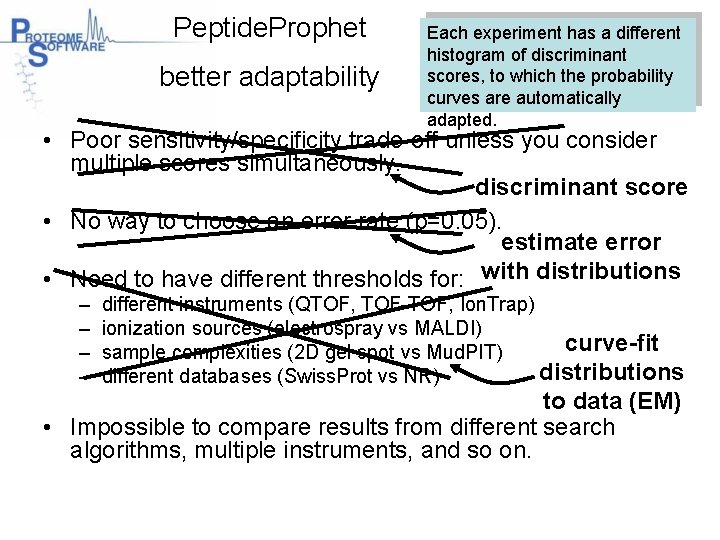
Peptide. Prophet better adaptability Each experiment has a different histogram of discriminant scores, to which the probability curves are automatically adapted. • Poor sensitivity/specificity trade-off unless you consider multiple scores simultaneously. discriminant score • No way to choose an error rate (p=0. 05). estimate error • Need to have different thresholds for: with distributions – – different instruments (QTOF, TOF-TOF, Ion. Trap) ionization sources (electrospray vs MALDI) curve-fit sample complexities (2 D gel spot vs Mud. PIT) distributions different databases (Swiss. Prot vs NR) to data (EM) • Impossible to compare results from different search algorithms, multiple instruments, and so on.
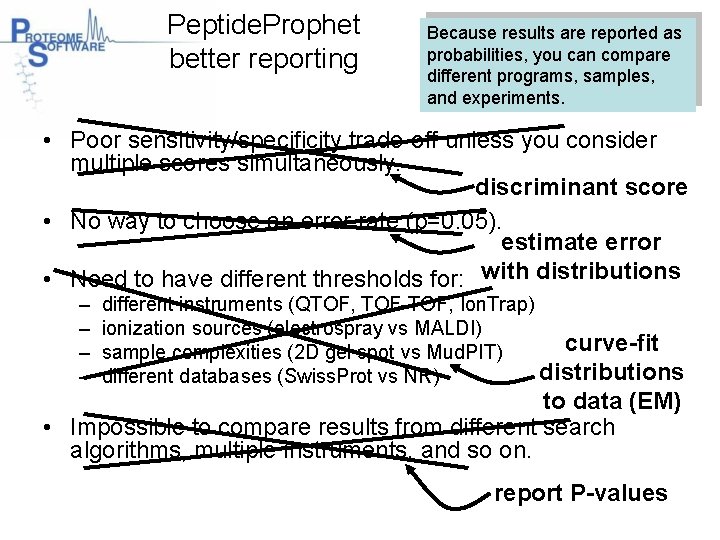
Peptide. Prophet better reporting Because results are reported as probabilities, you can compare different programs, samples, and experiments. • Poor sensitivity/specificity trade-off unless you consider multiple scores simultaneously. discriminant score • No way to choose an error rate (p=0. 05). estimate error • Need to have different thresholds for: with distributions – – different instruments (QTOF, TOF-TOF, Ion. Trap) ionization sources (electrospray vs MALDI) curve-fit sample complexities (2 D gel spot vs Mud. PIT) distributions different databases (Swiss. Prot vs NR) to data (EM) • Impossible to compare results from different search algorithms, multiple instruments, and so on. report P-values
Peptide. Prophet Summary • Identifies more peptides in each sample. • Allows trade-offs: wrong peptides against missed peptides. • Provides probabilities: – easy to interpret – comparable between experiments • Automatically adjusts for each data set. • Has been verified on many real proteome samples: see www. peptideatlas. org/repository.
- Slides: 22