
Peptide Mass FingerPrinting Part II MALDITOF Y o


- Slides: 25
Peptide Mass Finger-Printing Part II. MALDI-TOF Y o n s e i P r o t e o m e R e s e a r c h C e n t e r 2013 생화학 실험 (1) 6주차 자료 임종선 조교 limjs@proteomix. org 내선 6625 Yonsei Proteome Research Center
Concept of Mass Spectrometry Mass Spectrometer? • Instrument measuring molecular weight (MW) of sample • Only picomolar concentrations is required • Accuracy of 0. 01% of total weight of sample • Able to detect amino acid substitution/post-translational modifications Yonsei Proteome Research Center
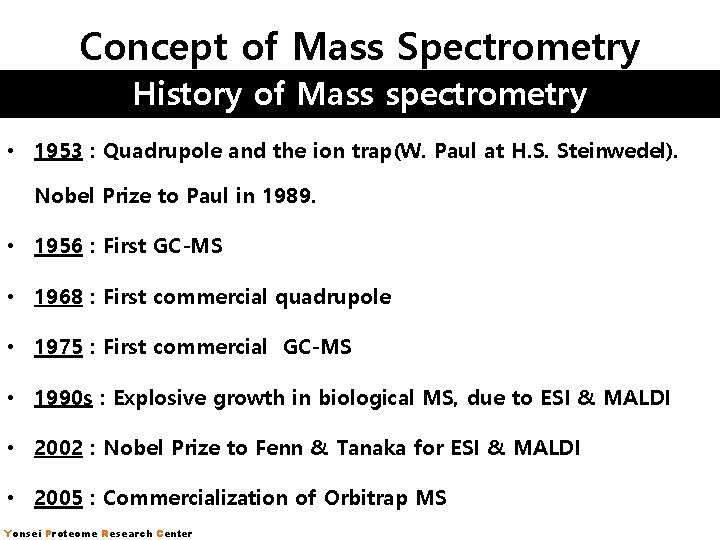
Concept of Mass Spectrometry History of Mass spectrometry • 1953 : Quadrupole and the ion trap(W. Paul at H. S. Steinwedel). Nobel Prize to Paul in 1989. • 1956 : First GC-MS • 1968 : First commercial quadrupole • 1975 : First commercial GC-MS • 1990 s : Explosive growth in biological MS, due to ESI & MALDI • 2002 : Nobel Prize to Fenn & Tanaka for ESI & MALDI • 2005 : Commercialization of Orbitrap MS Yonsei Proteome Research Center
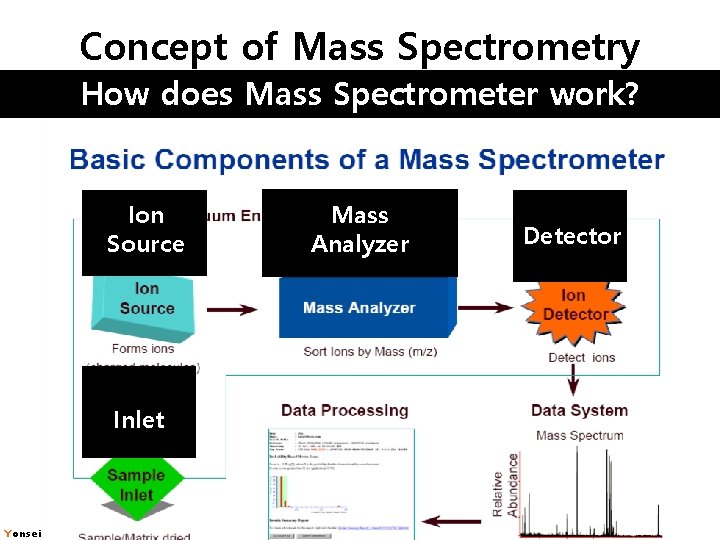
Concept of Mass Spectrometry How does Mass Spectrometer work? Ion Source Inlet Yonsei Proteome Research Center Mass Analyzer Detector
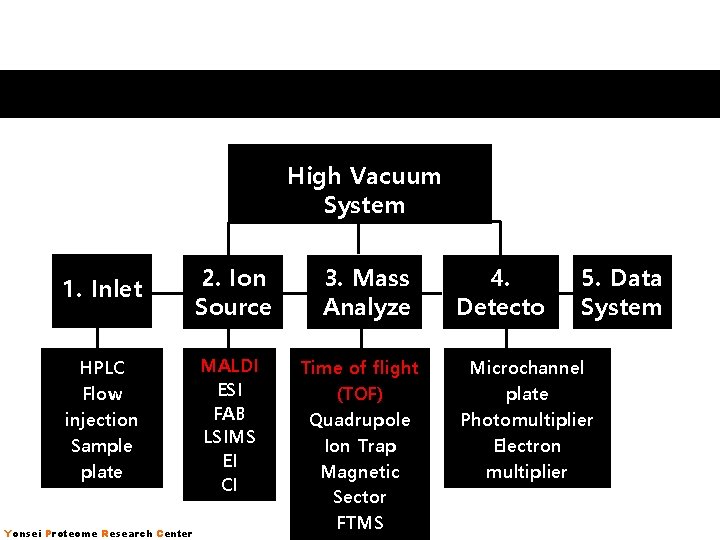
Concept of Mass Spectrometry Types of Machines / Techniques High Vacuum System 1. Inlet 2. Ion Source HPLC Flow injection Sample plate MALDI ESI FAB LSIMS EI CI Yonsei Proteome Research Center 3. Mass Analyze r Time of flight (TOF) Quadrupole Ion Trap Magnetic Sector FTMS 4. Detecto r 5. Data System Microchannel plate Photomultiplier Electron multiplier
Concept of MALDI-TOF “Sample Preparation” Peptide Sample Preparation gel Excise Extract Wash Dry Digest Reconstruction Inlet Yonsei Proteome Research Center
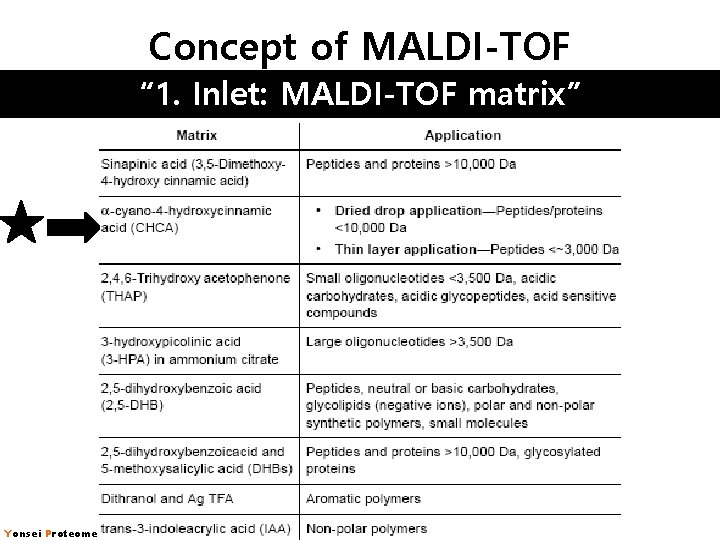
Concept of MALDI-TOF “ 1. Inlet: MALDI-TOF matrix” Yonsei Proteome Research Center
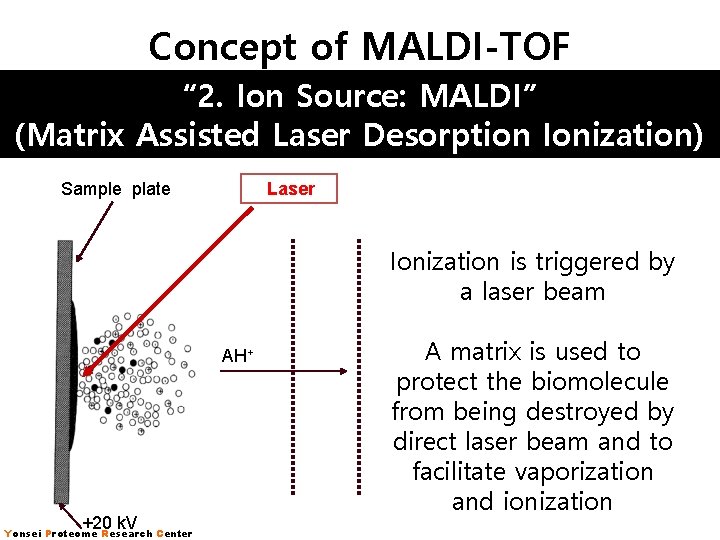
Concept of MALDI-TOF “ 2. Ion Source: MALDI” (Matrix Assisted Laser Desorption Ionization) Sample plate Laser hn Ionization is triggered by a laser beam AH+ +20 k. V Yonsei Proteome Research Center A matrix is used to protect the biomolecule from being destroyed by direct laser beam and to facilitate vaporization and ionization
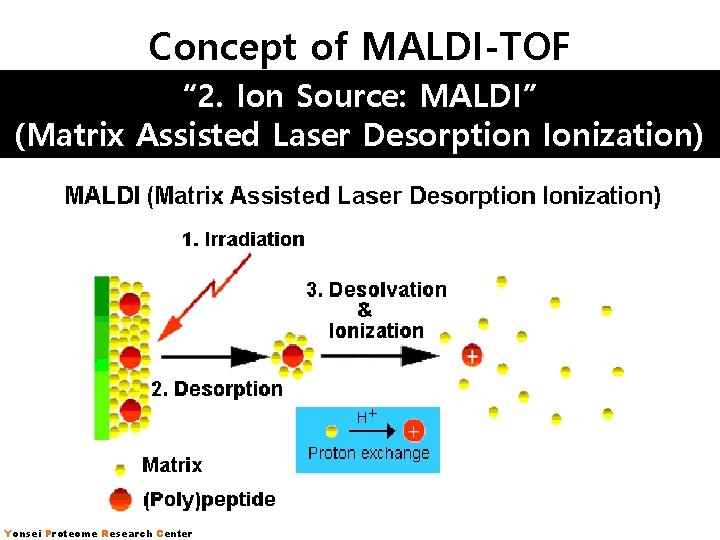
Concept of MALDI-TOF “ 2. Ion Source: MALDI” (Matrix Assisted Laser Desorption Ionization) Yonsei Proteome Research Center
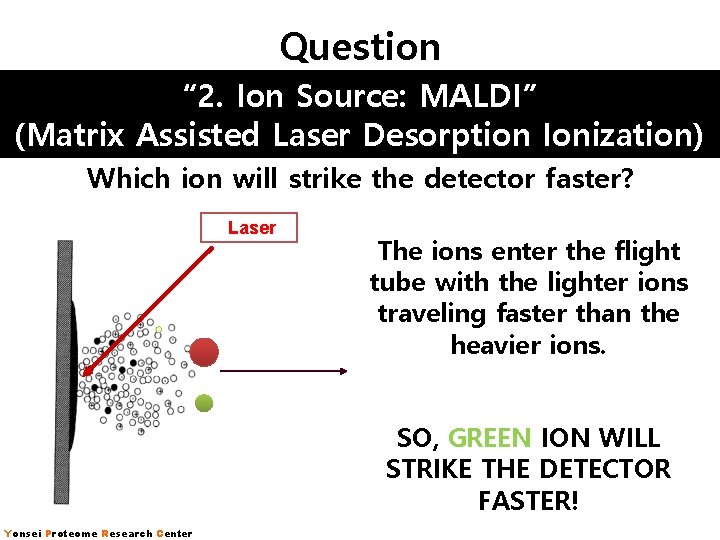
Question “ 2. Ion Source: MALDI” (Matrix Assisted Laser Desorption Ionization) Which ion will strike the detector faster? Laser The ions enter the flight tube with the lighter ions traveling faster than the heavier ions. SO, GREEN ION WILL STRIKE THE DETECTOR FASTER! Yonsei Proteome Research Center
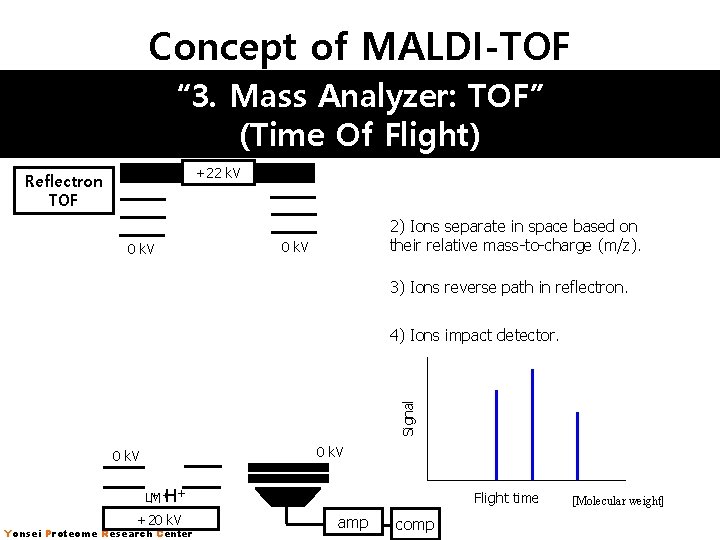
Concept of MALDI-TOF “ 3. Mass Analyzer: TOF” (Time Of Flight) +22 k. V Reflectron TOF 0 k. V 1) Ions enter source region, accelerated toward reflectron. 2) Ions separate in space based on their relative mass-to-charge (m/z). 0 k. V 3) Ions reverse path in reflectron. Signal 4) Ions impact detector. 0 k. V + + + LM H +20 k. V Yonsei Proteome Research Center Flight time amp comp [Molecular weight]
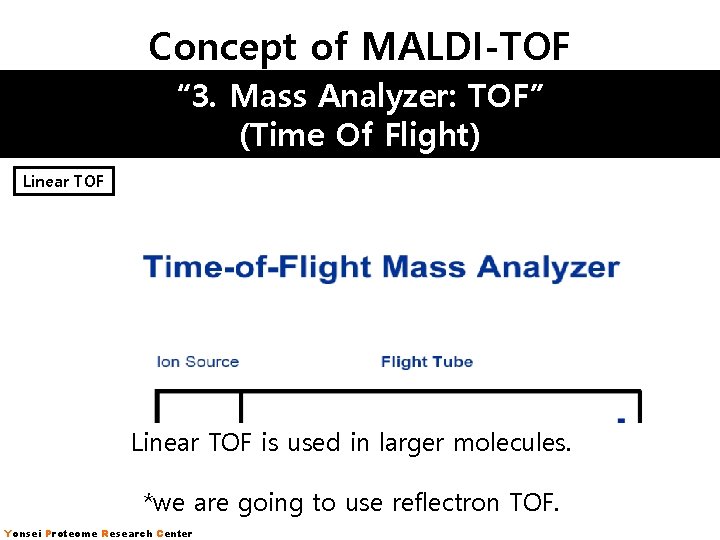
Concept of MALDI-TOF “ 3. Mass Analyzer: TOF” (Time Of Flight) Linear TOF is used in larger molecules. *we are going to use reflectron TOF. Yonsei Proteome Research Center
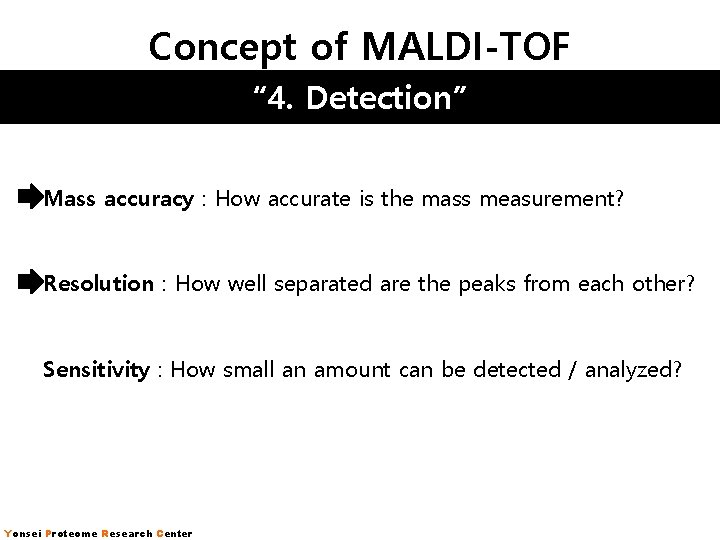
Concept of MALDI-TOF “ 4. Detection” Mass accuracy : How accurate is the mass measurement? Resolution : How well separated are the peaks from each other? Sensitivity : How small an amount can be detected / analyzed? Yonsei Proteome Research Center
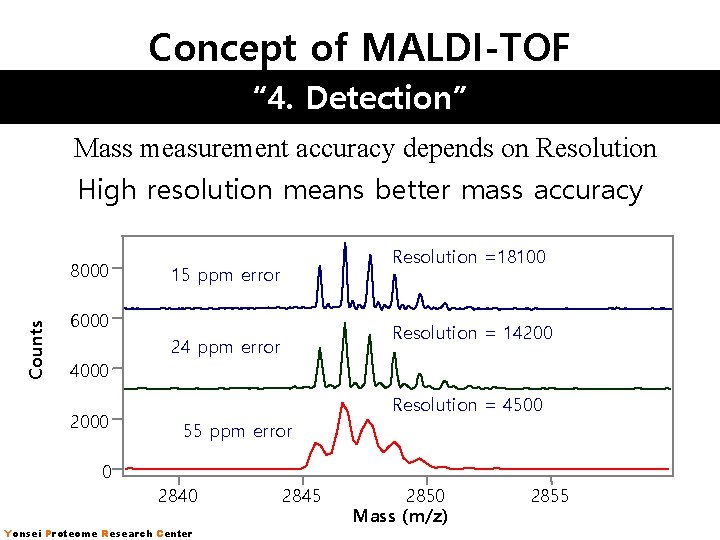
Concept of MALDI-TOF “ 4. Detection” Massmeasurement accuracy depends on Resolution Mass accuracy depends on resolution High resolution means better mass accuracy Counts 8000 Resolution =18100 15 ppm error 6000 4000 2000 Resolution = 14200 24 ppm error Resolution = 4500 55 ppm error 0 2840 Yonsei Proteome Research Center 2845 2850 Mass (m/z) 2855
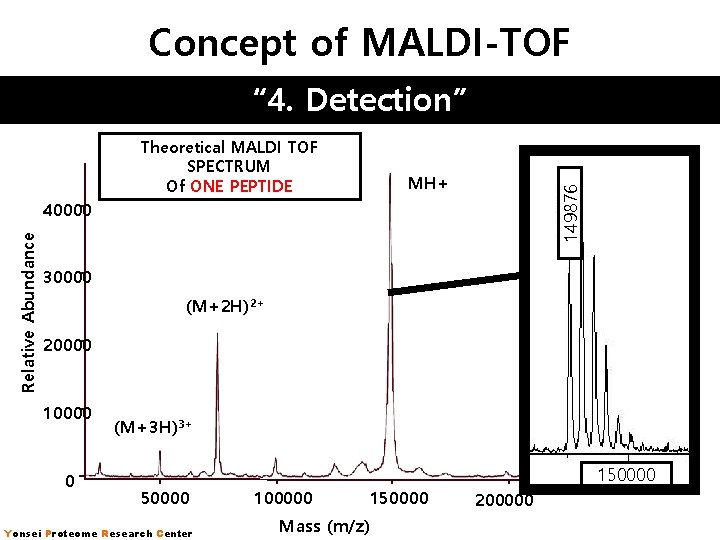
Concept of MALDI-TOF “ 4. Detection” Theoretical MALDI TOF SPECTRUM Of ONE PEPTIDE 149876 MH+ Relative Abundance 40000 30000 (M+2 H)2+ 20000 10000 0 (M+3 H)3+ 150000 Yonsei Proteome Research Center 100000 150000 Mass (m/z) 200000
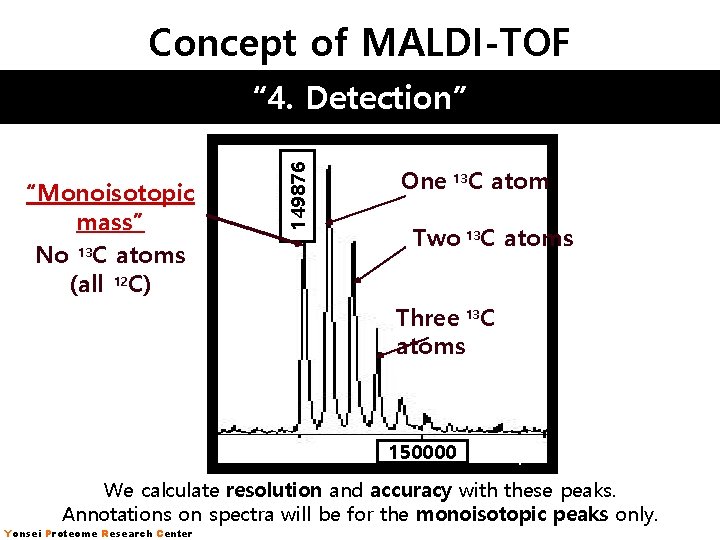
Concept of MALDI-TOF “Monoisotopic mass” No 13 C atoms (all 12 C) 149876 “ 4. Detection” One 13 C atom Two 13 C atoms Three 13 C atoms 150000 m/z We calculate resolution and accuracy with these peaks. Annotations on spectra will be for the monoisotopic peaks only. Yonsei Proteome Research Center
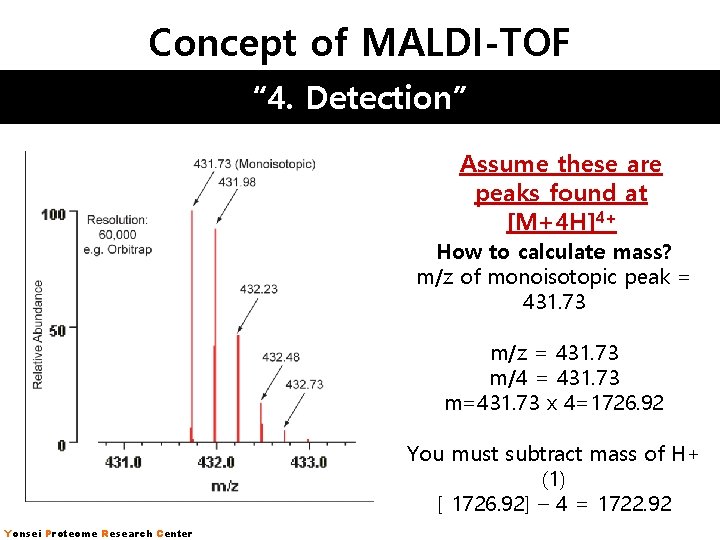
Concept of MALDI-TOF “ 4. Detection” Assume these are peaks found at [M+4 H]4+ How to calculate mass? m/z of monoisotopic peak = 431. 73 m/z = 431. 73 m/4 = 431. 73 m=431. 73 x 4=1726. 92 You must subtract mass of H+ (1) [ 1726. 92] – 4 = 1722. 92 Yonsei Proteome Research Center
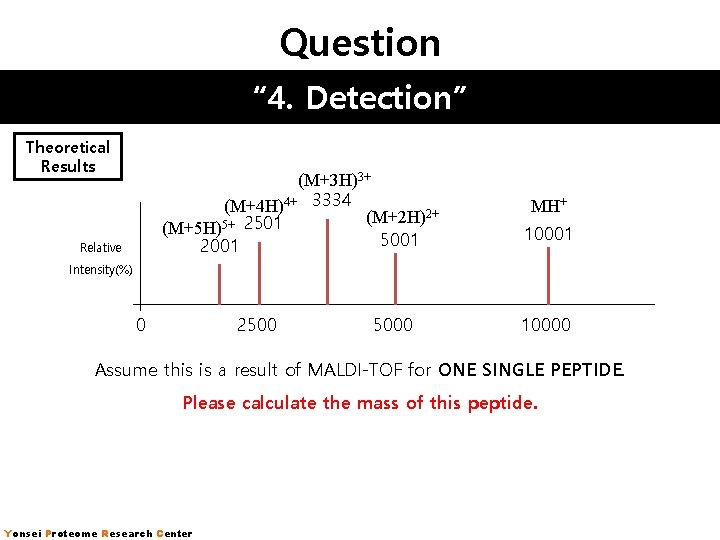
Question “ 4. Detection” Theoretical Results (M+3 H)3+ (M+4 H)4+ 3334 (M+2 H)2+ 5+ 2501 (M+5 H) 5001 2001 Relative MH+ 10001 Intensity(%) 0 2500 5000 10000 Assume this is a result of MALDI-TOF for ONE SINGLE PEPTIDE. Please calculate the mass of this peptide. Yonsei Proteome Research Center
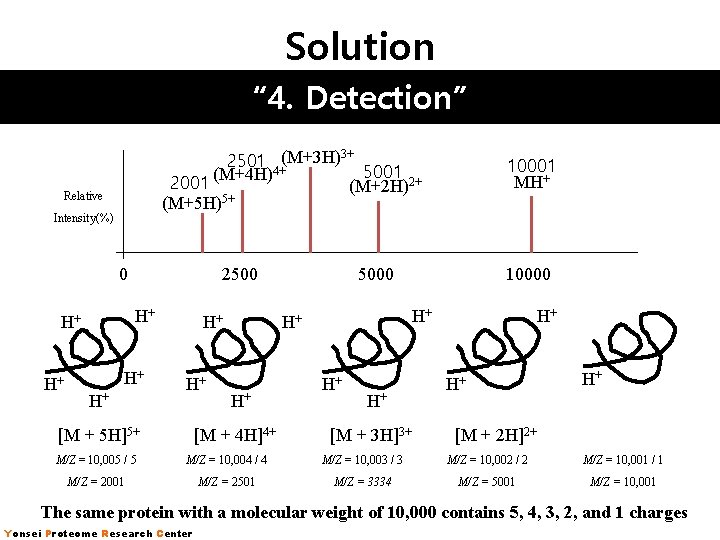
Solution “ 4. Detection” 3334 3+ (M+3 H) 2501 4+ 5001 2001 (M+4 H) (M+2 H)2+ (M+5 H)5+ Relative Intensity(%) 0 H+ H+ H+ 2500 H+ H+ [M + 5 H]5+ 5000 [M + 4 H]4+ 10000 H+ H+ H+ 10001 MH+ H+ H+ [M + 3 H]3+ H+ H+ [M + 2 H]2+ H+ [MH]+ M/Z = 10, 005 / 5 M/Z = 10, 004 / 4 M/Z = 10, 003 / 3 M/Z = 10, 002 / 2 M/Z = 10, 001 / 1 M/Z = 2001 M/Z = 2501 M/Z = 3334 M/Z = 5001 M/Z = 10, 001 The same protein with a molecular weight of 10, 000 contains 5, 4, 3, 2, and 1 charges Yonsei Proteome Research Center
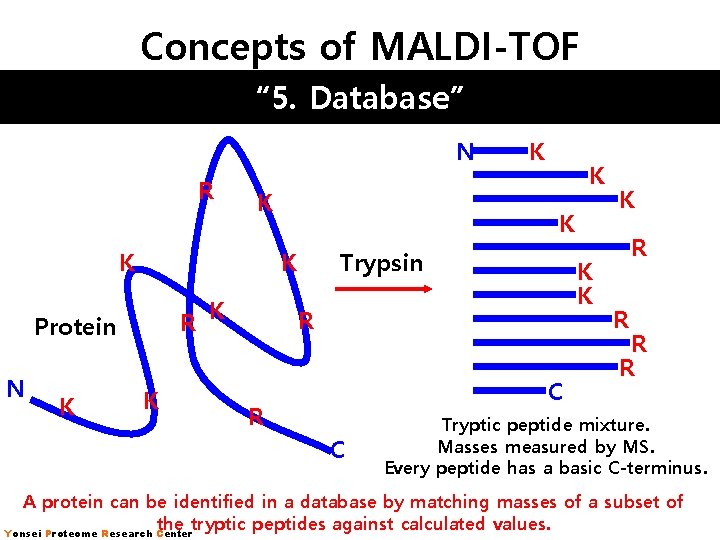
Concepts of MALDI-TOF “ 5. Database” N R K K Protein N K K Trypsin K R K K R C K R R Tryptic peptide mixture. Masses measured by MS. Every peptide has a basic C-terminus. A protein can be identified in a database by matching masses of a subset of the tryptic peptides against calculated values. Yonsei Proteome Research Center
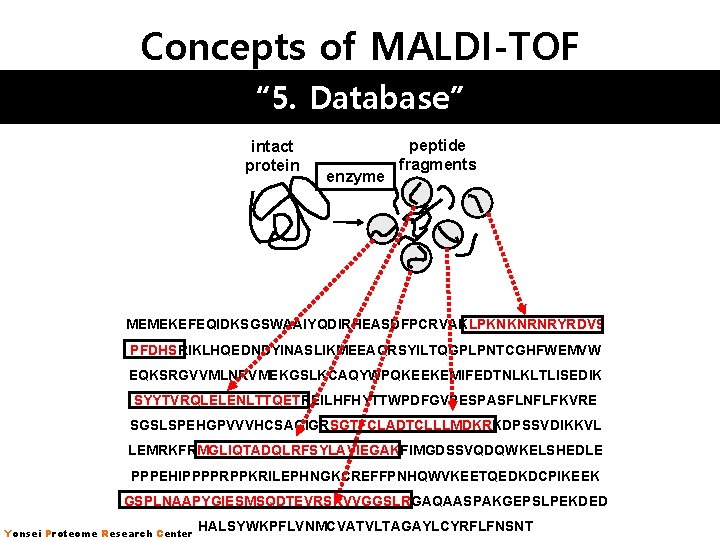
Concepts of MALDI-TOF “ 5. Database” intact protein enzyme peptide fragments MEMEKEFEQIDKSGSWAAIYQDIRHEASDFPCRVAKLPKNKNRNRYRDVS PFDHSRIKLHQEDNDYINASLIKMEEAQRSYILTQGPLPNTCGHFWEMVW EQKSRGVVMLNRVMEKGSLKCAQYWPQKEEKEMIFEDTNLKLTLISEDIK SYYTVRQLELENLTTQETREILHFHYTTWPDFGVPESPASFLNFLFKVRE SGSLSPEHGPVVVHCSAGIGRSGTFCLADTCLLLMDKRKDPSSVDIKKVL LEMRKFRMGLIQTADQLRFSYLAVIEGAKFIMGDSSVQDQWKELSHEDLE PPPEHIPPPPRPPKRILEPHNGKCREFFPNHQWVKEETQEDKDCPIKEEK GSPLNAAPYGIESMSQDTEVRSRVVGGSLRGAQAASPAKGEPSLPEKDED Yonsei Proteome Research Center HALSYWKPFLVNMCVATVLTAGAYLCYRFLFNSNT
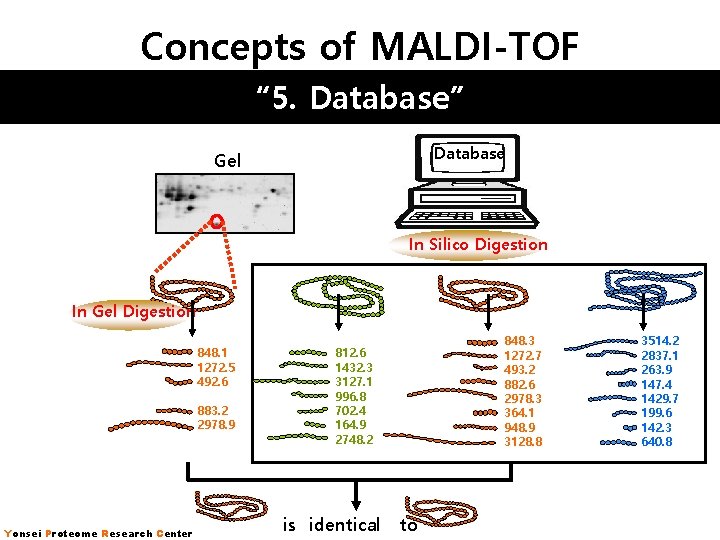
Concepts of MALDI-TOF “ 5. Database” Database Gel In Silico Digestion In Gel Digestion 848. 1 1272. 5 492. 6 883. 2 2978. 9 Yonsei Proteome Research Center 848. 3 1272. 7 493. 2 882. 6 2978. 3 364. 1 948. 9 3128. 8 812. 6 1432. 3 3127. 1 996. 8 702. 4 164. 9 2748. 2 is identical to 3514. 2 2837. 1 263. 9 147. 4 1429. 7 199. 6 142. 3 640. 8
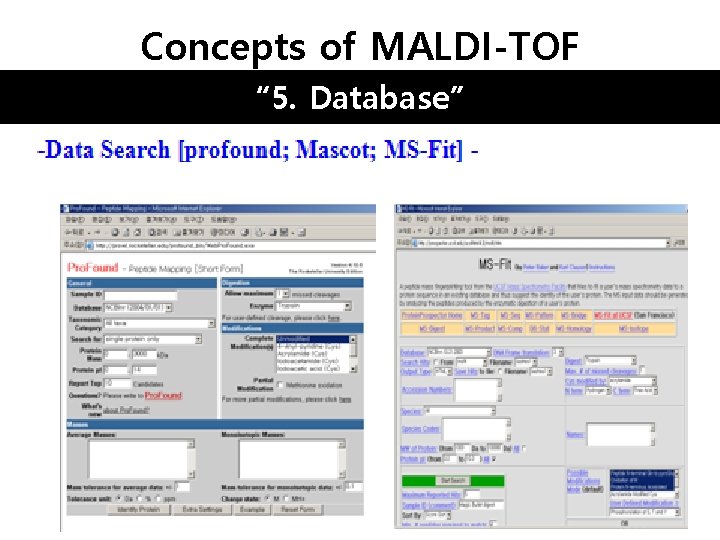
Concepts of MALDI-TOF “ 5. Database” Yonsei Proteome Research Center
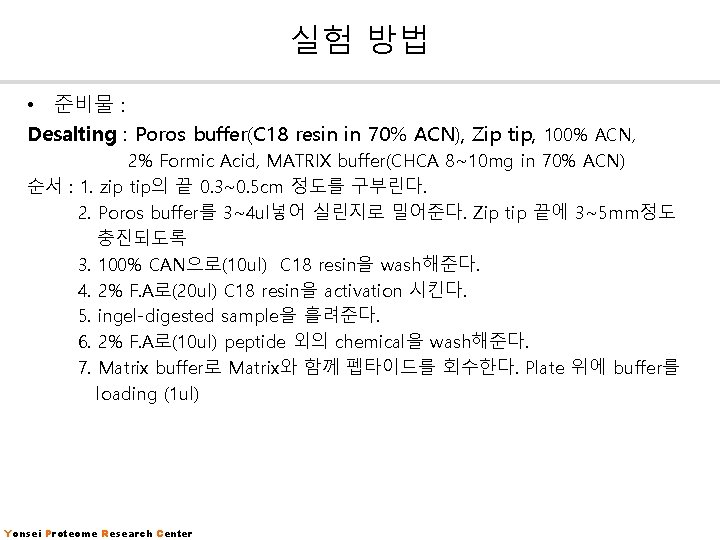
실험 방법 • 준비물 : Desalting : Poros buffer(C 18 resin in 70% ACN), Zip tip, 100% ACN, 2% Formic Acid, MATRIX buffer(CHCA 8~10 mg in 70% ACN) 순서 : 1. zip tip의 끝 0. 3~0. 5 cm 정도를 구부린다. 2. Poros buffer를 3~4 ul넣어 실린지로 밀어준다. Zip tip 끝에 3~5 mm정도 충진되도록 3. 100% CAN으로(10 ul) C 18 resin을 wash해준다. 4. 2% F. A로(20 ul) C 18 resin을 activation 시킨다. 5. ingel-digested sample을 흘려준다. 6. 2% F. A로(10 ul) peptide 외의 chemical을 wash해준다. 7. Matrix buffer로 Matrix와 함께 펩타이드를 회수한다. Plate 위에 buffer를 loading (1 ul) Yonsei Proteome Research Center