
PEPLAUS THEORY PRESERNTED BY BENAZEERA Asst Professor DEPT

PEPLAU’S THEORY PRESERNTED BY BENAZEERA Asst. Professor, DEPT. YENEPOYA NURSING COLLGE
LEARNING OBJECTIVES q. Describe Peplau’s International Relations Model q. Identify the model’s four phases q. List the roles of the nurse during each phase q. Discuss how Peplau address the four concepts of the nursing metaparadigm
ABOUT AUTHOR ü Paplau’s theory was introduced by Hildigaid E. Paplau. ü She was born on sep’ 1909. ü She completed MA in psychiatric nursing and ed. D in curriculum development. ü Paplau’s contribution to nursing and the speciality of psychiatric nursing has been enormous with her book Interpersonal Relation in Nursing. ü In 1969 she became executive director of the ANA.
II. Interpersonal relation Model • The concept of Interpersonal relationships involves social associations, connections or affiliations between two or more people. Such persons may interact overtly, covertly, face- toface; or may remain effectively unknown to each other. The term relationship as applied to personal life, as did the idea that there is a need for “intimacy” or “commitment” in personal life.
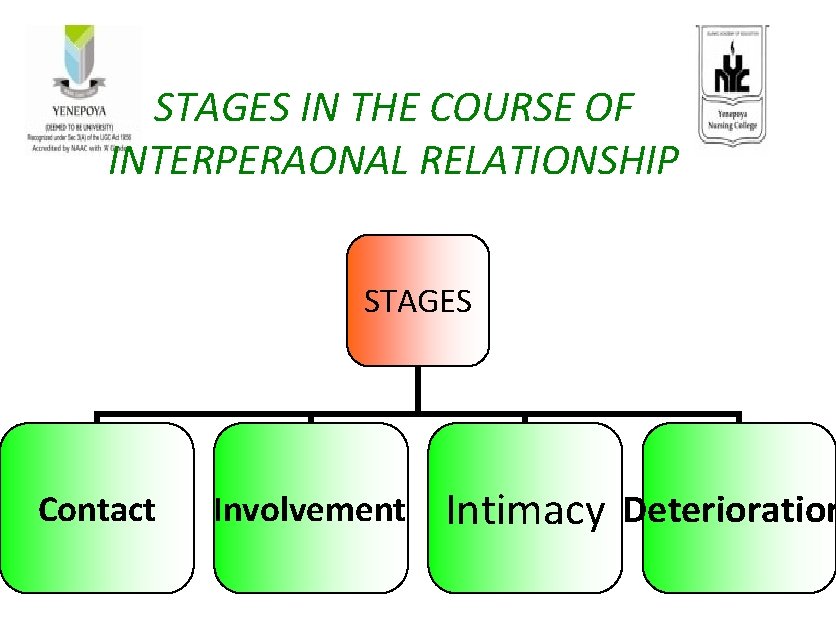
STAGES IN THE COURSE OF INTERPERAONAL RELATIONSHIP STAGES Contact Involvement Intimacy Deterioration
1. Contact • Perceptual : noticing how parties look at each other and their body – language • Intractional cues : nodding, maintaining eye contact • Invitational : encouraging the potential relationship • Avoidance strategies : if one person discloses and the other does not; minimal response
2. Involvement • Feelers: hints or questions • Intensifying strategies: furthering relationship • Public: parties seen in public together
3. Intimacy: Parties very close; may have exchanged some sort of personal belonging 4. Deterioration : things start to fall apart
TYPES OF INTERPERSONAL RELATIONSHIP • Kinship relationships: involve genetically and through marriage • Formalized intimate : Recognized by law and formalized through public ceremony. • Non formalized : long term relationship intimate with or without living together.
• Soulmates : individuals intimately drawn to one another through a favorable “meeting of minds”. • Casual : one can label the participants as “ friends with benefits”. • Pltonic love : an affectionate relationship • Friendship : which consist of mutual love , trust, respect and acceptance.
• • Brotherhood & : individuals united sisterhood in a common cause or having a common interest Partners : persons in a common work place Participation : in a community. Association : knowing someone by introduction /interaction.
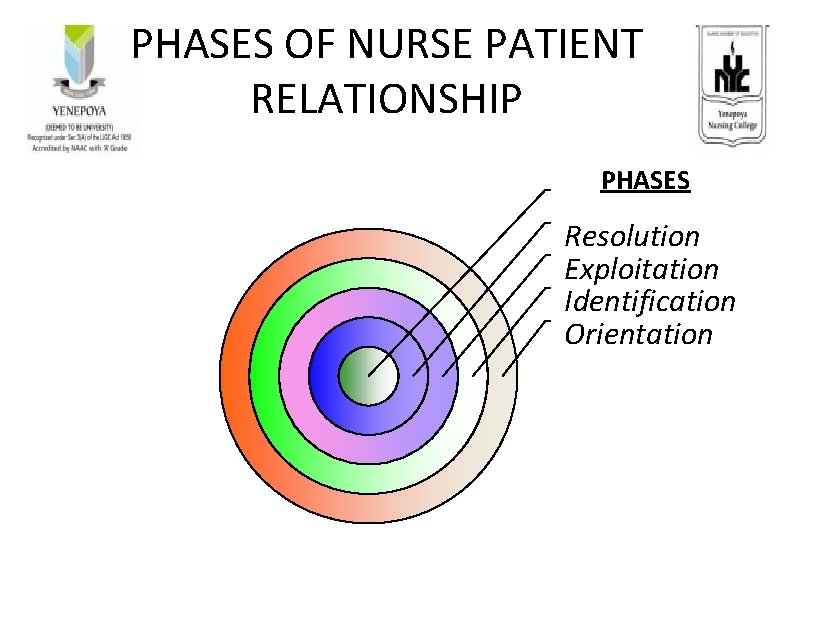
PHASES OF NURSE PATIENT RELATIONSHIP PHASES Resolution Exploitation Identification Orientation
NURSE PATIENT RELATIONSHIP • • She describes 4 phases of Nurse- patient Relationship Orientation – The individual has a “ felt need” & seek professional assistance. Identification – Patient identifies with those who can help him Exploitation – The patient attempt to drive full value from what he is offered him through the relationship Resolution – Old goals are gradually put asides & new goals adopted
NURSE-PATIENT RELATION Peplau’s describes six different nursing roles that emerges in Nurse Patient Relation. 1. Role of the stranger 2. Role of Resource person Instructional 3. Teaching role Experimental 4. Leadership role 5. Surrogate role 6. Counselling role
PSYCHO BIOLOGICAL EXPERIENCE • Peplaus describes four psycho biological experience Ø Ø Needs Frustration Conflict Anxiety
MAJOR ASSUMPTION Peplaus identifies two explicit assumption: 1. The kind of person the nurse becomes make a substantial differences in which each patient will learn as he receives nursing care. 2. Fostering personality development towards maturity in a function of nursing and nursing education
PEPLAU DEFINES AS FOLLOWS 1. NURSING: “ A significant, therapeutic, interpersonal process. It functions cooperatively with other human process that needs health possible for individual in communities”. 2. ENVIRONMENT: Existing force outside the organism in the contest of culture.
3. PERSON: Peplau defines person in terms of man. Man is an organism that lives in an unstable equilibrium. 4. HEALTH: Peplau defines health as word symbol that implies forward movement of personality and other ongoing human process in the direction of creative, constructive, productive, personal and community living.
APPLICATION OF THEORY IN NURSING PROFESSION 1. PRACTICE: Peplau brought a new perspective, a new approach, a theoretically based a foundation for a nursing practice for therapeutic work with patient. She stated “in working with individual with psychological problem, the development of the interpersonal process is of the utmost importance. Without the development of a therapeutic relationship, little work could be accomplished by the nurse- counsellor.
2. EDUCATION: Peplau’s book, interpersonal relations in nursing was specifically written as an aid to graduate nurse and nursing student. There are number of other publication during 1950’s and 1960’s.
3. RESEARCH: Peplau’s Work influence that the direction of clinical work and study. Initial efforts to use research as a tool to develop a body of nursing knowledge were uneven in quantity and quality and often did not explicitly recognize assumption. .
In Peplau’s model states “ the primary role of nurse is to provide services that assist in moving clients to their optimal health levels … and involves a helping relationship”. The Research is done to evaluate, validate, and make more precise theory of inter personal relationship
FURTHER DEVELOPMENT It indicated for client who are unable to effectively use their communication skills. • Increased use of Peplau's theory in practice is needed. • Continued research is needed to further refining theory and to build on nursing knowledge base. •
CONCLUSION Peplau’s work, thought and ideas have touched many nurses, from students to practitioners. Peplau’s work has provided a significant contributions to nursing knowledge base. The evaluative criteria of derivable consequences are unquestionably met.

Thank You
- Slides: 25