
PeopleCentered Screening and Assessment Module 4 Edinburgh Postnatal

People-Centered Screening and Assessment Module 4 Edinburgh Postnatal Depression Scale, EPDS
Learning Objectives- All At the end of this module home visiting professionals will be able to: p Understand the context and purpose of conducting the Edinburgh Postnatal Depression Scale p Identify the correct screening protocol and pitfalls for WI MIECHV grantees p Articulate the value of the survey for families p Frame the Edinburgh Postnatal Depression Scale and process to families effectively p Use the screen with greater intention and effectiveness to strengthen home visiting services and individualize supports to families
Learning Objectives- Supervisor At the end of the supervisor section of this module, supervisors will be able to: p Consider tools and strategies to support home visitors in conducting the Edinburgh Postnatal Depression Scale as an integrated and effective part of home visiting services.
Why Screening Matters “Because chronic and severe maternal depression has potentially far-reaching harmful effects on families and children, its widespread occurrence can undermine the future prosperity and well-being of society as a whole. When children grow up in an environment of mental illness, the development of their brains may be seriously weakened, with implications for their ability to learn as well as for their own later physical and mental health. When interventions are not available to ensure mothers’ well-being and children’s healthy development, the missed opportunities can be substantial. ” Center on the Developing Child at Harvard University (2009). Maternal Depression Can Undermine the Development of Young Children: Working Paper No. 8. http: //developingchild. harvard. edu/index. php/resources/reports_and _working_papers/wp 8/
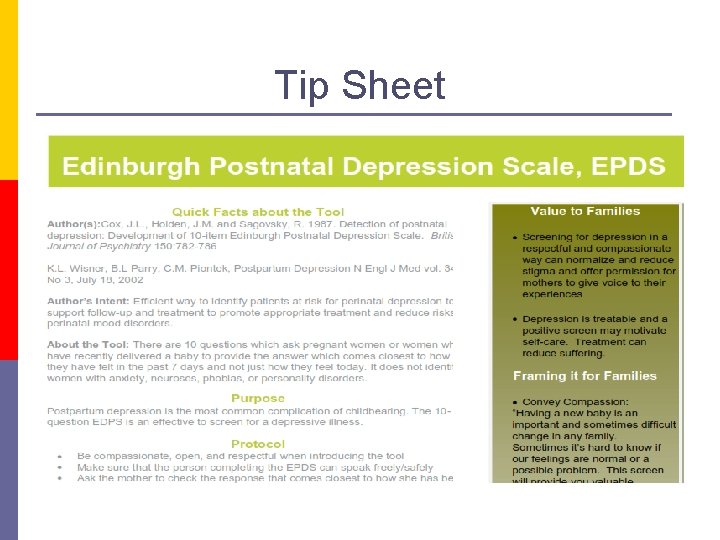
Tip Sheet

EPDS
Quick Facts about the Authors Author(s): Cox, J. L. , Holden, J. M. and Sagovsky, R. 1987. Detection of postnatal depression: Development of 10 -item Edinburgh Postnatal Depression Scale. British Journal of Psychiatry 150: 782 -786 p K. L. Wisner, B. L Parry, C. M. Piontek, Postpartum Depression N Engl J Med vol. 347, No 3, July 18, 2002 p
Quick Facts about the Authors’ Intent Efficient way to identify patients at risk for perinatal depression to support follow up and treatment to promote appropriate treatment and reduce risks to mothers and children of perinatal mood disorders.
Quick Facts about the Tool There are 10 questions which ask pregnant women or women who have recently delivered a baby to provide the answer which comes closest to how they have felt in the past 7 days, and not just how they feel today. It does not identify women with anxiety, neuroses, phobias, or personality disorders. The Edinburgh Postnatal Depression Scale has also been used with men.
Purpose of the Tool Postpartum depression is the most common complication of childbearing. The 10 -question EPDS is an effective way to screen for a depressive illness.
Who Experiences Perinatal Mood Disorder? p 10 -20% of new mothers experience postpartum depression triggered by childbirth (http: //www. sbpep. org/ppd/ retrieved August 2015). p Postpartum depression usually begins 2 to 3 weeks after giving birth, but can start any time during the first few days, weeks, or months post delivery.
Fathers Can Experience Perinatal Mood Disorders Too p Approximately 4% of fathers experience depression in the first year of their child’s life. (Dave, Petersen, Sherr, Nazareth November 2010 Archives of Pediatric and Adolescent Medicine) p U. S. fathers had nearly twice the rate of paternal prenatal and postpartum depression as fathers in other countries. (Paulson and Bazemore May 2010 JAMA) p 10% of men exhibited elevated levels of depressive symptoms when their child was 9 months old, compared to 14 percent of mothers. (Journal of Child Psychology 2008)
What are the Common Symptoms for PPD in Women? p p p A woman with postpartum depression may feel sad, hopeless, worthless, or alone. She may have trouble concentrating or completing routine tasks. She may lose her appetite or not feel interested in food. She may feel indifferent to her baby. She may feel overwhelmed by her situation and feel that there is no hope. She may feel like she is just going through the motions of her day without being able to feel happy, interested, pleased, or joyful about anything. (NIMH- http: //www. nimh. nih. gov/health/publications/postpartum-depressionfacts/index. shtml retrieved May 2014)
Additional Symptoms for Maternal Depression p p p Trouble sleeping when your baby sleeps (more than the lack of sleep new moms usually get) Feeling numb or disconnected from your baby Having scary or negative thoughts about the baby, like thinking someone will take your baby away or hurt your baby Worrying that you will hurt the baby Feeling guilty about not being a good mom, or ashamed that you cannot care for your baby http: //www. cdc. gov/reproductivehealth/Depression/index. htm CDC retrieved February 2015
What are the Common Symptoms for Depression in Men? p p p p p Increased anger and conflict with others Increased use of alcohol or other drugs Frustration or irritability Violent behavior Losing weight without trying Isolation from family and friends Being easily stressed Impulsiveness and taking risks, like reckless driving and extramarital sex Feeling discouraged Dr. Will Courtenay, www. postpartummen. com retrieved October 2015
What are the Common Symptoms for Depression in Men? (Continued) p p p p p Increases in complaints about physical problems Ongoing physical symptoms, like headaches, digestion problems or pain Problems with concentration and motivation Loss of interest in work, hobbies, and sex Working constantly Frustration or irritability Misuse of prescription medication Increased concerns about productivity and functioning at school or work Fatigue Experiencing conflict between how you think you should be as a man and how you actually are Thoughts of suicide p Dr. Will Courtenay, www. postpartummen. com retrieved October 2015
Which Women are at the Greatest Risk of Developing Postpartum Depression? Some women are at greater risk for developing postpartum depression because they have one or more risk factors, such as: p Symptoms of depression during or after a previous pregnancy p Previous experience with depression or bipolar disorder at another time in her life p A family member who has been diagnosed with depression or other mental illness p A stressful life event during pregnancy or shortly after giving birth, such as job loss, death of a loved one, domestic violence, or personal illness p Medical complications during childbirth, including premature delivery or having a baby with medical problems p Mixed feelings about the pregnancy, whether it was planned or unplanned p A lack of strong emotional support from her spouse, partner, family, or friends p Alcohol or other drug abuse problems. (NIMH 2014)

What Leads to Men Developing Postpartum Depression? p p p p p A lack of good sleep Changes in hormones Personal history of depression Poor relationship with spouse Poor relationship with one or both parents Relationship stress – with a partner or with in-laws Excessive stress about becoming a parent or father Nonstandard family (such as being unmarried or a stepfather) Poor social functioning A lack of support from others Dr. Will Courtenay, www. postpartummen. com retrieved October 2015 based on research from Matthey S, Barnett B, Kavanagh DJ, Howie P (2001). Validation of the Edinburgh postnatal depression scale for men, and comparison of item endorsement with their partners. Journal of Affective Disorders, 64, 175 -184.
Value of the Tool to Families There is still a lot of stigma about mental health in general and maternal depression in particular. Screening reduces stigma. p Depression is treatable and a positive screen may reduce some of the feelings of isolation and motivate self-care. p Treatment of depression can reduce suffering. p
Screening Protocol- Getting Started p Be compassionate, open, and respectful when introducing the tool. p Make sure that the person completing the EPDS can speak freely/safely. p The mother is asked to check the response that comes closest to how she has been feeling the previous 7 days. p Complete the tool between two weeks and 60 days postpartum. p In concerning cases, it may be useful to repeat the tool after two weeks to monitor risk.
Screening Protocol- During the Screening Discussion p All the items in the screen must be completed. p Care should be taken to avoid the possibility of the mother discussing her answers with others while completing it. p The mother should complete the scale herself, unless she has limited literacy. If that’s the case, then the home visitor should read the screen item by item and write the response. p Scoring in Wisconsin has been set at a more sensitive cutoff to encourage compassionate conversations about particular symptoms and an individualized determination of the need for more frequent screening or referral. p While a score of 13 or more is likely to be suffering from a depressive disorder, a careful clinical assessment should be completed by a qualified person. Mental health partners specializing in home visiting in Wisconsin identified a score of 9 as a cut-off based on research and risk factors.

Screening Protocol- After the Screen p Any yes, quite often or sometimes response related to suicidality (question 10) requires immediate follow-up with a healthcare provider. p Follow your agency’s protocol. p Referral as appropriate upon positive screen within 60 days of completion of EPDS. p Enter screening and follow-up data into SPHERE.
Potential Pitfalls with Screening p p The screen is NOT a diagnostic tool, and results should NOT be shared as a diagnosis. It’s important to clearly state that the results are NOT a diagnosis. Don’t wait until you’re entering the data into SPHERE to determine if it is a positive or negative screen. Score the EPDS onsite and have a meaningful conversation about referral needs or signs to watch for as PPD can emerge during the first few days, weeks, and months post delivery.
Completing the EPDS Can Strengthen Services p p Identifying potential depressive disorders and connecting mothers to resource can be pivotal in in vulnerable families. Screening can build trust and strengthen partnerships. Routine and repeated practice of skills that a mom shows some interest in are important in making progress and maintaining engagement. Maintaining regular visits and communicating between visits is even more important as a stabilizing force when a woman is experiencing symptoms of depression such as feelings of worthlessness, isolation, and loneliness.
Completing the EPDS Can Strengthen Goal Setting n n n When post partum depression impacts a mother’s thinking and feelings, simplifying goals becomes even more important to build trust and a mother’s self-confidence. Understanding the mothers’ mental health can provide insight into child development and parent-child attachment. Screening gives insight to home visitors about barriers families may be experiencing in meeting goals. A mother may have difficulty with problem-solving and followthrough while depressed.
Framing the EPDS for Families p p p This survey can be a valuable strategy to supporting a family’s motivation to make positive changes. Tending to a family’s need for compassion, openness/transparency, and autonomy during screening can strengthen motivation to change. Scripts or recommended talking points are not meant to be memorized. Instead, they are a guide for how you develop effective communication with families.
Let them know you’re not singling them out for this screen “We ask these questions to all families we work with because at least 1 in 10 women who’ve recently had a baby are at risk for depression. It’s nothing to be ashamed of and it can be treated so that women and their babies can connect and enjoy each other. ”
If you’re screening men, normalize the process “We ask these questions of all men and women we work with because it is not uncommon for women and men to suffer from post partum depression. It’s nothing to be ashamed of and it can be treated so that parents and their babies can connect, be healthy, and enjoy each other. ”
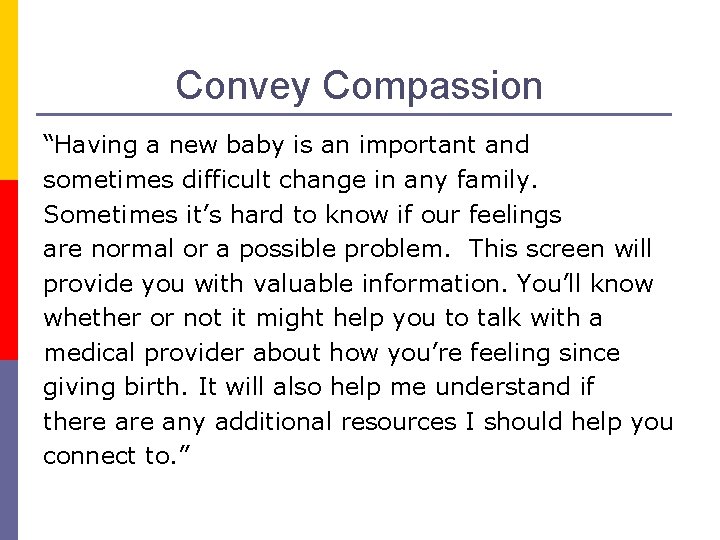
Convey Compassion “Having a new baby is an important and sometimes difficult change in any family. Sometimes it’s hard to know if our feelings are normal or a possible problem. This screen will provide you with valuable information. You’ll know whether or not it might help you to talk with a medical provider about how you’re feeling since giving birth. It will also help me understand if there any additional resources I should help you connect to. ”
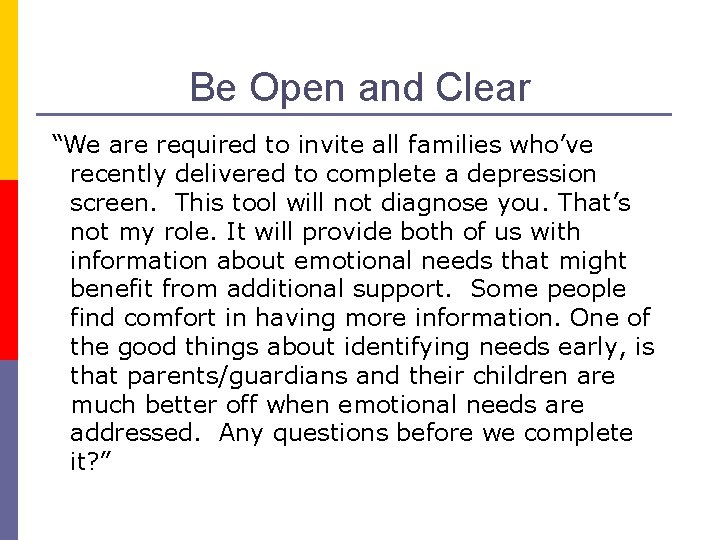
Be Open and Clear “We are required to invite all families who’ve recently delivered to complete a depression screen. This tool will not diagnose you. That’s not my role. It will provide both of us with information about emotional needs that might benefit from additional support. Some people find comfort in having more information. One of the good things about identifying needs early, is that parents/guardians and their children are much better off when emotional needs are addressed. Any questions before we complete it? ”

Keep Families in the Driver’s Seat “Please complete the screen. If you’d like me to explain a question, I can help. When you’re done with screen, I’ll take a few minutes to review it so we can discuss your answers. Then we can talk about any follow up that makes sense. ”

Video- Clip 1 Introducing the EPDS

Video- Reflection What were some strengths of how the CES Screen was introduced? p What else might you add to strengthen how the CES is offered? p

Video- Clip 2 Completing the EPDS
Video- Reflection What skills or strategies were used to follow the protocol and keep the survey warm and supportive? p What skills or strategies do you use to integrate screening as a natural part of a home visit? p
Video- Clip 3 Reviewing and Responding to the EPDS
Video- Reflection How did the home visitor send the message to the parent/guardian that the survey was more than a required exercise or paperwork? p What kind of follow-up do the parent/guardian and home visitor each need to do, if any? p How might the information learned in this survey influence how a home visitor works with this parent/guardian? p
Reflective Strategies. During Home Visits p p p Ask open-ended questions about what the mom/parent thinks the score means. Affirm the mom/parent’s ability to think carefully about her own well-being. Ask parents to share ideas they have about how understanding their own well-being can affect their child’s well-being. If a parent has a concerning score and mixed feelings about following up, explore the parent’s ambivalence about follow -up. Ask the mother to explore friends and family who she trusts that may be available to spend time regularly with the infant/toddler to boost positive interactions and provide support
Reflective Strategies- Future Visits p If concern about the possibility of postpartum depression persists, balance sharing concern with conveying confidence in the parent. n Encourage the parent to seek support. n Emphasize that depression is treatable. n Provide support to positive interactions with their child including active modeling, coaching, voicing the baby’s feelings and responses, and affirmations. n Avoid warning, shaming, or pushing for followup. n Develop a safety plan in which the mother identifies how she will know if she needs more help.
Reflective Exercise- After Home Visits p p p Communicate regularly with your supervisor to determine if greater intervention is in order. Document your follow-up that’s been completed and which tasks remain. During group reflective practice, explore strategies with colleagues to engage the mother in positive interactions with the child. Explore strategies and tips with your supervisor about having courageous conversations with parents about mental health. Consider role playing difficult conversations with supervisors and colleagues.

Supervisor Section
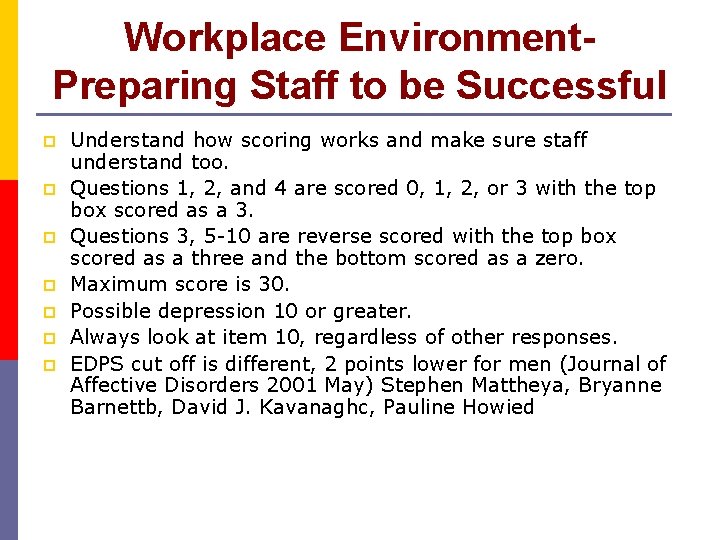
Workplace Environment. Preparing Staff to be Successful p p p p Understand how scoring works and make sure staff understand too. Questions 1, 2, and 4 are scored 0, 1, 2, or 3 with the top box scored as a 3. Questions 3, 5 -10 are reverse scored with the top box scored as a three and the bottom scored as a zero. Maximum score is 30. Possible depression 10 or greater. Always look at item 10, regardless of other responses. EDPS cut off is different, 2 points lower for men (Journal of Affective Disorders 2001 May) Stephen Mattheya, Bryanne Barnettb, David J. Kavanaghc, Pauline Howied

Trauma Informed Approaches. Promoting Self-Care Provide regular, dependable reflective supervision. p Honor time off policies. p Manage case loads to align with model standards. p Model healthy work-life balance. p Encourage use of EAP when appropriate. p
Recruiting Home Visitors Let potential home visitors know that screening for depression and discussing screening results is a part of the job responsibilities. p Give candidates a few minutes to review the EPDS, ask them to role play asking a mom to complete the EPDS and sharing screening results during the interview. p
Orienting Home Visiting Staff p p p Discuss the amount of perinatal mood disorders in the general population and in the program. Describe the impacts of depression on parentchild bonding. Schedule attendance at the next Maternal Depression Screening training offered by the UW Milwaukee Training Partnership. Provide multiple role play opportunities conducting the EPDS within the first 90 days of employment. The first administering of the screen should not be with a home visiting family.
Support a Reflective Approach Discuss feelings and reactions to administering the EPDS with home visitors during staff meetings and/or during oneon-one supervision. p Listen without judgment. p The supervisor and home visitor should discuss the implications of EPDS results on service delivery and add ideas to case notes for follow-up. p Identify staff who are comfortable and effective in delivering the EPDS and pair them with colleagues to practice skills. p
Administration and Quality Monitor completion of the EPDS using the Home Visiting Data Collection Table and make sure there is documentation of referrals for positive screens. p Monitor documentation of EPDS results in SPHERE. p Analyze data to see if there any trends in completion rate, documentation of follow-up, and family outcomes. p
Using Data to Celebrate and Support Success Keeping a data dashboard and discussing it during team meetings can support productive conversations with staff. n n n Celebrate the team for meeting goals to screen and follow-up with moms within the timelines. If staff are saying things like “Everyone is depressed, ” data can help staff understand how prevalent depression is for parents in the program. Looking at the data can also help reframe the belief that “Depression is awful we can’t do anything about it, ” to “Look how many parents have had a supportive conversation about their mental health because we’re screening and encouraging follow-up. ” Sometimes in the home visiting field, professionals want to measure success as an issue of how many people who are likely suffering from depression received services. While healthy family outcomes matter, so does the home visitor’s role in identifying potential mental health needs. By looking at the screening and follow-up data for each home visitor, teams may note people who are particularly effective at supporting families in follow-up. This member of the team can be encouraged to share tips and strategies with colleagues.
Resources Post partum depression fact sheet- English http: //www. womenshealth. gov/publicationsourpublications/f act-sheet/depressionpregnancy. html Post partum depression fact sheet- Spanish http: //womenshealth. gov/espanol/publicaciones/nuestraspublicacion es/hojas datos/depresion-embarazo. html National Women’s Health Information Center www. 4 women. gov Postpartum Support International www. chss. iup. edu/postpartum Depression after Delivery www. depressionafterdelivery. com
Articles and E-Book Maternal Depression Can Undermine the Development of Young Children: Working Paper No. 8. http: //developingchild. harvard. edu/index. php/resources/reports_and_working papers/working_papers/wp 8/ Prevalence, trauma history, and risk for posttraumatic Stress disorder among nulliparous women in maternity care Julia S. Seng, Lisa M. Kane Low, Mickey Sperlich, David L. Ronis, Israel Liberzon Obstet Gynecol. Author manuscript; available in PMC 2011 June 27. Published in final edited form as: Obstet Gynecol. 2009 October; 114(4): 839– 847. doi: 10. 1097/AOG. 0 b 013 e 3181 b 8 f 8 a 2 http: //www. ncbi. nlm. nih. gov/pmc/articles/PMC 3124073/ Trauma Stewardship An Everyday Guide To Caring For Self While Caring For Others By Lipsky Laura Van Dernoot Burk Connie 2009 http: //www. freeebooksonline. net/pdf/trauma-stewardship-an-everyday-guide -to-caring-for-self-while-caring-for-others-by-lipsky-laura-van-dernootburk-connie-2009 -paperback
Contact info for the author of the modules E-mail Lilly. Irvin. Vitela@commonworth. net Linked. In! Lilly Irvin-Vitela Website http: //commonworth. net Cell- 608 -577 -8987
- Slides: 51