
PEOPLE WHAT THE HOLOCAUST AND PEOPLES PERSONAL JOURNEYS
- Slides: 126
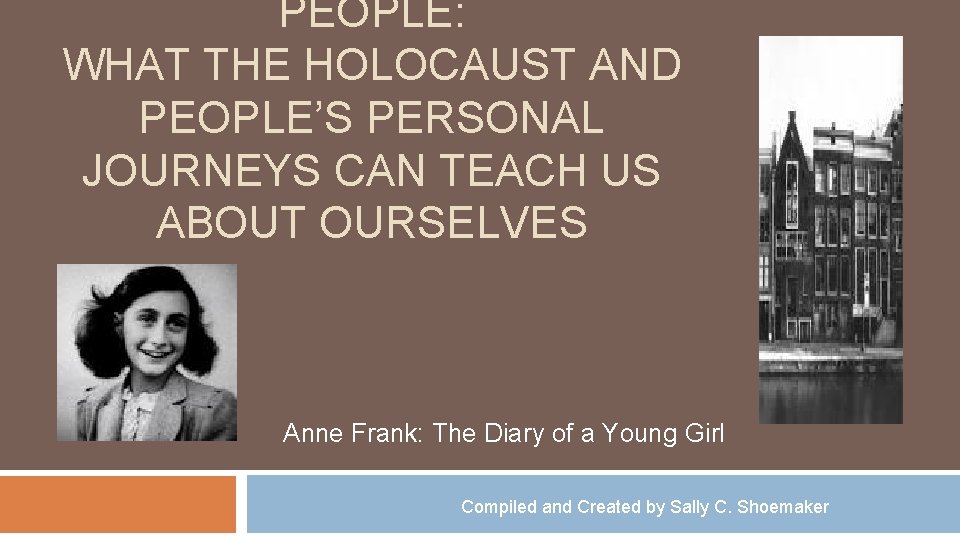
PEOPLE: WHAT THE HOLOCAUST AND PEOPLE’S PERSONAL JOURNEYS CAN TEACH US ABOUT OURSELVES Anne Frank: The Diary of a Young Girl Compiled and Created by Sally C. Shoemaker
Vocabulary List #1 - Advanced circumstances – introduction monument - introduction confide - dedication curiosity - 1 melancholy - 2 enhance - 3 satchel - 5 feminine - 7 stimulant - 9 circum – around fid – faith cur – care for mela – black ine – nature of vita - life 10/10
Vocabulary List #1 circumstances introduction confide - dedication melancholy - 2 satchel - 5 vital - 14 circum – around fid – faith mela – black vita - life
E. Q. : How does the context and background knowledge of the time period improve my understanding of the text? Setting Up YOUR Diary What do you know about a diary? In your diary (composition book) create a circle map and describe everything you know about a diary. Diary
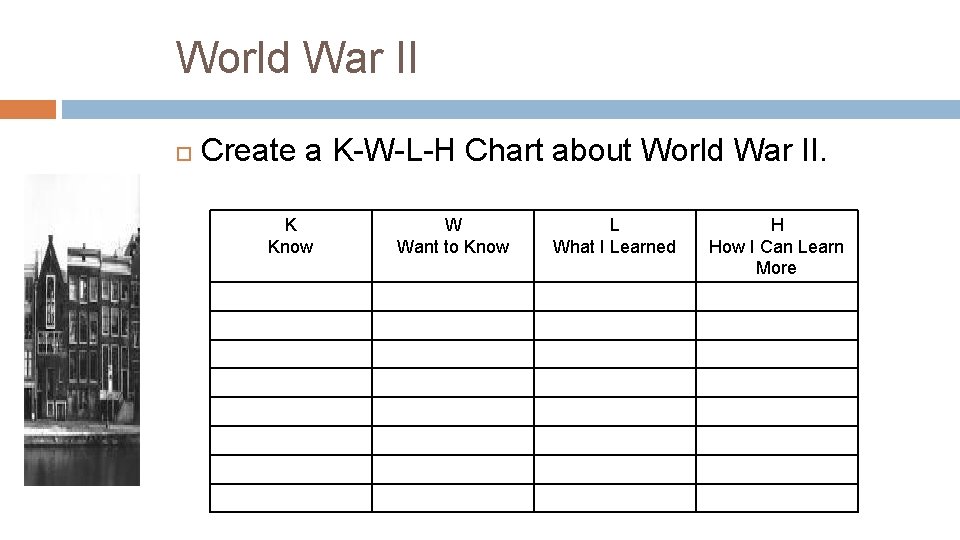
World War II Create a K-W-L-H Chart about World War II. K Know W Want to Know L What I Learned H How I Can Learn More
World War II Content Vocabulary Holocaust World War II Adolf Hitler The Nationalist Socialist (Nazi) concentration camps deportation rearmament Jews
World War II Introduction to World War II The American Chronicles: The Prelude to War: 19351939 Add more to your chart. Anne Frank: The Diary of a Young Girl Introduction Dedication
E. Q. : How does understanding the purpose for a diary impact the meaning of a text? How does word choice affect the tone of the diary? What is a diary used for? Answer this question in your diary. Make sure to give a complete explanation and examples. Refer back to your circle map. 10/11
Tone Words have attitude. List three (3) words that convey a positive tone. List three (3) words that convey a negative tone. List three (3) words that convey a humorous, ironic, or sarcastic tone. View this list. Create a list in your diary of words you would use. Tone Vocabulary List
Tone Words Reading Selections As we read today, recognize tone words and identify the tone of the diary entry. Make sure to note this in your diary. Sunday, 14 June, 1942 Monday, 15 June, 1942 Saturday, 20 June, 1942 (1) Look back to your Tone Vocabulary List
Written Response: Use of Tone If you were to write a diary entry today, what tone would it have? what words would you use? what would it teach you if you read it one (1) year from now?
10/12 E. Q. : How does comparing and contrasting similar incidents in history help you understand the author’s meaning in the text? What have you learned about the Civil Rights Movement? Answer this question in your diary. Make sure to give a complete explanation and examples. Think back to what we learned in our earlier units.
Compare and Contrast Create a Double Bubble Map View the video on The Treatment of Jews in World War II. Complete a comparison of these two eras in history. What do they have in common. How are these two times different?
Compare and Contrast Reading Selections As we read today, recognize how Jews were treated during this time. Saturday, 20 June, 1942 (2) Sunday 21, June, 1942 Wednesday, 24 June, 1942 Tuesday, 30 June, 1942
Written Response: Comparing History Look at the information you collected for your double bubble. Use this information to write a paragraph(s) that compares and contrasts the two incidents in history. Make sure to give a complete explanation and good examples.
E. Q. : How do readers effectively analyze and annotate texts for evidence? What do you already know about annotating text? Answer this question in your diary. Make sure to give a complete explanation and examples. Think back to what we learned in our earlier units. NOTES: Annotation 10/13
Annotating Text The Six Reading Habits http: //guides. hcl. harvard. edu/sixreadinghabits 1. 2. 3. 4. 5. 6. Preview Annotate – Make Notes Outline, Summarize, and Analyze Look for repetitions and patterns. Contextualize – Put in Time & Place Compare and Contrast
Reading Selections As we read today, look back at the six reading habits. Friday, 3 July, 1942 Sunday morning, 5 July, 1942 Wednesday, 8 July, 1942 Thursday, 9 July, 1942
Written Response: Annotation After reading, take the copy of one diary entry and annotate that text using the notes from the six habits of reading. You can do this using any format you choose. Remember, annotation has to work for you. It is individual!
10/14 E. Q. : How does reading about the Secret Annex help in understanding the setting? How would you feel living in a small hiding place? How do you think Anne felt? How do you think the other family members felt? Include all these impressions in your diary entry.
Reading Selections As we read today, think about how Anne feels. Friday, 10 July, 1942 Saturday, 11 July, 1942 Friday, 14 August, 1942 Friday, 21 August, 1942
Written Response: Diary Entry #1 Complete Personal Diary Entry #1 § § Write an entry about your impressions of Anne. Tell what you think or feel about what we have read so far. Include your own personal ideas. Predict problems that might occur living in such a small place.
10/17 Vocabulary List #2 - Advanced monotonous – 25 obstinate – 27 ludicrous – 28 sufficient – 47 rebuke – 65 emancipation – 70 clandestine – 83 tumult – 91 optimistic – 109 tranquility - 115 mono – one ob – against ine – nature of trans (tran) – across equi (qui) - equal
Vocabulary List #2 monotonous – 25 sufficient – 47 tumult – 91 optimistic – 109 tranquility - 115 mono – one trans (tran) – across equi (qui) equal
E. Q. : How does an author’s use of sentence structure impact the meaning of the text? What makes the writing of the diary seem complex? Tell what elements of the writing make it sound “smart” or “mature. ” Explain and give examples from the text.
Sentence Structure and variety can improve the “level” of the writing. To improve your own writing you must vary your sentence structure and incorporate more complex and compound complex sentences. Notes on Sentence Structure
Reading Selections FROM… Wednesday, 2 September, 1942 – Thursday, 12 November, 1942 Friday, 25 September, 1942 After reading, go back to this date and identify the sentence structure of the first 15 sentences in this diary entry.
Written Response: Goodbye Letter If you had to go into hiding suddenly and had a few minutes to write a letter to leave for important friends to find, what would you tell them? Remember you cannot give any information that would reveal that you are hiding or where. You can only say your goodbyes. Identify the sentence structure of each sentence in your entry.
10/18 E. Q. : How does understanding an individual’s traits and emotions impact the meaning of the text? How would you describe Anne? What is her character? What emotions does she express?
Reading Selections FROM: Tuesday, 17 November, 1942 – Friday, 12 March, 1943 Look back at page 51 The Prospectus and Guide to the “Secret Annexe”
Written Response: My Prospectus After reviewing the Prospectus and Guide, create a written response that includes the following: What could you live with? What could you not live with? Add rules or procedures that you think are important. Make sure to give reasons for those new rules or procedures.
E. Q. : How does the author’s use of figurative language affect the meaning of the text? Writing as a Gift Draw On a T chart in your diary. the left side write a poem to someone who is important to you. What emotions do you want to express? Write a 20 line (min. ) poem that you could give to someone special. 10/19
Figurative Language & Sound Devices List these forms of figurative language. Check which ones you think you know. metaphor simile personification hyperbole idiom alliteration onomatopoeia
Reading Selections FROM: Thursday, 18 March, 1943 – Monday, 26 July, 1943 Look back at page 82 Otto Frank’s Poem to Anne Identify Figurative Language and Sound Devises
Written Response: Diary Entry #2 Diary Entry How would it feel to have no gifts on your birthday or Christmas? Write a diary entry for either your birthday or Christmas. Reflect on how it would make you feel to receive no gifts. Think of what gifts you might give to someone if you could not buy anything.
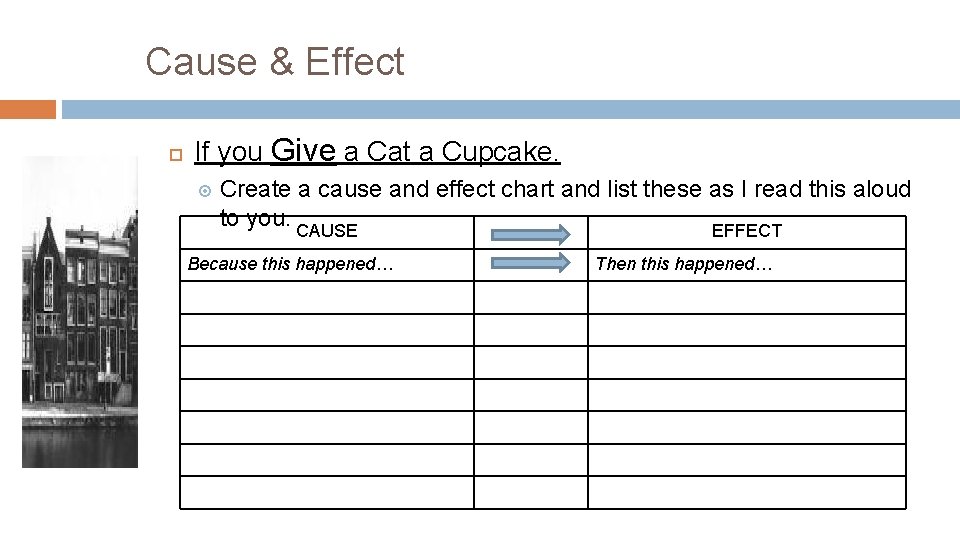
E. Q. : How do an author’s personal experiences affect the meaning and 10/20 understanding of the text? Look at what life events have occurred in the book. Write seven (7) If/Then statements that illustrate cause and effect.
Cause & Effect If you Give a Cat a Cupcake. Create a cause and effect chart and list these as I read this aloud to you. CAUSE EFFECT Because this happened… Then this happened…
Reading Selections FROM: Thursday, 29 July, 1943 – Wednesday, 17 November, 1943
Written Response: Diary Entry #3 Diary Entry Days in hiding were probably much the same. Write a detailed description of your daily routines. Use the style of today’s reading. Refer back to how Anne explained her routines.
E. Q. : How do demonstrate my comprehension of information from my 10/21 reading? Anne Frank Quiz #1 Use Your Own Paper Put your name, today’s date and your class period in the top right-hand corner. Number 1 – 25. There is also a BONUS! You may use the book and your diary. Turn in the test document and your answer sheet in the baskets on the front table. May The Force Be With You!
10/24 Vocabulary: List #3: Advanced morale – 122 supple – 136 saunter – 142 tinge – 155 coquettish – 168 hospitable – 184 sabotage – 193 livid – 210 pseudonym – 215 jocular - 217 ish – like co – together vid – look pseudo – false nym - name
Vocabulary: List #3 morale – 122 saunter – 142 hospitable – 184 sabotage – 193 pseudonym – 215 pseudo – false nym - name
E. Q. : How do an author’s experiences and changes in life affect the understanding of the text? What is life like in hiding? Answer this question in your diary. Use details from your reading.
Reading Selections FROM: Saturday, 27 November 1943 through Thursday, 27 January, 1944
Written Responses: Diary Entry #4 Diary Entry Write a paragraph explaining how you have changed since the beginning of sixth grade. Include information on what has caused those changes.
10/25 E. Q. : How do my personal experiences relate to the text? Odd Man Out Write about a time when you felt different or left out. Make sure to tell about the event and your feelings.
Reading Selections FROM: Friday, 28 January, 1944 through Tuesday, 7 March, 1944
Written Responses In Class Essay What Anne Frank experienced was an extreme version of the kinds of intolerance, bullying, and bigotry that people still experience every day. Write a personal narrative describing a time you were a victim of this type of behavior, or a time when you treated someone else unfairly. Let your unique voice come through in your writing, using verb tense, voice, imagery, and all the other literary tools at your disposal to engage your audience.
10/26 E. Q. : How do I correctly use intensive pronouns? Intensive Pronouns Write 5 sentences that include an intensive pronoun. Hint: An intensive pronoun ends in -self or selves and is not necessary to the basic meaning of the sentence. How is this different from a reflexive pronoun? It ends in –self or –selves?
Intensive Pronouns Examples from the text: Sunday, 27 September 1942 Sunday, 7 November, 1942 “Margot doesn’t need it, she is such a goody-goody, perfection itself, but I seem to have enough mischief in me for the two of us put together. ” “It is only that I long for Daddy’s real love: not only as his child, but for me – Anne, myself. ” Wednesday, 29 September, 1943 “If you just think that she still has to finish her office work downstairs, that Koophuis is ill, Miep at home with a cold, and that she herself has a sprained ankle, love worries, and a grumbling father, then it’s no wonder she’s at her wit’s end. ”
Reading Selections FROM: Sunday, 12 March, 1944 through Monday, 3 April, 1944.
Written Response: Intensives Using Intensive Pronouns Pick one diary entry from today’s reading. Rewrite 5 sentences and add intensive pronouns. Make sure to look back at the definition and any examples for reference.
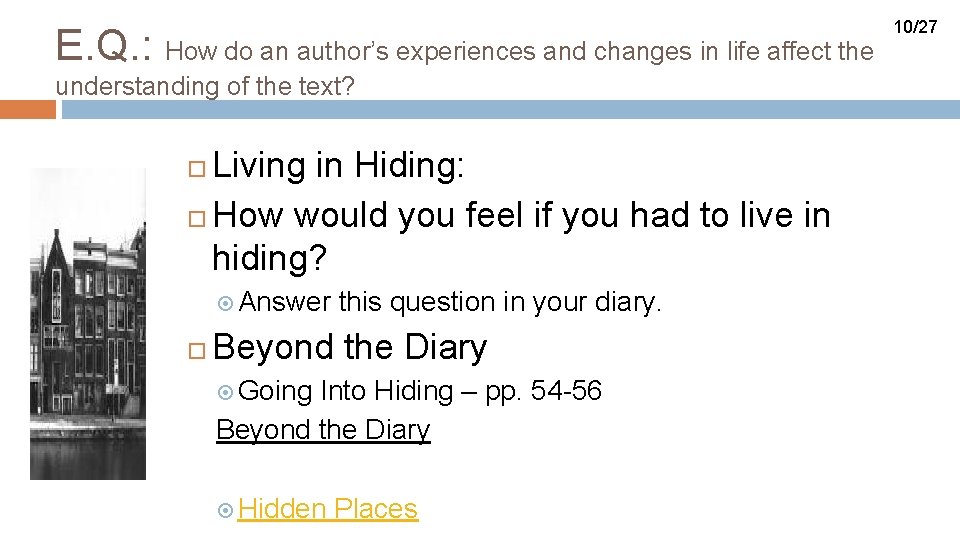
E. Q. : How do an author’s experiences and changes in life affect the understanding of the text? Living in Hiding: How would you feel if you had to live in hiding? Answer this question in your diary. Beyond the Diary Going Into Hiding – pp. 54 -56 Beyond the Diary Hidden Places 10/27
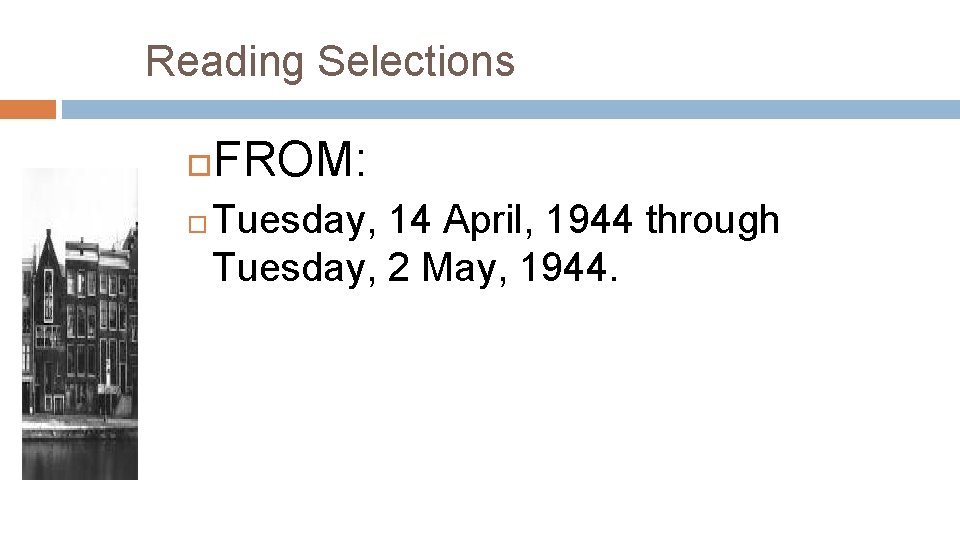
Reading Selections FROM: Tuesday, 14 April, 1944 through Tuesday, 2 May, 1944.
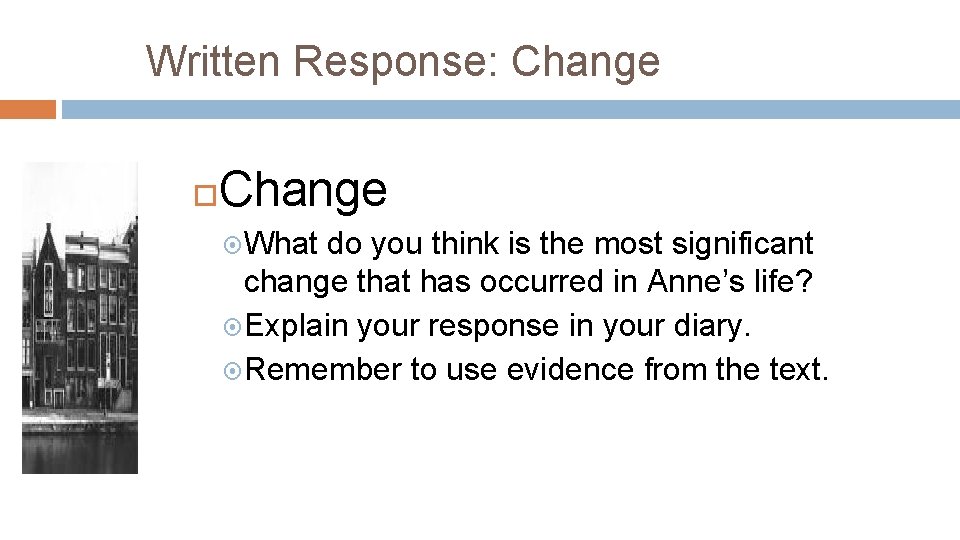
Written Response: Change What do you think is the most significant change that has occurred in Anne’s life? Explain your response in your diary. Remember to use evidence from the text.
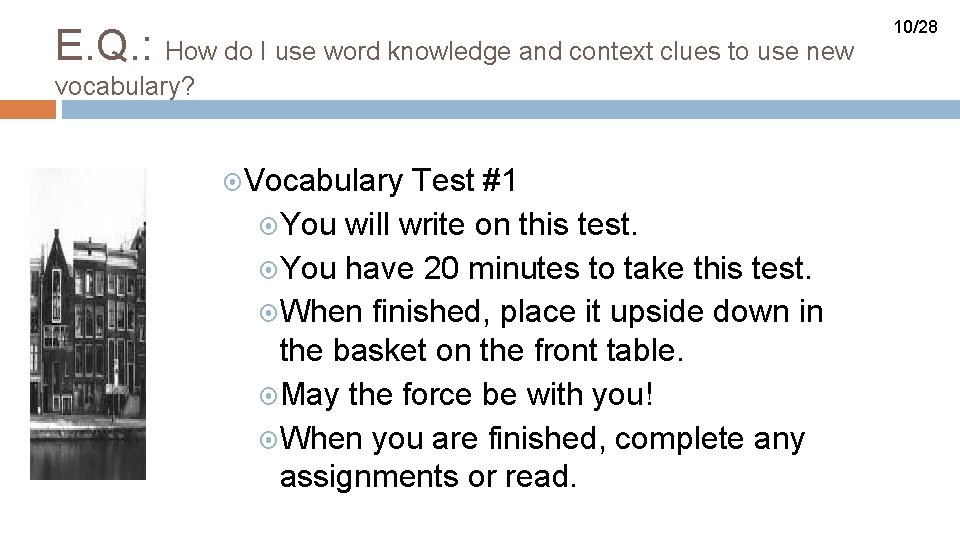
E. Q. : How do I use word knowledge and context clues to use new vocabulary? Vocabulary Test #1 You will write on this test. You have 20 minutes to take this test. When finished, place it upside down in the basket on the front table. May the force be with you! When you are finished, complete any assignments or read. 10/28
10/31 Vocabulary List #4: Advanced capitulation – 243 pamphlets – 244 commotion – 245 envious – 248 idle – 248 gale – 251 jittery – 253 finicky – 259 perturbed – 261 superficial - 266 capit – head let – little mot – move per – through super - over
Vocabulary List #4 pamphlets – 244 commotion – 245 idle – 248 jittery – 253 finicky – 259 let – little mot – move
E. Q. : How does an author’s personal experience show through in his or her writing? What racial or religious prejudice do you see in the world today? Write a paragraph describing your response to this question. Include descriptions, an explanation and give examples in your response.
Reading Selections FROM: Wednesday, 3 May, 1944 through Friday, 26 May, 1944.
Written Response: Hope for Anne Hope Why has Anne almost given up hope? How does she feel about her situation now?
E. Q. : How does an older generation’s viewpoint influence a younger person? How do you think the older generation views kids today? Write a paragraph giving your viewpoint on this question. Include an explanation and give examples in your response. 11/1
Reading Selections FROM: Wednesday, 31 May, 1944 through Tuesday, 1 August, 1944. The Afterword
Written Response: Comparing Compare Yourself How are Anne’s views different from those held by you and your classmates? How are they alike?
Reading Comprehension Anne Frank Quiz #2 Use Your Own Paper Put your name, today’s date and your class period in the top right-hand corner. Number 1 – 25. There is also a BONUS! You may use the book and your diary. Turn in the test document and your answer sheet in the baskets on the front table. May The Force Be With You!
11/2 – 11/4 E. Q. : How do filmmakers make judgments about what to include in a film? What do think are the most important scenes in the book? Make a list in your diary of the 5 most important scenes from the book. Be prepared to give an explanation and examples for your response.
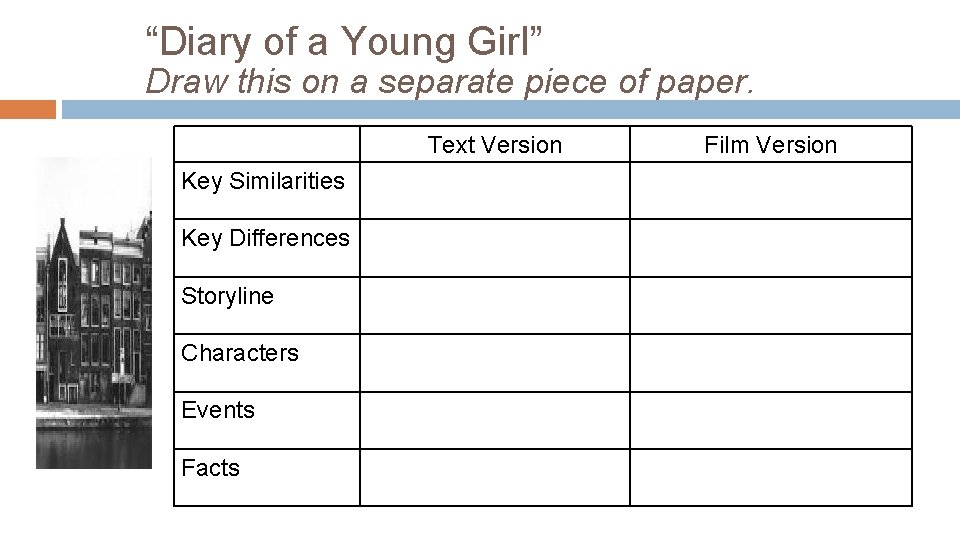
“Diary of a Young Girl” Draw this on a separate piece of paper. Text Version Key Similarities Key Differences Storyline Characters Events Facts Film Version
“Diary of a Young Girl” Why did the producers of the film choose to leave out certain important and relevant events and include others? What ways did the producers use to draw attention to these events and facts that they did include?
11/7 Vocabulary List #5: Advanced from “Blood, Toil, Tears and Sweat” and Roosevelt’s Speech to Congress urgency – BTTS 1 toil - 3 tyranny – 4 lamentable – 4 impulse – 4 infamy– Roosevelt 1 implications – 6 onslaught - 8 treachery - 9 dastardly - 12 im – not in – in or not
Vocabulary List #5 from “Blood, Toil, Tears and Sweat” and Roosevelt’s Speech to Congress urgency – BTTS 1 tyranny – 4 impulse – 4 infamy– Roosevelt 1 treachery - 9 im – not in – in or not
E. Q. : How does an author use words to persuade and appeal to his or her audience? How would you convince someone to turn a “no” into a “yes”? Answer this question in you diary. Make sure to use real-life examples.
Churchill’s Address to Parliament Winston Churchill, Prime Minister of Great Britain, spoke to Parliament on May 30, 1940. Persuasive Techniques - Notes What strategies did he use to persuade his audience to agree with him? Make a list of loaded words. Look for evidence of sound devices. Annotate the text of the speech.
Churchill’s Address to Parliament Does hearing change our perspective? Listen to the audio version. Listen for accent and pronunciation choice of words use of formal speech pace and delivery ability to inspire and inform tone Which do you prefer – hearing or viewing? Why?
Written Response: Churchill What was the purpose of Churchill’s speech? Make sure to include information about the persuasive techniques he used. Mention vocabulary choices. Explain how Churchill achieved his purpose. Explain your response by referring to the text of the speech.
11/9 E. Q. : How does word choice and language influence my understanding of the text? If you were upset about something, what words would you use to get your point across? Answer this question in your diary. Make a list of words and then explain your answer. How would you convince someone to turn a “no” into a “yes”? Answer this question in you diary. Make sure to use real-life examples.
Churchill’s Address to Parliament Winston Churchill, Prime Minister of Great Britain, spoke to Parliament on May 13, 1940. Persuasive Techniques - Notes What strategies did he use to persuade his audience to agree with him? Make a list of loaded words. Look for evidence of sound devices. Annotate the text of the speech.
President Roosevelt’s Speech to the Senate and House of Representatives Read President Roosevelt’s Speech Annotate the Speech Look for examples of: Word Choice Repetition Sound Reasoning/Logic Tone
E. Q. : How can I effectively show what I have learned in this text study? Writing Assessment: Choosing the Best – DUE MONDAY Prewriting Drafting Revising Editing Publishing Proofreading 11/10
Writing Assessment: Argumentative “Declaration of War on Japan” and “Blood, Toil, Tears, and Sweat: Address to Parliament on May 13, 1940” are famous speeches given during World War II. They were designed to elicit an audience response from listeners. Which of these speeches is more powerful? Analyze and describe the speeches subject, mood, tone, and use of sensory imagery. Support your choice with reasons, examples, and details from the speeches.
E. Q. : How can I effectively show what I have learned in this text study? Writing Day Create a checklist from your prompt. Check your essay to make sure you have completed these tasks: Did you address all areas of the prompt? Did you create a Controlling Idea and use it in an introduction? Did you use accurate and adequate evidence from the text to support your ideas and information? Did you use correct grammar, usage, and mechanics? 11/11
Writing Assessment: Argumentative Writing Assessment: Choosing the Best Today’s Tasks: Revising & Editing Use a Checklist to make changes to your rough draft. Final Drafts
11/14 Vocabulary List #6: Advanced incongruency – Marigolds 1 intimidated – Marigolds 3 pallet – Marigolds 4 guidance – L 606 transports – L 606 distinguished – L 598 podium – L 598 recognition – L 599 tortured – L 600 pranced – L 389 trans – across port – carry pod – foot cogn – know tort - twist
Vocabulary List #6 intimidated – Marigolds 3 transports – L 606 podium – L 598 recognition – L 599 tortured – L 600 trans – across port – carry pod – foot cogn – know tort - twist
E. Q. : How do authors use specific literary elements to convey character and character traits? What do you know about the Great Depression? Answer this question in your diary. Make sure to give as many examples as you can.
“Marigolds” by Eugenia W. Collier Read and Annotate the Text Make an Annotation Chart in your Diary. Make sure to make connections: to yourself and your life to other texts you have read or viewed to other real world events Notice words and phrases that are used. Write questions it makes you think of. Write down new ideas that you develop.
E. Q. : How can we link ideas from what we read to what we write? Why do survivors continue to tell personal stories from the Holocaust? Write this question in your diary. Answer by giving your opinion and support that opinion with reasons and evidence. 11/15
Reading Selections “Voices From the Holocaust” – p 598 “The Secret Schools” –p 604 And “What if” – p 389 All three of these selections are found in our Literature Book.
Reading Selection: Wiesel’s Message “Voices From the Holocaust” – p 598 After reading this selection, write a short essay that answers the following questions: Why is Wiesel’s message still important today? How did Wiesel’s experience in World War II bring out the best in him? How can Wiesel’s inner strength serve as an example for others? Why might this “type of terror” happen again if people do not learn about it?
E. Q. : How can we link ideas from what we read to what we write? Life in Sixth Grade Suppose that you are writing about the life of a sixth grade student in today’s world. What events or information would you include in a historical essay about life in sixth grade? 11/16
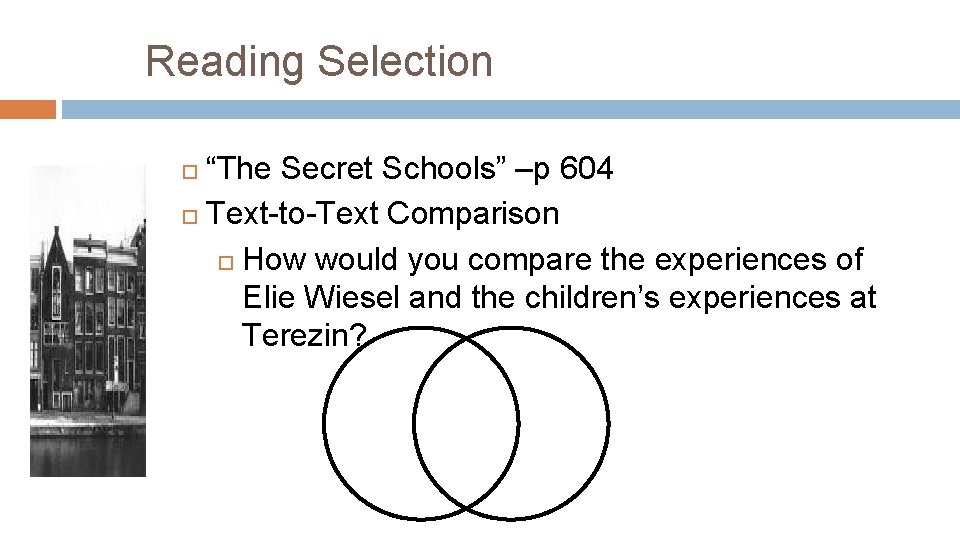
Reading Selection “The Secret Schools” –p 604 Text-to-Text Comparison How would you compare the experiences of Elie Wiesel and the children’s experiences at Terezin?
Inner Strength How do Friedl and the children use inner strength to bring out the best in themselves under terrible circumstances? Write a short response answering this question. Include a time when you had to use inner strength to handle a situation that you did not think you could handle.
E. Q. : How can we link ideas from what we read to what we write? What do you worry about when you are all alone? Write this question in your diary. Answer by writing a list of worries that you have. 11/17
What If? – p. 389 What do you fear the most? In all three of the selections we have read this week, we see elements of anxiety about someone’s life. Write this question in your diary. Answer this question using personal examples from your life and thoughts of your future.
E. Q. : How can I effectively demonstrate what I know about Vocabulary? Vocabulary Test #2 You will write on this test. Read and follow the instructions carefully. When finished, place it upside down in the basket on the front table. May the force be with you! When finished, use this time to finish assignments or read. 11/18
E. Q. : How can I use a simple story to teach me how to be a better 11/28 writer? What is your favorite “childhood” story? Write this question in your diary. Write your answer and give a brief summary of this story. Make sure to explain who the characters are, tell what events the plot includes, and explain both the conflict and resolution of the story.
Writing About Reading Retelling a Fairy Tale You will work with your partner to retell the story of “The Three Little Pigs. ” You will write one story together. You must agree on all the elements: Characters Plot Conflict Resolution
11/29 E. Q. : How can I craft a claim that explains my opinion about something I have read? What is your favorite dessert? Write this question in your diary. Write your answer and give a brief explanation for why it is your favorite. Make sure to give SOLID reasons to support your opinion.
Writing About Reading We will return to “The Three Little Pigs” today. We are going to craft claims that can be supported in an argumentative essay. Which one of the brothers is smarter than the others? Should the wolf be found guilty for his crimes? Should the mother of the pigs be charged with neglect for lack of good parenting?
Writing About Reading Choose one of these topics. Craft a claim using the Boxes-and-Bullets Essay Structure. Continue to use this structure to plan your essay. HOMEWORK Now write the essay stating and defending your claim. Remember, think like a lawyer making your case in court.
E. Q. : How can I dissect my writing to analyze its components? Have you ever taken anything apart? Write this response in your diary. Name something that you have taken apart. Explain what you did and what you discovered. 11/30
Writing About Reading Finish Writing this Essay. We are going to dissect your claim and evidence to determine the effectiveness of your argumentative essay. Underline your claim in RED. Underline each reason in GREEN. Underline all your evidence and examples in BLUE.
E. Q. : How can I analyze my writing to determine if I have included enough information? Name all the steps in making your favorite snack. Make sure to include each step and all of the ingredients. 12/1
Writing About Reading Look at your essay. Analyze the dissection of your essay. Do you have ONE claim underlined in RED? Do you have at least THREE reasons underlined in GREEN? Do you have at least THREE pieces of evidence and/or examples underlined in BLUE?
Writing About Reading Analyze your argument to make sure: You have the minimum number of reasons. You have sufficient evidence and examples. Now revise and edit your essay to make any additions you need. Make corrections to your essay.
E. Q. : How can I use all the strategies I have learned to complete my final draft? Final Drafts Follow all the correct procedures to complete your final drafts. These are DUE by the end of the class period. 12/2
12/5 E. Q. : How can I identify theme in a text? What is theme? Write this question in your diary. Answer it with a complete definition. Make sure to use your own words!
Writing About Reading Theme noun: a unifying or dominant idea, motif, etc. , the subject a piece of writing "the theme of the story was to never give up“ synonyms: subject, topic, subject-matter, thesis, argument, concern, message.
Writing About Reading “Raymond’s While Run” by Toni Cade Bambara we read today, try to determine theme of this story. After reading, turn to the next available page in your diary. Write an explanation of theme of this story. Make sure to provide evidence from the text.
E. Q. : How can I analyze character from a text by identifying motivations, problems, and lessons learned? What makes you do the right thing? What makes you do the wrong thing? Write these questions in your diary. List three reasons for each 12/6
How to Write a Theme-Based Literary Essay q q Think about the character’s motivations, problems, and lessons learned – and look for patterns. q What does the character want, and what gets in the way? q How does the character try to resolve his/her problems? q What lessons does the character learn from trying to resolve his problems? q Now what patterns do you see? Then craft a claim based on one of themes.
How to Write a Theme-Based Literary Essay q Look back at the Box-and-Bullets Structure. q q Plan a new essay analyzing a character from “Raymond’s Run. ” Make sure to refer to the text for evidence and examples. Your task is to identify theme and explain how the character shows us that theme in the story. HOMEWORK: q Write this essay.
E. Q. : How can I support my claim with quotes from the text? What is your favorite saying? Write this question in your diary. Write your answer and why you chose this as your favorite saying. 12/7
How to Write a Theme-Based Literary Essay q What does your theme-based claim look like? Claim: (The THEME) is (_______). (The Character) demonstrates this theme through (trait) because (one reason), (another reason), and above all, because (a third reason).
How to Write a Theme-Based Literary Essay Look back at “Raymond’s Run. ” q Also, look at your Box-and-Bullets Plan. q Identify quotes in the text that support your claim. q Underline these in the text. q Now, add these to your essay to strengthen your evidence. q
Punctuating Quotations 1. 2. 3. 4. Only the portion of that comes directly from the text goes inside the quotation marks. If the quote comes in the middle of a sentence, set it up with a comma. If the sentence continues after the quote, set up the rest of the sentence with a comma inside the quote. If the sentence ends after a quote, end it with a period inside the quotation mark.
E. Q. : How can I use my introduction and conclusion to frame a complete essay? Think of your favorite movie. How does it begin and how does it end? Write this question in your diary. Write your answer and describe the beginning and ending. 12/8
How to Write a Theme-Based Literary Essay Your Introduction q To write an introduction to your essay: q Start with a universal statement about life, q Transition to the text-based claim itself, q Focus on the story you are writing about. q Check your introduction to make sure you have done this.
How to Write a Theme-Based Literary Essay Your Conclusion q To write a conclusion to your essay, show connections in at least one of these ways: q Your thesis and emphasize why the claim and evidence matter (SO WHAT), q Yourself and the life lesson you learned or realized, q The author’s message, q or Leave your reader with something to think about. q Now, check your conclusion to make sure you have done at least one of these.
How to Write a Theme-Based Literary Essay Your Final Draft: Complete all changes and corrections. Complete your final draft by the end of class on Friday.
E. Q. : How can I use all the strategies that I have learned to complete a theme-based essay? Final Drafts Follow all the correct procedures to complete your final drafts. These are DUE by the end of the class period. 12/9
E. Q. : How can I effectively show what I have learned in this text 12/12 study? Writing Assessment: 100 Minute Writing Test Prewriting – 15 Minutes Drafting – 35 Minutes Revising & Editing – 20 Minutes Publishing (Final Drafts) – 20 Minutes Proofreading – 10 Minutes
Writing Assessment: Argumentative Anne’s dream of living beyond her death has happened. Anne continues to live in her diary as millions of people have read it. Consider the information at the end of the diary when writing your essay. In your opinion, do you think that Anne’s experiences make this dream (…to keep on living even after I am dead…) worthwhile, OR would the diary have had the same impact if she had survived the war instead? What might have happened to her diary if she had survived the war?
12/13 E. Q. : How can I effectively show what I have learned in this text study? Writing Day #2 Create a checklist from your prompt. Check your essay to make sure you have completed these tasks: Did you address all areas of the prompt? Did you create a Claim and use it in an introduction? Did you use accurate and adequate evidence from the text to support your claim? Did you use correct grammar, usage, and mechanics?
12/14 E. Q. : How can I effectively show what I have learned in this text study? Selection Test: Marigolds DO NOT WRITE ON THIS TEST! Take out a sheet of paper. Number from 1 - 20. Do NOT skip lines. For 1 -14, choose the correct letter. For 15 -19, choose the correct word from the word bank. For 20, write a short essay that answers all parts of the question. When complete, place you answer sheet and test in the baskets.
E. Q. : How can I express what I have accomplished in a unit of study? 12/15 • Reflective Writing • Complete the Unit Reflection Guide • Use a quote you select from any reading we have done this quarter as the beginning of your reflective essay. Make sure to connect it to what your essay is about. • Write an essay that communicates what you have learned in this unit and how you will use it in your own life.
12/16 Reflective Writing • Writing Tasks: Revise and Edit your Reflective Essay Look Back at the Reflection Guide to make sure you included everything. Follow the procedures to complete your final draft. These completed essays are due by the end of the class period on Thursday.