
Pentaquarks from chiral solitons Maxim V Polyakov Liege

- Slides: 35
Pentaquarks from chiral solitons Maxim V. Polyakov Liege Universitiy & Petersburg NPI Outline: - Predictions - Post-dictions - Implications GRENOBLE, March 24
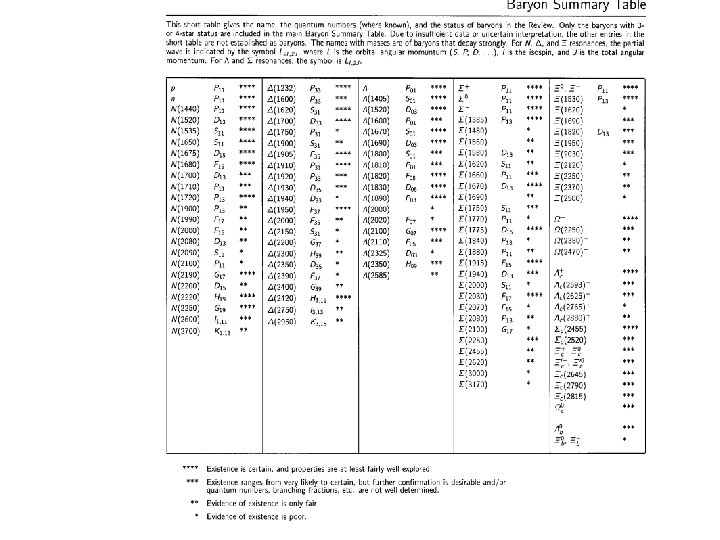
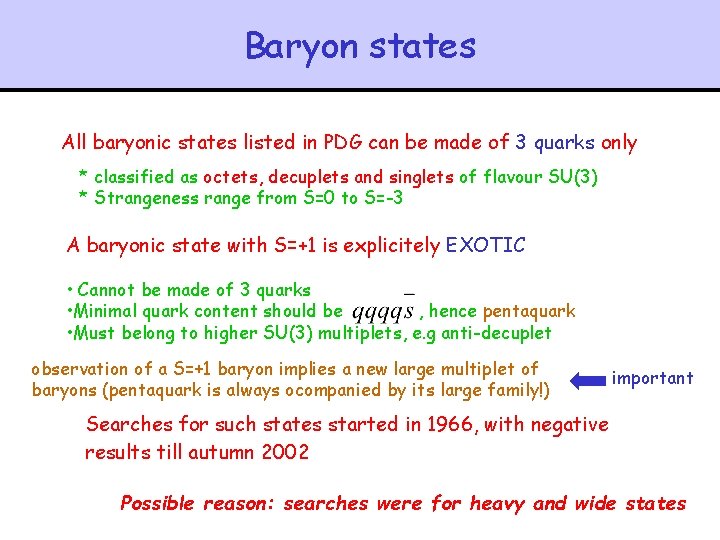
Baryon states All baryonic states listed in PDG can be made of 3 quarks only * classified as octets, decuplets and singlets of flavour SU(3) * Strangeness range from S=0 to S=-3 A baryonic state with S=+1 is explicitely EXOTIC • Cannot be made of 3 quarks • Minimal quark content should be , hence pentaquark • Must belong to higher SU(3) multiplets, e. g anti-decuplet observation of a S=+1 baryon implies a new large multiplet of baryons (pentaquark is always ocompanied by its large family!) important Searches for such states started in 1966, with negative results till autumn 2002 Possible reason: searches were for heavy and wide states
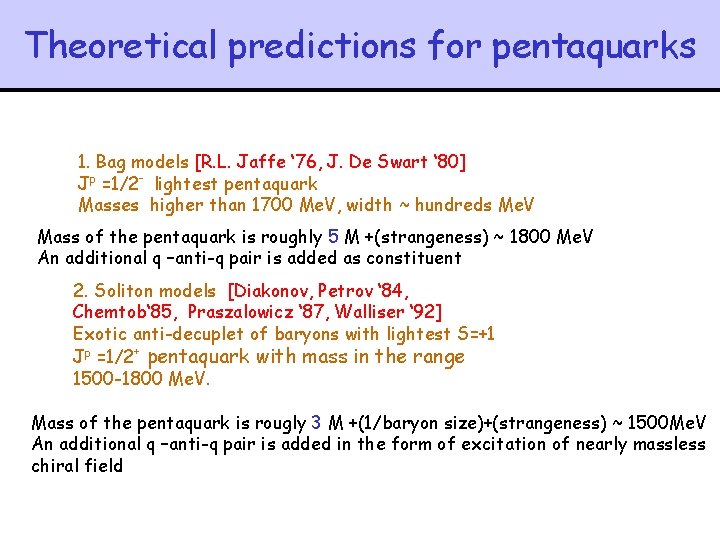
Theoretical predictions for pentaquarks 1. Bag models [R. L. Jaffe ‘ 76, J. De Swart ‘ 80] Jp =1/2 - lightest pentaquark Masses higher than 1700 Me. V, width ~ hundreds Me. V Mass of the pentaquark is roughly 5 M +(strangeness) ~ 1800 Me. V An additional q –anti-q pair is added as constituent 2. Soliton models [Diakonov, Petrov ‘ 84, Chemtob‘ 85, Praszalowicz ‘ 87, Walliser ‘ 92] Exotic anti-decuplet of baryons with lightest S=+1 Jp =1/2+ pentaquark with mass in the range 1500 -1800 Me. V. Mass of the pentaquark is rougly 3 M +(1/baryon size)+(strangeness) ~ 1500 Me. V An additional q –anti-q pair is added in the form of excitation of nearly massless chiral field
The question what is the width of the exotic pentaquark In soliton picture has not been address untill 1997 It came out that it should be „anomalously“ narrow! Light and narrow pentaquark is expected -> drive for experiments [D. Diakonov, V. Petrov, MVP ’ 97]
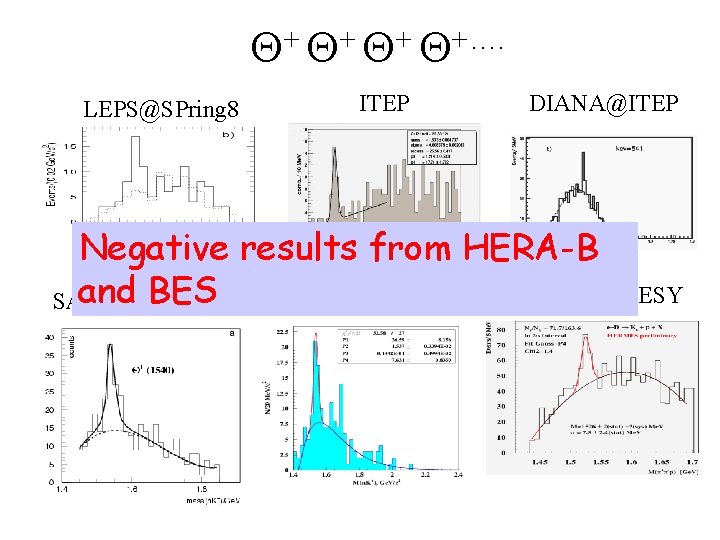
Q+ Q+…. LEPS@SPring 8 ITEP DIANA@ITEP Negative results from HERA-B CLAS@JLAB HERMES@DESY and @BES SAPHIR ELSA
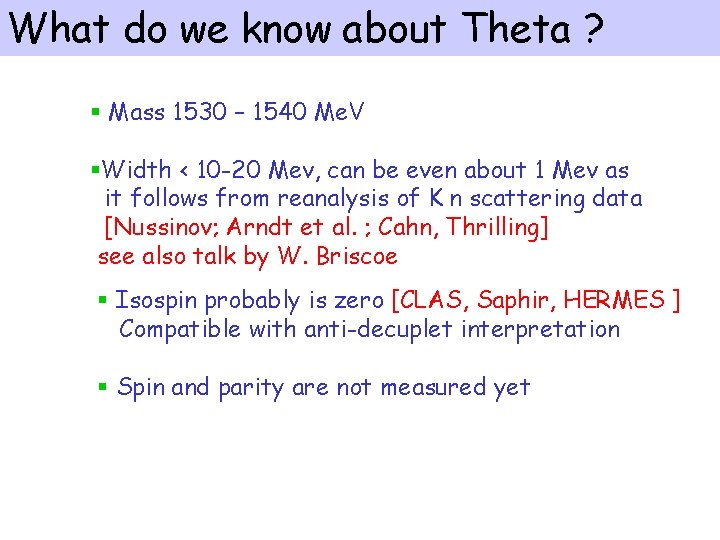
What do we know about Theta ? § Mass 1530 – 1540 Me. V §Width < 10 -20 Mev, can be even about 1 Mev as it follows from reanalysis of K n scattering data [Nussinov; Arndt et al. ; Cahn, Thrilling] see also talk by W. Briscoe § Isospin probably is zero [CLAS, Saphir, HERMES ] Compatible with anti-decuplet interpretation § Spin and parity are not measured yet
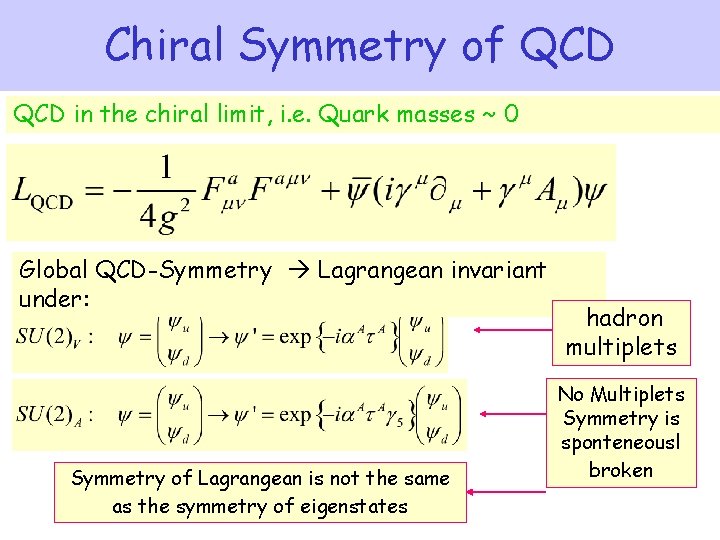
Chiral Symmetry of QCD in the chiral limit, i. e. Quark masses ~ 0 Global QCD-Symmetry Lagrangean invariant under: Symmetry of Lagrangean is not the same as the symmetry of eigenstates hadron multiplets No Multiplets Symmetry is sponteneousl broken
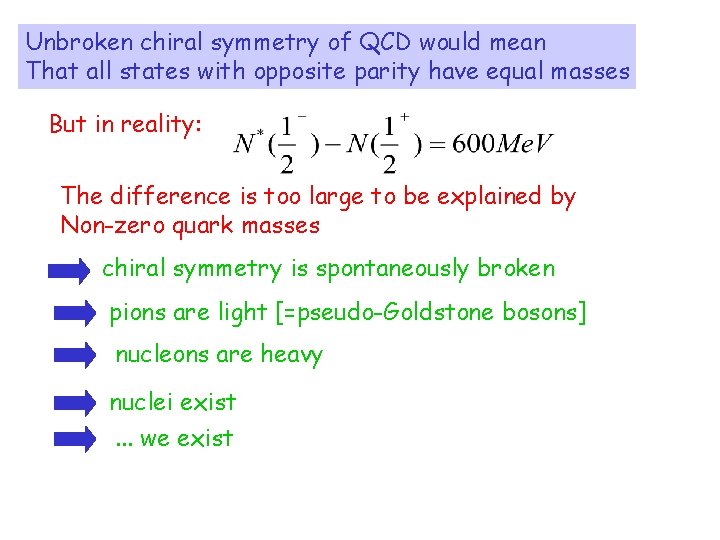
Unbroken chiral symmetry of QCD would mean That all states with opposite parity have equal masses But in reality: The difference is too large to be explained by Non-zero quark masses chiral symmetry is spontaneously broken pions are light [=pseudo-Goldstone bosons] nucleons are heavy nuclei exist. . . we exist
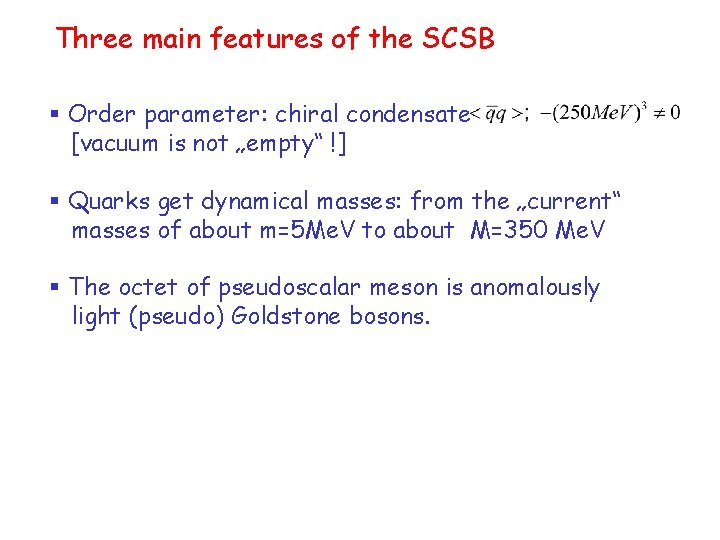
Three main features of the SCSB § Order parameter: chiral condensate [vacuum is not „empty“ !] § Quarks get dynamical masses: from the „current“ masses of about m=5 Me. V to about M=350 Me. V § The octet of pseudoscalar meson is anomalously light (pseudo) Goldstone bosons.
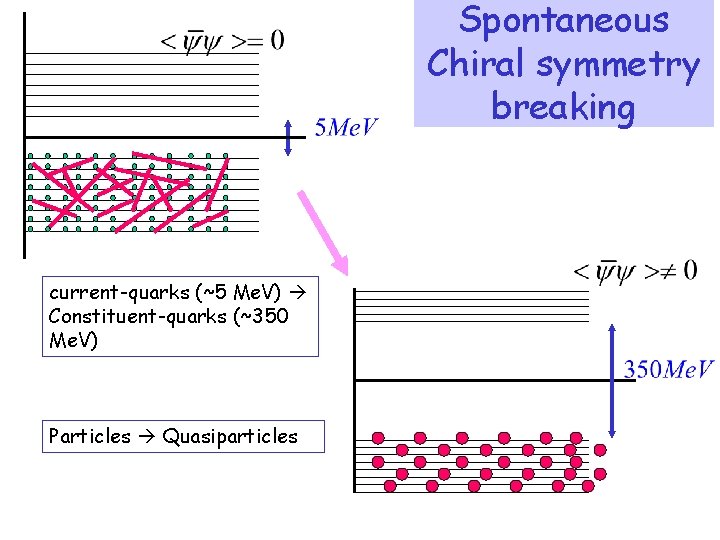
Spontaneous Chiral symmetry breaking current-quarks (~5 Me. V) Constituent-quarks (~350 Me. V) Particles Quasiparticles
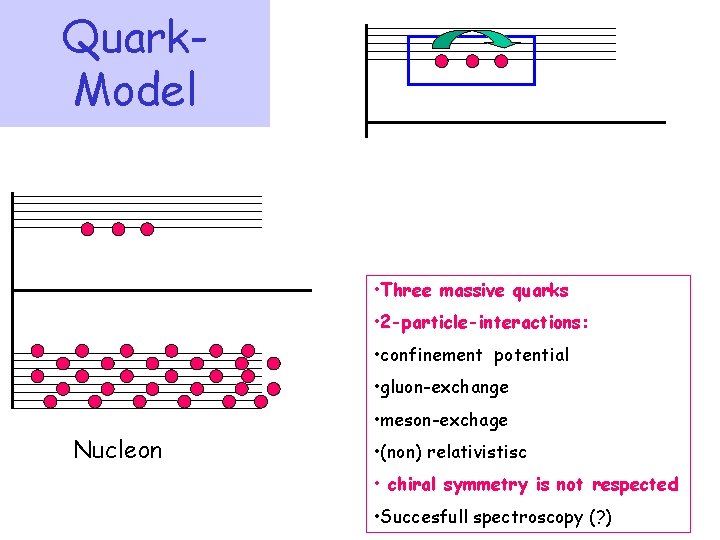
Quark. Model • Three massive quarks • 2 -particle-interactions: • confinement potential • gluon-exchange • meson-exchage Nucleon • (non) relativistisc • chiral symmetry is not respected • Succesfull spectroscopy (? )
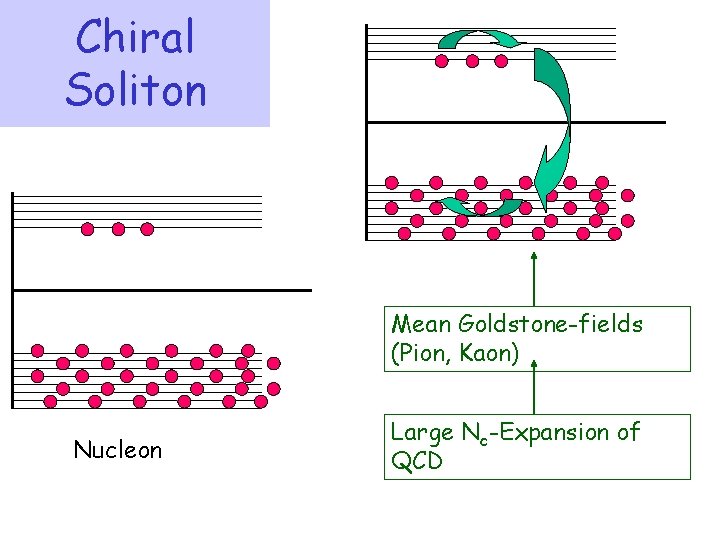
Chiral Soliton Mean Goldstone-fields (Pion, Kaon) Nucleon Large Nc-Expansion of QCD
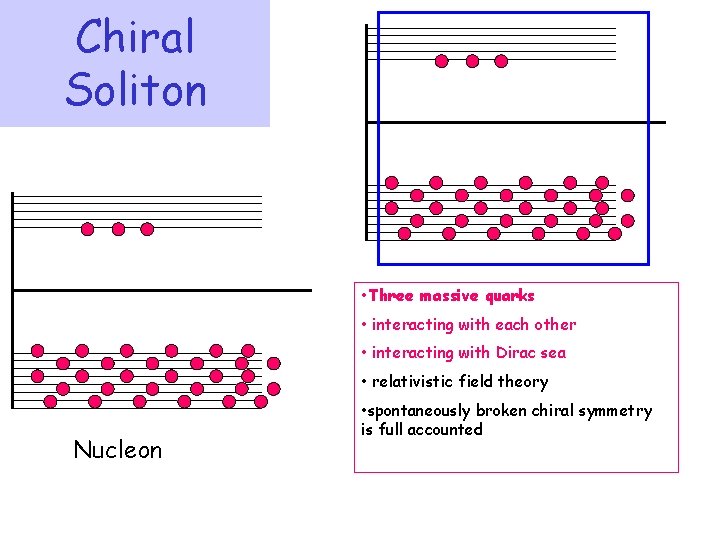
Chiral Soliton • Three massive quarks • interacting with each other • interacting with Dirac sea • relativistic field theory Nucleon • spontaneously broken chiral symmetry is full accounted
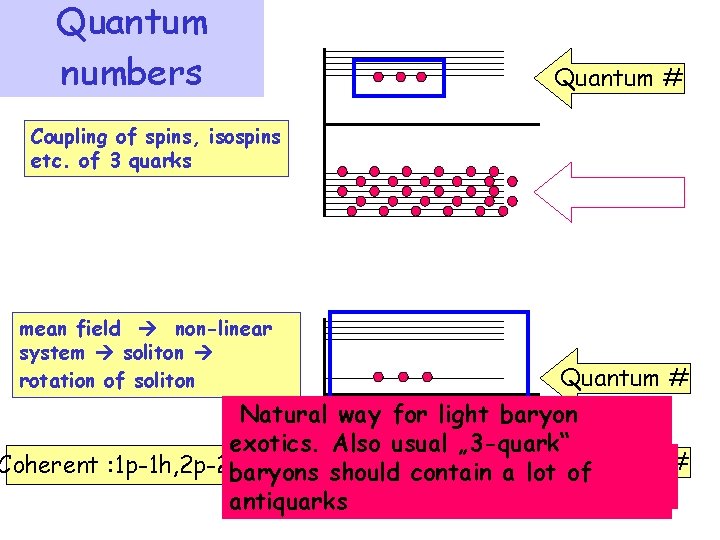
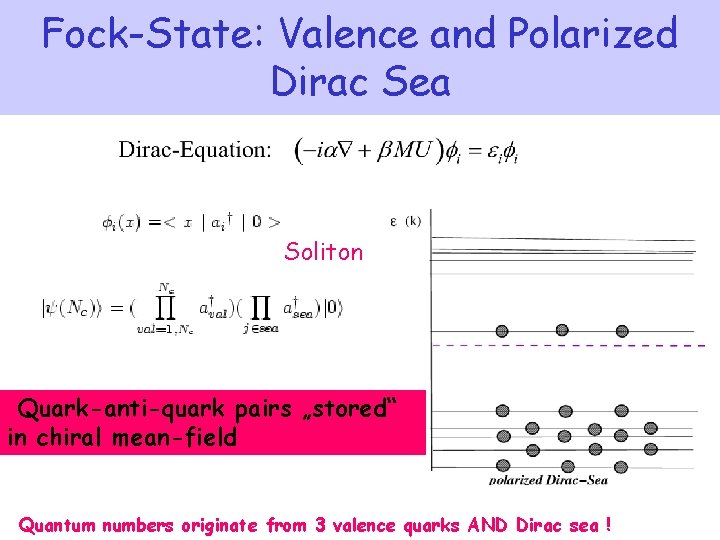
Quantum numbers Quantum # Coupling of spins, isospins etc. of 3 quarks mean field non-linear system soliton rotation of soliton Quantum # Natural way for light baryon exotics. Also usual „ 3 -quark“ Quantum Quark-anti-quark pairs „stored“ in # Coherent : 1 p-1 h, 2 p-2 h, . . baryons should contain a lot of chiral mean-field antiquarks
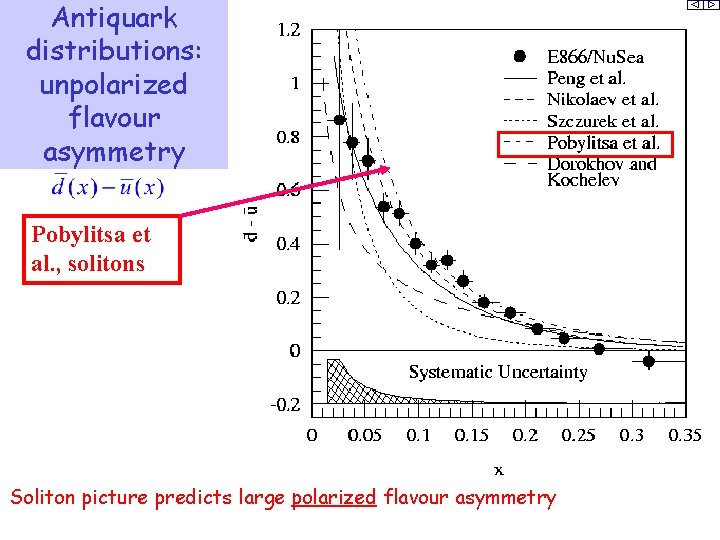
Antiquark distributions: unpolarized flavour asymmetry d-bar minus ubar Pobylitsa et al. , solitons Soliton picture predicts large polarized flavour asymmetry
Fock-State: Valence and Polarized Dirac Sea Soliton Quark-anti-quark pairs „stored“ in chiral mean-field Quantum numbers originate from 3 valence quarks AND Dirac sea !
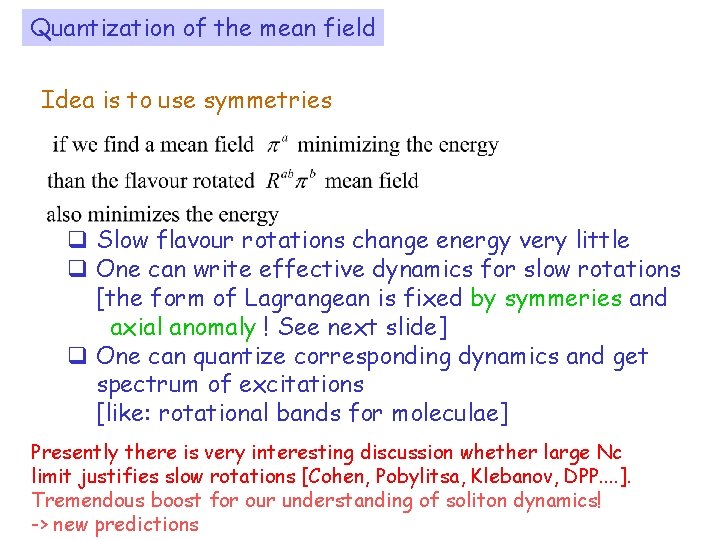
Quantization of the mean field Idea is to use symmetries q Slow flavour rotations change energy very little q One can write effective dynamics for slow rotations [the form of Lagrangean is fixed by symmeries and axial anomaly ! See next slide] q One can quantize corresponding dynamics and get spectrum of excitations [like: rotational bands for moleculae] Presently there is very interesting discussion whether large Nc limit justifies slow rotations [Cohen, Pobylitsa, Klebanov, DPP. . ]. Tremendous boost for our understanding of soliton dynamics! -> new predictions
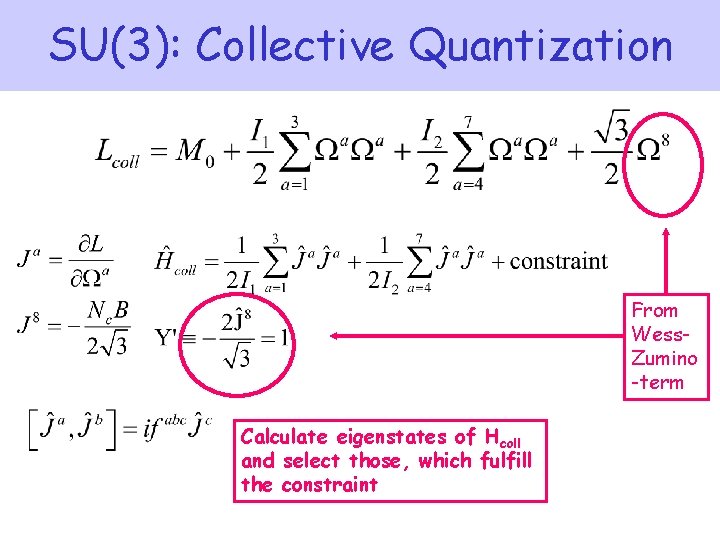
SU(3): Collective Quantization From Wess. Zumino -term Calculate eigenstates of Hcoll and select those, which fulfill the constraint
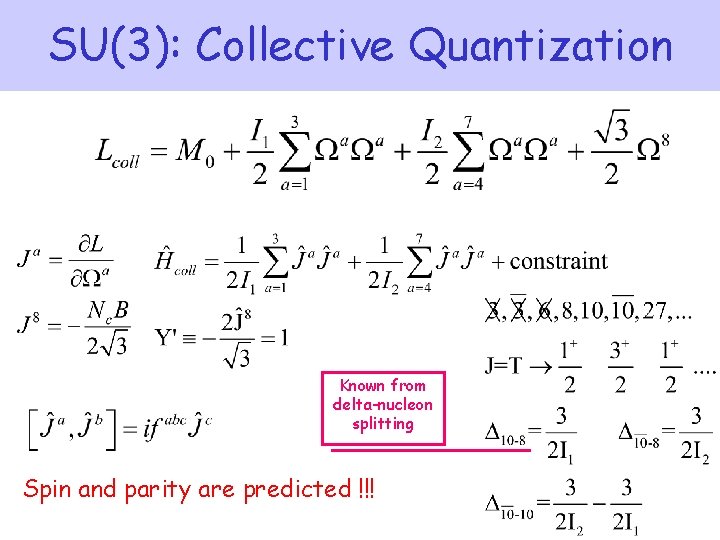
SU(3): Collective Quantization Known from delta-nucleon splitting Spin and parity are predicted !!!
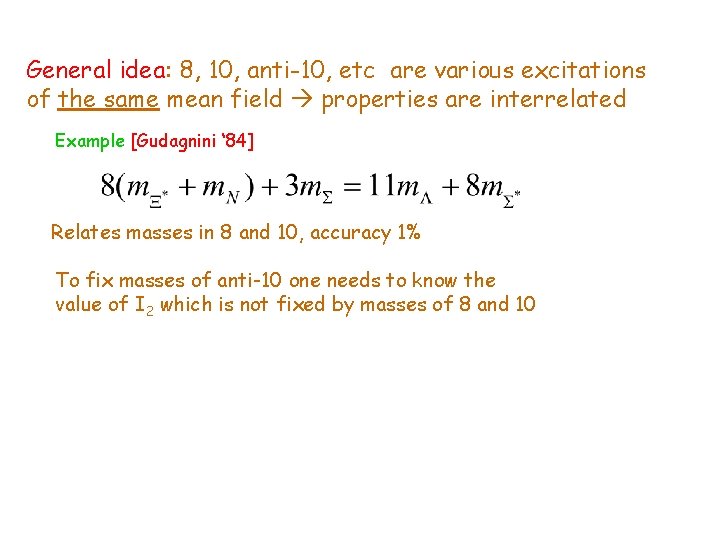
General idea: 8, 10, anti-10, etc are various excitations of the same mean field properties are interrelated Example [Gudagnini ‘ 84] Relates masses in 8 and 10, accuracy 1% To fix masses of anti-10 one needs to know the value of I 2 which is not fixed by masses of 8 and 10
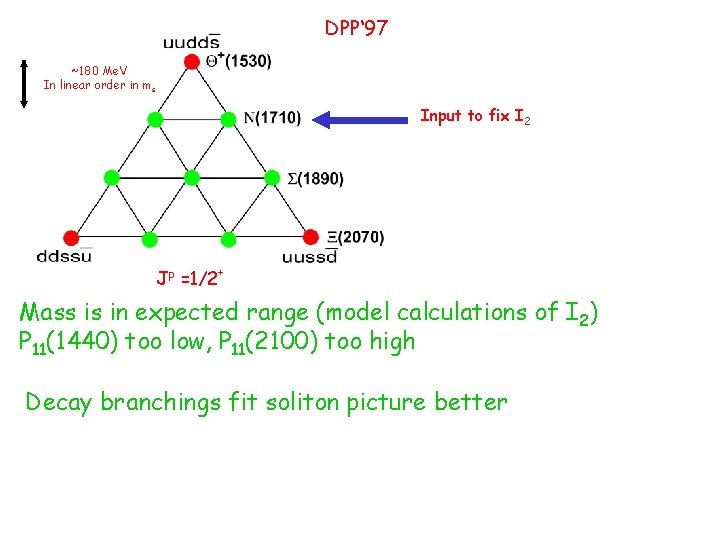
DPP‘ 97 ~180 Me. V In linear order in ms Input to fix I 2 Jp =1/2+ Mass is in expected range (model calculations of I 2) P 11(1440) too low, P 11(2100) too high Decay branchings fit soliton picture better
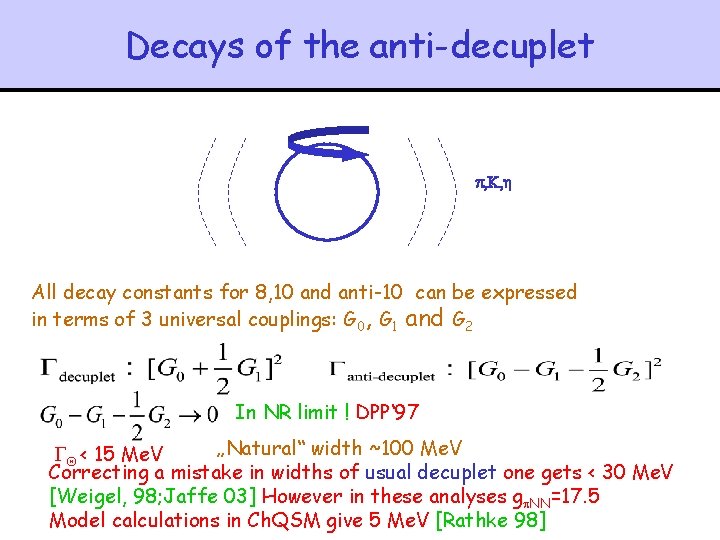
Decays of the anti-decuplet p, K, h All decay constants for 8, 10 and anti-10 can be expressed in terms of 3 universal couplings: G 0, G 1 and G 2 In NR limit ! DPP‘ 97 „Natural“ width ~100 Me. V GQ < 15 Me. V Correcting a mistake in widths of usual decuplet one gets < 30 Me. V [Weigel, 98; Jaffe 03] However in these analyses gp. NN=17. 5 Model calculations in Ch. QSM give 5 Me. V [Rathke 98]
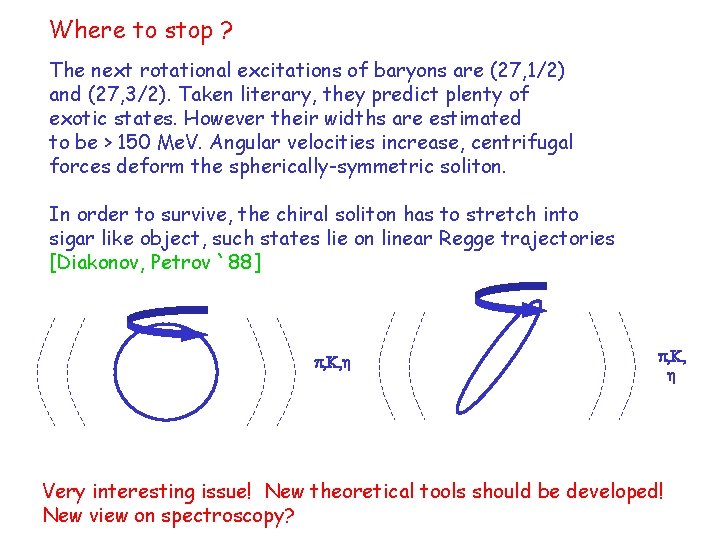
Where to stop ? The next rotational excitations of baryons are (27, 1/2) and (27, 3/2). Taken literary, they predict plenty of exotic states. However their widths are estimated to be > 150 Me. V. Angular velocities increase, centrifugal forces deform the spherically-symmetric soliton. In order to survive, the chiral soliton has to stretch into sigar like object, such states lie on linear Regge trajectories [Diakonov, Petrov `88] p, K, h Very interesting issue! New theoretical tools should be developed! New view on spectroscopy?
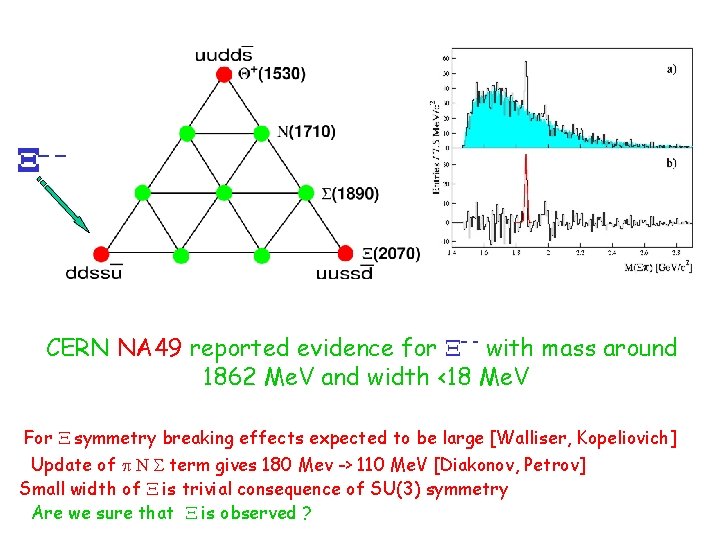
X- - CERN NA 49 reported evidence for X– - with mass around 1862 Me. V and width <18 Me. V For X symmetry breaking effects expected to be large [Walliser, Kopeliovich] Update of p N S term gives 180 Mev -> 110 Me. V [Diakonov, Petrov] Small width of X is trivial consequence of SU(3) symmetry Are we sure that X is observed ?
Non strange partners revisited N(1710) is not seen anymore in most recent p. N scattering PWA [Arndt et al. 03] If Q is extremely narrow N* should be also narrow 10 -20 Me. V. Narrow resonance easy to miss in PWA. There is a possiblity for narrow N*(1/2+) at 1680 and/or 1730 Me. V [Arndt et al. 03] In the soliton picture mixing with usual nucleon is very important. p N mode is suppressed, h. N and p. D modes are enhanced. Anti-decuplet nature of N* can be checked by photoexcitation. It is excited much stronger from the neuteron, not from the proton [Rathke, MVP]
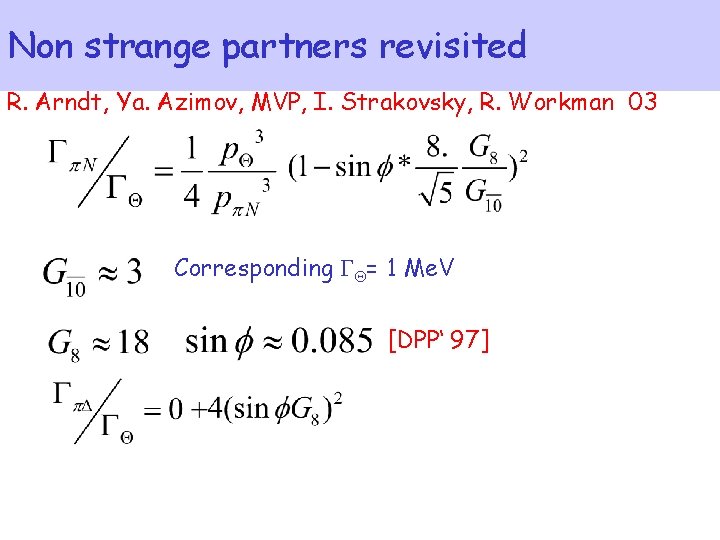
Non strange partners revisited R. Arndt, Ya. Azimov, MVP, I. Strakovsky, R. Workman 03 Corresponding GQ= 1 Me. V [DPP‘ 97]
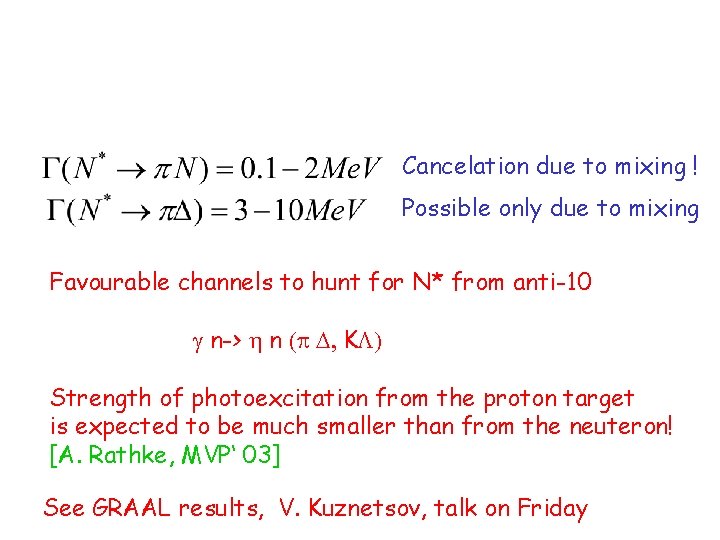
Cancelation due to mixing ! Possible only due to mixing Favourable channels to hunt for N* from anti-10 g n-> h n (p D, KL) Strength of photoexcitation from the proton target is expected to be much smaller than from the neuteron! [A. Rathke, MVP‘ 03] See GRAAL results, V. Kuznetsov, talk on Friday
Theory Postdictions Super radiance resonance Diamond lattice of gluon strings Rapidly developing theory: >140 papers Q+(1540)>as 2. 5 a heptaquark resubmissions in 1 hep QCD sumper rules, paper parity =Lattice QCD P=-1 or P=+1, see next talk by T. Kovacs di-quarks + antiquark, P=+1, see talk by C. Semay colour molecula, P=+1 Constituent quark models, P=-1 or P=+1, review by K. Maltman Exotic baryons in the large Nc limit Anti-charmed Q , and anti-beauty Q Q produced in the quark-gluon plasma and nuclear matter SU(3) partners of Q
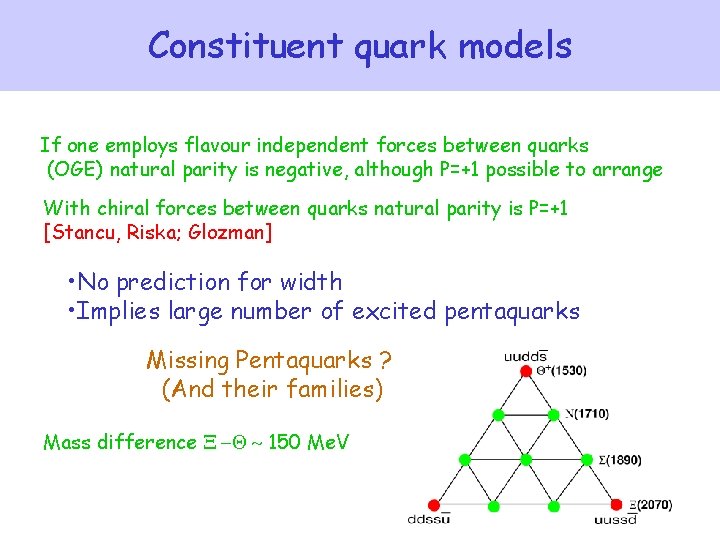
Constituent quark models If one employs flavour independent forces between quarks (OGE) natural parity is negative, although P=+1 possible to arrange With chiral forces between quarks natural parity is P=+1 [Stancu, Riska; Glozman] • No prediction for width • Implies large number of excited pentaquarks Missing Pentaquarks ? (And their families) Mass difference X -Q ~ 150 Me. V
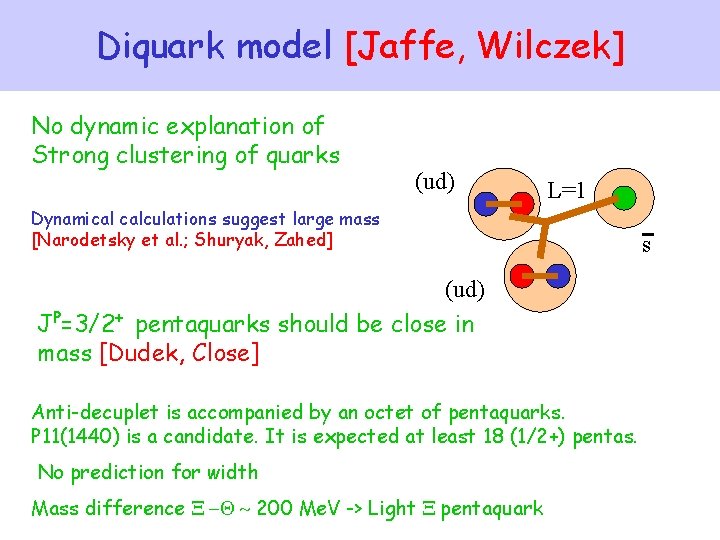
Diquark model [Jaffe, Wilczek] No dynamic explanation of Strong clustering of quarks (ud) L=1 Dynamical calculations suggest large mass [Narodetsky et al. ; Shuryak, Zahed] (ud) JP=3/2+ pentaquarks should be close in mass [Dudek, Close] Anti-decuplet is accompanied by an octet of pentaquarks. P 11(1440) is a candidate. It is expected at least 18 (1/2+) pentas. No prediction for width Mass difference X -Q ~ 200 Me. V -> Light X pentaquark s
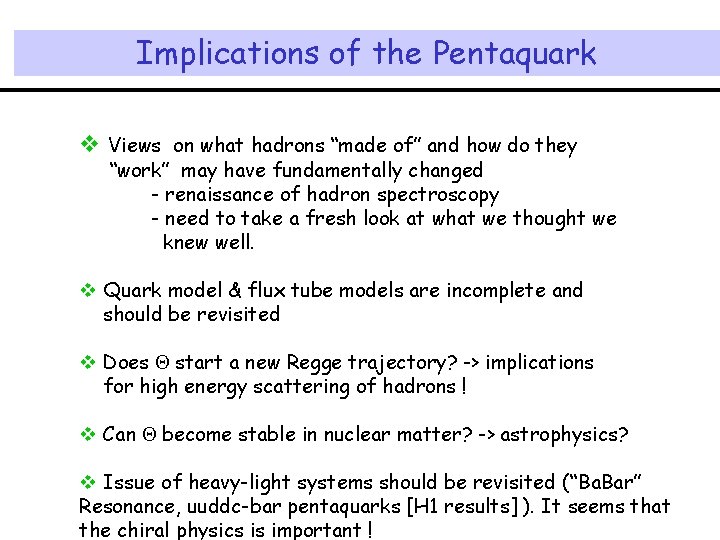
Implications of the Pentaquark v Views on what hadrons “made of” and how do they “work” may have fundamentally changed - renaissance of hadron spectroscopy - need to take a fresh look at what we thought we knew well. v Quark model & flux tube models are incomplete and should be revisited v Does Q start a new Regge trajectory? -> implications for high energy scattering of hadrons ! v Can Q become stable in nuclear matter? -> astrophysics? v Issue of heavy-light systems should be revisited (“Ba. Bar” Resonance, uuddc-bar pentaquarks [H 1 results] ). It seems that the chiral physics is important !
uuddc* pentaquark mass is NOT MQ + mc –ms like in QM but rather MQ + mc + M, i. e. 3000 – 3200 Me. V, 200 -300 Me. V above QM The point is that neither c* nor qqqq can be „hidden“ in a chiral excitation
Summary q Assuming that chiral forces are essential in binding of quarks one gets the lowest baryon multiplets (8, 1/2+), (10, 3/2+), (anti-10, 1/2+) whose properties are related by symmetry q Predicted Q pentaquark is light NOT because it is a sum of 5 constituent quark masses but rather a collective excitation of the mean chiral field. It is narrow for the same reason q Where are family members accompaning the pentaquark Are these “well established 3 -quark states”? Or we should look for new “missing resonances”? Or we should reconsider fundamentally our view on spectroscopy?
Surely new discoveries are waiting us around the corner !