
Pentaquark Surprise Recent Observation of Fivequark Resonance at
Penta-quark Surprise - Recent Observation of Five-quark Resonance at SPring-8/LEPS Experiment Wen-Chen Chang 章文箴 中央研究院 物理研究所
Outline • Hadrons in the quark models. • Exotic multi-quark states. • LEPS experiment at SPring-8, Japan. – Photoproduction of mesons. – Beam asymmetry of K+ photo-production. – + resonance. • Theoretical interpretations. • Outlook.
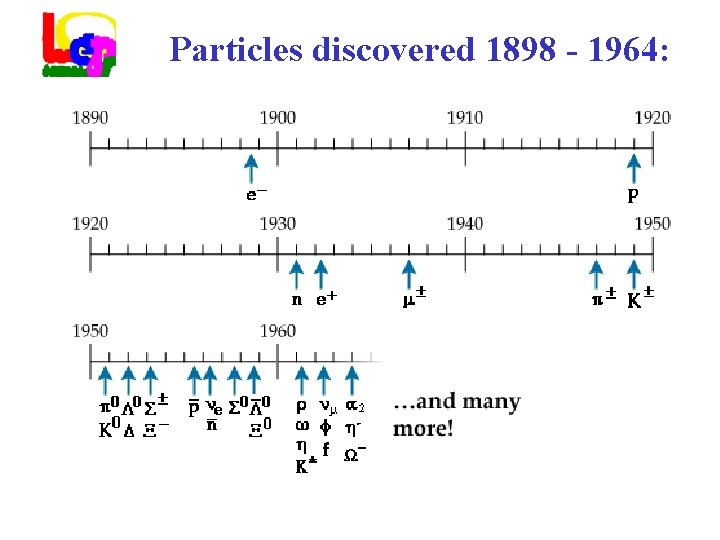
Particles discovered 1898 - 1964:
Back to Year 1964 • A hundred or so types of particles were identified: – Baryons (fermion): n, p, , …. – Mesons (boson) : , , …. . • Murray Gell-Mann (Mendeleev of elementary particle physics) proposed “the eightfold way” to put these particles in order, suggesting more elementary constituents: quarks. – There are three types of quarks, u, d and s. – Every baryon is composed of three quarks. – Every meson is composed of a quark and an antiquark.
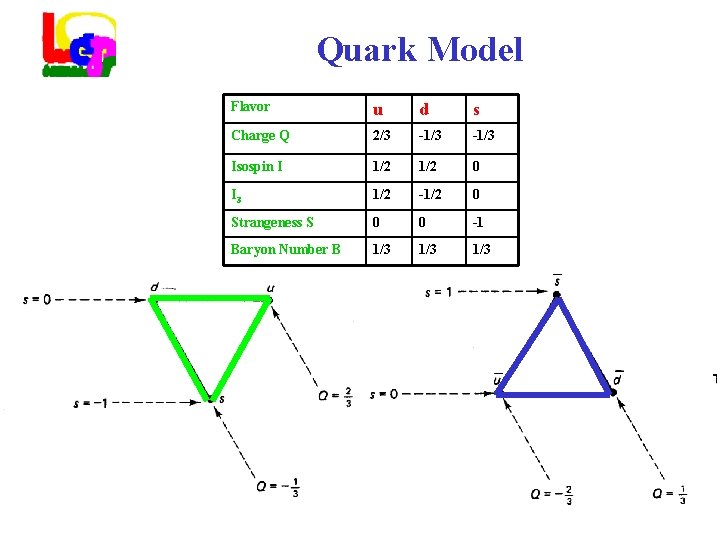
Quark Model Flavor u d s Charge Q 2/3 -1/3 Isospin I 1/2 0 I 3 1/2 -1/2 0 Strangeness S 0 0 -1 Baryon Number B 1/3 1/3
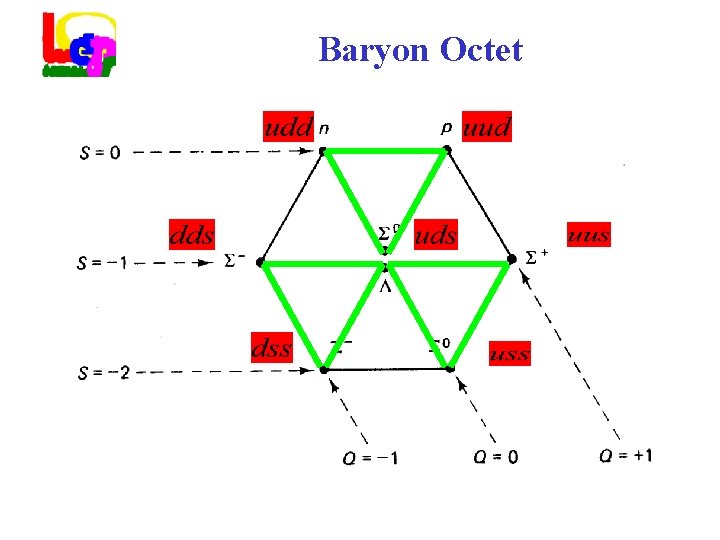
Baryon Octet
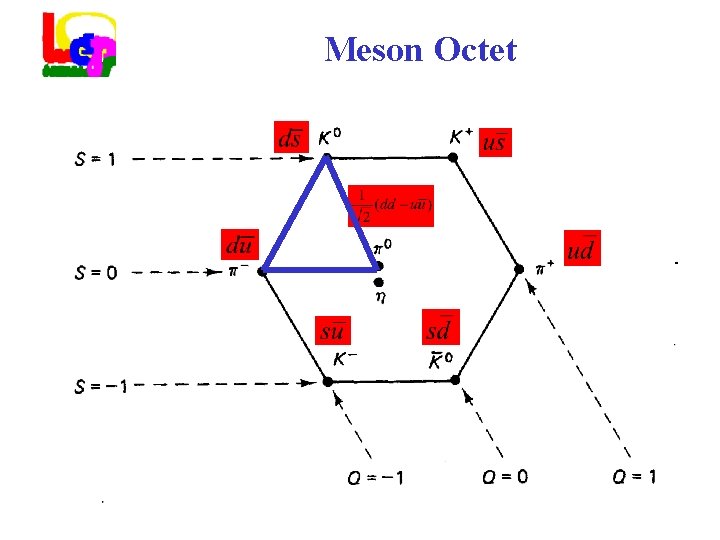
Meson Octet
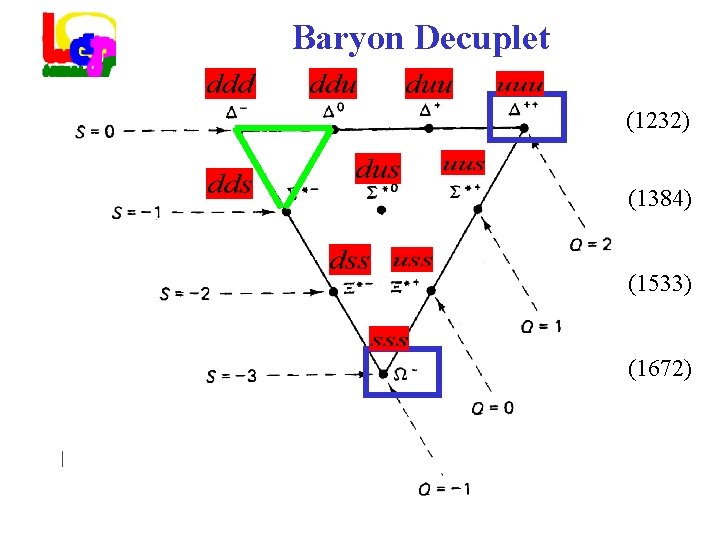
Baryon Decuplet (1232) (1384) (1533) (1672)
The Color Space • The overall wave function is product of space*flavor*spin. Pauli principle requires an antisymmetric wave function for a fermion system. • The quark configuration of ++(1232) is (uuu) and s=3/2. The wave function is symmetric in flavor, spin and space. • Introduce another degree of freedom (strong interaction charge), COLOR, to quarks and each quark in ++ has different color (uuu), but the system overall has to be colorless or white. • Fundamental theory of describing “the Strong Interaction”: Quantum Chromo Dynamics (QCD).
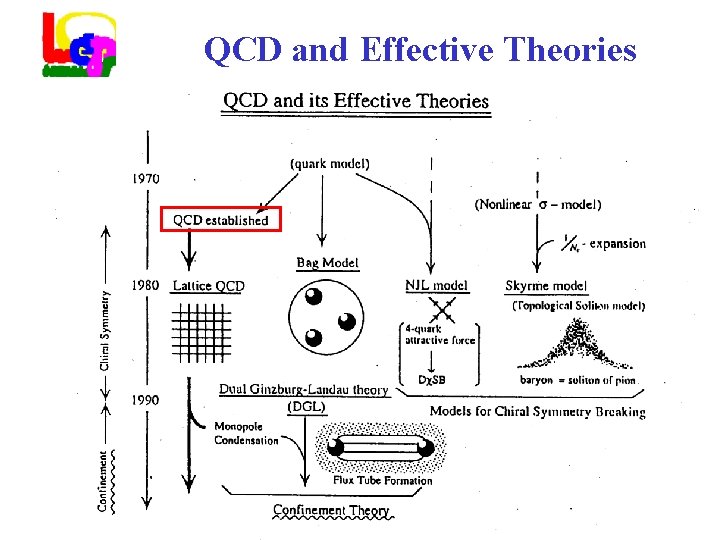
QCD and Effective Theories
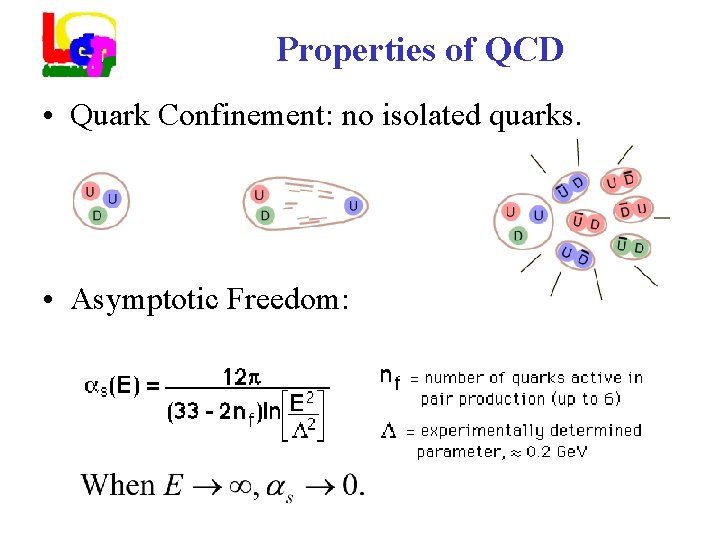
Properties of QCD • Quark Confinement: no isolated quarks. • Asymptotic Freedom:
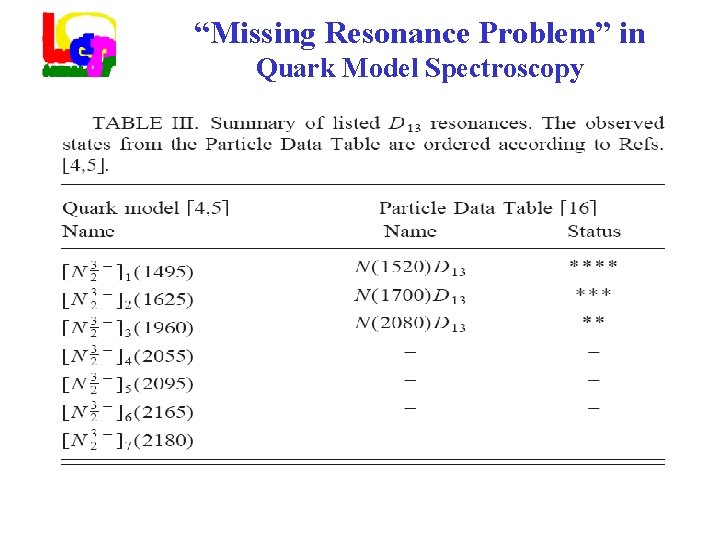
“Missing Resonance Problem” in Quark Model Spectroscopy
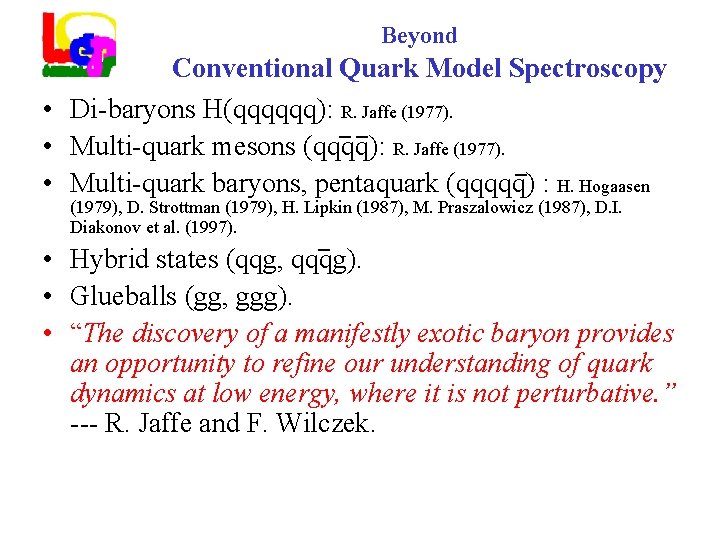
Beyond Conventional Quark Model Spectroscopy • Di-baryons H(qqqqqq): R. Jaffe (1977). • Multi-quark mesons (qqqq): ¯ ¯ R. Jaffe (1977). • Multi-quark baryons, pentaquark (qqqqq) ¯ : H. Hogaasen (1979), D. Strottman (1979), H. Lipkin (1987), M. Praszalowicz (1987), D. I. Diakonov et al. (1997). • Hybrid states (qqg, qqqg). ¯ • Glueballs (gg, ggg). • “The discovery of a manifestly exotic baryon provides an opportunity to refine our understanding of quark dynamics at low energy, where it is not perturbative. ” --- R. Jaffe and F. Wilczek.
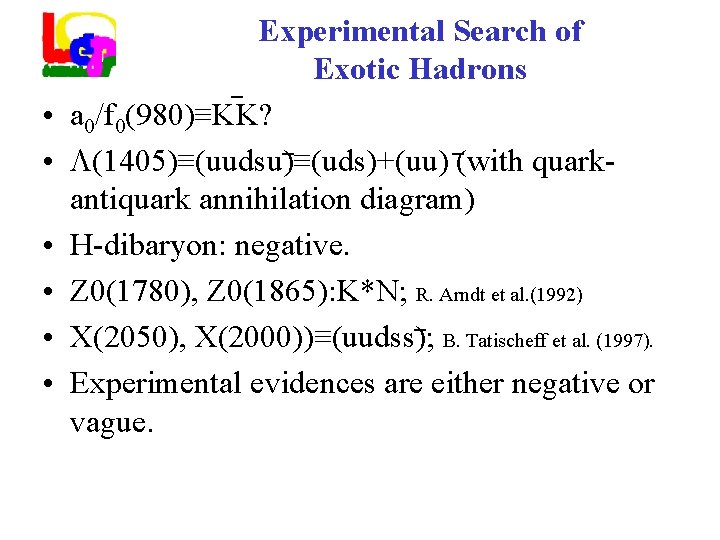
• • • Experimental Search of Exotic Hadrons ¯ a 0/f 0(980)≡KK? (1405)≡(uudsu)≡(uds)+(uu) ¯ ¯(with quarkantiquark annihilation diagram) H-dibaryon: negative. Z 0(1780), Z 0(1865): K*N; R. Arndt et al. (1992) X(2050), X(2000))≡(uudss); ¯ B. Tatischeff et al. (1997). Experimental evidences are either negative or vague.
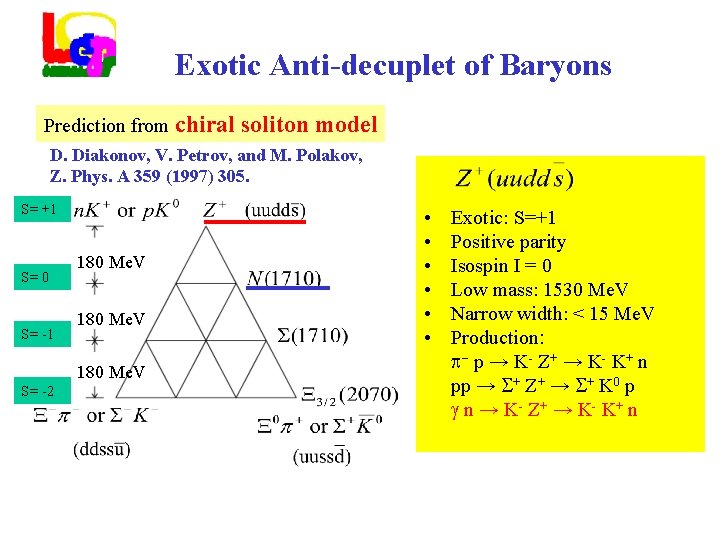
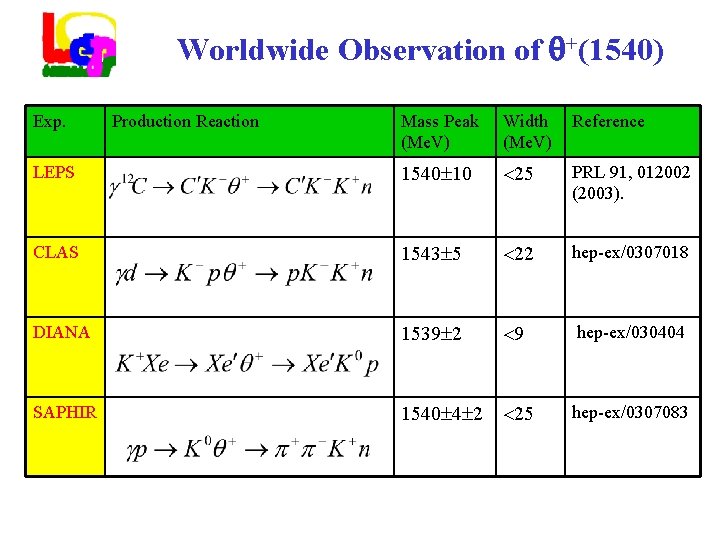
Exotic Anti-decuplet of Baryons Prediction from chiral soliton model D. Diakonov, V. Petrov, and M. Polakov, Z. Phys. A 359 (1997) 305. S= +1 S= 0 S= -1 180 Me. V S= -2 • • • Exotic: S=+1 Positive parity Isospin I = 0 Low mass: 1530 Me. V Narrow width: < 15 Me. V Production: p → K- Z + → K- K+ n pp → + Z+ → + K 0 p n → K- Z + → K- K+ n
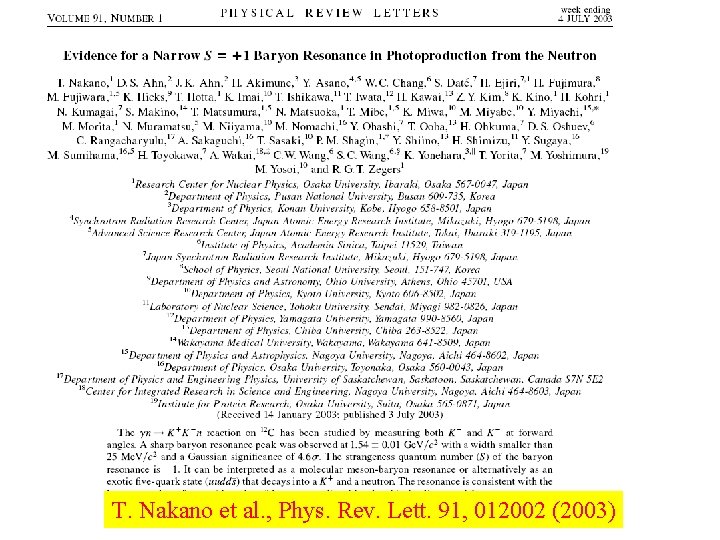
T. Nakano et al. , Phys. Rev. Lett. 91, 012002 (2003)
Worldwide Observation of +(1540) Exp. Production Reaction Mass Peak (Me. V) Width (Me. V) Reference LEPS 1540 10 25 PRL 91, 012002 (2003). CLAS 1543 5 22 hep-ex/0307018 DIANA 1539 2 9 hep-ex/030404 SAPHIR 1540 4 2 25 hep-ex/0307083
LEPS Collaboration RCNP, Osaka University, Japan H. Fujimura, M. Fujiwara, T. Hotta, H. Kohri, T. Matsumura, N. Matsuoka, T. Mibe, M. Morita, T. Nakano, T. Yorita Osaka University, Japan N. Nomachi, A. Sakaguchi, Y. Sugaya, M. Sumihama Academia Sinica, Taiwan W. C. Chang, D. S. Oshuev, C. W. Wang, S. C. Wang Chiba University, Japan H. Kawai, T. Ooba, Y. Shiino IHEP, Russia P. Shagin JAERI, Japan Y. Asano, N. Muramatsu, R. G. T. Zegers JASRI, Japan S. Date, N. Kumagai, Y. Ohashi, H. Ookuma Konan University, Japan H. Akimune Kyoto University, Japan K. Imai, T. Ishikawa, M. Miyabe, M. Niiyamma , M. Yosoi Nagoya University, Japan S. Fukui, T. Iwata, Y. Miyachi, A. Wakai Ohio University, U. S. K. Hicks Pusan National University, S. Korea J. K. Ahn Saskatchewan University, Canada C. Rangacharyulu Tohoku University, Japan H. Shimizu Wakayam Med. University, Japan S. Makino
Super Photon Ring 8 Ge. V (SPring-8)
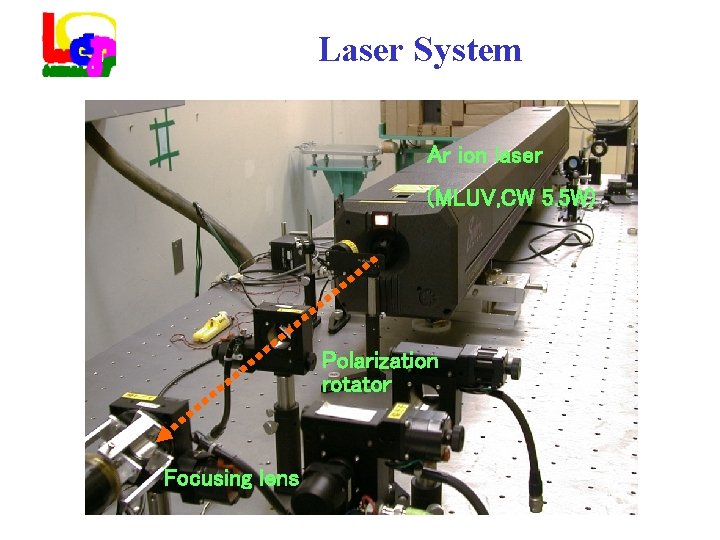
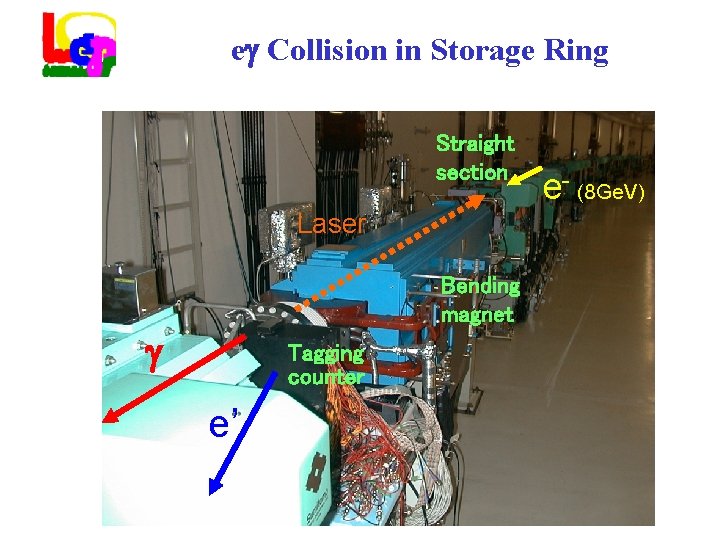
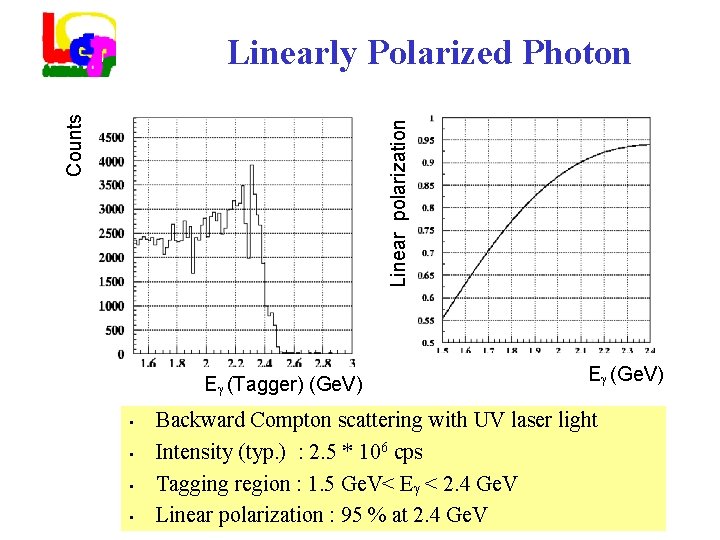
Ge. V Photon from Backward Compton Scattering
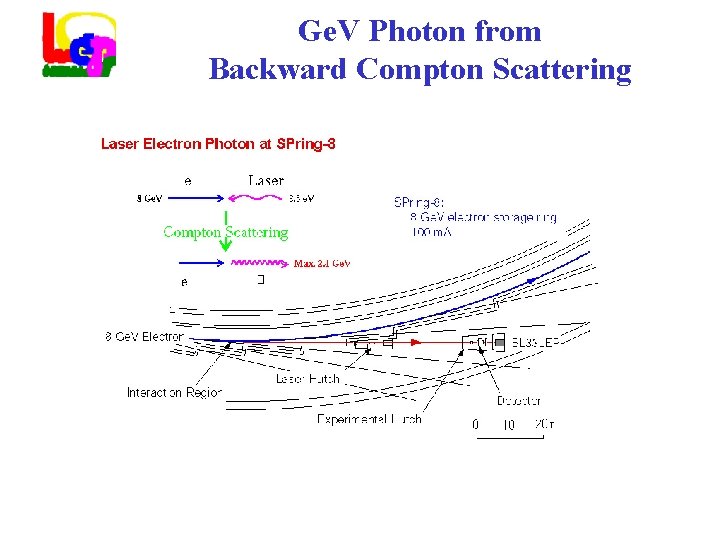
Laser System Ar ion laser (MLUV, CW 5. 5 W) Polarization rotator Focusing lens
e Collision in Storage Ring Straight section Laser Bending magnet Tagging counter e’ e- (8 Ge. V)
Linear polarization Counts Linearly Polarized Photon E (Tagger) (Ge. V) • • E (Ge. V) Backward Compton scattering with UV laser light Intensity (typ. ) : 2. 5 * 106 cps Tagging region : 1. 5 Ge. V< E < 2. 4 Ge. V Linear polarization : 95 % at 2. 4 Ge. V
Experimental Hutch
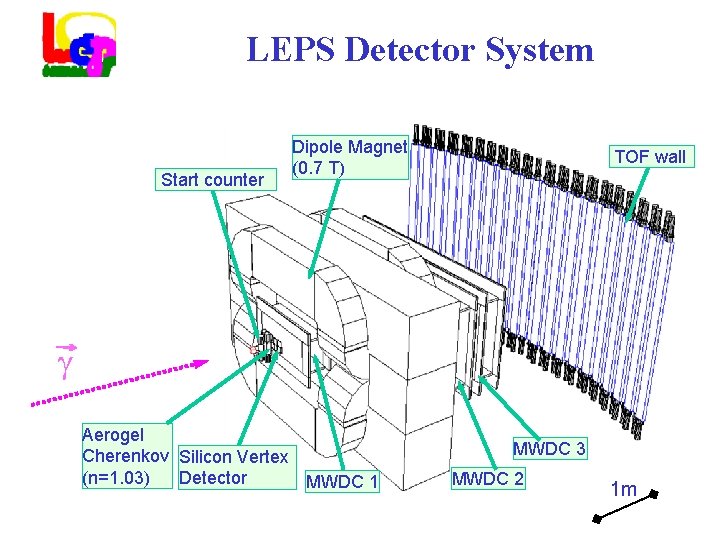
LEPS Detector System Start counter Dipole Magnet (0. 7 T) TOF wall Aerogel Cherenkov Silicon Vertex (n=1. 03) Detector MWDC 1 MWDC 3 MWDC 2 1 m
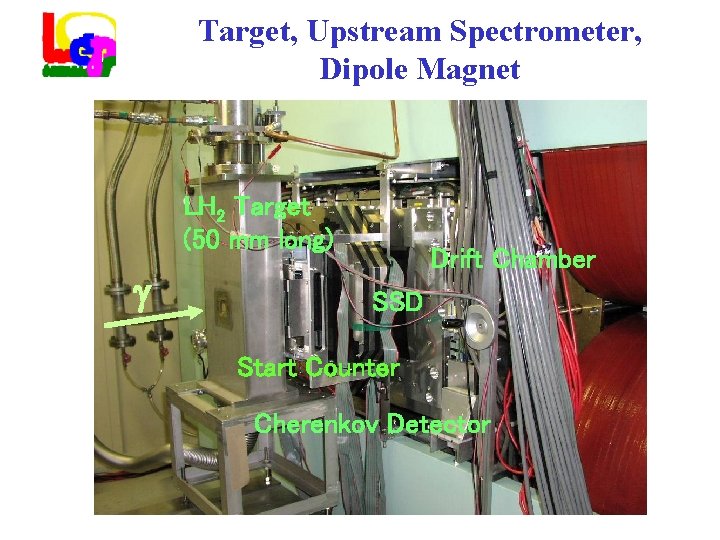
Target, Upstream Spectrometer, Dipole Magnet LH 2 Target (50 mm long) Drift Chamber SSD Start Counter Cherenkov Detector
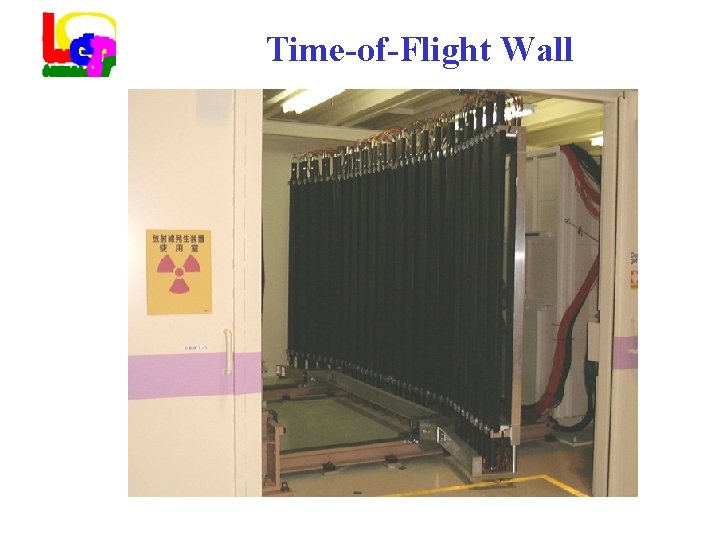
Time-of-Flight Wall
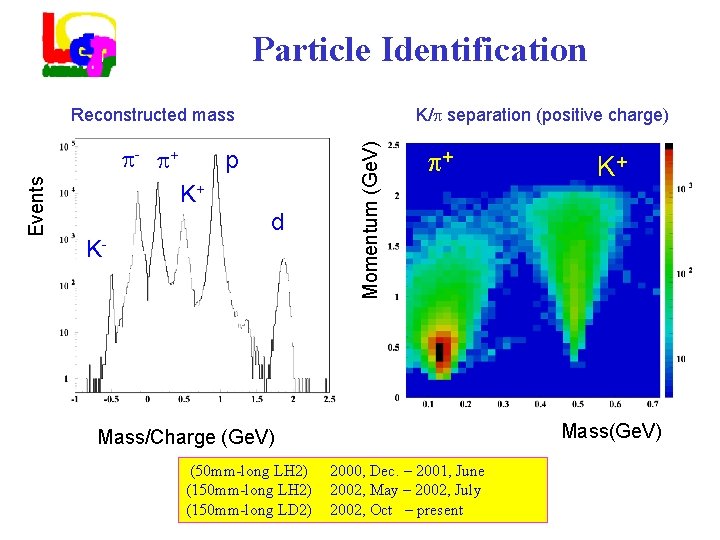
Particle Identification K/ separation (positive charge) Events - + p K+ K- d Momentum (Ge. V) Reconstructed mass + Mass(Ge. V) Mass/Charge (Ge. V) (50 mm-long LH 2) (150 mm-long LD 2) K+ 2000, Dec. – 2001, June 2002, May – 2002, July 2002, Oct – present
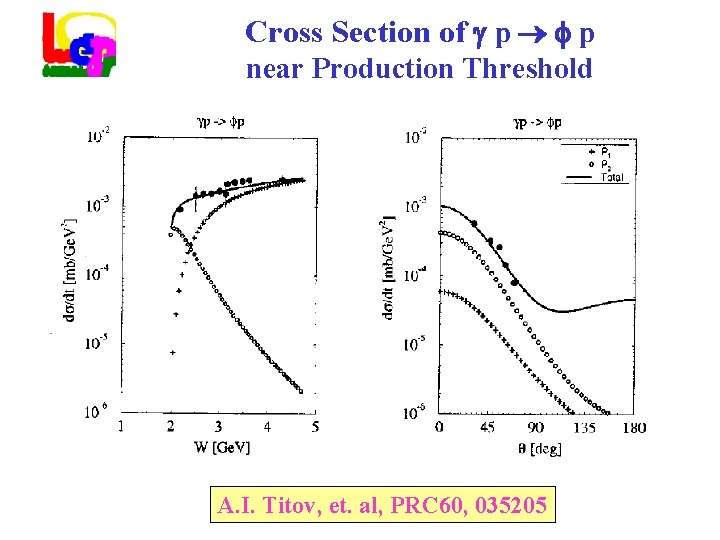
Cross Section of p p near Production Threshold A. I. Titov, et. al, PRC 60, 035205
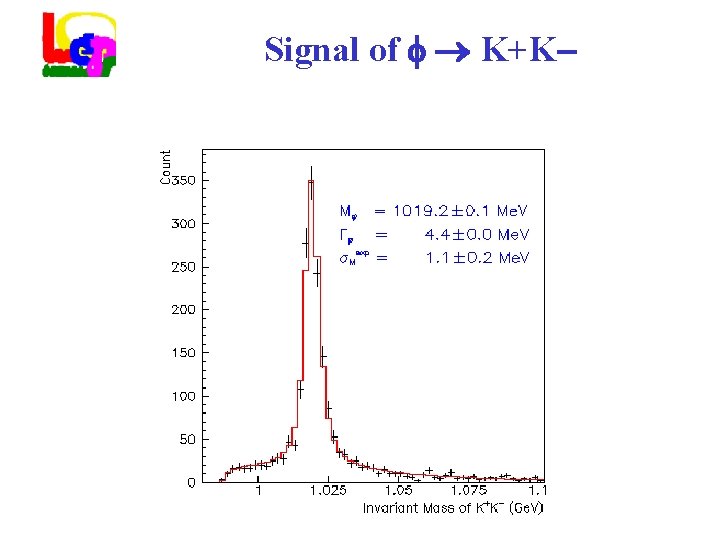
Signal of K+K
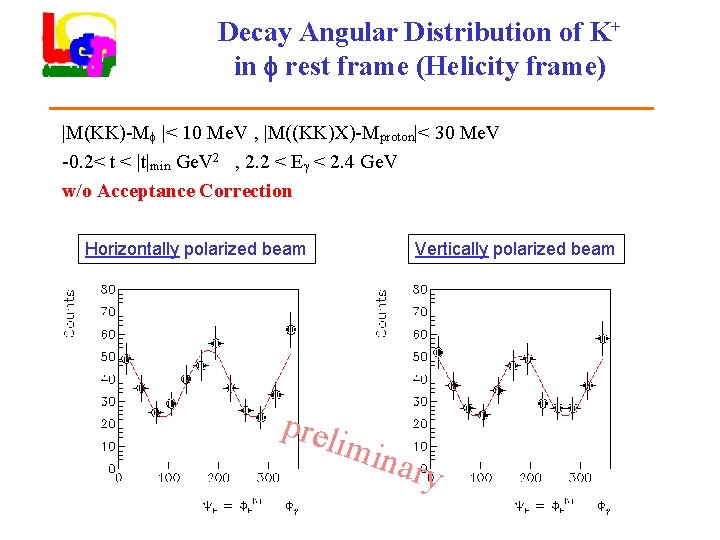
Decay Angular Distribution of K+ in rest frame (Helicity frame) |M(KK)-M |< 10 Me. V , |M((KK)X)-Mproton|< 30 Me. V -0. 2< t < |t|min Ge. V 2 , 2. 2 < E < 2. 4 Ge. V w/o Acceptance Correction Horizontally polarized beam prel Vertically polarized beam imin ary
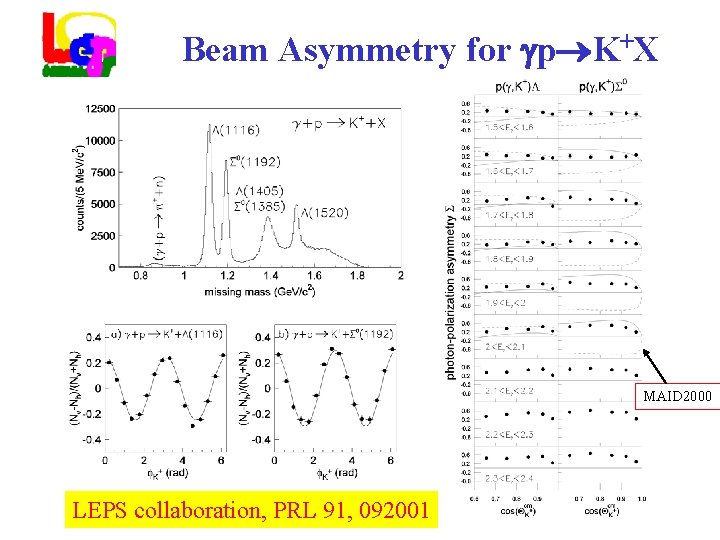
Beam Asymmetry for p K+X MAID 2000 LEPS collaboration, PRL 91, 092001
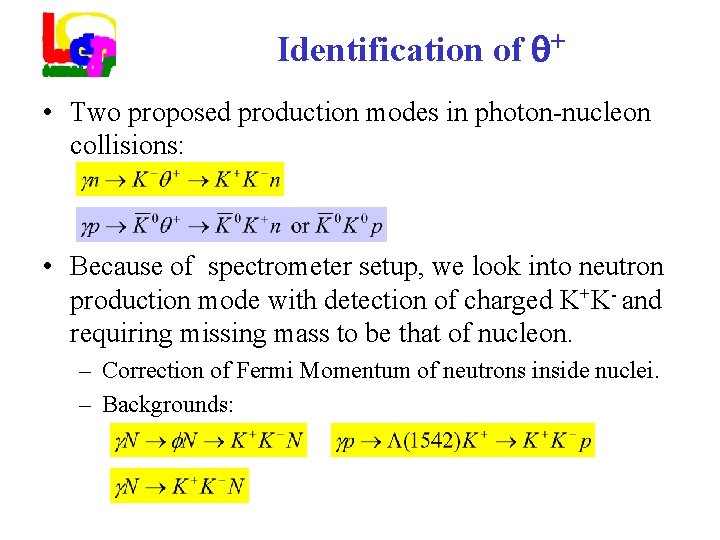
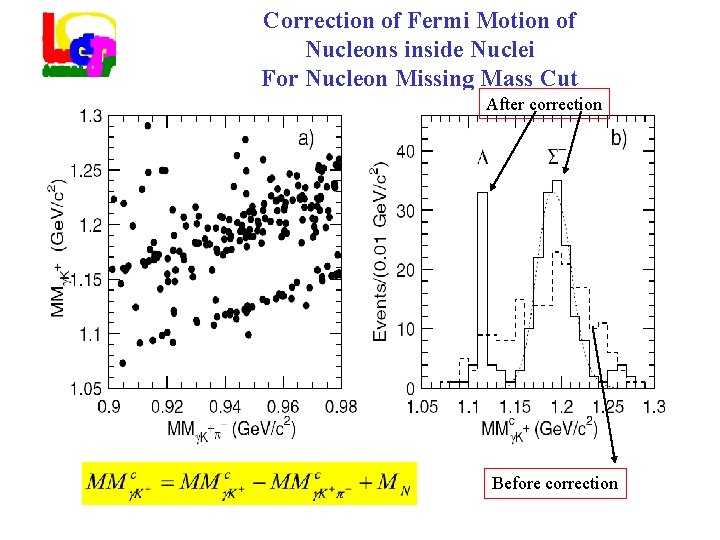
Identification of + • Two proposed production modes in photon-nucleon collisions: • Because of spectrometer setup, we look into neutron production mode with detection of charged K+K- and requiring missing mass to be that of nucleon. – Correction of Fermi Momentum of neutrons inside nuclei. – Backgrounds:
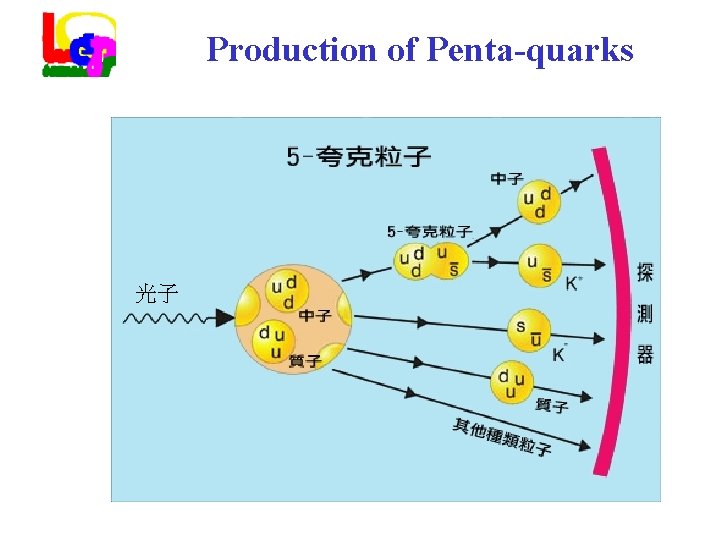
Production of Penta-quarks 光子
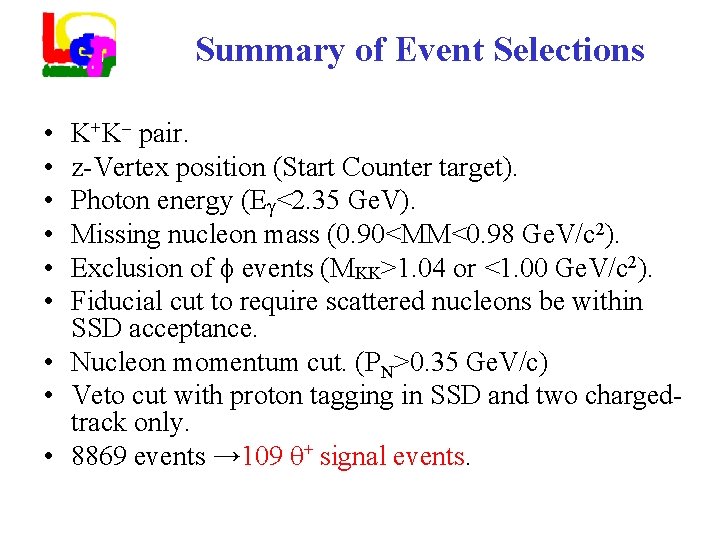
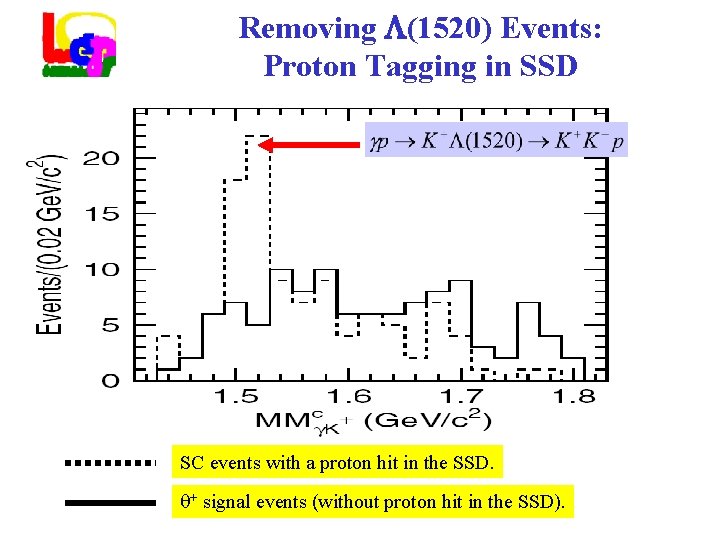
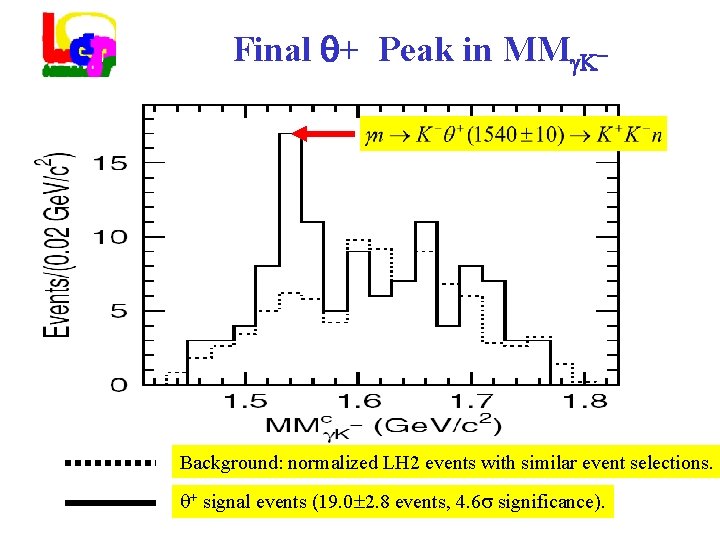
Summary of Event Selections K+K pair. z-Vertex position (Start Counter target). Photon energy (E <2. 35 Ge. V). Missing nucleon mass (0. 90<MM<0. 98 Ge. V/c 2). Exclusion of events (MKK>1. 04 or <1. 00 Ge. V/c 2). Fiducial cut to require scattered nucleons be within SSD acceptance. • Nucleon momentum cut. (PN>0. 35 Ge. V/c) • Veto cut with proton tagging in SSD and two chargedtrack only. • 8869 events → 109 + signal events. • • •
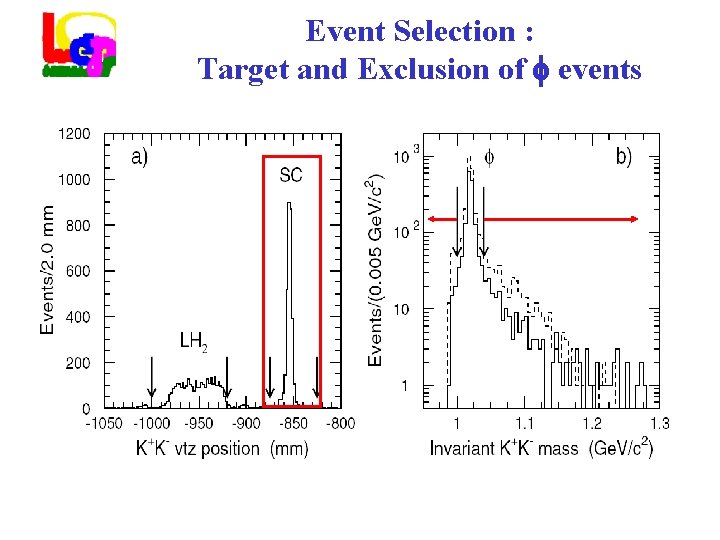
Event Selection : Target and Exclusion of events
Correction of Fermi Motion of Nucleons inside Nuclei For Nucleon Missing Mass Cut After correction Before correction
Removing (1520) Events: Proton Tagging in SSD SC events with a proton hit in the SSD. + signal events (without proton hit in the SSD).
Final + Peak in MM Background: normalized LH 2 events with similar event selections. + signal events (19. 0 2. 8 events, 4. 6 significance).
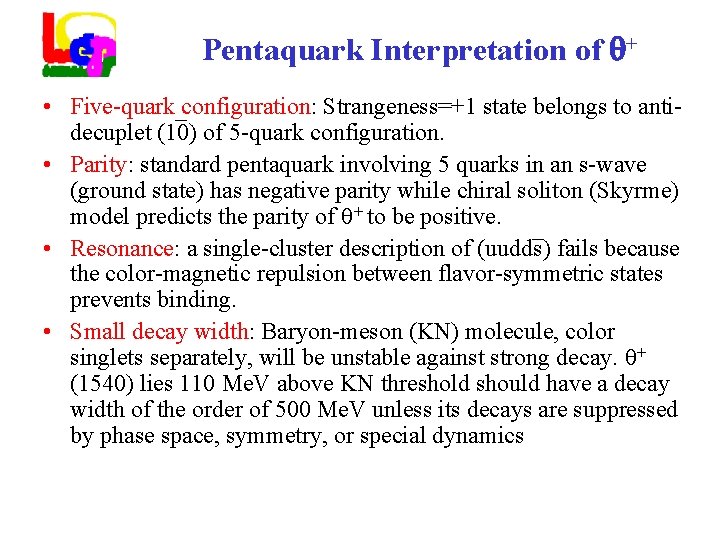
Pentaquark Interpretation of + • Five-quark configuration: Strangeness=+1 state belongs to anti decuplet (10) of 5 -quark configuration. • Parity: standard pentaquark involving 5 quarks in an s-wave (ground state) has negative parity while chiral soliton (Skyrme) model predicts the parity of + to be positive. fails because • Resonance: a single-cluster description of (uudds) the color-magnetic repulsion between flavor-symmetric states prevents binding. • Small decay width: Baryon-meson (KN) molecule, color singlets separately, will be unstable against strong decay. + (1540) lies 110 Me. V above KN threshold should have a decay width of the order of 500 Me. V unless its decays are suppressed by phase space, symmetry, or special dynamics
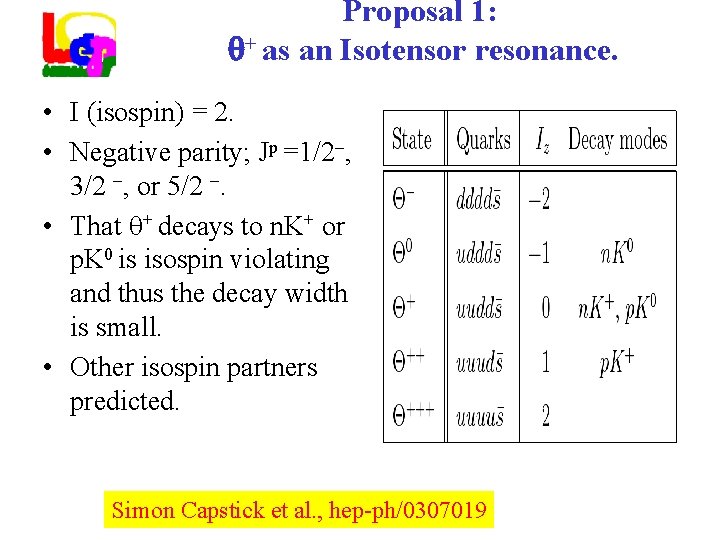
Proposal 1: + as an Isotensor resonance. • I (isospin) = 2. • Negative parity; Jp =1/2 , 3/2 , or 5/2 . • That + decays to n. K+ or p. K 0 is isospin violating and thus the decay width is small. • Other isospin partners predicted. Simon Capstick et al. , hep-ph/0307019
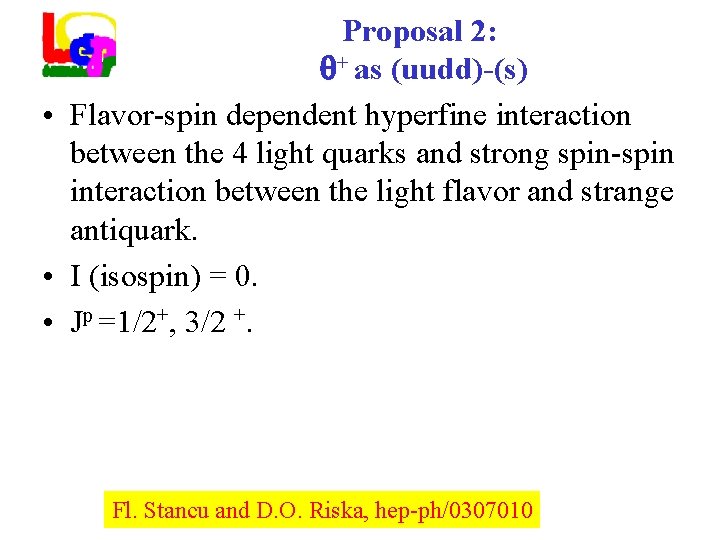
Proposal 2: + as (uudd)-(s) • Flavor-spin dependent hyperfine interaction between the 4 light quarks and strong spin-spin interaction between the light flavor and strange antiquark. • I (isospin) = 0. • Jp =1/2+, 3/2 +. Fl. Stancu and D. O. Riska, hep-ph/0307010
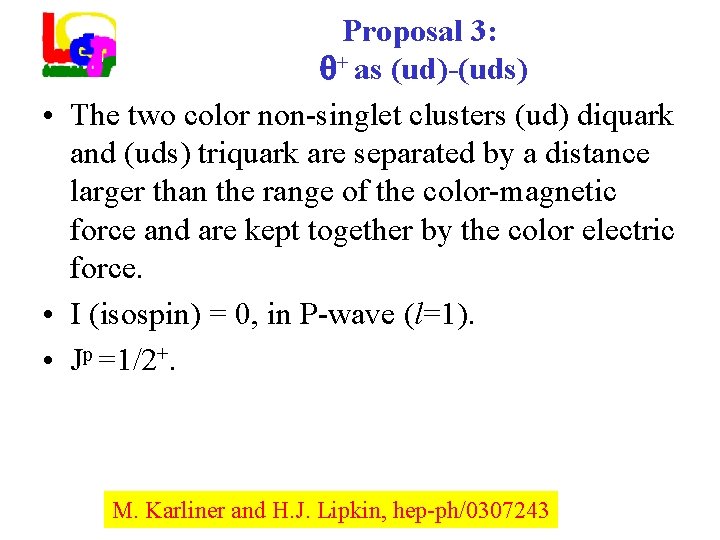
Proposal 3: + as (ud)-(uds) • The two color non-singlet clusters (ud) diquark and (uds) triquark are separated by a distance larger than the range of the color-magnetic force and are kept together by the color electric force. • I (isospin) = 0, in P-wave (l=1). • Jp =1/2+. M. Karliner and H. J. Lipkin, hep-ph/0307243
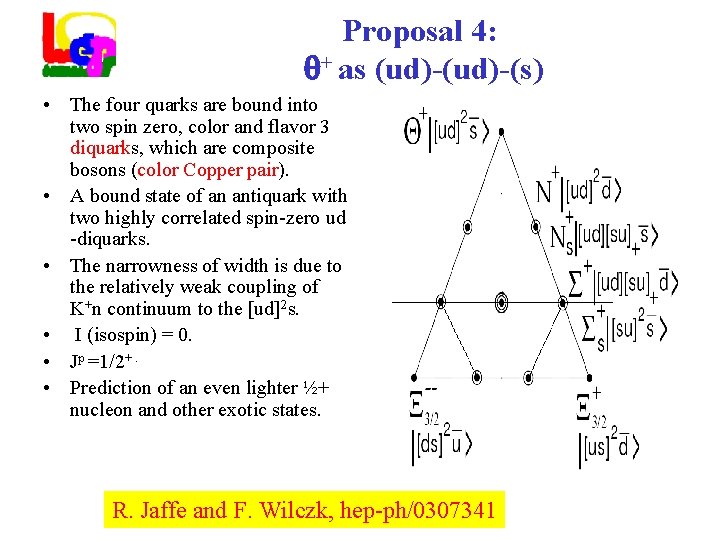
Proposal 4: + as (ud)-(s) • The four quarks are bound into two spin zero, color and flavor 3 diquarks, which are composite bosons (color Copper pair). • A bound state of an antiquark with two highly correlated spin-zero ud -diquarks. • The narrowness of width is due to the relatively weak coupling of K+n continuum to the [ud]2 s. • I (isospin) = 0. • Jp =1/2+. • Prediction of an even lighter ½+ nucleon and other exotic states. R. Jaffe and F. Wilczk, hep-ph/0307341
Summary and Outlook (1) • The pentaquark surprise triggers new efforts in understanding how the strong interaction binds quarks and gluons into hadrons. • The quantum numbers of + , like spin, parity and isospin, and total decay width, are desirable to be determined experimentally soon. • Look for the other possible five-quark states (predicted by theory). • Identity these exotic states in lattice QCD.
Summary and Outlook (2) • JLAB approved one-month beam time in yr 2004 for the study of +. • About LEPS/SPring-8: – Analyzing data from 150 -cm long LH 2 and LD targets for more statistics. – New physics programs with Time-Projection-Chamber (2003 -2004). • Nuclear medium effect of mesons produced in nuclei. • Property of (1405). – Plan of constructing another beam line for study of pentaquark. – Construct a new TPC to accommodate LH 2 or LD targets.
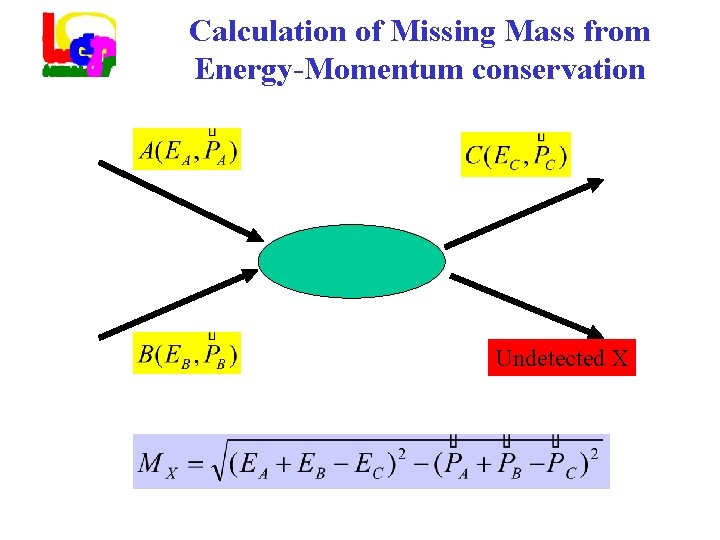
Calculation of Missing Mass from Energy-Momentum conservation Undetected X
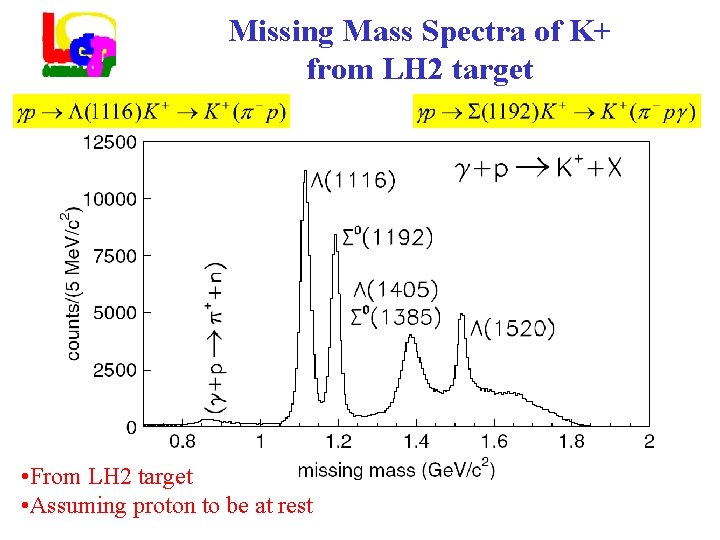
Missing Mass Spectra of K+ from LH 2 target • From LH 2 target • Assuming proton to be at rest
- Slides: 48