
Pensions at a Crossroads Hedging Liability Risk and
Pensions at a Crossroads – Hedging Liability Risk and Generating Investment Return Aaron H. Meder, FSA, EA Head of Asset-Liability Investment Solutions, Americas Drew Carrington, CFA Senior US Fixed Income Portfolio Manager December 5, 2006, 11: 00 am - 11: 40 am Not intended for public distribution. For important additional information, please see the Additional Disclosures at the end of the presentation.
Agenda Focus on funding ratio Case example Implementation — a better benchmark — hedging strategies — absolute return Appendix 2
Focus on funding ratio 3

The case for liability-driven investing Drop in equity markets lowered plan asset levels Funding levels reduced during the “perfect storm” of 2000 -2002 Pension reform increases attention to funding ratio volatility Increased short-term volatility Growing interest in the relationship between liability structure and market value of plan assets Increased focus on funding ratio Falling interest rates increased plan liabilities Large drop in funding ratios Greater incentive for sponsors to reduce pension funding volatility US-I
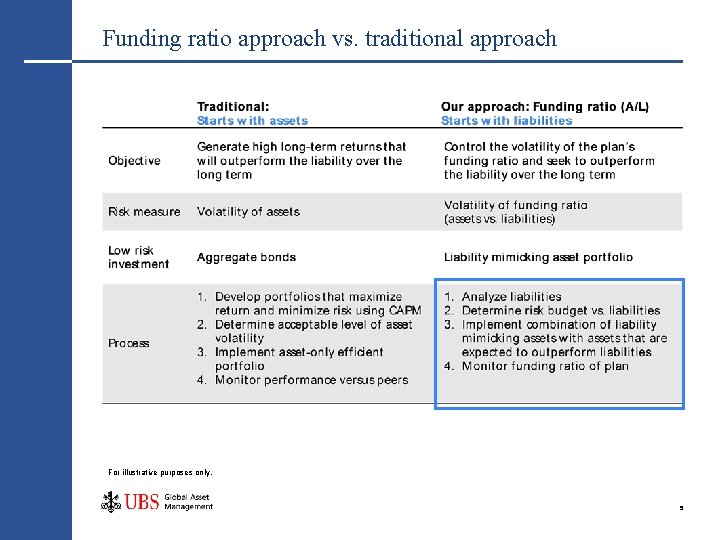
Funding ratio approach vs. traditional approach For illustrative purposes only. 5
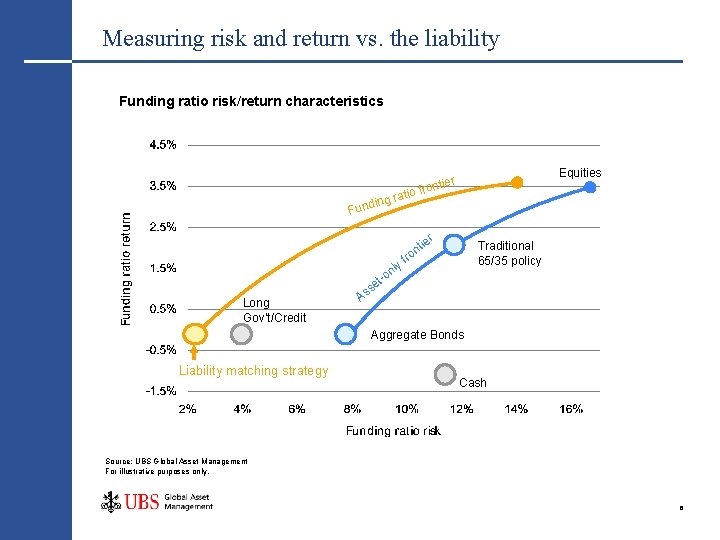
Measuring risk and return vs. the liability Funding ratio risk/return characteristics Fund Equities r ontie tio fr a ing r r y nl -t o se Long Gov’t/Credit ie nt o fr Traditional 65/35 policy As Aggregate Bonds Liability matching strategy Cash Source: UBS Global Asset Management For illustrative purposes only. 6
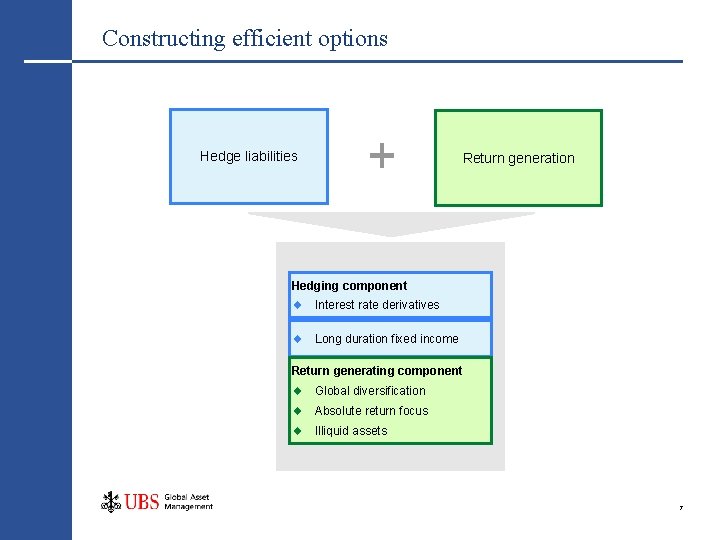
Constructing efficient options Hedge liabilities Return generation Hedging component Interest rate derivatives Long duration fixed income Return generating component Global diversification Absolute return focus Illiquid assets 7

Case example 8
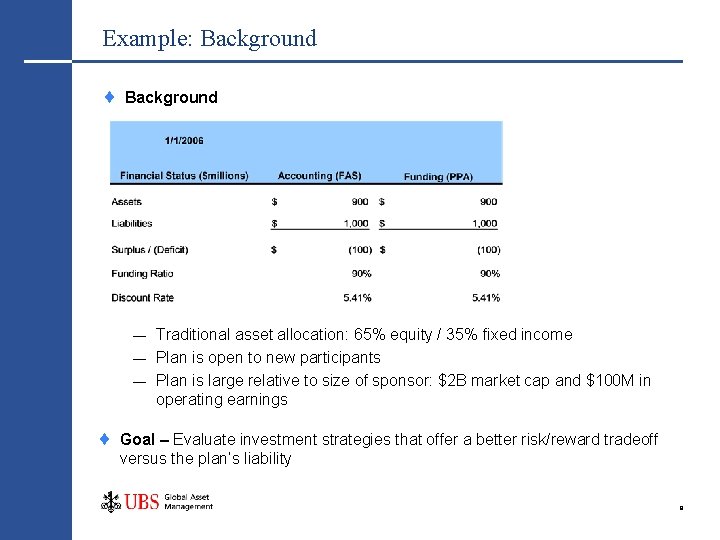
Example: Background Traditional asset allocation: 65% equity / 35% fixed income — Plan is open to new participants — Plan is large relative to size of sponsor: $2 B market cap and $100 M in operating earnings — Goal – Evaluate investment strategies that offer a better risk/reward tradeoff versus the plan’s liability 9
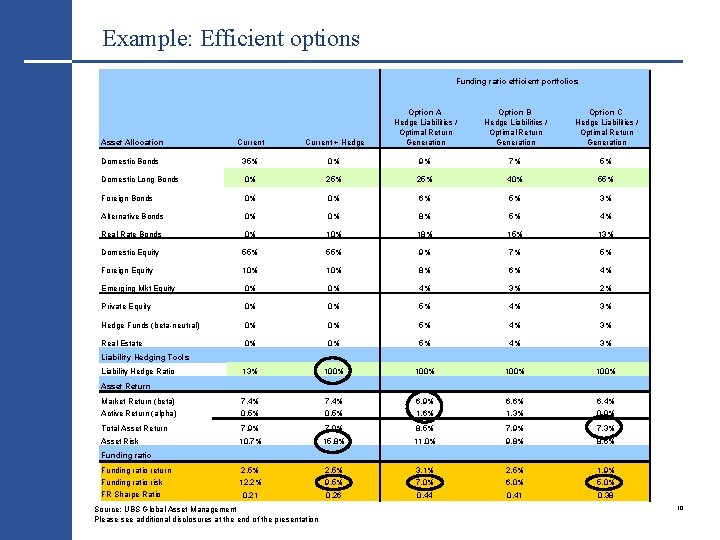
Example: Efficient options Funding ratio efficient portfolios Asset Allocation Current + Hedge Option A Hedge Liabilities / Optimal Return Generation Option B Hedge Liabilities / Optimal Return Generation Option C Hedge Liabilities / Optimal Return Generation Domestic Bonds 35% 0% 9% 7% 5% Domestic Long Bonds 0% 25% 40% 55% Foreign Bonds 0% 0% 6% 5% 3% Alternative Bonds 0% 0% 8% 5% 4% Real Rate Bonds 0% 18% 15% 13% Domestic Equity 55% 9% 7% 5% Foreign Equity 10% 8% 6% 4% Emerging Mkt Equity 0% 0% 4% 3% 2% Private Equity 0% 0% 5% 4% 3% Hedge Funds (beta-neutral) 0% 0% 5% 4% 3% Real Estate 0% 0% 5% 4% 3% 100% 100% Market Return (beta) 7. 4% 6. 9% 6. 6% 6. 4% Active Return (alpha) 0. 5% 1. 6% 1. 3% 0. 9% Total Asset Return 7. 9% 8. 5% 7. 9% 7. 3% Asset Risk 10. 7% 15. 8% 11. 0% 9. 8% 8. 6% Funding ratio return 2. 5% 3. 1% 2. 5% 1. 9% Funding ratio risk FR Sharpe Ratio 12. 2% 9. 5% 7. 0% 6. 0% 5. 0% 0. 21 0. 26 0. 44 0. 41 0. 38 Liability Hedging Tools Liability Hedge Ratio Asset Return Funding ratio Source: UBS Global Asset Management Please see additional disclosures at the end of the presentation 10
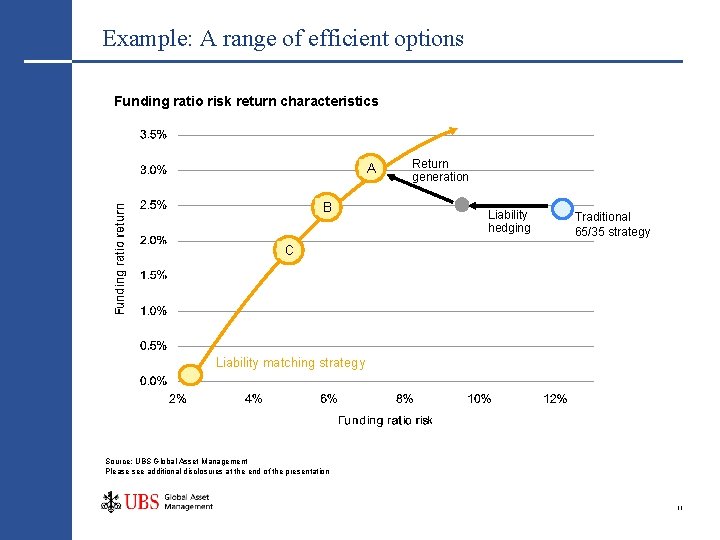
Example: A range of efficient options Funding ratio risk return characteristics A B Return generation Liability hedging Traditional 65/35 strategy C Liability matching strategy Source: UBS Global Asset Management Please see additional disclosures at the end of the presentation 11
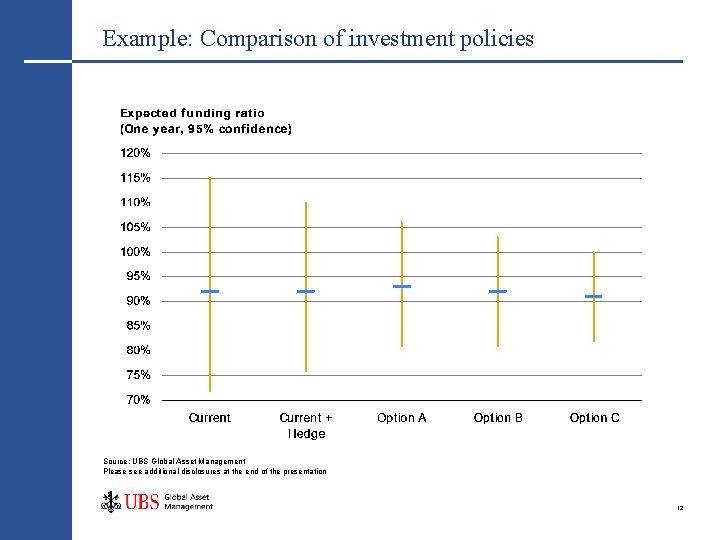
Example: Comparison of investment policies Source: UBS Global Asset Management Please see additional disclosures at the end of the presentation 12
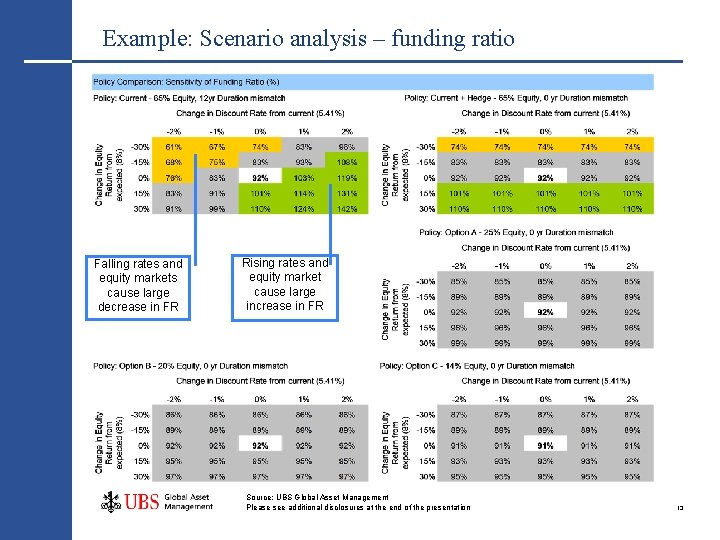
Example: Scenario analysis – funding ratio Falling rates and equity markets cause large decrease in FR Rising rates and equity market cause large increase in FR Source: UBS Global Asset Management Please see additional disclosures at the end of the presentation 13
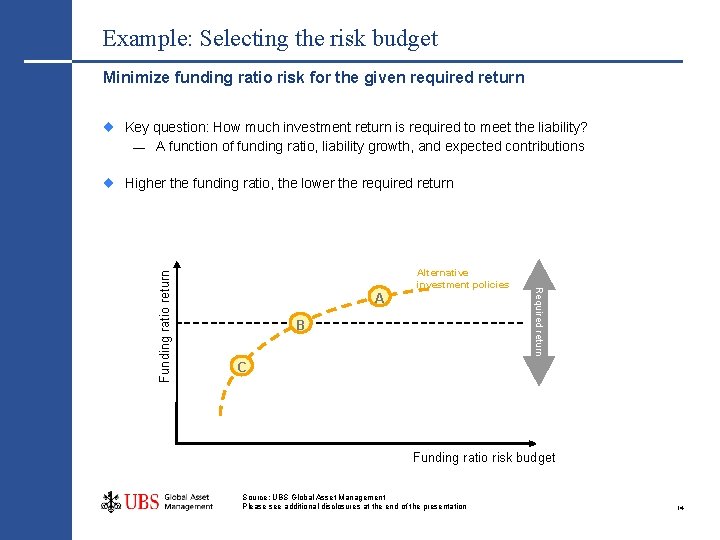
Example: Selecting the risk budget Minimize funding ratio risk for the given required return Key question: How much investment return is required to meet the liability? — A function of funding ratio, liability growth, and expected contributions Higher the funding ratio, the lower the required return Alternative investment policies A B Required return Funding ratio return C Funding ratio risk budget Source: UBS Global Asset Management Please see additional disclosures at the end of the presentation 14
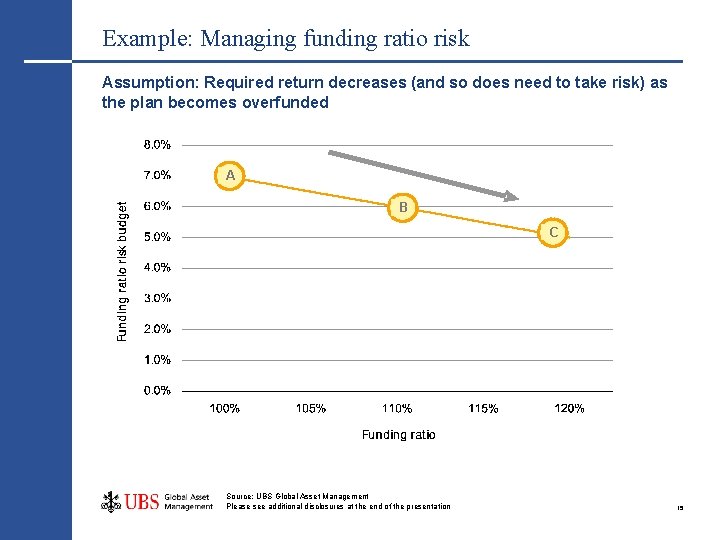
Example: Managing funding ratio risk Assumption: Required return decreases (and so does need to take risk) as the plan becomes overfunded A B C Source: UBS Global Asset Management Please see additional disclosures at the end of the presentation 15
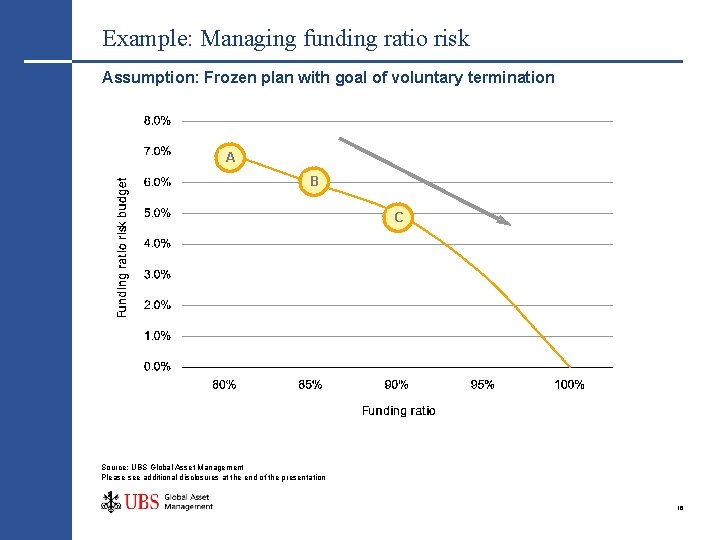
Example: Managing funding ratio risk Assumption: Frozen plan with goal of voluntary termination A B C Source: UBS Global Asset Management Please see additional disclosures at the end of the presentation 16
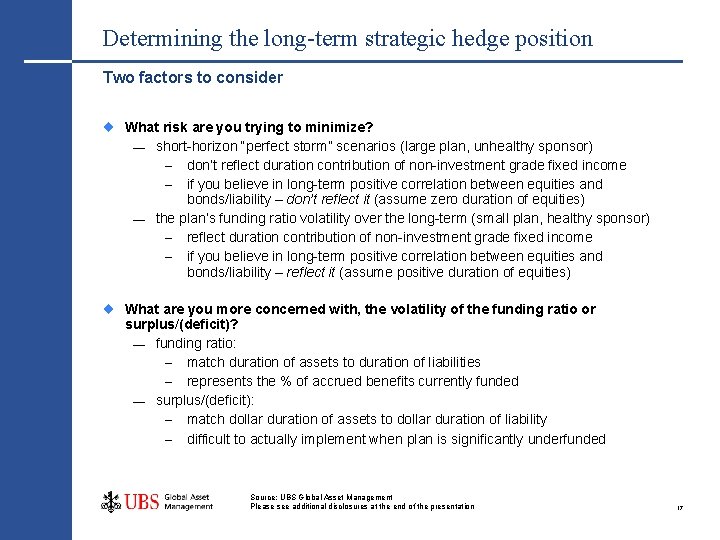
Determining the long-term strategic hedge position Two factors to consider What risk are you trying to minimize? — short-horizon “perfect storm” scenarios (large plan, unhealthy sponsor) – don’t reflect duration contribution of non-investment grade fixed income – if you believe in long-term positive correlation between equities and bonds/liability – don’t reflect it (assume zero duration of equities) — the plan’s funding ratio volatility over the long-term (small plan, healthy sponsor) – reflect duration contribution of non-investment grade fixed income – if you believe in long-term positive correlation between equities and bonds/liability – reflect it (assume positive duration of equities) What are you more concerned with, the volatility of the funding ratio or surplus/(deficit)? — funding ratio: – match duration of assets to duration of liabilities – represents the % of accrued benefits currently funded — surplus/(deficit): – match dollar duration of assets to dollar duration of liability – difficult to actually implement when plan is significantly underfunded Source: UBS Global Asset Management Please see additional disclosures at the end of the presentation 17
Implementation: A better fixed income benchmark i. Boxx US Pension Liability Indices 18
i. Boxx US Pension Liability indices i. Boxx US Pension Liability Index – Active Member, which mimics the performance of an active (i. e. , non-retired) member liability profile for a model traditional defined benefit plan in the US i. Boxx US Pension Liability Index – Retired Member, which will mimic the performance of a retired member liability profile for a model traditional defined benefit plan in the US i. Boxx US Pension Liability Index – Aggregate, which mimics the performance of a model (or typical) traditional defined benefit plan in the US The performance of all three indices reflect the passage of time and changes in the term structure of interest rates 19
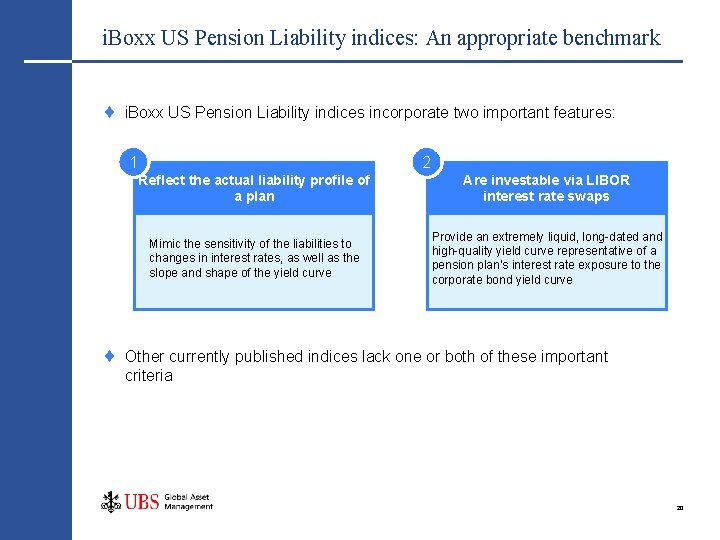
i. Boxx US Pension Liability indices: An appropriate benchmark i. Boxx US Pension Liability indices incorporate two important features: 1 2 Reflect the actual liability profile of a plan Are investable via LIBOR interest rate swaps Mimic the sensitivity of the liabilities to changes in interest rates, as well as the slope and shape of the yield curve Provide an extremely liquid, long-dated and high-quality yield curve representative of a pension plan’s interest rate exposure to the corporate bond yield curve Other currently published indices lack one or both of these important criteria 20
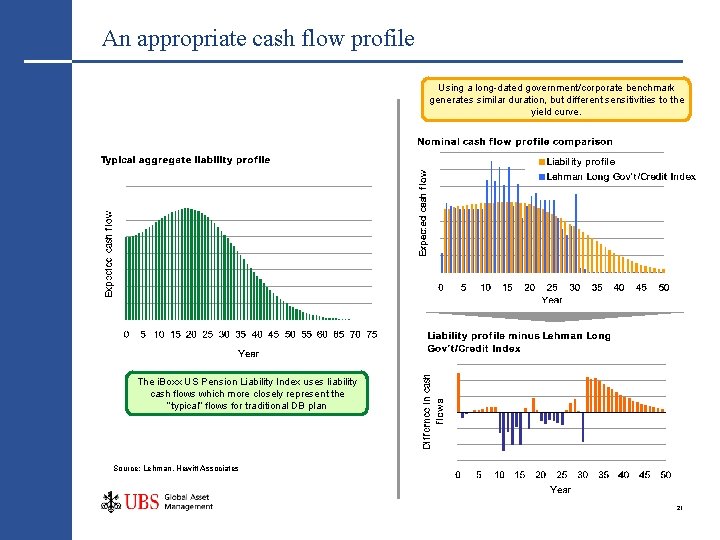
An appropriate cash flow profile Using a long-dated government/corporate benchmark generates similar duration, but different sensitivities to the yield curve. The i. Boxx US Pension Liability Index uses liability cash flows which more closely represent the “typical” flows for traditional DB plan Source: Lehman, Hewitt Associates 21
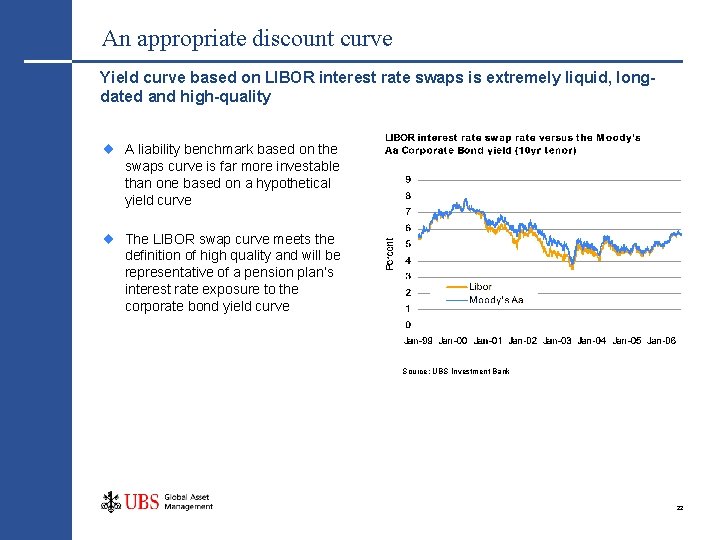
An appropriate discount curve Yield curve based on LIBOR interest rate swaps is extremely liquid, longdated and high-quality A liability benchmark based on the swaps curve is far more investable than one based on a hypothetical yield curve The LIBOR swap curve meets the definition of high quality and will be representative of a pension plan’s interest rate exposure to the corporate bond yield curve Source: UBS Investment Bank 22
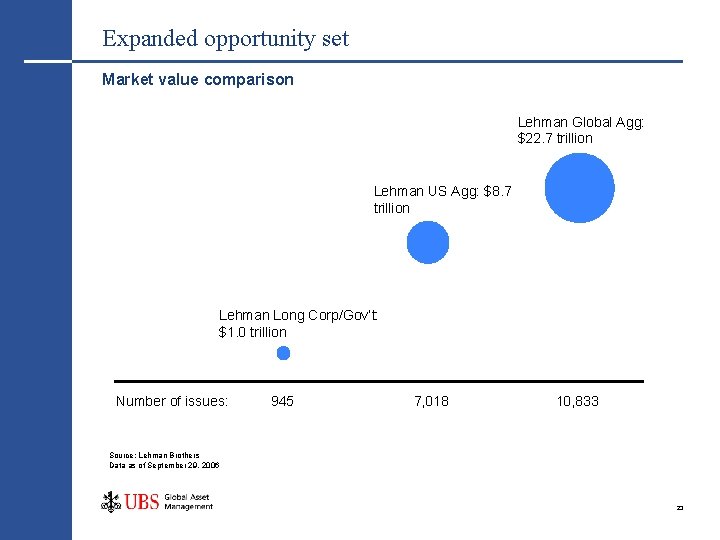
Expanded opportunity set Market value comparison Lehman Global Agg: $22. 7 trillion Lehman US Agg: $8. 7 trillion Lehman Long Corp/Gov’t: $1. 0 trillion Number of issues: 945 7, 018 10, 833 Source: Lehman Brothers Data as of September 29, 2006 23
Implementation: Hedging strategies 24
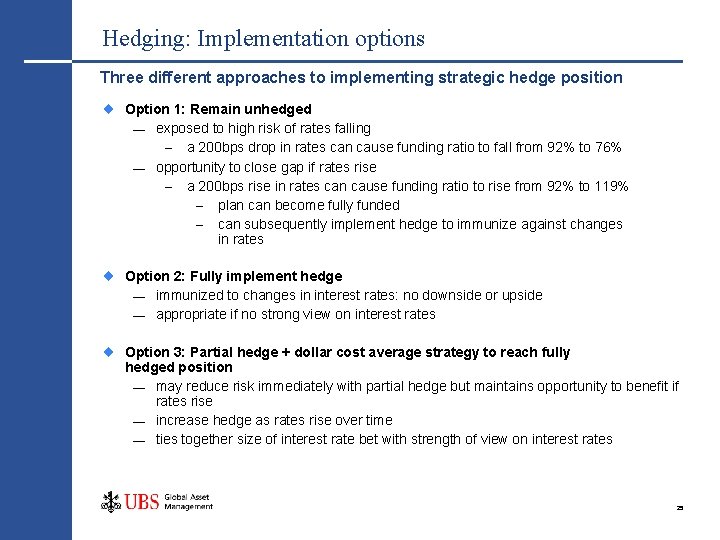
Hedging: Implementation options Three different approaches to implementing strategic hedge position Option 1: Remain unhedged — exposed to high risk of rates falling – a 200 bps drop in rates can cause funding ratio to fall from 92% to 76% — opportunity to close gap if rates rise – a 200 bps rise in rates can cause funding ratio to rise from 92% to 119% – plan can become fully funded – can subsequently implement hedge to immunize against changes in rates Option 2: Fully implement hedge — immunized to changes in interest rates: no downside or upside — appropriate if no strong view on interest rates Option 3: Partial hedge + dollar cost average strategy to reach fully hedged position — may reduce risk immediately with partial hedge but maintains opportunity to benefit if rates rise — increase hedge as rates rise over time — ties together size of interest rate bet with strength of view on interest rates 25
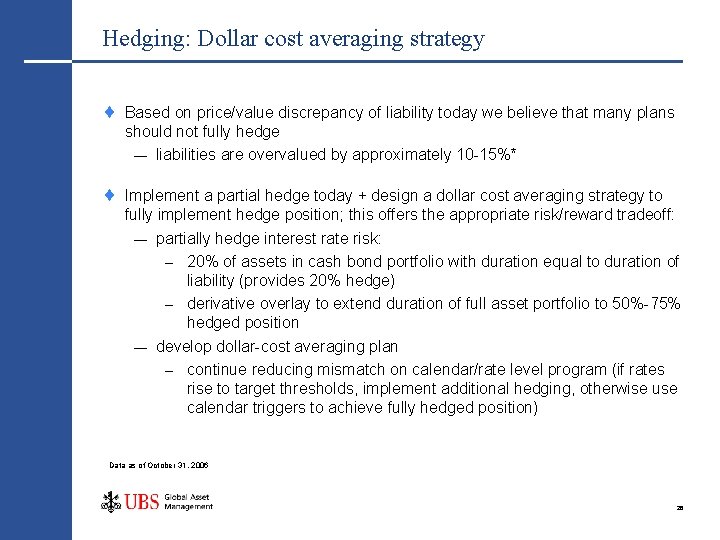
Hedging: Dollar cost averaging strategy Based on price/value discrepancy of liability today we believe that many plans should not fully hedge — liabilities are overvalued by approximately 10 -15%* Implement a partial hedge today + design a dollar cost averaging strategy to fully implement hedge position; this offers the appropriate risk/reward tradeoff: — partially hedge interest rate risk: – 20% of assets in cash bond portfolio with duration equal to duration of liability (provides 20% hedge) – derivative overlay to extend duration of full asset portfolio to 50%-75% hedged position — develop dollar-cost averaging plan – continue reducing mismatch on calendar/rate level program (if rates rise to target thresholds, implement additional hedging, otherwise use calendar triggers to achieve fully hedged position) Data as of October 31, 2006 26
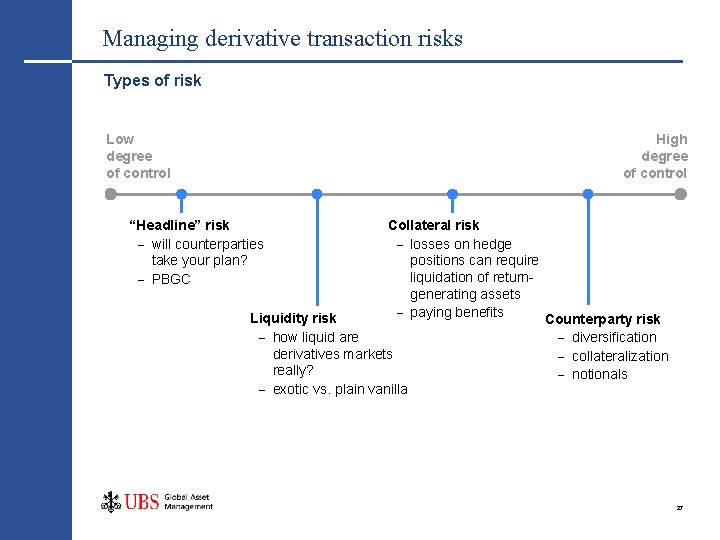
Managing derivative transaction risks Types of risk Low degree of control High degree of control “Headline” risk - will counterparties take your plan? - PBGC Collateral risk - losses on hedge positions can require liquidation of returngenerating assets - paying benefits Liquidity risk Counterparty risk - how liquid are - diversification derivatives markets - collateralization really? - notionals - exotic vs. plain vanilla 27
Implementation: Generating an absolute return 28
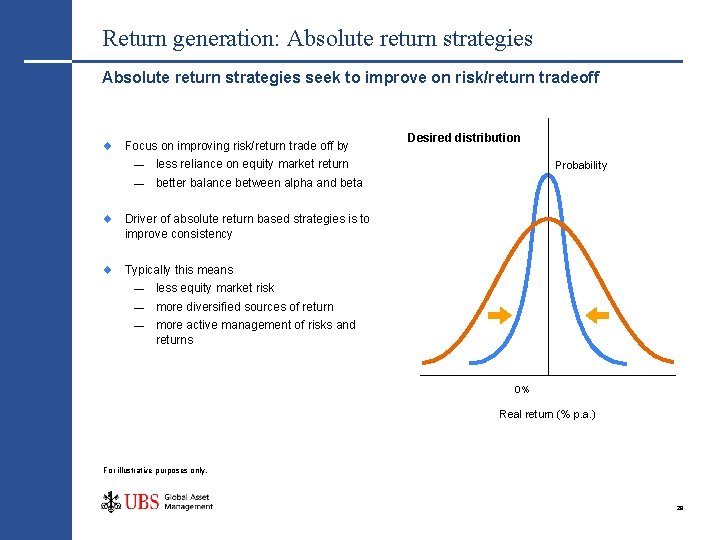
Return generation: Absolute return strategies seek to improve on risk/return tradeoff Focus on improving risk/return trade off by — less reliance on equity market return — better balance between alpha and beta Driver of absolute return based strategies is to improve consistency Typically this means — less equity market risk — more diversified sources of return — more active management of risks and returns Desired distribution Probability 0% Real return (% p. a. ) For illustrative purposes only. 29
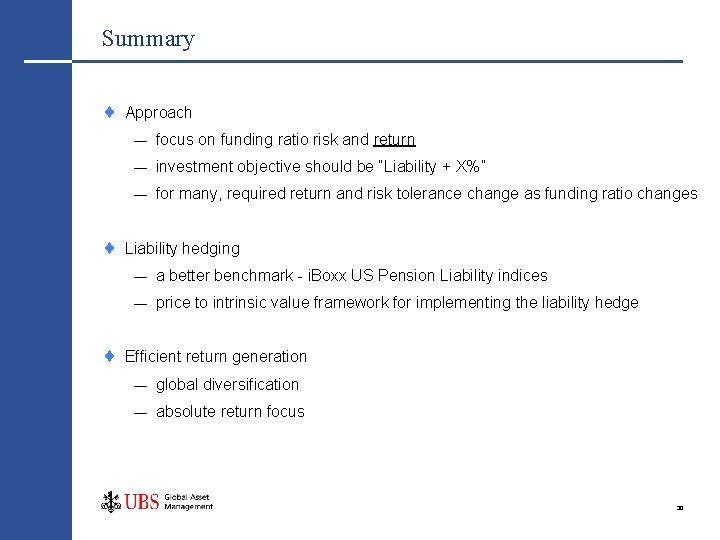
Summary Approach — focus on funding ratio risk and return — investment objective should be “Liability + X%” — for many, required return and risk tolerance change as funding ratio changes Liability hedging — a better benchmark - i. Boxx US Pension Liability indices — price to intrinsic value framework for implementing the liability hedge Efficient return generation — global diversification — absolute return focus 30
Drew Carrington, CFA Senior US Fixed Income Portfolio Manager Executive Director Years of investment industry experience: 16 Education: Harvard University (US) BA Drew Carrington is a member of the US Core/Core Plus and Emerging Market Debt strategy teams, focusing on fixed income strategy and development of the portfolios. Drew is also responsible for communicating the firm's full range of fixed income strategies to clients and consultants. Additionally, Drew works with the firm's GIS (Global Investment Strategy) team on the development of asset/liability solutions for clients. Prior to joining the firm in early 2005, Drew was a principal at Mercer Investment Consulting, serving an array of institutional clients. Drew was also a member of Mercer's manager review committee and the strategic research committee. Prior to joining UBS, Drew's entire 16 years of professional experience was in the institutional investment consulting field. Drew is a long-time member of the Atlanta Society of Financial Analysts.

Aaron H. Meder, FSA, EA Head of Asset-Liability Investment Solutions, Americas Associate Director Years of industry experience: 6 Education: University of Illinois (US), BS Aaron Meder is Head of Asset-Liability Investment Solutions (ALIS), Americas. In this role, he is responsible for developing and overseeing pension fund investment strategies that focus on the plan’s funding ratio. Prior to joining the firm in 2004, Aaron was an actuary in the HR Services line of business with Towers Perrin. In that role, he managed the completion of actuarial valuations, forecasted future accounting cost results and ERISA minimum/maximum required contributions and developed funding policies for several large corporations’ pension and retiree medical plans. Aaron’s previous experience also includes work at Watson Wyatt Worldwide as an actuary.
Additional disclosures Past performance is no guarantee of future results. There is no guarantee that investment objectives, risk or return targets discussed in this presentation will be achieved. The opinions expressed in this presentation are those of the UBS Global Asset Management Business Group of UBS AG and are subject to change. No part of this presentation may be reproduced or redistributed in any form, or referred to in any publication, without express written permission of UBS Global Asset Management. This material supports the presentation(s) given on the specific date(s) noted. It is not intended to be read in isolation and may not provide a full explanation of all the topics that were presented and discussed. Information contained in this presentation has been obtained from sources believed to be reliable, but not guaranteed. Furthermore, there can be no assurance that any trends described in this presentation will continue or that forecasts will occur because economic and market conditions change frequently. The information contained in this presentation should not be considered a recommendation to purchase or sell any particular security. There is no assurance that any securities discussed herein will remain in an account’s portfolio at the time you receive this information or that securities sold have not been repurchased. The securities discussed do not represent an account’s entire portfolio over the course of a full market cycle. It should not be assumed that any of the securities transactions or holdings referred to herein were or will prove to be profitable, or that the investment recommendations or decisions we make in the future will be profitable or will equal the investment performance of the securities referred to in this presentation. A client's returns will be reduced by advisory fees and other expenses incurred by the client. Advisory fees are described in Part II of Form ADV for UBS Global Asset Management (Americas) Inc. This presentation does not constitute an offer to sell or a solicitation to offer to buy any securities and nothing in this presentation shall limit or restrict the particular terms of any specific offering. Offers will be made only to qualified investors by means of a prospectus or confidential private placement memorandum providing information as to the specifics of the offering. No offer of any interest in any product will be made in any jurisdiction in which the offer, solicitation or sale is not permitted, or to any person to whom it is unlawful to make such offer, solicitation or sale. Any statements made regarding investment performance expectations, risk and/or return targets shall not constitute a representation or warranty that such investment objectives or expectations will be achieved. The achievement of a targeted ex-ante tracking error does not imply the achievement of an equal ex-post tracking error or actual specified return. According to independent studies, ex-ante tracking error can underestimate realized risk (ex-post tracking error), particularly in times of above-average market volatility and increased momentum. Different models for the calculation of ex-ante tracking error may lead to different results. There is no guarantee that the models used provide the same results as other available models. Copyright © 2006 UBS Global Asset Management (Americas) Inc. 33
- Slides: 33