
Pennsylvanias Student Learning Objectives SLOs Process 1 Todays
Pennsylvania’s Student Learning Objectives (SLOs) Process 1
Today’s Objectives § To know what Student Learning Objectives (SLOs) are § To know how SLOs fit into the larger picture of Educator Effectiveness § To explore the SLO Template § To know the three components in developing SLOs (Design, Build, and Review) § To know where you can find the tools to develop your SLOs § To give you time to begin brainstorming/drafting your SLO 2
SLO Pilot Team �Missy Bream �Charley Dittrich �Laura Davenport �Rusty Mc. Collum �Justin Tate �Danny Leiphart �Greg Zirkle 3
Options �SLO Overview/Training �Remain in Auditorium �Move to work groups with pilot team members �Collaborate with group/work independently 4
What is the role of Student Learning Objectives in Pennsylvania’s Teacher Evaluation System?
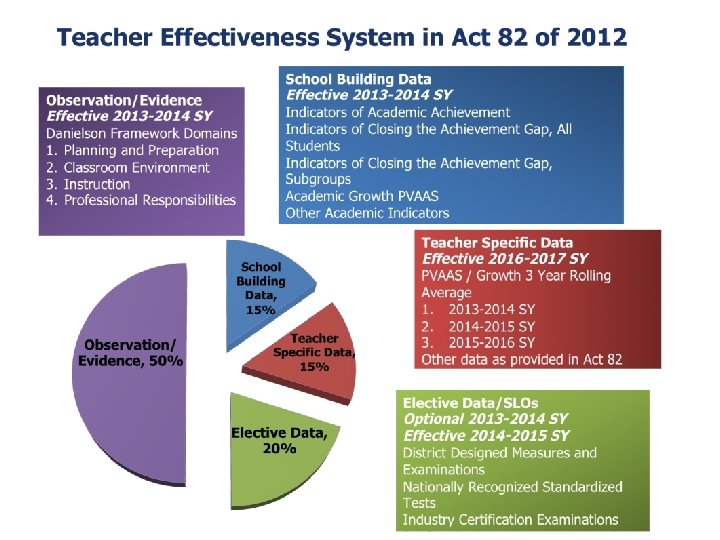
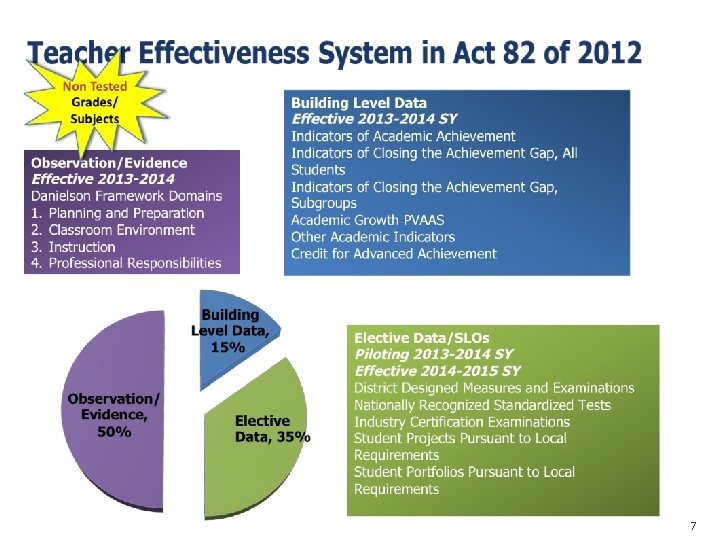
7
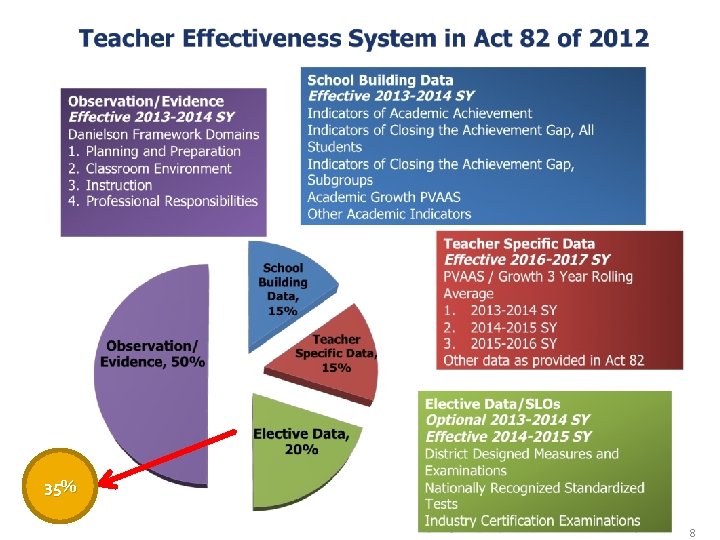
35% 8
What is a Student Learning Objective?
What is a SLO? Student Learning Objective PDE’s Definition: A process to document a measure of educator effectiveness based on student achievement of content standards. 10
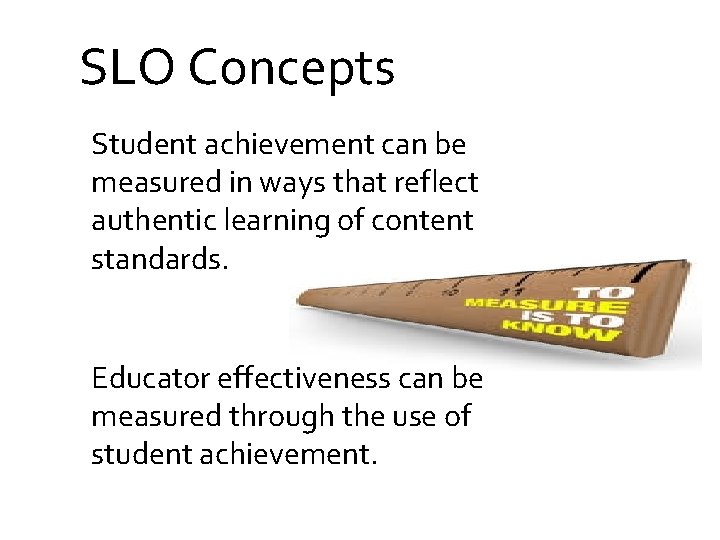
SLO Concepts Student achievement can be measured in ways that reflect authentic learning of content standards. Educator effectiveness can be measured through the use of student achievement.
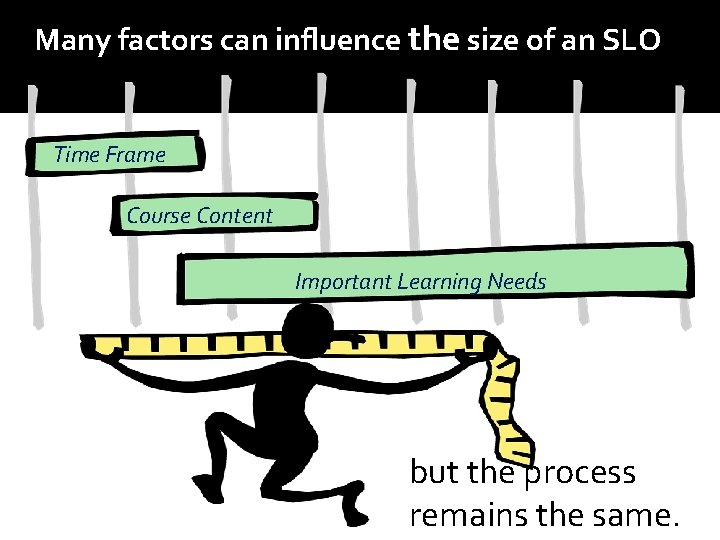
Many factors can influence the size of an SLO, Time Frame Course Content Important Learning Needs but the process remains the same.
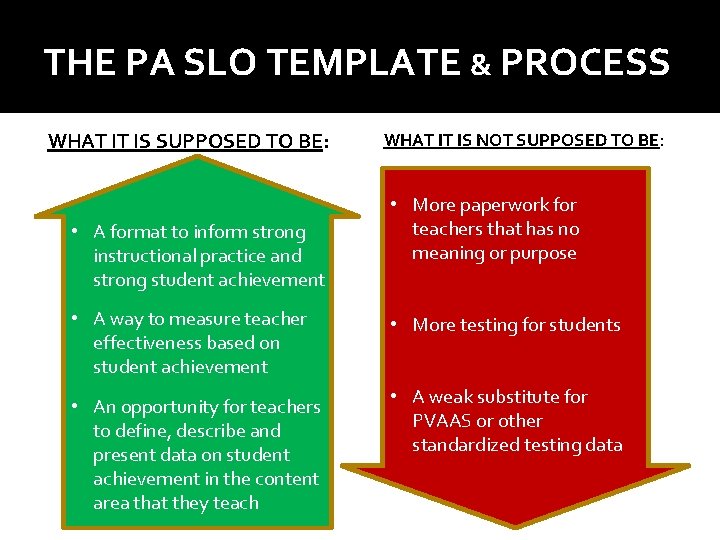
THE PA SLO TEMPLATE & PROCESS WHAT IT IS SUPPOSED TO BE: WHAT IT IS NOT SUPPOSED TO BE: More paperwork for • More paperwork teachers thatforhas no teachers that has no meaning or purpose � More testing for students � • A format to inform strong instructional practice and strong student achievement • A way to measure teacher effectiveness based on student achievement • An opportunity for teachers to define, describe and present data on student achievement in the content area that they teach • More testing for students A weak substitute for PVAAS or other • Astandardized weak substitute for testing PVAAS data or other � standardized testing data
Don’t be frightened! I will not be afraid. I will not be frustrated. I will not be angry. I will not be crabby. We’ve got this!!
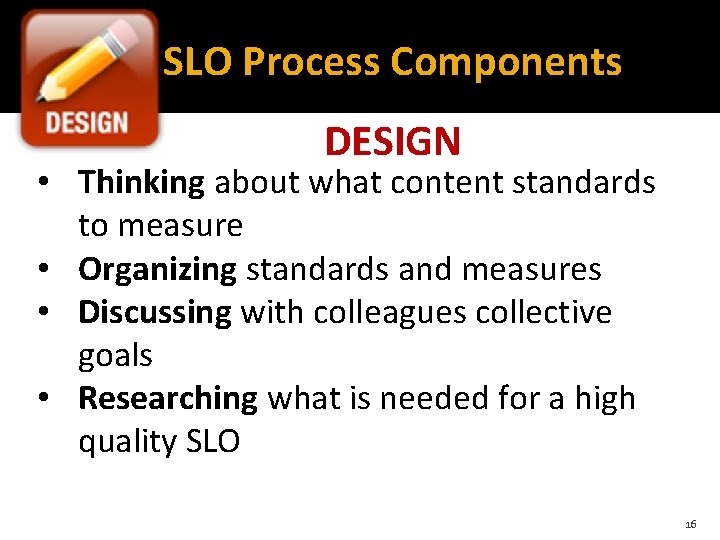
SLO Process Components DESIGN • Thinking about what content standards to measure • Organizing standards and measures • Discussing with colleagues collective goals • Researching what is needed for a high quality SLO 16
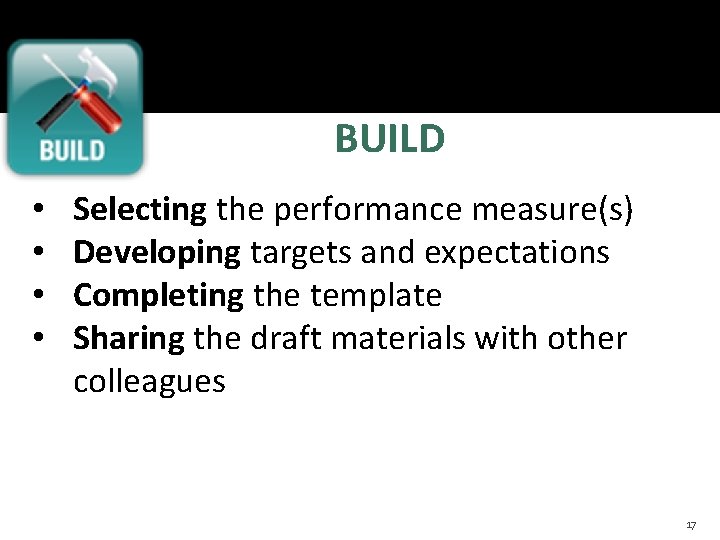
SLO Process Components BUILD • • Selecting the performance measure(s) Developing targets and expectations Completing the template Sharing the draft materials with other colleagues 17
SLO Process Components REVIEW • Checking the drafted SLO (including the performance measures for quality) • Refining measures and targets • Editing text and preparing discussion points/highlights for principal • Finalizing materials • Updating completed SLOs with performance data 18
Student Learning Objective (SLO) Template
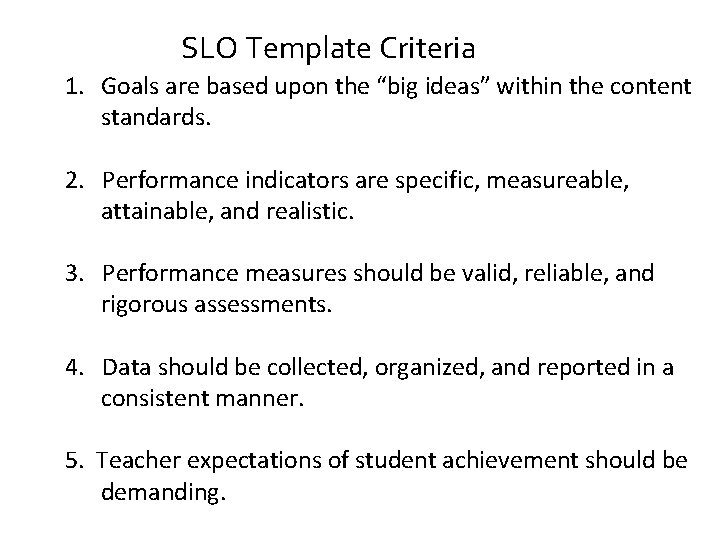
SLO Template Criteria 1. Goals are based upon the “big ideas” within the content standards. 2. Performance indicators are specific, measureable, attainable, and realistic. 3. Performance measures should be valid, reliable, and rigorous assessments. 4. Data should be collected, organized, and reported in a consistent manner. 5. Teacher expectations of student achievement should be demanding.
Key Process Points The SLO process facilitates a conversation about expectations between educators (principals and teachers, teachers and teachers)
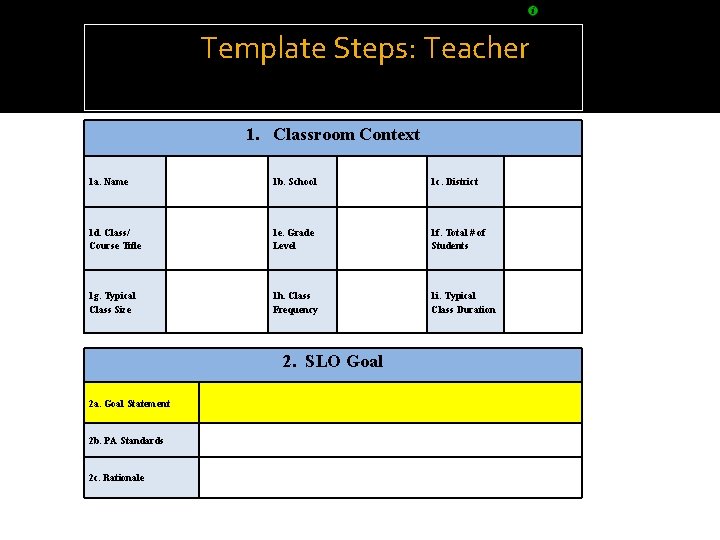
SLO Template Steps: Teacher 1. Classroom Context 1 a. Name 1 b. School 1 c. District 1 d. Class/ Course Title 1 e. Grade Level 1 f. Total # of Students 1 g. Typical Class Size 1 h. Class Frequency 1 i. Typical Class Duration 2. SLO Goal 2 a. Goal Statement 2 b. PA Standards 2 c. Rationale
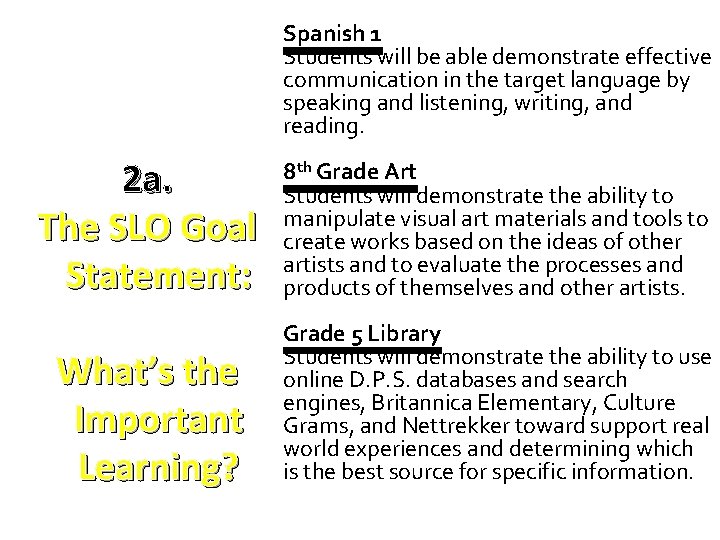
Spanish 1 Students will be able demonstrate effective communication in the target language by speaking and listening, writing, and reading. 2 a. The SLO Goal Statement: 8 th Grade Art Students will demonstrate the ability to manipulate visual art materials and tools to create works based on the ideas of other artists and to evaluate the processes and products of themselves and other artists. What’s the Important Learning? Grade 5 Library Students will demonstrate the ability to use online D. P. S. databases and search engines, Britannica Elementary, Culture Grams, and Nettrekker toward support real world experiences and determining which is the best source for specific information.
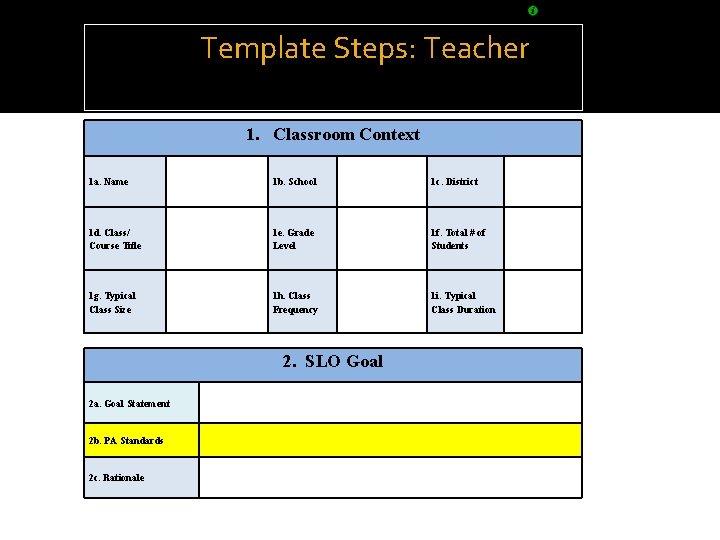
SLO Template Steps: Teacher 1. Classroom Context 1 a. Name 1 b. School 1 c. District 1 d. Class/ Course Title 1 e. Grade Level 1 f. Total # of Students 1 g. Typical Class Size 1 h. Class Frequency 1 i. Typical Class Duration 2. SLO Goal 2 a. Goal Statement 2 b. PA Standards 2 c. Rationale
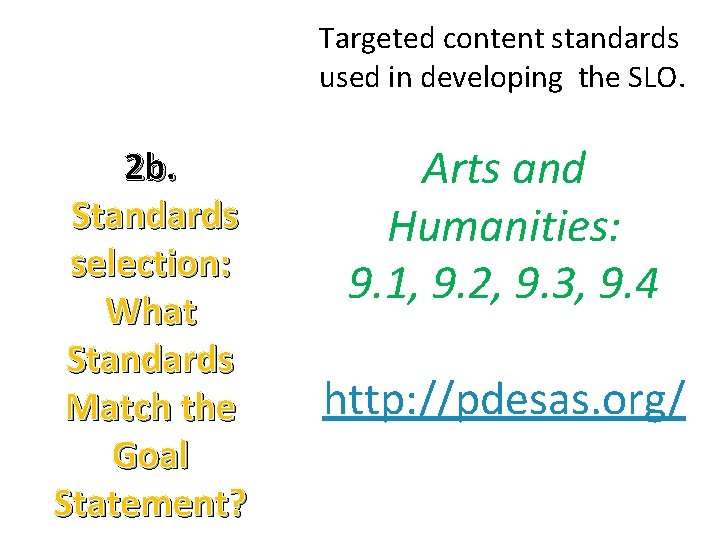
Targeted content standards used in developing the SLO. 2 b. Standards selection: What Standards Match the Goal Statement? Arts and Humanities: 9. 1, 9. 2, 9. 3, 9. 4 http: //pdesas. org/
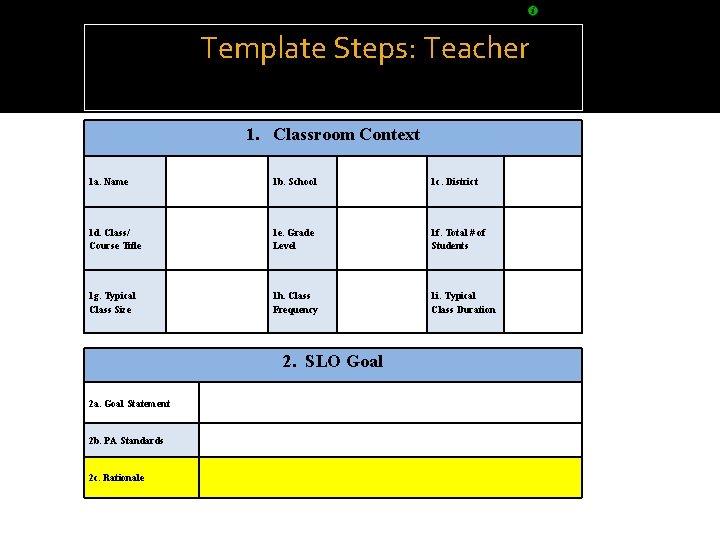
SLO Template Steps: Teacher 1. Classroom Context 1 a. Name 1 b. School 1 c. District 1 d. Class/ Course Title 1 e. Grade Level 1 f. Total # of Students 1 g. Typical Class Size 1 h. Class Frequency 1 i. Typical Class Duration 2. SLO Goal 2 a. Goal Statement 2 b. PA Standards 2 c. Rationale
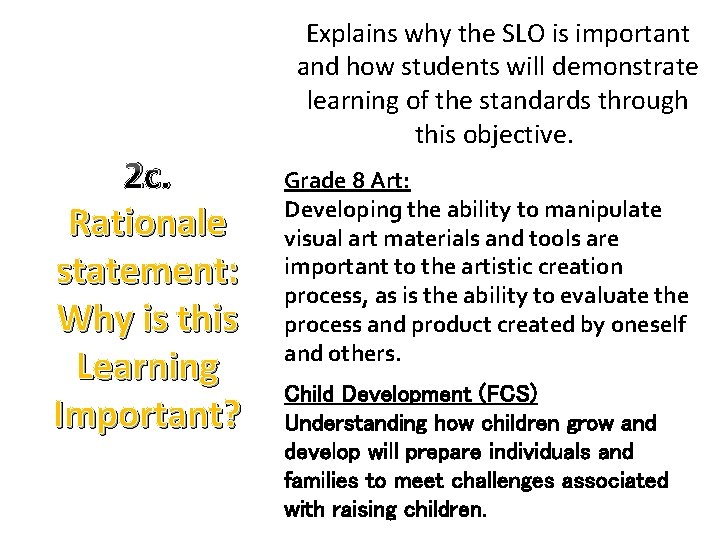
2 c. Rationale statement: Why is this Learning Important? Explains why the SLO is important and how students will demonstrate learning of the standards through this objective. . Grade 8 Art: Developing the ability to manipulate visual art materials and tools are important to the artistic creation process, as is the ability to evaluate the process and product created by oneself and others. Child Development (FCS) Understanding how children grow and develop will prepare individuals and families to meet challenges associated with raising children.
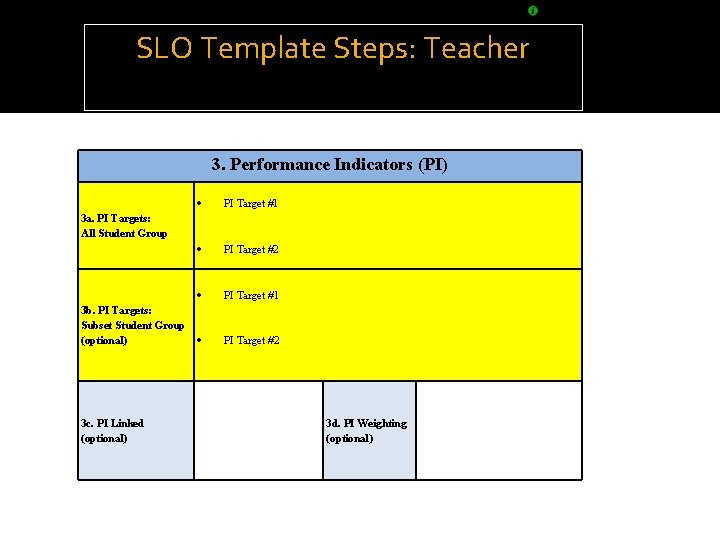
SLO Template Steps: Teacher 3. Performance Indicators (PI) PI Target #1 PI Target #2 3 a. PI Targets: All Student Group 3 b. PI Targets: Subset Student Group (optional) 3 c. PI Linked (optional) 3 d. PI Weighting (optional)
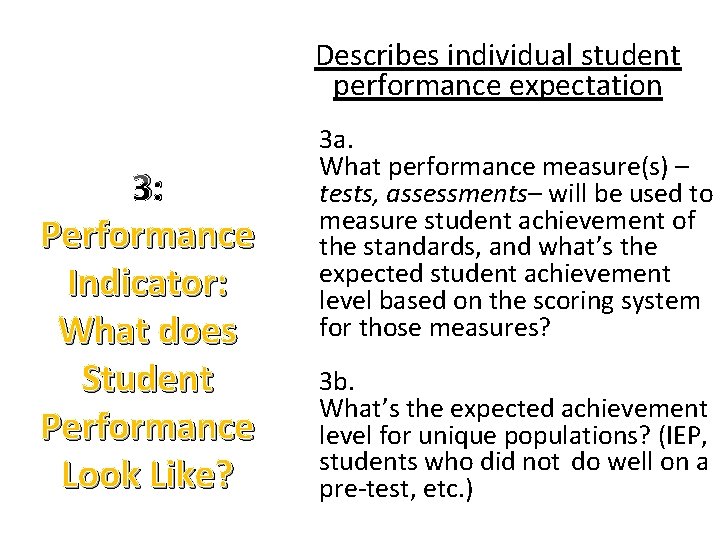
Describes individual student performance expectation 3: Performance Indicator: What does Student Performance Look Like? 3 a. What performance measure(s) – tests, assessments– will be used to measure student achievement of the standards, and what’s the expected student achievement level based on the scoring system for those measures? 3 b. What’s the expected achievement level for unique populations? (IEP, students who did not do well on a pre-test, etc. )
Performance Indicator Statement HS Choral Individual Vocal Assessment Task Students will achieve proficient or advanced levels in 6 out of 8 criteria of the second scoring rubric. 5 th Grade ELA DRA text gradient chart Students will demonstrate one year of reading growth
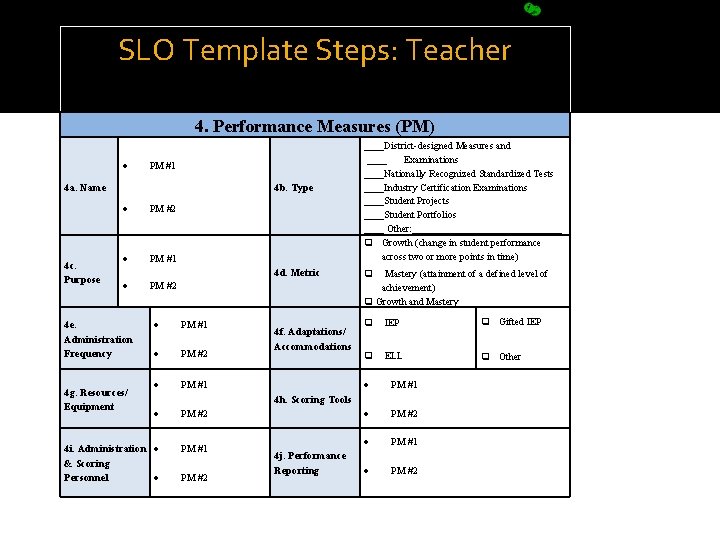
SLO Template Steps: Teacher 4. Performance Measures (PM) PM #1 4 a. Name 4 c. Purpose 4 b. Type PM #2 PM #1 4 d. Metric 4 e. Administration Frequency 4 g. Resources/ Equipment PM #2 PM #1 4 f. Adaptations/ Accommodations ____District-designed Measures and ____ Examinations ____Nationally Recognized Standardized Tests ____Industry Certification Examinations ____Student Projects ____Student Portfolios ____ Other: _______________ q Growth (change in student performance across two or more points in time) q Mastery (attainment of a defined level of achievement) q Growth and Mastery q IEP q Gifted IEP q ELL q Other PM #1 PM #2 4 h. Scoring Tools PM #2 4 i. Administration & Scoring Personnel PM #1 PM #2 4 j. Performance Reporting
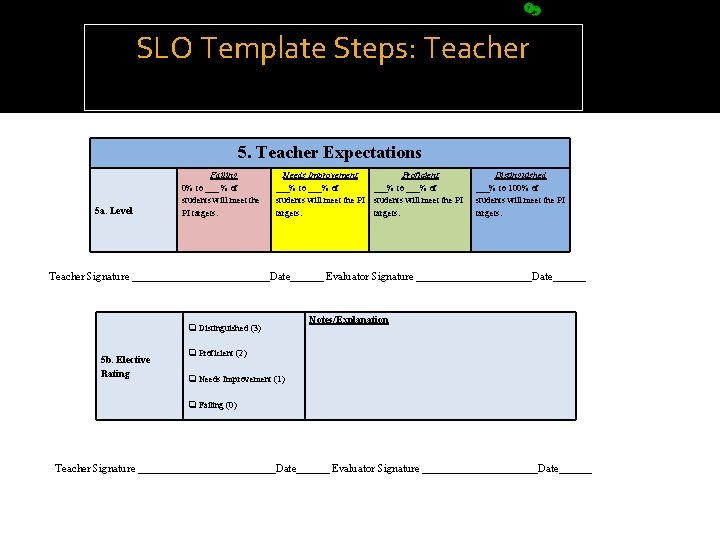
SLO Template Steps: Teacher 5. Teacher Expectations 5 a. Level Failing 0% to ___ % of students will meet the PI targets. Needs Improvement ___% to ___% of students will meet the PI targets. Proficient ___% to ___% of students will meet the PI targets. Distinguished ___% to 100% of students will meet the PI targets. . Teacher Signature _____________Date______ Evaluator Signature ___________Date______ q Distinguished (3) 5 b. Elective Rating Notes/Explanation q Proficient (2) q Needs Improvement (1) q Failing (0) . Teacher Signature _____________Date______ Evaluator Signature ___________Date______
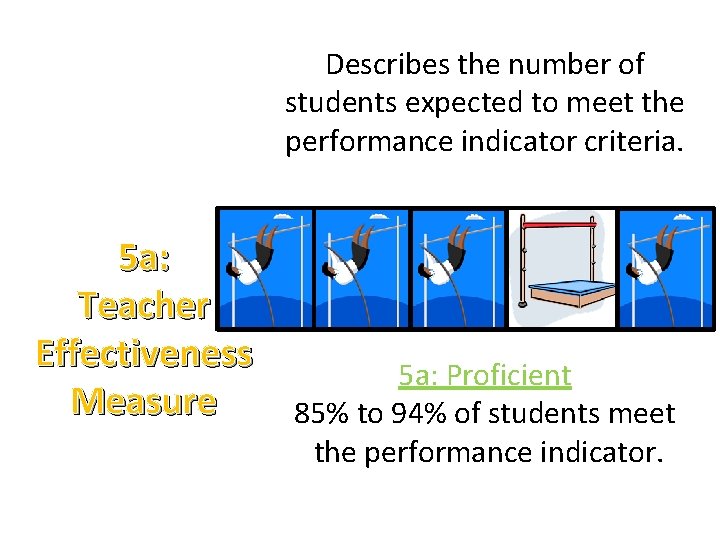
Describes the number of students expected to meet the performance indicator criteria. 5 a: Teacher Effectiveness Measure 5 a: Proficient 85% to 94% of students meet the performance indicator.
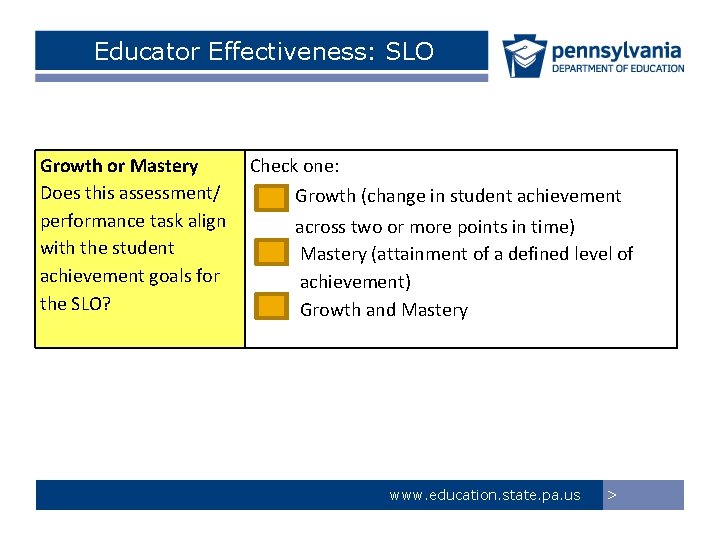
Educator Effectiveness: SLO Growth or Mastery Does this assessment/ performance task align with the student achievement goals for the SLO? Check one: Growth (change in student achievement across two or more points in time) Mastery (attainment of a defined level of achievement) Growth and Mastery www. education. state. pa. us >
39
Student Learning Objective (SLO) Resources
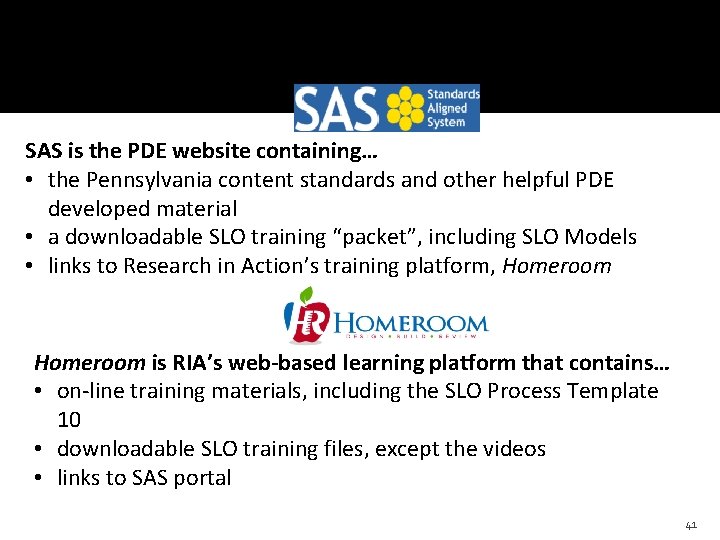
Training Resources SAS is the PDE website containing… • the Pennsylvania content standards and other helpful PDE developed material • a downloadable SLO training “packet”, including SLO Models • links to Research in Action’s training platform, Homeroom is RIA’s web-based learning platform that contains… • on-line training materials, including the SLO Process Template 10 • downloadable SLO training files, except the videos • links to SAS portal 41
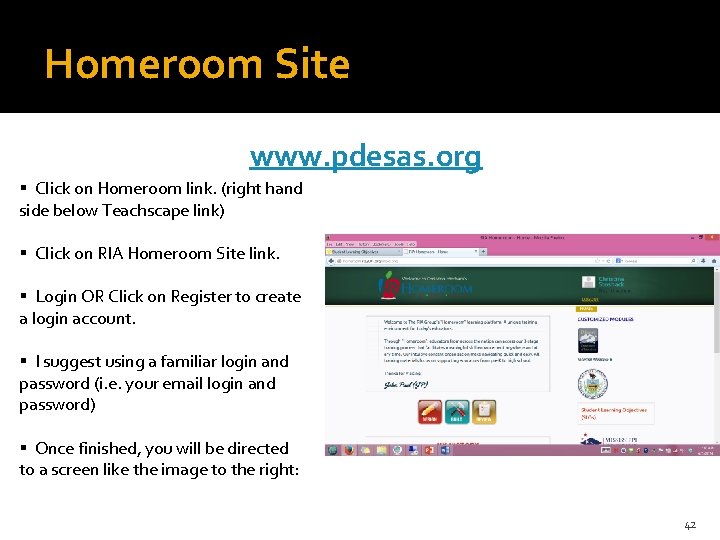
Homeroom Site www. pdesas. org § Click on Homeroom link. (right hand side below Teachscape link) § Click on RIA Homeroom Site link. § Login OR Click on Register to create a login account. § I suggest using a familiar login and password (i. e. your email login and password) § Once finished, you will be directed to a screen like the image to the right: 42
Summarizer/Review � SLO stands for _____________. � The three steps in developing a SLO are _________, and ______. � SLO data fits into what category of the Educator Effectiveness pie? What will the percentage be for 20142015? � An example of a performance measure is ______. � The two places I can find additional SLO resources are __________ and __________. 44
Thank You! Have a productive day and a FANTASTIC Summer!! 45
Next Steps �Remain in the auditorium with Missy and Stacey § Move to work groups with pilot team members Library – Laura and Charley Rm. 200 – Danny and Greg Rm. 206 – Rusty and Justin § Collaborate with group/work independently 46
- Slides: 40