
PENN PLACE LUZERNE COUNTY COURTHOUSE ANNEX WilkesBarre PA
PENN PLACE: LUZERNE COUNTY COURTHOUSE ANNEX Wilkes-Barre, PA “Introducing Contaminant Sensors in a Government Building to Control Air System Safety for Occupants while Minimizing Operating Cost & Energy Use” A Mechanical Option Thesis Presentation By Tracey Nawrocki April 11, 2005
OUTLINE 1. General Building Information 2. Mechanical System Description 3. Mechanical System Troubleshooting 4. Goals & Approach for Mechanical Improvements 5. Redesign and Alternative Solutions 6. Breadth Study: Building Security 7. Possibilities for Future Work 8. Conclusions Tracey Nawrocki – AE Senior Thesis 2005 Penn Place: Luzerne County Courthouse Annex
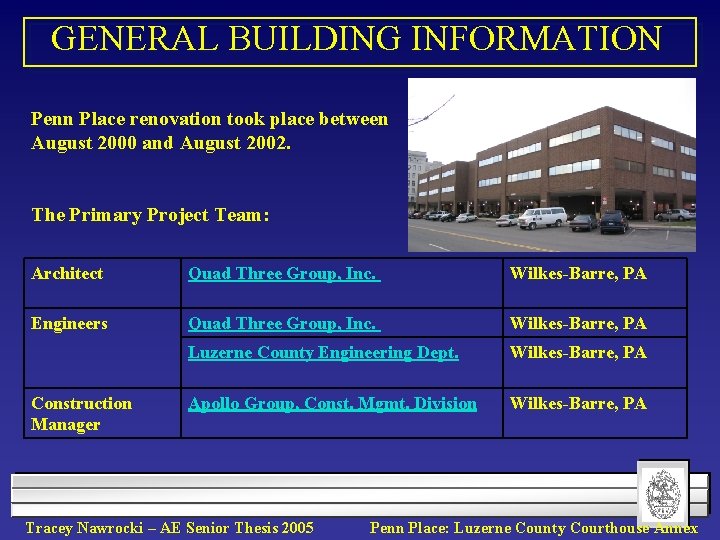
GENERAL BUILDING INFORMATION Penn Place renovation took place between August 2000 and August 2002. The Primary Project Team: Architect Quad Three Group, Inc. Wilkes-Barre, PA Engineers Quad Three Group, Inc. Wilkes-Barre, PA Luzerne County Engineering Dept. Wilkes-Barre, PA Apollo Group, Const. Mgmt. Division Wilkes-Barre, PA Construction Manager Tracey Nawrocki – AE Senior Thesis 2005 Penn Place: Luzerne County Courthouse Annex
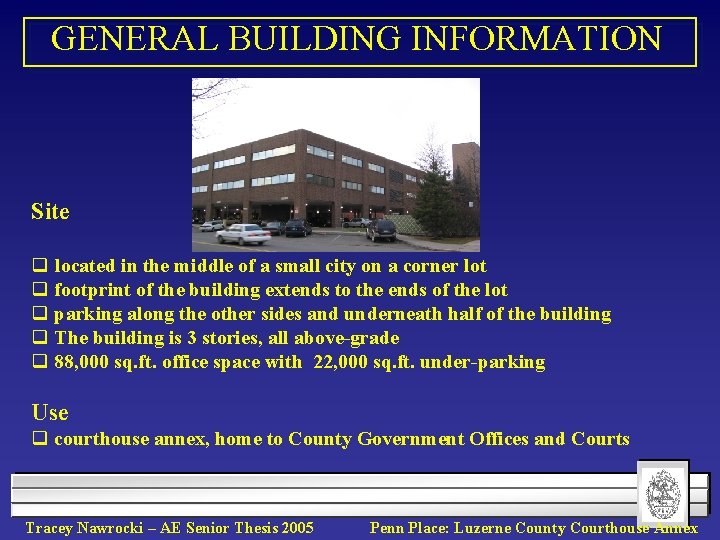
GENERAL BUILDING INFORMATION Site q located in the middle of a small city on a corner lot q footprint of the building extends to the ends of the lot q parking along the other sides and underneath half of the building q The building is 3 stories, all above-grade q 88, 000 sq. ft. office space with 22, 000 sq. ft. under-parking Use q courthouse annex, home to County Government Offices and Courts Tracey Nawrocki – AE Senior Thesis 2005 Penn Place: Luzerne County Courthouse Annex
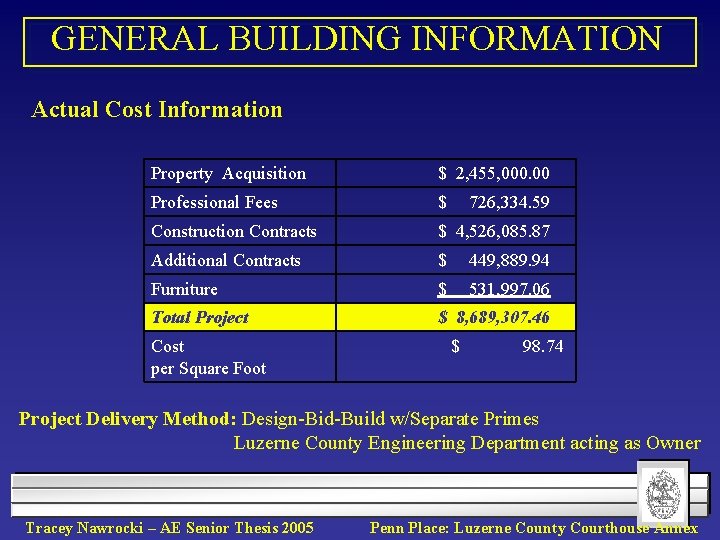
GENERAL BUILDING INFORMATION Actual Cost Information Property Acquisition $ 2, 455, 000. 00 Professional Fees $ 726, 334. 59 Construction Contracts $ 4, 526, 085. 87 Additional Contracts $ 449, 889. 94 Furniture $ 531, 997. 06 Total Project Cost per Square Foot $ 8, 689, 307. 46 $ 98. 74 Project Delivery Method: Design-Bid-Build w/Separate Primes Luzerne County Engineering Department acting as Owner Tracey Nawrocki – AE Senior Thesis 2005 Penn Place: Luzerne County Courthouse Annex

GENERAL BUILDING INFORMATION Architecture q International Style: concise form, attention paid only to functional details q simple brick façade is divided by rows of ribbon windows q appropriate authoritative appearance q two larger sections of building wrap around a central courtyard q steel and concrete structure allows for large open courtroom spaces inside Building Envelope q typical brick veneered cavity wall system qdouble-glazed, in an aluminum sill system. q main entrance is a set of double aluminum doors with 1” insulated tempered glass Major National Model Codes BOCA Building Code 1996 Edition Zoning and Historical q Commercial. Re-zoning was not necessary for renovation. q renovation: converted from a multi-tenant building to owner-occupied County building Tracey Nawrocki – AE Senior Thesis 2005 Penn Place: Luzerne County Courthouse Annex
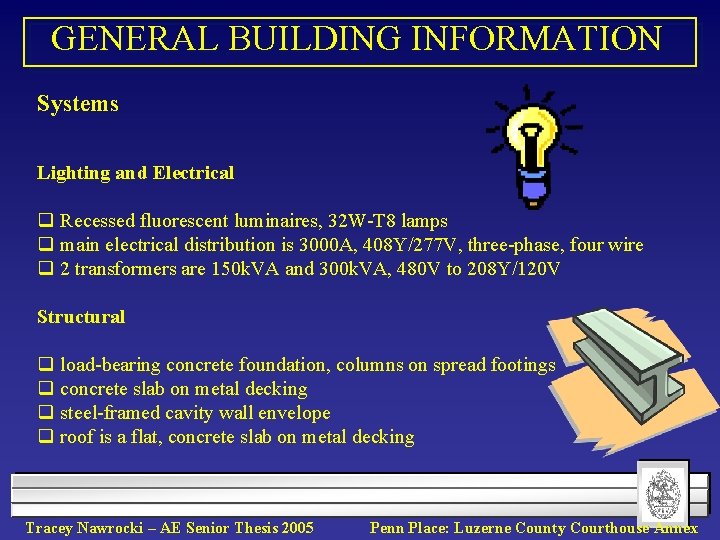
GENERAL BUILDING INFORMATION Systems Lighting and Electrical q Recessed fluorescent luminaires, 32 W-T 8 lamps q main electrical distribution is 3000 A, 408 Y/277 V, three-phase, four wire q 2 transformers are 150 k. VA and 300 k. VA, 480 V to 208 Y/120 V Structural q load-bearing concrete foundation, columns on spread footings q concrete slab on metal decking q steel-framed cavity wall envelope q roof is a flat, concrete slab on metal decking Tracey Nawrocki – AE Senior Thesis 2005 Penn Place: Luzerne County Courthouse Annex
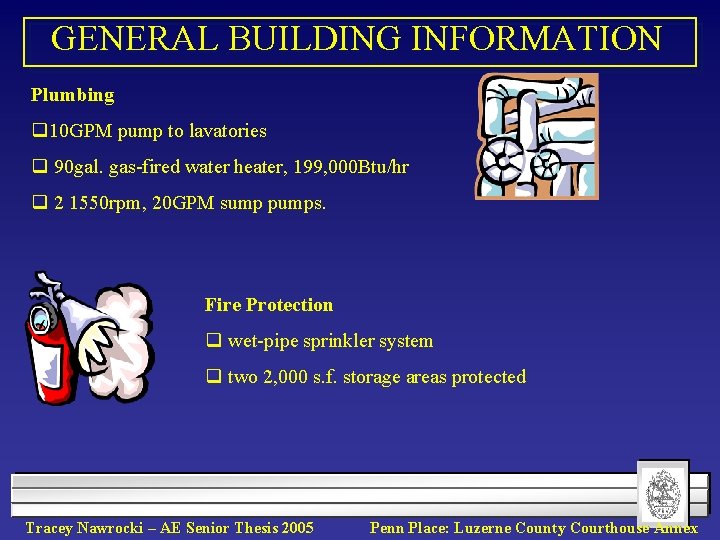
GENERAL BUILDING INFORMATION Plumbing q 10 GPM pump to lavatories q 90 gal. gas-fired water heater, 199, 000 Btu/hr q 2 1550 rpm, 20 GPM sump pumps. Fire Protection q wet-pipe sprinkler system q two 2, 000 s. f. storage areas protected Tracey Nawrocki – AE Senior Thesis 2005 Penn Place: Luzerne County Courthouse Annex
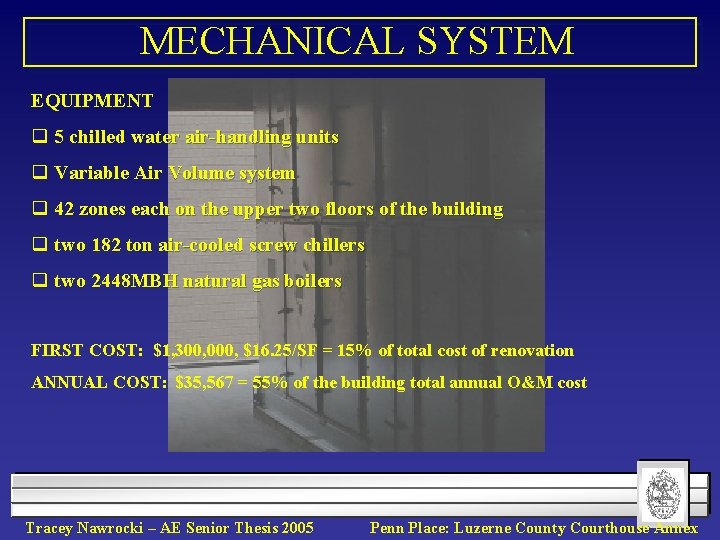
MECHANICAL SYSTEM EQUIPMENT q 5 chilled water air-handling units q Variable Air Volume system q 42 zones each on the upper two floors of the building q two 182 ton air-cooled screw chillers q two 2448 MBH natural gas boilers FIRST COST: $1, 300, 000, $16. 25/SF = 15% of total cost of renovation ANNUAL COST: $35, 567 = 55% of the building total annual O&M cost Tracey Nawrocki – AE Senior Thesis 2005 Penn Place: Luzerne County Courthouse Annex
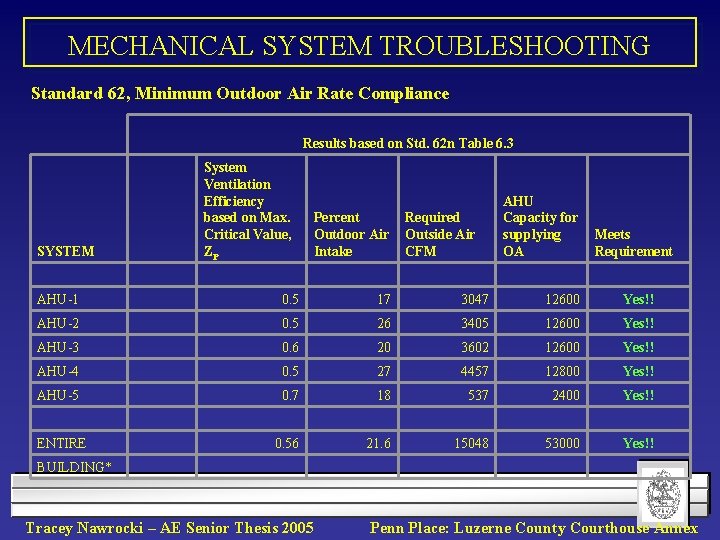
MECHANICAL SYSTEM TROUBLESHOOTING Standard 62, Minimum Outdoor Air Rate Compliance Results based on Std. 62 n Table 6. 3 SYSTEM System Ventilation Efficiency based on Max. Critical Value, ZP Percent Required Outdoor Air Outside Air Intake CFM AHU Capacity for supplying Meets OA Requirement AHU-1 0. 5 17 3047 12600 Yes!! AHU-2 0. 5 26 3405 12600 Yes!! AHU-3 0. 6 20 3602 12600 Yes!! AHU-4 0. 5 27 4457 12800 Yes!! AHU-5 0. 7 18 537 2400 Yes!! ENTIRE BUILDING* 0. 56 21. 6 15048 53000 Yes!! Tracey Nawrocki – AE Senior Thesis 2005 Penn Place: Luzerne County Courthouse Annex
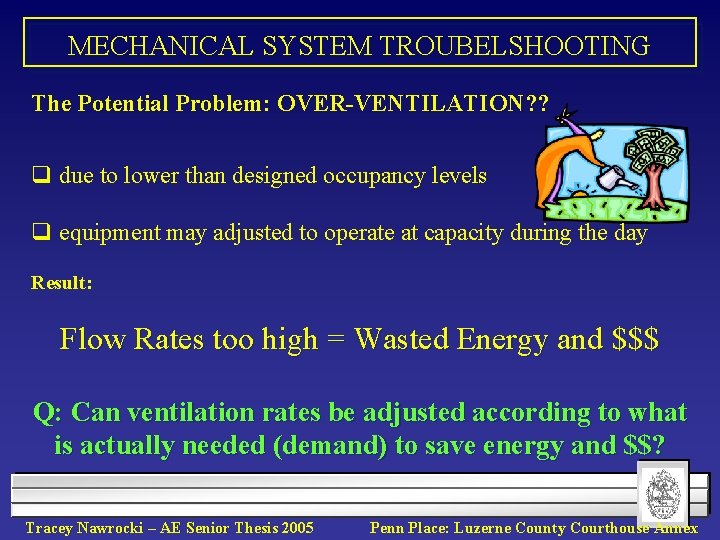
MECHANICAL SYSTEM TROUBELSHOOTING The Potential Problem: OVER-VENTILATION? ? q due to lower than designed occupancy levels q equipment may adjusted to operate at capacity during the day Result: Flow Rates too high = Wasted Energy and $$$ Q: Can ventilation rates be adjusted according to what is actually needed (demand) to save energy and $$? Tracey Nawrocki – AE Senior Thesis 2005 Penn Place: Luzerne County Courthouse Annex
Goals & Approach for Mechanical Improvements “Introducing Contaminant Sensors in a Government Building to Control Air System Safety for Occupants while Minimizing Operating Cost & Energy Use” Tracey Nawrocki – AE Senior Thesis 2005 Penn Place: Luzerne County Courthouse Annex
Goals & Approach for Mechanical Improvements Goals: 1. Monitor CO 2 levels, and determine occupancy levels from readings 2. Use CO 2 information as initial indication of how to regulate outdoor air intake to zones 3. Less ventilation needed = less money and energy spent Tracey Nawrocki – AE Senior Thesis 2005 Penn Place: Luzerne County Courthouse Annex
Goals & Approach for Mechanical Improvements APPROACH: q CO 2 Compliance q Adjusting Flow Rates: Mass Balance q Fulfilling Standard 62 Ventilation Requirements q Energy Utilization and Cost Analysis Tracey Nawrocki – AE Senior Thesis 2005 Penn Place: Luzerne County Courthouse Annex
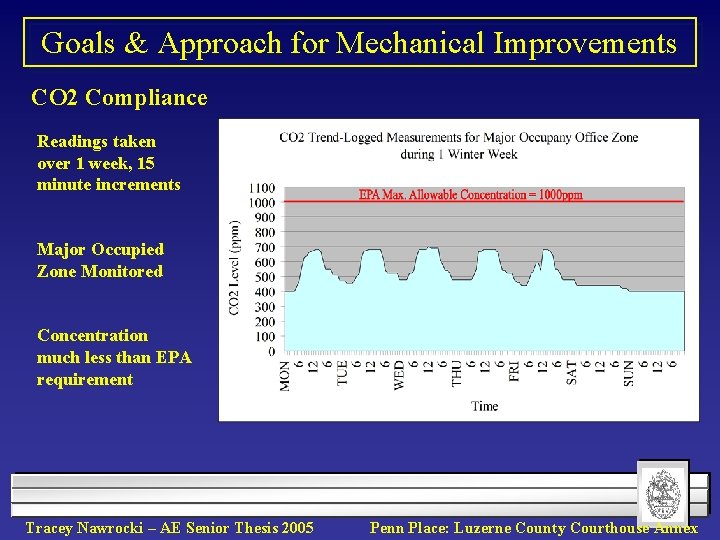
Goals & Approach for Mechanical Improvements CO 2 Compliance Readings taken over 1 week, 15 minute increments Major Occupied Zone Monitored Concentration much less than EPA requirement Tracey Nawrocki – AE Senior Thesis 2005 Penn Place: Luzerne County Courthouse Annex
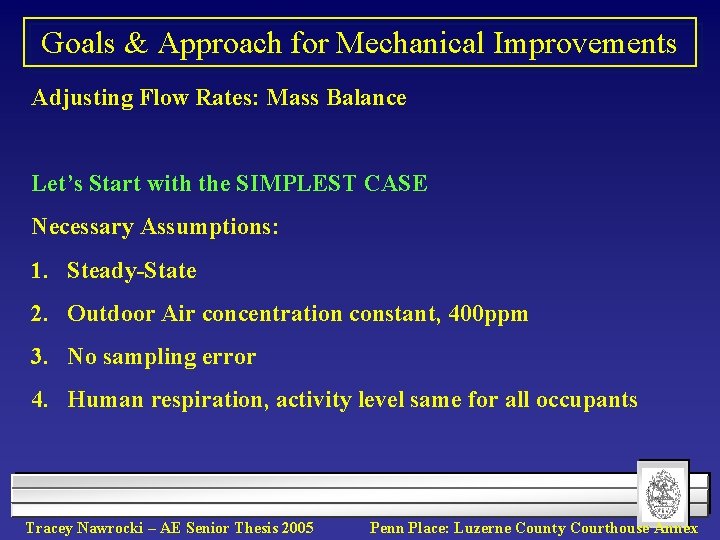
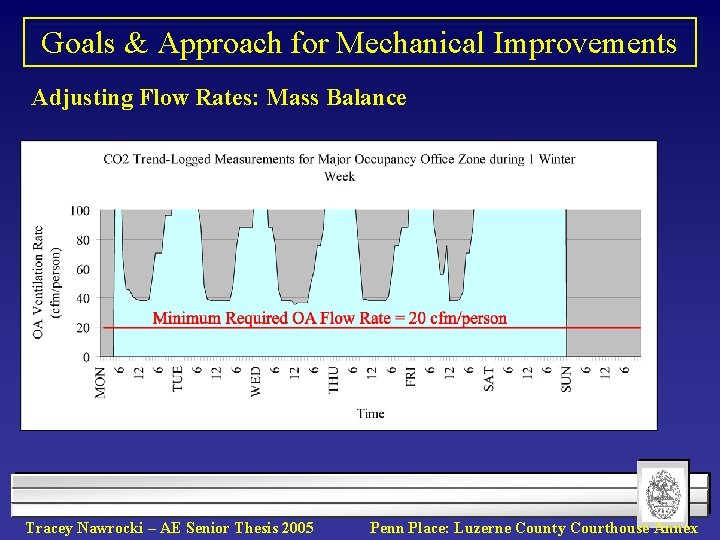
Goals & Approach for Mechanical Improvements Adjusting Flow Rates: Mass Balance Let’s Start with the SIMPLEST CASE Necessary Assumptions: 1. Steady-State 2. Outdoor Air concentration constant, 400 ppm 3. No sampling error 4. Human respiration, activity level same for all occupants Tracey Nawrocki – AE Senior Thesis 2005 Penn Place: Luzerne County Courthouse Annex
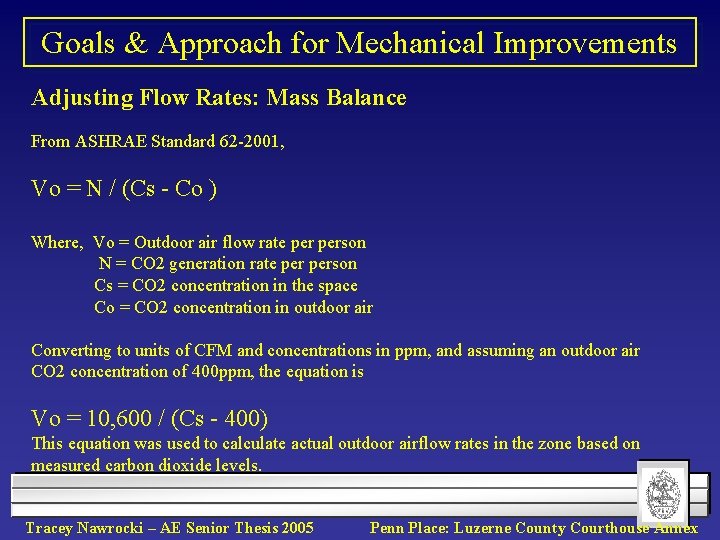
Goals & Approach for Mechanical Improvements Adjusting Flow Rates: Mass Balance From ASHRAE Standard 62 -2001, Vo = N / (Cs - Co ) Where, Vo = Outdoor air flow rate person N = CO 2 generation rate person Cs = CO 2 concentration in the space Co = CO 2 concentration in outdoor air Converting to units of CFM and concentrations in ppm, and assuming an outdoor air CO 2 concentration of 400 ppm, the equation is Vo = 10, 600 / (Cs - 400) This equation was used to calculate actual outdoor airflow rates in the zone based on measured carbon dioxide levels. Tracey Nawrocki – AE Senior Thesis 2005 Penn Place: Luzerne County Courthouse Annex
Goals & Approach for Mechanical Improvements Adjusting Flow Rates: Mass Balance Tracey Nawrocki – AE Senior Thesis 2005 Penn Place: Luzerne County Courthouse Annex
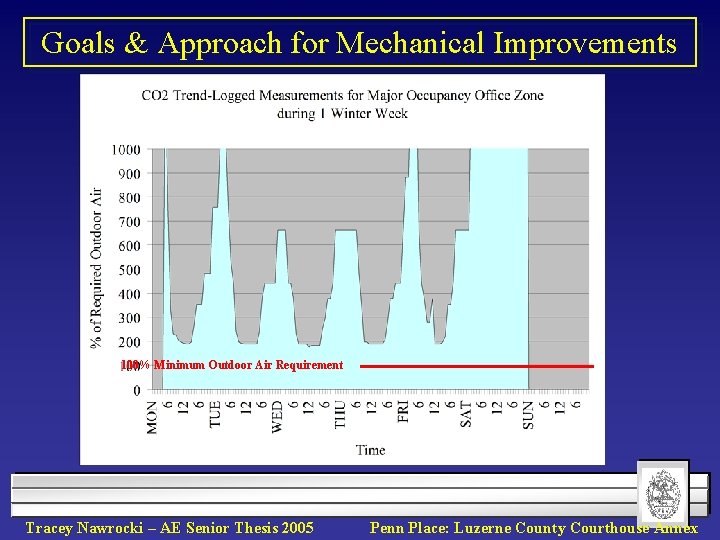
Goals & Approach for Mechanical Improvements Adjusting Flow Rates: Mass Balance Findings: Peak levels ~ 680 ppm = 38 CFM/person (almost twice the required minimum outdoor air flow rate) Off-peak hours ( 2/3 of each work day, weekends, and holidays) Required Fresh Air = 1. 9 and 13. 2 times the amount of fresh air required to meet acceptable ventilation guidelines. Although many assumptions are made using the steady-state equations, these values are justification enough to demonstrate a need for a solution to regulate flow rates more properly for the sake of energy savings. Tracey Nawrocki – AE Senior Thesis 2005 Penn Place: Luzerne County Courthouse Annex
Goals & Approach for Mechanical Improvements 100% Minimum Outdoor Air Requirement Tracey Nawrocki – AE Senior Thesis 2005 Penn Place: Luzerne County Courthouse Annex
Goals & Approach for Mechanical Improvements POINT: There is a point beyond which the level of safety is fulfilled where there are conditions where the over-design is detrimental concerning energy and resources. COUNTERPOINT: This analysis is based solely on representative CO 2 levels in the space. Outdoor air calculations are based on ideal, steady-state conditions, which are unlikely to exist. RESOLUTION: However, considering the extremely high levels of fresh air supplied to the spaces, even with a considerable margin of error, demand-control ventilation appears to be a good cure for optimizing air supply to spaces. Tracey Nawrocki – AE Senior Thesis 2005 Penn Place: Luzerne County Courthouse Annex
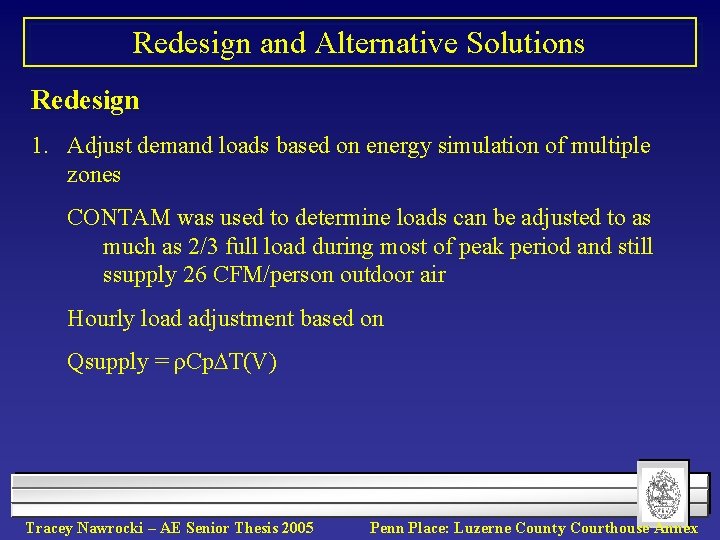
Redesign and Alternative Solutions Redesign 1. Adjust demand loads based on energy simulation of multiple zones CONTAM was used to determine loads can be adjusted to as much as 2/3 full load during most of peak period and still ssupply 26 CFM/person outdoor air Hourly load adjustment based on Qsupply = ρCp T(V) Tracey Nawrocki – AE Senior Thesis 2005 Penn Place: Luzerne County Courthouse Annex
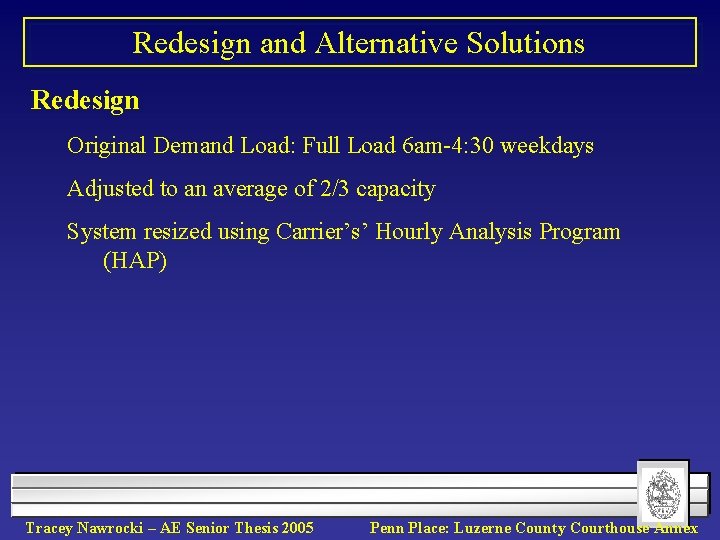
Redesign and Alternative Solutions Redesign Original Demand Load: Full Load 6 am-4: 30 weekdays Adjusted to an average of 2/3 capacity System resized using Carrier’s’ Hourly Analysis Program (HAP) Tracey Nawrocki – AE Senior Thesis 2005 Penn Place: Luzerne County Courthouse Annex
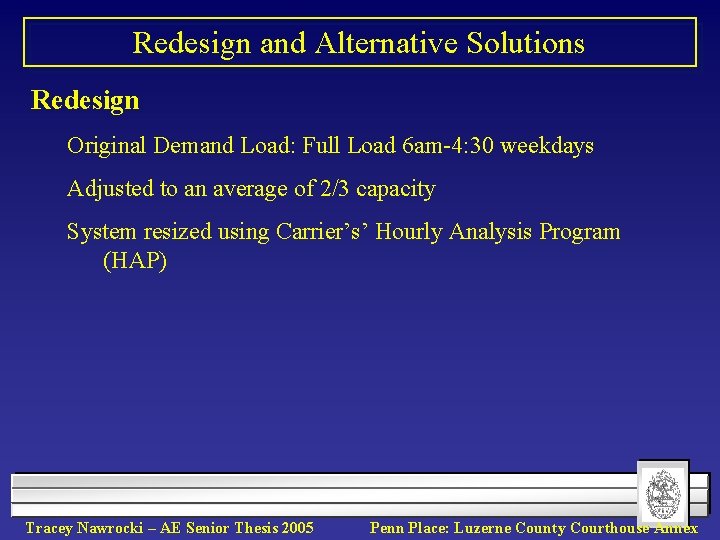
Redesign and Alternative Solutions Redesign Original Demand Load: Full Load 6 am-4: 30 weekdays Adjusted to an average of 2/3 capacity System resized using Carrier’s’ Hourly Analysis Program (HAP) Tracey Nawrocki – AE Senior Thesis 2005 Penn Place: Luzerne County Courthouse Annex
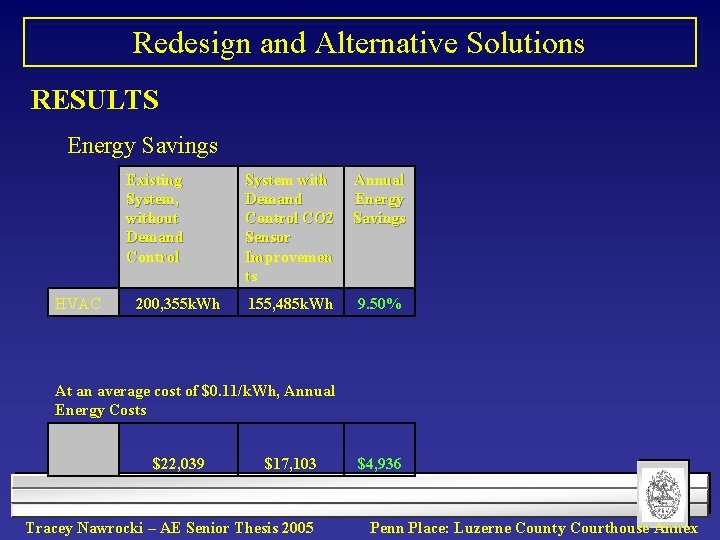
Redesign and Alternative Solutions RESULTS Energy Savings Existing System, without Demand Control HVAC 200, 355 k. Wh System with Annual Demand Energy Control CO 2 Savings Sensor Improvemen ts 155, 485 k. Wh 9. 50% At an average cost of $0. 11/k. Wh, Annual Energy Costs $22, 039 $17, 103 $4, 936 Tracey Nawrocki – AE Senior Thesis 2005 Penn Place: Luzerne County Courthouse Annex
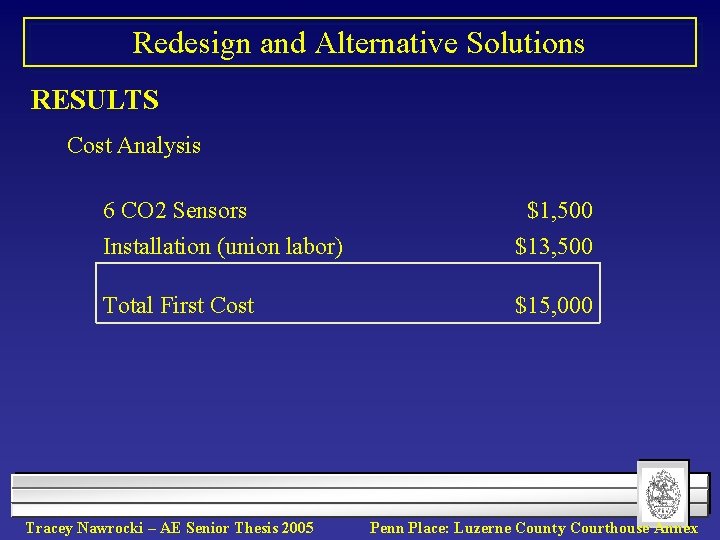
Redesign and Alternative Solutions RESULTS Cost Analysis 6 CO 2 Sensors $1, 500 Installation (union labor) $13, 500 Total First Cost $15, 000 Tracey Nawrocki – AE Senior Thesis 2005 Penn Place: Luzerne County Courthouse Annex
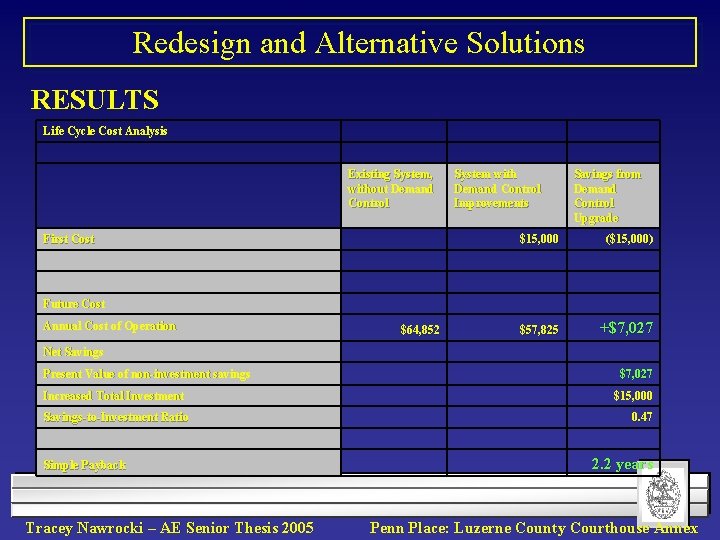
Redesign and Alternative Solutions RESULTS Life Cycle Cost Analysis Existing System, without Demand Control System with Demand Control Improvements Savings from Demand Control Upgrade First Cost Future Cost Annual Cost of Operation $15, 000 $64, 852 ($15, 000) +$7, 027 $57, 825 Net Savings Present Value of non-investment savings $7, 027 Increased Total Investment $15, 000 Savings-to-Investment Ratio 0. 47 Simple Payback 2. 2 years Tracey Nawrocki – AE Senior Thesis 2005 Penn Place: Luzerne County Courthouse Annex
Redesign and Alternative Solutions RESULTS County engineers would implement the sensors for demand-controlled ventilation if the building was not located in Luzerne County (O&M issues) Tracey Nawrocki – AE Senior Thesis 2005 Penn Place: Luzerne County Courthouse Annex
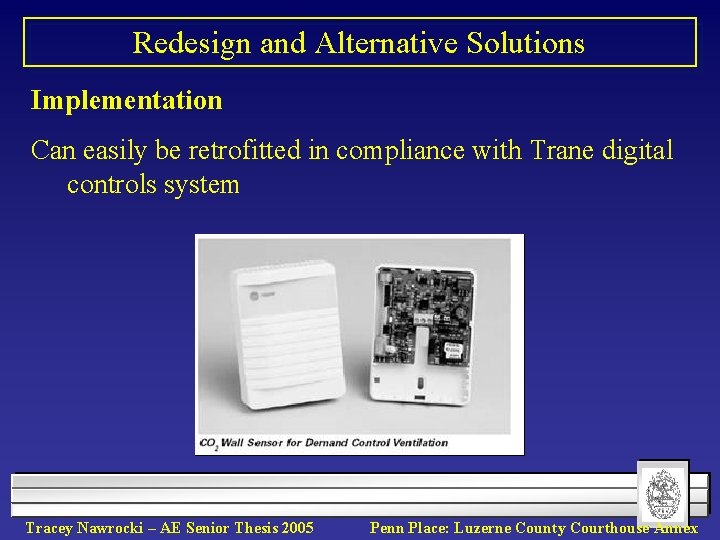
Redesign and Alternative Solutions Implementation Can easily be retrofitted in compliance with Trane digital controls system Tracey Nawrocki – AE Senior Thesis 2005 Penn Place: Luzerne County Courthouse Annex
Redesign and Alternative Solutions Alternative Solution Direct Electrical Airflow measurement Considered “more direct” apprach by some professionals, but not based on occupancy demands, other than Standard 62 design rates Tracey Nawrocki – AE Senior Thesis 2005 Penn Place: Luzerne County Courthouse Annex
Redesign and Alternative Solutions Continuing Project “Investigation of New Sensoring Technology and Guidelines for Preparing Existing Variable-Air-Volume (VAV) Systems for Response to Contaminant Dispersion in Moderate-Risk Office Buildings” ASHRAE Graduate Grant-in-Aid Tracey Nawrocki – AE Senior Thesis 2005 Penn Place: Luzerne County Courthouse Annex
Breadth Study: Building Security Design Goal: Coordinating Systems Security Design: Guidelines for Designers and Owners in first, planning stages of Project an “AE” approach to Building Security planning Tracey Nawrocki – AE Senior Thesis 2005 Penn Place: Luzerne County Courthouse Annex
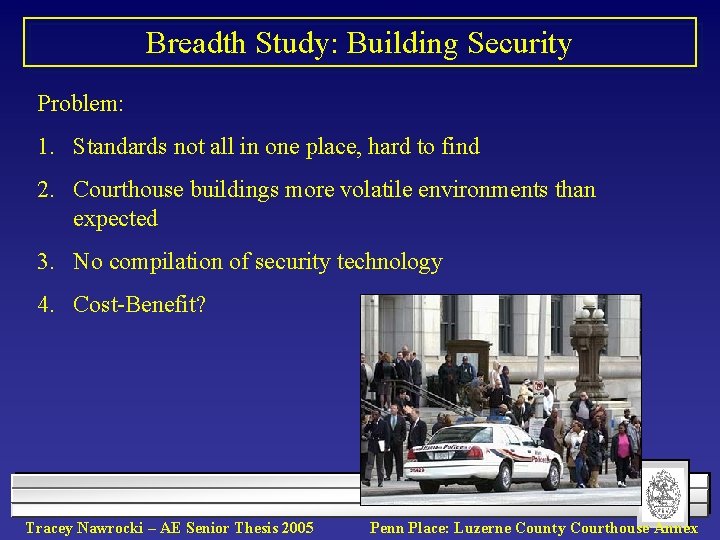
Breadth Study: Building Security Problem: 1. Standards not all in one place, hard to find 2. Courthouse buildings more volatile environments than expected 3. No compilation of security technology 4. Cost-Benefit? Tracey Nawrocki – AE Senior Thesis 2005 Penn Place: Luzerne County Courthouse Annex
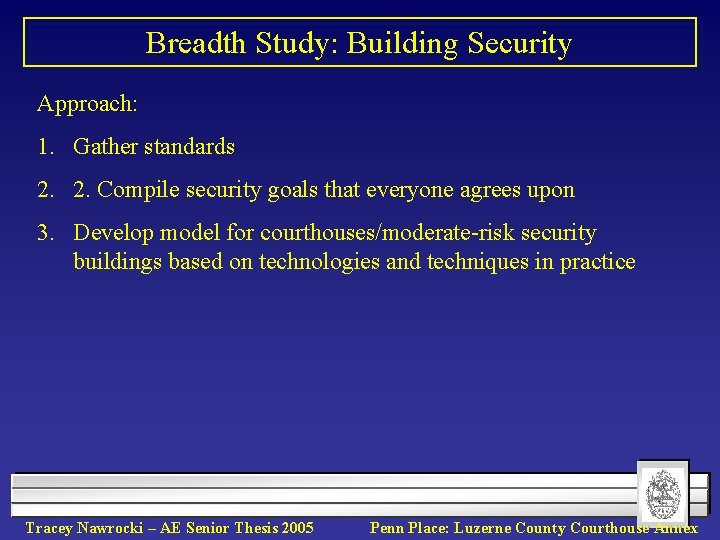
Breadth Study: Building Security Approach: 1. Gather standards 2. 2. Compile security goals that everyone agrees upon 3. Develop model for courthouses/moderate-risk security buildings based on technologies and techniques in practice Tracey Nawrocki – AE Senior Thesis 2005 Penn Place: Luzerne County Courthouse Annex
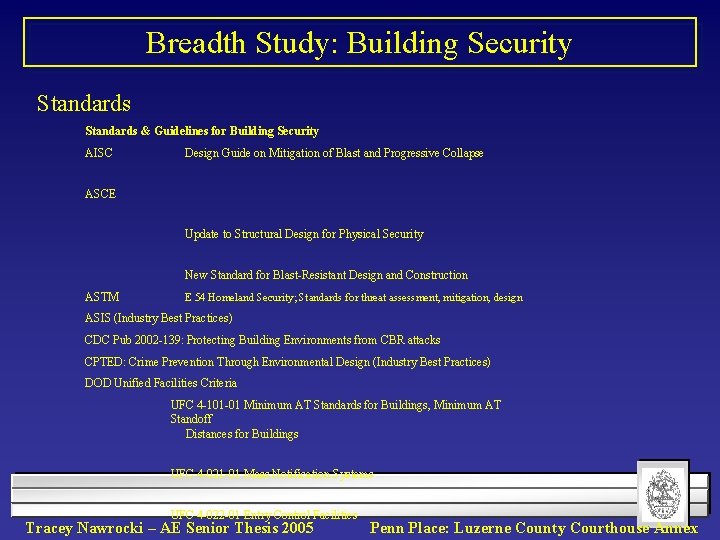
Breadth Study: Building Security Standards & Guidelines for Building Security AISC Design Guide on Mitigation of Blast and Progressive Collapse ASCE Update to Structural Design for Physical Security New Standard for Blast-Resistant Design and Construction ASTM E 54 Homeland Security; Standards for threat assessment, mitigation, design ASIS (Industry Best Practices) CDC Pub 2002 -139: Protecting Building Environments from CBR attacks CPTED: Crime Prevention Through Environmental Design (Industry Best Practices) DOD Unified Facilities Criteria UFC 4 -101 -01 Minimum AT Standards for Buildings, Minimum AT Standoff Distances for Buildings UFC 4 -021 -01 Mass Notification Systems UFC 4 -022 -01 Entry Control Facilities Tracey Nawrocki – AE Senior Thesis 2005 Penn Place: Luzerne County Courthouse Annex
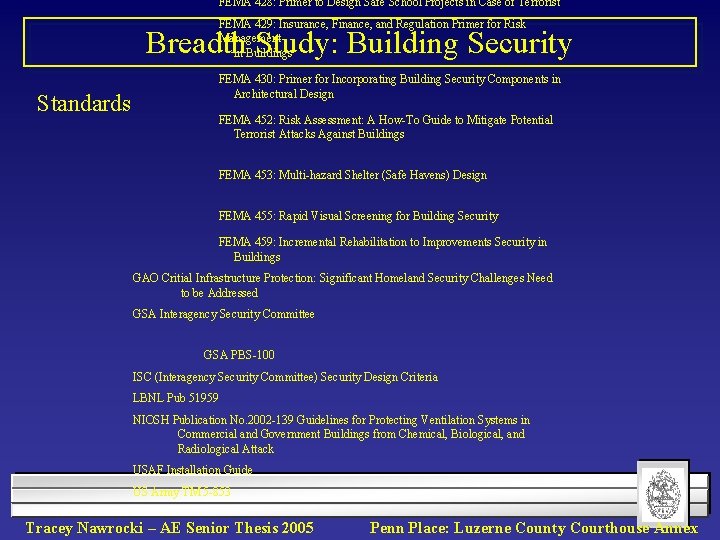
FEMA 428: Primer to Design Safe School Projects in Case of Terrorist FEMA 429: Insurance, Finance, and Regulation Primer for Risk Management in Buildings Breadth Study: Building Security Standards FEMA 430: Primer for Incorporating Building Security Components in Architectural Design FEMA 452: Risk Assessment: A How-To Guide to Mitigate Potential Terrorist Attacks Against Buildings FEMA 453: Multi-hazard Shelter (Safe Havens) Design FEMA 455: Rapid Visual Screening for Building Security FEMA 459: Incremental Rehabilitation to Improvements Security in Buildings GAO Critial Infrastructure Protection: Significant Homeland Security Challenges Need to be Addressed GSA Interagency Security Committee GSA PBS-100 ISC (Interagency Security Committee) Security Design Criteria LBNL Pub 51959 NIOSH Publication No. 2002 -139 Guidelines for Protecting Ventilation Systems in Commercial and Government Buildings from Chemical, Biological, and Radiological Attack USAF Installation Guide US Army TM 5 -853 Tracey Nawrocki – AE Senior Thesis 2005 Penn Place: Luzerne County Courthouse Annex
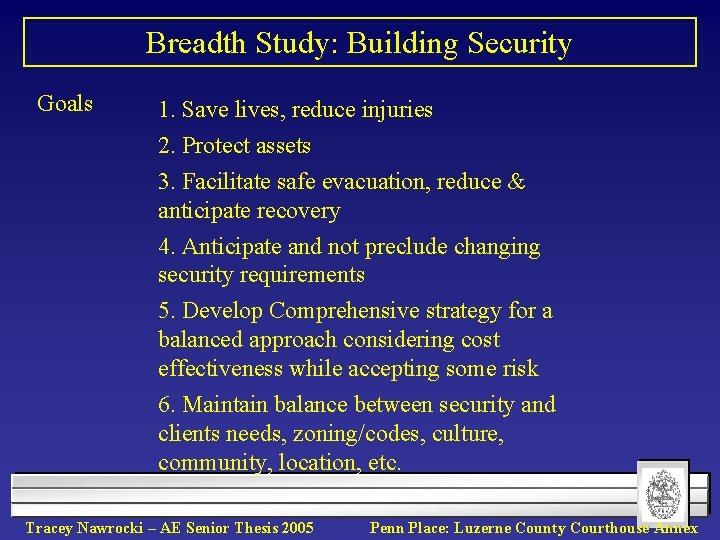
Breadth Study: Building Security Goals 1. Save lives, reduce injuries 2. Protect assets 3. Facilitate safe evacuation, reduce & anticipate recovery 4. Anticipate and not preclude changing security requirements 5. Develop Comprehensive strategy for a balanced approach considering cost effectiveness while accepting some risk 6. Maintain balance between security and clients needs, zoning/codes, culture, community, location, etc. Tracey Nawrocki – AE Senior Thesis 2005 Penn Place: Luzerne County Courthouse Annex

Breadth Study: Building Security Technologies based on Trade Tracey Nawrocki – AE Senior Thesis 2005 Penn Place: Luzerne County Courthouse Annex
Conclusions Penn Place Mechanical System A case of over-ventilation and fluctuation in occupancy and operations makes the Penn Place building an excellent candidate for demand- controlled ventilation based on CO 2 levels. Renovating the system with sensors and controls can save as much as 10% of energy per year, and about 12% of the current building overall operating cost. Payback would be about 2. 2 years, making the solution one worth investigating. Security A basic security master plan for Penn Place includes guarded parking lot gated entrance, and smart card readers throughout the building. The most important security tactic for this building, because of its location and level of public use is making occupants aware of who should be in the building and who should not. Tracey Nawrocki – AE Senior Thesis 2005 Penn Place: Luzerne County Courthouse Annex
- Slides: 39