
Penicillins Part 2 Chemotherapy VPT411 Lecture11 Dr Kumari
- Slides: 16
Penicillins (Part 2) ……………………………………………………………………………………………………………………… Chemotherapy (VPT-411) (Lecture-11) Dr. Kumari Anjana Asstt. Professor Deptt. of Veterinary Pharmacology & Toxicology Bihar Veterinary College, Bihar Animal Sciences University, Patna
Content of the chapter • Penicillins – Pharmacokinetics Clinical Uses of Penicillins Administration and Dosages of Penicillins Adverse Reactions and Toxicity of Penicillin Beta-lactamases Beta-lactamase inhibitors Potentiated Penicillins
Pharmacokinetics • Penicillin G, its salts and methicillin are destroyed by gastric acid and are orally ineffective. • Only the acid resistant Penicillins can be given orally and their peak plasma concentration is reached within about two hours. • Most of the Penicillins including repository Penicillins are administered parenterally (usually IM). • Penicillins are widely distributed in the body fluid and tissue.
Clinical Uses of Penicillins • The penicillins are used in the treatment of local and systemic infections caused by the sensitive bacteria. • Penicillin G is of value in the treatment of • • • Bovine mastitis (primarily in streptococcal mastitis), Anthrax, Erysipelothrix infection in sheep, pigs and birds. Strangles in horses, Clostridial infections (tetanus and black quarter), Pyelonephritis and lumpy jaw in cattle, Beta-haemolytic streptococcal infection in puppies, Meningococcal meningitis and Leptospirosis.
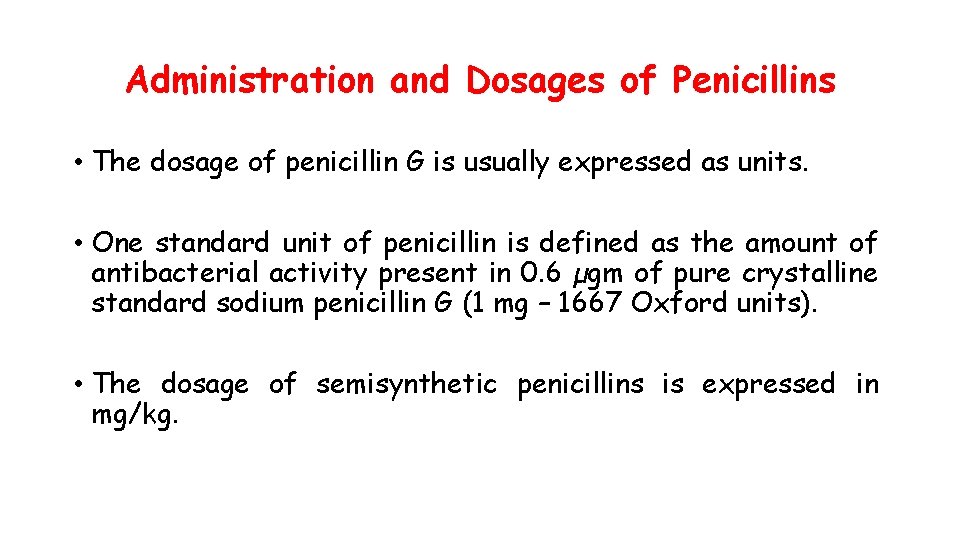
Administration and Dosages of Penicillins • The dosage of penicillin G is usually expressed as units. • One standard unit of penicillin is defined as the amount of antibacterial activity present in 0. 6 µgm of pure crystalline standard sodium penicillin G (1 mg – 1667 Oxford units). • The dosage of semisynthetic penicillins is expressed in mg/kg.
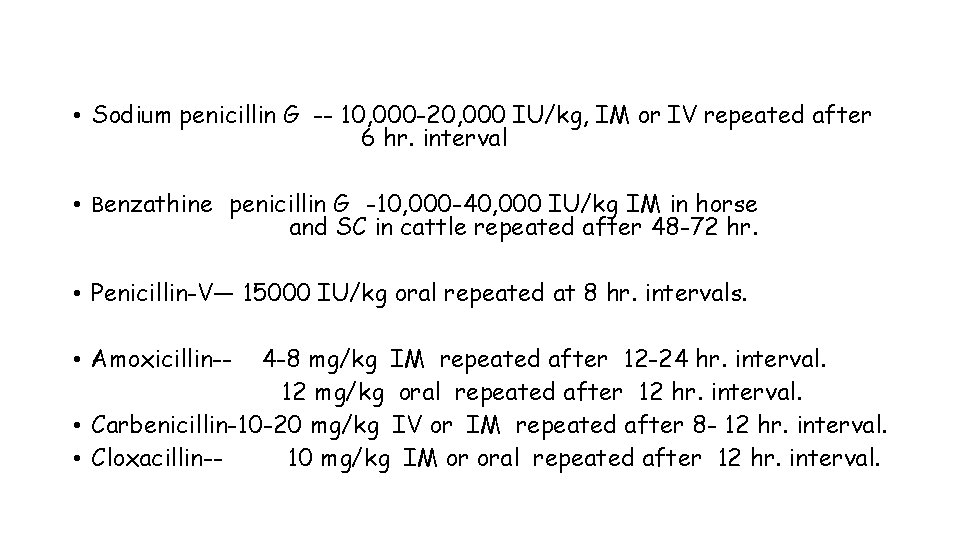
• Sodium penicillin G -- 10, 000 -20, 000 IU/kg, IM or IV repeated after 6 hr. interval • Benzathine penicillin G -10, 000 -40, 000 IU/kg IM in horse and SC in cattle repeated after 48 -72 hr. • Penicillin-V— 15000 IU/kg oral repeated at 8 hr. intervals. • Amoxicillin-- 4 -8 mg/kg IM repeated after 12 -24 hr. interval. 12 mg/kg oral repeated after 12 hr. interval. • Carbenicillin-10 -20 mg/kg IV or IM repeated after 8 - 12 hr. interval. • Cloxacillin-10 mg/kg IM or oral repeated after 12 hr. interval.
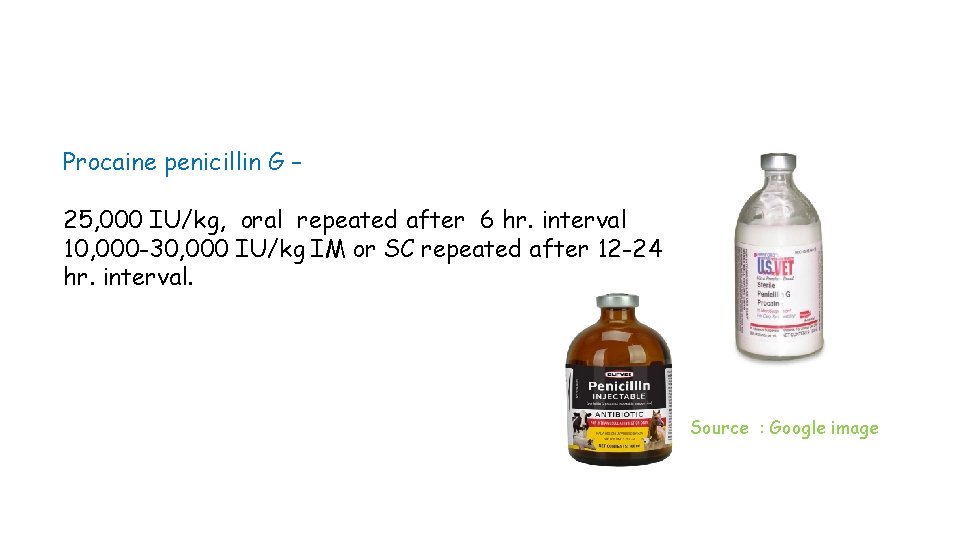
Procaine penicillin G – 25, 000 IU/kg, oral repeated after 6 hr. interval 10, 000 -30, 000 IU/kg IM or SC repeated after 12 -24 hr. interval. Source : Google image
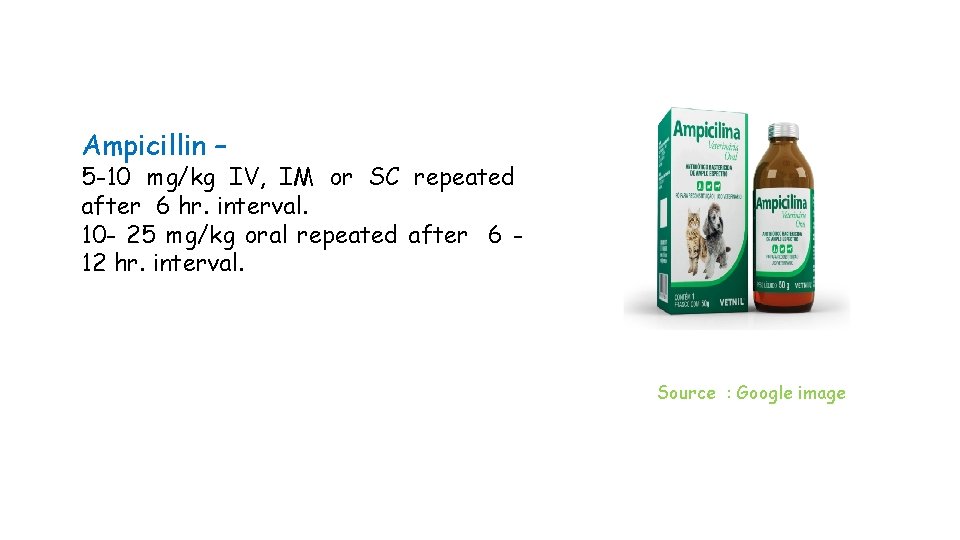
Ampicillin – 5 -10 mg/kg IV, IM or SC repeated after 6 hr. interval. 10 - 25 mg/kg oral repeated after 6 12 hr. interval. Source : Google image
Repository Penicillins • Benzathine penicilline G and procaine penicillin G in oil. • These are the penicillins which are slowly absorbed over a period of 5 -7 days following a single IM injection. • Probenecid was developed as an alternative to caronamide to competitively inhibit renal excretion of some drugs, thereby increasing their plasma concentration and prolonging their effects. • Probenecid delays renal excretion of penicillins and prolongs the blood levels of penicillins with short plasma half-life. • It is added @ 1 -2 mg/1000 IU of penicillin G for oral dosing in dog at 6 hr. intervals. • The repository forms of penicillin should never be injected IV.
Adverse Reactions and Toxicity of Penicillin • Hypersensitive, allergic or anaphylactic reactions (mostly along with streptomycin) are reported in dog, cattle and horse following prior sensitization to the antibiotic. • GI disturbances • Platelet dysfunction • Organ toxicity • Cation Toxicity
Beta-lactamases • Beta-lactamases are enzymes produced by penicillinresistant bacteria, which break the antibiotic into inactive penicilloic acid. • They are named as beta-lactamases as they act by splitting the beta-lactam ring present in beta-lactam antibiotics, penicillins and cephalosporins. • The enzyme is of two types: Penicillinase and Cephalosporinase.
Beta-lactamase inhibitors: • These potentiate or reestablish the antibacterial potency penicillinase sensitive penicillins. • It is active against beta-lactamase producing organisms by inhibition of the enzyme (suicidal inhibition). • These inhibitors are structurally similar to penicillin and act as substitutes for penicillinase (B-lactamase) causing inhibition of the enzyme.
• Clavulanic acid: Obtained from Streptomyces clavuligerus, has no antibacterial activity of its own. It is generally combined with amoxicillin (Augmentin) or ticarcillin (Timentin). • Sulbactam: A semisynthetic beta-lactamase inhibitor, related chemically and in activity to clavulanic acid. It is combined with ampicllin and preferably for oral and parenteral administration. • Tazobactam: It is similar to sulbactam and combined with piperacillin.
Potentiated Penicillins • Potentiated Penicillins: Penicillins + β-lactamase inhibitors = Potentiated Penicillins • The combinations are: • Amoxicillin-Clavulanic acid (4: 1), • Ticarcillin-clavulanic acid- (15: 1) and • Ampicillin-sulbactam. • Dose: Potassium clavulanate: amoxicillin (1: 4) @ 10 -20 mg/kg (amoxicillin) and ; 2. 5 -5 mg/kg (clavulanate) orally at 12 hr. • Penicillins with sulbactam and tazobactum are administered IV; with clavulanic acid are administered orally or IV.
Summary • (1 mg – 1667 Oxford units). • Beta-lactamase inhibitors: These potentiate or reestablish the antibacterial potency penicillinase sensitive penicillins. • Potentiated Penicillins: Penicillins + β-lactamase inhibitors = Potentiated Penicillins
Thank You