
PENDLETON HOUSING NEEDS ANALYSIS Presentation to Housing Committee

- Slides: 17
PENDLETON HOUSING NEEDS ANALYSIS Presentation to Housing Committee 10/5/2019
History of Pendleton Housing Analyses 2011: Technical Memos for Periodic Comp. Plan Update (Winterbrook Planning) 2011: Analysis of the Housing Market in Pendleton, OR (Sabino Community Development Resources) 2012: Residential Buildable Lands Inventory (Pendleton Solutions Housing Group) 2016: Update to Analysis of the Housing Market in Pendleton, OR (Sabino Community Development Resources) 2019: Housing Needs Analysis (FCS Group)
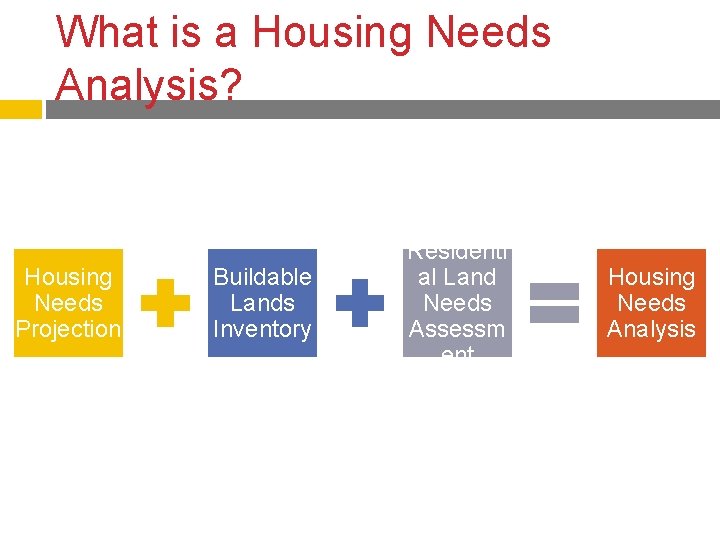
What is a Housing Needs Analysis? Housing Needs Projection Buildable Lands Inventory Residenti al Land Needs Assessm ent Housing Needs Analysis
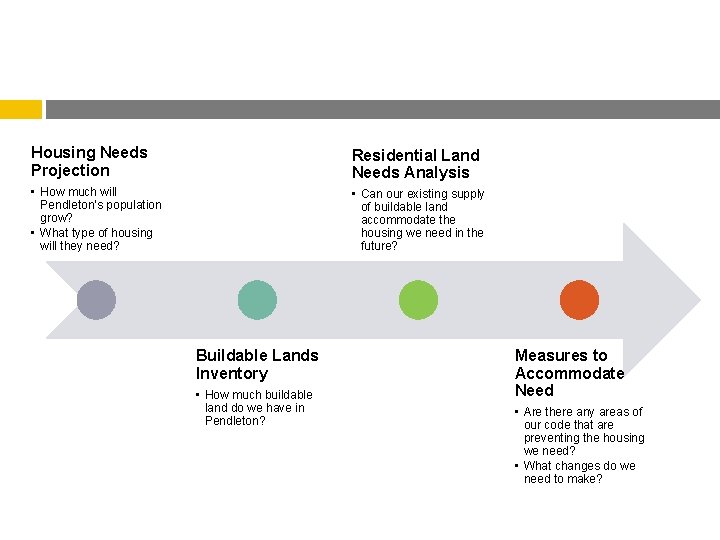
Housing Needs Projection Residential Land Needs Analysis • How much will Pendleton’s population grow? • What type of housing will they need? • Can our existing supply of buildable land accommodate the housing we need in the future? Buildable Lands Inventory • How much buildable land do we have in Pendleton? Measures to Accommodate Need • Are there any areas of our code that are preventing the housing we need? • What changes do we need to make?
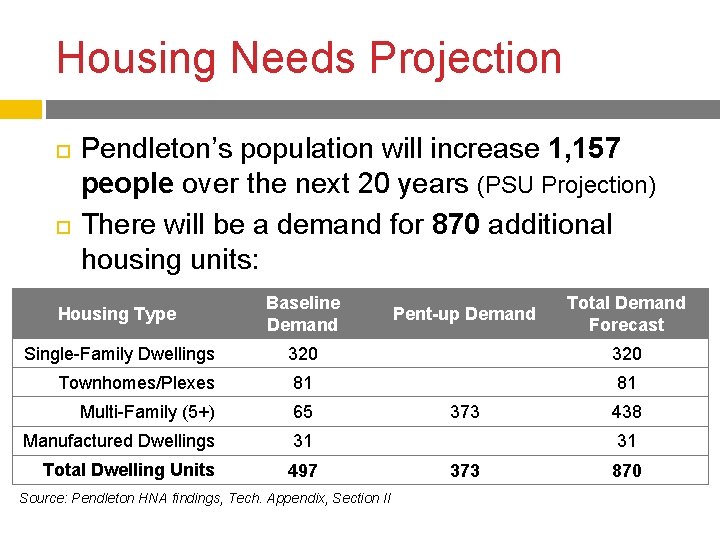
Housing Needs Projection Pendleton’s population will increase 1, 157 people over the next 20 years (PSU Projection) There will be a demand for 870 additional housing units: Housing Type Baseline Demand Single-Family Dwellings 320 Townhomes/Plexes 81 81 Multi-Family (5+) 65 Manufactured Dwellings 31 Total Dwelling Units 497 Source: Pendleton HNA findings, Tech. Appendix, Section II Pent-up Demand 373 Total Demand Forecast 438 31 373 870
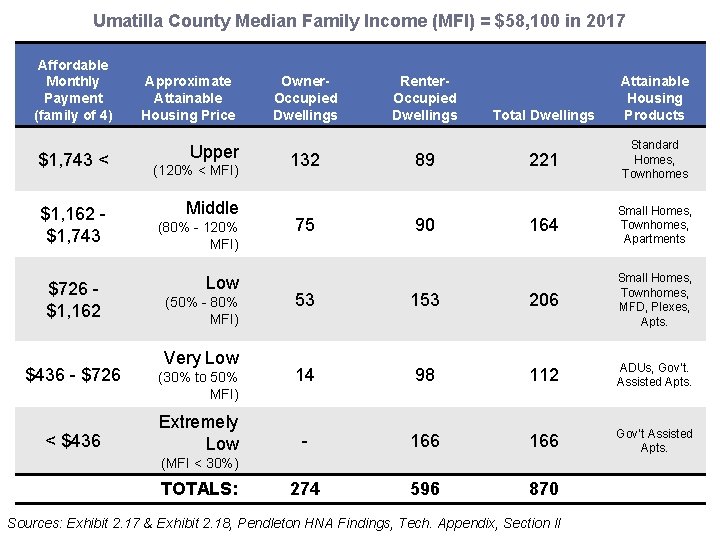
Umatilla County Median Family Income (MFI) = $58, 100 in 2017 Affordable Monthly Payment (family of 4) $1, 743 < $1, 162 $1, 743 $726 $1, 162 $436 - $726 < $436 Approximate Attainable Housing Price Upper (120% < MFI) Middle (80% - 120% MFI) Low (50% - 80% MFI) Very Low (30% to 50% MFI) Extremely Low Owner. Occupied Dwellings 132 75 Renter. Occupied Dwellings 89 90 Total Dwellings 221 Standard Homes, Townhomes 164 Small Homes, Townhomes, Apartments 53 153 206 Small Homes, Townhomes, MFD, Plexes, Apts. 14 98 112 ADUs, Gov’t. Assisted Apts. - 166 Gov’t Assisted Apts. 274 596 870 (MFI < 30%) TOTALS: Attainable Housing Products Sources: Exhibit 2. 17 & Exhibit 2. 18, Pendleton HNA Findings, Tech. Appendix, Section II
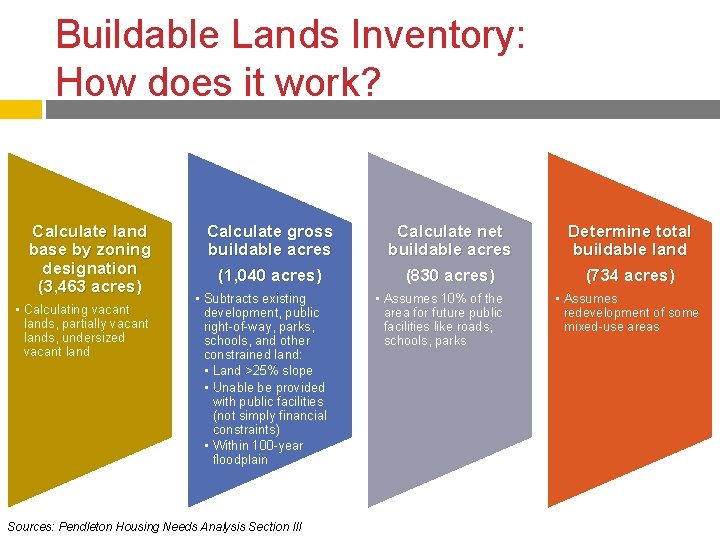
Buildable Lands Inventory: How does it work? Calculate land base by zoning designation (3, 463 acres) • Calculating vacant lands, partially vacant lands, undersized vacant land Calculate gross buildable acres (1, 040 acres) • Subtracts existing development, public right-of-way, parks, schools, and other constrained land: • Land >25% slope • Unable be provided with public facilities (not simply financial constraints) • Within 100 -year floodplain Sources: Pendleton Housing Needs Analysis Section III Calculate net buildable acres (830 acres) • Assumes 10% of the area for future public facilities like roads, schools, parks Determine total buildable land (734 acres) • Assumes redevelopment of some mixed-use areas
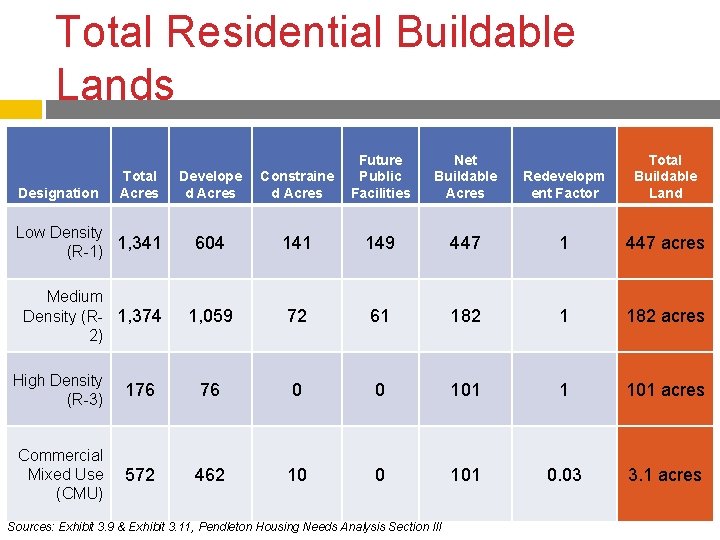
Total Residential Buildable Lands Develope d Acres Constraine d Acres Future Public Facilities Low Density 1, 341 (R-1) 604 141 149 447 1 447 acres Medium Density (R- 1, 374 2) 1, 059 72 61 182 acres Designation Total Acres Net Buildable Acres Redevelopm ent Factor Total Buildable Land High Density (R-3) 176 76 0 0 101 1 101 acres Commercial Mixed Use (CMU) 572 462 10 0 101 0. 03 3. 1 acres Sources: Exhibit 3. 9 & Exhibit 3. 11, Pendleton Housing Needs Analysis Section III
Distribution of Land CMU; 0, 42% High Density; 13, 78% Medium Density; 24, 83% Low Density; 60, 97% Sources: Exhibit 3. 9 & Exhibit 3. 11, Pendleton Housing Needs Analysis Section III
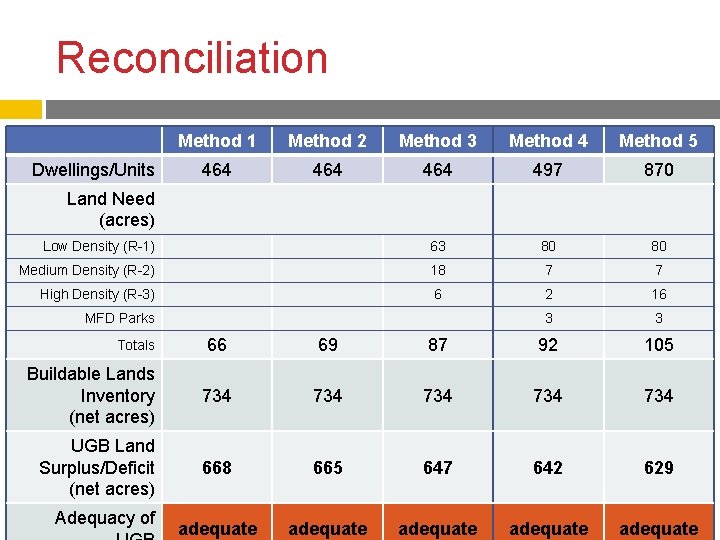
Reconciliation Method 1 Method 2 Method 3 Method 4 Method 5 464 464 497 870 Low Density (R-1) 63 80 80 Medium Density (R-2) 18 7 7 High Density (R-3) 6 2 16 3 3 Dwellings/Units Land Need (acres) MFD Parks 66 69 87 92 105 Buildable Lands Inventory (net acres) 734 734 734 UGB Land Surplus/Deficit (net acres) 668 665 647 642 629 adequate adequate Totals Adequacy of
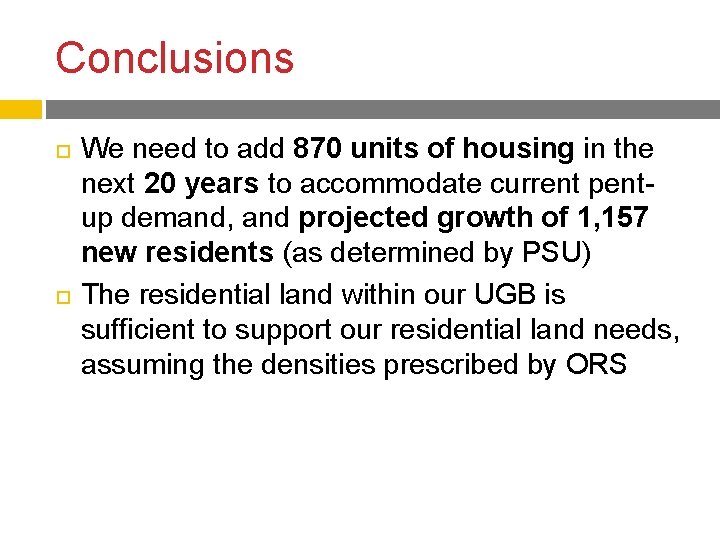
Conclusions We need to add 870 units of housing in the next 20 years to accommodate current pentup demand, and projected growth of 1, 157 new residents (as determined by PSU) The residential land within our UGB is sufficient to support our residential land needs, assuming the densities prescribed by ORS
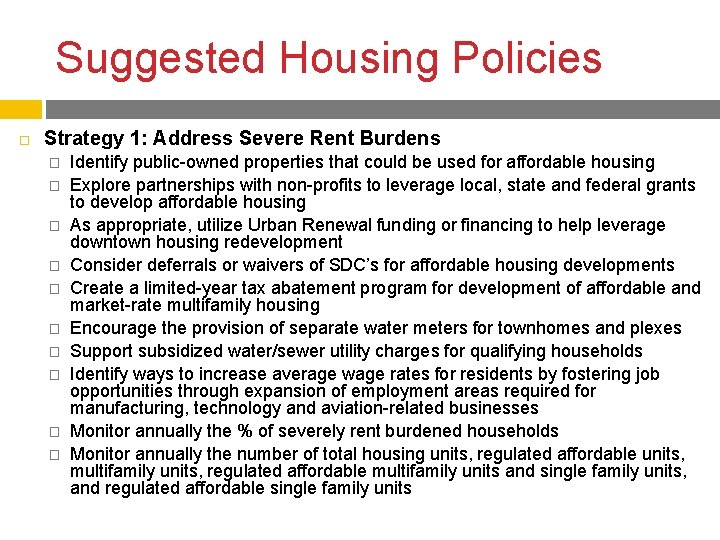
Suggested Housing Policies Strategy 1: Address Severe Rent Burdens � � � � � Identify public-owned properties that could be used for affordable housing Explore partnerships with non-profits to leverage local, state and federal grants to develop affordable housing As appropriate, utilize Urban Renewal funding or financing to help leverage downtown housing redevelopment Consider deferrals or waivers of SDC’s for affordable housing developments Create a limited-year tax abatement program for development of affordable and market-rate multifamily housing Encourage the provision of separate water meters for townhomes and plexes Support subsidized water/sewer utility charges for qualifying households Identify ways to increase average wage rates for residents by fostering job opportunities through expansion of employment areas required for manufacturing, technology and aviation-related businesses Monitor annually the % of severely rent burdened households Monitor annually the number of total housing units, regulated affordable units, multifamily units, regulated affordable multifamily units and single family units, and regulated affordable single family units
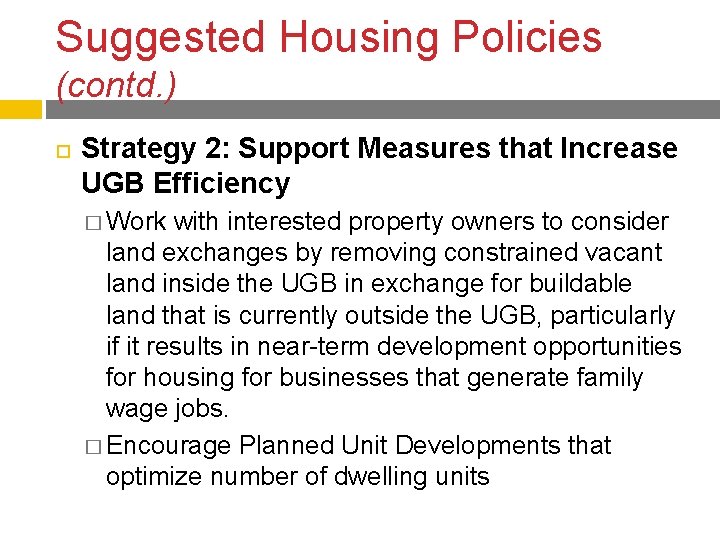
Suggested Housing Policies (contd. ) Strategy 2: Support Measures that Increase UGB Efficiency � Work with interested property owners to consider land exchanges by removing constrained vacant land inside the UGB in exchange for buildable land that is currently outside the UGB, particularly if it results in near-term development opportunities for housing for businesses that generate family wage jobs. � Encourage Planned Unit Developments that optimize number of dwelling units
Next Steps Recommend adoption by City Council, either in whole or in part Not recommend adoption by City Council
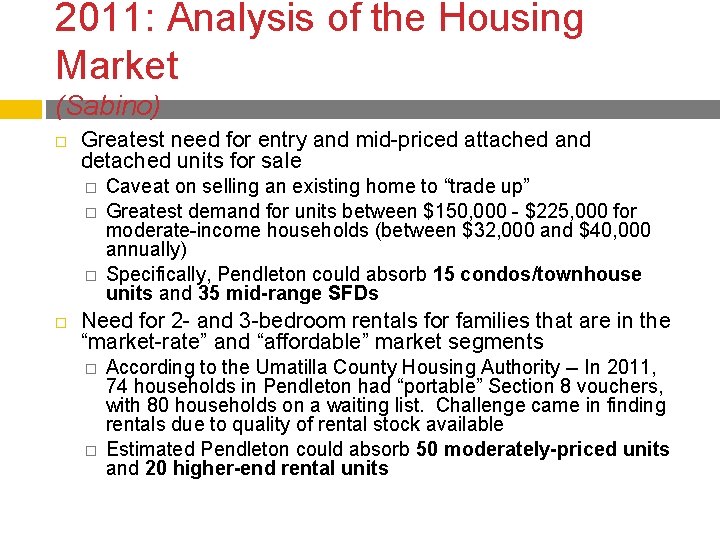
2011: Analysis of the Housing Market (Sabino) Greatest need for entry and mid-priced attached and detached units for sale � � � Caveat on selling an existing home to “trade up” Greatest demand for units between $150, 000 - $225, 000 for moderate-income households (between $32, 000 and $40, 000 annually) Specifically, Pendleton could absorb 15 condos/townhouse units and 35 mid-range SFDs Need for 2 - and 3 -bedroom rentals for families that are in the “market-rate” and “affordable” market segments � � According to the Umatilla County Housing Authority -- In 2011, 74 households in Pendleton had “portable” Section 8 vouchers, with 80 households on a waiting list. Challenge came in finding rentals due to quality of rental stock available Estimated Pendleton could absorb 50 moderately-priced units and 20 higher-end rental units
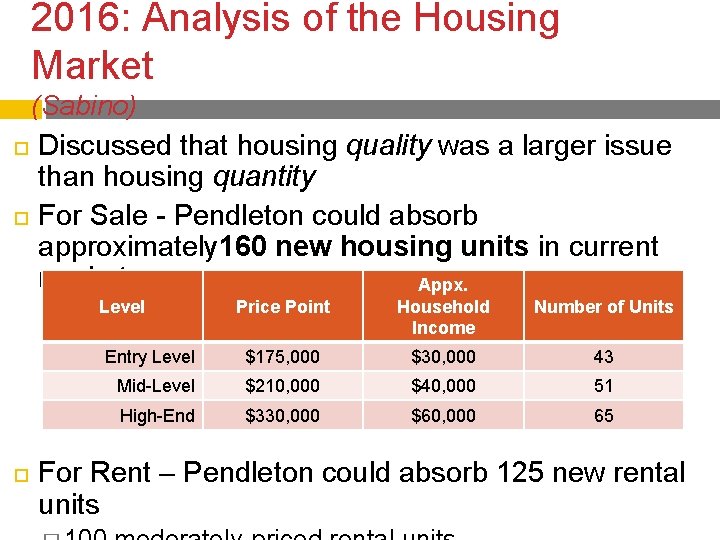
2016: Analysis of the Housing Market (Sabino) Discussed that housing quality was a larger issue than housing quantity For Sale - Pendleton could absorb approximately 160 new housing units in current market: Appx. Level Price Point Household Income Number of Units Entry Level $175, 000 $30, 000 43 Mid-Level $210, 000 $40, 000 51 High-End $330, 000 $60, 000 65 For Rent – Pendleton could absorb 125 new rental units
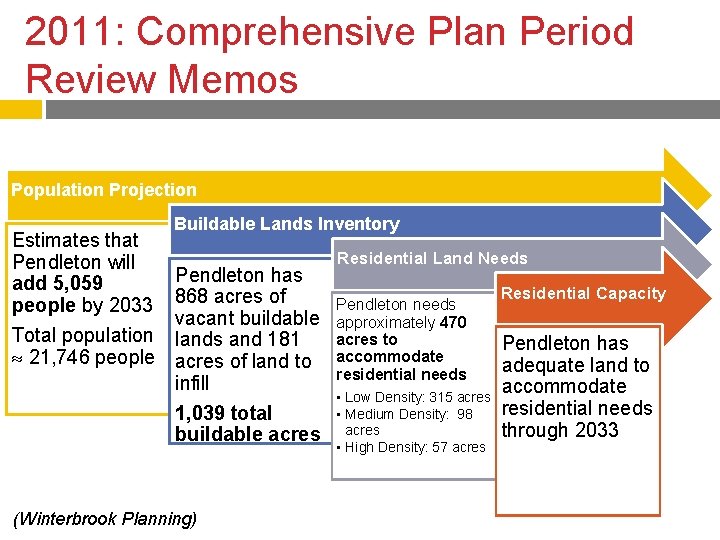
2011: Comprehensive Plan Period Review Memos Population Projection Estimates that Pendleton will add 5, 059 people by 2033 Total population 21, 746 people Buildable Lands Inventory Pendleton has 868 acres of vacant buildable lands and 181 acres of land to infill 1, 039 total buildable acres (Winterbrook Planning) Residential Land Needs Pendleton needs approximately 470 acres to accommodate residential needs • Low Density: 315 acres • Medium Density: 98 acres • High Density: 57 acres Residential Capacity Pendleton has adequate land to accommodate residential needs through 2033