
PenaltyBased Solution for the Interval Finite Element Methods
Penalty-Based Solution for the Interval Finite Element Methods Rafi L. Muhanna Georgia Institute of Technology Robert L. Mullen Case Western Reserve University Hao Zhang Georgia Institute of Technology First Scandinavian Workshop on INTERVAL METHODS AND THEIR APPLICATIONS August 14 -16, 2003, Technical University of Denmark, Copenhagen, Denmark
Outline Interval Finite Elements n Element-By-Element n Penalty Approach n Examples n Conclusions n

Center for Reliable Engineering Computing (REC)
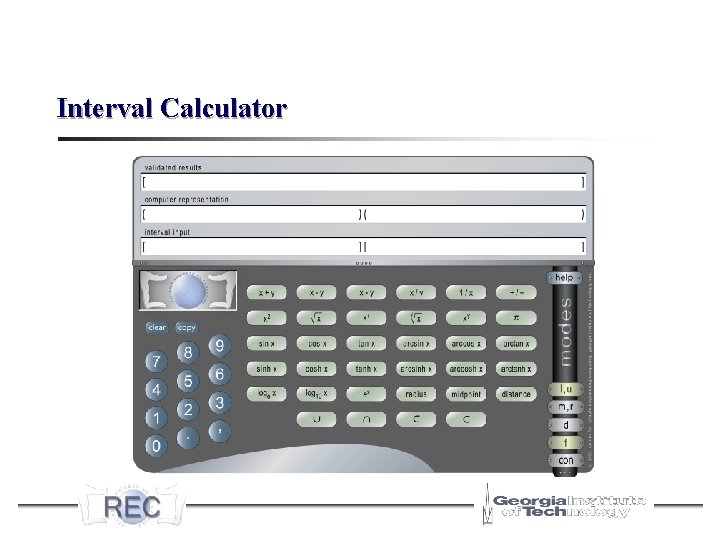
Interval Calculator
Outline Interval Finite Elements n Element-by-Element n Penalty Approach n Examples n Conclusions n
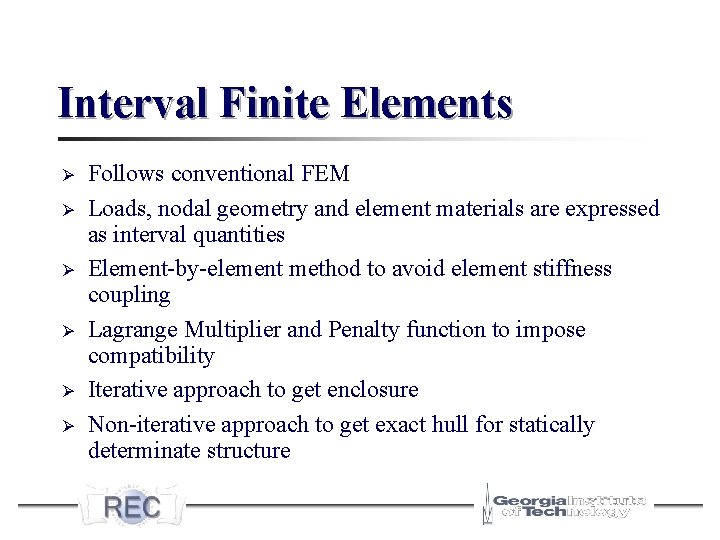
Interval Finite Elements Ø Ø Ø Follows conventional FEM Loads, nodal geometry and element materials are expressed as interval quantities Element-by-element method to avoid element stiffness coupling Lagrange Multiplier and Penalty function to impose compatibility Iterative approach to get enclosure Non-iterative approach to get exact hull for statically determinate structure
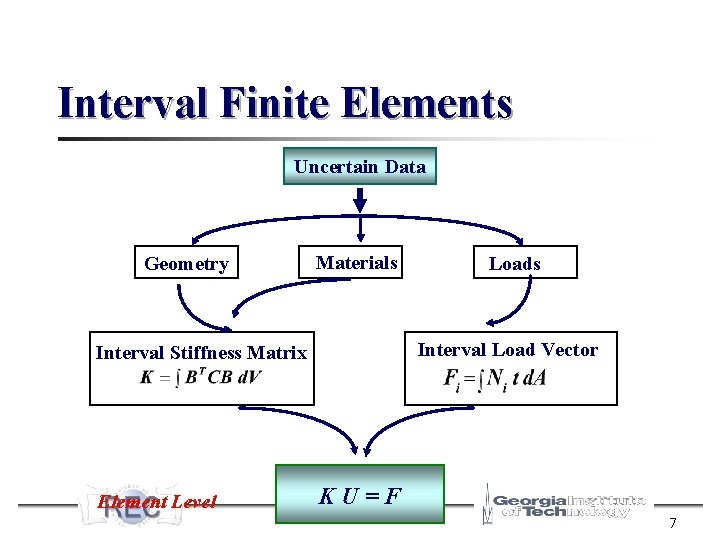
Interval Finite Elements Uncertain Data Geometry Materials Interval Load Vector Interval Stiffness Matrix Element Level Loads KU=F 7
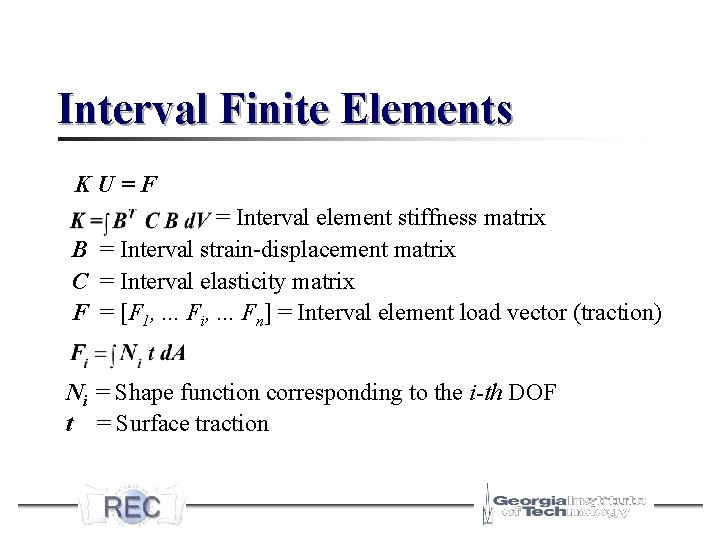
Interval Finite Elements KU=F = Interval element stiffness matrix B = Interval strain-displacement matrix C = Interval elasticity matrix F = [F 1, . . . Fi, . . . Fn] = Interval element load vector (traction) Ni = Shape function corresponding to the i-th DOF t = Surface traction
Finite Element 1. Load Dependency 2. Stiffness Dependency
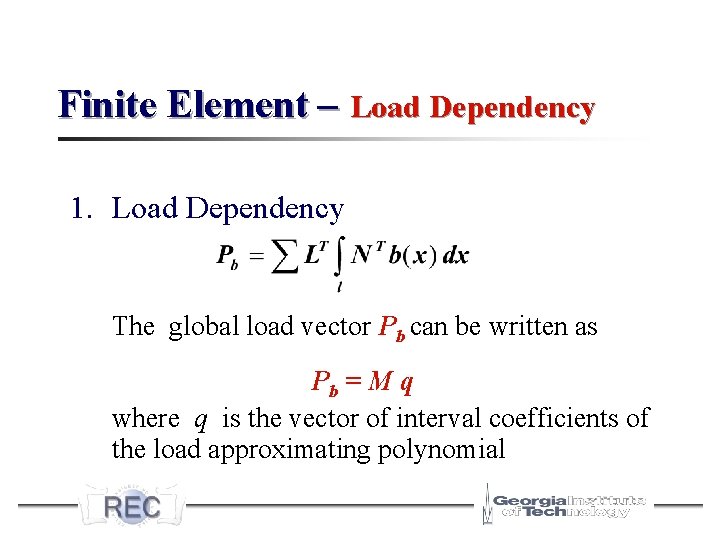
Finite Element – Load Dependency 1. Load Dependency The global load vector Pb can be written as Pb = M q where q is the vector of interval coefficients of the load approximating polynomial
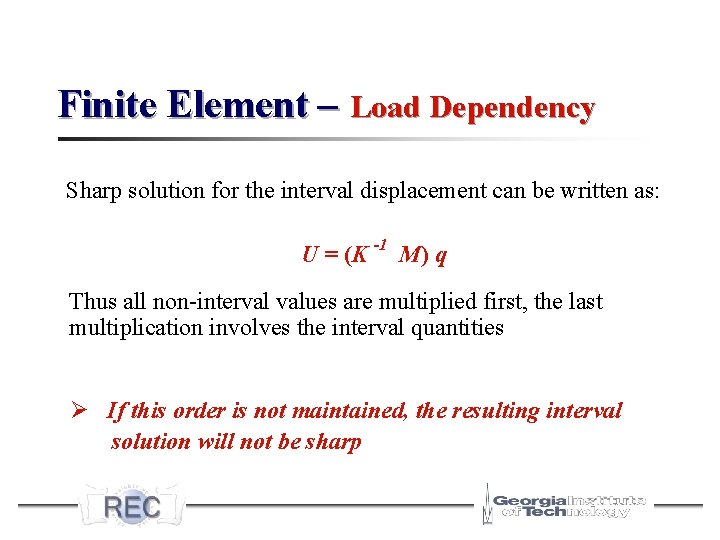
Finite Element – Load Dependency Sharp solution for the interval displacement can be written as: U = (K -1 M) q Thus all non-interval values are multiplied first, the last multiplication involves the interval quantities Ø If this order is not maintained, the resulting interval solution will not be sharp
Outline Interval Finite Elements n Element-by-Element n Penalty Approach n Examples n Conclusions n
Finite Element – Element-by-Element Approach Ø Stiffness Dependency Coupling (assemblage process)
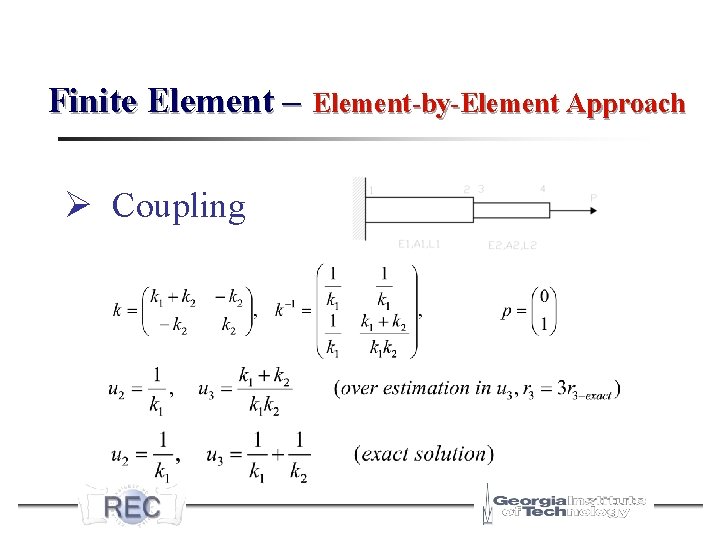
Finite Element – Element-by-Element Approach Ø Coupling
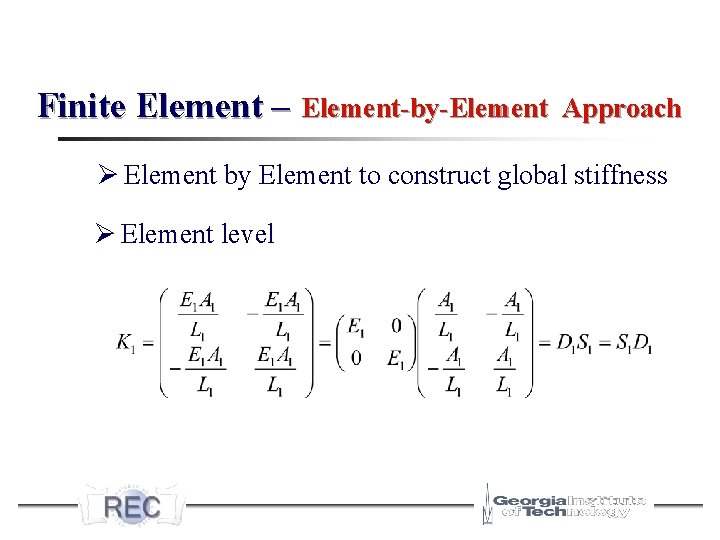
Finite Element – Element-by-Element Approach Ø Element by Element to construct global stiffness Ø Element level
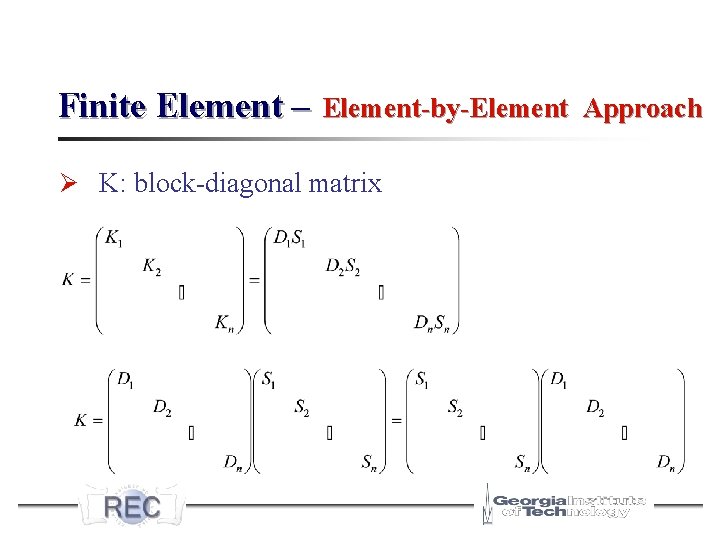
Finite Element – Element-by-Element Approach Ø K: block-diagonal matrix

Finite Element – Element-by-Element Approach Ø Element-by-Element
Outline Interval Finite Elements n Element-by-Element n Penalty Approach n Examples n Conclusions n
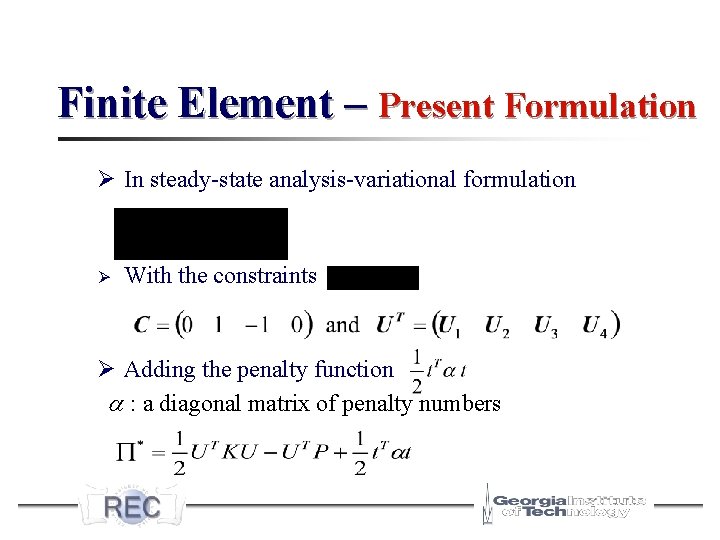
Finite Element – Present Formulation Ø In steady-state analysis-variational formulation Ø With the constraints Ø Adding the penalty function : a diagonal matrix of penalty numbers
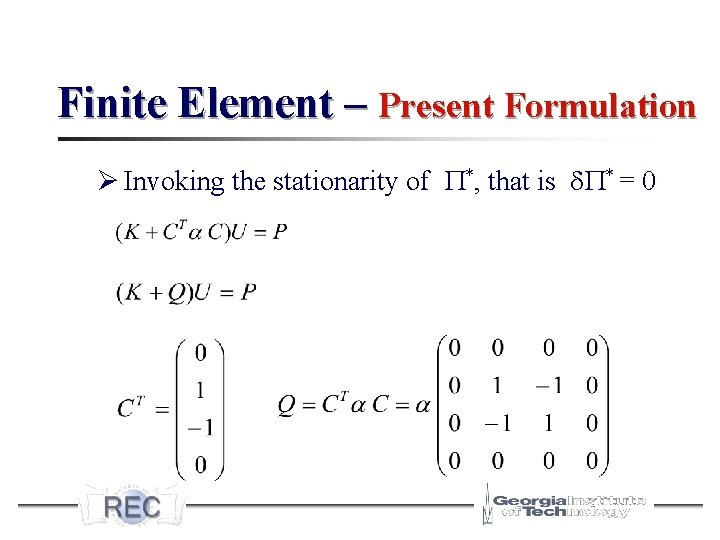
Finite Element – Present Formulation Ø Invoking the stationarity of *, that is * = 0
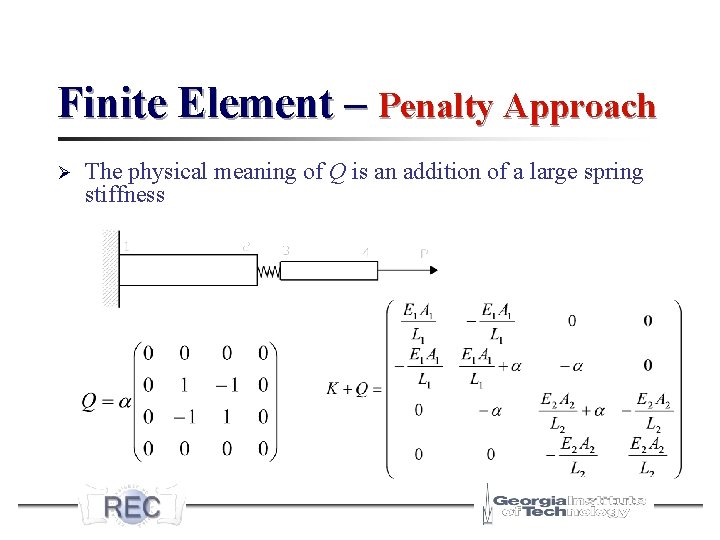
Finite Element – Penalty Approach The physical meaning of Q is an addition of a large spring stiffness Ø
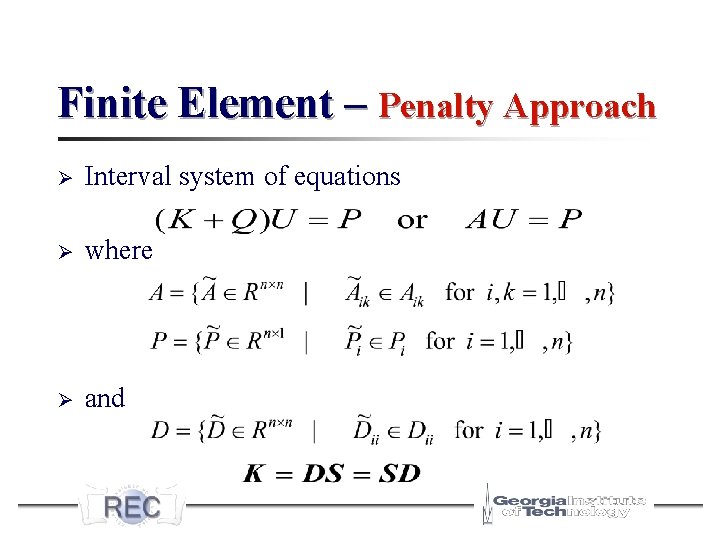
Finite Element – Penalty Approach Ø Interval system of equations Ø where Ø and
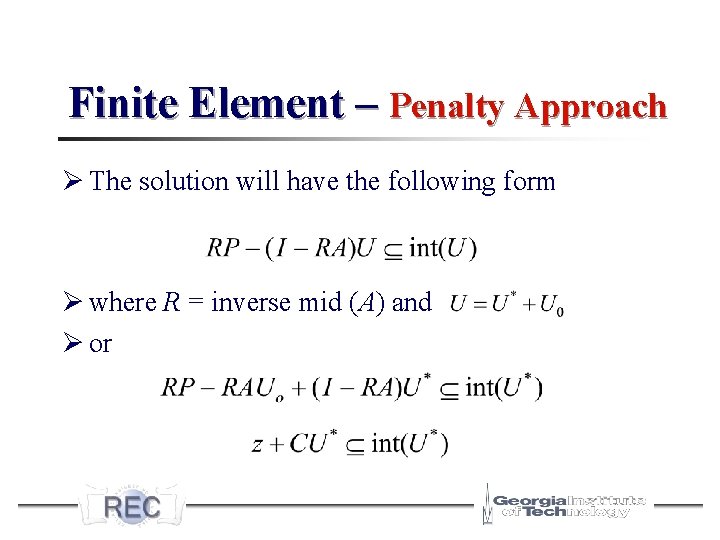
Finite Element – Penalty Approach Ø The solution will have the following form Ø where R = inverse mid (A) and Ø or
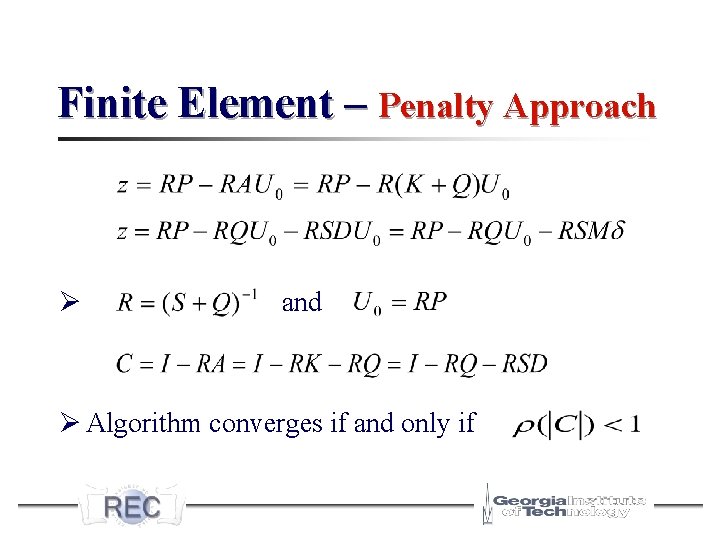
Finite Element – Penalty Approach Ø and Ø Algorithm converges if and only if
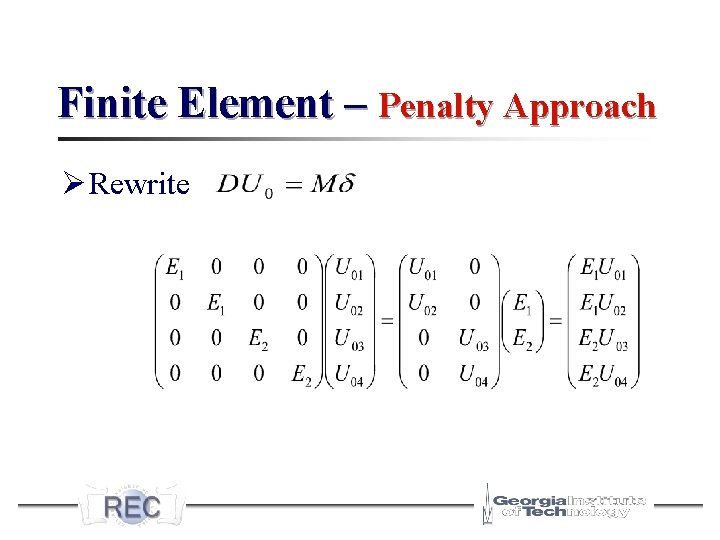
Finite Element – Penalty Approach Ø Rewrite
Outline Interval Finite Elements n Element-by-Element n Penalty Approach n Examples n Conclusions n
Examples n Statically indeterminate (general case) Two-bay truss Ø Three-bay truss Ø Four-bay truss Ø Statically indeterminate beam Ø n Statically determinate Ø Three-step bar
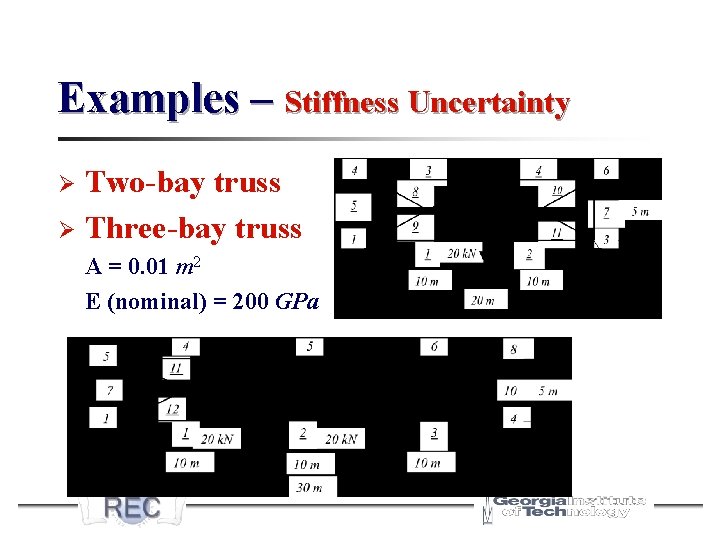
Examples – Stiffness Uncertainty Two-bay truss Ø Three-bay truss Ø A = 0. 01 m 2 E (nominal) = 200 GPa
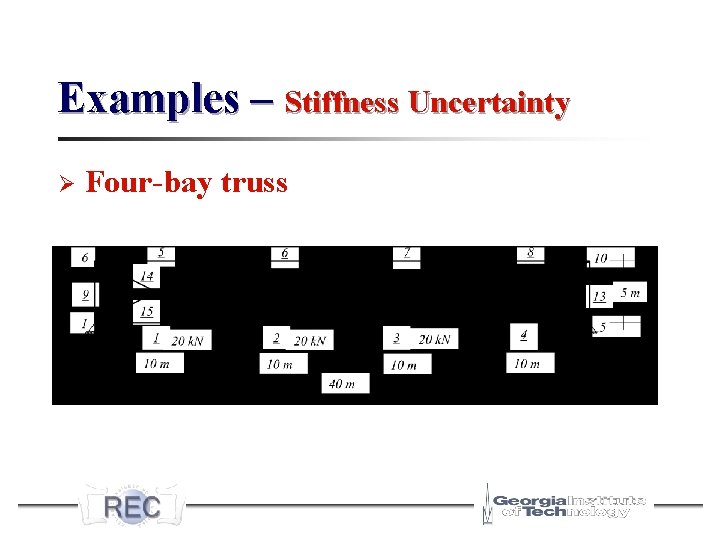
Examples – Stiffness Uncertainty Ø Four-bay truss
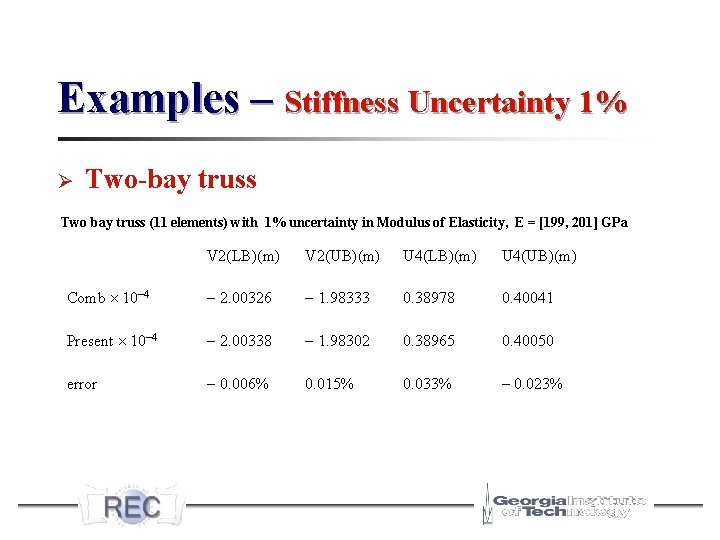
Examples – Stiffness Uncertainty 1% Ø Two-bay truss Two bay truss (11 elements) with 1% uncertainty in Modulus of Elasticity, E = [199, 201] GPa V 2(LB)(m) V 2(UB)(m) U 4(LB)(m) U 4(UB)(m) Comb 10 4 2. 00326 1. 98333 0. 38978 0. 40041 Present 10 4 2. 00338 1. 98302 0. 38965 0. 40050 error 0. 006% 0. 015% 0. 033% 0. 023%
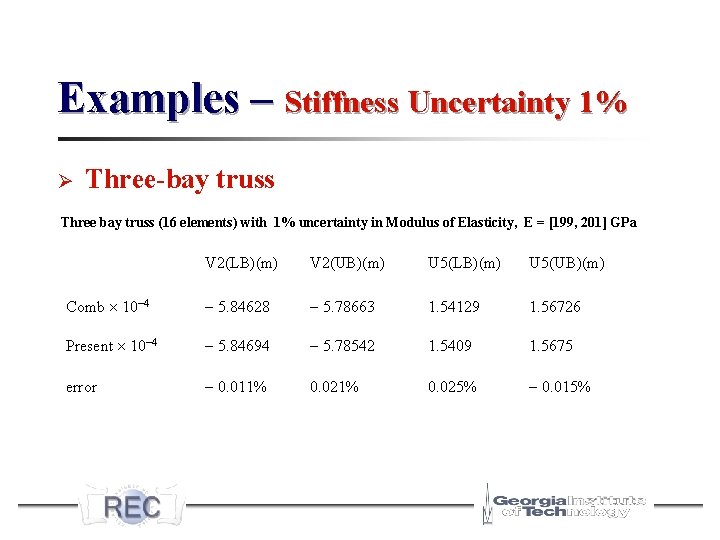
Examples – Stiffness Uncertainty 1% Ø Three-bay truss Three bay truss (16 elements) with 1% uncertainty in Modulus of Elasticity, E = [199, 201] GPa V 2(LB)(m) V 2(UB)(m) U 5(LB)(m) U 5(UB)(m) Comb 10 4 5. 84628 5. 78663 1. 54129 1. 56726 Present 10 4 5. 84694 5. 78542 1. 5409 1. 5675 error 0. 011% 0. 025% 0. 015%
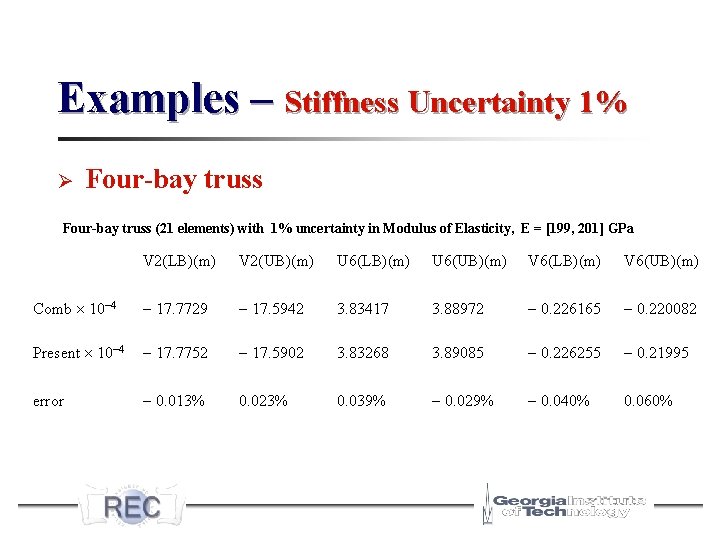
Examples – Stiffness Uncertainty 1% Ø Four-bay truss (21 elements) with 1% uncertainty in Modulus of Elasticity, E = [199, 201] GPa V 2(LB)(m) V 2(UB)(m) U 6(LB)(m) U 6(UB)(m) V 6(LB)(m) V 6(UB)(m) Comb 10 4 17. 7729 17. 5942 3. 83417 3. 88972 0. 226165 0. 220082 Present 10 4 17. 7752 17. 5902 3. 83268 3. 89085 0. 226255 0. 21995 error 0. 013% 0. 023% 0. 039% 0. 029% 0. 040% 0. 060%
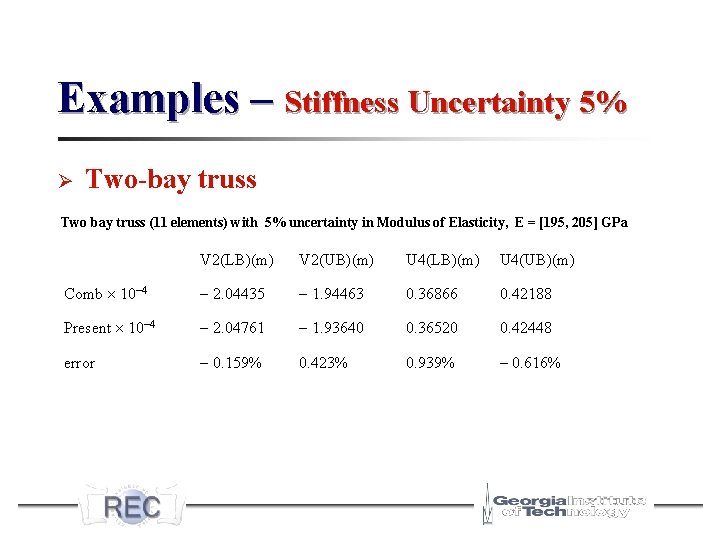
Examples – Stiffness Uncertainty 5% Ø Two-bay truss Two bay truss (11 elements) with 5% uncertainty in Modulus of Elasticity, E = [195, 205] GPa V 2(LB)(m) V 2(UB)(m) U 4(LB)(m) U 4(UB)(m) Comb 10 4 2. 04435 1. 94463 0. 36866 0. 42188 Present 10 4 2. 04761 1. 93640 0. 36520 0. 42448 error 0. 159% 0. 423% 0. 939% 0. 616%
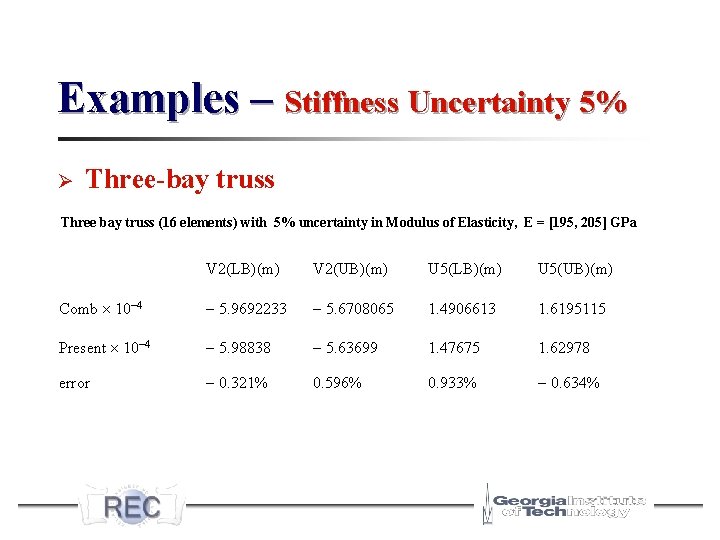
Examples – Stiffness Uncertainty 5% Ø Three-bay truss Three bay truss (16 elements) with 5% uncertainty in Modulus of Elasticity, E = [195, 205] GPa V 2(LB)(m) V 2(UB)(m) U 5(LB)(m) U 5(UB)(m) Comb 10 4 5. 9692233 5. 6708065 1. 4906613 1. 6195115 Present 10 4 5. 98838 5. 63699 1. 47675 1. 62978 error 0. 321% 0. 596% 0. 933% 0. 634%
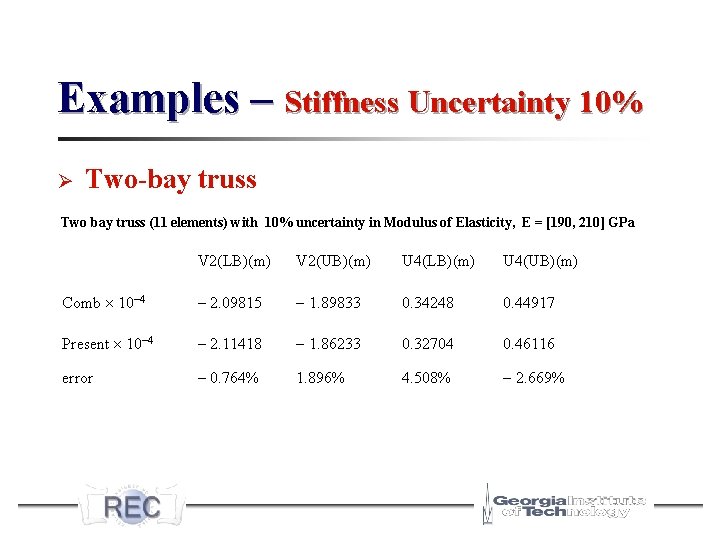
Examples – Stiffness Uncertainty 10% Ø Two-bay truss Two bay truss (11 elements) with 10% uncertainty in Modulus of Elasticity, E = [190, 210] GPa V 2(LB)(m) V 2(UB)(m) U 4(LB)(m) U 4(UB)(m) Comb 10 4 2. 09815 1. 89833 0. 34248 0. 44917 Present 10 4 2. 11418 1. 86233 0. 32704 0. 46116 error 0. 764% 1. 896% 4. 508% 2. 669%
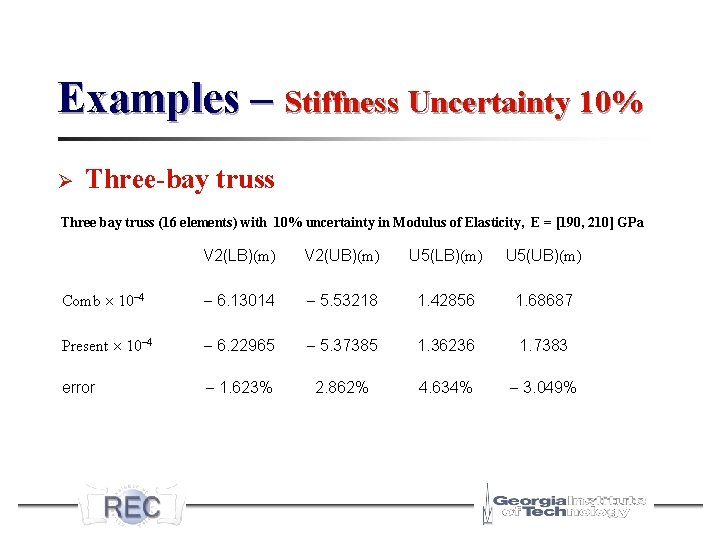
Examples – Stiffness Uncertainty 10% Ø Three-bay truss Three bay truss (16 elements) with 10% uncertainty in Modulus of Elasticity, E = [190, 210] GPa V 2(LB)(m) V 2(UB)(m) U 5(LB)(m) U 5(UB)(m) Comb 10 4 6. 13014 5. 53218 1. 42856 1. 68687 Present 10 4 6. 22965 5. 37385 1. 36236 1. 7383 error 1. 623% 2. 862% 4. 634% 3. 049%
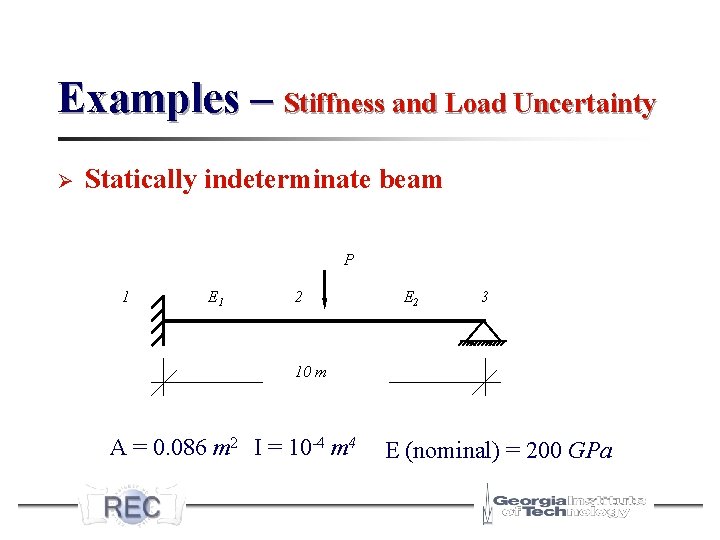
Examples – Stiffness and Load Uncertainty Ø Statically indeterminate beam P 1 E 1 2 E 2 3 10 m A = 0. 086 m 2 I = 10 -4 m 4 E (nominal) = 200 GPa
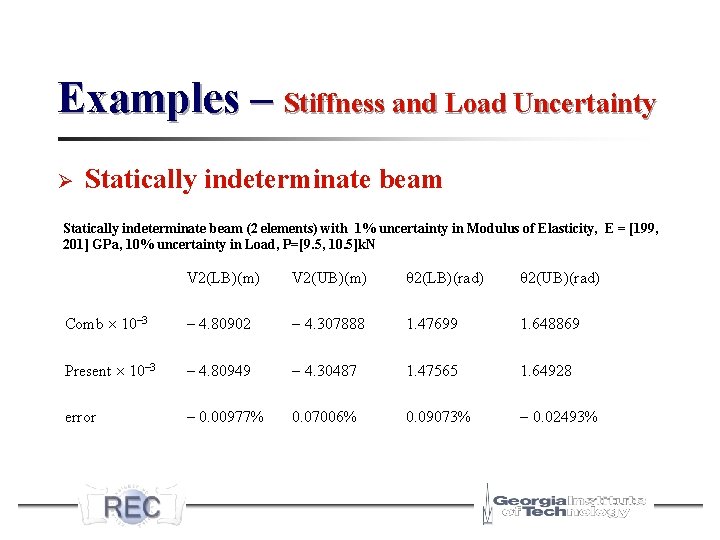
Examples – Stiffness and Load Uncertainty Ø Statically indeterminate beam (2 elements) with 1% uncertainty in Modulus of Elasticity, E = [199, 201] GPa, 10% uncertainty in Load, P=[9. 5, 10. 5]k. N V 2(LB)(m) V 2(UB)(m) θ 2(LB)(rad) θ 2(UB)(rad) Comb 10 3 4. 80902 4. 307888 1. 47699 1. 648869 Present 10 3 4. 80949 4. 30487 1. 47565 1. 64928 error 0. 00977% 0. 07006% 0. 09073% 0. 02493%
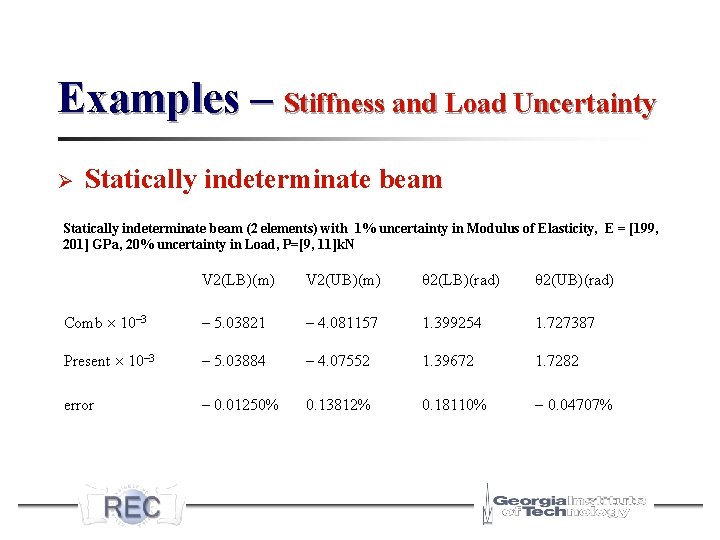
Examples – Stiffness and Load Uncertainty Ø Statically indeterminate beam (2 elements) with 1% uncertainty in Modulus of Elasticity, E = [199, 201] GPa, 20% uncertainty in Load, P=[9, 11]k. N V 2(LB)(m) V 2(UB)(m) θ 2(LB)(rad) θ 2(UB)(rad) Comb 10 3 5. 03821 4. 081157 1. 399254 1. 727387 Present 10 3 5. 03884 4. 07552 1. 39672 1. 7282 error 0. 01250% 0. 13812% 0. 18110% 0. 04707%
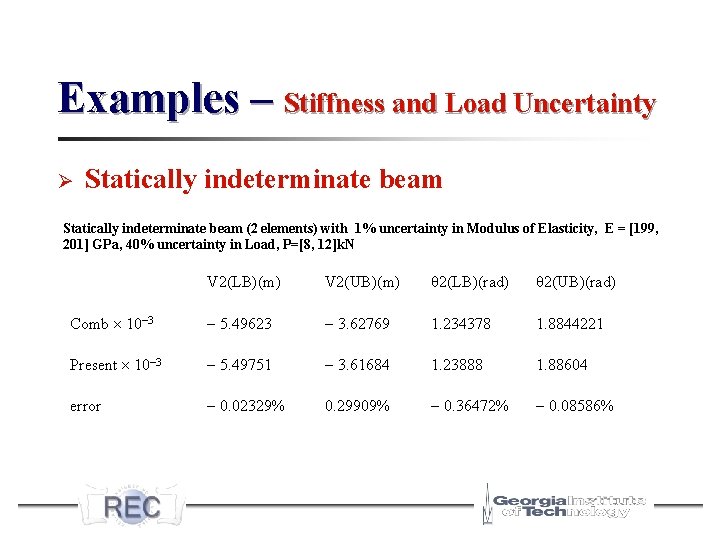
Examples – Stiffness and Load Uncertainty Ø Statically indeterminate beam (2 elements) with 1% uncertainty in Modulus of Elasticity, E = [199, 201] GPa, 40% uncertainty in Load, P=[8, 12]k. N V 2(LB)(m) V 2(UB)(m) θ 2(LB)(rad) θ 2(UB)(rad) Comb 10 3 5. 49623 3. 62769 1. 234378 1. 8844221 Present 10 3 5. 49751 3. 61684 1. 23888 1. 88604 error 0. 02329% 0. 29909% 0. 36472% 0. 08586%
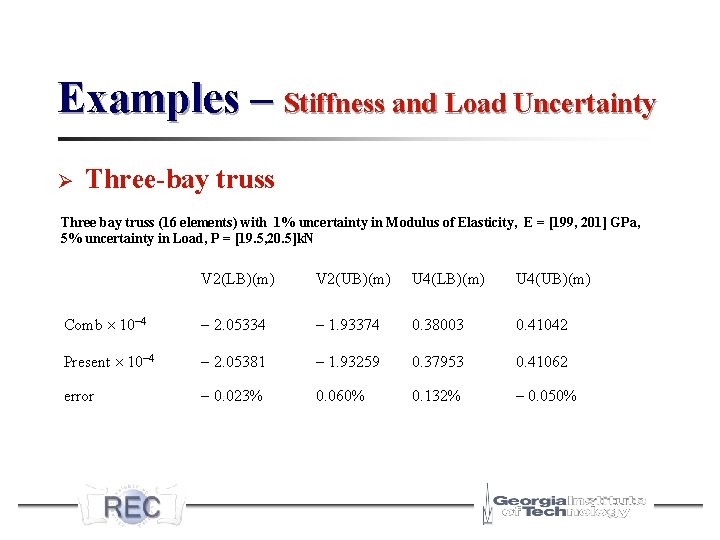
Examples – Stiffness and Load Uncertainty Ø Three-bay truss Three bay truss (16 elements) with 1% uncertainty in Modulus of Elasticity, E = [199, 201] GPa, 5% uncertainty in Load, P = [19. 5, 20. 5]k. N V 2(LB)(m) V 2(UB)(m) U 4(LB)(m) U 4(UB)(m) Comb 10 4 2. 05334 1. 93374 0. 38003 0. 41042 Present 10 4 2. 05381 1. 93259 0. 37953 0. 41062 error 0. 023% 0. 060% 0. 132% 0. 050%
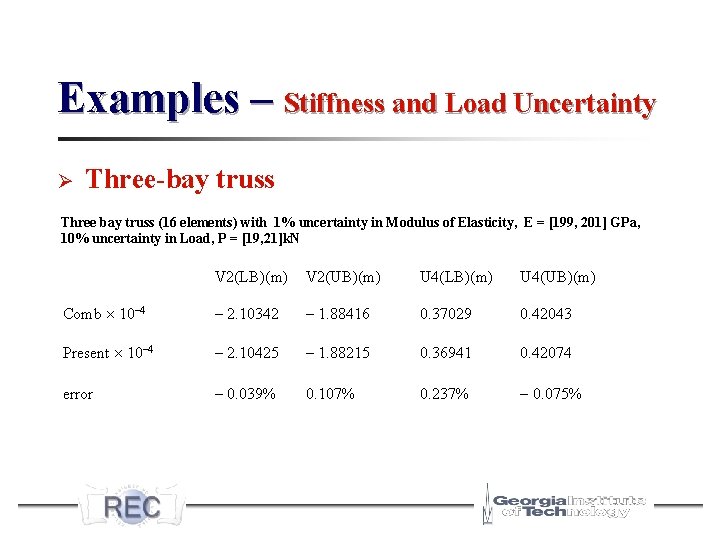
Examples – Stiffness and Load Uncertainty Ø Three-bay truss Three bay truss (16 elements) with 1% uncertainty in Modulus of Elasticity, E = [199, 201] GPa, 10% uncertainty in Load, P = [19, 21]k. N V 2(LB)(m) V 2(UB)(m) U 4(LB)(m) U 4(UB)(m) Comb 10 4 2. 10342 1. 88416 0. 37029 0. 42043 Present 10 4 2. 10425 1. 88215 0. 36941 0. 42074 error 0. 039% 0. 107% 0. 237% 0. 075%
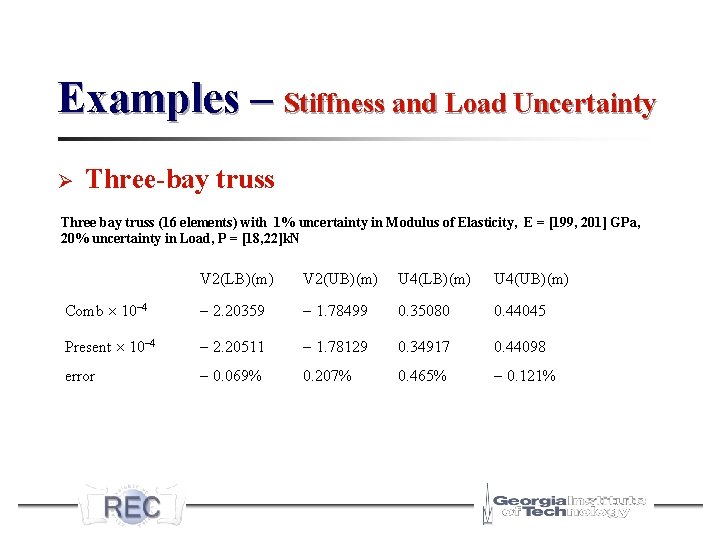
Examples – Stiffness and Load Uncertainty Ø Three-bay truss Three bay truss (16 elements) with 1% uncertainty in Modulus of Elasticity, E = [199, 201] GPa, 20% uncertainty in Load, P = [18, 22]k. N V 2(LB)(m) V 2(UB)(m) U 4(LB)(m) U 4(UB)(m) Comb 10 4 2. 20359 1. 78499 0. 35080 0. 44045 Present 10 4 2. 20511 1. 78129 0. 34917 0. 44098 error 0. 069% 0. 207% 0. 465% 0. 121%
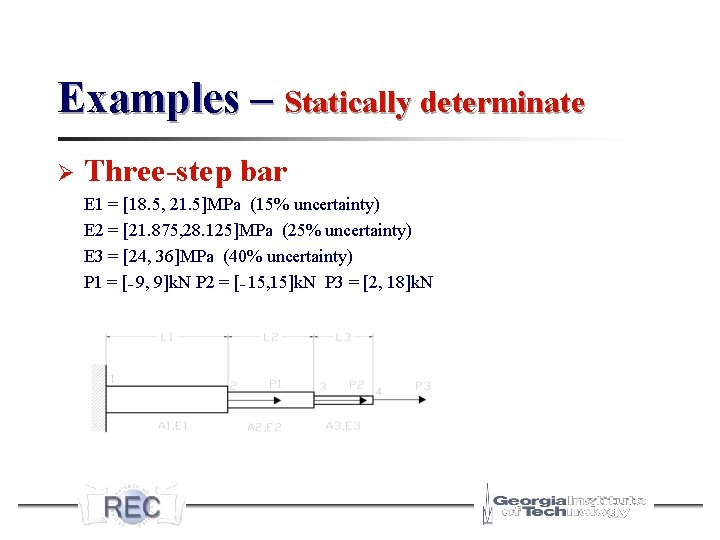
Examples – Statically determinate Ø Three-step bar E 1 = [18. 5, 21. 5]MPa (15% uncertainty) E 2 = [21. 875, 28. 125]MPa (25% uncertainty) E 3 = [24, 36]MPa (40% uncertainty) P 1 = [ 9, 9]k. N P 2 = [ 15, 15]k. N P 3 = [2, 18]k. N
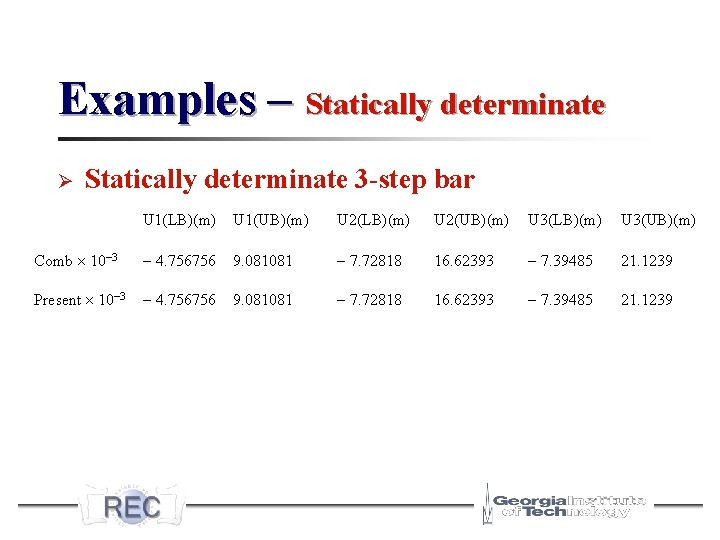
Examples – Statically determinate Ø Statically determinate 3 -step bar U 1(LB)(m) U 1(UB)(m) U 2(LB)(m) U 2(UB)(m) U 3(LB)(m) U 3(UB)(m) Comb 10 3 4. 756756 9. 081081 7. 72818 16. 62393 7. 39485 21. 1239 Present 10 3 4. 756756 9. 081081 7. 72818 16. 62393 7. 39485 21. 1239
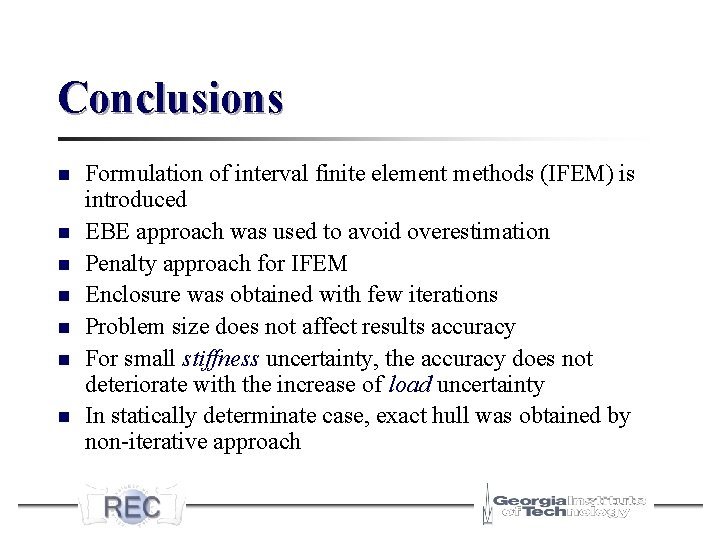
Conclusions n n n n Formulation of interval finite element methods (IFEM) is introduced EBE approach was used to avoid overestimation Penalty approach for IFEM Enclosure was obtained with few iterations Problem size does not affect results accuracy For small stiffness uncertainty, the accuracy does not deteriorate with the increase of load uncertainty In statically determinate case, exact hull was obtained by non-iterative approach
- Slides: 46