
PEMPAL IACOP PUBLIC INTERNAL CONTROL MANAGEMENT AND CONTROL
PEMPAL IACOP PUBLIC INTERNAL CONTROL: MANAGEMENT AND CONTROL OF THE PUBLIC ENTITIES Presenter: Malapateng Teka; National Treasury| March 2016
OUTLINE • Importance of Control (Slide 3) • Components and Benefits of Internal Control (Slide 4) • Legislative and Governance Framework (Slide 5) • Combined Assurance on Internal Control (Slide 6) • Oversight Instruments (Slide 7, 8) • Role of Oversight Statutory Bodies (Slide 9, 10, 11) • Drivers of internal control (Slide 12) 2
Importance of Internal Control • The Constitution of the RSA requires public resources to be managed efficiently, effectively and economically; • RSA has enormous social and development challenges which demands that Government institutions: –Deliver on their mandates and objectives –Report timeously and accurately on their use public funds –Comply with laws and regulations –Exercise responsible stewardship • Constitution empowers the National Assembly with the power to scruitinize and oversee the executive action; and • Government acknowledges the positive relationship between proper control and successful outcomes of government actions. 3
Components and Benefits of Internal Control Components of Internal Control: • • • The risk assessment process – this relates to the process for identifying the business risks relevant to the financial reporting objectives; Control activities – these are the policies and procedures that ensure controls are in place to achieve internal control objectives; and Monitoring of controls – this is the process which the entity has in place to assess the effectiveness of internal controls over time. Benefits of Internal Control: • • • adherence to management policies pertaining to the activities of the Public Entities; the safeguarding of the Public Entities’s assets; the prevention and detection of fraud and error; the accuracy and completeness of the accounting records; and the timely preparation of reliable financial and other information 4
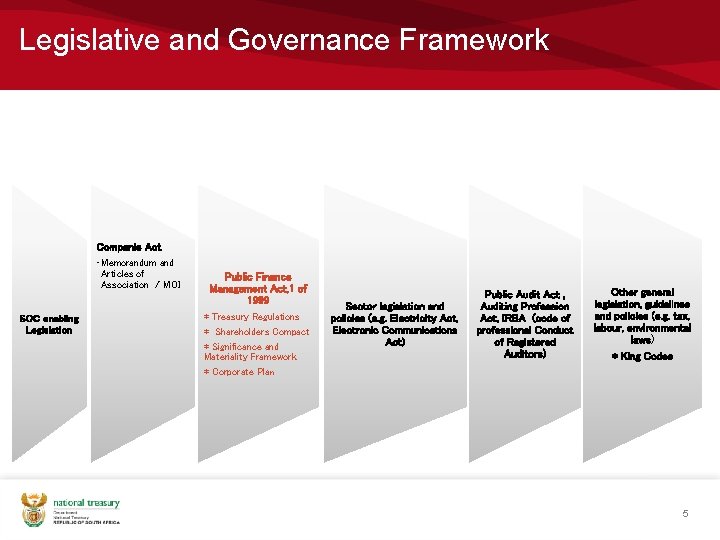
Legislative and Governance Framework Companie Act • Memorandum and Articles of Association / MOI SOC enabling Legislation Public Finance Management Act, 1 of 1999 * Treasury Regulations * Shareholders Compact * Significance and Materiality Framework Sector legislation and policies (e. g. Electricity Act, Electronic Communications Act) Public Audit Act , Auditing Profession Act, IRBA (code of professional Conduct of Registered Auditors) Other general legislation, guidelines and policies (e. g. tax, labour, environmental laws) * King Codes * Corporate Plan 5
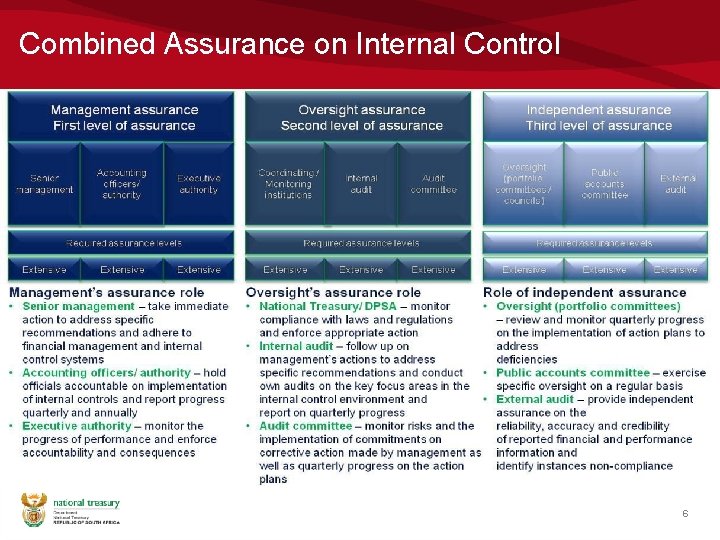
Combined Assurance on Internal Control 6
Oversight Instruments to ensure effective control of Public Entities – Strategic Plan • Treasury Regulations (TRs) imposes that, the accounting authority for a public entity must: – annually conclude a strategic plan and annual performance plan for tabling in Parliament; – setting out performance measures and targets; – indicating what funds are required to implement strategic plans; and – Legislatures approve the budget, and so appropriate funds for the implementation of the strategic plans. • In terms of the Money Bills Amendment Procedure and Related Matters Act 9 of 2009, after the adoption of the fiscal framework: – the relevant members of Cabinet must table updated strategic/corporate plans for each department, public entity or institution, which must be referred to the relevant committee for consideration 7
Oversight Instruments to ensure effective control of Public Entities- Annual Reports • In terms of the Public Finance Management Act (PFMA): • The Accounting Officer must submit within five months of the end of the financial year to the Minister responsible for that Department an Annual Report; • the Minister responsible for a department must table the annual report in the relevant legislature within one month; and • a Minister who fails to table an annual report for an entity by 30 September (6 months after year end) must table a written explanation in the legislature setting out the reasons why the report was not tabled and indicating when the report will be tabled. • The annual reports indicate how the executive has used appropriated funds to implement strategic plan; • TR, requires that the accounting authority of a public entity must establish procedures for quarterly reporting to the executive authority; and • Quarterly reports measure the achievement of performance indicators that have been determined with regard to the delivery of their respective mandates. 8
Role of Parliament Committees : Standing committee on public accounts • SCOPA fulfils the responsibility of reviewing audit reports; • In fulfilling this role the Committee focuses on the following: – Issues raised in the report of the AGSA; – Compliance with PFMA, TRs, the audit committee and management report. – Functioning of risk management systems; – Interrogation of instance of overspending unauthorised expenditure; – Interrogation of instance of irregular, fruitless and wasteful expenditure; and – Corporate governance issues. 3
Portfolio Committees • Portfolio Committee fulfils the responsibility of reviewing nonfinancial information contained in the annual reports; • These committee exercise oversight as to whether entities have delivered on service delivery commitments; • The focus areas on the annual report are as follows: – The technical quality of the annual reports; – The economic, efficiency and effectiveness of service delivery; – Explanation on underperformance; and – Table above shows inconsistency in terms of the composition and development of KPIs. • The oversight process provide a complete picture of an PE’s performance, encompassing finances, systems, corporate governance and service delivery performance. 4
Role of Auditor General and National Treasury • The Auditor General is a state institution accountable to the National Assembly. • AG audit and report on the accounts, financial statements and financial management • AG must submit audit reports to the relevant legislature • National Treasury as s protector of the NRF and sovereign credit rating is to exercise oversight through – Setting reporting guidelines to enforce transparency of assets, liabilities, expenditure and income – Oversight over the funding of public entities – Controlling the utilisation of contingent liabilities 11
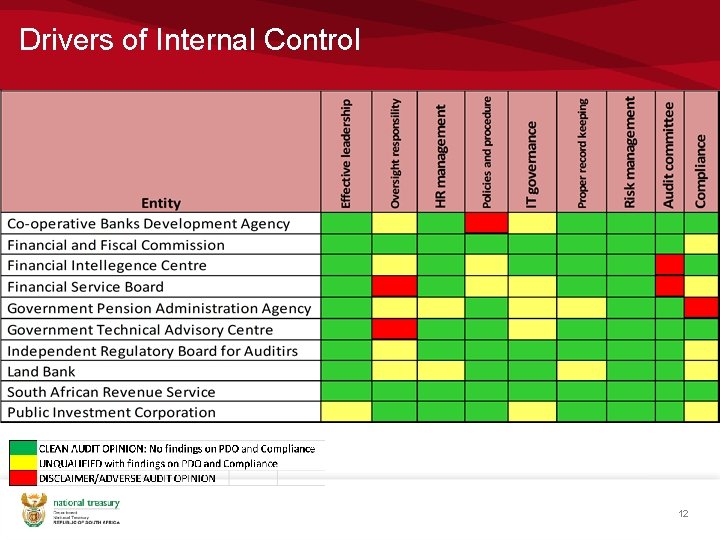
Drivers of Internal Control 12

Thank you
- Slides: 13