
PELVIS I BONES AND MUSCLES Introductionwhy is pelvis
PELVIS I: BONES AND MUSCLES Introduction--why is pelvis so hard? n Bony structures of the pelvis n Muscles of the pelvis--attaching the legs for upright living n The floor of the pelvis n
Why is the pelvis hard--#1 upright n Pelvic tilt or how we got to be upright – Compare with quadruped (cat for instance) n Bowl concept – pelvis spills forward – Hernia – “beer belly” – In human minor pelvis is behind (posterior) to guts and abdominal cavity Frolich, Human Anatomy, Pelvis I
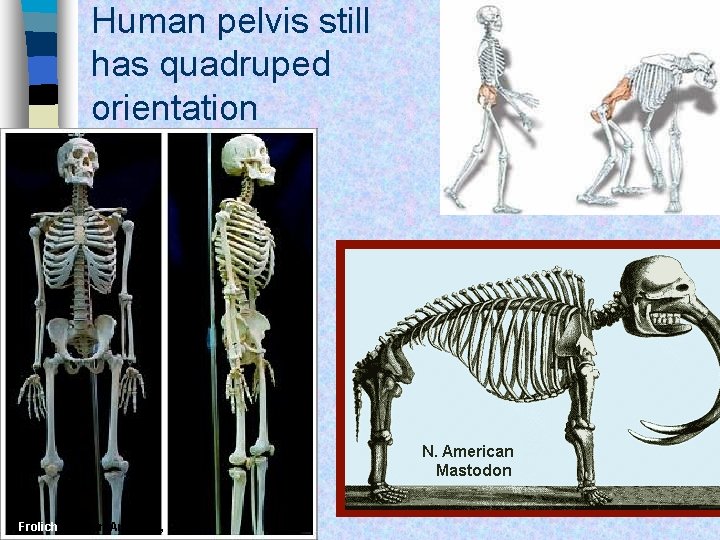
Human pelvis still has quadruped orientation Frolich, Human Anatomy, Pelvis I
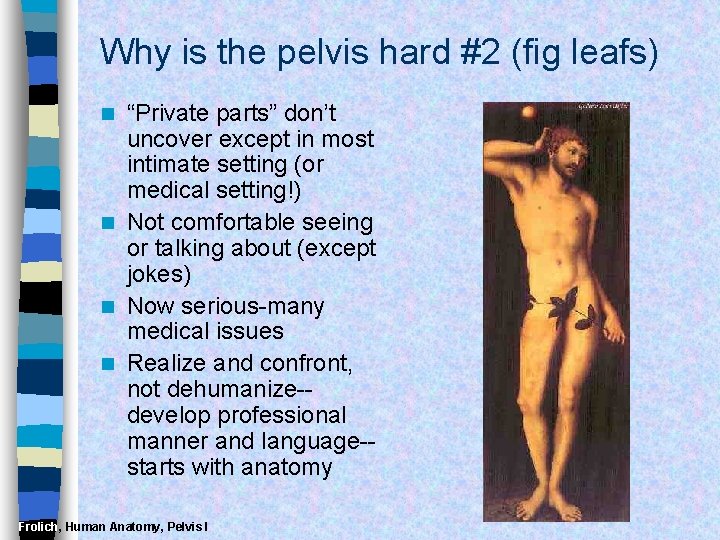
Why is the pelvis hard #2 (fig leafs) “Private parts” don’t uncover except in most intimate setting (or medical setting!) n Not comfortable seeing or talking about (except jokes) n Now serious-many medical issues n Realize and confront, not dehumanize-develop professional manner and language-starts with anatomy n Frolich, Human Anatomy, Pelvis I
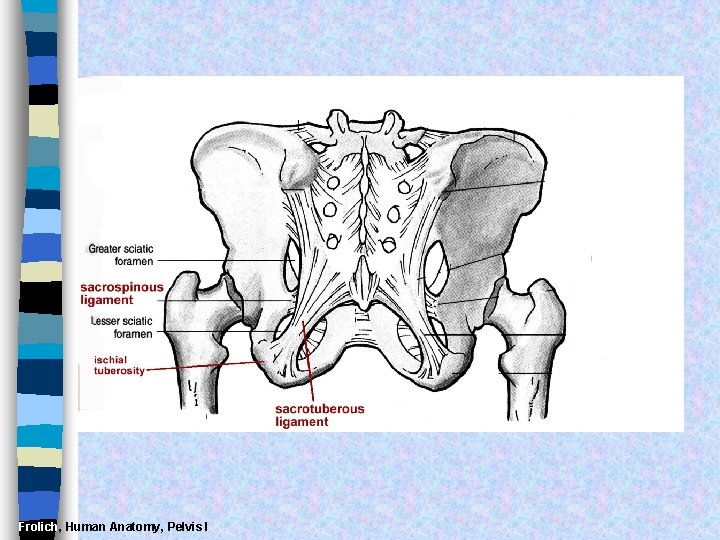
Bony structure of the pelvis MAIN STRUCTURES n Hip bone (innominate, os coxae)--fusion of – Ilium (“hips”) – Ischium (“rear”) – Pubis (anterior midline) Sacrum and coccyx n Acetabulum n Femur--head, neck, greater trochanter n Frolich, Human Anatomy, Pelvis I HOLES n False and true pelvis (major, minor pelvis) n Pelvic inlet, pelvic outlet n Sacrotuberous ligament n Sacrospinous ligament n Greater, lesser sciatic foramen n Obturator foramen
Frolich, Human Anatomy, Pelvis I
Frolich, Human Anatomy, Pelvis I

Frolich, Human Anatomy, Pelvis I
Muscles of the pelvis--attaching legs for upright posture n Iliopsoas (from abdomen) n Gluteus maximus (smaller in cat) n Gluteus minimus (bigger in cat) n Lateral rotators (not important in cat) Frolich, Human Anatomy, Pelvis I

Muscle tables--example NAME Iliopsoas Gluteus maximus Gluteus minimus Lateral rotators Frolich, Human Anatomy, Pelvis I ORIGIN INSERTION ACTION INNERV.

Female n n n Cavity is broad, shallow n Pelvic inlet oval + outlet round n Bones are lighter, thinner n Pubic angle larger n Coccyx more flexible, straighter n Ischial tuberosities shorter, more n everted Frolich, Human Anatomy, Pelvis I Male Cavity is narrow, deep Smaller inlet + outlet Bones heavier, thicker Pubic angle more acute Coccyx less flexible, more curved Ischial tuberosities longer, face more medially
The pelvic floor MAIN STRUCTURES n Ischial tuberosity n Pubic symphysis n Coccyx n Sacrotuberous ligament n Ischipubic ramus n Perineal body n Anus n External urethral opening n Vaginal opening Frolich, Human Anatomy, Pelvis I MUSCULAR FLOOR AND SPHINCHTERS n transverse perineal m. n Anal triangle and urogentical triangle n Levator ani m. n Urogenital diaphragm EXTERNAL GENITALIA n Clitoris or penis n Ischiocavernosus m. n Bulbospongiosus m. (and labia majorum)
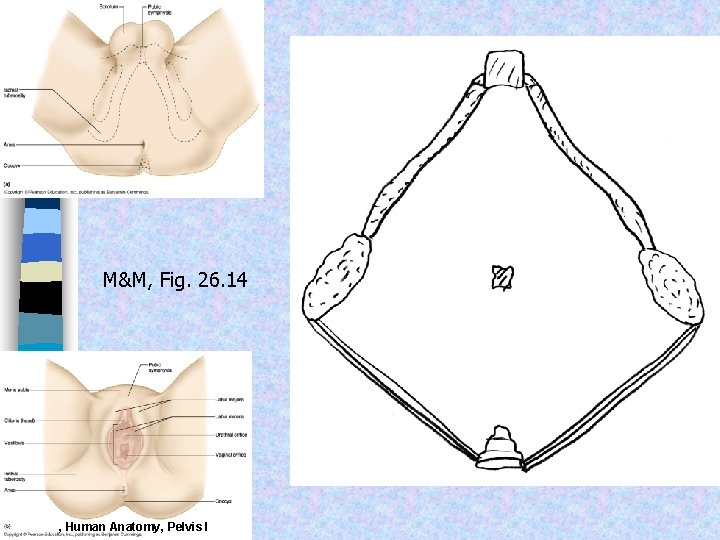
M&M, Fig. 26. 14 Frolich, Human Anatomy, Pelvis I
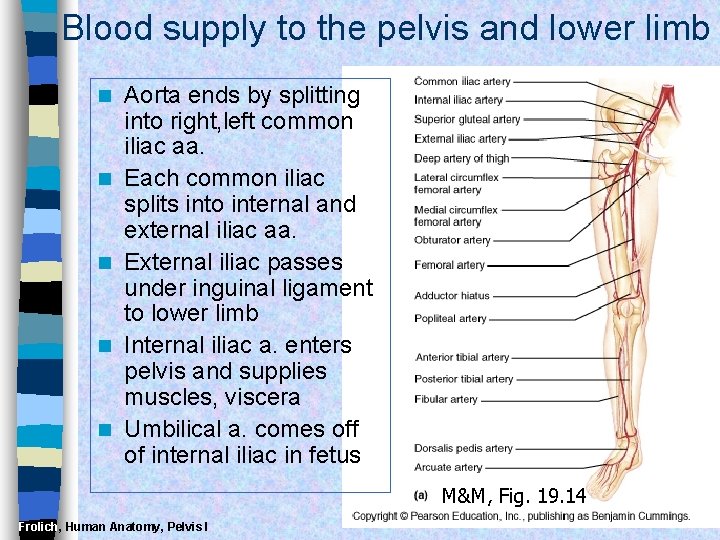
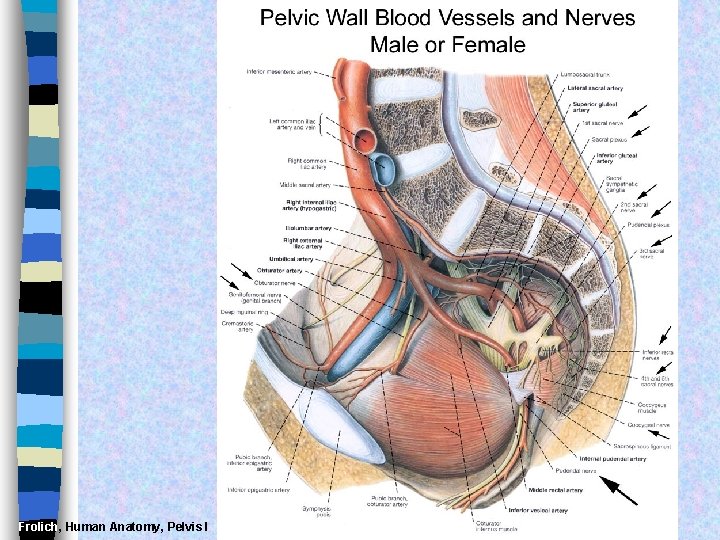
Blood supply to the pelvis and lower limb n n n Aorta ends by splitting into right, left common iliac aa. Each common iliac splits into internal and external iliac aa. External iliac passes under inguinal ligament to lower limb Internal iliac a. enters pelvis and supplies muscles, viscera Umbilical a. comes off of internal iliac in fetus M&M, Fig. 19. 14 Frolich, Human Anatomy, Pelvis I
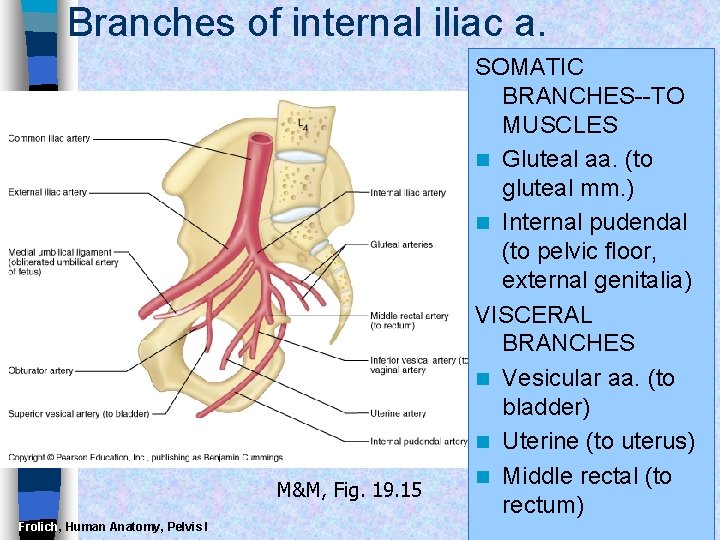
Branches of internal iliac a. M&M, Fig. 19. 15 Frolich, Human Anatomy, Pelvis I SOMATIC BRANCHES--TO MUSCLES n Gluteal aa. (to gluteal mm. ) n Internal pudendal (to pelvic floor, external genitalia) VISCERAL BRANCHES n Vesicular aa. (to bladder) n Uterine (to uterus) n Middle rectal (to rectum)
Coming Next Pelvis II: Function Taboos
- Slides: 16