
Pelvic Tilt Lower Crossed Syndrome Hips and Pelvis
- Slides: 18
Pelvic Tilt & Lower Crossed Syndrome
Hips and Pelvis Structural core of the body Contains center of gravity Innominate Sacroiliac Bone = Ilium/Ischium/Pubis Joints - moveable eg. walking, running, breathing - supported by strong ant. /post. ligaments
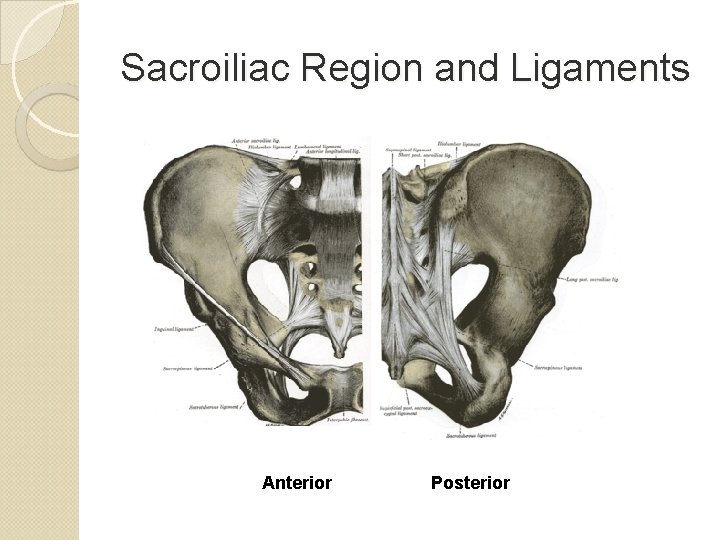
Sacroiliac Region and Ligaments Anterior Posterior
Pelvic Tilting Common causes: - acquired postural distortions - muscle imbalances (weak/tight) - leg length inequality
Pelvic Tilt Assessment Anatomical Landmarks ◦ ASIS, PSIS, Iliac Crest Normal posture = No tilting Innominate bones rotate: PSIS > ASIS anterior rotation ASIS > PSIS posterior rotation
ANTERIOR PELVIC TILT
Anterior Pelvic Tilt Forward/Anterior rotation of the pelvis PSIS higher than ASIS Most common type of tilt Corresponding hyperlordosis
Anterior Pelvic Tilt ASIS lower than PSIS by >= ½” Contributes to: - SI joint dysfunction - vertebral dysfunction - decreased spinal shock absorption - altered biomechanics Causes hyperlordosis
Anterior Pelvic Tilt May be asymptomatic due to compensation or may cause symptoms elsewhere Unilateral (one sided tilt) = R or L anterior tilt
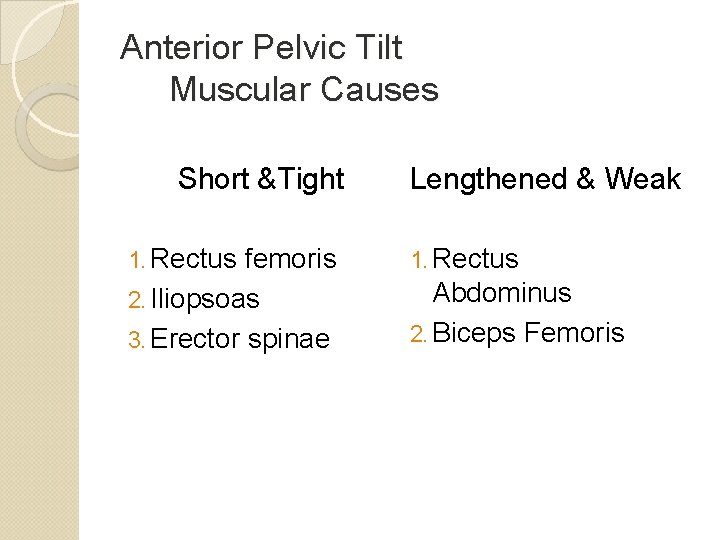
Anterior Pelvic Tilt Muscular Causes Short &Tight 1. Rectus femoris 2. Iliopsoas 3. Erector spinae Lengthened & Weak 1. Rectus Abdominus 2. Biceps Femoris
Anterior Pelvic Tilt Muscular Attachments Rectus femoris – AIIS Iliopsoas – lesser trochanter Erector spinae – indirectly into pelvis Rectus abdominis – pubic bone Biceps femoris – ischial tuberosity
Anterior Pelvic Tilt - Assessment ASIS vs. PSIS height LBP due to - muscle hypertonicity - facet joint compression Hyperlordosis / prominent gluteals Hypertonic QL, RF, ES AROM: trunk flexion hip extension (tight psoas)
Anterior Pelvic Tilt Assessment Anterior Innominate Rotation Test - positive if ASIS > I cm lower than PSIS
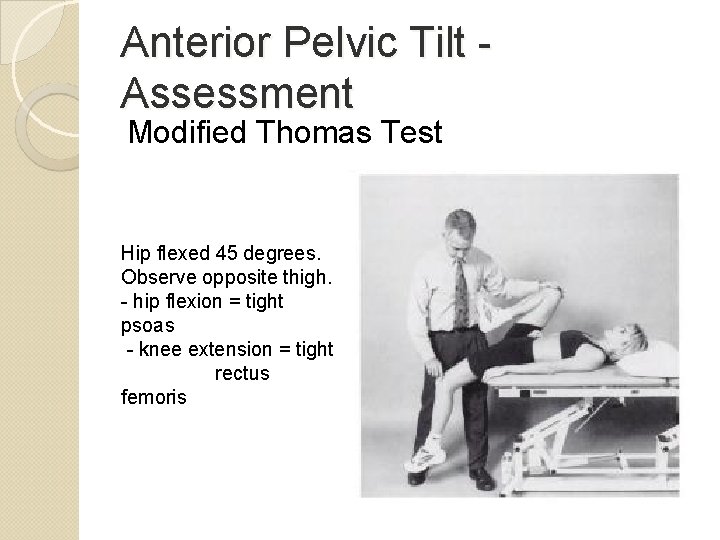
Anterior Pelvic Tilt Assessment Modified Thomas Test Hip flexed 45 degrees. Observe opposite thigh. - hip flexion = tight psoas - knee extension = tight rectus femoris
Anterior Pelvic Tilt Treatment Massage, Stretching & Postural reeducation Manually release hypertonic muscles Stretch tight muscles Strengthen weak muscles
Three sacral angles and corresponding lordosis
POSTERIOR PELVIC TILT
Posterior Pelvic Tilt Backward/Posterior rotation of the pelvis ASIS higher than PSIS Corresponding hyporlordosis