
Pelvic mass Dr T Allameh MD Pelvic mass


- Slides: 36
Pelvic mass Dr. T Allameh MD
Pelvic mass : Gynecologic • Uterine • Adnexal • Ovarian Urinary Bowel
Pre pubertal age group • Fewer than 5% of ovarian malignancies occur in children and adolescents. • Ovarian tumors occurs for approximately 1% of all tumors in these age groups • Germ cell tumors make up ½ to 2/3 of ovarian neoplasms in individuals younger than 20 years old.
• In girls younger than 9 years of age approximately 80% of the ovarian neoplasms were found to be malignant. • Germ cell tumors occurs for approximately 60% of ovarian neoplasms in children and adolescents compared with 20% of these tumors in adults.
In a review : • 6% of all ovarian masses in childhood and adolescence were neoplasms and only 10% of neoplasms were malignant In one series : • Non neoplastic masses in young women and girls younger than 20 years constitute 2/3 of the total • In girls younger than 10 years of age 60% of masses were non neoplastic and 2/3 of the neoplastic masses were benign
Symptoms and signs • Pelvic mass • Abdominal mass • Non specific
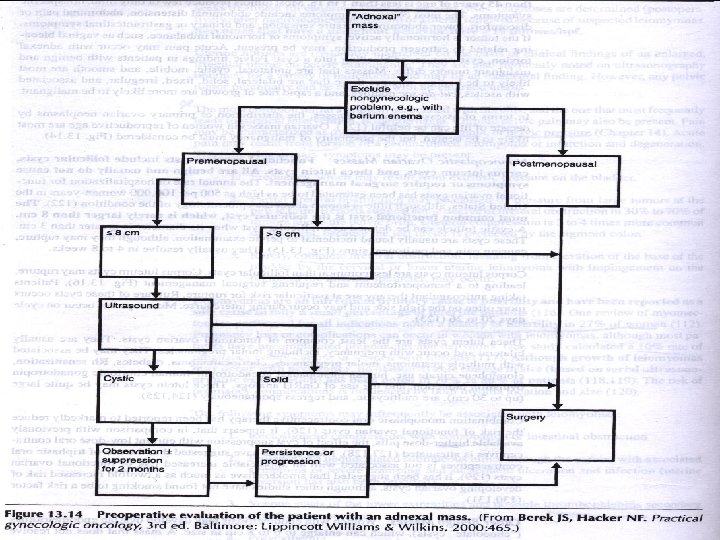
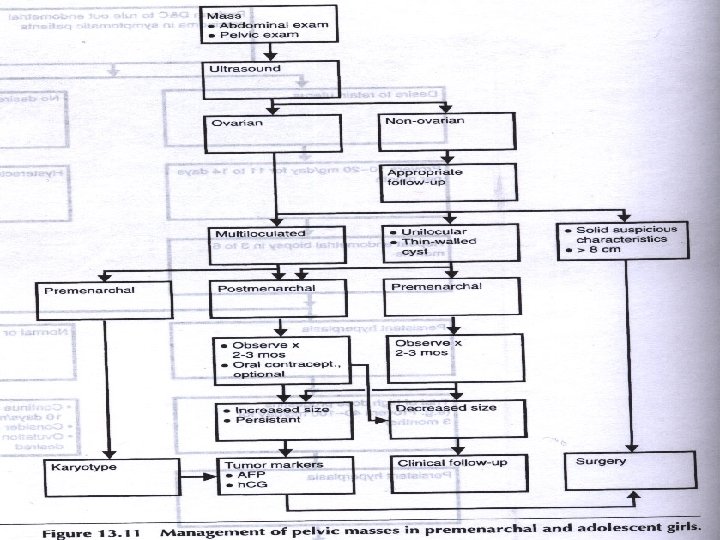
Diagnosis and management • Unilocular cysts are virtually always benign and will regress in 3 – 6 month • They do not require surgical management with oophorectomy or cystectomy. • Close observation • Risk of ovarian torsion
• Recurrence rate after cyst aspiration 50% • premature surgical therapy for a functional ovarian mass can result in ovarian and tubal adhesions that can affect future fertility.
• CT , MRI or Doppler flow studies may be helpful • Because the risk of germ cell tumor , solid component mandates surgical assessment
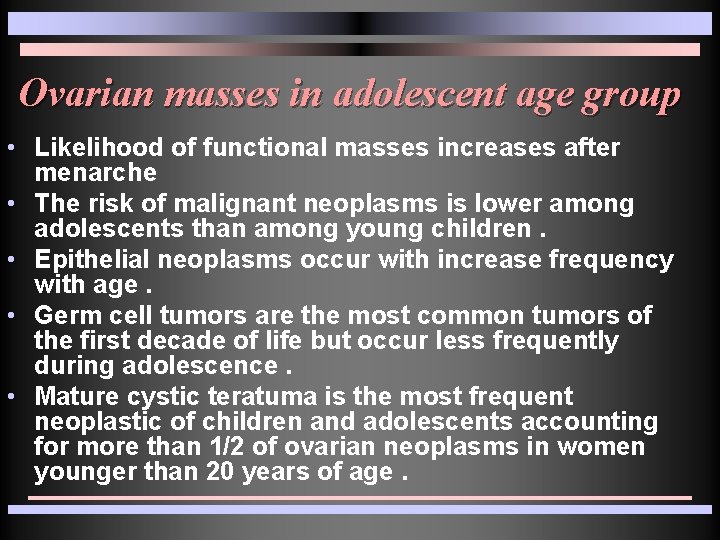
Ovarian masses in adolescent age group • Likelihood of functional masses increases after menarche • The risk of malignant neoplasms is lower among adolescents than among young children. • Epithelial neoplasms occur with increase frequency with age. • Germ cell tumors are the most common tumors of the first decade of life but occur less frequently during adolescence. • Mature cystic teratuma is the most frequent neoplastic of children and adolescents accounting for more than 1/2 of ovarian neoplasms in women younger than 20 years of age.
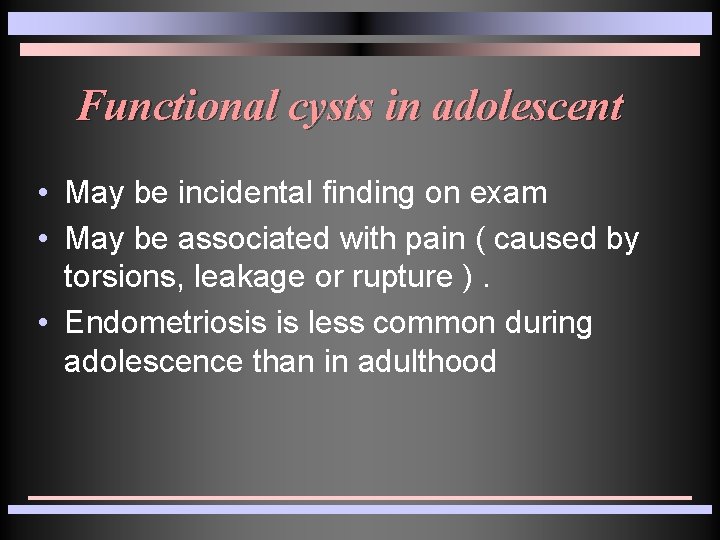
Functional cysts in adolescent • May be incidental finding on exam • May be associated with pain ( caused by torsions, leakage or rupture ). • Endometriosis is less common during adolescence than in adulthood
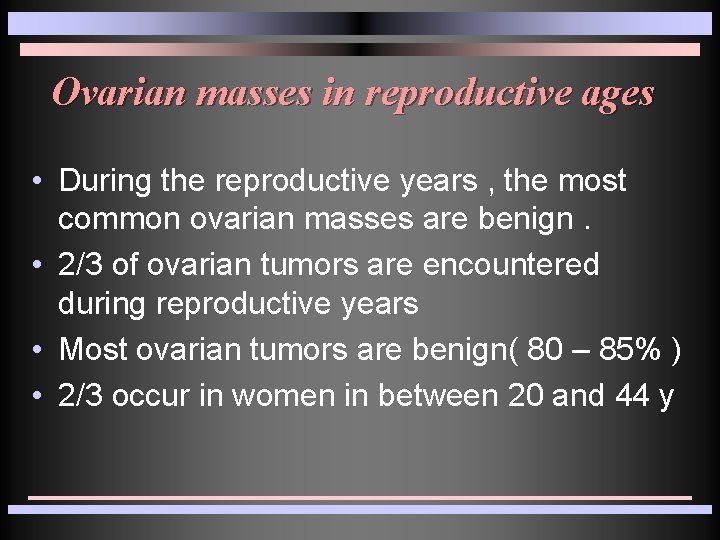
Ovarian masses in reproductive ages • During the reproductive years , the most common ovarian masses are benign. • 2/3 of ovarian tumors are encountered during reproductive years • Most ovarian tumors are benign( 80 – 85% ) • 2/3 occur in women in between 20 and 44 y
• The chance that a primary ovarian tumor is malignant in a patient younger than 45 years of age is less than 15.
Symptoms • • Mild , non specific Abdominal distension , pain , discomfort Lower abdominal pressure Vaginal bleeding if the tumor is hormonally active • Urinary & GI symptoms. • Acute pain ( due to torsion , rupture or bleeding into a cyst )
Benign tumors : • • Unilateral Cystic Mobile Smooth
Malignant masses • • Bilateral Solid Fixed Irregular Associated with : Ascites Cul – de – sac nodules Rapid growth
Functional ovarian cysts : • • Follicular cysts Corpus luteum cysts Techa lutein cysts All are benign and usually do not cause symptoms or require surgical management.
• The annual rate of hospitalization 500 per 100, 000 women per year
Follicular cyst • The most common cysts , which is rarely larger than 8 cm. • A cystic follicle can be defined as a follicular cyst when it's diameter is greater than 3 cm. • They usually resolve in 4 to 8 weeks.
Corpus luteum cysts • Less common than follicular cyst • May rupture leading to a hemoperitoneum and requiring surgical management • Patients taking anticoagulant therapy are at particular risk for rupture • Rupture occurs more often on the right side and may occur during intercourse • Most ruptures occur on cycle days 20 to 26.
Theca lutein cysts • Least common of functional ovarian cysts • Usually bilateral and occur with pregnancy. • They may be associated with : Multiple gestations molar pregnancies , clomiphen citrate use , HMG , HCG , and GNRH analogs.
Theca lutein cysts : • May be quite large ( up to 30 cm ) • Are multi cystic • Regress spontaneously
Oral Cotraception • HD reduce the risk of functional ovarian cysts • LD is attenuated • Triphasic OC is not associated with an appreciable increased risk of functional ovarian cysts.
Endometriosis • Ovarian endometioma (chocolate cysts) Can enlarge to 6 – 8 cm. • Does not resolve by observation
Neoplastic masses • More than 80% of benign cystic teratomas (dermoid cysts) occur during the reproductive years • Dermoid cysts represented 62% of all ovarian neoplasms in women younger than 40 years old • Malignant transformation occurs in less than 2% of dermoid cysts in women of all ages. (most cases occur in women older than 40 years ).
• The risk of torsion with dermoid cysts is 15% ( more frequently than other tumors ) • Dermoid cysts are frequently anterior • They are bilateral in 10% • An ovarian cystectomy is almost always possible
Epithelial tumors • The risk of epithelial tumors increases with age. • Serous cyst adenomas are often considered • The more common benign neoplasm
Serous tumors • Generally are benign • 5% -10% have borderline malignant potential • 20% -25% are malignant
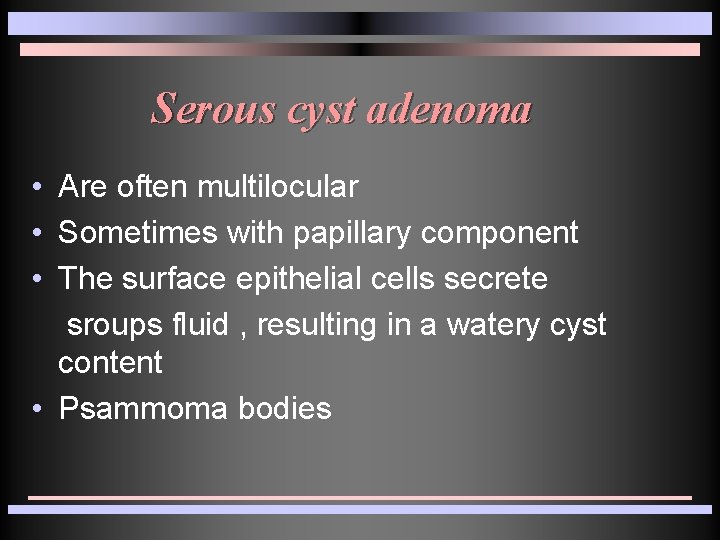
Serous cyst adenoma • Are often multilocular • Sometimes with papillary component • The surface epithelial cells secrete sroups fluid , resulting in a watery cyst content • Psammoma bodies
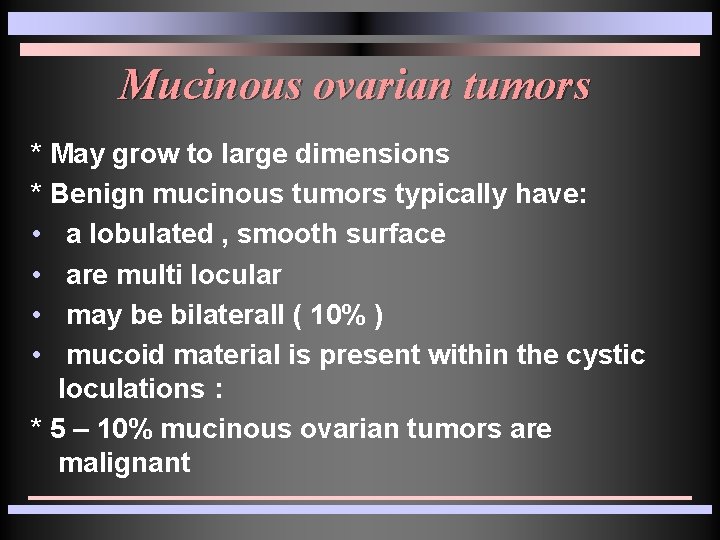
Mucinous ovarian tumors * May grow to large dimensions * Benign mucinous tumors typically have: • a lobulated , smooth surface • are multi locular • may be bilaterall ( 10% ) • mucoid material is present within the cystic loculations : * 5 – 10% mucinous ovarian tumors are malignant
Other benign ovarian tumors : • Fibroma • Brenner tumors • Mixed forms of tumors such as cystadenofibroma.
Ultrasound • Both abdominal and vaginal should be used: Size : • The normal ovary is 3. 5 x 2 x 1. 5 cm in premenopausal patient and 1. 5 x 0. 7 x 0. 5 cm two to five years after menopause • A postmenopausal ovary twice the size of the contralateral ovary is considered suspicious for malignancy. • Ovarian cyst size dose not correlate with risk of malignancy for unilocular cysts ( most are benign ) • Large multilocular cysts and solid tumors are more likely to be malignant
Cystic or solid : • 0. 3% of uniloculary cysts are malignant • 8% of multilocular cysts are malignant • 36% of mutilocular solid tumors are malignant • 39% solid tumors are malignant • Thick septa ( > 2 -3 mm ) is suggestive of malignancy.