
PELLS EQUATION Nivedita Notation d positive square root



- Slides: 23
PELL’S EQUATION - Nivedita
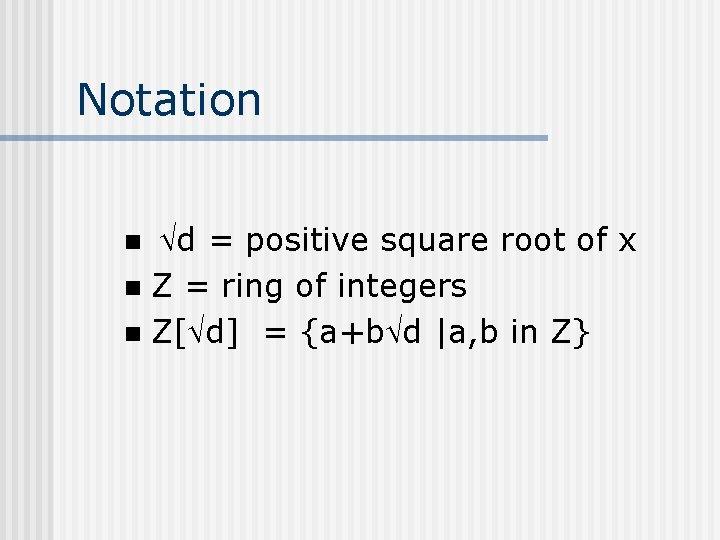
Notation d = positive square root of x n Z = ring of integers n Z[ d] = {a+b d |a, b in Z} n
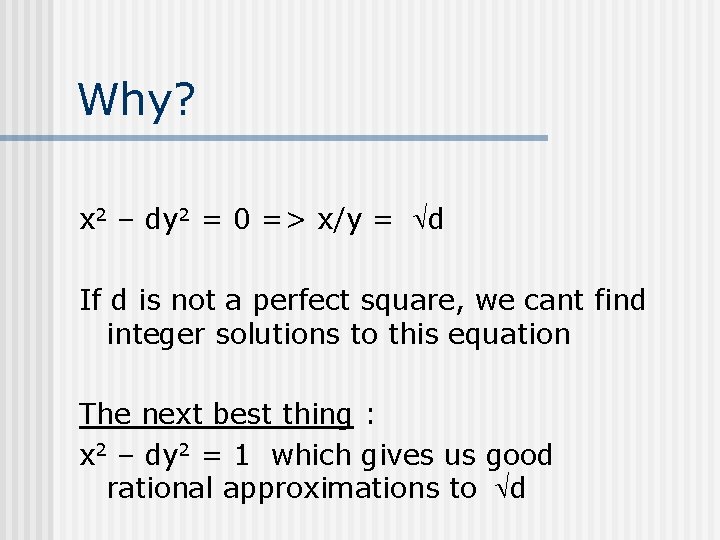
Why? x 2 – dy 2 = 0 => x/y = d If d is not a perfect square, we cant find integer solutions to this equation The next best thing : x 2 – dy 2 = 1 which gives us good rational approximations to d
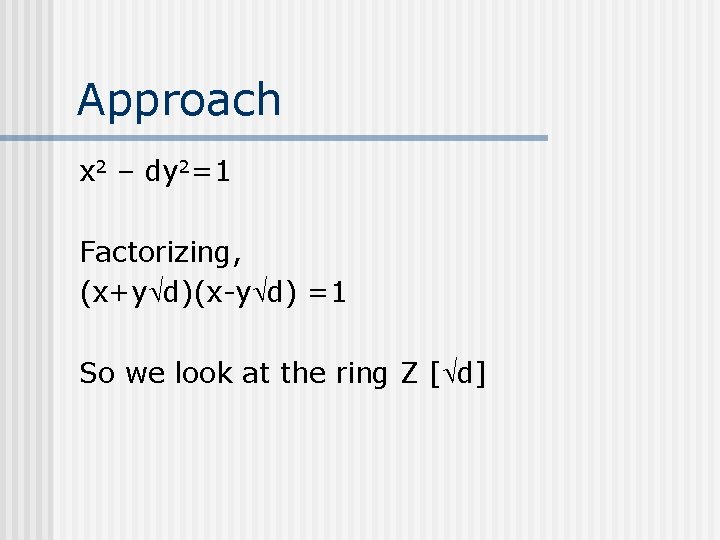
Approach x 2 – dy 2=1 Factorizing, (x+y d)(x-y d) =1 So we look at the ring Z [ d]
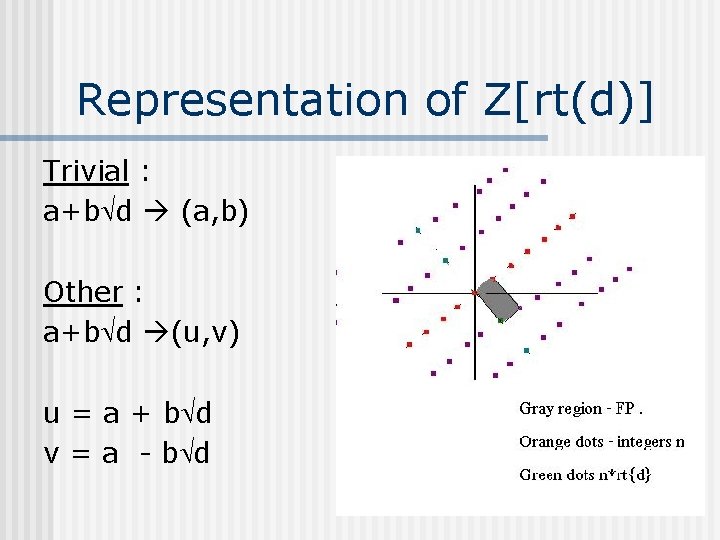
Representation of Z[rt(d)] Trivial : a+b d (a, b) Other : a+b d (u, v) u = a + b d v = a - b d
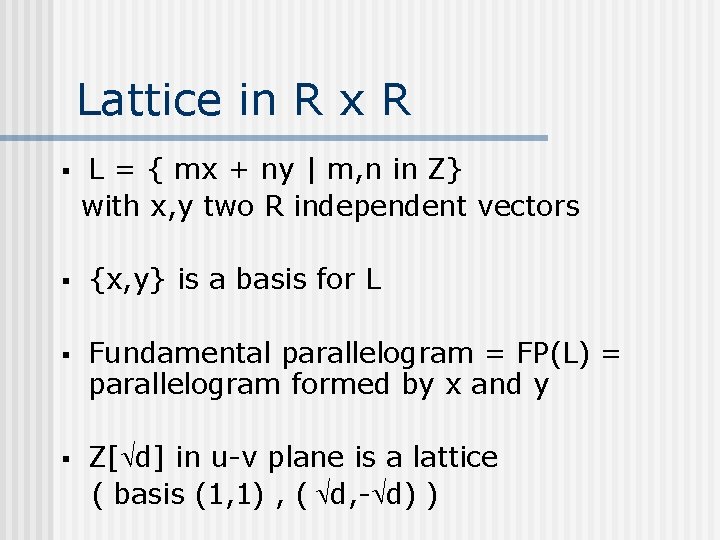
Lattice in R x R § L = { mx + ny | m, n in Z} with x, y two R independent vectors § {x, y} is a basis for L § Fundamental parallelogram = FP(L) = parallelogram formed by x and y § Z[ d] in u-v plane is a lattice ( basis (1, 1) , ( d, - d) )
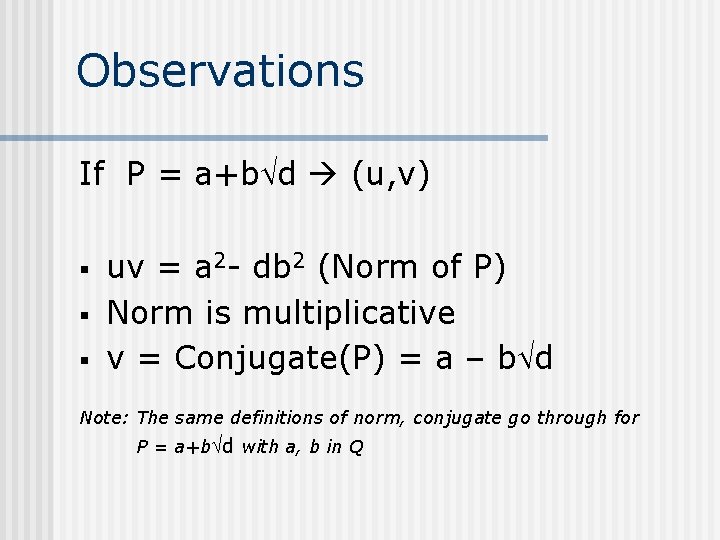
Observations If P = a+b d (u, v) § § § uv = a 2 - db 2 (Norm of P) Norm is multiplicative v = Conjugate(P) = a – b d Note: The same definitions of norm, conjugate go through for P = a+b d with a, b in Q
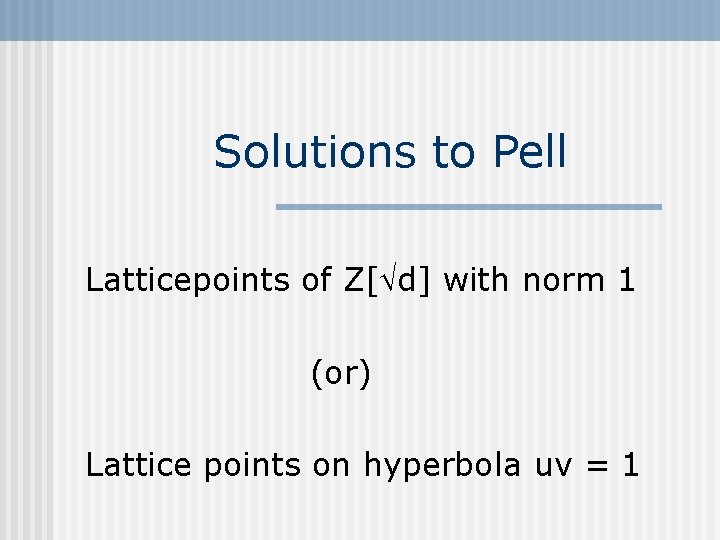
Solutions to Pell Latticepoints of Z[ d] with norm 1 (or) Lattice points on hyperbola uv = 1
Idea and a glitch If Norm(P) = Norm (Q) then Norm (P/Q) =1 ! But… P/Q need’nt be in Z[ d]
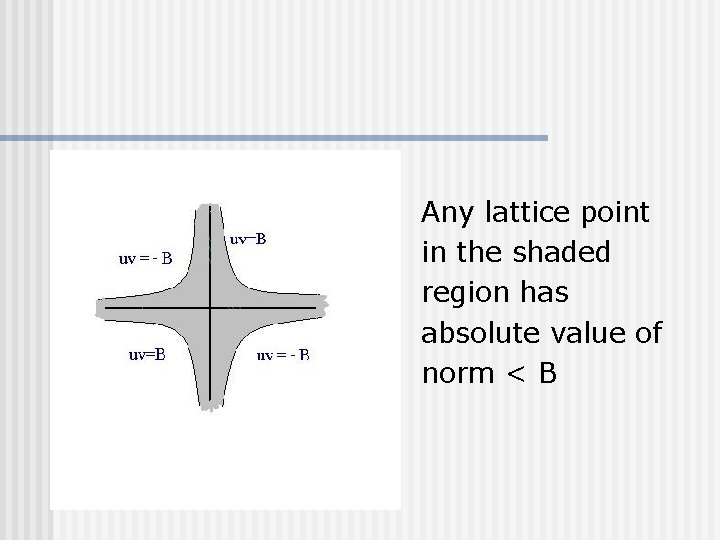
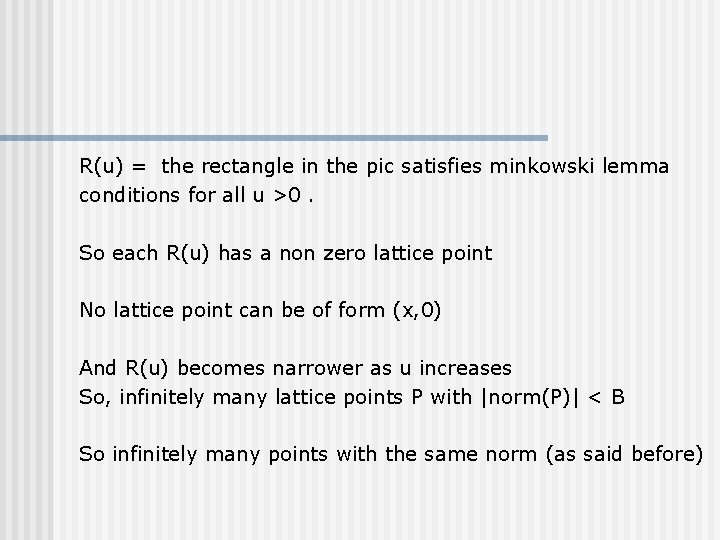
Any lattice point in the shaded region has absolute value of norm < B
Implementation of the idea If we can infinitely many lattice points inside the region, (note, they’ll all have |norm| < B ), then we can find infinitely many points which have the same norm r, |r| < B ( norms are integers and finitely many bet –B and B)
So, identifying lattice points in nice sets of R x R seems to be useful. Here follows a lemma
But what’s a nice set in Rx. R § Convex : S is convex if p in S, q in S => line-segment joining p and q is in S § Centrally symmetric : p in S => -p in S § Bounded : S is bounded if it lies inside a circle of radius R for big enough R
Minkowski’s lemma Let L be a lattice in R x R with fundamental parallelogram FP. If S is a bounded, convex, centrally symmetric set such that area(S) > 4* area(FP) then S contains a non-zero lattice point
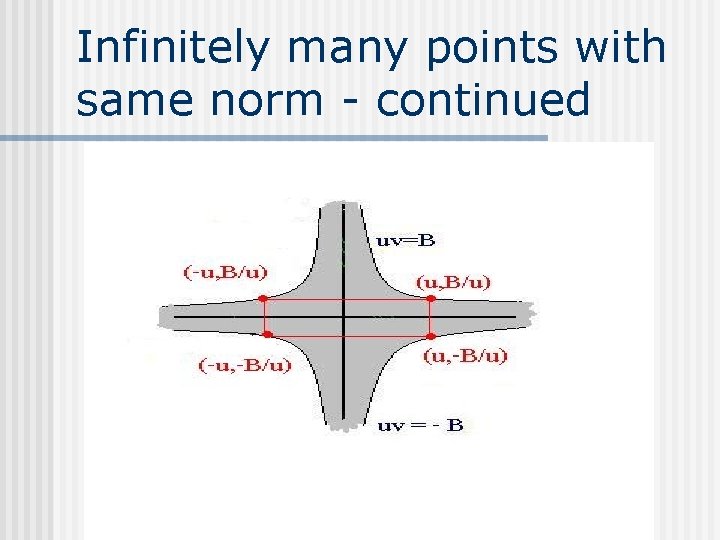
Infinitely many points with same norm - continued
R(u) = the rectangle in the pic satisfies minkowski lemma conditions for all u >0. So each R(u) has a non zero lattice point No lattice point can be of form (x, 0) And R(u) becomes narrower as u increases So, infinitely many lattice points P with |norm(P)| < B So infinitely many points with the same norm (as said before)
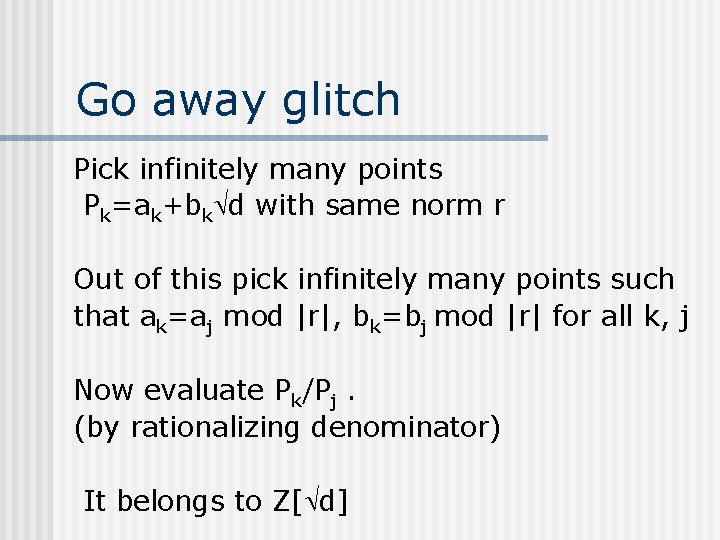
Go away glitch Pick infinitely many points Pk=ak+bk d with same norm r Out of this pick infinitely many points such that ak=aj mod |r|, bk=bj mod |r| for all k, j Now evaluate Pk/Pj. (by rationalizing denominator) It belongs to Z[ d]
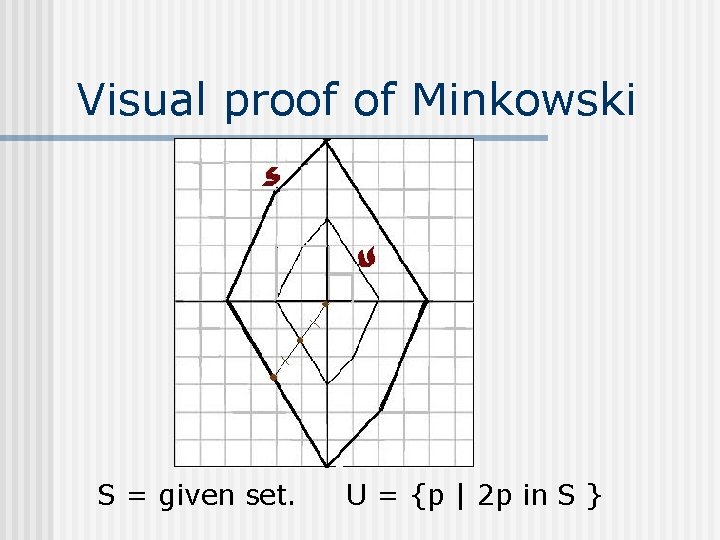
Visual proof of Minkowski S = given set. U = {p | 2 p in S }
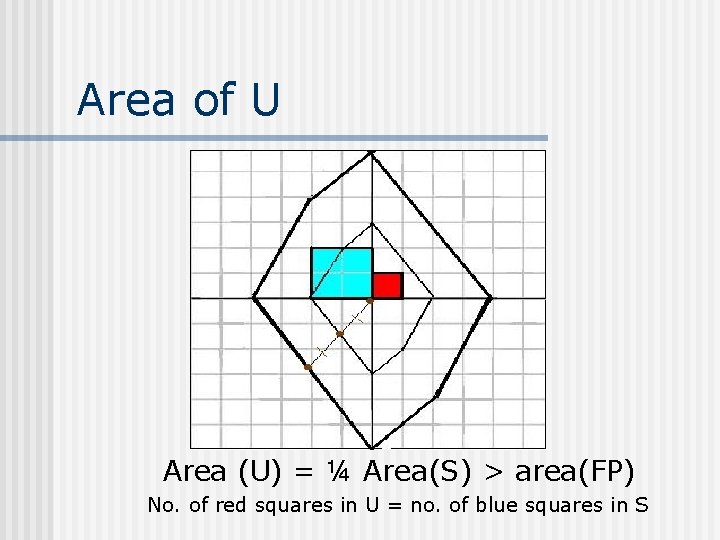
Area of U Area (U) = ¼ Area(S) > area(FP) No. of red squares in U = no. of blue squares in S
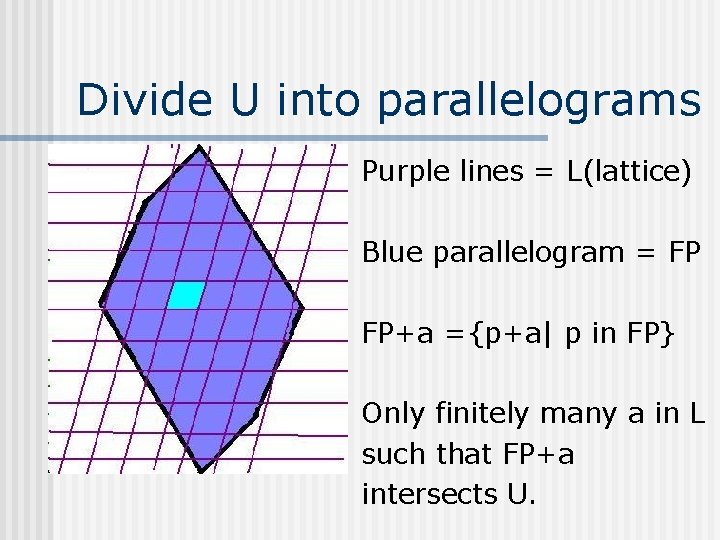
Divide U into parallelograms Purple lines = L(lattice) Blue parallelogram = FP FP+a ={p+a| p in FP} Only finitely many a in L such that FP+a intersects U.
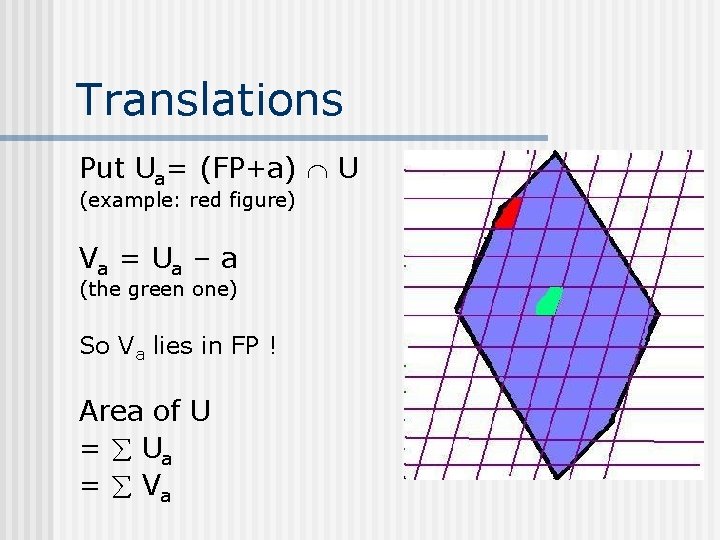
Translations Put Ua= (FP+a) U (example: red figure) Va = U a – a (the green one) So Va lies in FP ! Area of U = Ua = Va
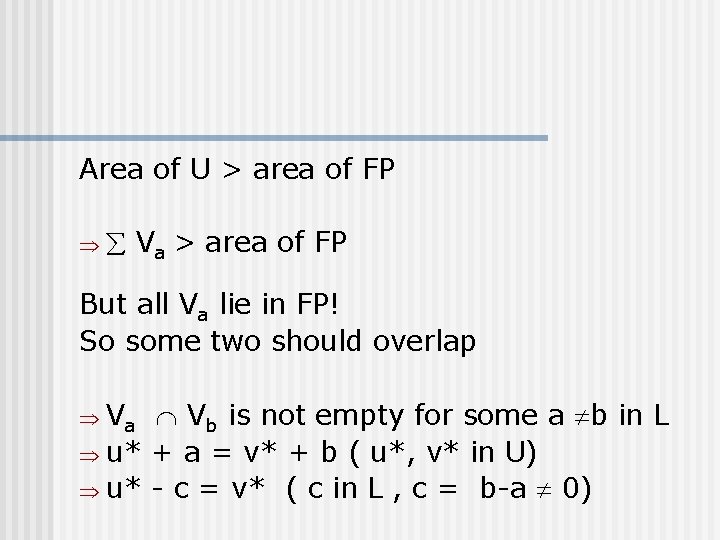
Area of U > area of FP Þ Va > area of FP But all Va lie in FP! So some two should overlap Þ Va Vb is not empty for some a b in L Þ u* + a = v* + b ( u*, v* in U) Þ u* - c = v* ( c in L , c = b-a 0)
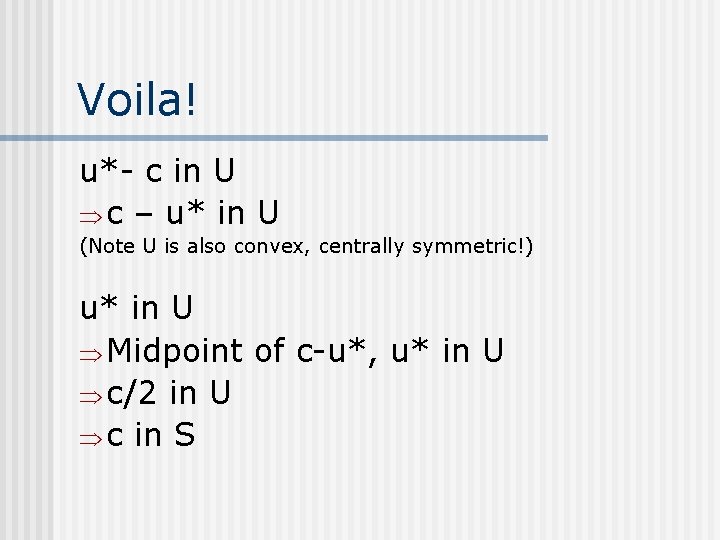
Voila! u*- c in U Þ c – u* in U (Note U is also convex, centrally symmetric!) u* in U Þ Midpoint of c-u*, u* in U Þ c/2 in U Þ c in S