
Pelitic Schists Fun with AFM Diagrams 1 2
- Slides: 12
Pelitic Schists: Fun with AFM Diagrams 1. 2. 3. 4. 5. AFM basics Getting P-T constraints Comparison with mafic rocks Interpreting complex assemblages Sample localities… c Jane Selverstone, University of New Mexico
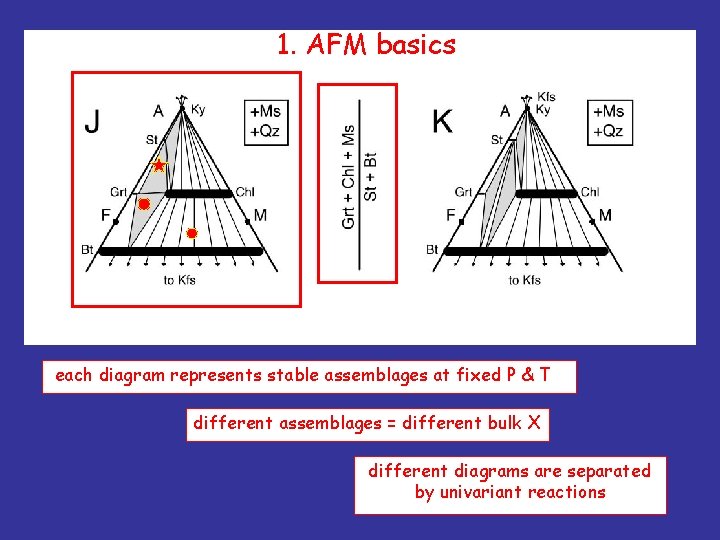
1. AFM basics each diagram represents stable assemblages at fixed P & T different assemblages = different bulk X different diagrams are separated by univariant reactions
Topological changes from 500 -650°C at constant P=6 kbar Watch for terminal and nonterminal reactions….
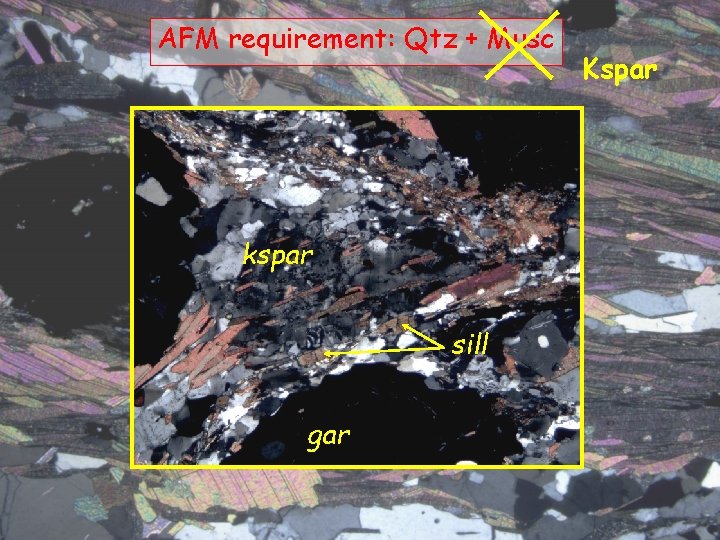
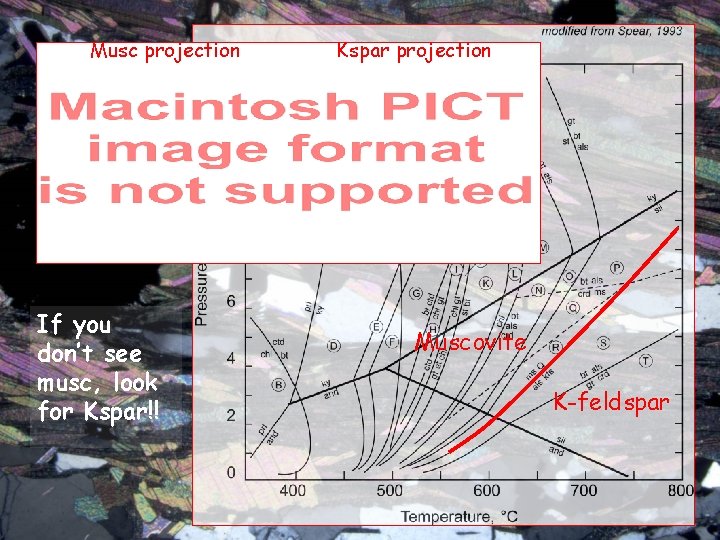
AFM requirement: Qtz + Musc …but musc breaks down at high T qtz sill kspar musc sill Musc + Qtzgar = AS + Kspar + H 2 O Kspar
Musc projection If you don’t see musc, look for Kspar!! Kspar projection Muscovite K-feldspar
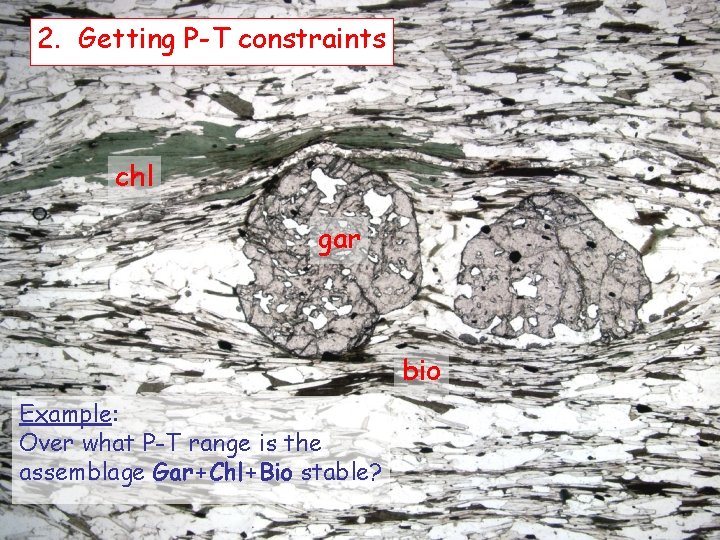
2. Getting P-T constraints chl gar bio Example: Over what P-T range is the assemblage Gar+Chl+Bio stable?
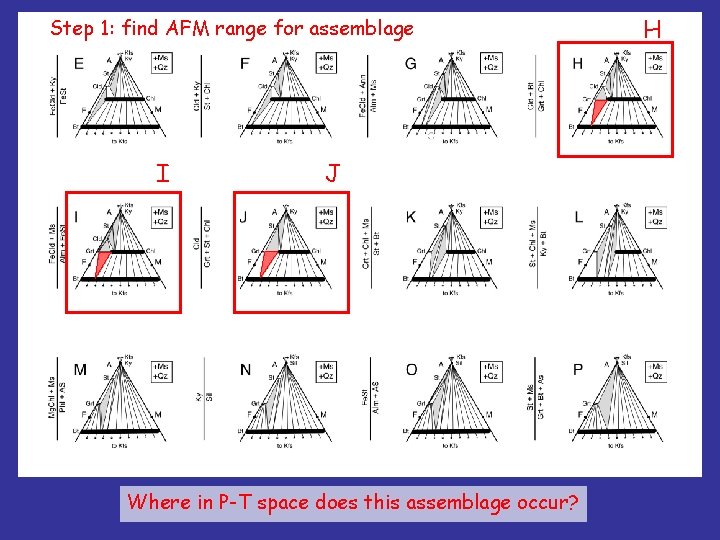
Step 1: find AFM range for assemblage I J Where in P-T space does this assemblage occur? H
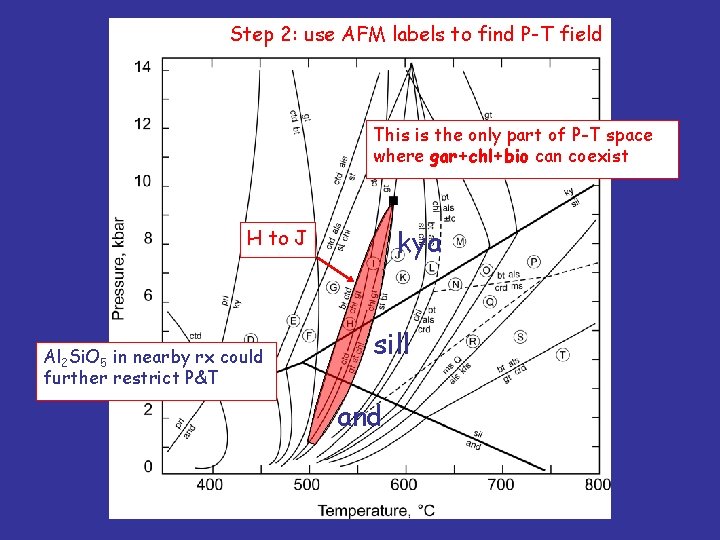
Step 2: use AFM labels to find P-T field This is the only part of P-T space where gar+chl+bio can coexist kya H to J Al 2 Si. O 5 in nearby rx could further restrict P&T sill and
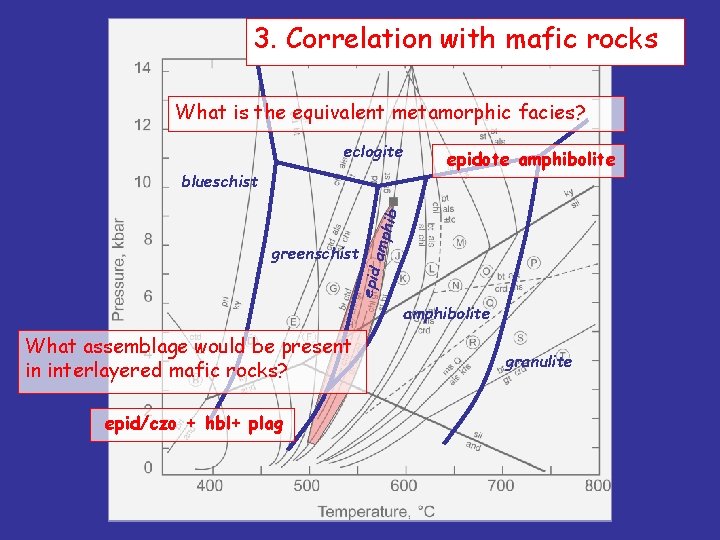
3. Correlation with mafic rocks What is the equivalent metamorphic facies? eclogite epid greenschist amp hib blueschist epidote amphibolite What assemblage would be present in interlayered mafic rocks? epid/czo + hbl+ plag granulite
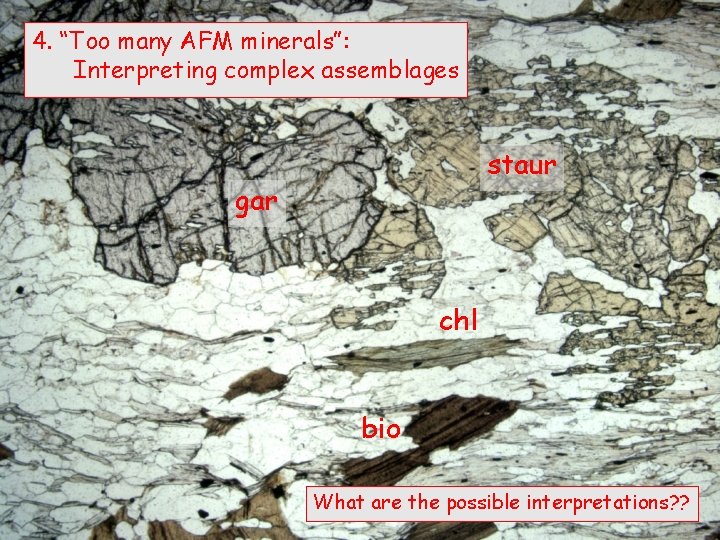
4. “Too many AFM minerals”: Interpreting complex assemblages staur gar chl bio What are the possible interpretations? ?
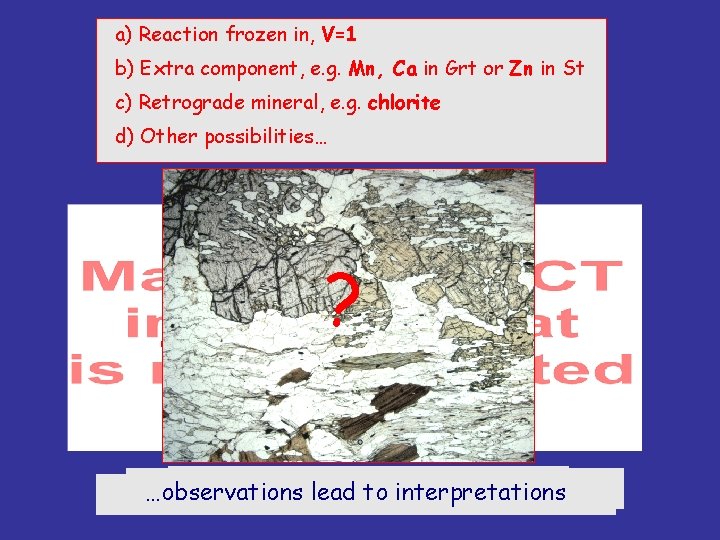
a) Reaction frozen in, V=1 b) Extra component, e. g. Mn, Ca in Grt or Zn in St c) Retrograde mineral, e. g. chlorite d) Other possibilities… ? …look for textural of rxn …chl replacing …no Grt, or Bt; don’t plot chl …observations lead. St, toevidence interpretations
Insert info here on the tectonic settings/metamorphic histories of your own samples