
PEGASUS A PETASCALE GRAPH MINING SYSTEM PRESENTER ANURADHA
![WHY GRAPHS? Internet Map [lumeta. com] Sites D 1 . . . DN Friendship](https://slidetodoc.com/presentation_image_h2/ceba7dd54138ac38f5366dfb466e5ad0/image-3.jpg "WHY GRAPHS? Internet Map [lumeta. com] Sites D 1 . . . DN Friendship")
![RUNNING ALGORITHMS: PAGE RANK §Command: compute pagerank [graph_name] §Additional parameters: § the number of](https://slidetodoc.com/presentation_image_h2/ceba7dd54138ac38f5366dfb466e5ad0/image-30.jpg "RUNNING ALGORITHMS: PAGE RANK §Command: compute pagerank [graph_name] §Additional parameters: § the number of")
![PLOTTING RESULT: PAGERANK §The Page. Rank distribution is plotted by the plot pagerank [graph_name]](https://slidetodoc.com/presentation_image_h2/ceba7dd54138ac38f5366dfb466e5ad0/image-32.jpg "PLOTTING RESULT: PAGERANK §The Page. Rank distribution is plotted by the plot pagerank [graph_name]")
![RUNNING ALGORITHMS: DEGREE §Command: compute deg [graph_name] §Additional parameters: the type of the degree](https://slidetodoc.com/presentation_image_h2/ceba7dd54138ac38f5366dfb466e5ad0/image-33.jpg "RUNNING ALGORITHMS: DEGREE §Command: compute deg [graph_name] §Additional parameters: the type of the degree")
![PLOTTING RESULT: DEGREE §The Degree distribution is plotted by the plot deg [graph_name] §The](https://slidetodoc.com/presentation_image_h2/ceba7dd54138ac38f5366dfb466e5ad0/image-35.jpg "PLOTTING RESULT: DEGREE §The Degree distribution is plotted by the plot deg [graph_name] §The")
![RUNNING ALGORITHMS: RADIUS §Command: compute radius [graph_name] §Additional parameters: § the number of nodes](https://slidetodoc.com/presentation_image_h2/ceba7dd54138ac38f5366dfb466e5ad0/image-36.jpg "RUNNING ALGORITHMS: RADIUS §Command: compute radius [graph_name] §Additional parameters: § the number of nodes")
![PLOTTING RESULT: RADIUS §The Degree distribution is plotted by the plot radius [graph_name] §The](https://slidetodoc.com/presentation_image_h2/ceba7dd54138ac38f5366dfb466e5ad0/image-39.jpg "PLOTTING RESULT: RADIUS §The Degree distribution is plotted by the plot radius [graph_name] §The")
![Reference [1] U Kang, Charalampos E. Tsourakakis, and Christos Faloutsos, PEGASUS: A Peta Mining](https://slidetodoc.com/presentation_image_h2/ceba7dd54138ac38f5366dfb466e5ad0/image-40.jpg "Reference [1] U Kang, Charalampos E. Tsourakakis, and Christos Faloutsos, PEGASUS: A Peta Mining")

- Slides: 41
PEGASUS: A PETA-SCALE GRAPH MINING SYSTEM PRESENTER : ANURADHA KULKARNI
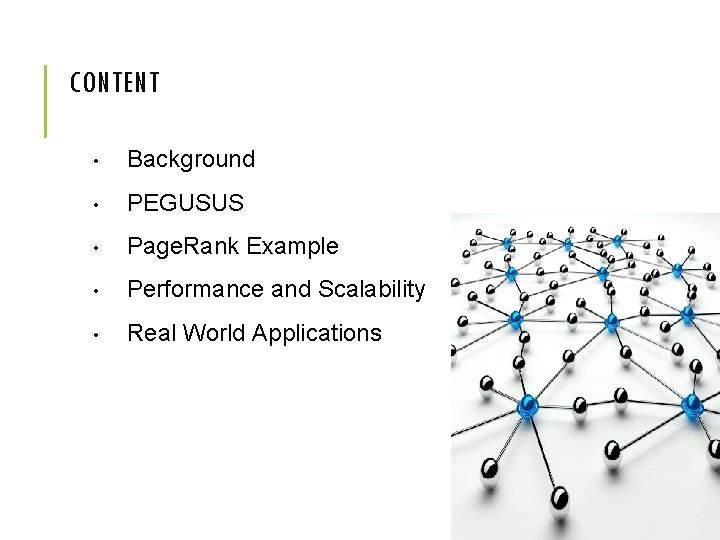
CONTENT • Background • PEGUSUS • Page. Rank Example • Performance and Scalability • Real World Applications
WHY GRAPHS? Internet Map [lumeta. com] Sites D 1 . . . DN Friendship Network [Moody ’ 01] Protein Interactions [genomebiology. com] Social Networking IR : BI-PARTITE GRAPHS T 1 TM WEB: HYPER TEXT LINK
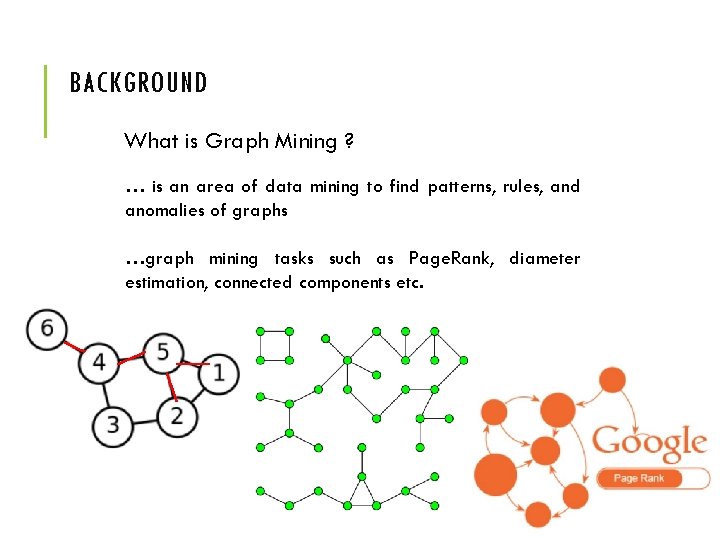
BACKGROUND What is Graph Mining ? … is an area of data mining to find patterns, rules, and anomalies of graphs …graph mining tasks such as Page. Rank, diameter estimation, connected components etc.
BACKGROUND What is the problem? § Large volume of available data § Limited scalability § Rely on a shared memory model - limits their ability to handle large disk-resident graph Why is it important? § Graphs or networks are everywhere § We must find graph mining algorithms that are faster and can scale up to billions of nodes and edges to tackle real world applications
PEGASUS § Based on Hadoop § Handling graphs with billions of nodes and edges § Unification of seemingly different graph mining tasks § Generalized Iterated Matrix-Vector multiplication(GIM-V)
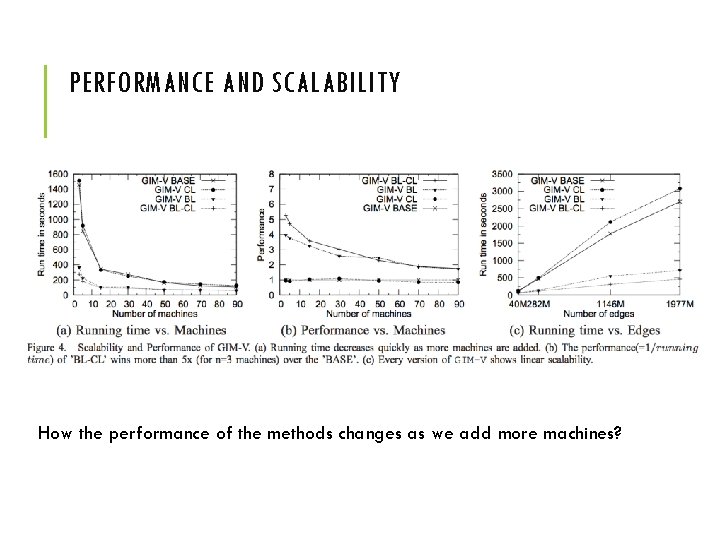
PEGASUS § Linear runtime on the numbers of edges § Scales up well with the number of available machines § Combination of optimizations can speed up 5 times
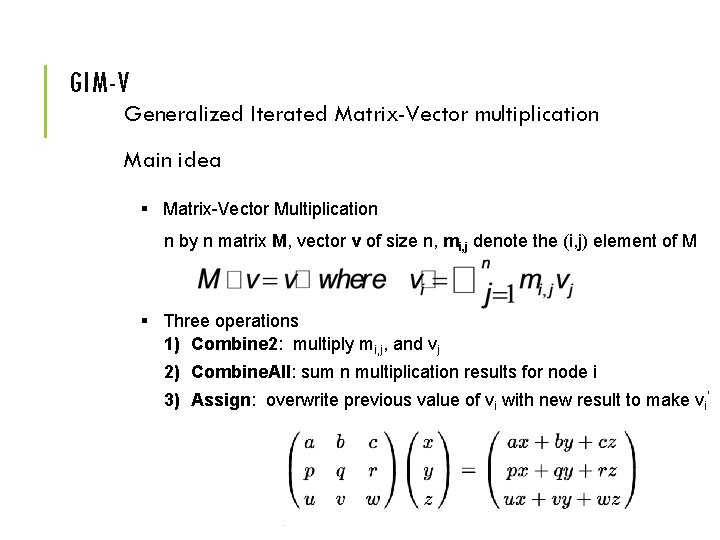
GIM-V Generalized Iterated Matrix-Vector multiplication Main idea § Matrix-Vector Multiplication n by n matrix M, vector v of size n, mi, j denote the (i, j) element of M § Three operations 1) Combine 2: multiply mi, j, and vj 2) Combine. All: sum n multiplication results for node i 3) Assign: overwrite previous value of vi with new result to make vi’
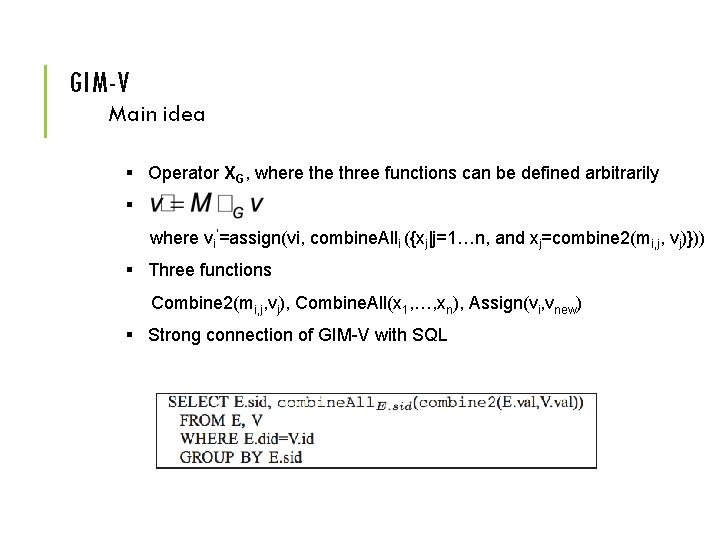
GIM-V Main idea § Operator XG, where three functions can be defined arbitrarily § where vi’=assign(vi, combine. Alli ({xj|j=1…n, and xj=combine 2(mi, j, vj)})) § Three functions Combine 2(mi, j, vj), Combine. All(x 1, …, xn), Assign(vi, vnew) § Strong connection of GIM-V with SQL
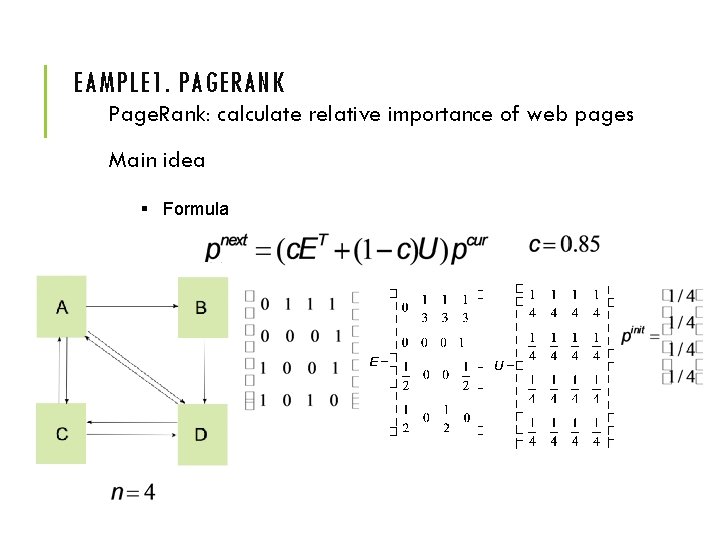
EAMPLE 1. PAGERANK Page. Rank: calculate relative importance of web pages Main idea § Formula
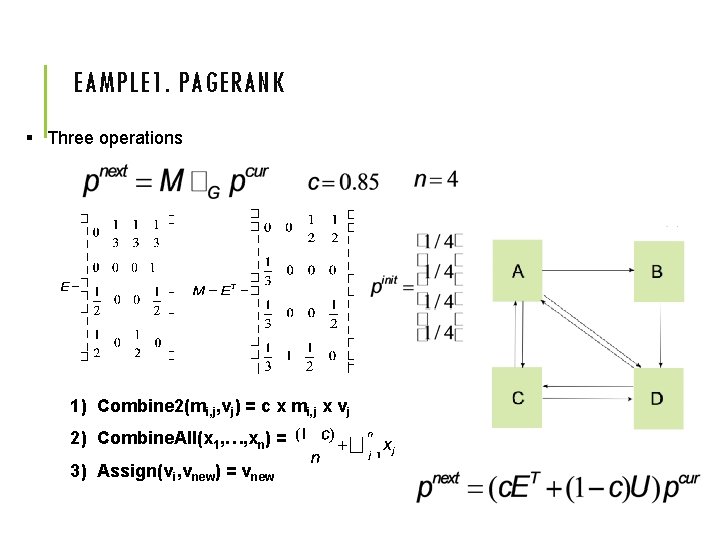
EAMPLE 1. PAGERANK § Three operations 1) Combine 2(mi, j, vj) = c x mi, j x vj 2) Combine. All(x 1, …, xn) = 3) Assign(vi, vnew) = vnew
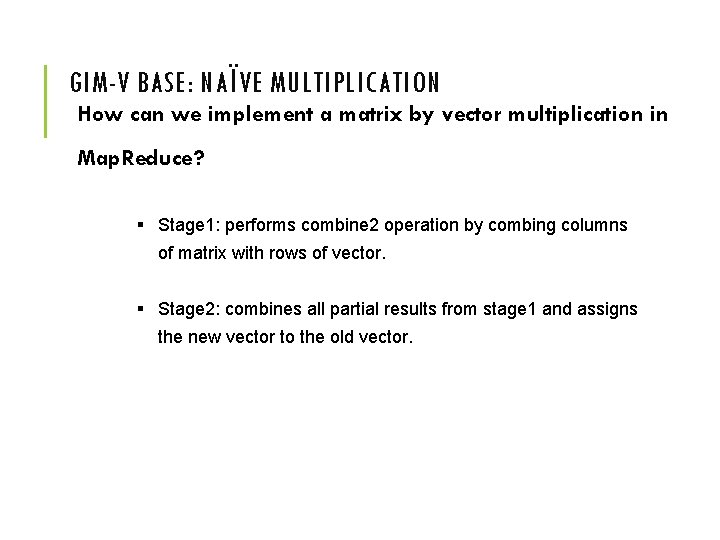
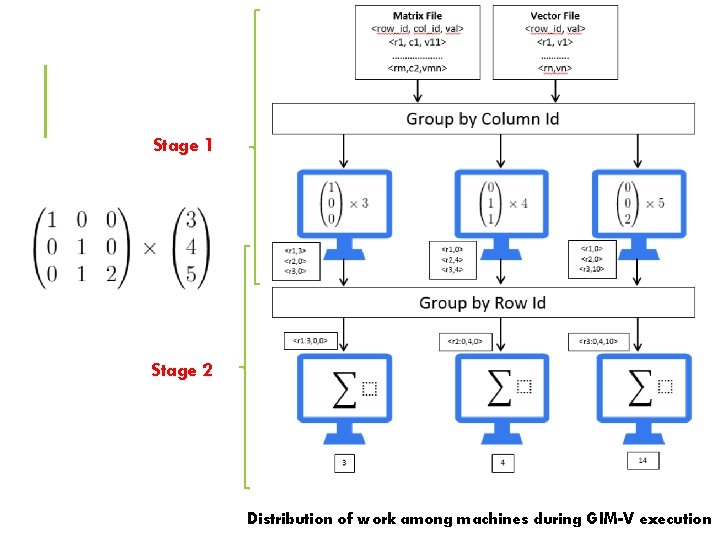
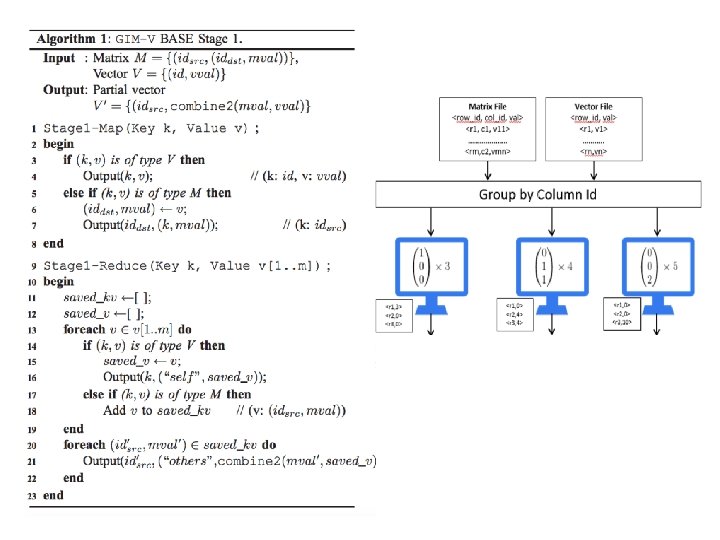
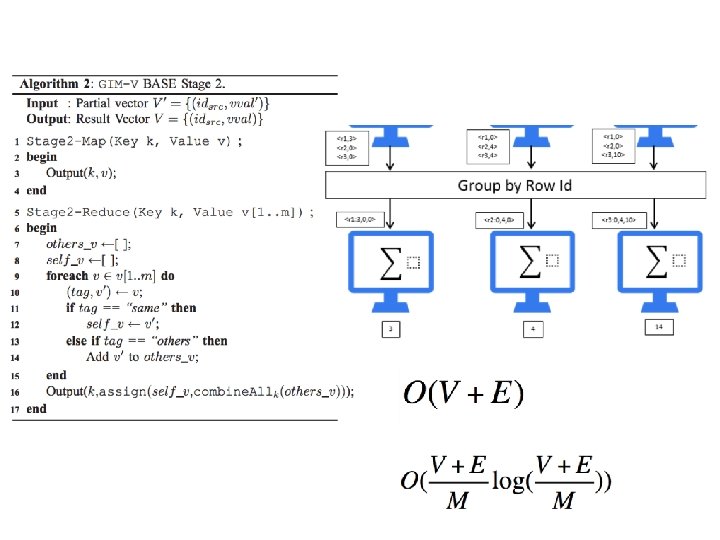
GIM-V BASE: NAÏVE MULTIPLICATION How can we implement a matrix by vector multiplication in Map. Reduce? § Stage 1: performs combine 2 operation by combing columns of matrix with rows of vector. § Stage 2: combines all partial results from stage 1 and assigns the new vector to the old vector.
Stage 1 Stage 2 Distribution of work among machines during GIM-V execution
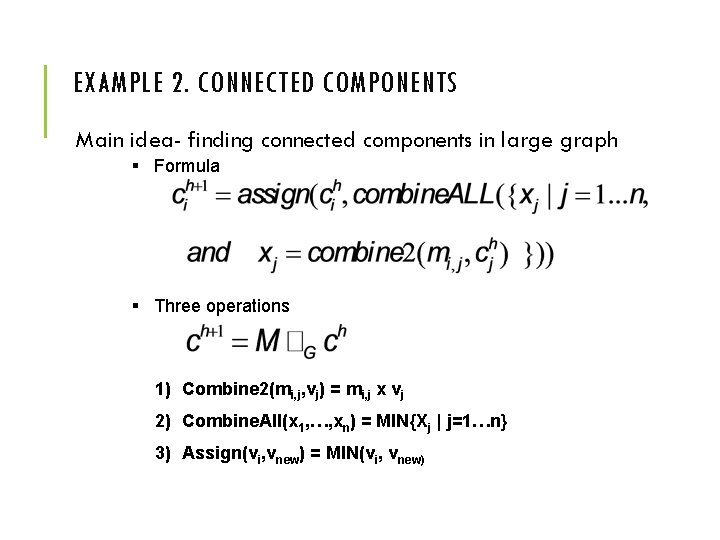
EXAMPLE 2. CONNECTED COMPONENTS Main idea- finding connected components in large graph § Formula § Three operations 1) Combine 2(mi, j, vj) = mi, j x vj 2) Combine. All(x 1, …, xn) = MIN{Xj | j=1…n} 3) Assign(vi, vnew) = MIN(vi, vnew)
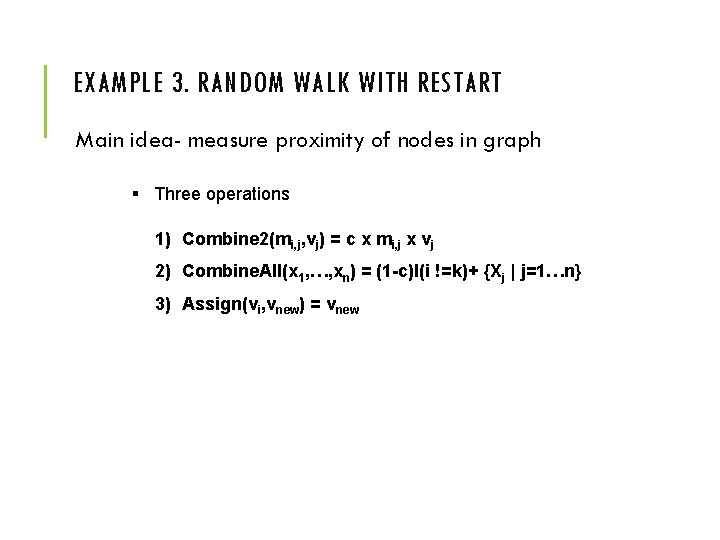
EXAMPLE 3. RANDOM WALK WITH RESTART Main idea- measure proximity of nodes in graph § Three operations 1) Combine 2(mi, j, vj) = c x mi, j x vj 2) Combine. All(x 1, …, xn) = (1 -c)I(i !=k)+ {Xj | j=1…n} 3) Assign(vi, vnew) = vnew
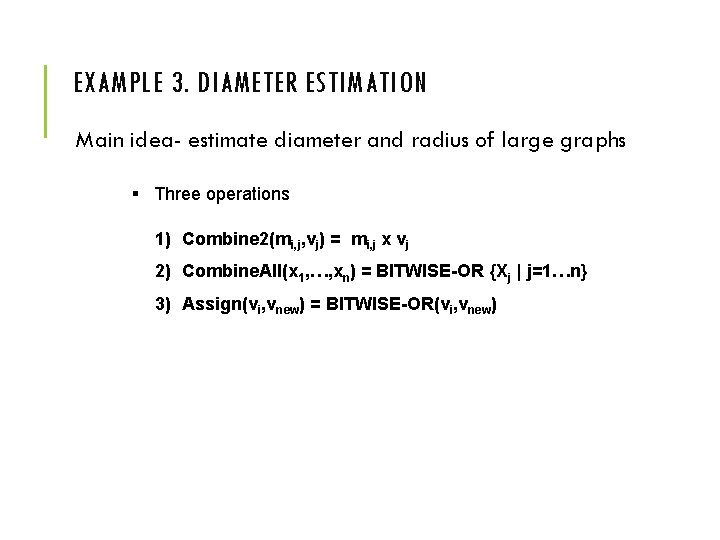
EXAMPLE 3. DIAMETER ESTIMATION Main idea- estimate diameter and radius of large graphs § Three operations 1) Combine 2(mi, j, vj) = mi, j x vj 2) Combine. All(x 1, …, xn) = BITWISE-OR {Xj | j=1…n} 3) Assign(vi, vnew) = BITWISE-OR(vi, vnew)
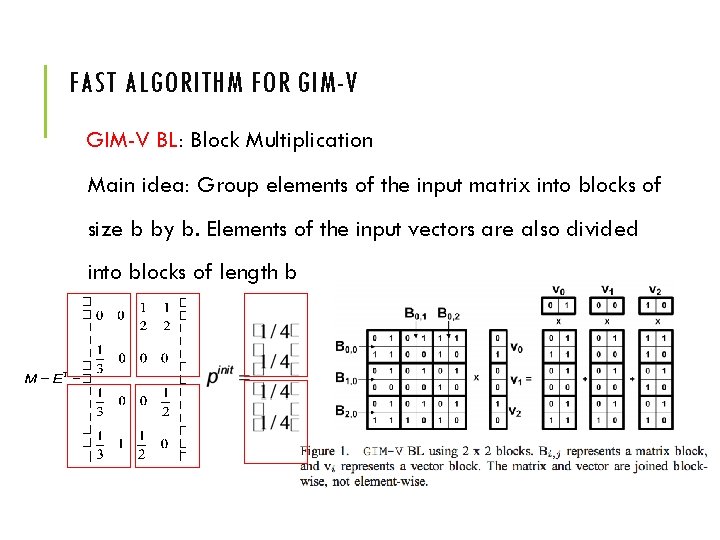
FAST ALGORITHM FOR GIM-V BL: Block Multiplication Main idea: Group elements of the input matrix into blocks of size b by b. Elements of the input vectors are also divided into blocks of length b
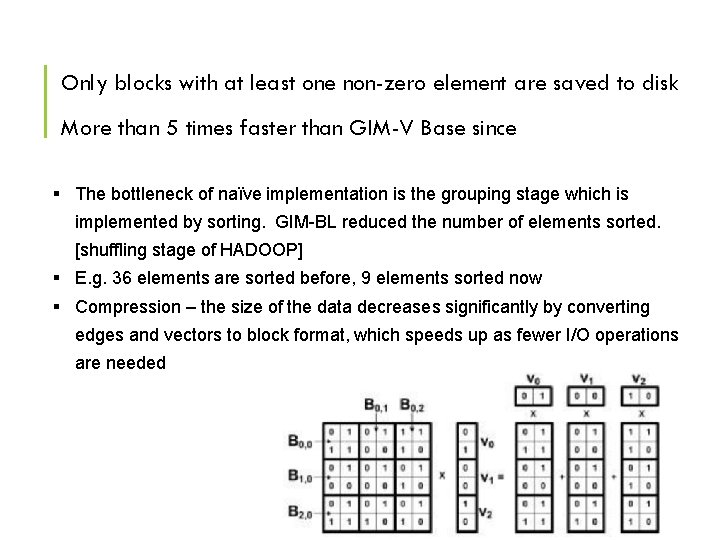
Only blocks with at least one non-zero element are saved to disk More than 5 times faster than GIM-V Base since § The bottleneck of naïve implementation is the grouping stage which is implemented by sorting. GIM-BL reduced the number of elements sorted. [shuffling stage of HADOOP] § E. g. 36 elements are sorted before, 9 elements sorted now § Compression – the size of the data decreases significantly by converting edges and vectors to block format, which speeds up as fewer I/O operations are needed
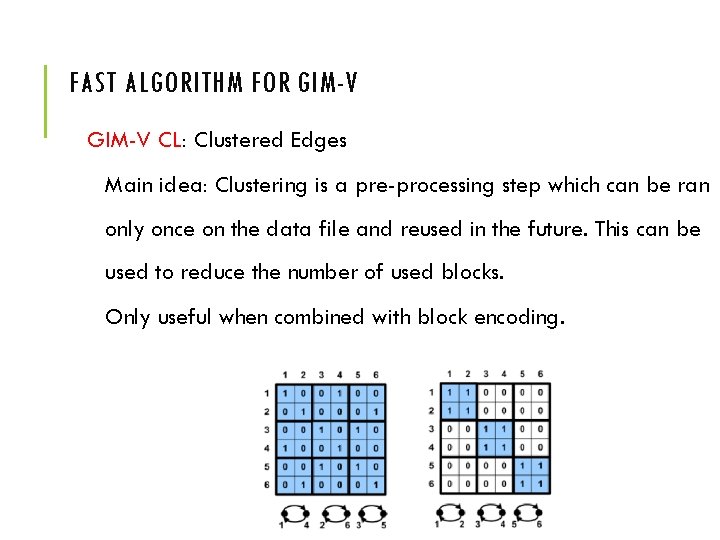
FAST ALGORITHM FOR GIM-V CL: Clustered Edges Main idea: Clustering is a pre-processing step which can be ran only once on the data file and reused in the future. This can be used to reduce the number of used blocks. Only useful when combined with block encoding.
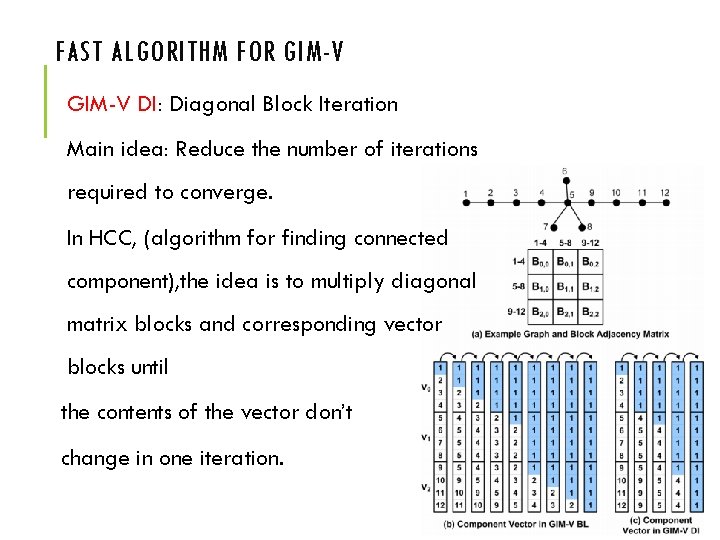
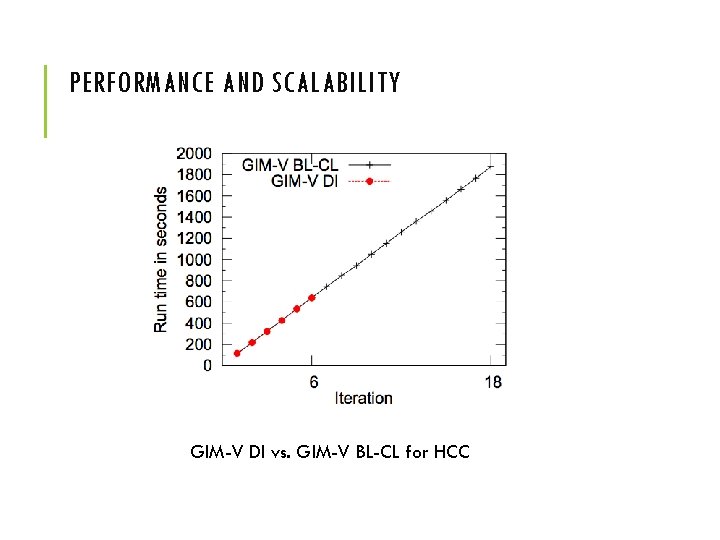
FAST ALGORITHM FOR GIM-V DI: Diagonal Block Iteration Main idea: Reduce the number of iterations required to converge. In HCC, (algorithm for finding connected component), the idea is to multiply diagonal matrix blocks and corresponding vector blocks until the contents of the vector don’t change in one iteration.
PERFORMANCE AND SCALABILITY How the performance of the methods changes as we add more machines?
PERFORMANCE AND SCALABILITY GIM-V DI vs. GIM-V BL-CL for HCC
REAL WORLD APPLICATIONS PEGASUS can be useful for finding patterns, outliers, and interesting observations. § Connected Components of Real Networks § Page. Ranks of Real Networks § Diameter of Real Networks
INSTALLATION: ENVIRONMENT PEGASUS needs the following software's to be installed in the system: §Hadoop 0. 20. 1 or greater §Apache Ant 1. 7. 0 or greater §Java 1. 6. x or greater, preferably from Sun §Python 2. 4. x or greater §Gnuplot 4. 2. x or greater
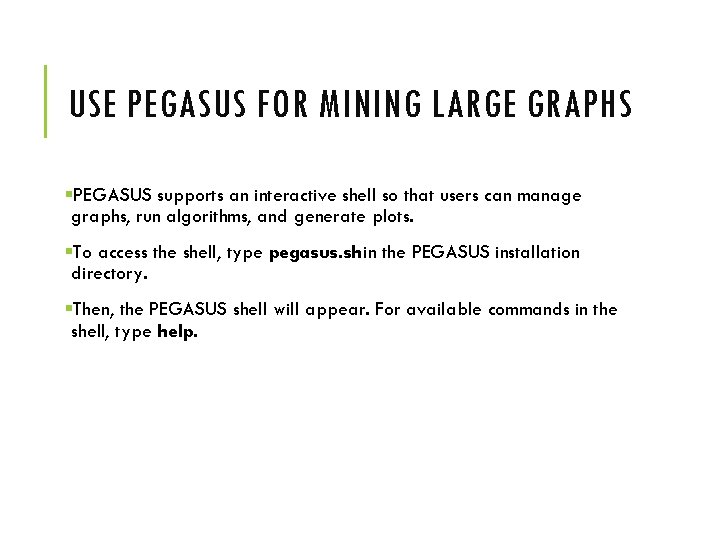
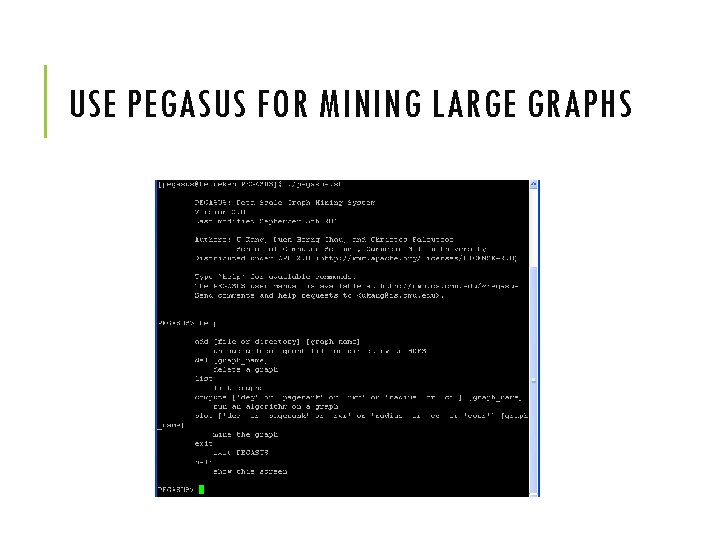
USE PEGASUS FOR MINING LARGE GRAPHS §PEGASUS supports an interactive shell so that users can manage graphs, run algorithms, and generate plots. §To access the shell, type pegasus. sh in the PEGASUS installation directory. §Then, the PEGASUS shell will appear. For available commands in the shell, type help.
USE PEGASUS FOR MINING LARGE GRAPHS
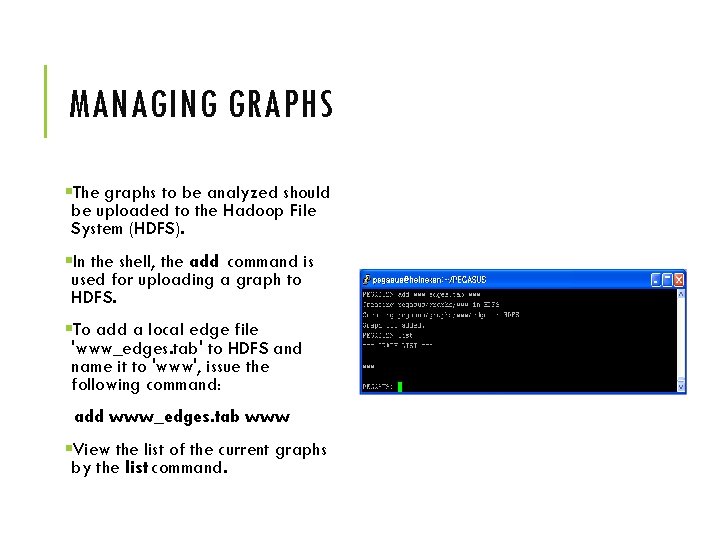
MANAGING GRAPHS §The graphs to be analyzed should be uploaded to the Hadoop File System (HDFS). §In the shell, the add command is used for uploading a graph to HDFS. §To add a local edge file 'www_edges. tab' to HDFS and name it to 'www', issue the following command: add www_edges. tab www §View the list of the current graphs by the list command.
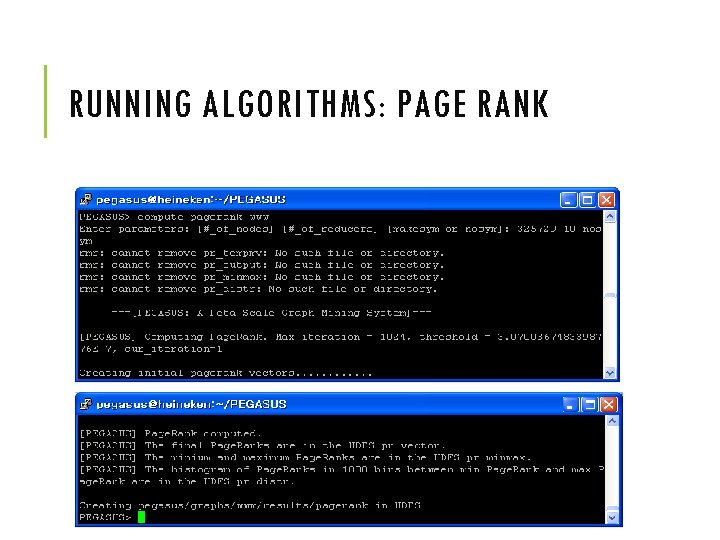
RUNNING ALGORITHMS: PAGE RANK §Command: compute pagerank [graph_name] §Additional parameters: § the number of nodes in the graph § the number of reducers § whether to symmetrize the graph. (sym or nosym)
RUNNING ALGORITHMS: PAGE RANK
PLOTTING RESULT: PAGERANK §The Page. Rank distribution is plotted by the plot pagerank [graph_name] §The output file yweb_pagerank. eps is generated in the current directory. §Here is the Page. Rank distribution plotted.
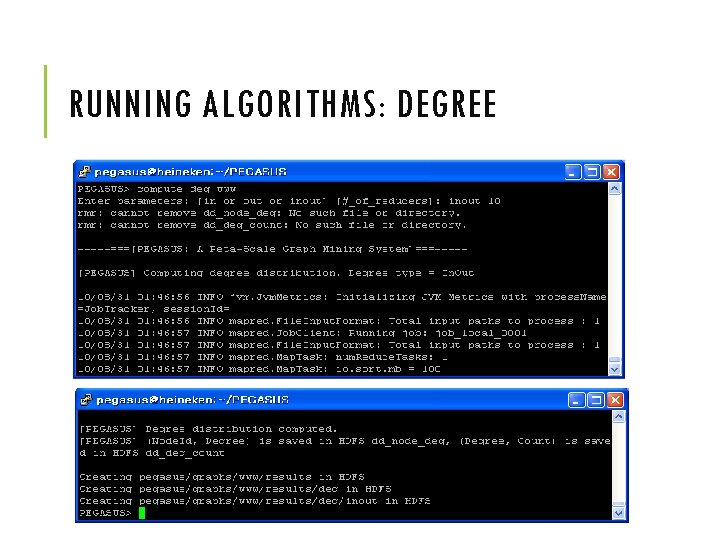
RUNNING ALGORITHMS: DEGREE §Command: compute deg [graph_name] §Additional parameters: the type of the degree (inout, in, out) the number of reducers
RUNNING ALGORITHMS: DEGREE
PLOTTING RESULT: DEGREE §The Degree distribution is plotted by the plot deg [graph_name] §The output file www_deg_inout. epsis generated in the current directory. §Here is the Degree distribution plotted.
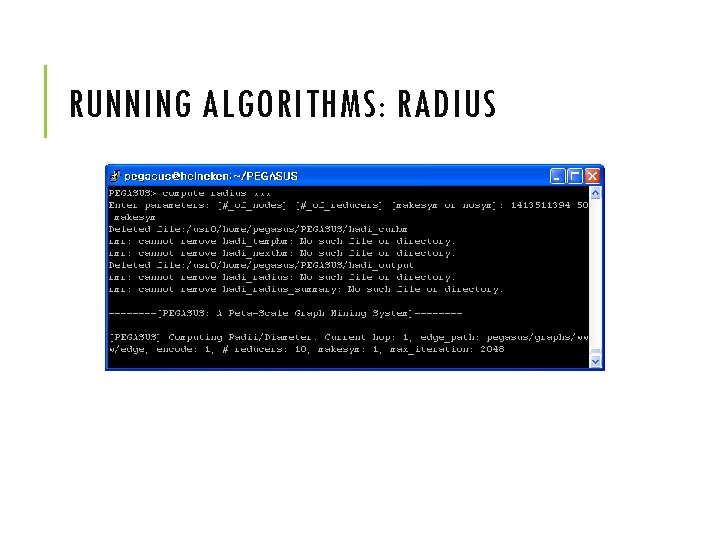
RUNNING ALGORITHMS: RADIUS §Command: compute radius [graph_name] §Additional parameters: § the number of nodes in the graph § the number of reducers § whether to symmetrize the graph
RUNNING ALGORITHMS: RADIUS
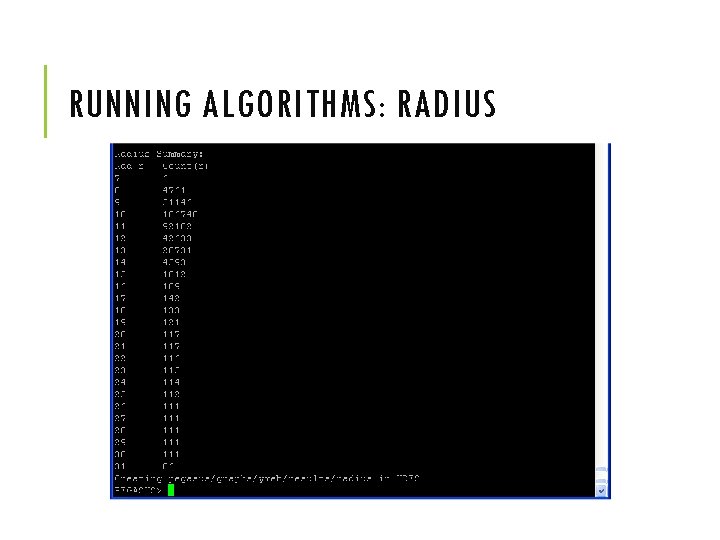
RUNNING ALGORITHMS: RADIUS
PLOTTING RESULT: RADIUS §The Degree distribution is plotted by the plot radius [graph_name] §The output file yweb_radius. eps is generated in the current directory. §Here is the Radius distribution plotted.
Reference [1] U Kang, Charalampos E. Tsourakakis, and Christos Faloutsos, PEGASUS: A Peta Mining System - Implementation and Observations. Proc. Intl. Conf. Data Mining, 2009, 229 -238 [2] U Kang. "Mining Tera-Scale Graphs: Theory, Engineering and Discoveries. " Diss. Carnegie Mellon U, 2012. Print. [3]Kenneth Shum. “Notes on Page. Rank Algorithm. ” Http: //home. ie. cuhk. edu. hk/~wkshum/papers/pagerank. pdf. N. p. , n. d. Web. 20 Sept. 2016.
THANK YOU!!!