
PEFA FRAMEWORK FOR ASSESSING PUBLIC FINANCIAL MANAGEMENT Module
PEFA FRAMEWORK FOR ASSESSING PUBLIC FINANCIAL MANAGEMENT Module 1: The PEFA Program & the Mechanics of the Framework

Content • 1 Overview of the PEFA Program • 2 The Mechanics of the Framework 2
Content: 1 Overview of PEFA Program • Overview of the PEFA Program • Global Roll-out of the Framework • Upgrade 2016 & Quality Assurance • Support to users 3
Content • Overview of the PEFA Program • Global Roll-out of the Framework • Phase IV – 2012 -17 • Support to users 4
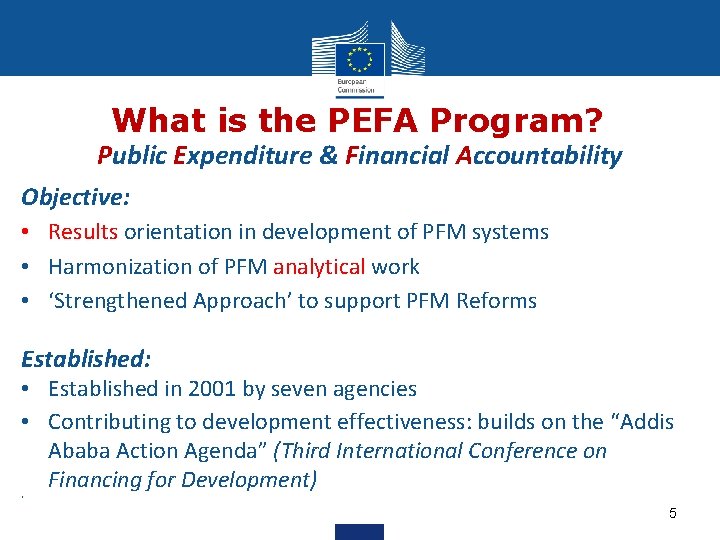
What is the PEFA Program? Public Expenditure & Financial Accountability Objective: • Results orientation in development of PFM systems • Harmonization of PFM analytical work • ‘Strengthened Approach’ to support PFM Reforms Established: • Established in 2001 by seven agencies • Contributing to development effectiveness: builds on the “Addis Ababa Action Agenda” (Third International Conference on Financing for Development) • 5
The PEFA Partners 6
‘Strengthened Approach’: implications Focus on improvement in country PFM systems: • Emphasizing country leadership & ownership for results • Common information pool, few duplicative diagnostics • Joint donor work in country, reducing transaction costs & creating consistency in analysis 7
Purpose of the PEFA Framework The Framework provides: • a high level overview of all aspects of a country’s PFM systems performance (including revenue, expenditure, procurement, financial assets/ liabilities): are tools in place to help deliver the 3 main budgetary outcomes? (aggregate fiscal discipline; strategic resource allocation; efficient service delivery) It does not provide an assessment of : • underlying causes for good or poor performance i. e. the capacity factors (other tools are available) • government fiscal & financial policies 8
What can countries use PEFA for? • Inform PFM reformulation, priorities • Monitor results of reform efforts • Harmonize information needs for external agencies around a common assessment tool • Compare to and learn from peers & can use for ‘self-assessment’ 9
Budget Support and PEFA • PEFA allows assessment of status of PFM in a country, can support reform dialogue, & facilitates monitoring of progress over medium term • Budget support instrument requires establishing benchmarks for demonstrating progress in PFM systems & progress from year to trigger disbursements • One object of budget support instrument is to foster dialogue on improving PFM and in so doing enhance the chances of increasing rate of development 10
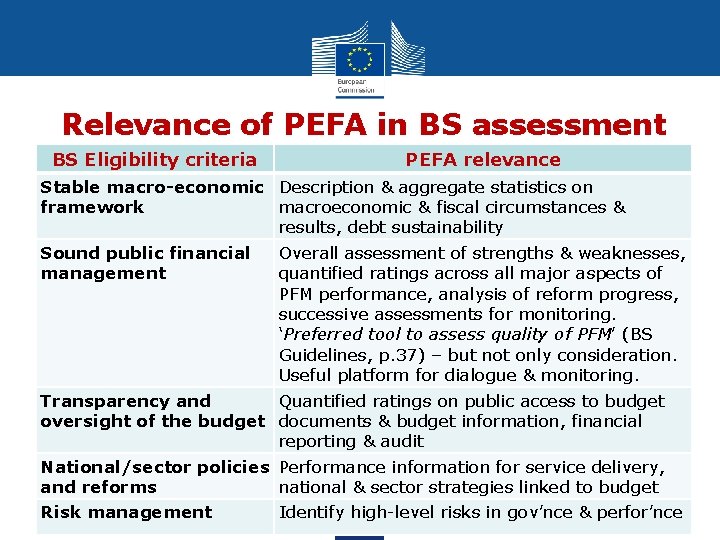
Relevance of PEFA in BS assessment BS Eligibility criteria PEFA relevance Stable macro-economic Description & aggregate statistics on framework macroeconomic & fiscal circumstances & results, debt sustainability Sound public financial Overall assessment of strengths & weaknesses, management quantified ratings across all major aspects of PFM performance, analysis of reform progress, successive assessments for monitoring. ‘Preferred tool to assess quality of PFM’ (BS Guidelines, p. 37) – but not only consideration. Useful platform for dialogue & monitoring. Transparency and Quantified ratings on public access to budget oversight of the budget documents & budget information, financial reporting & audit National/sector policies Performance information for service delivery, and reforms national & sector strategies linked to budget Risk management Identify high-level risks in gov’nce & perfor’nce
Content • Overview of the PEFA Program • Global Roll-out of the Framework • Upgrade 2016 & Quality Assurance • Support to users 12
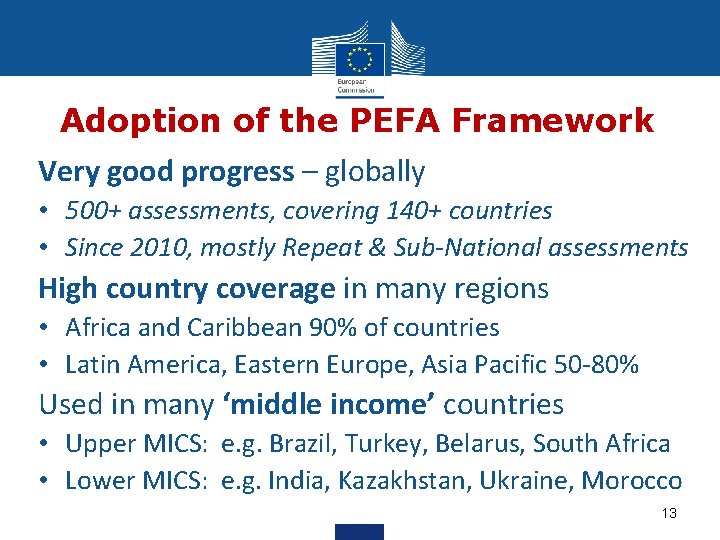
Adoption of the PEFA Framework Very good progress – globally • 500+ assessments, covering 140+ countries • Since 2010, mostly Repeat & Sub-National assessments High country coverage in many regions • Africa and Caribbean 90% of countries • Latin America, Eastern Europe, Asia Pacific 50 -80% Used in many ‘middle income’ countries • Upper MICS: e. g. Brazil, Turkey, Belarus, South Africa • Lower MICS: e. g. India, Kazakhstan, Ukraine, Morocco 13
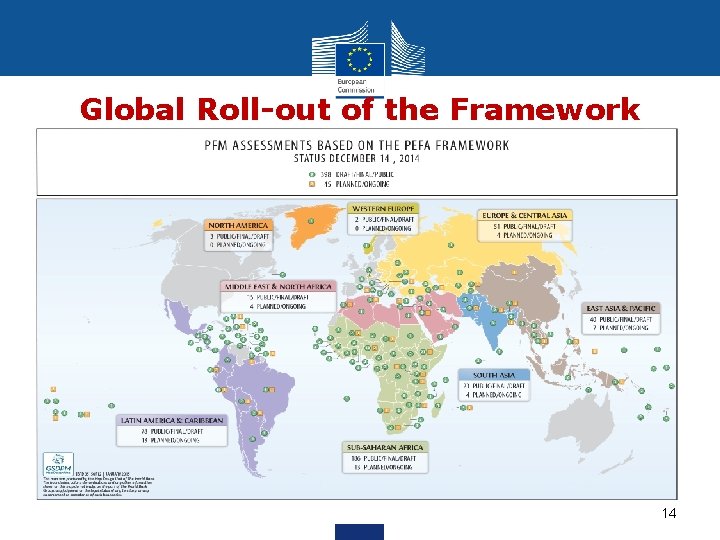
Global Roll-out of the Framework 14
Mounting an assessment Country focus and decision: • Application of the Framework is entirely decentralized to country level (if, when, how to use) • Financed by ‘Lead Agency’, often using consultants Inclusiveness: • All stakeholders can be involved any agency can, in principle, undertake any role in implementation; it does not ‘belong’ to any organization Supported by a neutral body: PEFA Secretariat – ‘guardian of the methodology’ 15
Stakeholder Involvement Government leadership/self-assessment • Active government participation in assessment is key to (later) use in reform policy dialogue, but caution…. • Increasing frequency of self-assessment with expert assistance & external validation – but still a minority, as full self-assessment demanding on govt capacity Development Agencies • 25 development banks & donor agencies involved (leading, financing or in reference group) • EU & World Bank have led 63% of all assessments • Increased frequency of partner inclusiveness 16
Content • Overview of the PEFA Program • Global Roll-out of the Framework • Upgrade 2016 & Quality Assurance • Support to users 17
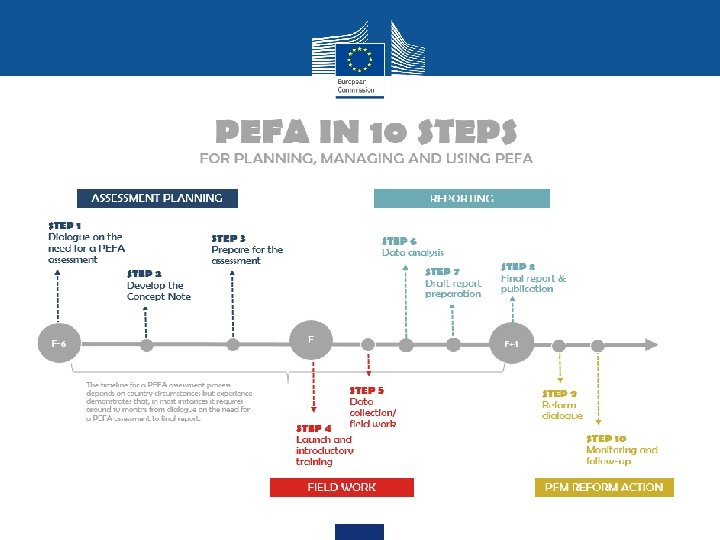
Upgrade 2016 • Comprehensive upgrade of the Framework • Guidance to users: • • • 10 Steps for planning, implementing and using PEFA Reporting performance changes in PEFA 2016 Aligning 2015 with PEGFA 2016 Concept note template Excel calculation spreadsheets for indicators • Strengthened Quality Assurance via “PEFA CHECK” • Respond to increasing need for & use of PEFA at Sub. National level through guidance & support capacity 18
Content • Overview of the PEFA Program • Global Roll-out of the Framework • Upgrade 2016 & Quality Assurance • Support to users 19
The PEFA Secretariat Neutral body: • Supports / advises any user of Framework – free of charge • Does not undertake or finance assessments, nor represent any particular interest • Exercises ‘Quality Assurance’ role, via “PEFA Check” • Provides ‘Guidance’ targeted at different users (in multiple languages): ‘Handbook’; aids for assessors; database of assessments; training materials – see website www. pefa. org: also 20
IN SUMMARY…. • PEFA initiative is a partnership, built on principles of ‘Strengthened Approach’ to supporting PFM Reform • Framework determines if a country has systems to deliver 3 main budgetary outcomes • Framework globally adopted: 500+ assessments in 144 countries • Upgraded Framework released in February 2016 21
Content • 1 Overview of the PEFA Program • 2 The Mechanics of the Framework 22
Content: 2 Framework Mechanics • The PEFA Framework • The high-level Indicator Set • Scoring Methodology • The PFM Performance Report • Guidance materials 23
Content • The PEFA Framework • The high-level Indicator Set • Scoring Methodology • The PFM Performance Report 24

The PEFA Framework • PFM Performance Measurement Framework • Better known as ‘the PEFA Framework’ [Blue Book] • The ‘flagship’ product of the PEFA Program • Launched in June 2005; revised 2011: Upgrade 2016 • Designed to measure performance of national PFM systems • Application to countries at different stages of development 25
Components of the Framework • A standard set of 31 high level indicators to assess performance against 7 ‘pillars’ of a country’s PFM system • A concise, integrated performance report developed to provide a narrative which analyses the implications of the indicator ratings for the three budgetary outcomes – goes beyond the scores 26
• • Focus of the Framework Focused on central government operations, but links to other parts of public sector (SNGs, PEs) to the extent these have implications for CG Applicable to SNGs, but specific guidelines Not for public business / state-owned enterprises, as different governance standards Sector level PFM assessment – not directly applicable 27
Content • The PEFA Framework • The high-level Indicator Set • Scoring Methodology • The PFM Performance Report 29
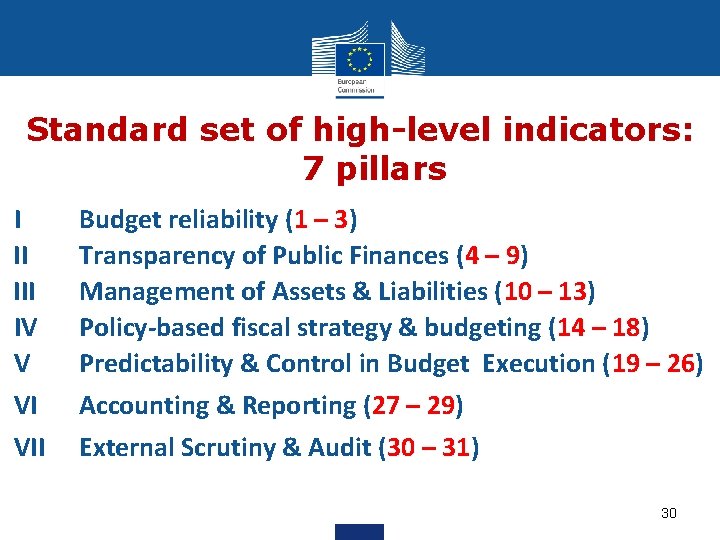
Standard set of high-level indicators: 7 pillars I II IV V VI Budget reliability (1 – 3) Transparency of Public Finances (4 – 9) Management of Assets & Liabilities (10 – 13) Policy-based fiscal strategy & budgeting (14 – 18) Predictability & Control in Budget Execution (19 – 26) Accounting & Reporting (27 – 29) VII External Scrutiny & Audit (30 – 31) 30
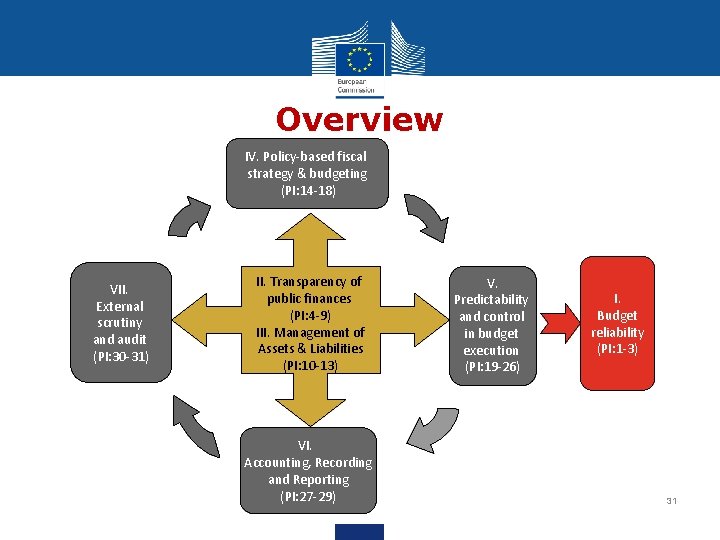
Overview IV. Policy-based fiscal strategy & budgeting (PI: 14 -18) VII. External scrutiny and audit (PI: 30 -31) II. Transparency of public finances (PI: 4 -9) III. Management of Assets & Liabilities (PI: 10 -13) VI. Accounting, Recording and Reporting (PI: 27 -29) V. Predictability and control in budget execution (PI: 19 -26) I. Budget reliability (PI: 1 -3) 31
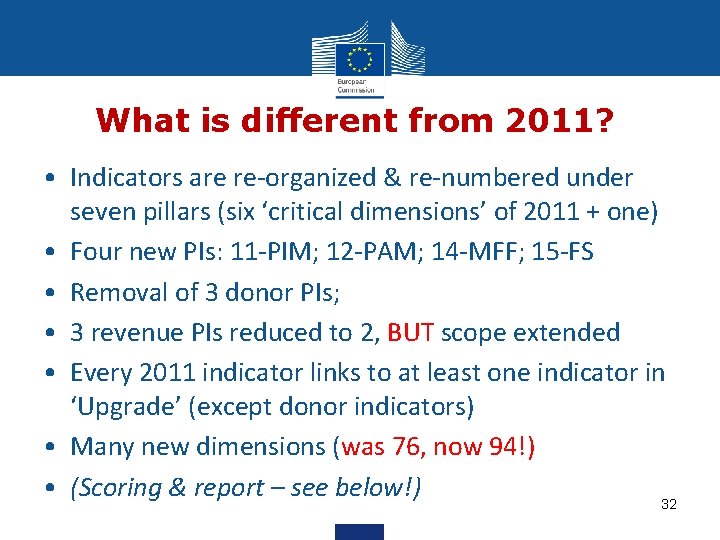
What is different from 2011? • Indicators are re-organized & re-numbered under seven pillars (six ‘critical dimensions’ of 2011 + one) • Four new PIs: 11 -PIM; 12 -PAM; 14 -MFF; 15 -FS • Removal of 3 donor PIs; • 3 revenue PIs reduced to 2, BUT scope extended • Every 2011 indicator links to at least one indicator in ‘Upgrade’ (except donor indicators) • Many new dimensions (was 76, now 94!) • (Scoring & report – see below!) 32
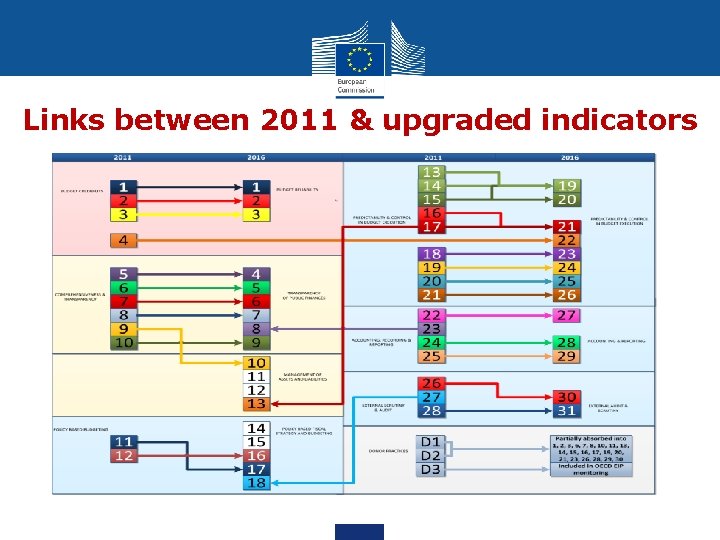
Links between 2011 & upgraded indicators
Interconnection of PIs – EG: Coverage of Internal Control Often inadequately covered, despite importance for: • • countries; to increase efficiency of expenditure & improve service delivery donors; to help manage risk of misuse of funds & to achieve development objectives Dedicated indicator PI-20 focuses on unique aspects of internal control not captured in other indicators, ie: 25. 1. Segregation of duties 25. 2. Effectiveness of expenditure commitment controls 25. 3. Compliance with payment rules and procedures Other indicators capture aspects of Internal control (but no ‘double jeopardy’!), & report section 4. 2 & Annex 2 34
Content • The PEFA Framework • The high-level Indicator Set • Scoring Methodology • The PFM Performance Report 35
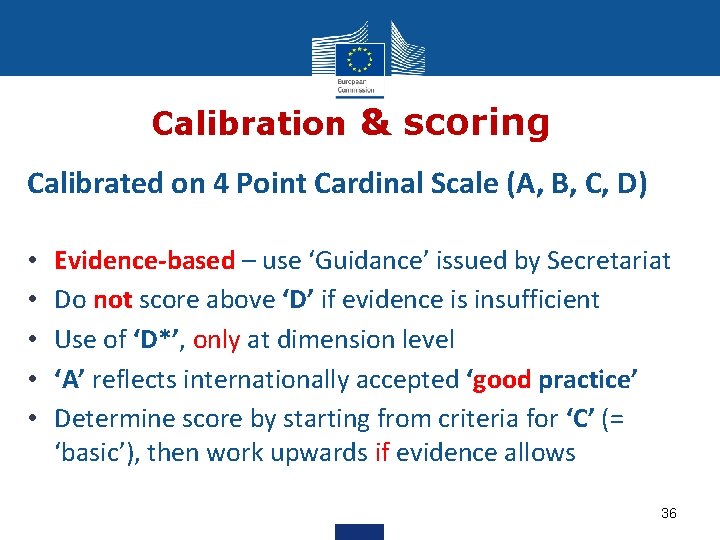
Calibration & scoring Calibrated on 4 Point Cardinal Scale (A, B, C, D) • • • Evidence-based – use ‘Guidance’ issued by Secretariat Do not score above ‘D’ if evidence is insufficient Use of ‘D*’, only at dimension level ‘A’ reflects internationally accepted ‘good practice’ Determine score by starting from criteria for ‘C’ (= ‘basic’), then work upwards if evidence allows 36
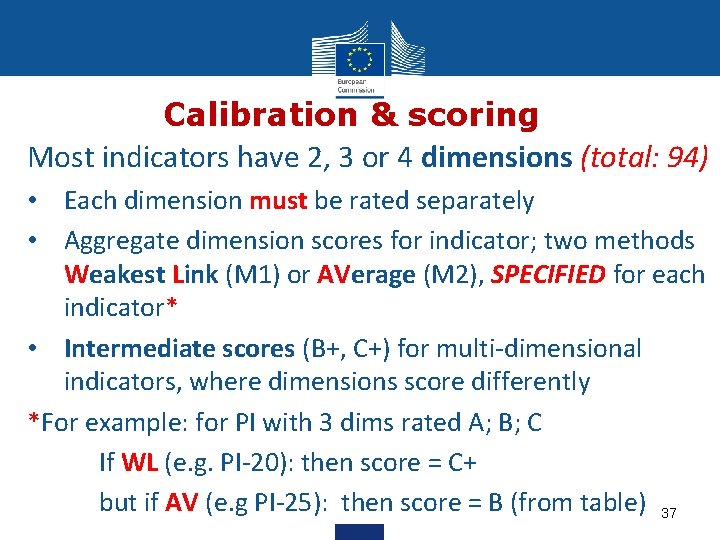
Calibration & scoring Most indicators have 2, 3 or 4 dimensions (total: 94) • Each dimension must be rated separately • Aggregate dimension scores for indicator; two methods Weakest Link (M 1) or AVerage (M 2), SPECIFIED for each indicator* • Intermediate scores (B+, C+) for multi-dimensional indicators, where dimensions score differently *For example: for PI with 3 dims rated A; B; C If WL (e. g. PI-20): then score = C+ but if AV (e. g PI-25): then score = B (from table) 37
Content • The PEFA Framework • The high-level Indicator Set • Scoring Methodology • The PFM Performance Report 38
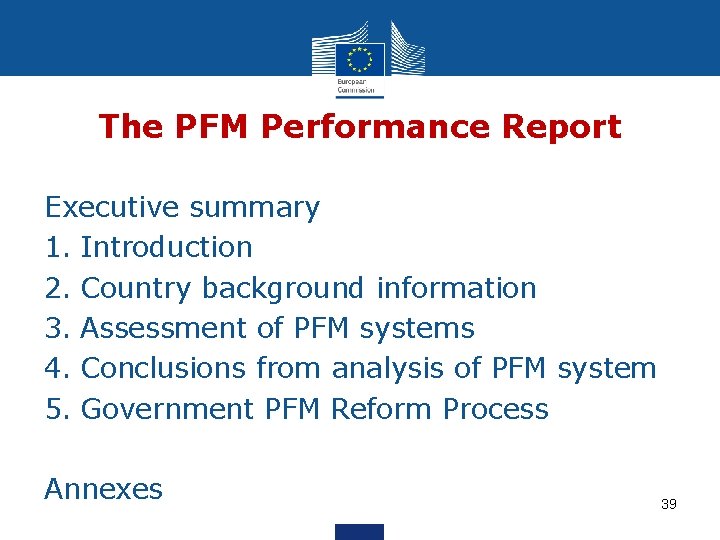
The PFM Performance Report Executive summary 1. Introduction 2. Country background information 3. Assessment of PFM systems 4. Conclusions from analysis of PFM system 5. Government PFM Reform Process Annexes 39
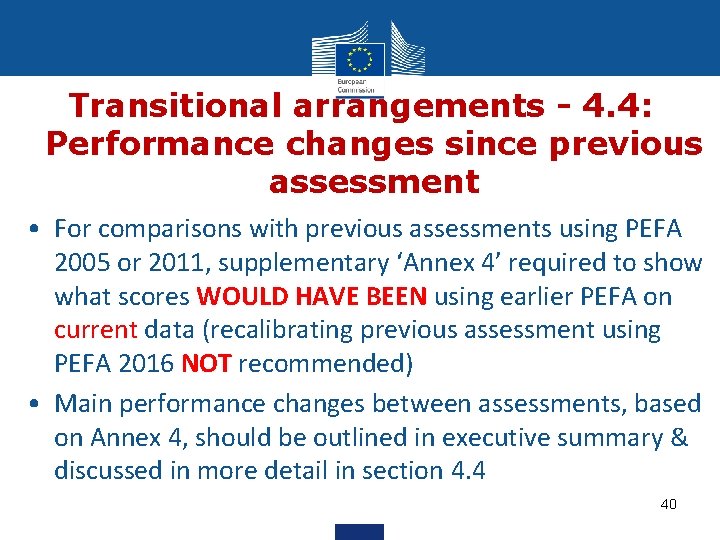
Transitional arrangements - 4. 4: Performance changes since previous assessment • For comparisons with previous assessments using PEFA 2005 or 2011, supplementary ‘Annex 4’ required to show what scores WOULD HAVE BEEN using earlier PEFA on current data (recalibrating previous assessment using PEFA 2016 NOT recommended) • Main performance changes between assessments, based on Annex 4, should be outlined in executive summary & discussed in more detail in section 4. 4 40
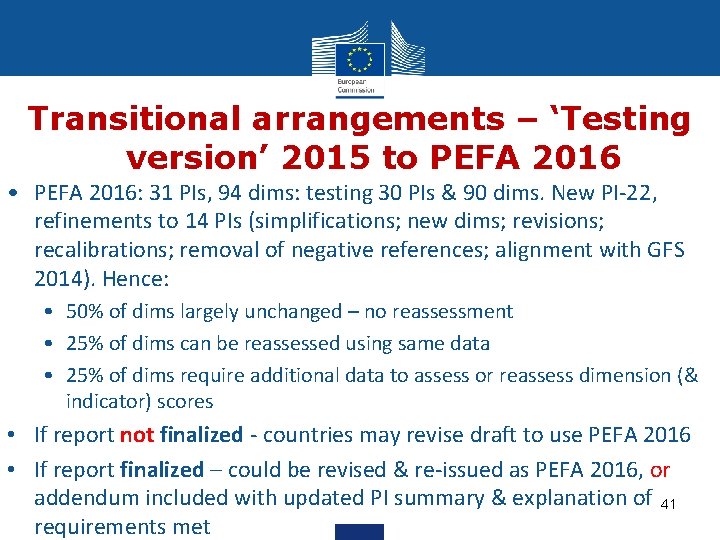
Transitional arrangements – ‘Testing version’ 2015 to PEFA 2016 • PEFA 2016: 31 PIs, 94 dims: testing 30 PIs & 90 dims. New PI-22, refinements to 14 PIs (simplifications; new dims; revisions; recalibrations; removal of negative references; alignment with GFS 2014). Hence: • 50% of dims largely unchanged – no reassessment • 25% of dims can be reassessed using same data • 25% of dims require additional data to assess or reassess dimension (& indicator) scores • If report not finalized - countries may revise draft to use PEFA 2016 • If report finalized – could be revised & re-issued as PEFA 2016, or addendum included with updated PI summary & explanation of 41 requirements met
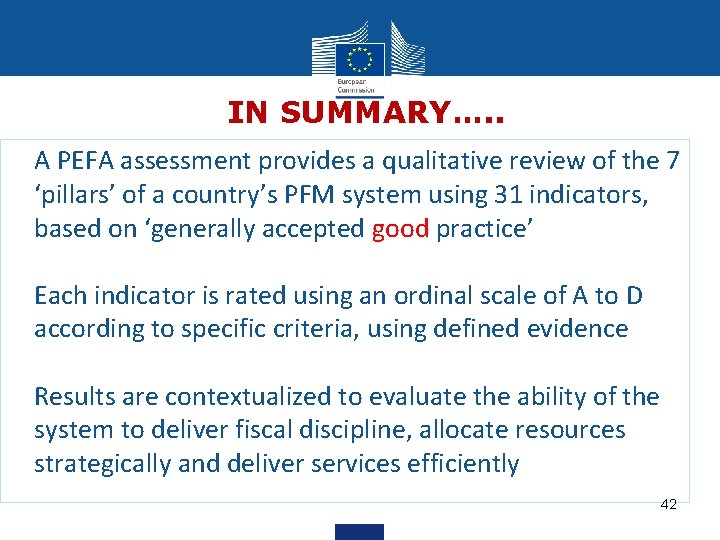
IN SUMMARY…. . • A PEFA assessment provides a qualitative review of the 7 ‘pillars’ of a country’s PFM system using 31 indicators, based on ‘generally accepted good practice’ • Each indicator is rated using an ordinal scale of A to D according to specific criteria, using defined evidence • Results are contextualized to evaluate the ability of the system to deliver fiscal discipline, allocate resources strategically and deliver services efficiently 42

Thank you for your attention: Questions?
- Slides: 43