
PeertoPeer File Sharing Jennifer Rexford COS 461 Computer
- Slides: 35
Peer-to-Peer File Sharing Jennifer Rexford COS 461: Computer Networks Lectures: MW 10 -10: 50 am in Architecture N 101 http: //www. cs. princeton. edu/courses/archive/spr 12/cos 461/
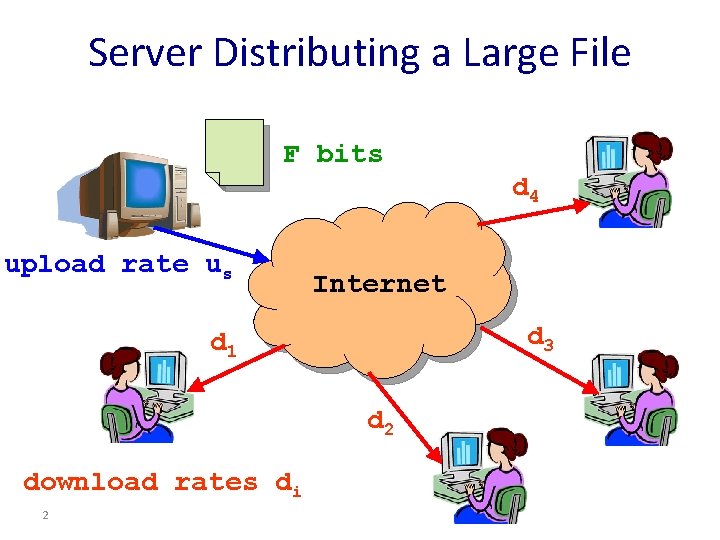
Server Distributing a Large File F bits d 4 upload rate us Internet d 3 d 1 d 2 download rates di 2
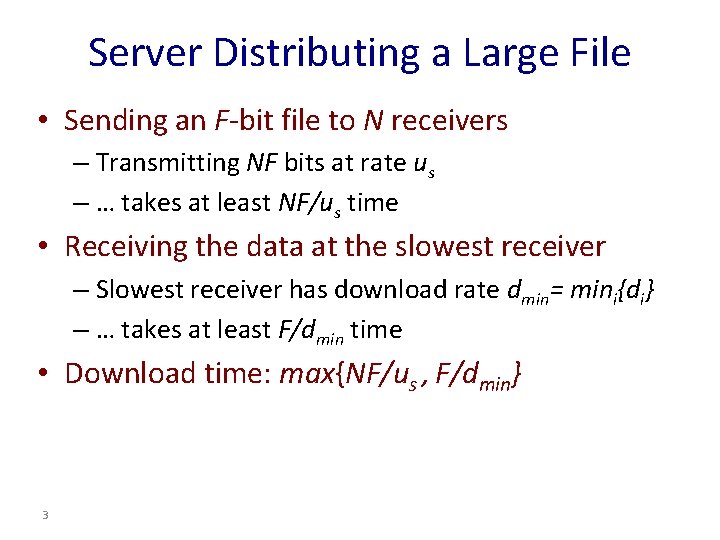
Server Distributing a Large File • Sending an F-bit file to N receivers – Transmitting NF bits at rate us – … takes at least NF/us time • Receiving the data at the slowest receiver – Slowest receiver has download rate dmin= mini{di} – … takes at least F/dmin time • Download time: max{NF/us , F/dmin} 3
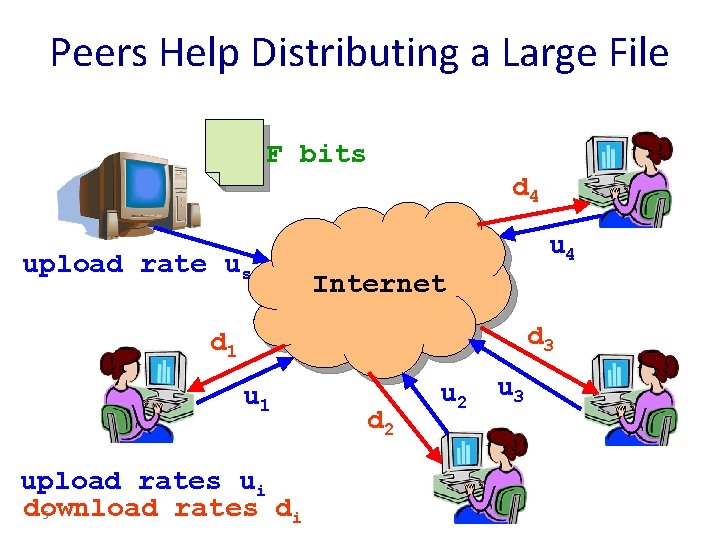
Speeding Up the File Distribution • Increase the server upload rate – Higher link bandwidth at the server – Multiple servers, each with their own link • Alternative: have the receivers help – Receivers get a copy of the data – … and redistribute to other receivers – To reduce the burden on the server 4
Peers Help Distributing a Large File F bits d 4 upload rate us u 4 Internet d 3 d 1 upload rates ui download rates di 5 d 2 u 3
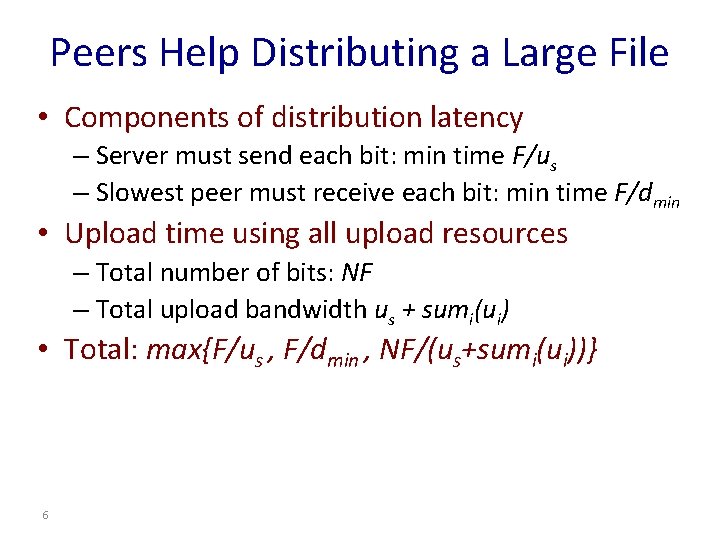
Peers Help Distributing a Large File • Components of distribution latency – Server must send each bit: min time F/us – Slowest peer must receive each bit: min time F/dmin • Upload time using all upload resources – Total number of bits: NF – Total upload bandwidth us + sumi(ui) • Total: max{F/us , F/dmin , NF/(us+sumi(ui))} 6
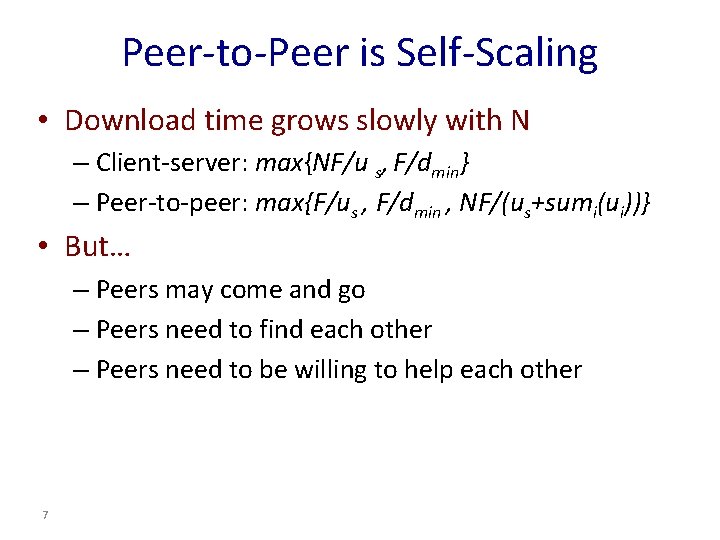
Peer-to-Peer is Self-Scaling • Download time grows slowly with N – Client-server: max{NF/u s, F/dmin} – Peer-to-peer: max{F/us , F/dmin , NF/(us+sumi(ui))} • But… – Peers may come and go – Peers need to find each other – Peers need to be willing to help each other 7
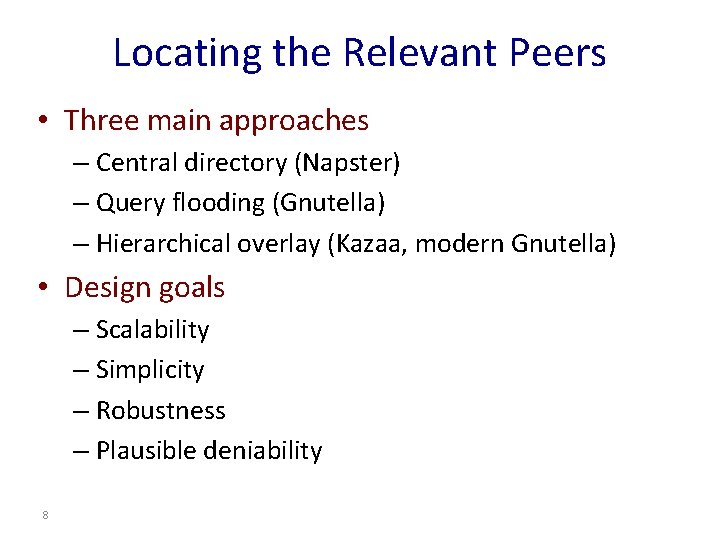
Locating the Relevant Peers • Three main approaches – Central directory (Napster) – Query flooding (Gnutella) – Hierarchical overlay (Kazaa, modern Gnutella) • Design goals – Scalability – Simplicity – Robustness – Plausible deniability 8
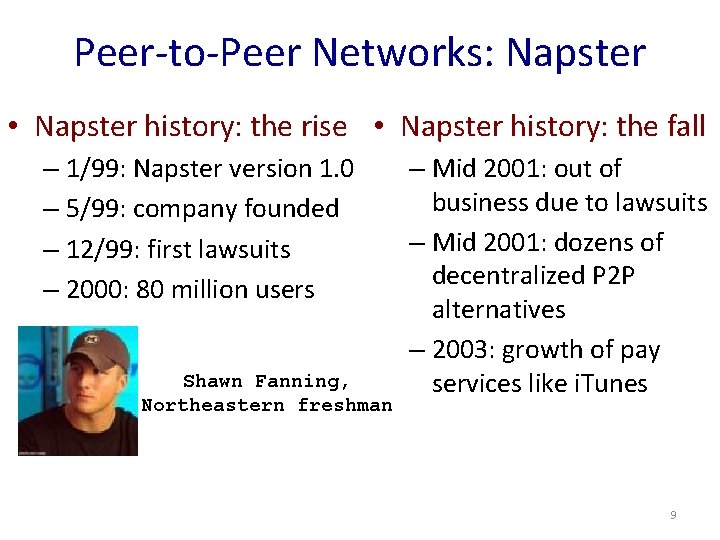
Peer-to-Peer Networks: Napster • Napster history: the rise • Napster history: the fall – 1/99: Napster version 1. 0 – 5/99: company founded – 12/99: first lawsuits – 2000: 80 million users Shawn Fanning, Northeastern freshman – Mid 2001: out of business due to lawsuits – Mid 2001: dozens of decentralized P 2 P alternatives – 2003: growth of pay services like i. Tunes 9
Napster Directory Service • Client contacts Napster (via TCP) – Provides a list of music files it will share – … and Napster’s central server updates the directory • Client searches on a title or performer – Napster identifies online clients with the file – … and provides their IP addresses • Client requests the file from the chosen supplier – Supplier transmits the file to the client – Both client and supplier report status to Napster 10
Napster Properties • Server’s directory continually updated – Always know what music is currently available – Point of vulnerability for legal action • Peer-to-peer file transfer – No load on the server – Plausible deniability for legal action (but not enough) • Bandwidth – Suppliers ranked by apparent bandwidth and response time 11
Napster: Limitations of Directory • Single point of failure • Performance bottleneck • Copyright infringement File transfer is decentralized, but locating content is highly centralized • So, later P 2 P systems were more distributed – Gnutella went to the other extreme… 12
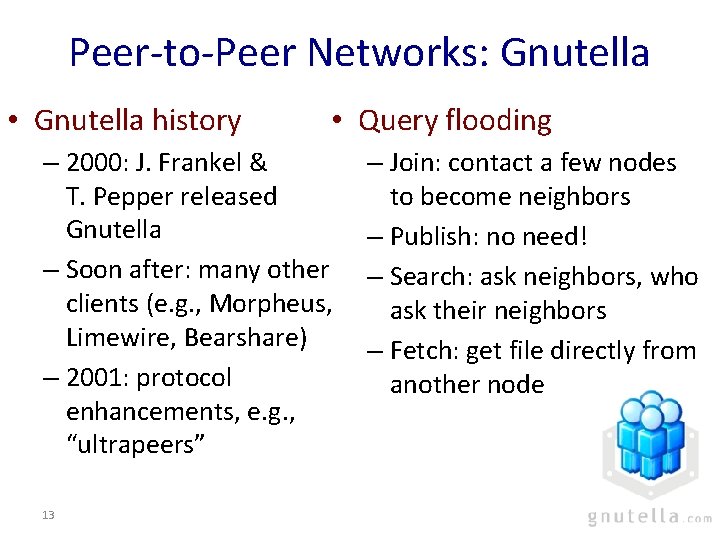
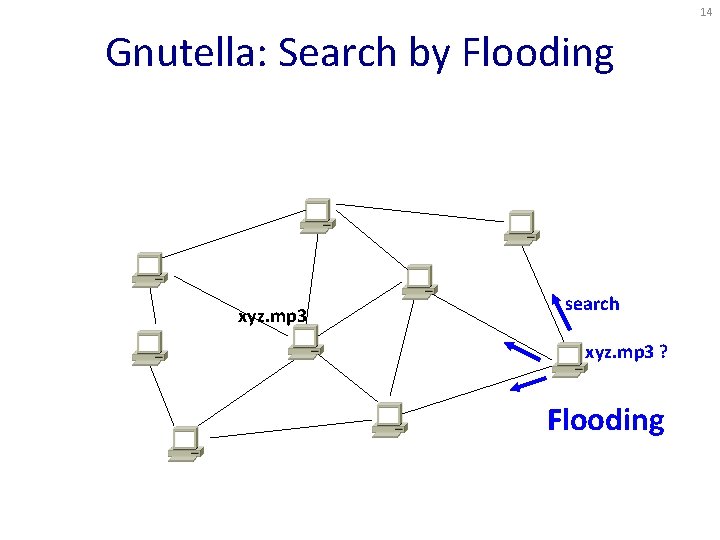
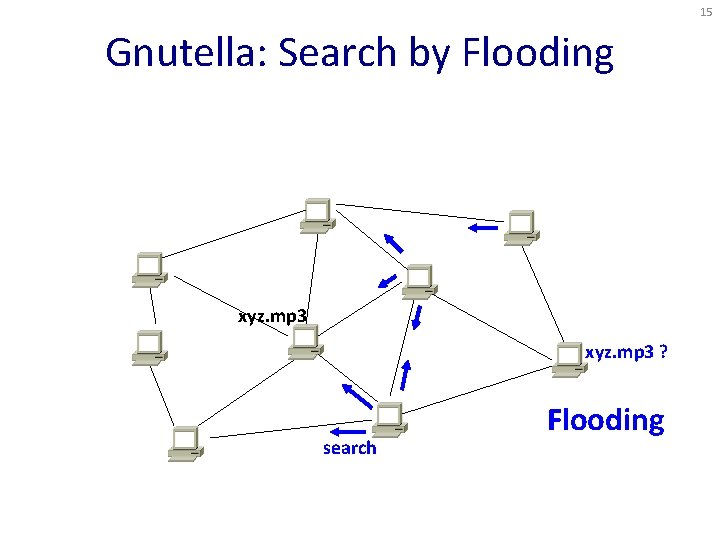
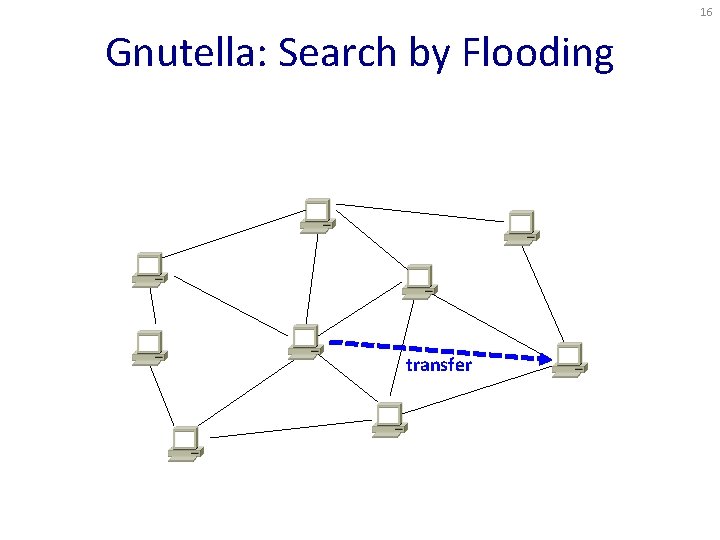
Peer-to-Peer Networks: Gnutella • Gnutella history • Query flooding – 2000: J. Frankel & T. Pepper released Gnutella – Soon after: many other clients (e. g. , Morpheus, Limewire, Bearshare) – 2001: protocol enhancements, e. g. , “ultrapeers” 13 – Join: contact a few nodes to become neighbors – Publish: no need! – Search: ask neighbors, who ask their neighbors – Fetch: get file directly from another node
14 Gnutella: Search by Flooding xyz. mp 3 search xyz. mp 3 ? Flooding
15 Gnutella: Search by Flooding xyz. mp 3 ? search Flooding
16 Gnutella: Search by Flooding transfer
Gnutella: Pros and Cons • Advantages – Fully decentralized – Search cost distributed – Processing per node permits powerful search semantics • Disadvantages – Search scope may be quite large – Search time may be quite long – High overhead, and nodes come and go often 17
Peer-to-Peer Networks: Ka. Az. A • Ka. Za. A history • Super-node hierarchy – 2001: created by Dutch company (Kazaa BV) – Single network called Fast. Track used by other clients as well – Eventually protocol changed so others could no longer use it 18 – Join: on start, the client contacts a super-node – Publish: client sends list of files to its super-node – Search: queries flooded among super-nodes – Fetch: get file directly from one or more peers
Ka. Za. A: Motivation for Super-Nodes • Query consolidation – Many connected nodes may have only a few files – Propagating query to a sub-node may take more time than for the super-node to answer itself • Stability – Super-node selection favors nodes with high up-time – How long you’ve been on is a good predictor of how long you’ll be around in the future 19
Peer-to-Peer Networks: Bit. Torrent • Bit. Torrent history – 2002: B. Cohen debuted Bit. Torrent • Emphasis on efficient fetching, not searching – Distribute same file to many peers – Single publisher, many downloaders • Preventing free-loading – Incentives for peers to contribute 20
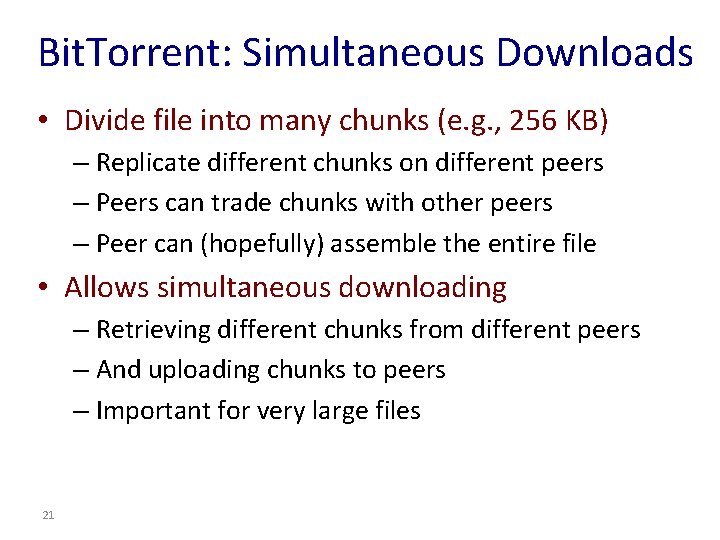
Bit. Torrent: Simultaneous Downloads • Divide file into many chunks (e. g. , 256 KB) – Replicate different chunks on different peers – Peers can trade chunks with other peers – Peer can (hopefully) assemble the entire file • Allows simultaneous downloading – Retrieving different chunks from different peers – And uploading chunks to peers – Important for very large files 21
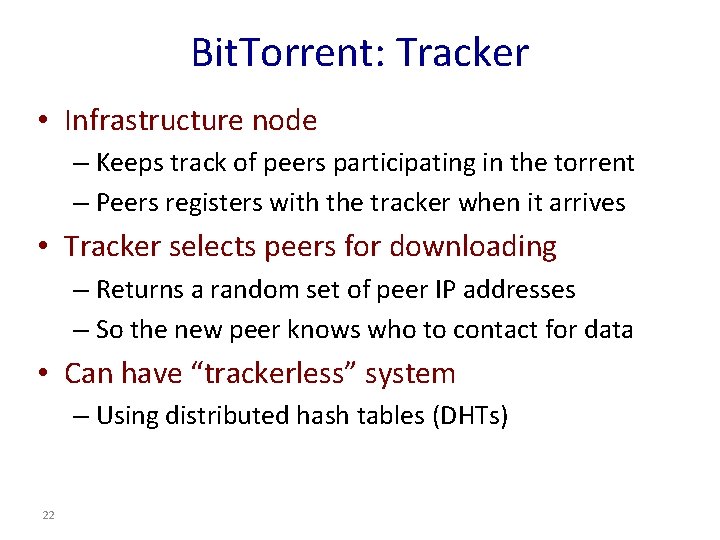
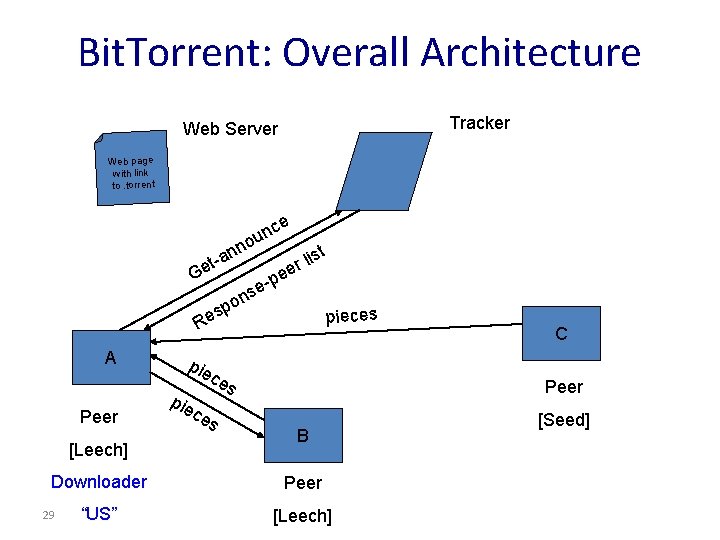
Bit. Torrent: Tracker • Infrastructure node – Keeps track of peers participating in the torrent – Peers registers with the tracker when it arrives • Tracker selects peers for downloading – Returns a random set of peer IP addresses – So the new peer knows who to contact for data • Can have “trackerless” system – Using distributed hash tables (DHTs) 22
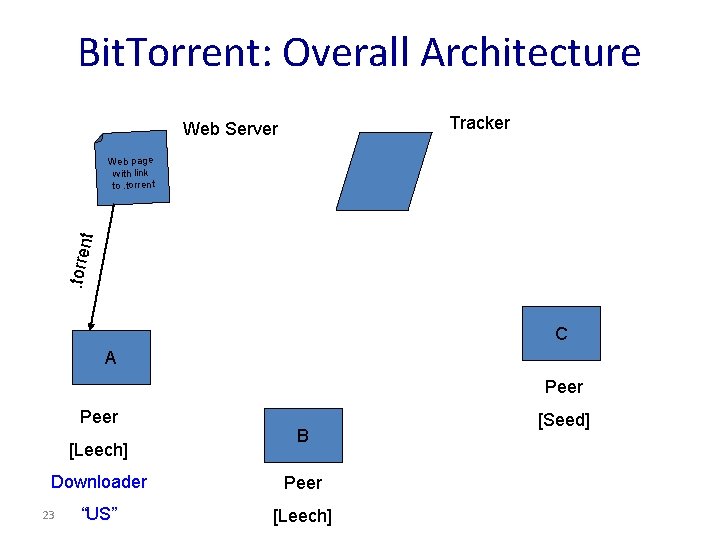
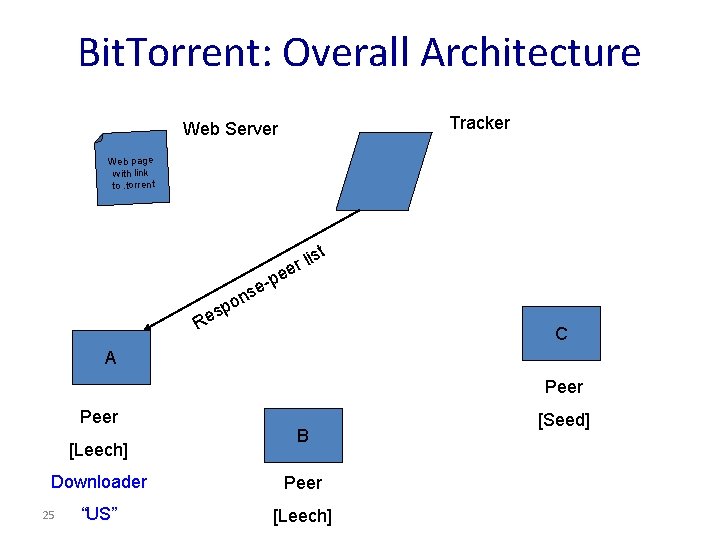
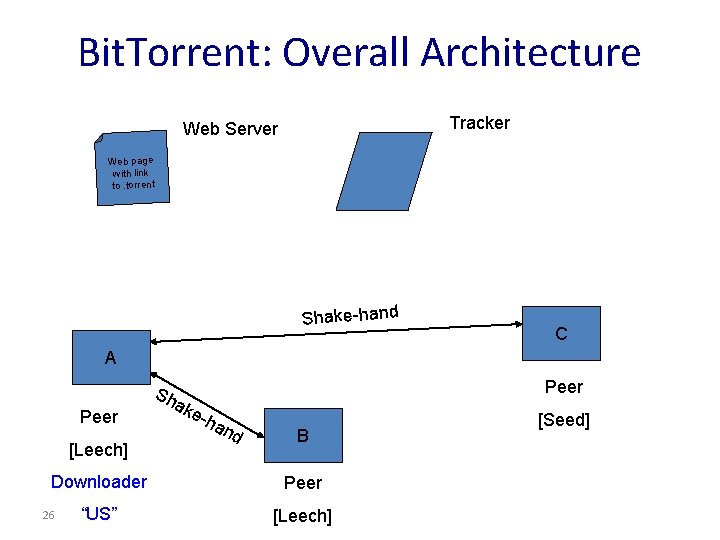
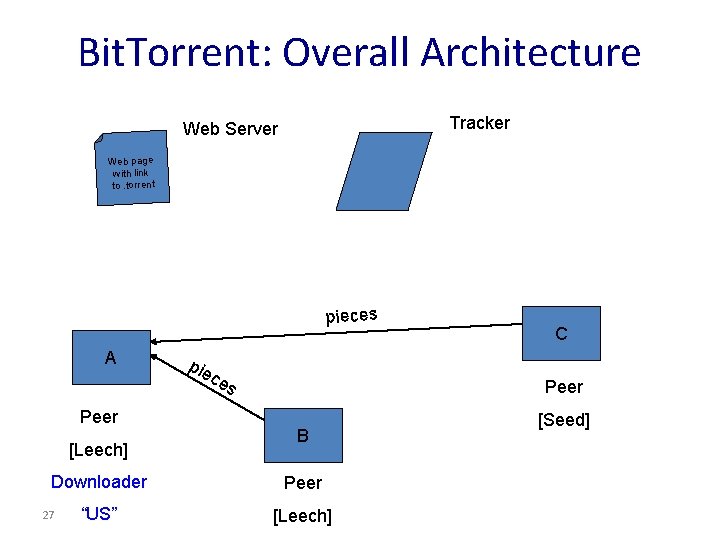
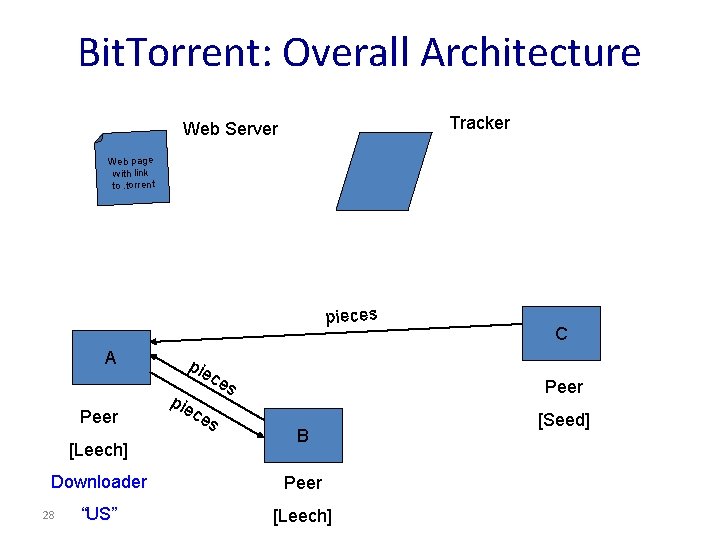
Bit. Torrent: Overall Architecture Tracker Web Server . torre nt Web page with link to. torrent C A Peer [Leech] B Downloader Peer “US” [Leech] 23 [Seed]
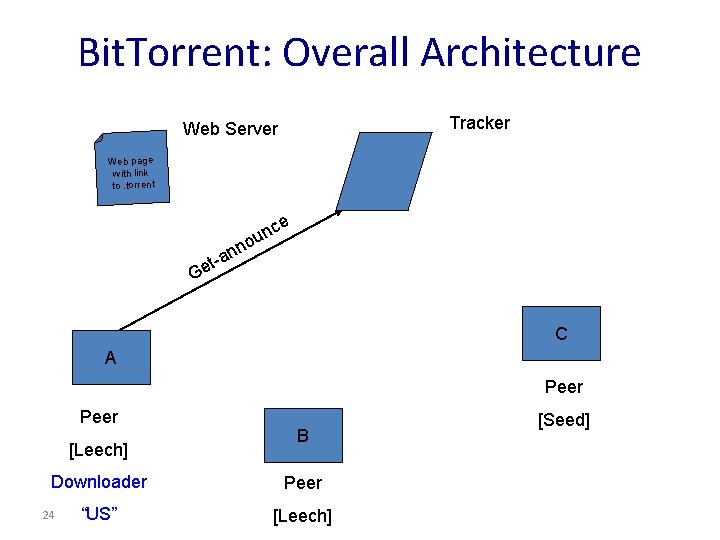
Bit. Torrent: Overall Architecture Tracker Web Server Web page with link to. torrent ce un o n n a et- G C A Peer [Leech] B Downloader Peer “US” [Leech] 24 [Seed]
Bit. Torrent: Overall Architecture Tracker Web Server Web page with link to. torrent st -p e ns o sp e R li r ee C A Peer [Leech] B Downloader Peer “US” [Leech] 25 [Seed]
Bit. Torrent: Overall Architecture Tracker Web Server Web page with link to. torrent Shake-hand C A Peer [Leech] Peer Sh ak e-h an d B Downloader Peer “US” [Leech] 26 [Seed]
Bit. Torrent: Overall Architecture Tracker Web Server Web page with link to. torrent pieces A Peer [Leech] pie ce s Peer B Downloader Peer “US” [Leech] 27 C [Seed]
Bit. Torrent: Overall Architecture Tracker Web Server Web page with link to. torrent pieces A Peer [Leech] pie c ce s es Peer B Downloader Peer “US” [Leech] 28 C [Seed]
Bit. Torrent: Overall Architecture Tracker Web Server Web page with link to. torrent e nc u no n ist a l t r ee Ge p se n o sp e pieces R A Peer [Leech] pie c ce s es Peer B Downloader Peer “US” [Leech] 29 C [Seed]
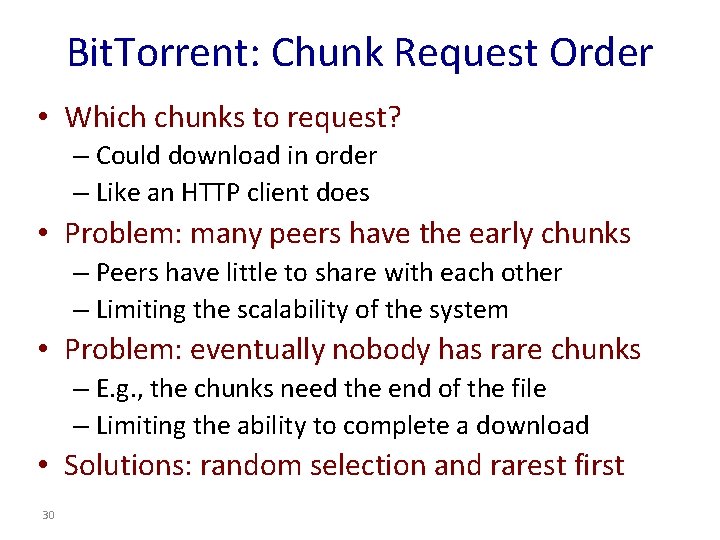
Bit. Torrent: Chunk Request Order • Which chunks to request? – Could download in order – Like an HTTP client does • Problem: many peers have the early chunks – Peers have little to share with each other – Limiting the scalability of the system • Problem: eventually nobody has rare chunks – E. g. , the chunks need the end of the file – Limiting the ability to complete a download • Solutions: random selection and rarest first 30
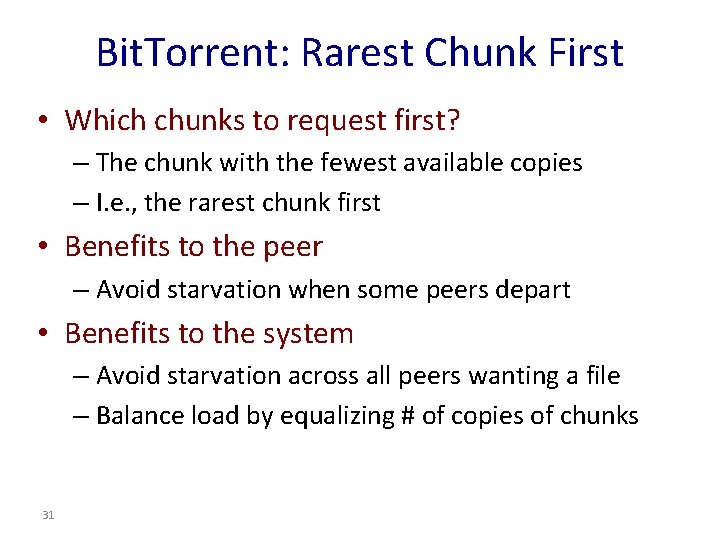
Bit. Torrent: Rarest Chunk First • Which chunks to request first? – The chunk with the fewest available copies – I. e. , the rarest chunk first • Benefits to the peer – Avoid starvation when some peers depart • Benefits to the system – Avoid starvation across all peers wanting a file – Balance load by equalizing # of copies of chunks 31
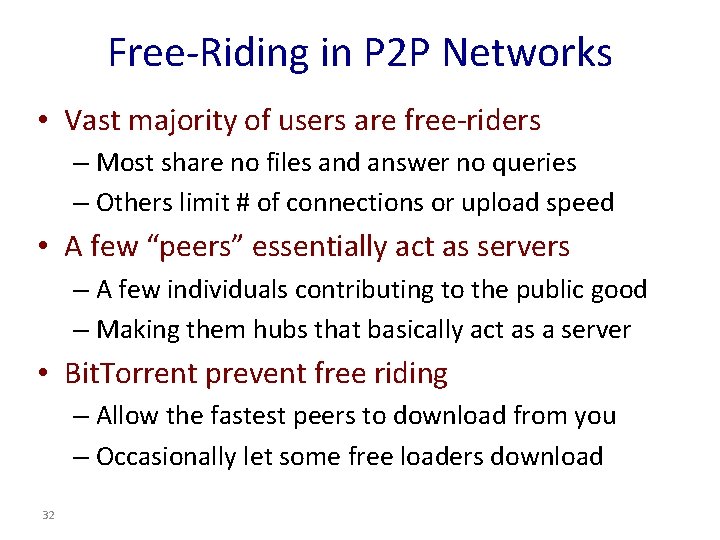
Free-Riding in P 2 P Networks • Vast majority of users are free-riders – Most share no files and answer no queries – Others limit # of connections or upload speed • A few “peers” essentially act as servers – A few individuals contributing to the public good – Making them hubs that basically act as a server • Bit. Torrent prevent free riding – Allow the fastest peers to download from you – Occasionally let some free loaders download 32
Bit-Torrent: Preventing Free-Riding • Peer has limited upload bandwidth – And must share it among multiple peers – Tit-for-tat: favor neighbors uploading at highest rate • Rewarding the top four neighbors – Measure download bit rates from each neighbor – Reciprocate by sending to the top four peers • Optimistic unchoking – Randomly try a new neighbor every 30 seconds – So new neighbor has a chance to be a better partner 33
Bit. Tyrant: Gaming Bit. Torrent • Bit. Torrent can be gamed, too – Peer uploads to top N peers at rate 1/N – E. g. , if N=4 and peers upload at 15, 12, 10, 9, 8, 3 – … peer uploading at rate 9 gets treated quite well • Best to be the Nth peer in the list, rather than 1 st – Offer just a bit more bandwidth than low-rate peers – And you’ll still be treated well by others • Bit. Tyrant software 34 – Uploads at higher rates to higher-bandwidth peers – http: //bittyrant. cs. washington. edu/
Conclusions • Finding the appropriate peers – Centralized directory (Napster) – Query flooding (Gnutella) – Super-nodes (Ka. Za. A) • Bit. Torrent – Distributed download of large files – Anti-free-riding techniques • Great example of how change can happen so quickly in application-level protocols 35