
PeertoPeer Data Management COMP 3211 Advanced Databases Dr

Peer-to-Peer Data Management COMP 3211 Advanced Databases Dr Nicholas Gibbins – nmg@ecs. soton. ac. uk 2014 -2015
Peer-to-Peer Characteristics Autonomy Query Expressiveness Efficiency Quality of Service Fault-Tolerance Security 2
Peer-to-Peer Characteristics Autonomy Query Expressiveness Efficiency Quality of Service • Peers may join or leave at any time without restriction • Peers control the data they store • Peers control which other peers store their data Fault-Tolerance Security 3
Peer-to-Peer Characteristics Autonomy Query Expressiveness Efficiency Quality of Service • User may describe desired data at appropriate level of detail - Key lookup - Keyword search with ranking - Structured queries Fault-Tolerance Security 4
Peer-to-Peer Characteristics Autonomy • Efficient use of resources Query Expressiveness - Lower cost Efficiency - Higher throughput Quality of Service Fault-Tolerance Security 5
Peer-to-Peer Characteristics Autonomy • User-perceived: Query Expressiveness - Completeness of results Efficiency - Data consistency Quality of Service Fault-Tolerance - Data availability - Query response time Security 6
Peer-to-Peer Characteristics Autonomy Query Expressiveness Efficiency • Efficiency and quality maintained despite peer failures • Requires replication Quality of Service Fault-Tolerance Security 7
Peer-to-Peer Characteristics Autonomy • Cannot rely on trusted servers! Query Expressiveness • Access controls Efficiency Quality of Service Fault-Tolerance Security 8
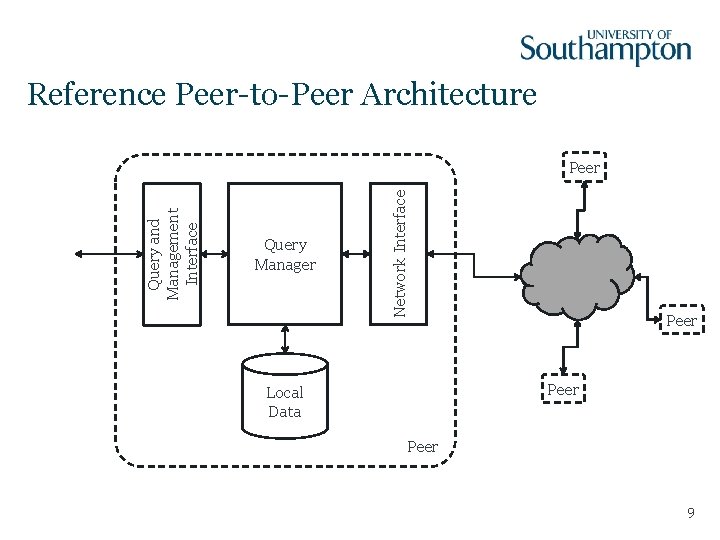
Reference Peer-to-Peer Architecture Query Manager Network Interface Query and Management Interface Peer Local Data Peer 9
Data Management Issues Data Location: peers must be able to refer to and locate data stored by other peers Query Processing: given a query, discover peers that contribute relevant data and efficiently execute the query Data Integration: access data despite heterogeneous schemas Data Consistency: maintain consistency on duplicate data when replicating or caching 10
Overlay Networks Peers connect to each other via an overlay network – Usually has different topology to underlying physical network – Concentrate on optimising communication overlay network Two common distinctions: – Pure versus hybrid – Structured versus unstructured 11
Pure versus Hybrid Networks Pure Overlay Network – No differentiation between peers – all are considered equal Hybrid Overlay Network – Some peers are given special tasks to perform – Also referred to as super-peer systems 12
Structured versus Unstructured Networks Unstructured Overlay Network – Peers may communicate directly with any of their neighbours – Peers may join network by attaching to any other peer Structured Overlay Network – Tightly controlled topology and message routing – Peers may only communicate with certain other peers – Peers may only join the network in certain places 13
Unstructured Peer-to-Peer Networks Overlay network constructed in an ad hoc manner Data placement is unrelated to overlay topology Examples: – Gnutella, Freenet, Bit. Torrent, Kazaa Fundamental issue of index management: – Which peers hold which resources? – Centralised versus distributed 14
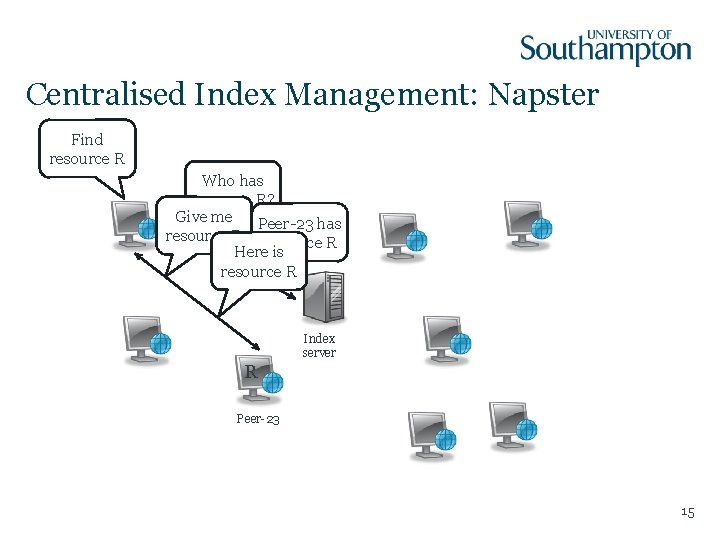
Centralised Index Management: Napster Find resource R Who has resource R? Give me Peer-23 has resource R Here is resource R Index server R Peer-23 15
Centralised Index Management P 2 P networks with centralised indexes are hybrid networks – Specialised peer for handling index – Not all peers are equal Centralised indexes are problematic – Central point of failure (kill the index, kill the network) – Bottleneck (limits throughput) 16
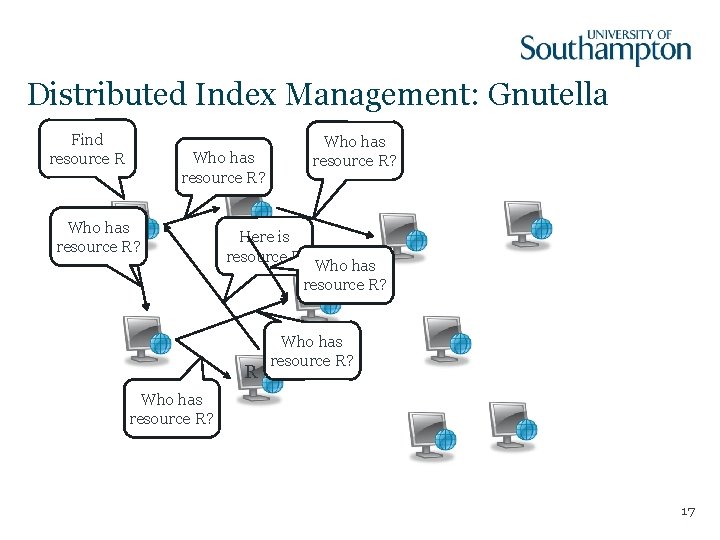
Distributed Index Management: Gnutella Find resource R Who has resource R? Here is resource R R Who has resource R? 17
Distributed Index Management Search neighbour using flooding or gossiping • Flooding – Each peer sends the request to all of its neighbours – Not scalable – heavy demands on network resources – Time-to-live (maximum number of hops) on messages • Gossiping – Each peer knows all other peers in network – Chooses one peer to pass on request – Request eventually propagated to all nodes 18
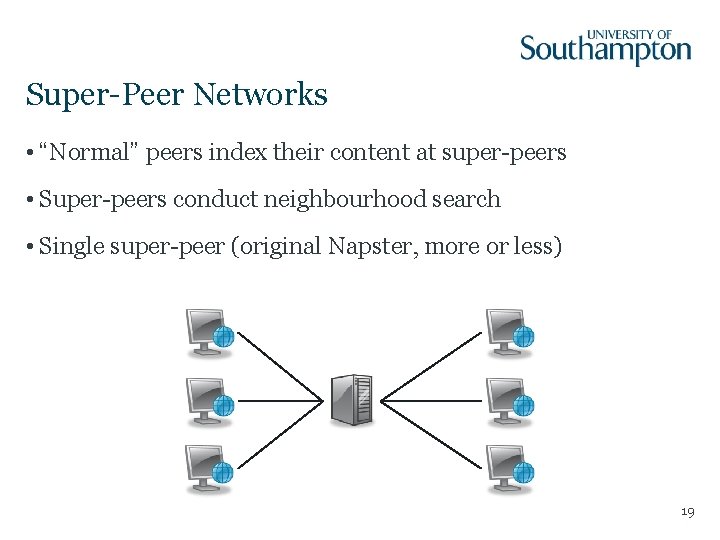
Super-Peer Networks • “Normal” peers index their content at super-peers • Super-peers conduct neighbourhood search • Single super-peer (original Napster, more or less) 19
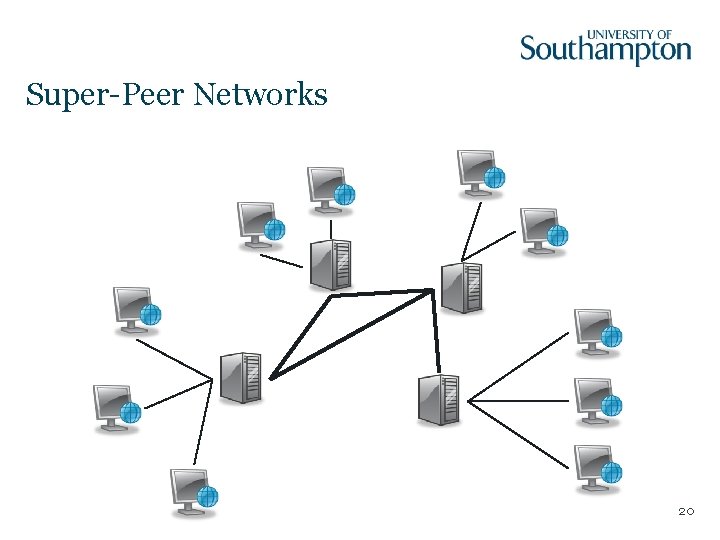
Super-Peer Networks 20
Structured Peer-to-Peer Networks Address scalability shortcomings of unstructured networks Distributed Hash Tables are most popular approach Range of applications: – Peer-to-peer file sharing – Content distribution networks – Distributed file systems 21
Distributed Hash Tables Provides a lookup service similar to a hash table – put(key, resource) – get(key) → resource Hash of resource key used to locate peer holding that resource Routing protocol used to locate target peer (requires that peers share routing information between themselves) Several approaches, based on different routing geometries: – Ring, hypercube, tree 22
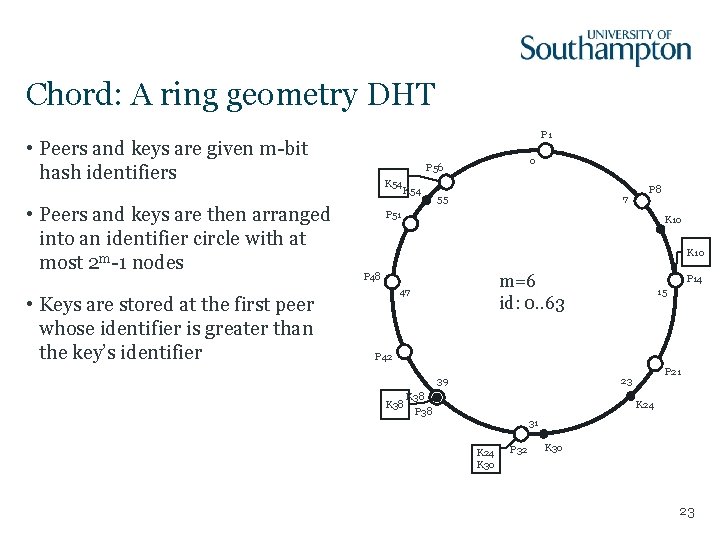
Chord: A ring geometry DHT P 1 • Peers and keys are given m-bit hash identifiers • Peers and keys are then arranged into an identifier circle with at most 2 m-1 nodes • Keys are stored at the first peer whose identifier is greater than the key’s identifier 0 P 56 K 54 55 7 P 8 P 51 K 10 m=6 id: 0. . 63 P 48 47 P 14 15 P 42 39 K 38 P 21 23 K 38 P 38 K 24 31 K 24 K 30 P 32 K 30 23
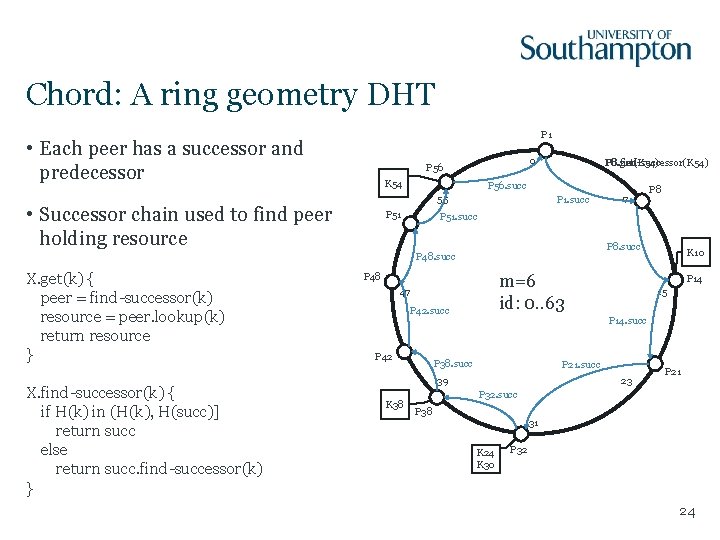
Chord: A ring geometry DHT P 1 • Each peer has a successor and predecessor 0 P 56 K 54 P 56. succ 55 • Successor chain used to find peer holding resource P 8. find-successor(K 54) P 8. get(K 54) P 51 P 1. succ X. find-successor(k) { if H(k) in (H(k), H(succ)] return succ else return succ. find-successor(k) } P 8. succ m=6 id: 0. . 63 P 48 47 P 42. succ P 42 K 10 P 14 15 P 14. succ P 38. succ P 21. succ 39 K 38 P 51. succ P 48. succ X. get(k) { peer = find-successor(k) resource = peer. lookup(k) return resource } 7 23 P 21 P 32. succ P 38 31 K 24 K 30 P 32 24
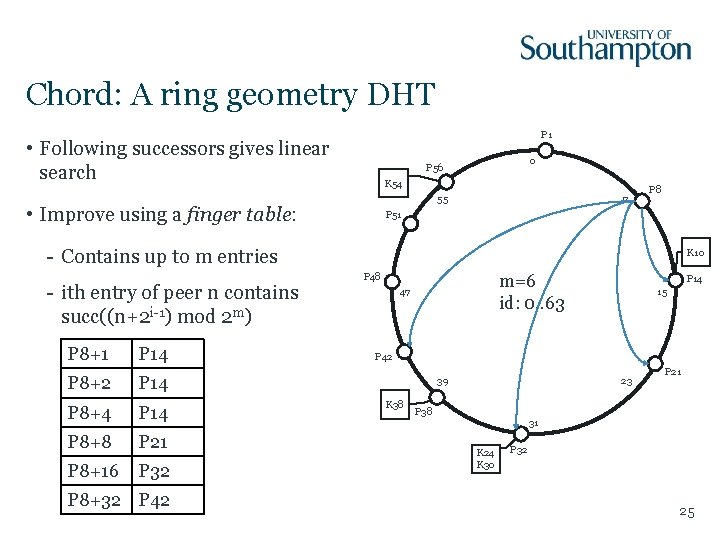
Chord: A ring geometry DHT P 1 • Following successors gives linear search 0 P 56 K 54 55 • Improve using a finger table: 7 P 8 P 51 - Contains up to m entries - ith entry of peer n contains succ((n+2 i-1) mod 2 m) P 8+1 P 14 P 8+2 P 14 P 8+4 P 14 P 8+8 P 21 P 8+16 P 32 P 8+32 P 42 K 10 m=6 id: 0. . 63 P 48 47 P 14 15 P 42 39 K 38 23 P 21 P 38 31 K 24 K 30 P 32 25
Join Queries in DHTs Assume a binary join Q = R � S • Tuples of R and S are distributed across peers in system • HR, HS are the sets of peers storing tuples of R, S • Hres is the set of peers storing the output relation Example algorithm: PIERjoin – Three phases: Multicast, Hash, Probe/Join 26
PIERjoin Multicast Phase – Multicast Q to all peers in HR, HS Hash Phase – Each peer receiving Q scans its local tuples – Any tuples that match the predicate are sent to peers in Hres using put() Probe/Join – Each peer in Hres inserts the new tuples into its local tuples, probes the other members to find matching tuples and constructs the joined tuples 27
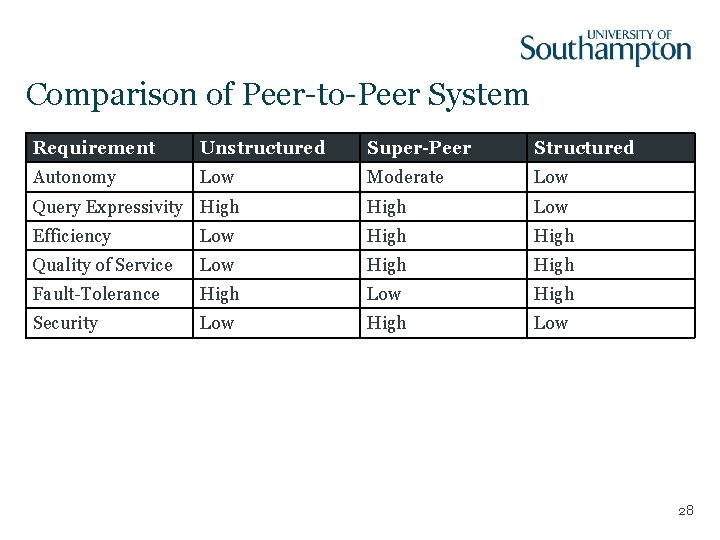
Comparison of Peer-to-Peer System Requirement Unstructured Super-Peer Structured Autonomy Low Moderate Low Query Expressivity High Low Efficiency Low High Quality of Service Low High Fault-Tolerance High Low High Security Low High Low 28
- Slides: 28