
Peer Review whats in it for me Dr

- Slides: 17
Peer Review– what’s in it for me? Dr Helen Barefoot Deputy Director of the Learning and Teaching Innovation Centre h. barefoot@herts. ac. uk @helenbarefoot
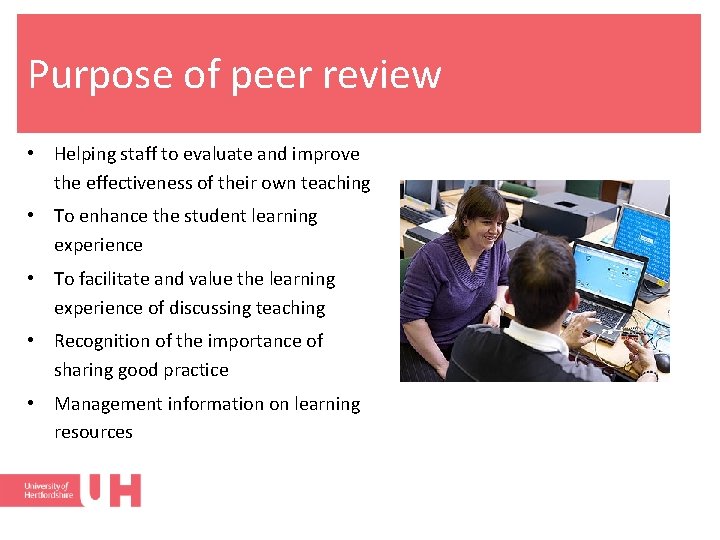
Purpose of peer review • Helping staff to evaluate and improve the effectiveness of their own teaching • To enhance the student learning experience • To facilitate and value the learning experience of discussing teaching • Recognition of the importance of sharing good practice • Management information on learning resources
QAA Higher Education Review How does the institution review and improve the quality of the student learning experience? • How does the institution review and seek to enhance the quality of the student learning experience? • How effective is teaching in relation to curriculum content and programme aims? • How effectively do staff draw upon their research, scholarship or professional activity to inform their teaching? • How good are the materials provided to support learning? • Is there effective engagement with and participation by students? • Is the quality of teaching maintained and enhanced through effective staff development, peer review of teaching, integration of part-time and visiting staff, effective team teaching and induction and mentoring of new staff? • How effectively is learning facilitated in terms of student workloads? Is the quality of teaching maintained and enhanced through effective staff development, peer review of teaching, integration of part-time and visiting staff, effective team teaching and induction and mentoring of new staff?
Positives • What have you changes or implemented based on feedback from a colleague following peer review?
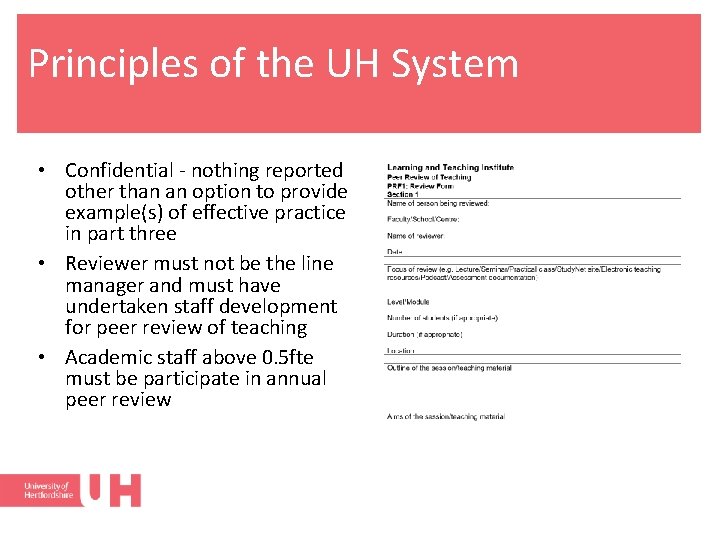
Principles of the UH System • Confidential - nothing reported other than an option to provide example(s) of effective practice in part three • Reviewer must not be the line manager and must have undertaken staff development for peer review of teaching • Academic staff above 0. 5 fte must be participate in annual peer review
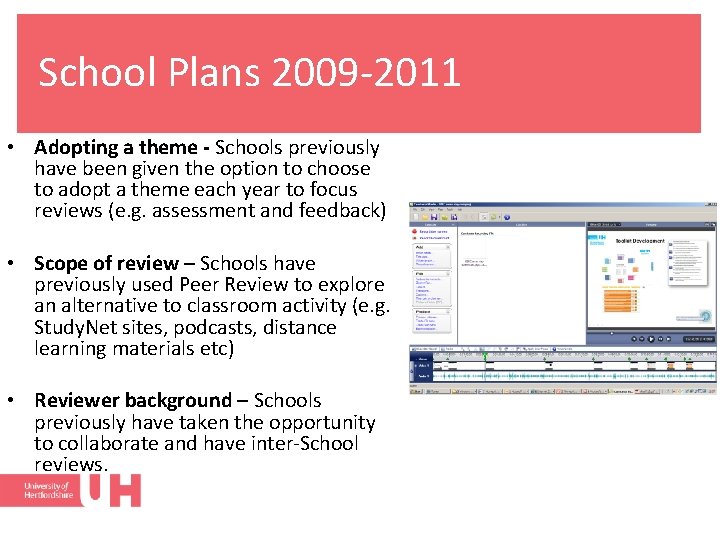
School Plans 2009 -2011 • Adopting a theme - Schools previously have been given the option to choose to adopt a theme each year to focus reviews (e. g. assessment and feedback) • Scope of review – Schools have previously used Peer Review to explore an alternative to classroom activity (e. g. Study. Net sites, podcasts, distance learning materials etc) • Reviewer background – Schools previously have taken the opportunity to collaborate and have inter-School reviews.
University theme 2015 -16 - peer review of assessment and feedback practice • Peer review of assessment briefs, quality of feedback, assessment practices. • The allocation of reviewer and reviewee roles should be made by the Associate Dean (L&T)
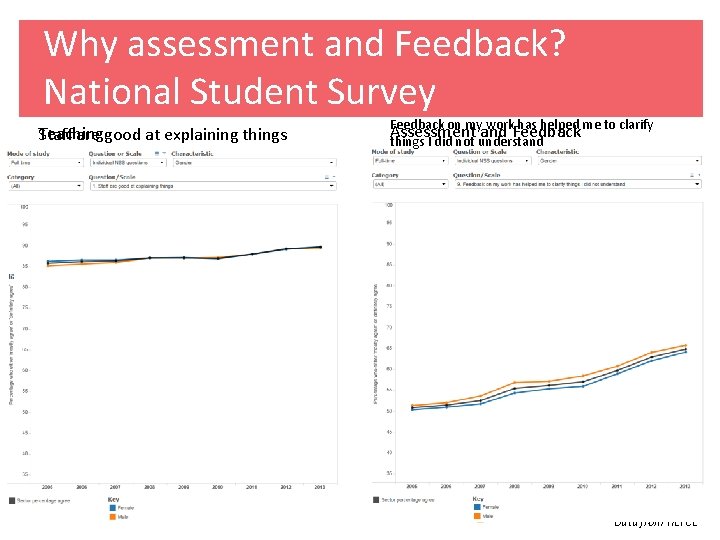
Why assessment and Feedback? National Student Survey Teaching Staff are good at explaining things Feedback on my work has helped me to clarify Assessment and Feedback things I did not understand Data from HEFCE
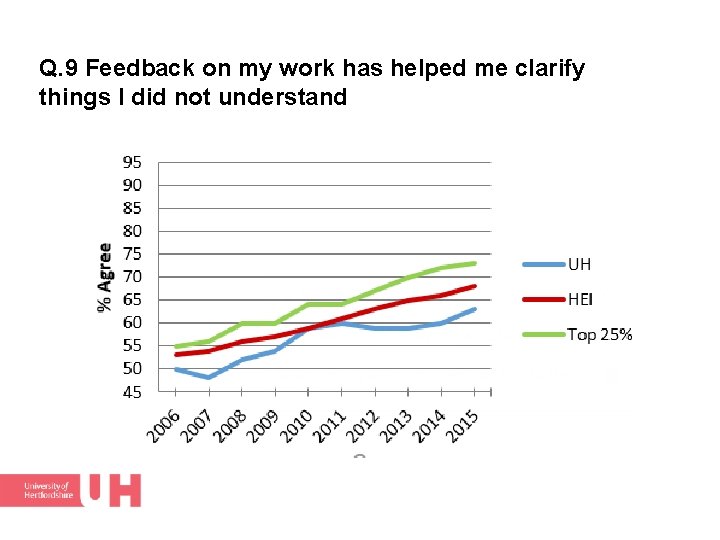
Q. 9 Feedback on my work has helped me clarify things I did not understand
What could we review? • Consideration of a set of marked assignments to look at the quality and depth of the feedback offered. – – • Has the student been given encouragement? Has the student been given the opportunity to practice further? Is it obvious that the advice given will help them do better in the future? Is the marking fair and consistent? Observation of a session where coursework is returned. – How has the staff member facilitated the discussion of the assignment and considered class performance? – Are all students engaging in discussion of the assignment and their feedback? – Is guidance provided for future development? • Attendance at presentations or other face to face assessment activities – Was the briefing for the students clear and did they understand what they needed to do? – Did the member of staff attempt to reduce anxieties of the students? – How was immediate feedback provided and was the tone of the feedback constructive? – where questions are asked from the floor.
What could we review? • Review of the design and communication of an assignment – – Is the assignment brief clear? Does the assignment assess the learning outcomes it is claimed to? Are the grading criteria and marking schemes clearly communicated? What are the modes of communication if students have queries about the assignment? • Discussion of the construction of a piece of coursework. – Does the structure give the student a clear ‘way in’? – Can a pass be achieved with reasonable honest effort and can a high mark be achieved whilst pushing the student to excel? – Could this work be assessed in a more imaginative way that the students might enjoy more?
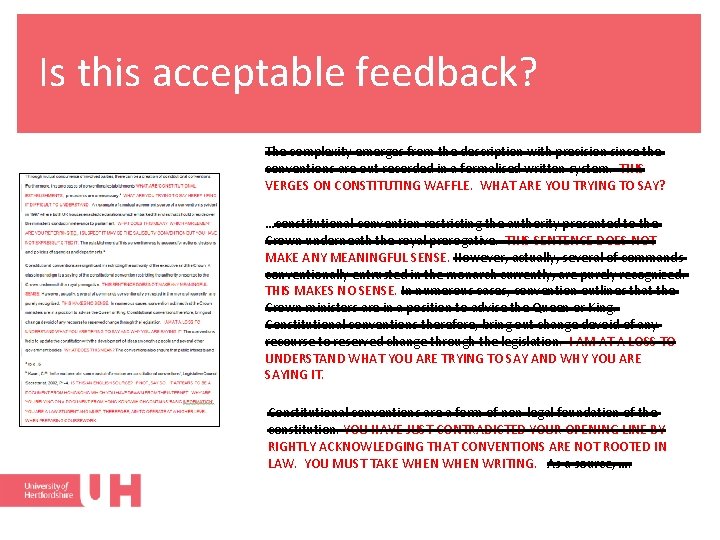
Is this acceptable feedback? The complexity emerges from the description with precision since the conventions are out recorded in a formalised written system. THIS VERGES ON CONSTITUTING WAFFLE. WHAT ARE YOU TRYING TO SAY? …constitutional convention restricting the authority presented to the Crown underneath the royal prerogative. THIS SENTENCE DOES NOT MAKE ANY MEANINGFUL SENSE. However, actually, several of commands conventionally entrusted in the monarch currently, are purely recognized. THIS MAKES NO SENSE. In numerous cases, convention outlines that the Crown ministers are in a position to advise the Queen or King. Constitutional conventions therefore, bring out change devoid of any recourse to reserved change through the legislation. I AM AT A LOSS TO UNDERSTAND WHAT YOU ARE TRYING TO SAY AND WHY YOU ARE SAYING IT. Constitutional conventions are a form of non-legal foundation of the constitution. YOU HAVE JUST CONTRADICTED YOUR OPENING LINE BY RIGHTLY ACKNOWLEDGING THAT CONVENTIONS ARE NOT ROOTED IN LAW. YOU MUST TAKE WHEN WRITING. As a source, ….
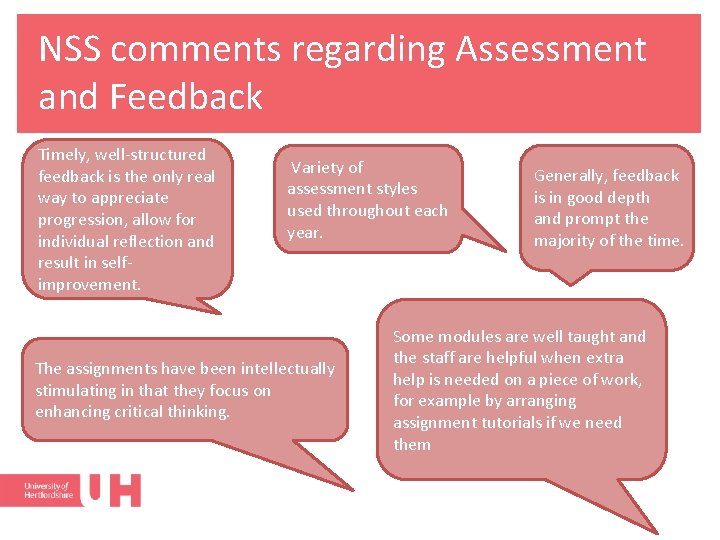
NSS comments regarding Assessment and Feedback Timely, well-structured feedback is the only real way to appreciate progression, allow for individual reflection and result in selfimprovement. Variety of assessment styles used throughout each year. The assignments have been intellectually stimulating in that they focus on enhancing critical thinking. Generally, feedback is in good depth and prompt the majority of the time. Some modules are well taught and the staff are helpful when extra help is needed on a piece of work, for example by arranging assignment tutorials if we need them
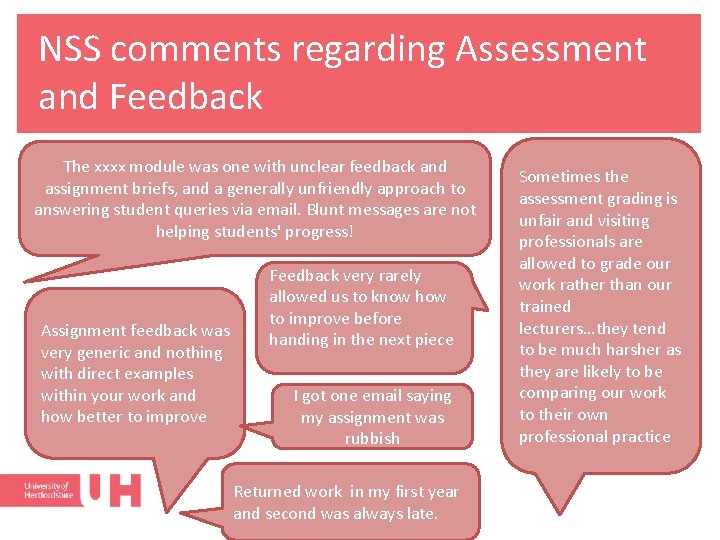
NSS comments regarding Assessment and Feedback The xxxx module was one with unclear feedback and assignment briefs, and a generally unfriendly approach to answering student queries via email. Blunt messages are not helping students' progress! Assignment feedback was very generic and nothing with direct examples within your work and how better to improve Feedback very rarely allowed us to know how to improve before handing in the next piece I got one email saying my assignment was rubbish Returned work in my first year and second was always late. Sometimes the assessment grading is unfair and visiting professionals are allowed to grade our work rather than our trained lecturers…they tend to be much harsher as they are likely to be comparing our work to their own professional practice
Providing feedback to our peers – what is important?
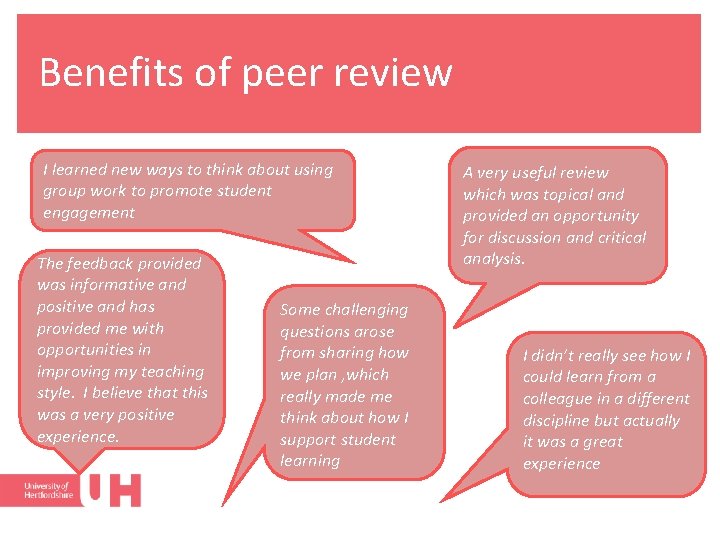
Benefits of peer review I learned new ways to think about using group work to promote student engagement The feedback provided was informative and positive and has provided me with opportunities in improving my teaching style. I believe that this was a very positive experience. Some challenging questions arose from sharing how we plan , which really made me think about how I support student learning A very useful review which was topical and provided an opportunity for discussion and critical analysis. I didn’t really see how I could learn from a colleague in a different discipline but actually it was a great experience