
Peer Relationships Overview Theory and overview Peer Groups
- Slides: 51
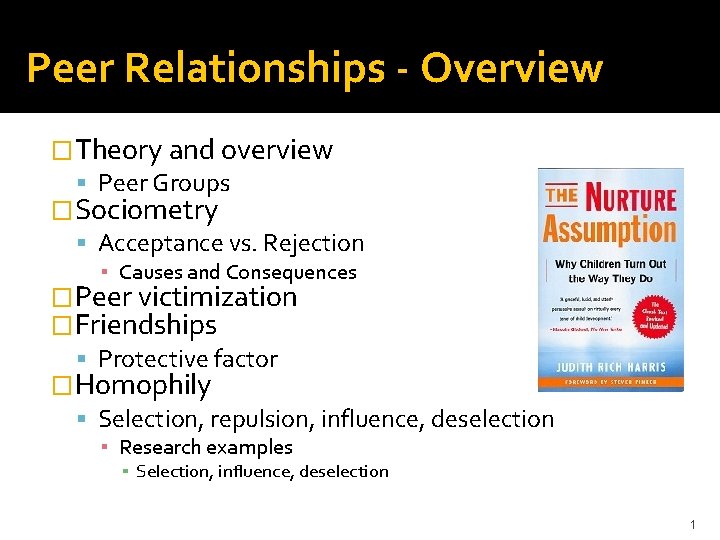
Peer Relationships - Overview �Theory and overview Peer Groups �Sociometry Acceptance vs. Rejection ▪ Causes and Consequences �Peer victimization �Friendships Protective factor �Homophily Selection, repulsion, influence, deselection ▪ Research examples ▪ Selection, influence, deselection 1
Theories �Sullivan emphasized pre-adolescent chumships as foundation of intimacy and precursor to romantic coupling �Piaget emphasized moral development occurring during give-and-take with peers (rather than obedience to, or rebellion against, adults) 2
Middle childhood & school �Peer interaction rises and changes 10% (3 y olds) to 30% (middle childhood) Peer group increases and is less supervised �Friendship develops Friends more likely to resolve conflicts with eye toward protecting relationship �Groups emerge As does understanding of role and status in group 4
Adolescence � 29% of waking time with peers Out of classroom � Friendship Autonomy granting and increased intimacy � Groups Single sex cliques mesh into looser mixed-sex groups � Crowds Druggies, loners, brains, jocks Increasingly prominent aspect of social life 5
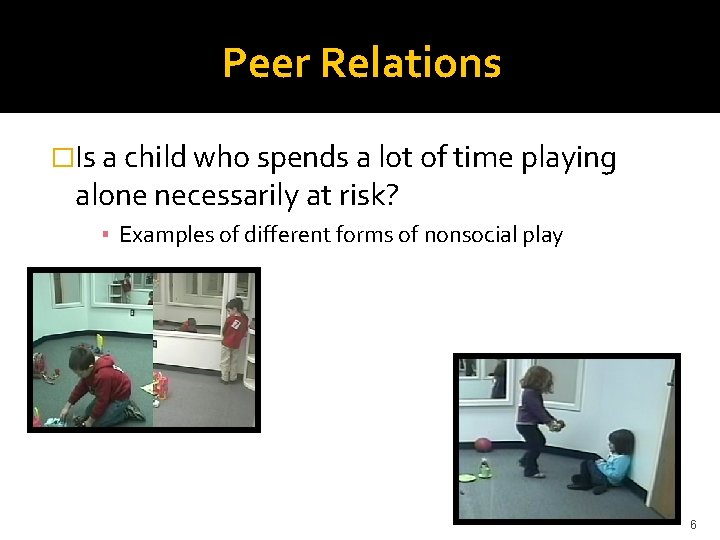
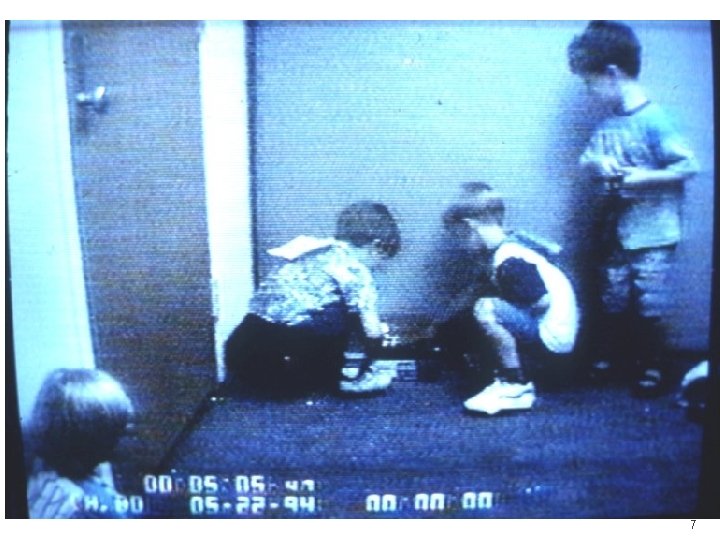
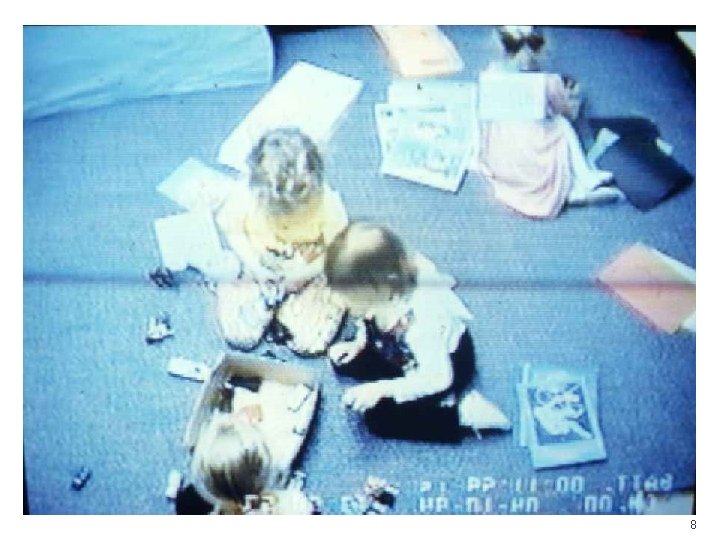
Peer Relations �Is a child who spends a lot of time playing alone necessarily at risk? ▪ Examples of different forms of nonsocial play 6
7
8
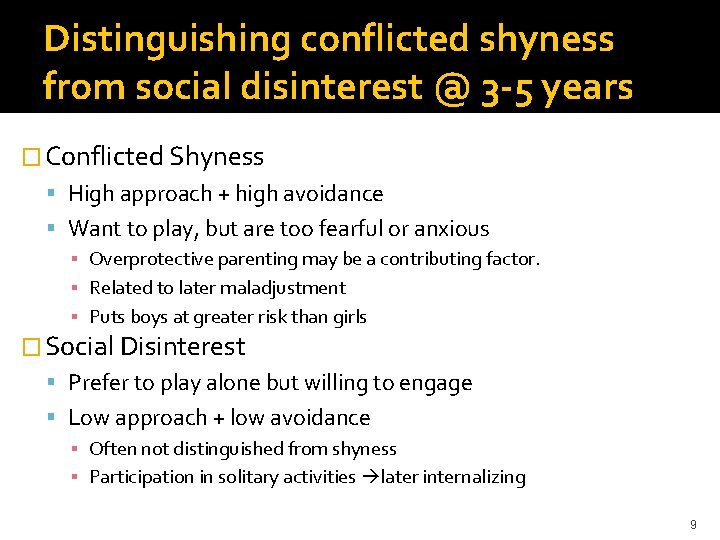
Distinguishing conflicted shyness from social disinterest @ 3 -5 years � Conflicted Shyness High approach + high avoidance Want to play, but are too fearful or anxious ▪ Overprotective parenting may be a contributing factor. ▪ Related to later maladjustment ▪ Puts boys at greater risk than girls � Social Disinterest Prefer to play alone but willing to engage Low approach + low avoidance ▪ Often not distinguished from shyness ▪ Participation in solitary activities later internalizing 9
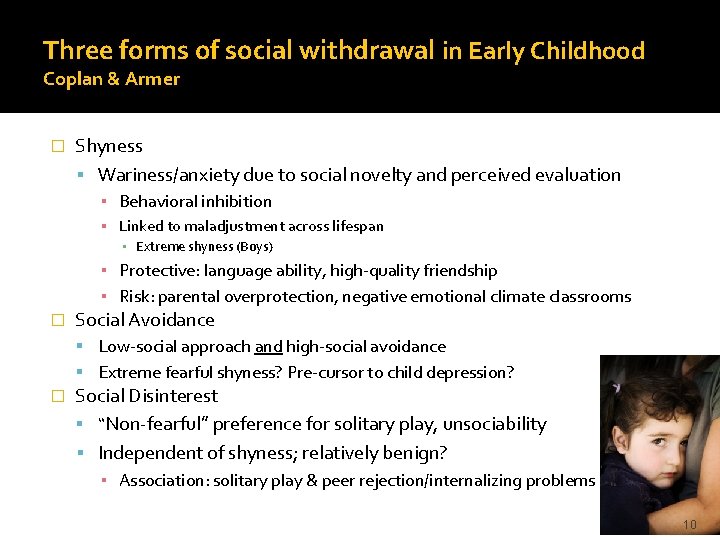
Three forms of social withdrawal in Early Childhood Coplan & Armer � Shyness Wariness/anxiety due to social novelty and perceived evaluation ▪ Behavioral inhibition ▪ Linked to maladjustment across lifespan ▪ Extreme shyness (Boys) ▪ Protective: language ability, high-quality friendship ▪ Risk: parental overprotection, negative emotional climate classrooms � Social Avoidance Low-social approach and high-social avoidance Extreme fearful shyness? Pre-cursor to child depression? � Social Disinterest “Non-fearful” preference for solitary play, unsociability Independent of shyness; relatively benign? ▪ Association: solitary play & peer rejection/internalizing problems 10
Classroom Context “Children with an early childhood history of anxious solitude were more rejected, poorly accepted (boys), and victimized (girls) by peers and demonstrated more depressive symptoms (girls) in 1 st-grade classrooms with a negative observed emotional climate. ” 11
National Social context �Pronounced role of peer group in Cuban society regulating social behaviors. Withdrawal associated with loneliness in Cuban > Canadian Aggression a correlate of loneliness in Cuba � Social withdrawal and maladjustment in a very group-oriented society. Valdivia, Ibis Alvarez; Schneider, Barry H. ; Chavez, Kenia Lorenzo; Chen, Xinyin International Journal of Behavioral Development. Vol 29(3), May 2005, 219 -228. 12
Peer group as socialization context Cooperative activity in support of collective goals Skills associated with leading and following Regulation aggression/hostility Group loyalty 13
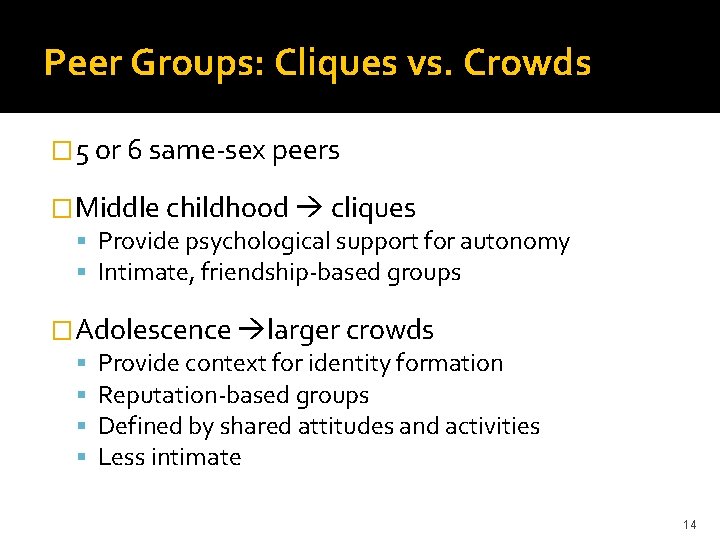
Peer Groups: Cliques vs. Crowds � 5 or 6 same-sex peers �Middle childhood cliques Provide psychological support for autonomy Intimate, friendship-based groups �Adolescence larger crowds Provide context for identity formation Reputation-based groups Defined by shared attitudes and activities Less intimate 14
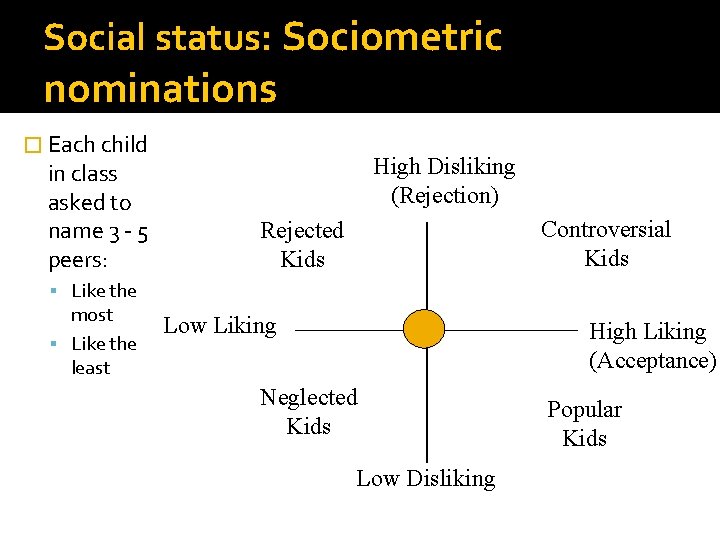
Social status: Sociometric nominations � Each child in class asked to name 3 - 5 peers: High Disliking (Rejection) Controversial Kids Rejected Kids Like the most Like the least Low Liking High Liking (Acceptance) Neglected Kids Low Disliking Popular Kids
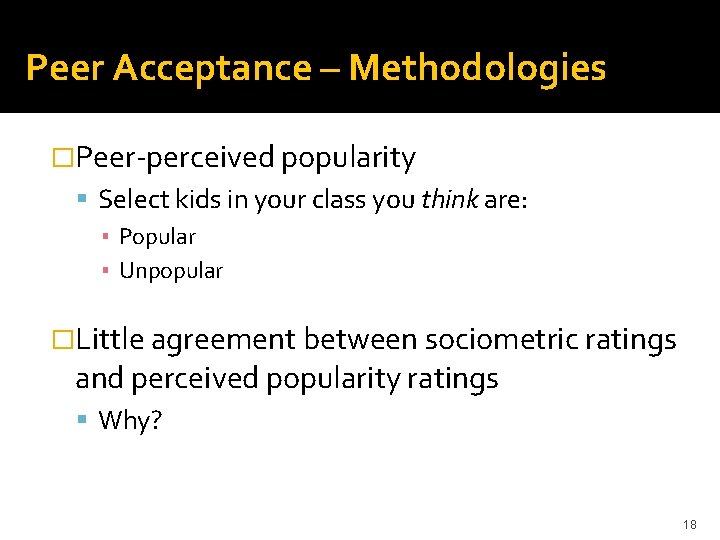
Peer Acceptance – Methodologies �Peer-perceived popularity Select kids in your class you think are: ▪ Popular ▪ Unpopular �Little agreement between sociometric ratings and perceived popularity ratings Why? 18
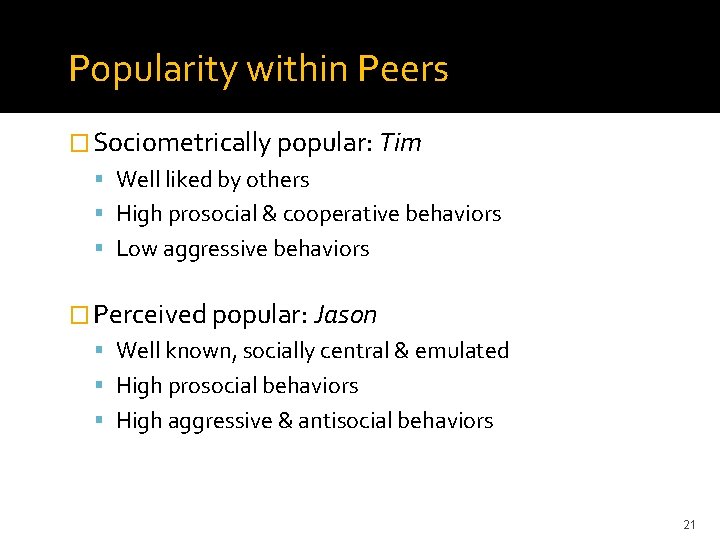
Popularity within Peers � Sociometrically popular: Tim Well liked by others High prosocial & cooperative behaviors Low aggressive behaviors � Perceived popular: Jason Well known, socially central & emulated High prosocial behaviors High aggressive & antisocial behaviors 21
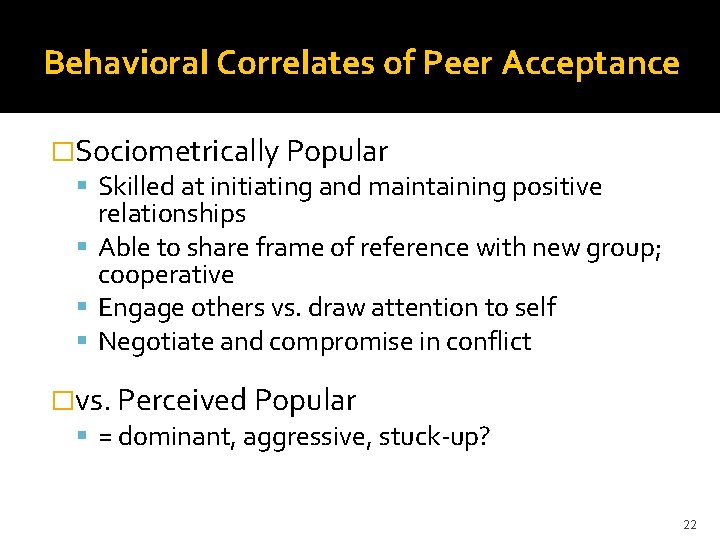
Behavioral Correlates of Peer Acceptance �Sociometrically Popular Skilled at initiating and maintaining positive relationships Able to share frame of reference with new group; cooperative Engage others vs. draw attention to self Negotiate and compromise in conflict �vs. Perceived Popular = dominant, aggressive, stuck-up? 22
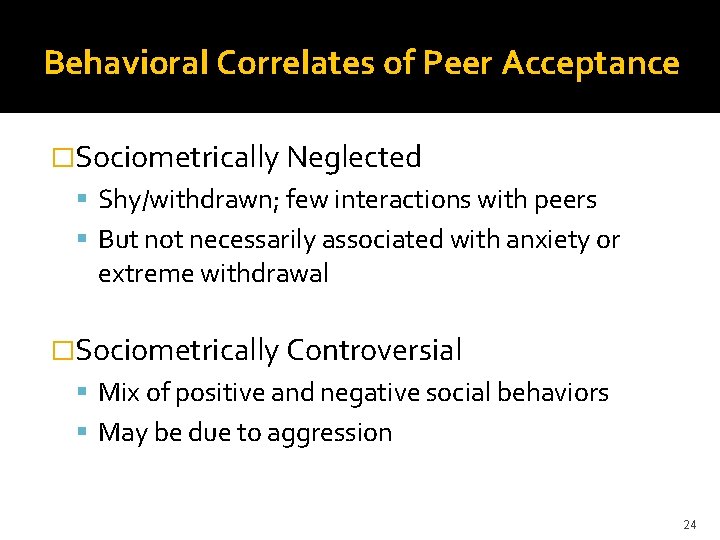
Behavioral Correlates of Peer Acceptance �Sociometrically Neglected Shy/withdrawn; few interactions with peers But not necessarily associated with anxiety or extreme withdrawal �Sociometrically Controversial Mix of positive and negative social behaviors May be due to aggression 24
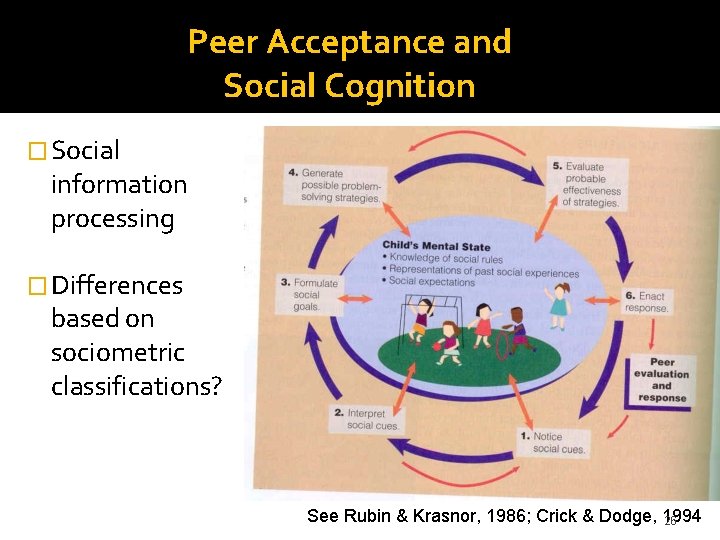
Peer Acceptance and Social Cognition � Social information processing � Differences based on sociometric classifications? See Rubin & Krasnor, 1986; Crick & Dodge, 1994 26
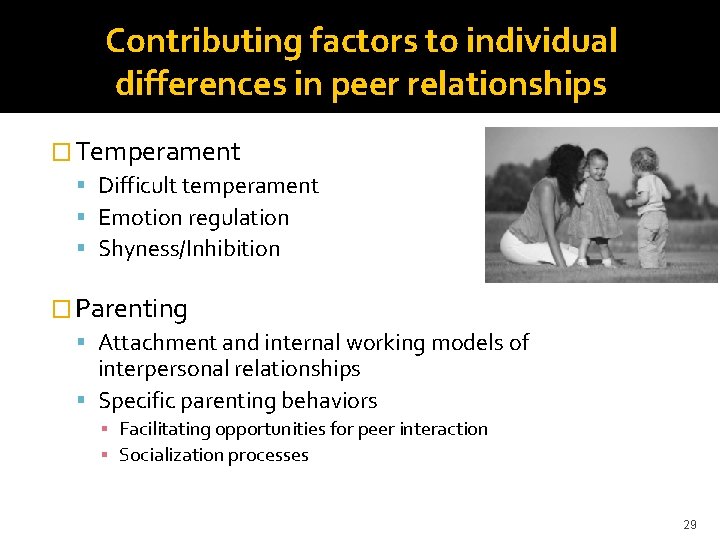
Contributing factors to individual differences in peer relationships � Temperament Difficult temperament Emotion regulation Shyness/Inhibition � Parenting Attachment and internal working models of interpersonal relationships Specific parenting behaviors ▪ Facilitating opportunities for peer interaction ▪ Socialization processes 29
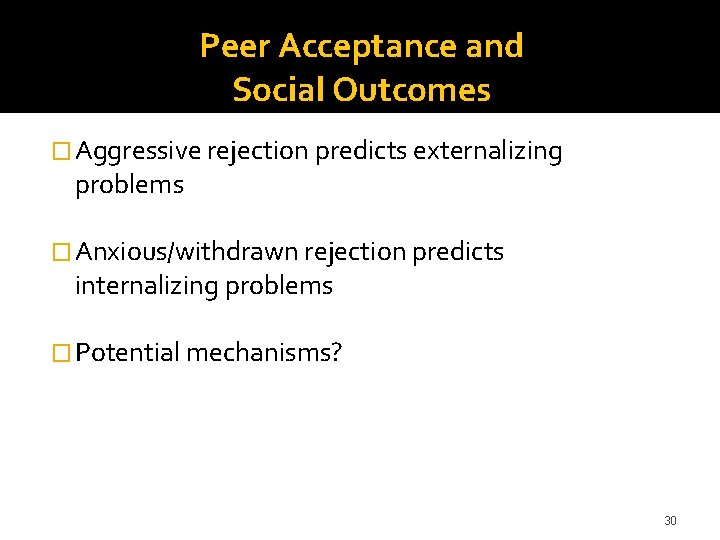
Peer Acceptance and Social Outcomes � Aggressive rejection predicts externalizing problems � Anxious/withdrawn rejection predicts internalizing problems � Potential mechanisms? 30
Rudolph et al. (2014) Peer Victimization and Social Alienation: Predicting Deviant Peer Affiliation in Middle School 33
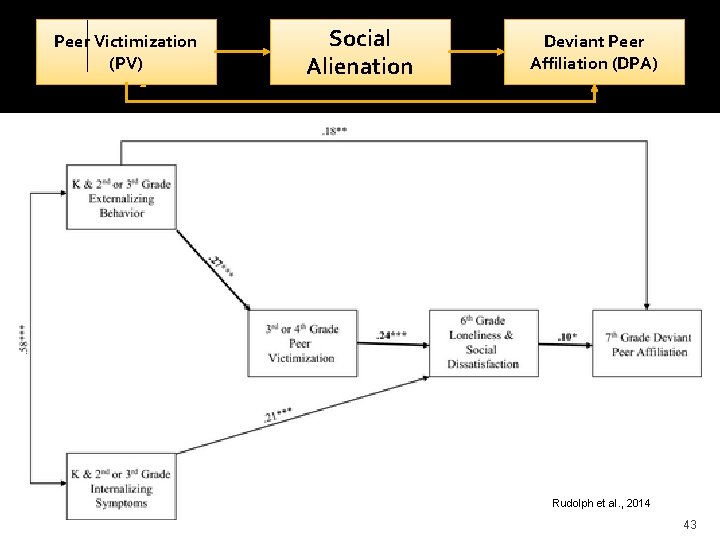
Peer Victimization (PV) Study 1: Social Alienation Deviant Peer Affiliation (DPA) Rudolph et al. , 2014 43
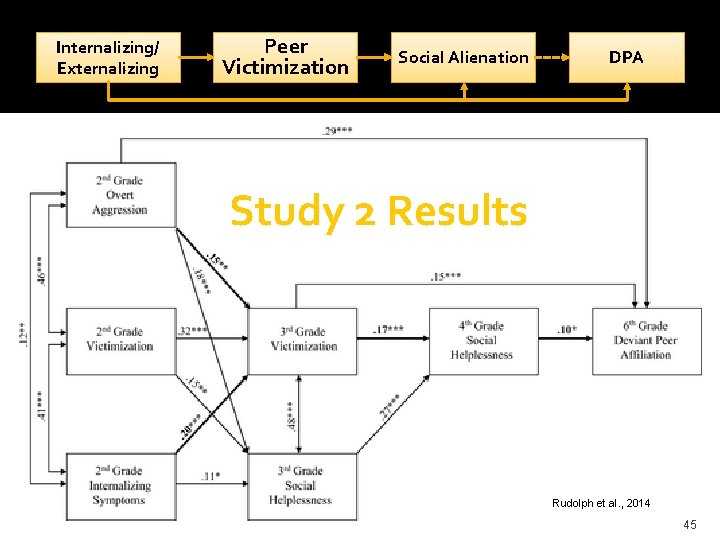
Internalizing/ Externalizing Peer Victimization Social Alienation DPA Study 2 Results Rudolph et al. , 2014 45
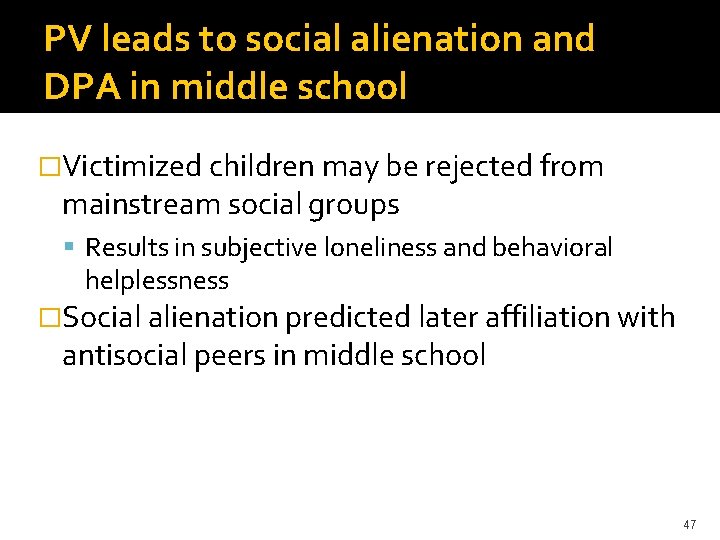
PV leads to social alienation and DPA in middle school �Victimized children may be rejected from mainstream social groups Results in subjective loneliness and behavioral helplessness �Social alienation predicted later affiliation with antisocial peers in middle school 47
Schwartz et al. (2014) Peer Victimization During Middle Childhood as Lead Indicator of Internalizing Problems and Diagnostic Outcomes in Late Adolescence 49
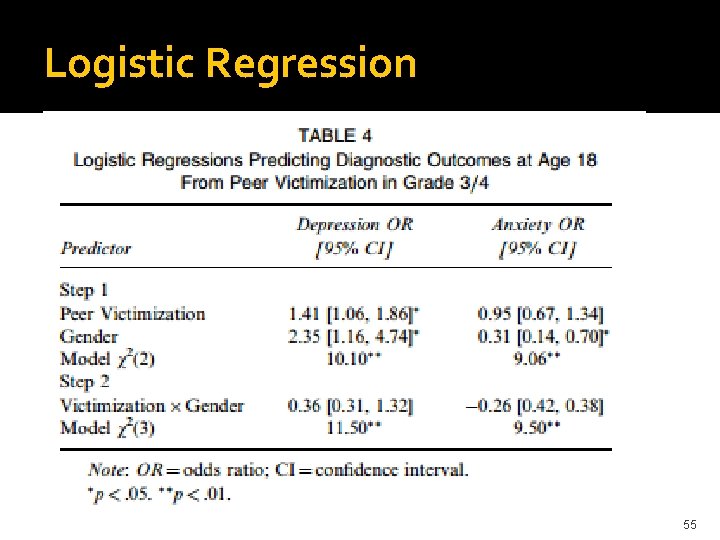
Logistic Regression 55
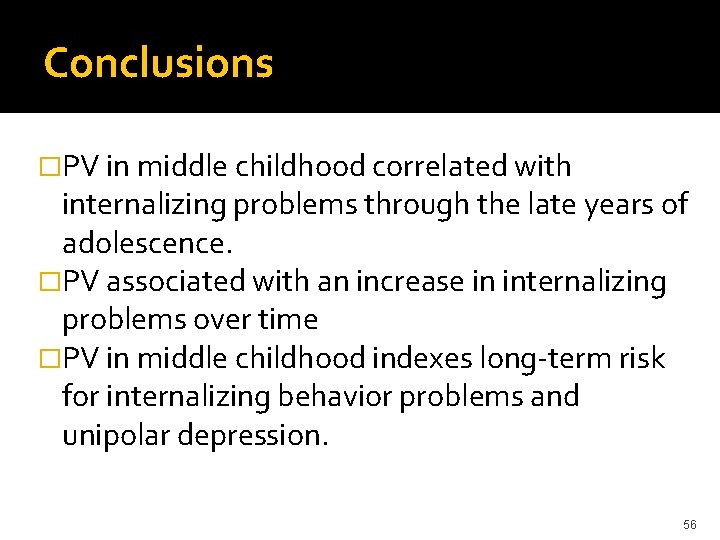
Conclusions �PV in middle childhood correlated with internalizing problems through the late years of adolescence. �PV associated with an increase in internalizing problems over time �PV in middle childhood indexes long-term risk for internalizing behavior problems and unipolar depression. 56
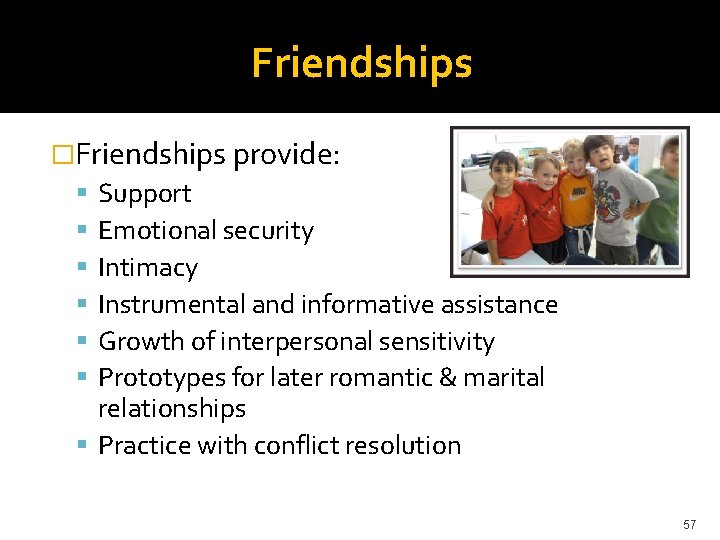
Friendships �Friendships provide: Support Emotional security Intimacy Instrumental and informative assistance Growth of interpersonal sensitivity Prototypes for later romantic & marital relationships Practice with conflict resolution 57
Friendship development Behaviors with friends differ vs. with non-friends from early ages Children’s understandings of friendships change with development (Bigelow & La. Gaipa, 1980) ▪ Reward-cost stage (7 -8 yrs) ▪ Normative stage (10 -11 yrs) ▪ Empathic stage (11 -13 yrs) 58
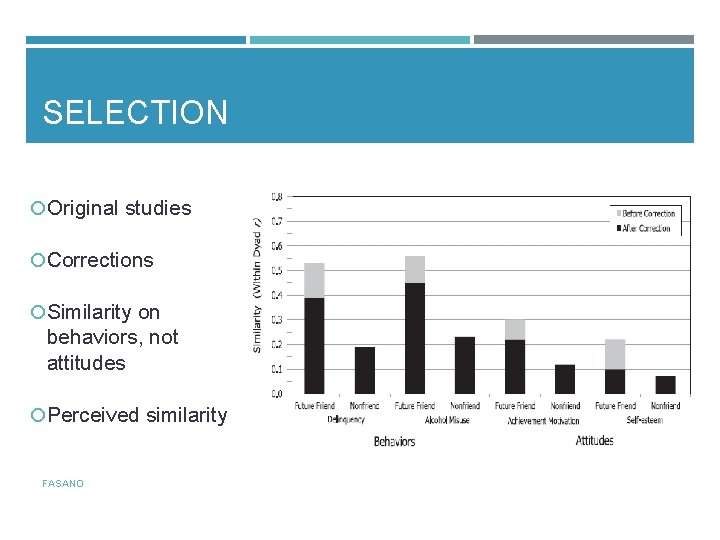
Friendships (cont) �In early childhood friends are similar in terms of observable characteristics Age, sex, racial/ethnic background, behavioral tendencies �By adolescence friends are similar in terms of attitudes School, academic aspirations, use of drugs/alcohol 59
Presence of a mutual best friend as a protective factor � Most children have at least one friend, BUT 15% estimated to be chronically friendless Associated with increased loneliness, poor self-esteem � Hodges et al. (1999); victimization predicts behavior only for children without a best friend problems � Although stable friendships can also have negative consequences depending on characteristics of the friend 60
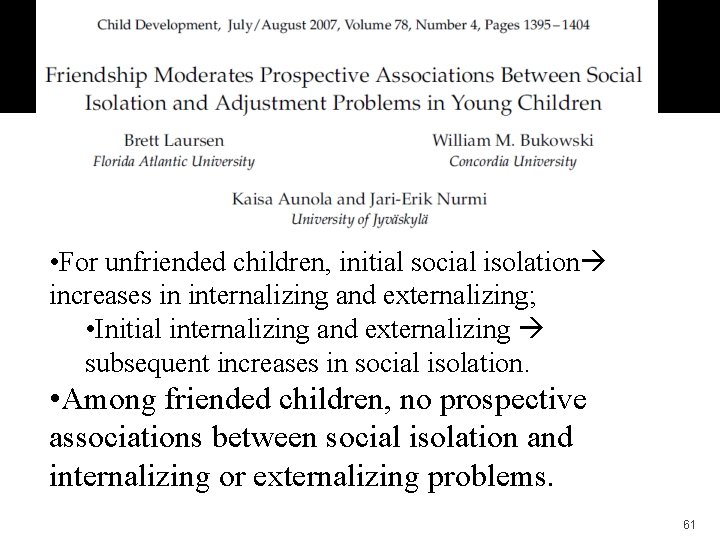
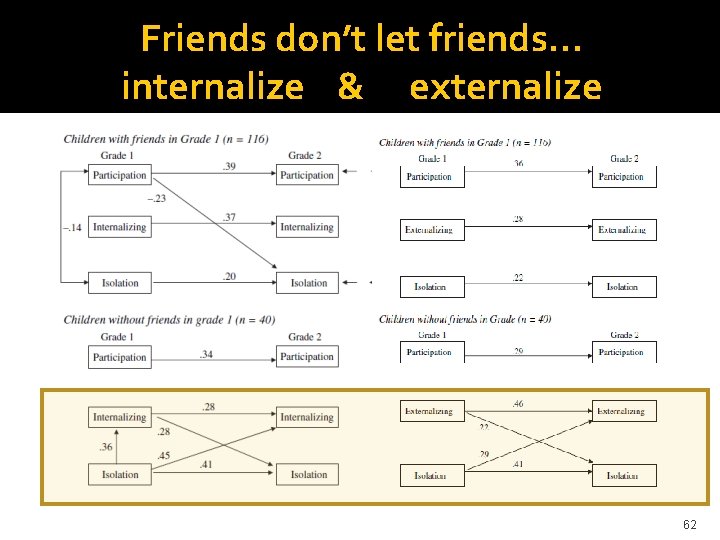
• For unfriended children, initial social isolation increases in internalizing and externalizing; • Initial internalizing and externalizing subsequent increases in social isolation. • Among friended children, no prospective associations between social isolation and internalizing or externalizing problems. 61
Friends don’t let friends… internalize & externalize 62
MAKING AND KEEPING FRIENDS: THE IMPORTANCE OF BEING SIMILAR LAURSEN, 2017 FASANO
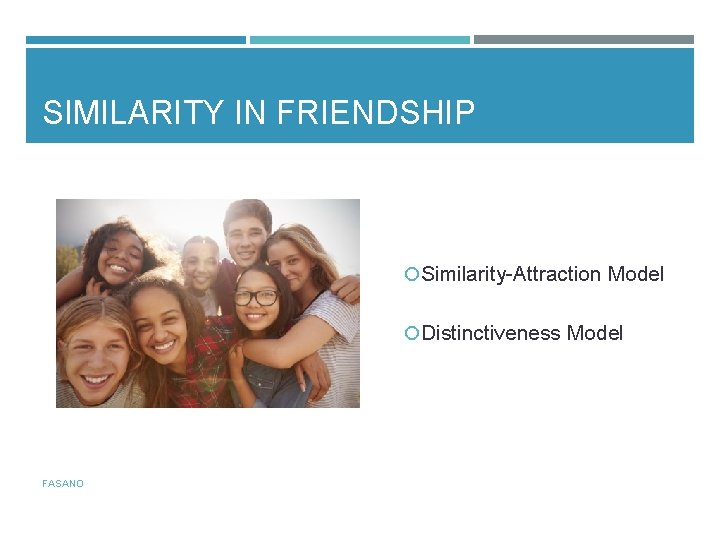
SIMILARITY IN FRIENDSHIP Similarity-Attraction Model Distinctiveness Model FASANO
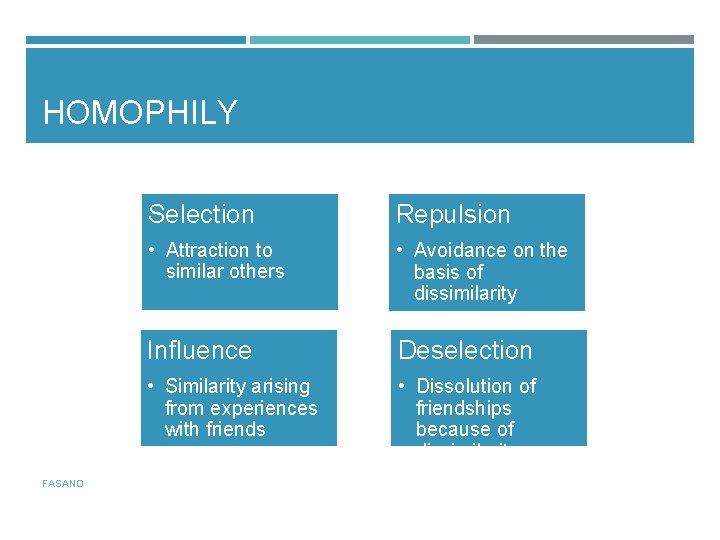
HOMOPHILY FASANO Selection Repulsion • Attraction to similar others • Avoidance on the basis of dissimilarity Influence Deselection • Similarity arising from experiences with friends • Dissolution of friendships because of dissimilarity
SELECTION Original studies Corrections Similarity on behaviors, not attitudes Perceived similarity FASANO
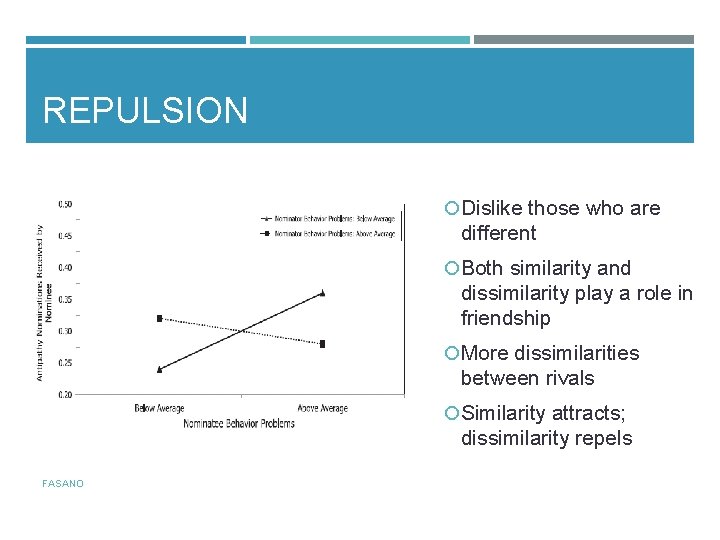
REPULSION Dislike those who are different Both similarity and dissimilarity play a role in friendship More dissimilarities between rivals Similarity attracts; dissimilarity repels FASANO
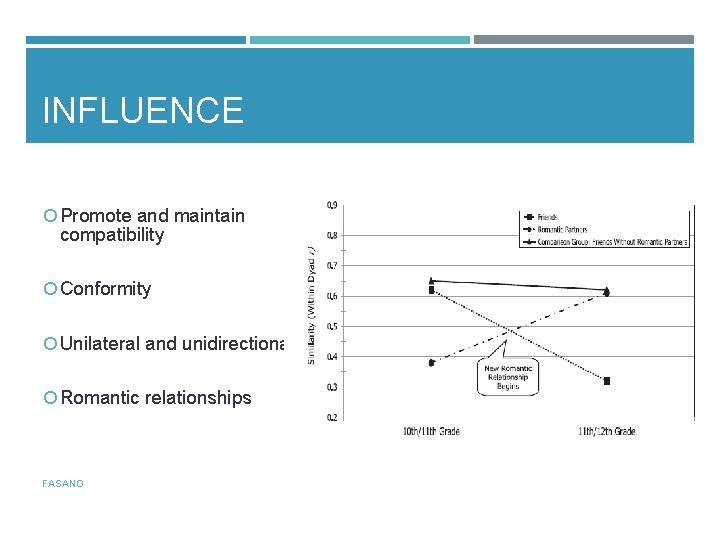
INFLUENCE Promote and maintain compatibility Conformity Unilateral and unidirectional Romantic relationships FASANO
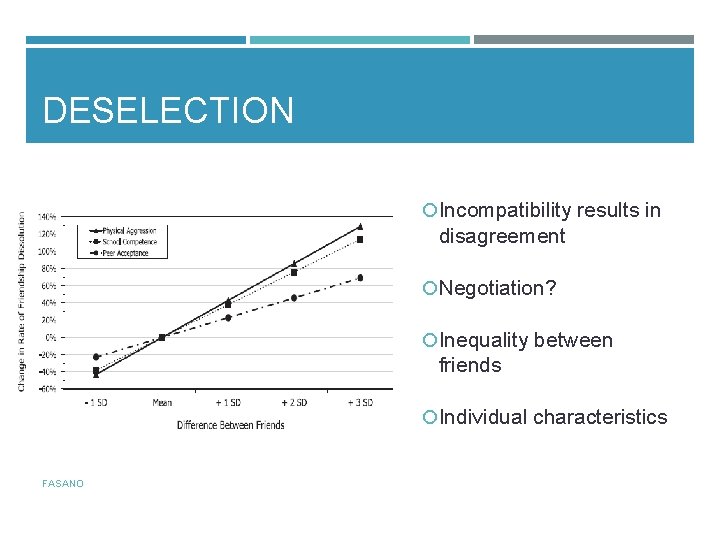
DESELECTION Incompatibility results in disagreement Negotiation? Inequality between friends Individual characteristics FASANO
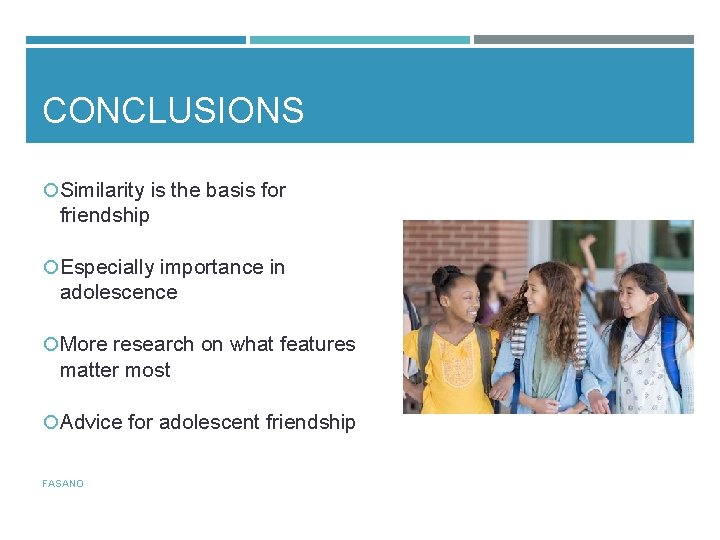
CONCLUSIONS Similarity is the basis for friendship Especially importance in adolescence More research on what features matter most Advice for adolescent friendship FASANO
DISCUSSION QUESTIONS What level of dissimilarity is tolerable, or even ideal for a friendship? Do certain characteristics matter more at different stages in life? How do these apply to romantic relationship? FASANO
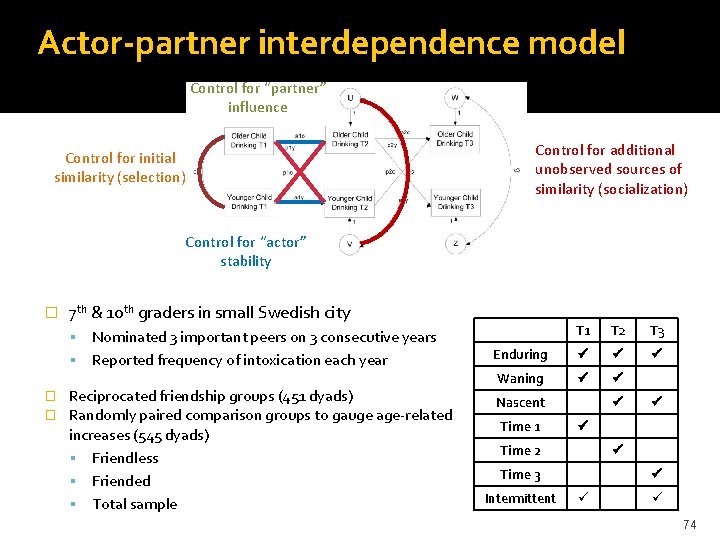
Modeling homophily over time with an actorpartner interdependence model Popp, D. , Laursen, B. , Kerr, M. , Stattin, H. , & Burk, W. (2008). Developmental Psychology, 44(4), 1028 -1039. � Why do friends engage in similar deviant behavior (homophily)? Socialization: friends influence behavior Selection: deviant kids choose deviant friends � Evidence for selection effect Higher similarity in deviant behavior pre-friendship � Evidence for socialization effect Increased deviant behavior controlling for pre-friendship levels � Difficulty in disentangling unique contributions Friends behave interdependently, i. e. behaviors are not statistically independent Actor-partner interdependence model (APIM) takes this into account 73
Actor-partner interdependence model Control for “partner” influence Control for initial similarity (selection) Control for additional unobserved sources of similarity (socialization) Control for “actor” stability � 7 th & 10 th graders in small Swedish city Nominated 3 important peers on 3 consecutive years Reported frequency of intoxication each year � � Reciprocated friendship groups (451 dyads) Randomly paired comparison groups to gauge age-related increases (545 dyads) Friendless Friended Total sample T 1 T 2 T 3 Enduring Waning Nascent Time 1 Time 2 Time 3 Intermittent 74
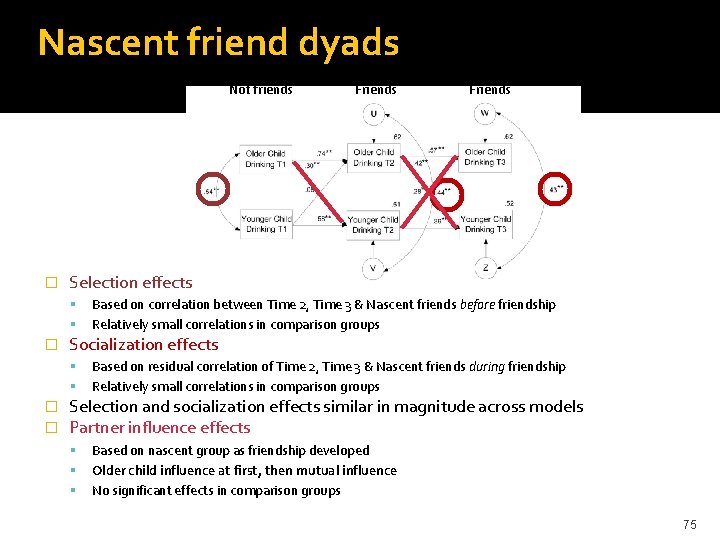
Nascent friend dyads Not friends � Based on correlation between Time 2, Time 3 & Nascent friends before friendship Relatively small correlations in comparison groups Socialization effects � � Friends Selection effects � Friends Based on residual correlation of Time 2, Time 3 & Nascent friends during friendship Relatively small correlations in comparison groups Selection and socialization effects similar in magnitude across models Partner influence effects Based on nascent group as friendship developed Older child influence at first, then mutual influence No significant effects in comparison groups 75
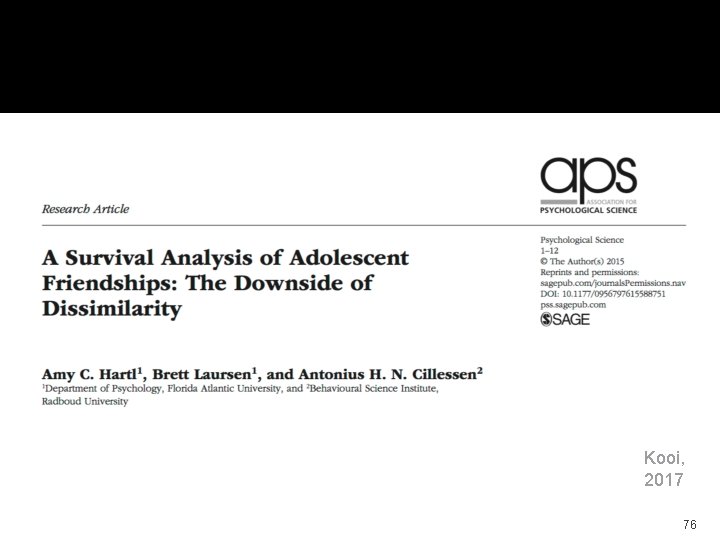
Kooi, 2017 76
Method � Participants: 410 adolescents (12 -15 years old) with at least 1 new, reciprocated friendship in 7 th grade (201 boys, 209 girls) Participants were followed from 7 th grade until 12 th grade Those who participated in the study through their senior year had higher school competence � Measures: Peer nominations ▪ Friendship “dissolution” happened when one friend no longer nominated that particular friend Friendship nominations Teacher reported school competence (Multidimensional Self Concept Scale) Mitsven, 2018; Bailey & Kooi, 2017 78
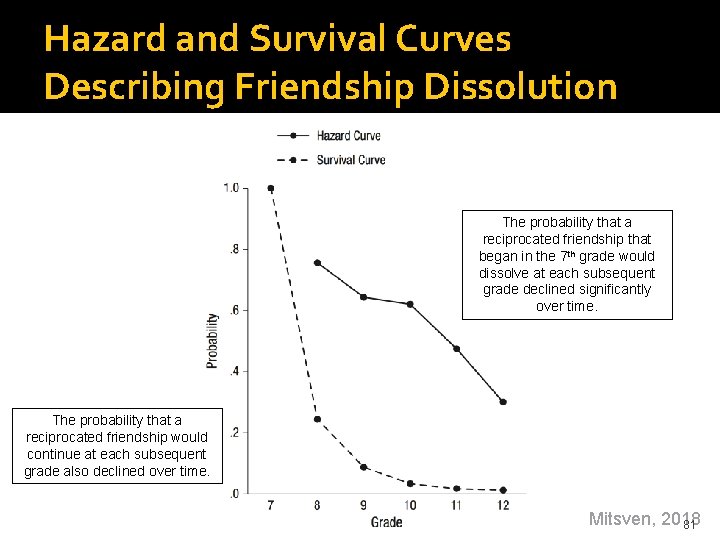
Hazard and Survival Curves Describing Friendship Dissolution The probability that a reciprocated friendship that began in the 7 th grade would dissolve at each subsequent grade declined significantly over time. The probability that a reciprocated friendship would continue at each subsequent grade also declined over time. Mitsven, 2018 81
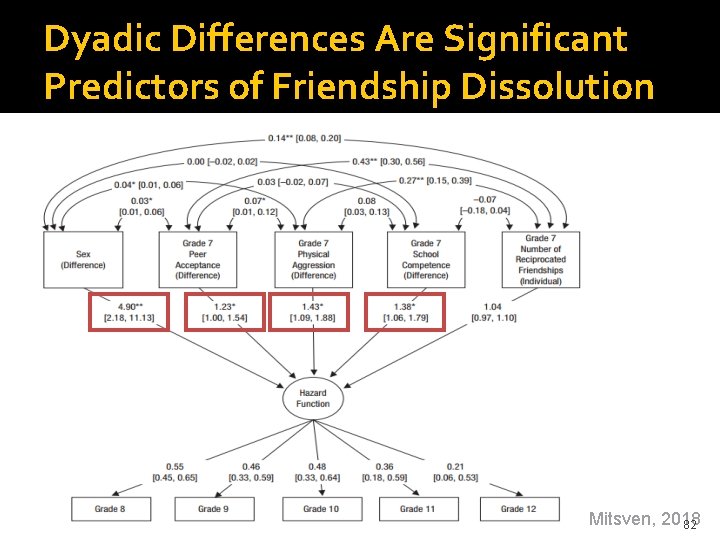
Dyadic Differences Are Significant Predictors of Friendship Dissolution Mitsven, 2018 82
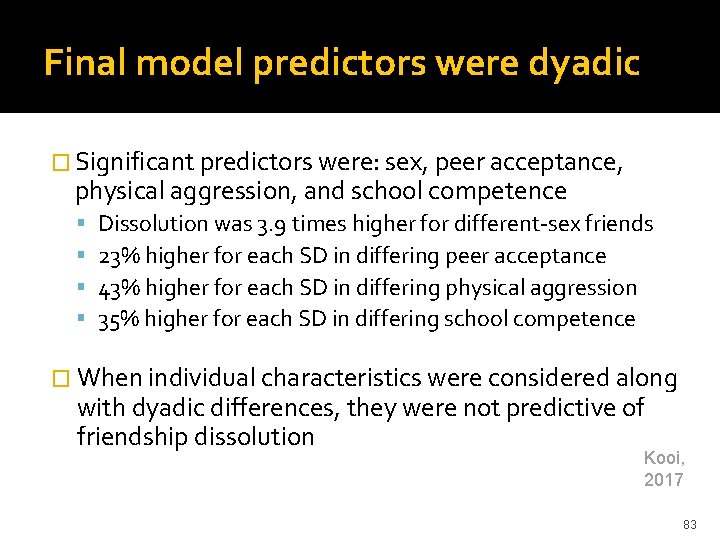
Final model predictors were dyadic � Significant predictors were: sex, peer acceptance, physical aggression, and school competence Dissolution was 3. 9 times higher for different-sex friends 23% higher for each SD in differing peer acceptance 43% higher for each SD in differing physical aggression 35% higher for each SD in differing school competence � When individual characteristics were considered along with dyadic differences, they were not predictive of friendship dissolution Kooi, 2017 83