
Peer Recovery Support in Recovery Marylands Learning Collaborative
Peer Recovery Support in Recovery Maryland’s Learning Collaborative May 17 th 2011 1
Topics to be addressed n n n n Peer to Peer Recovery Support Services What is a Recovery Community Center? What Happens There? Staff Roles Volunteer Roles How to Start a Recovery Community Center What is the role of the Recovery Community Organization in running a Recovery Community Center 2
About PRO-ACT n n n PRO-ACT, Pennsylvania Recovery Organization – Achieving Community Together, was founded in 1997. Hosted by The Council of Southeast Pennsylvania, Inc. , which has a 36 -year history of community mobilizing, education and advocacy. Grassroots advocacy initiative promotes the rights of and ensures opportunities for those still suffering from the disease of addiction, members of the recovery community and their family members. Provides advocacy and peer-to-peer recovery support services throughout the 5 counties of Southeastern Pennsylvania. 1998, 2001 and 2006 RCSP recipient, helped to grow PRO-ACT. 3
Recovery Basics n n Abstinence - restraint from indulging a desire for something Recovery - the regaining of something lost or taken away The Goal of Recovery is exemplified through a life that includes: n n Health - Managing one’s disease, and living in a physically and emotionally healthy way. Home – A stable and safe place that supports recovery. Purpose – Meaningful daily activities such as job, school, volunteerism, family caretaking, creative endeavors. Community – Relationships and social networks that provide support, friendship, love and hope. 4
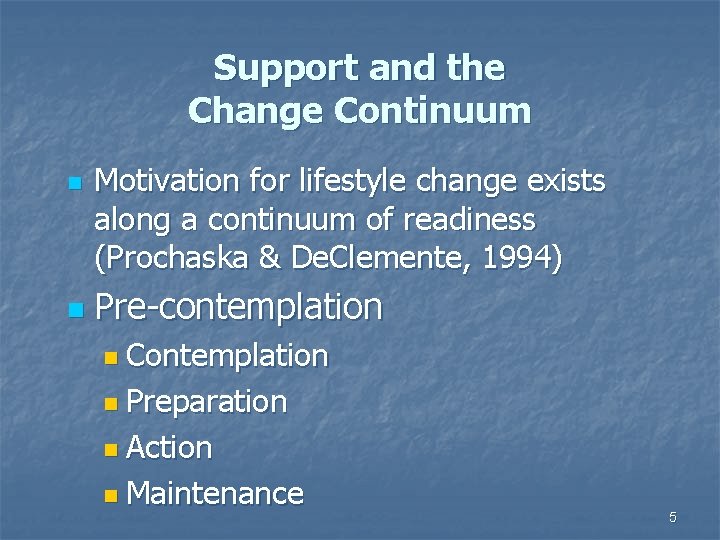
Support and the Change Continuum n n Motivation for lifestyle change exists along a continuum of readiness (Prochaska & De. Clemente, 1994) Pre-contemplation n Contemplation n Preparation n Action n Maintenance 5
Understanding The Role of Recovery Support 6
Research Shows: n Addiction has a higher recovery rate than other chronic diseases such as: hypertension, diabetes, and asthma when the individual has an opportunity to participate in a full continuum of services, including recovery support. 7
From the Clinical Treatment to the Recovery Lens: A Paradigm Shift n n n End point of treatment - absence of symptoms of clinical disorder. End point of recovery - holistic health. Recovery support services are grounded in a strength-based approach that focuses on wellness and a full reengagement with the community. Recovery support services build on capacities that already exists within communities. 8
Social Support and Recovery Support Services n n Social support appears to be one of the most potent factors to move people along the change continuum (Hanna, 2002) Social support has been correlated with numerous positive health outcomes, including reductions in drug and alcohol use (Cobb, 1976; Salser, 1998). 9
Recovery Support Services n n These services refer to non-clinical services created to begin and maintain a persons (Recoveree) recovery from addiction and better the quality of his or hers own recovery. These services are believed to be “ a lost function of addiction counseling” 1 1 White, W. (2004) Recovery coaching, Counselor, 5, 20 -22 10
Self Direction, Empowerment, and Choice n Embedded in the shared values of peer recovery support services is a philosophy of self direction, choice, and empowerment. The many pathways to recovery are acknowledged; the person seeking recovery is assumed to be fully capable of making informed choices, and his or her preferences are respected. 11
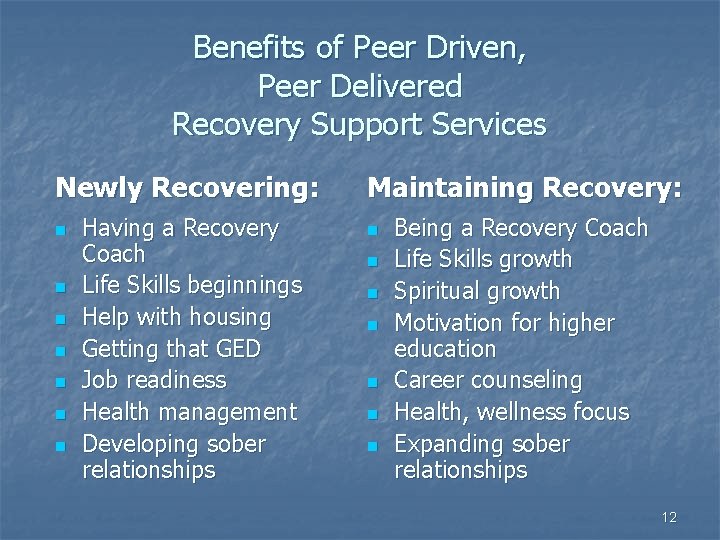
Benefits of Peer Driven, Peer Delivered Recovery Support Services Newly Recovering: n n n n Having a Recovery Coach Life Skills beginnings Help with housing Getting that GED Job readiness Health management Developing sober relationships Maintaining Recovery: n n n n Being a Recovery Coach Life Skills growth Spiritual growth Motivation for higher education Career counseling Health, wellness focus Expanding sober relationships 12
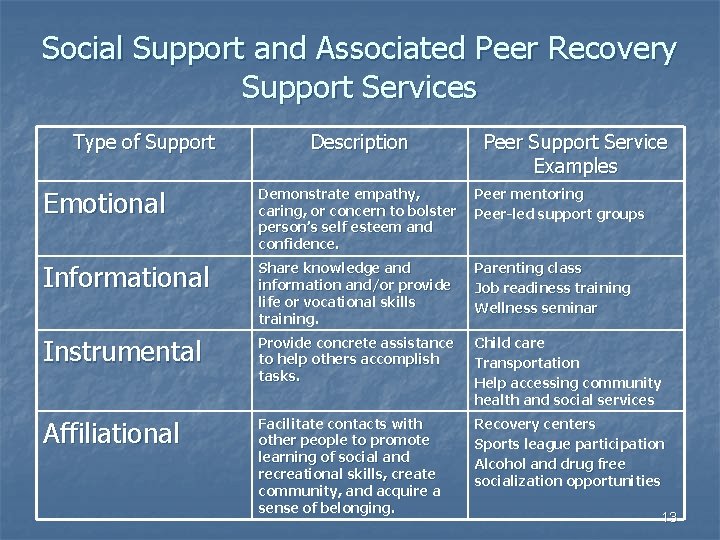
Social Support and Associated Peer Recovery Support Services Type of Support Description Peer Support Service Examples Emotional Demonstrate empathy, Peer mentoring caring, or concern to bolster Peer-led support groups person’s self esteem and confidence. Informational Share knowledge and information and/or provide life or vocational skills training. Parenting class Job readiness training Wellness seminar Instrumental Provide concrete assistance to help others accomplish tasks. Child care Transportation Help accessing community health and social services Affiliational Facilitate contacts with other people to promote learning of social and recreational skills, create community, and acquire a sense of belonging. Recovery centers Sports league participation Alcohol and drug free socialization opportunities 13
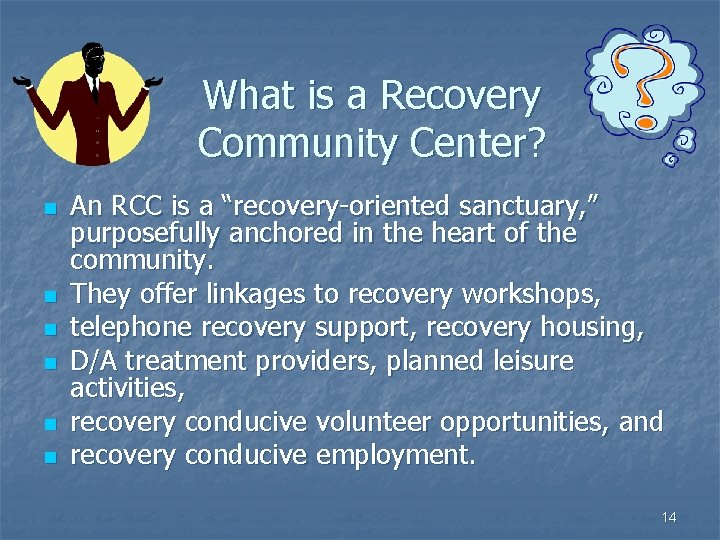
What is a Recovery Community Center? n n n An RCC is a “recovery-oriented sanctuary, ” purposefully anchored in the heart of the community. They offer linkages to recovery workshops, telephone recovery support, recovery housing, D/A treatment providers, planned leisure activities, recovery conducive volunteer opportunities, and recovery conducive employment. 14
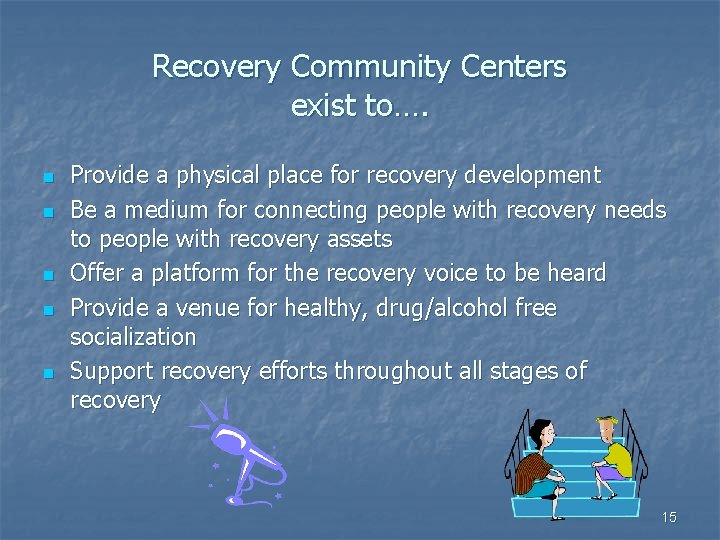
Recovery Community Centers exist to…. n n n Provide a physical place for recovery development Be a medium for connecting people with recovery needs to people with recovery assets Offer a platform for the recovery voice to be heard Provide a venue for healthy, drug/alcohol free socialization Support recovery efforts throughout all stages of recovery 15
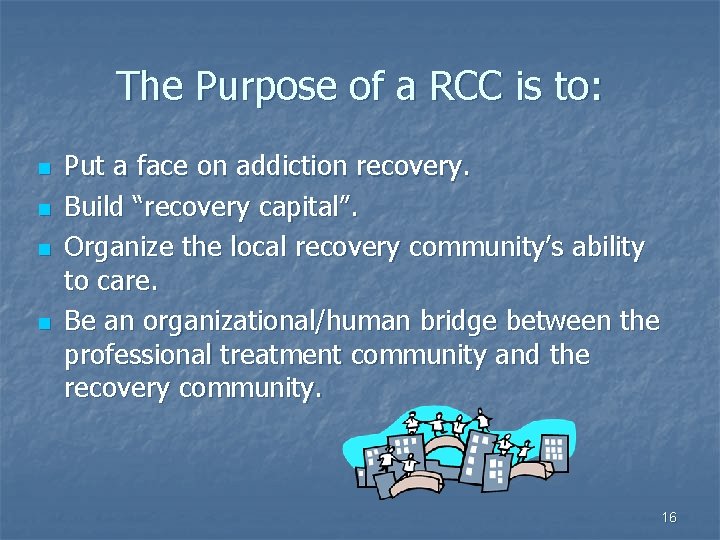
The Purpose of a RCC is to: n n Put a face on addiction recovery. Build “recovery capital”. Organize the local recovery community’s ability to care. Be an organizational/human bridge between the professional treatment community and the recovery community. 16
n n n Recovery Community Centers offer a unique blending of peer-to-peer services aimed at strengthening recovery within an inclusive, supportive communitybased setting. Peer leaders staff each Center. They draw from their own professional and personal experience to provide practical skill-building support and opportunities for others. Peer-delivered services aim to help people initiate and sustain long-term recovery while gaining overall wellness. 17
What it is NOT: n n n It is not a 12 step club or a “drop in” center. It is not a treatment or rehab center, nor is it a place whose primary purpose is to refer and help people get into treatment. It is not a place to simply “hang out”, watch television, play cards, etc. **Adapted from CCAR “Recovery Centers in Connecticut” 18
PRCC Services include: n n n 24/hour Information and Referral Hotline (800 -221 -6333) Peer-facilitated Recovery Support Groups Recovery Mentoring and/or Recovery Coaching Individual Recovery Plan Development Gender-Specific Support Groups PCB approved Volunteer Training Program Recovery Promoting Life Skills Groups Family Education Workshops Alcohol and Drug Free Social Events Education/Career Planning Resource Identification On-line Computer Stations 19
The Recovery Plan Components: n Life Domains n Individual Goals and Aspirations n Resources, Strengths and Skills n Barriers and Challenges 20
Recovery Planning Why use a Recovery Plan? n Helps to identify goals and objectives to attain them. n n n Provides a tool for measuring progress. Keeps your role as a Recovery Coach defined. Setting and achieving goals improves confidence and motivation. 21
Recovery Planning Promotes an Increase in Recovery Capital 22
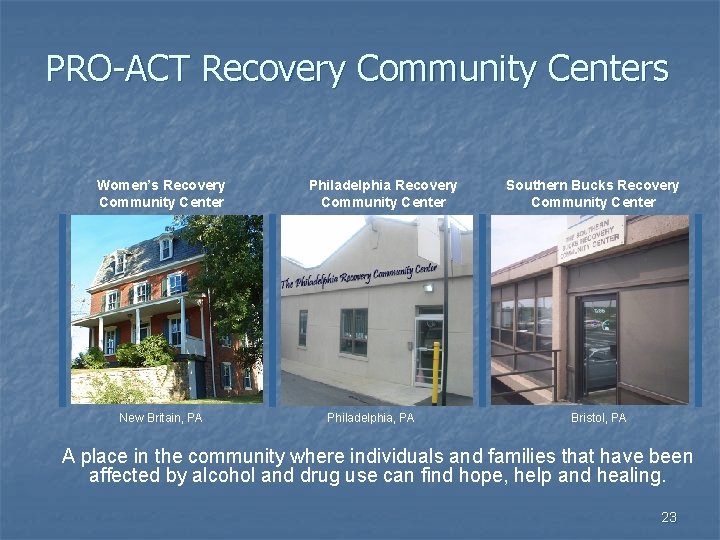
PRO-ACT Recovery Community Centers Women’s Recovery Community Center New Britain, PA Philadelphia Recovery Community Center Philadelphia, PA Southern Bucks Recovery Community Center Bristol, PA A place in the community where individuals and families that have been affected by alcohol and drug use can find hope, help and healing. 23
Typical Member’s Experience Engagement Phase n Individuals come to Centers with various needs and interests – engagement is a priority and a process n Welcomed with – “How can we help you with your recovery? ” n Tour Center n Interest Survey select n 5 interests n 5 skills to share n Calendar of programs and events n Opportunity to participate at whatever level 24
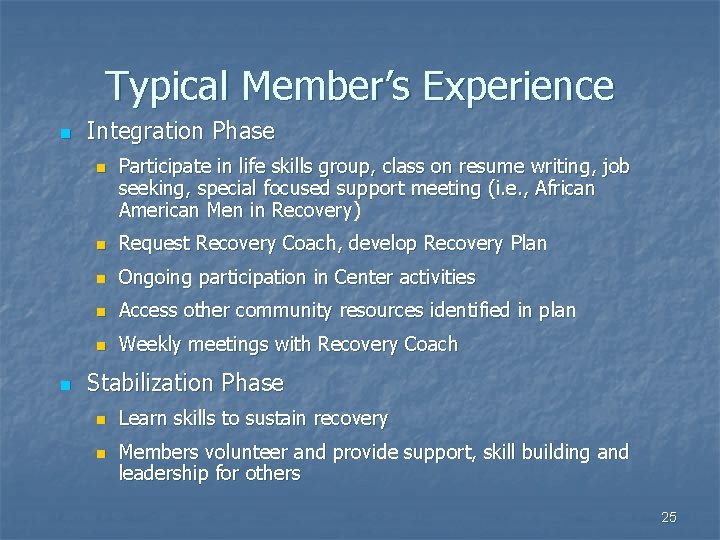
Typical Member’s Experience n Integration Phase n n Participate in life skills group, class on resume writing, job seeking, special focused support meeting (i. e. , African American Men in Recovery) n Request Recovery Coach, develop Recovery Plan n Ongoing participation in Center activities n Access other community resources identified in plan n Weekly meetings with Recovery Coach Stabilization Phase n n Learn skills to sustain recovery Members volunteer and provide support, skill building and leadership for others 25

“Give a man a fish and he eats for a day. Teach a man to fish and he eats for a lifetime. ” 26
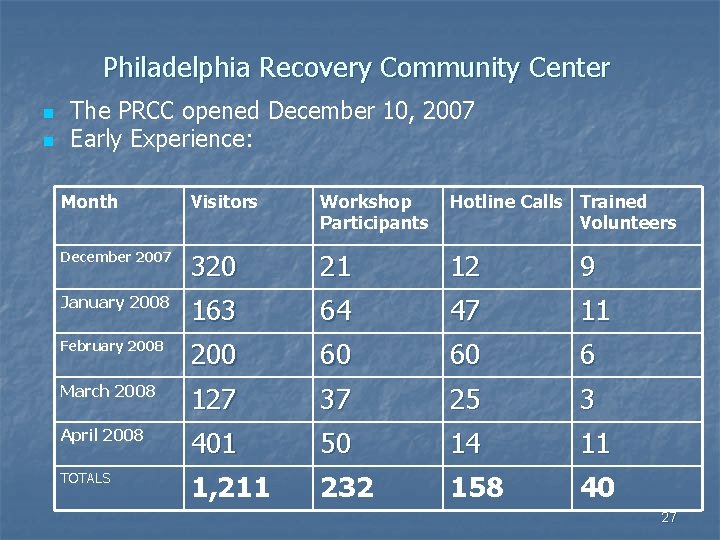
Philadelphia Recovery Community Center n n The PRCC opened December 10, 2007 Early Experience: Month Visitors Workshop Participants Hotline Calls Trained Volunteers December 2007 320 21 12 9 January 2008 163 64 47 11 February 2008 200 60 60 6 March 2008 127 37 25 3 April 2008 401 50 14 11 TOTALS 1, 211 232 158 40 27
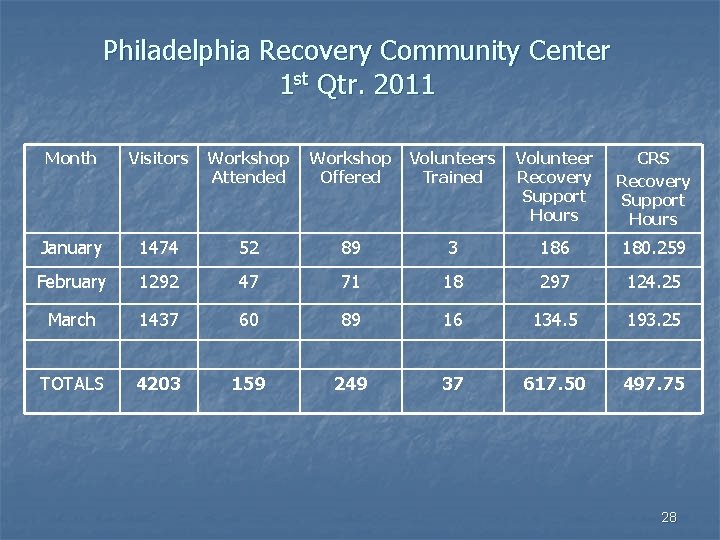
Philadelphia Recovery Community Center 1 st Qtr. 2011 Month Visitors Workshop Attended Workshop Volunteers Volunteer Offered Trained Recovery Support Hours CRS Recovery Support Hours January 1474 52 89 3 186 180. 259 February 1292 47 71 18 297 124. 25 March 1437 60 89 16 134. 5 193. 25 TOTALS 4203 159 249 37 617. 50 497. 75 28
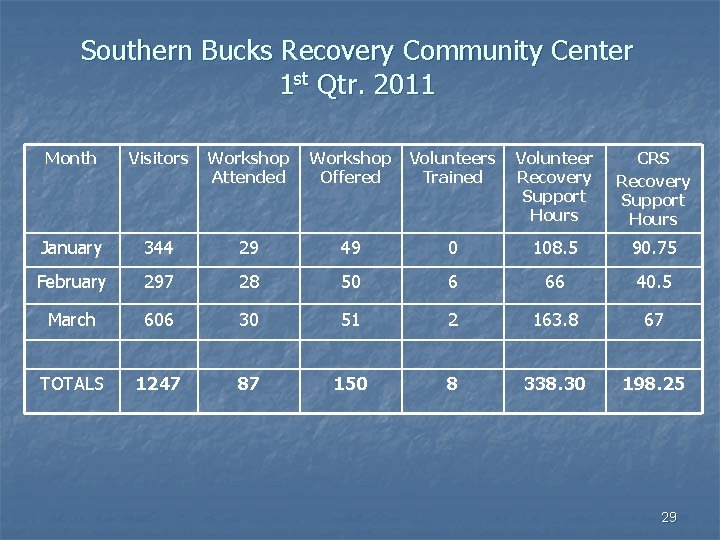
Southern Bucks Recovery Community Center 1 st Qtr. 2011 Month Visitors Workshop Attended Workshop Volunteers Volunteer Offered Trained Recovery Support Hours CRS Recovery Support Hours January 344 29 49 0 108. 5 90. 75 February 297 28 50 6 66 40. 5 March 606 30 51 2 163. 8 67 TOTALS 1247 87 150 8 338. 30 198. 25 29
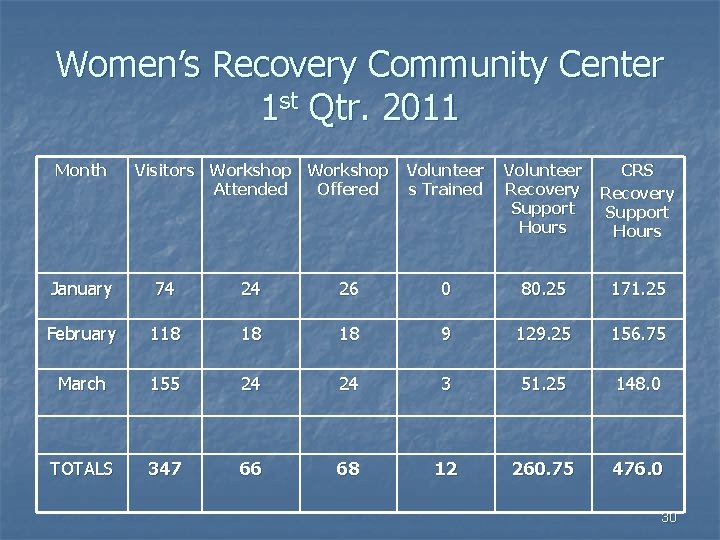
Women’s Recovery Community Center 1 st Qtr. 2011 Month Visitors Workshop Volunteer Attended Offered s Trained Volunteer CRS Recovery Support Hours January 74 24 26 0 80. 25 171. 25 February 118 18 18 9 129. 25 156. 75 March 155 24 24 3 51. 25 148. 0 TOTALS 347 66 68 12 260. 75 476. 0 30
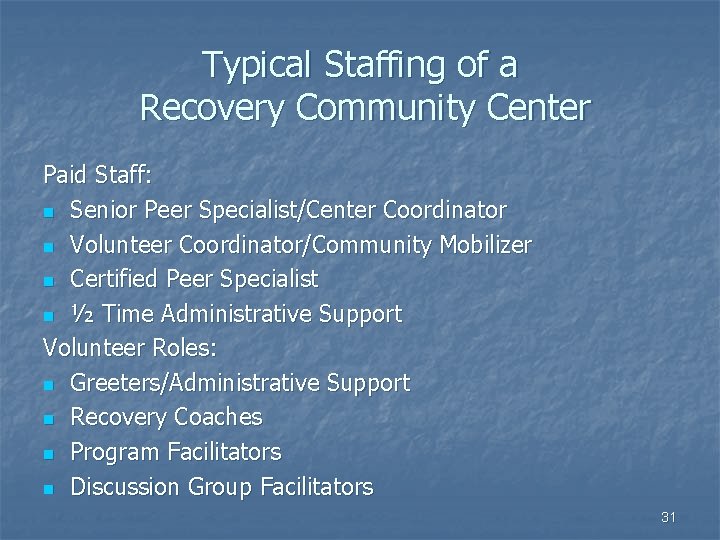
Typical Staffing of a Recovery Community Center Paid Staff: n Senior Peer Specialist/Center Coordinator n Volunteer Coordinator/Community Mobilizer n Certified Peer Specialist n ½ Time Administrative Support Volunteer Roles: n Greeters/Administrative Support n Recovery Coaches n Program Facilitators n Discussion Group Facilitators 31
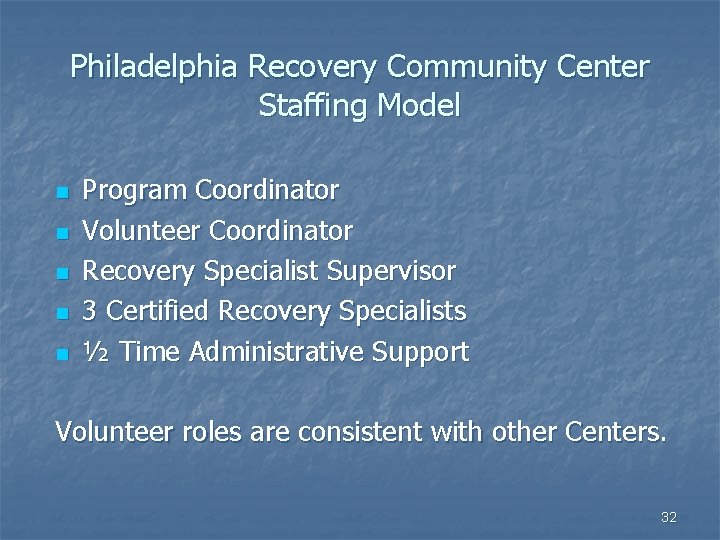
Philadelphia Recovery Community Center Staffing Model n n n Program Coordinator Volunteer Coordinator Recovery Specialist Supervisor 3 Certified Recovery Specialists ½ Time Administrative Support Volunteer roles are consistent with other Centers. 32
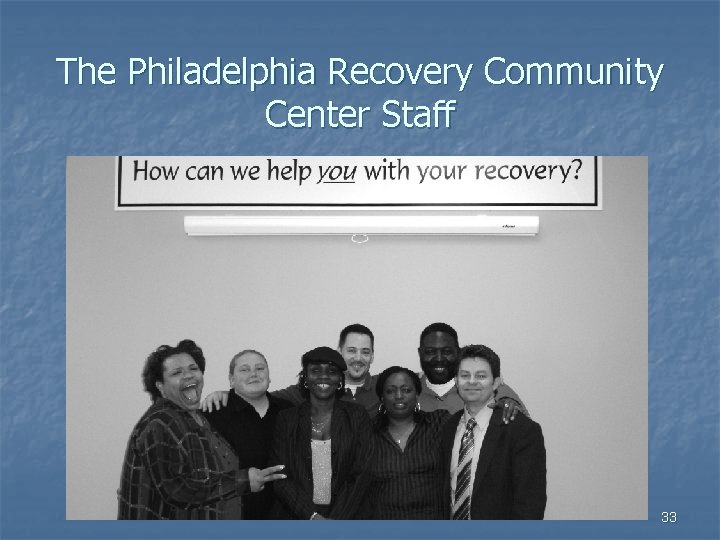
The Philadelphia Recovery Community Center Staff 33
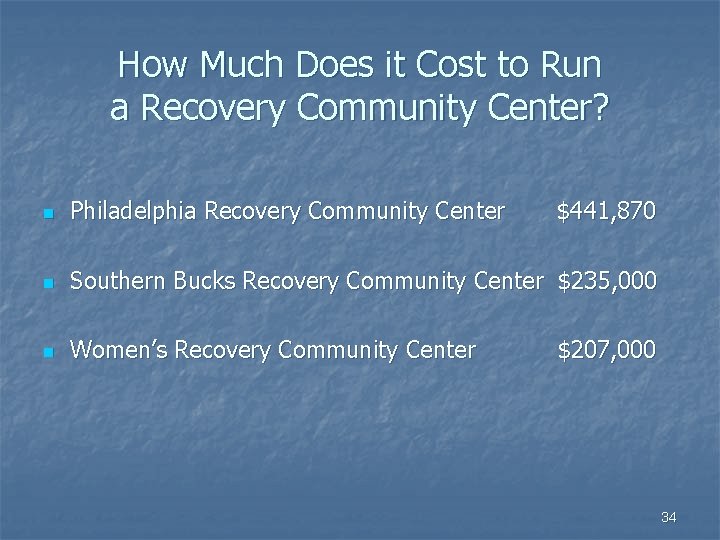
How Much Does it Cost to Run a Recovery Community Center? n Philadelphia Recovery Community Center $441, 870 n Southern Bucks Recovery Community Center $235, 000 n Women’s Recovery Community Center $207, 000 34
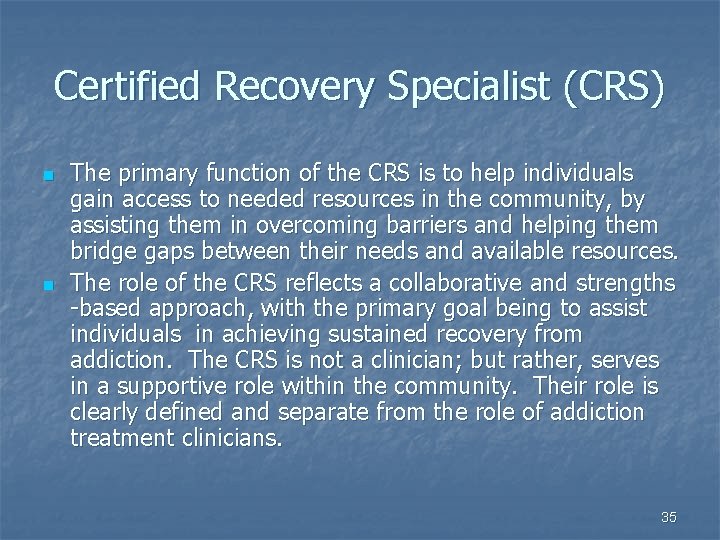
Certified Recovery Specialist (CRS) n n The primary function of the CRS is to help individuals gain access to needed resources in the community, by assisting them in overcoming barriers and helping them bridge gaps between their needs and available resources. The role of the CRS reflects a collaborative and strengths -based approach, with the primary goal being to assist individuals in achieving sustained recovery from addiction. The CRS is not a clinician; but rather, serves in a supportive role within the community. Their role is clearly defined and separate from the role of addiction treatment clinicians. 35
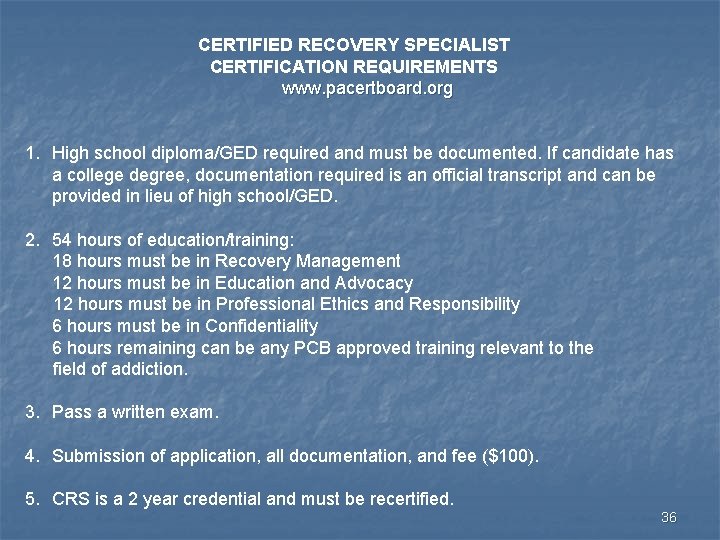
CERTIFIED RECOVERY SPECIALIST CERTIFICATION REQUIREMENTS www. pacertboard. org 1. High school diploma/GED required and must be documented. If candidate has a college degree, documentation required is an official transcript and can be provided in lieu of high school/GED. 2. 54 hours of education/training: 18 hours must be in Recovery Management 12 hours must be in Education and Advocacy 12 hours must be in Professional Ethics and Responsibility 6 hours must be in Confidentiality 6 hours remaining can be any PCB approved training relevant to the field of addiction. 3. Pass a written exam. 4. Submission of application, all documentation, and fee ($100). 5. CRS is a 2 year credential and must be recertified. 36
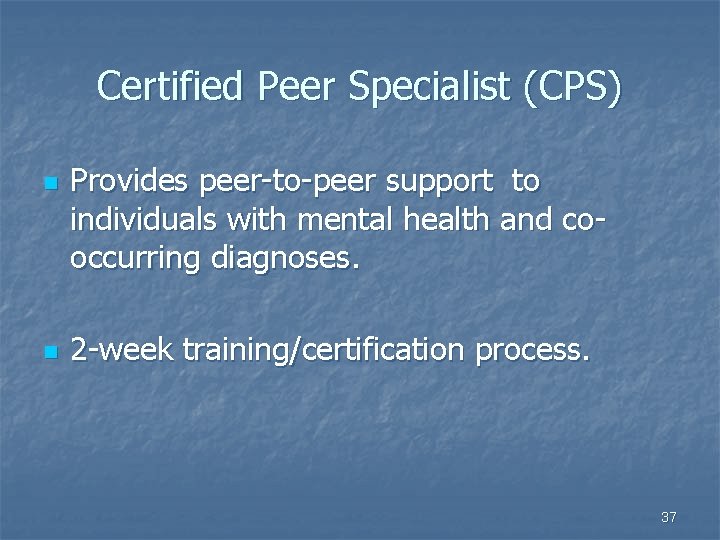
Certified Peer Specialist (CPS) n n Provides peer-to-peer support to individuals with mental health and cooccurring diagnoses. 2 -week training/certification process. 37
Recovery Coaches are the Arms and legs of the Certified Recovery Specialist 38
What is the Difference between a 12 Step Sponsor and a Recovery Coach? 39
12 Step Sponsor n n n Representative of voluntary, financially self-supported recovery mutual-aid society. Relationship is isolated from professional helpers. Sponsor provides support within a particular program of recovery. Sponsor’s support is limited to those who have sought help through the 12 Step program. Primary focus is on the 12 Step tools. Mutual confidentiality is negotiated between the sponsor and sponsee. 40
Recovery Coach n n n Representative of a formal service organization or funded peer support services program. Recovery Coaching relationship occurs within the context of a recovery planning process and/or multidisciplinary service team. Recovery Coaching acknowledges multiple pathways to recovery and provides support across those frameworks. Recovery Coaches provide support services to people at various stages of change. Recovery Coaches work within the four areas of social support have access to a spectrum of services to achieve recovery goals. Ethical guidelines and supervision protect all parties involved in the recovery support services process. White, W. (2006) 41
Counselor vs. Recovery Coach? 42
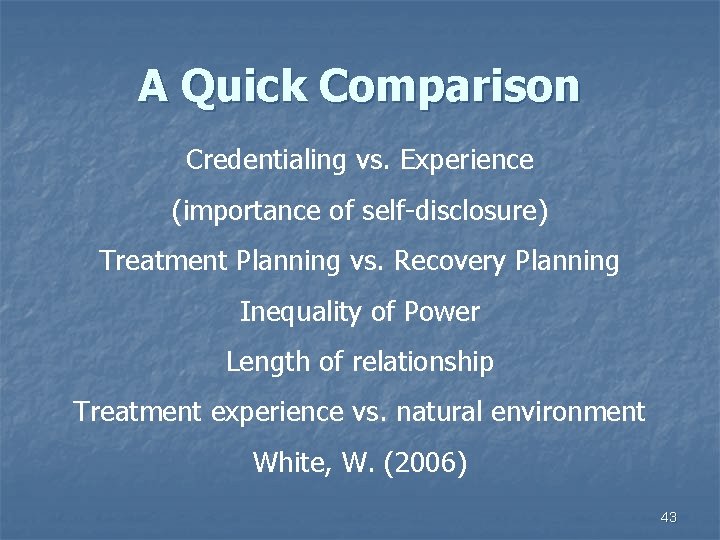
A Quick Comparison Credentialing vs. Experience (importance of self-disclosure) Treatment Planning vs. Recovery Planning Inequality of Power Length of relationship Treatment experience vs. natural environment White, W. (2006) 43
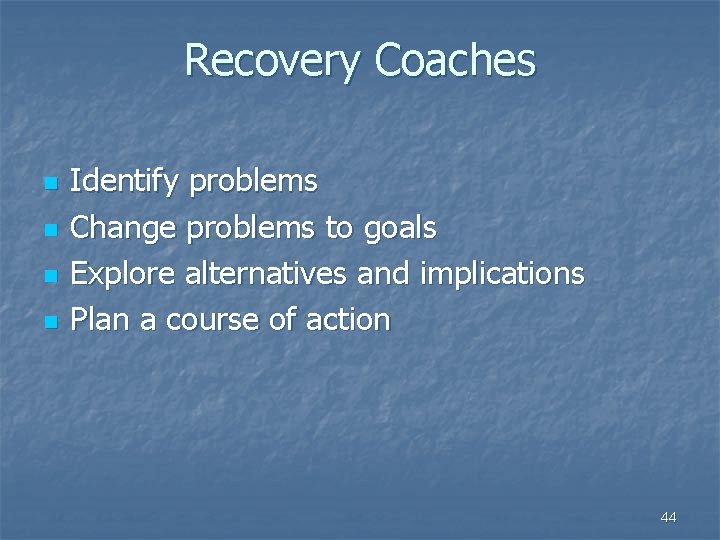
Recovery Coaches n n Identify problems Change problems to goals Explore alternatives and implications Plan a course of action 44
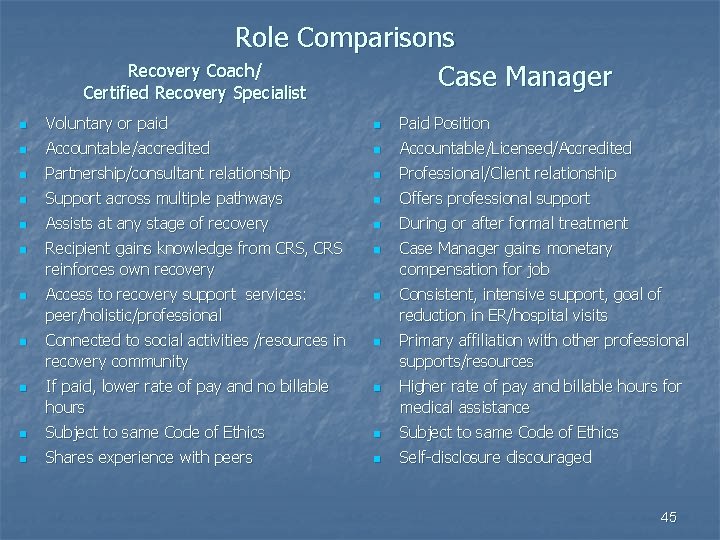
Role Comparisons Recovery Coach/ Case Manager Certified Recovery Specialist n Voluntary or paid n Paid Position n Accountable/accredited n Accountable/Licensed/Accredited n Partnership/consultant relationship n Professional/Client relationship n Support across multiple pathways n Offers professional support n Assists at any stage of recovery n During or after formal treatment n n Recipient gains knowledge from CRS, CRS reinforces own recovery Access to recovery support services: peer/holistic/professional Connected to social activities /resources in recovery community If paid, lower rate of pay and no billable hours n n Case Manager gains monetary compensation for job Consistent, intensive support, goal of reduction in ER/hospital visits Primary affiliation with other professional supports/resources Higher rate of pay and billable hours for medical assistance n Subject to same Code of Ethics n Shares experience with peers n Self-disclosure discouraged 45
Certified Recovery Specialists are Developing Specific Areas of Expertise n n n Criminal Justice/Drug Court Representative Women’s Issues Hispanic Outreach Veterans Issues Medication Assisted Recovery 46
How often does supervision take place? n n Supervision occurs weekly or more frequently if necessary. As a recovery Coach, you should view Supervision as a resource. Monthly Recovery Coach Meetings provide an opportunity for Group Supervision for each geographical location. 47
Benefits of Supervision n n Support Feedback Guidance Opportunity to focus on strengths and identify areas where growth is possible Resource access 48
Starting a Recovery Community Center Three Strategies: n Mobilize n Collaborate n Initiate Mobilization Components: n Engage n Educate n Activate n Support 49
Our Experience: Three Strategies, Three Different Locations n n n Initiate Model – In Central Bucks County, The Women’s Recovery Community Center was started when the recovery community identified a need for Recovery Support Services and safe and sober housing that would be accessible to women in that community. Fundraising Vision Team Activation Collaboration Model – The Philadelphia Recovery Community Center was created using a collaboration with OAS to pilot center. Mobilization Model – Southern Bucks Recovery Community Center used Community Mobilization and Participatory Process to identify needs. Once needs were identified, decision was made that developing the Center was the correct approach. 50
Achieving Excellence Workshops n Regional meetings are be held for all Recovery Coaches. These meetings provide continuing education, networking and collaborative opportunities for Recovery Coaches throughout Recovery Support Services Programs. 51
HOW WAS THE PRCC DEVELOPED? Utilizing a research based, mobilization strategy (which encompasses engagement, education, activation, and support) the Department of Behavioral Health and Mental Retardation Services (DBH/MRS) collaborated with Pennsylvania Recovery Organization Achieving Community Together (PRO-ACT), recovering persons, consumers, family members, the community, and providers to establish the Philadelphia Recovery Community Center. 52
TO BE MORE SPECIFIC The Philadelphia Recovery Community Center (PRCC) is a pilot program collaboration between The City of Philadelphia Office of Addiction Services (OAS) and PRO-ACT. OAS and PRO-ACT agreed that a PRCC could be the innovative framework through which peer-based recovery support services could be delivered. A Visionary Team was developed to formulate the Mission and insure the birth of the PRCC. 53
What Is A Vision Team? n A Group Of Community Peers Who Take On Leadership Responsibilities For A Recovery Community Center or Recovery Support Services in a targeted community 54
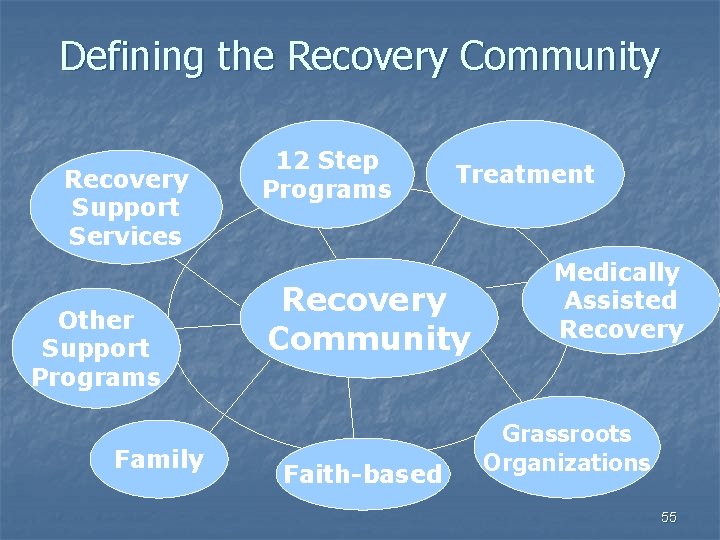
Defining the Recovery Community Recovery Support Services Other Support Programs Family 12 Step Programs Treatment Recovery Community Faith-based Medically Assisted Recovery Grassroots Organizations 55
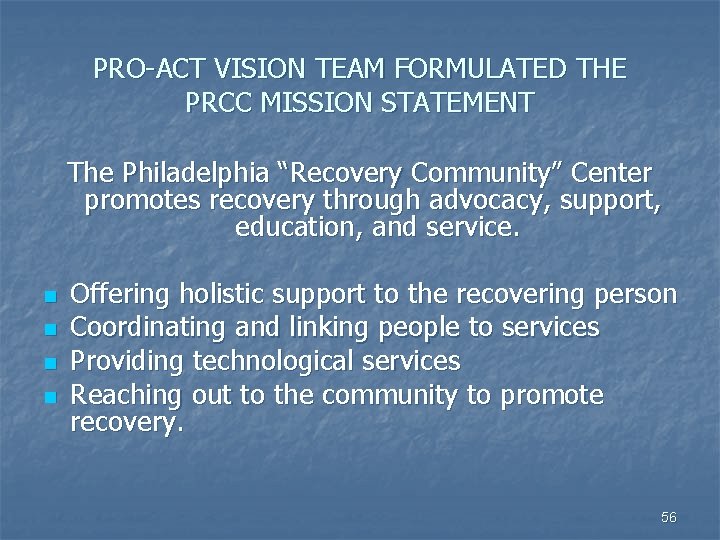
PRO-ACT VISION TEAM FORMULATED THE PRCC MISSION STATEMENT The Philadelphia “Recovery Community” Center promotes recovery through advocacy, support, education, and service. n n Offering holistic support to the recovering person Coordinating and linking people to services Providing technological services Reaching out to the community to promote recovery. 56
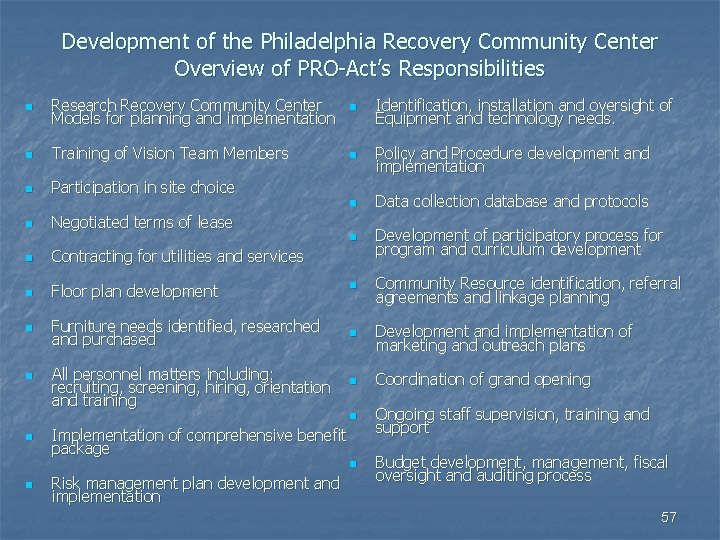
Development of the Philadelphia Recovery Community Center Overview of PRO-Act’s Responsibilities n Research Recovery Community Center Models for planning and implementation n Identification, installation and oversight of Equipment and technology needs. n Training of Vision Team Members n Policy and Procedure development and implementation n Participation in site choice n Data collection database and protocols n Development of participatory process for program and curriculum development n Negotiated terms of lease n Contracting for utilities and services n Floor plan development n Community Resource identification, referral agreements and linkage planning n Furniture needs identified, researched and purchased n Development and implementation of marketing and outreach plans All personnel matters including: recruiting, screening, hiring, orientation and training n Coordination of grand opening n Ongoing staff supervision, training and support n Budget development, management, fiscal oversight and auditing process n n n Implementation of comprehensive benefit package Risk management plan development and implementation 57
Developing the Philadelphia Recovery Community Center Lessons Learned n If you build it they will come so it is important to design programs and services that can be delivered by volunteers – Volunteer Health Organization Model. n Provide adequate time for developing policies and procedures, recruiting, and training staff to provide consistent, stress-free service. n Mobilize local recovery community members to participate in the development of each Center for community engagement. n Have a well run ongoing volunteer recruitment, engagement, and training and supervision program for continued success. n Provide staff with ongoing training, support, encouragement and growth oriented supervision to promote self-care and avoiding relapse. 58
Developing the Philadelphia Recovery Community Center Lessons Learned Continued n n n Provide opportunities for providers and community organizations to use space for their activities when the Center is closed. Provide monthly calendar of activities and adhere to schedule to assist service recipients and reduce staff stress. Create a Vision Team to reviewing the monthly offerings/activities and new programming ideas. 59
Research Targets for Recovery Centers n To understand what happens between baseline and follow-up and link outcomes to type and amount of services provided n Instrument and tracking approach – GPRA - CCAMP n Evaluation Tracking Domains n Drug and alcohol use n Family and living conditions n Education, employment and income n Crime and criminal justice status n Mental and physical health and treatment/recovery n Social connectedness 60
Research Targets CCAMP Asset Mapping System Also Enables Us To n n Identify community and individual strengths, needs and interests Plan programs that are meaningful to potential participants Engage volunteers, participants and community groups based on their own unique strengths and interests Link community members with common skills and interests and create stronger recovery-oriented networks 61
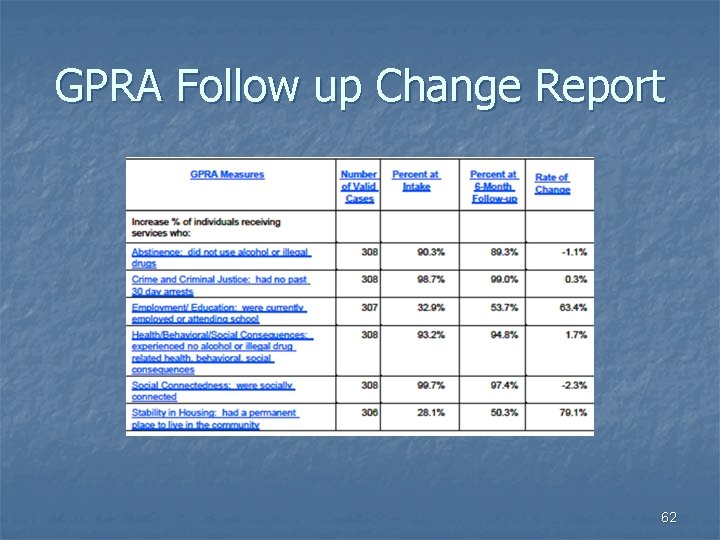
GPRA Follow up Change Report 62
Early Recovery n n Often requires a concerted effort to change people, places and things that might trigger relapse. A highly active, visible and welcoming Community Recovery Organization provides great competition to drug dealers who are trying to get back a good customer. 63
Members of the Recovery Community Play Increasing Role and Voice n n n n Certified Recovery Specialist Certified Peer Specialist Recovery Coaches Facilitators Zip Code Leaders Vision Team Members Representative On Focus Groups, Task Forces, Planning Committees, Steering Committees Participate Throughout the Decision Making Process 64
Beverly J. Haberle, M. H. S. , L. P. C. , C. A. D. C. Project Director PRO-ACT 252 West Swamp Road, Bailiwick Office Campus Unit 12 Doylestown, Pennsylvania 18901 Phone: (215) 345 -6644 bhaberle@councilsepa. org www. proact. org 65
- Slides: 65