
Peer observation for coaching and mentoring How do
Peer observation for coaching and mentoring: How do we give feedback and support? How can we create a culture of peer to peer coaching at Oakham? By Dr Julie Summers (Senior Lead Practitioner)
• When was the last time you were observed? • Have you ever been observed when a lesson when completely ‘wrong’? • How does being observed make you feel? • Does WHO is observing you make a difference to this?
To what extent do you agree with these statements? • Observations are all about rating a teacher’s performance, not about improving practice. • I’m much more comfortable being watched when I don’t know anyone is coming. • I’d rather be observed by someone I don’t know. • I always learn something from watching a lesson, even if the pupils don’t! • Observations are never natural, even if they are informal. • Being observed makes me up my game and I always value the feedback I get.

Peer observation has been shown to be an effective way of helping teachers to improve their practise and have a positive impact on pupils learning. Observation is one element of peer coaching. Peer coaching is a confidential process through which two or more professional colleagues work together to reflect on current practices; expand, refine, and build new skills; share ideas; teach one another; conduct classroom research; or solve problems in the workplace. • • Top things you can learn from watching someone else teach Top benefits of being observed. What are people most ‘afraid’ of? How can we foster a culture of non-evaluative peer support in school?
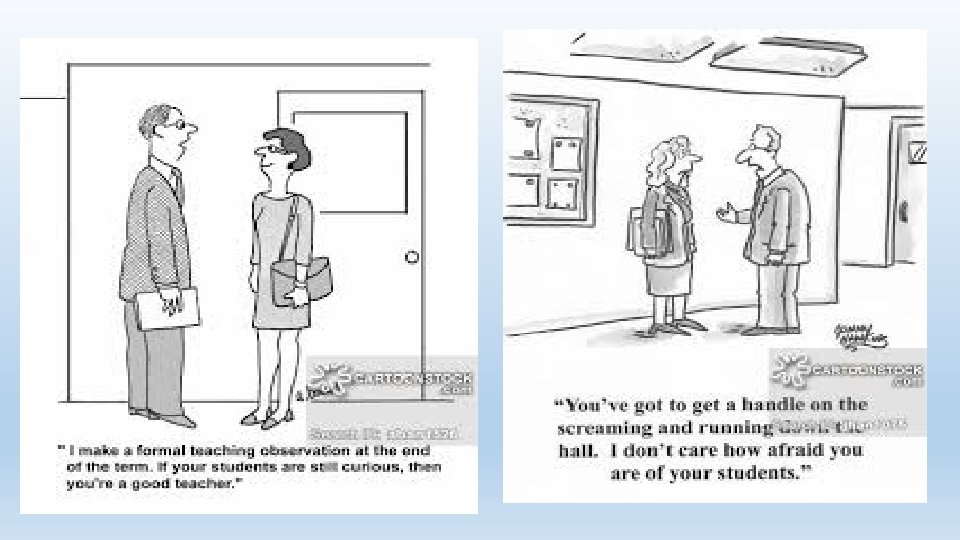
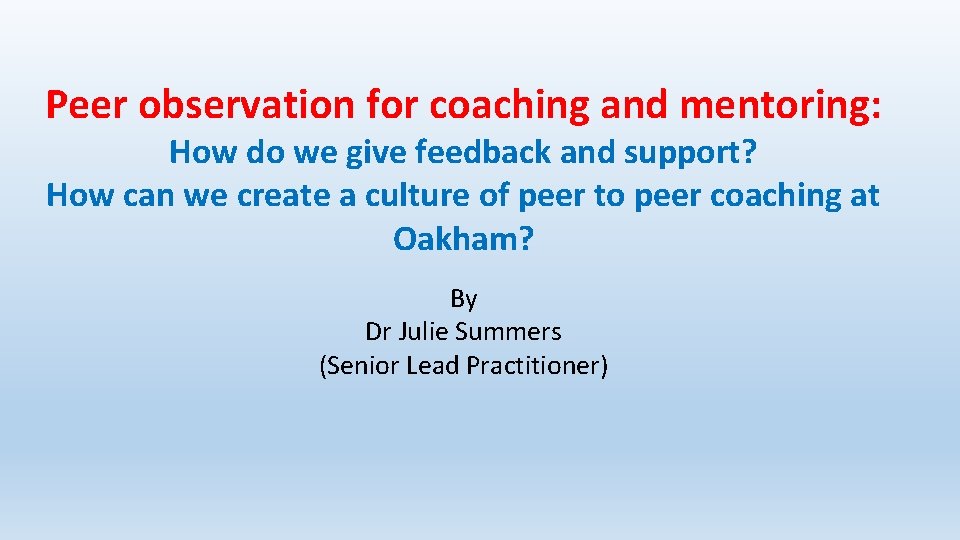
Why does observation make many people nervous? • When they feel judged • When it is used for performance management rather than professional development • When it isn’t done often, it feels like a bigger deal • When it’s only ever carried out by SLT or equivalent (sense of hierarchy) • When observation feedback is critical but unconstructive • When observation feedback is bland, unspecific or dishonest
The main benefits of observing each other regularly… • Peer coaching has nothing to do with evaluation! • Equal status • It’s like holding a mirror up for a colleague so they can see themselves in it more clearly. • Peer coaches have one another’s best interests at heart, enabling them to be brutally honest. • Low stakes – both have something to gain, but no hierarchy involved so nothing to lose. • Encourages collaboration • Encourages reflection and the sharing of best practice • Peer advice can help resolve small issues with CR management, instructions, feedback etc • We should practice what we preach and lead by example – we want our pupils to learn from each other, talk about their learning and to reflect upon how they could improve!
When doesn’t it work? • When colleagues don’t rate or respect each other • When it’s not approached in the right spirit. Nothing should be intended or interpreted as critical rather, it should be mutually constructive. • When egos interfere it breaks down. • When there is no specific focus – feedback should be given on the areas set by the teacher being observed.
So…. How can we foster a culture of peer observation and support? - Learning walks, not just by SLT! Open door teaching when appropriate Casual conversation about T and L Joint planning/reflection on new schemes of work Lesson Study Establishing the practice of having a critical friend
How do you get the most out of being observed? - Set a focus for the observer. A particular pupil, aspect of your teaching (e. g. instructions, praise. . ), new activity… - Set the context. Explain beforehand what you hope to try out/achieve and where the lesson fits in with a particular topic or skill you are teaching. - Set aside a time to have a proper conversation about the lesson - Make it mutual – observe each other - Lesson Study – be involved in each other’s planning and delivery towards a common target.
How to be a good observer! • Agree on a time and place for feedback and what form it will take (e. g. written on school observation form or informal chat? ) • Ask the teacher what they want your involvement to be • Make notes of what happens, what is said so feedback can be very specific • Only feedback on the areas agreed upon beforehand • Be honest, be constructive • Say ‘I noticed that…’ so all feedback is based on observed fact. • Note down any questions you have during the lesson
Further reading around Observation: • Lesson Observation Feedback Book: An essential resource for any teacher interested in getting better (High Impact Teaching) by Pepps Mccrea (2015) • Classroom Observation by Matt O’Leary (2013) • Reclaiming Lesson Observation by Matt O’Leary (2016) • The Transparent Teacher: Taking Charge of Your Instruction with Peer-Collected Classroom Data (2013) • Peer Observation: Improving Teaching and Learning Through Collaboration by John Blanchard (2012) • Lesson Observation Pocketbook by Roy Watson-Davis (2009) • https: //www. researchgate. net/profile/David_Gosling/publication/267687499_Mo dels_of_Peer_Observation_of_Teaching/links/545 b 64810 cf 249070 a 7955 d 3. pdf • https: //www. tandfonline. com/doi/abs/10. 1080/19415257. 2012. 693119
In the school library…. Cohen, Louis, Lawrence Manion, and Keith Morrison. Research Methods in Education. 7 th ed. London: Routledge, 2011 Knight, Oliver, and David Benson. Creating Outstanding Classrooms : A Whole. School Approach. London: Routledge, 2013. Macintyre, Christine. The Art of Action Research in the Classroom. London: David Fulton, 2000 Swann, Joanna, and John Pratt. Educational Research in Practice : Making Sense of Methodology. London: Continuum, 2003. Taber, Keith. Classroom-Based Research and Evidence-Based Practice : An Introduction. Second edition. Los Angeles: SAGE, 2013 These two also have short sections, but are lighter reads: Bentley-Davies, Caroline. How to Be an Amazing Teacher. Carmarthen: Crown House Publishing, 2010. Tolhurst, Judith. The Essential Guide to Coaching and Mentoring. The Essential Guides. 2 nd Revised edition Harlow: Pearson Education Limited, 2010.
- Slides: 13