
Peer Flow Secure Load Balancing in Tor Aaron

Peer. Flow: Secure Load Balancing in Tor Aaron Johnson 1 Rob Jansen 1 Aaron Segal 2 Nicholas Hopper 3 Paul Syverson 1 1 U. S. Naval Research Laboratory 2 Yale University 3 University of Minnesota July 18 th, 2017 Privacy Enhancing Technologies Symposiu
Overview • Problem: Secure load-balancing in Tor • Existing Solutions • Tor. Flow Demonstrate attacks • Eigen. Speed • New Solution: Peer. Flow • Prove security against bandwidth-limited adversary • Experiments show similar performance to Tor. Flow 2
Overview • Problem: Secure load-balancing in Tor • Existing Solutions • Tor. Flow Demonstrate attacks • Eigen. Speed • New Solution: Peer. Flow • Prove security against bandwidth-limited adversary • Experiments show similar performance to Tor. Flow 3
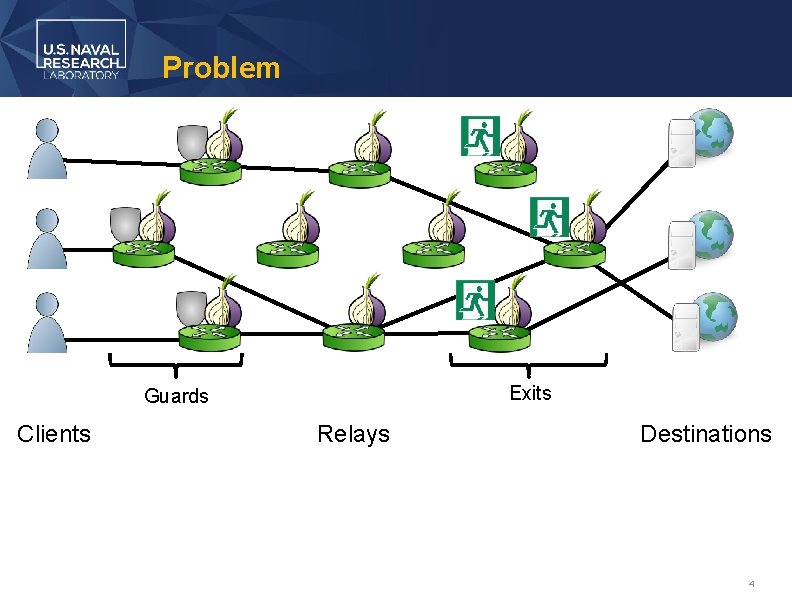
Problem Exits Guards Clients Relays Destinations 4
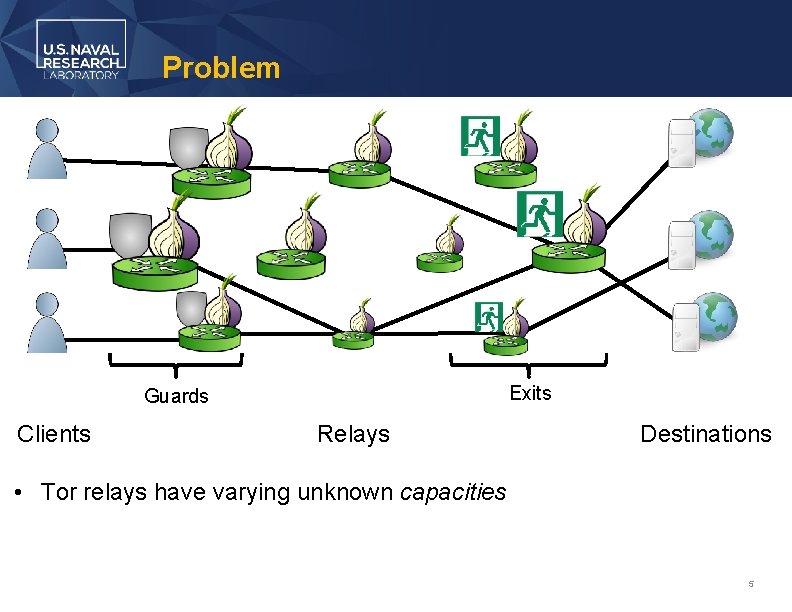
Problem Exits Guards Clients Relays Destinations • Tor relays have varying unknown capacities 5
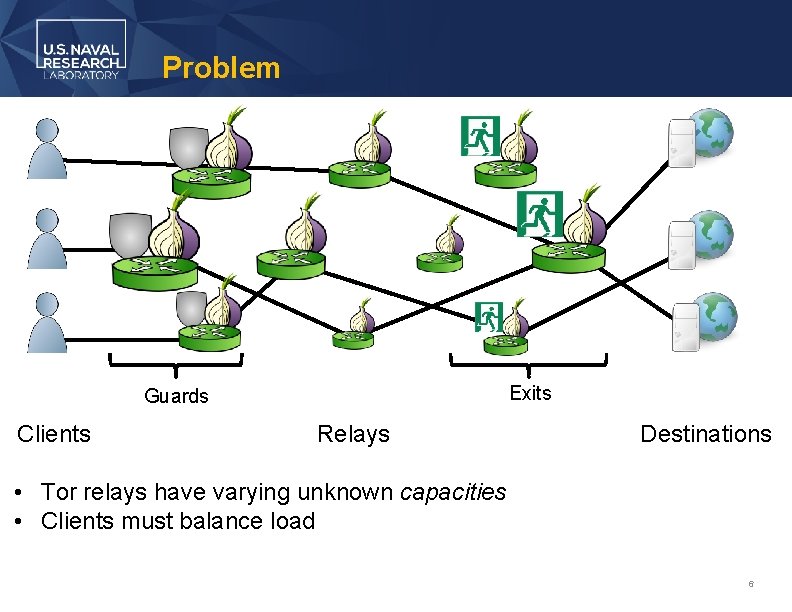
Problem Exits Guards Clients Relays Destinations • Tor relays have varying unknown capacities • Clients must balance load 6
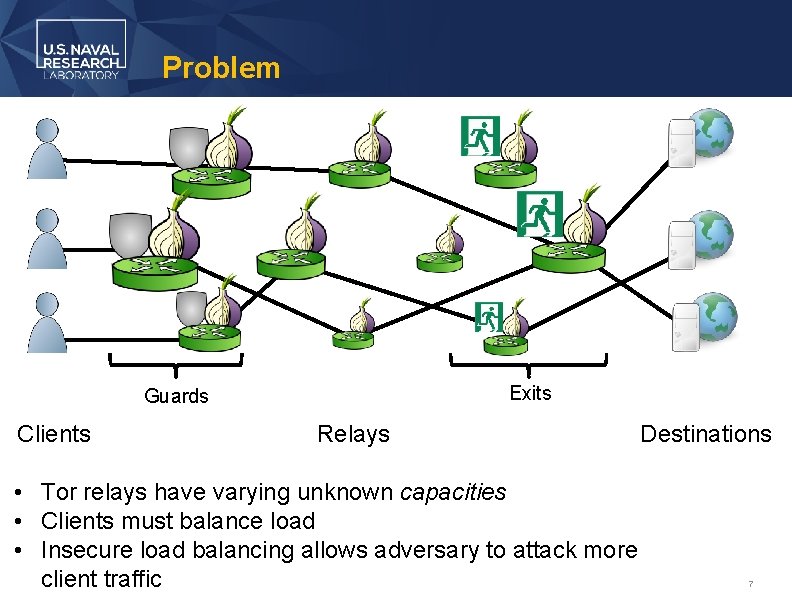
Problem Exits Guards Clients Relays • Tor relays have varying unknown capacities • Clients must balance load • Insecure load balancing allows adversary to attack more client traffic Destinations 7
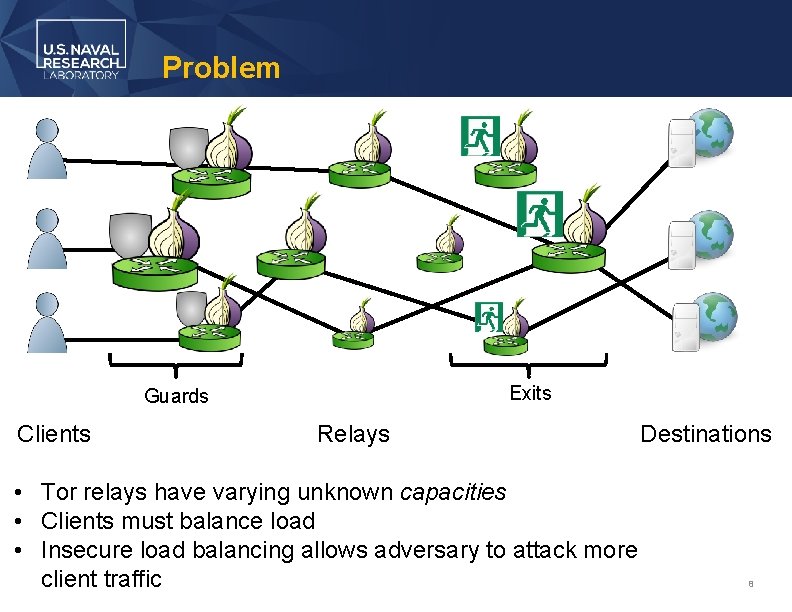
Problem Exits Guards Clients Relays • Tor relays have varying unknown capacities • Clients must balance load • Insecure load balancing allows adversary to attack more client traffic Destinations 8
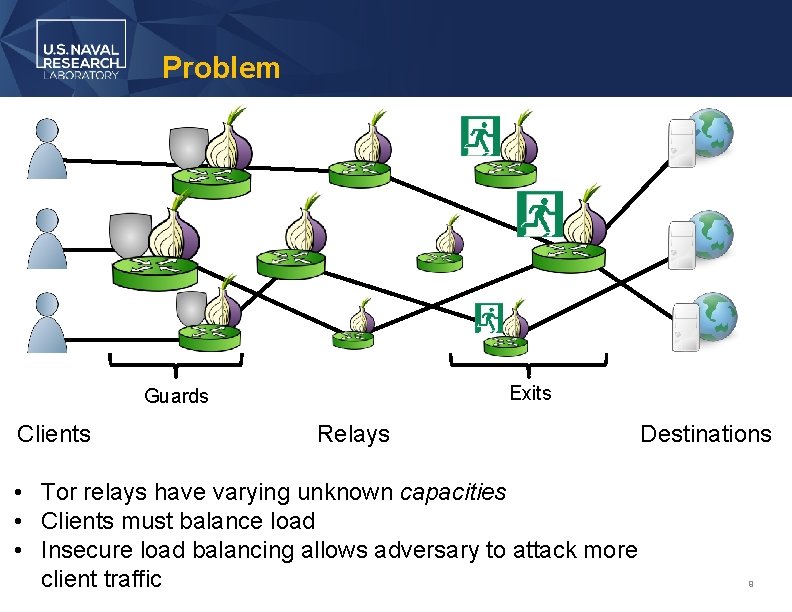
Problem Exits Guards Clients Relays • Tor relays have varying unknown capacities • Clients must balance load • Insecure load balancing allows adversary to attack more client traffic Destinations 9
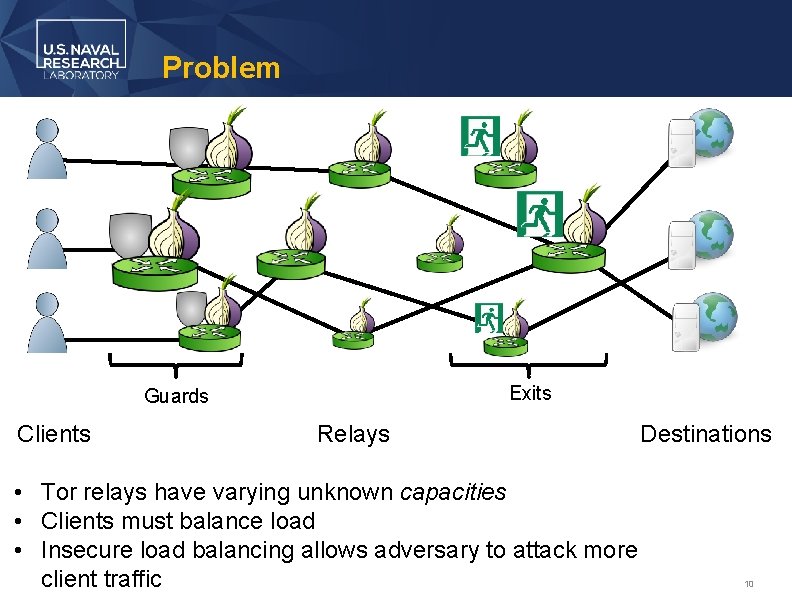
Problem Exits Guards Clients Relays • Tor relays have varying unknown capacities • Clients must balance load • Insecure load balancing allows adversary to attack more client traffic Destinations 10
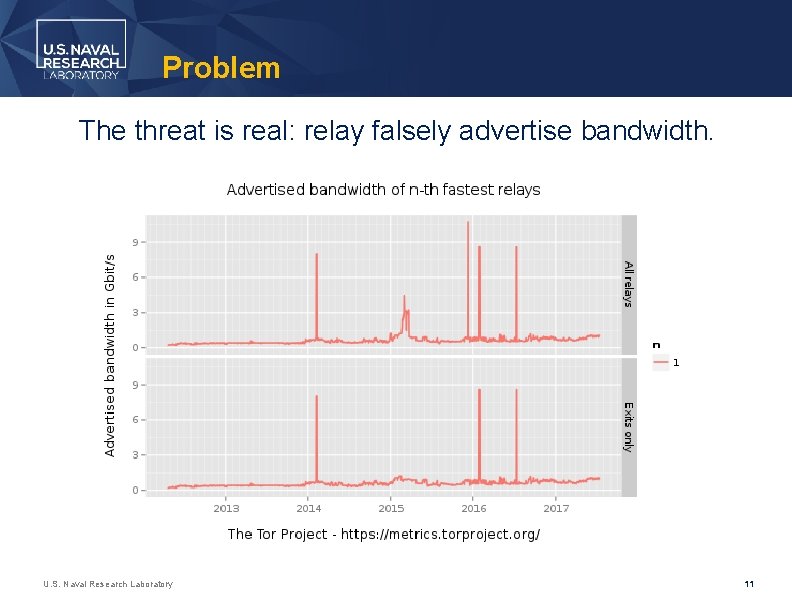
Problem The threat is real: relay falsely advertise bandwidth. U. S. Naval Research Laboratory 11
Overview • Problem: Secure load-balancing in Tor • Existing Solutions • Tor. Flow Demonstrate attacks • Eigen. Speed • New Solution: Peer. Flow • Prove security against bandwidth-limited adversary • Experiments show similar performance to Tor. Flow 12
Overview • Problem: Secure load-balancing in Tor • Existing Solutions • Tor. Flow Demonstrate attacks • Eigen. Speed • New Solution: Peer. Flow • Prove security against bandwidth-limited adversary • Experiments show similar performance to Tor. Flow 13
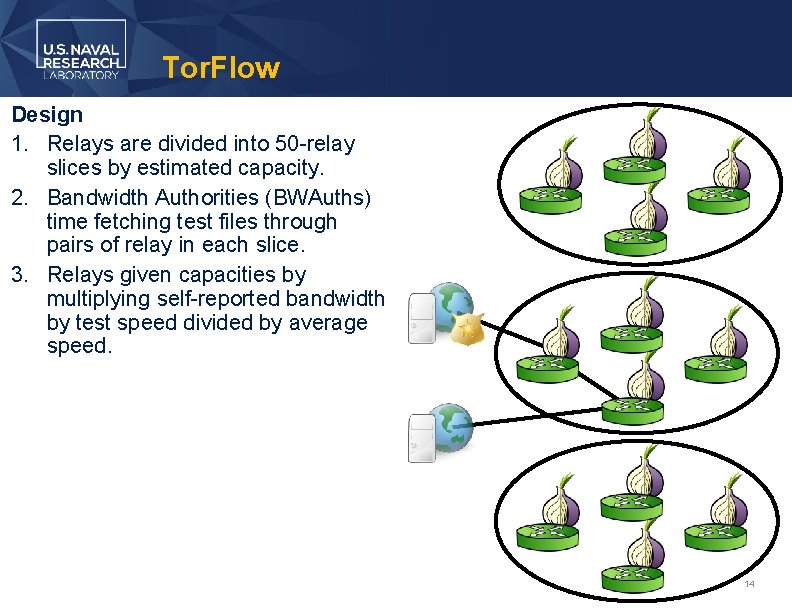
Tor. Flow Design 1. Relays are divided into 50 -relay slices by estimated capacity. 2. Bandwidth Authorities (BWAuths) time fetching test files through pairs of relay in each slice. 3. Relays given capacities by multiplying self-reported bandwidth by test speed divided by average speed. 14
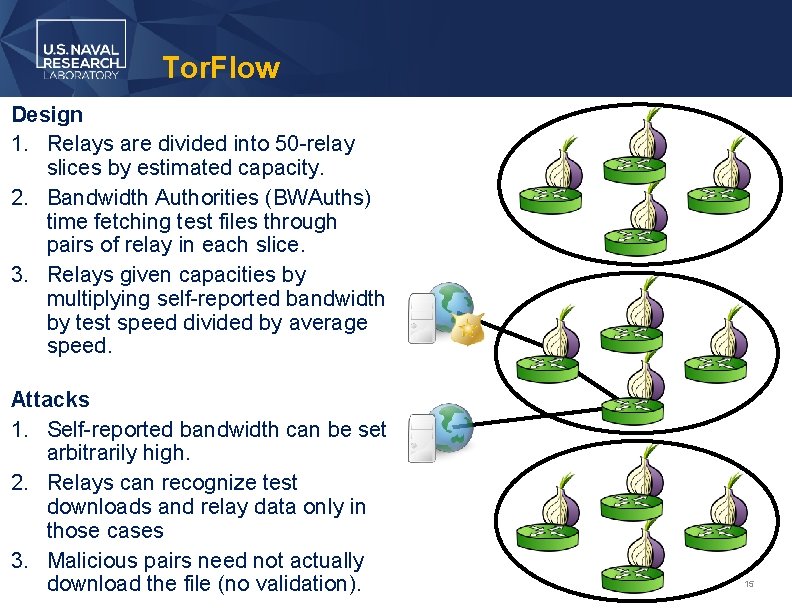
Tor. Flow Design 1. Relays are divided into 50 -relay slices by estimated capacity. 2. Bandwidth Authorities (BWAuths) time fetching test files through pairs of relay in each slice. 3. Relays given capacities by multiplying self-reported bandwidth by test speed divided by average speed. Attacks 1. Self-reported bandwidth can be set arbitrarily high. 2. Relays can recognize test downloads and relay data only in those cases 3. Malicious pairs need not actually download the file (no validation). 15

Tor. Flow Design 1. Relays are divided into 50 -relay slices by estimated capacity. 2. Bandwidth Authorities (BWAuths) time fetching test files through pairs of relay in each slice. 3. Relays given capacities by multiplying self-reported bandwidth by test speed divided by average speed. Attacks 1. Self-reported bandwidth can be set arbitrarily high. 2. Relays can recognize test downloads and relay data only in those cases 3. Malicious pairs need not actually download the file (no validation). Shadow experiments w/ #1: - Goodput: 22. 5 0. 2 - Weight: 7 11 16
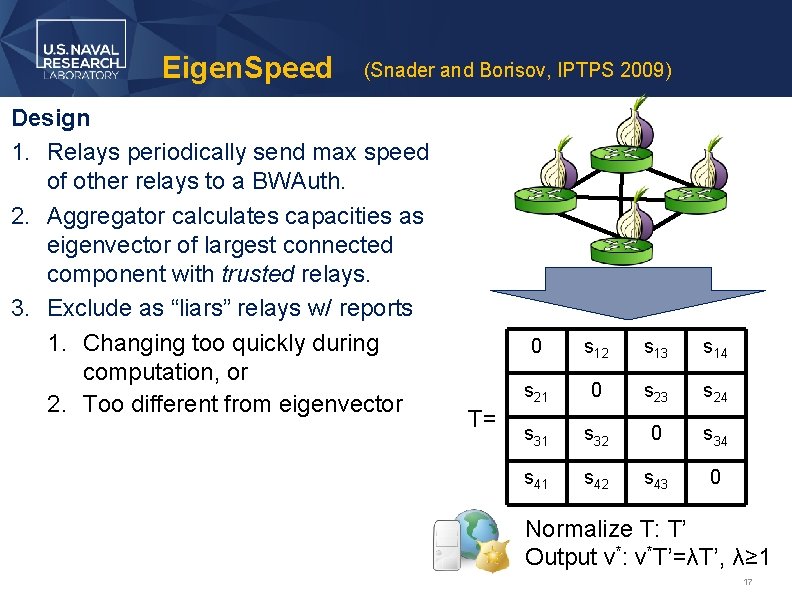
Eigen. Speed (Snader and Borisov, IPTPS 2009) Design 1. Relays periodically send max speed of other relays to a BWAuth. 2. Aggregator calculates capacities as eigenvector of largest connected component with trusted relays. 3. Exclude as “liars” relays w/ reports 1. Changing too quickly during computation, or 2. Too different from eigenvector T= 0 s 12 s 13 s 14 s 21 0 s 23 s 24 s 31 s 32 0 s 34 s 41 s 42 s 43 0 Normalize T: T’ Output v*: v*T’=λT’, λ≥ 1 17
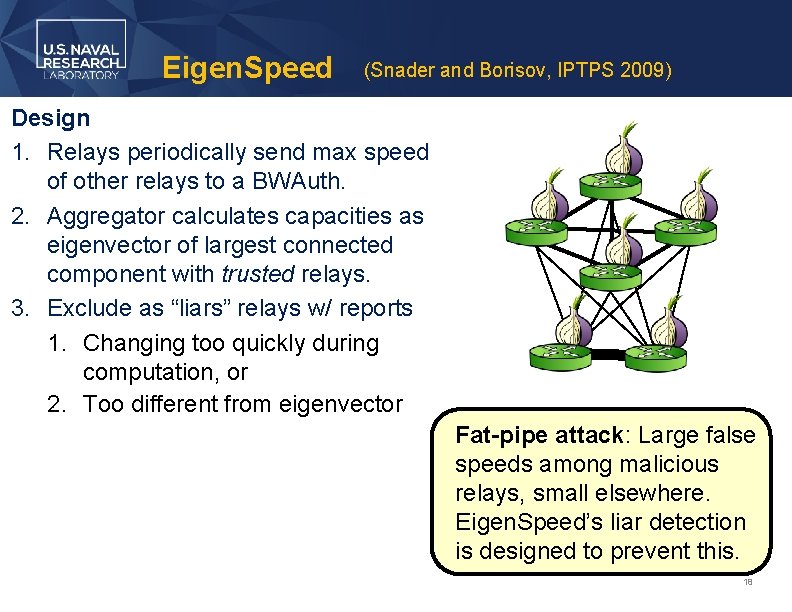
Eigen. Speed (Snader and Borisov, IPTPS 2009) Design 1. Relays periodically send max speed of other relays to a BWAuth. 2. Aggregator calculates capacities as eigenvector of largest connected component with trusted relays. 3. Exclude as “liars” relays w/ reports 1. Changing too quickly during computation, or 2. Too different from eigenvector Fat-pipe attack: Large false speeds among malicious relays, small elsewhere. Eigen. Speed’s liar detection is designed to prevent this. 18
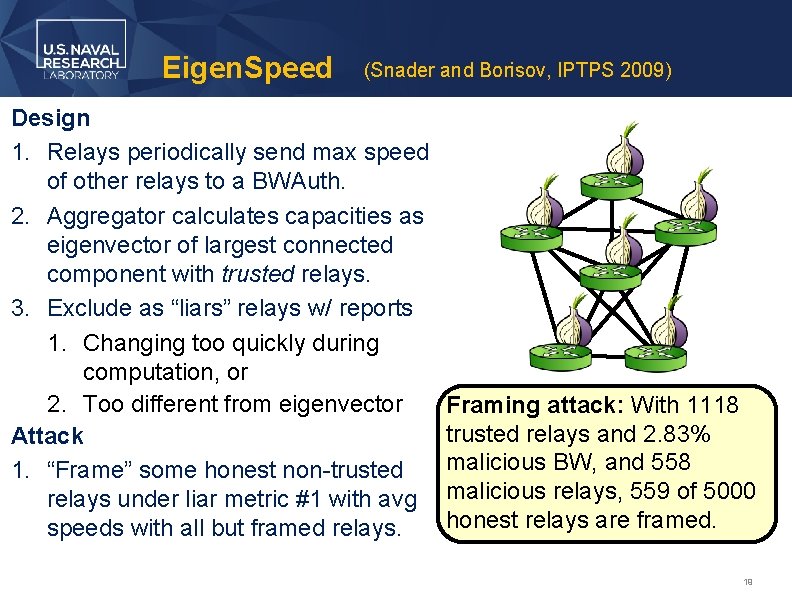
Eigen. Speed (Snader and Borisov, IPTPS 2009) Design 1. Relays periodically send max speed of other relays to a BWAuth. 2. Aggregator calculates capacities as eigenvector of largest connected component with trusted relays. 3. Exclude as “liars” relays w/ reports 1. Changing too quickly during computation, or 2. Too different from eigenvector Attack 1. “Frame” some honest non-trusted relays under liar metric #1 with avg speeds with all but framed relays. Framing attack: With 1118 trusted relays and 2. 83% malicious BW, and 558 malicious relays, 559 of 5000 honest relays are framed. 19
Overview • Problem: Secure load-balancing in Tor • Existing Solutions • Tor. Flow Demonstrate attacks • Eigen. Speed • New Solution: Peer. Flow • Prove security against bandwidth-limited adversary • Experiments show similar performance to Tor. Flow 20

Peer. Flow: Design 21
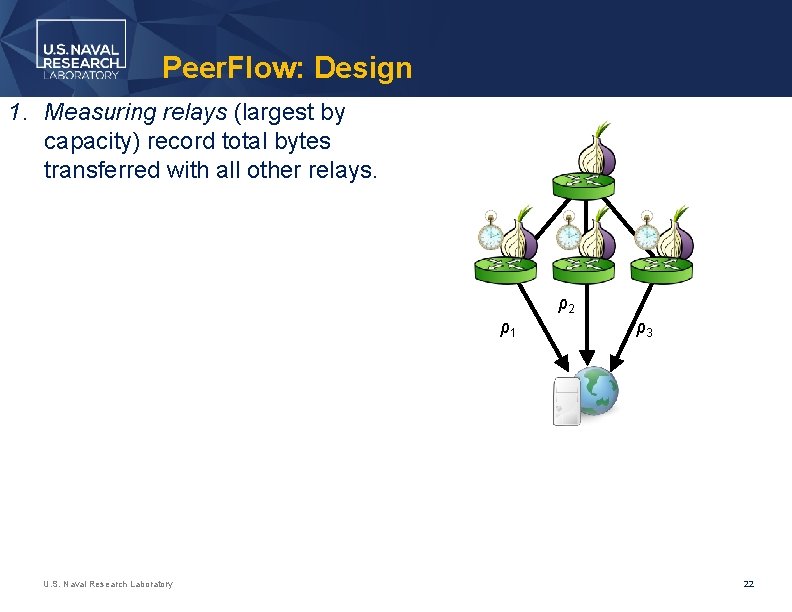
Peer. Flow: Design 1. Measuring relays (largest by capacity) record total bytes transferred with all other relays. ρ2 ρ1 U. S. Naval Research Laboratory ρ3 22
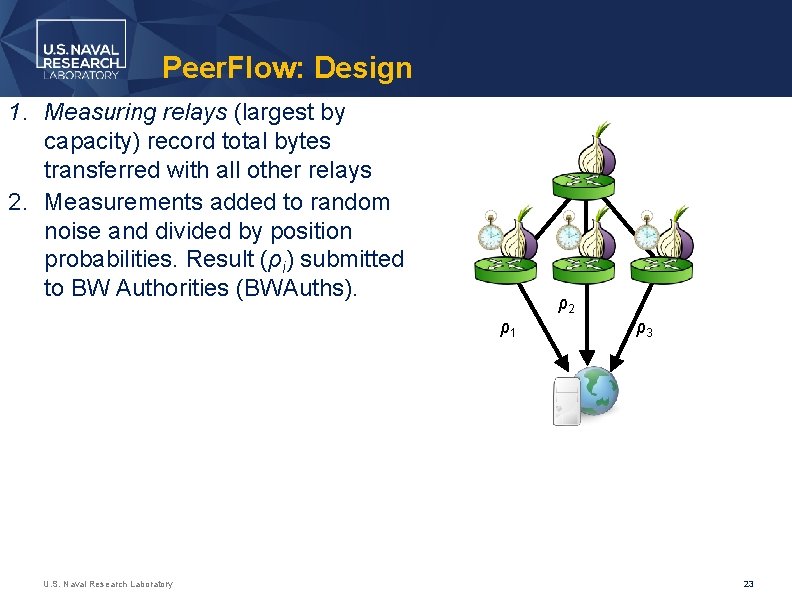
Peer. Flow: Design 1. Measuring relays (largest by capacity) record total bytes transferred with all other relays 2. Measurements added to random noise and divided by position probabilities. Result (ρi) submitted to BW Authorities (BWAuths). ρ2 ρ1 U. S. Naval Research Laboratory ρ3 23
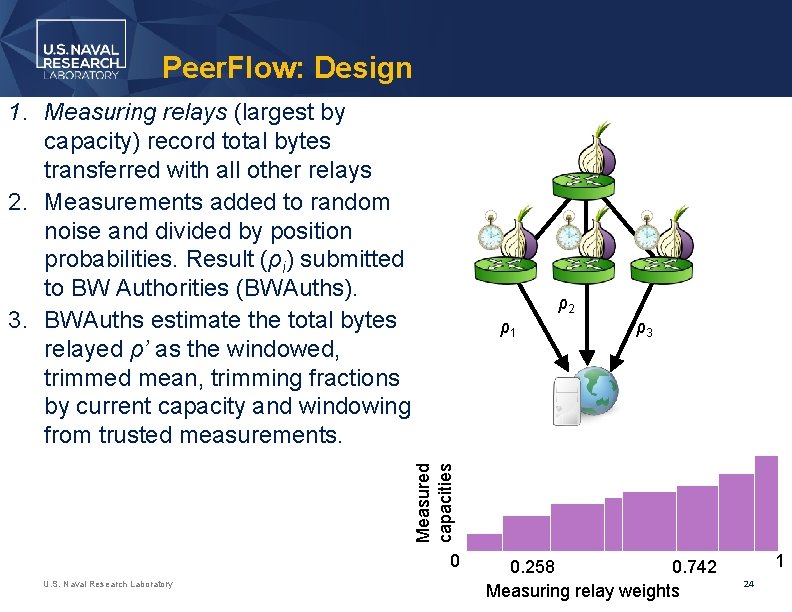
Peer. Flow: Design 1. Measuring relays (largest by capacity) record total bytes transferred with all other relays 2. Measurements added to random noise and divided by position probabilities. Result (ρi) submitted to BW Authorities (BWAuths). 3. BWAuths estimate the total bytes relayed ρ’ as the windowed, trimmed mean, trimming fractions by current capacity and windowing from trusted measurements. ρ2 ρ3 Measured capacities ρ1 0 U. S. Naval Research Laboratory 0. 258 0. 742 Measuring relay weights 1 24
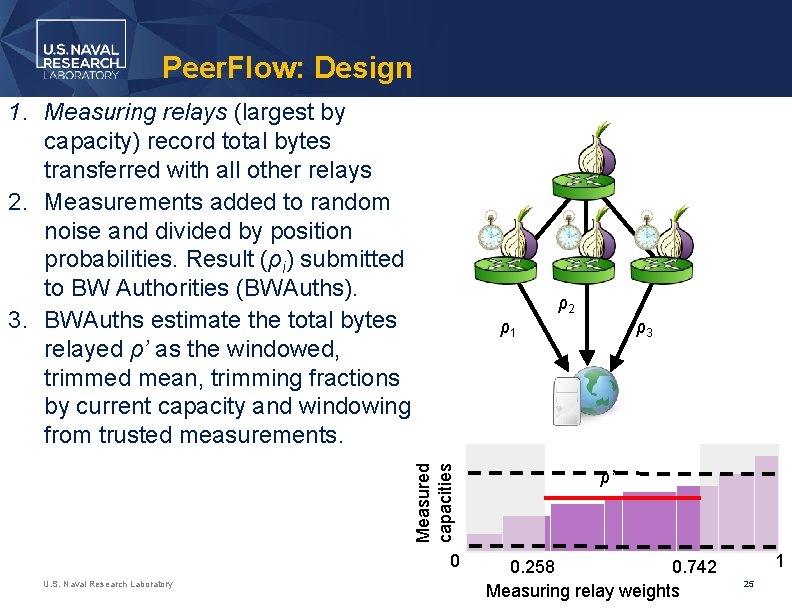
Peer. Flow: Design 1. Measuring relays (largest by capacity) record total bytes transferred with all other relays 2. Measurements added to random noise and divided by position probabilities. Result (ρi) submitted to BW Authorities (BWAuths). 3. BWAuths estimate the total bytes relayed ρ’ as the windowed, trimmed mean, trimming fractions by current capacity and windowing from trusted measurements. ρ2 Measured capacities ρ1 0 U. S. Naval Research Laboratory ρ3 ρ’ 0. 258 0. 742 Measuring relay weights 1 25
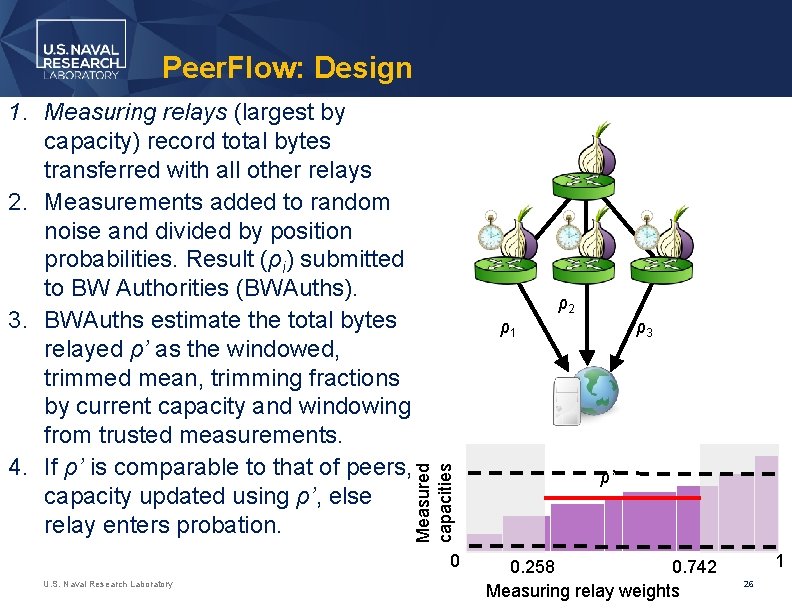
Peer. Flow: Design ρ2 ρ1 Measured capacities 1. Measuring relays (largest by capacity) record total bytes transferred with all other relays 2. Measurements added to random noise and divided by position probabilities. Result (ρi) submitted to BW Authorities (BWAuths). 3. BWAuths estimate the total bytes relayed ρ’ as the windowed, trimmed mean, trimming fractions by current capacity and windowing from trusted measurements. 4. If ρ’ is comparable to that of peers, capacity updated using ρ’, else relay enters probation. 0 U. S. Naval Research Laboratory ρ3 ρ’ 0. 258 0. 742 Measuring relay weights 1 26
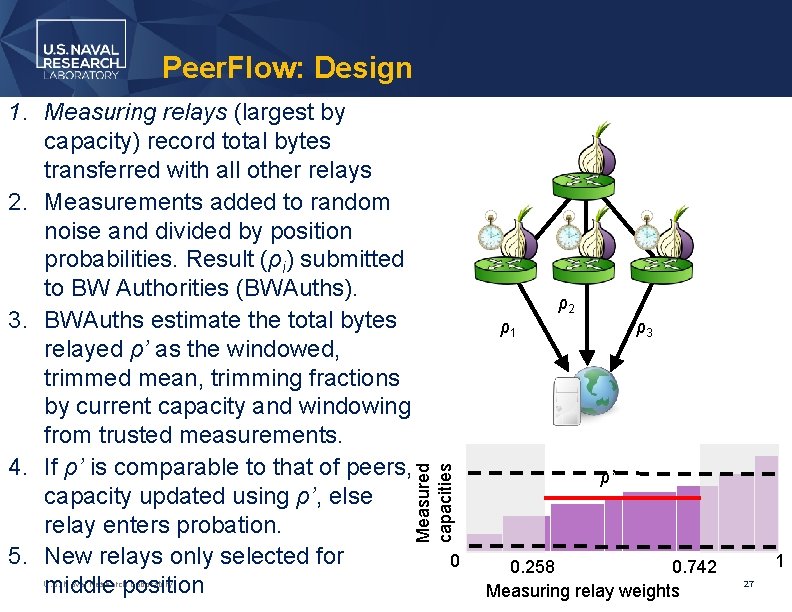
Peer. Flow: Design ρ2 ρ1 Measured capacities 1. Measuring relays (largest by capacity) record total bytes transferred with all other relays 2. Measurements added to random noise and divided by position probabilities. Result (ρi) submitted to BW Authorities (BWAuths). 3. BWAuths estimate the total bytes relayed ρ’ as the windowed, trimmed mean, trimming fractions by current capacity and windowing from trusted measurements. 4. If ρ’ is comparable to that of peers, capacity updated using ρ’, else relay enters probation. 5. New relays only selected for middle position U. S. Naval Research Laboratory 0 ρ3 ρ’ 0. 258 0. 742 Measuring relay weights 1 27
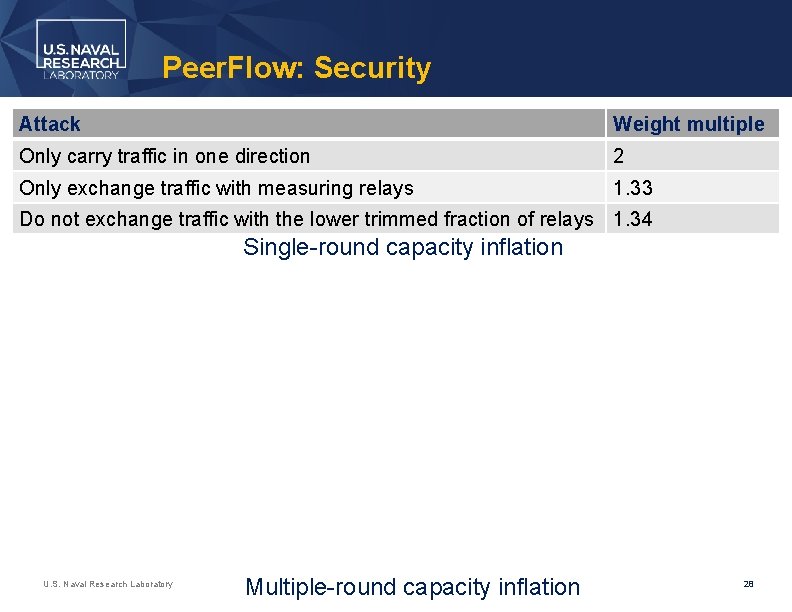
Peer. Flow: Security Attack Weight multiple Only carry traffic in one direction 2 Only exchange traffic with measuring relays 1. 33 Do not exchange traffic with the lower trimmed fraction of relays 1. 34 Single-round capacity inflation U. S. Naval Research Laboratory Multiple-round capacity inflation 28
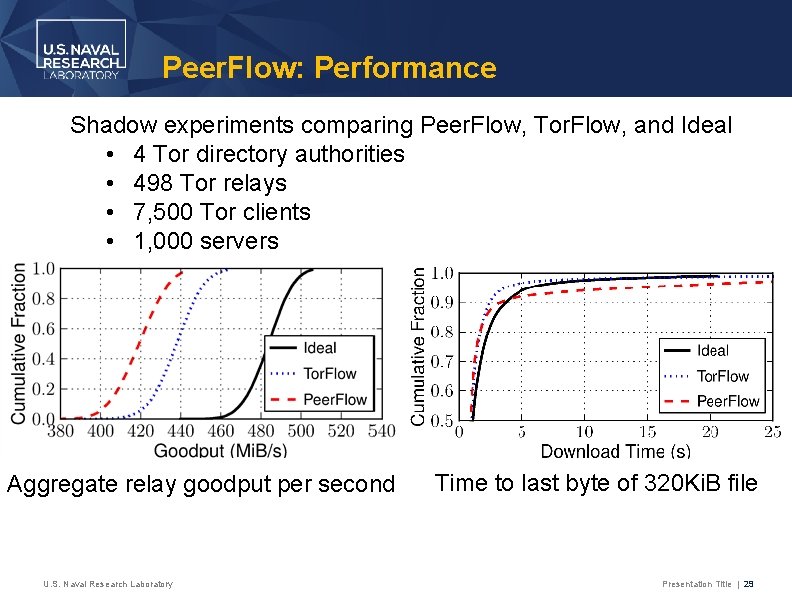
Peer. Flow: Performance Shadow experiments comparing Peer. Flow, Tor. Flow, and Ideal • 4 Tor directory authorities • 498 Tor relays • 7, 500 Tor clients • 1, 000 servers Aggregate relay goodput per second U. S. Naval Research Laboratory Time to last byte of 320 Ki. B file Presentation Title | 29
Conclusion 1. Tor needs secure load balancing 2. Demonstrated attacks on existing solutions • Tor. Flow • Eigen. Speed 3. Presented Peer. Flow • Demonstrated secure against bandwidth-limited adversary • Experimentally showed performance is similar to current Tor performance 30

Backup slides 31
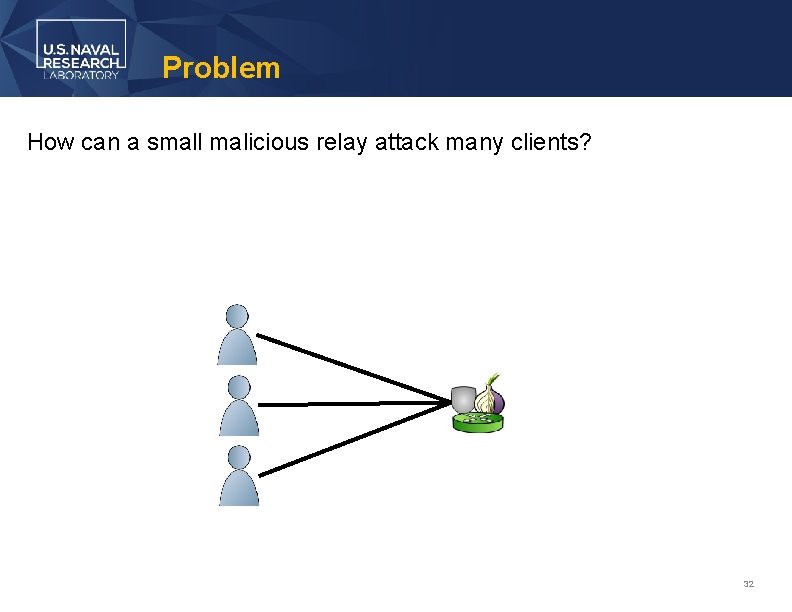
Problem How can a small malicious relay attack many clients? 32
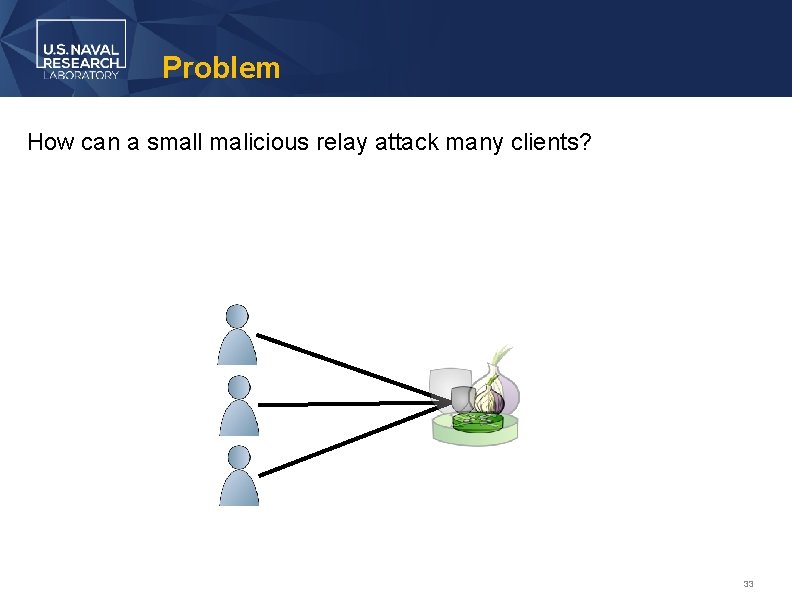
Problem How can a small malicious relay attack many clients? 33
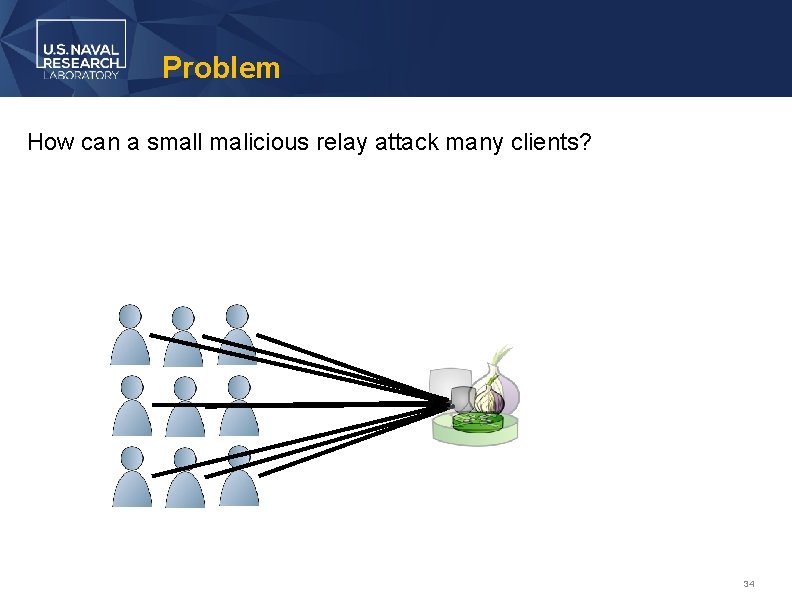
Problem How can a small malicious relay attack many clients? 34
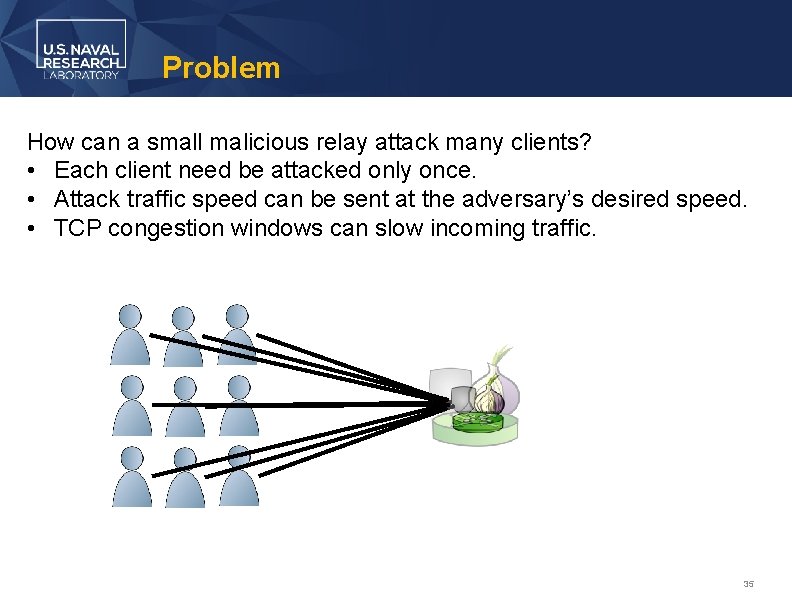
Problem How can a small malicious relay attack many clients? • Each client need be attacked only once. • Attack traffic speed can be sent at the adversary’s desired speed. • TCP congestion windows can slow incoming traffic. 35
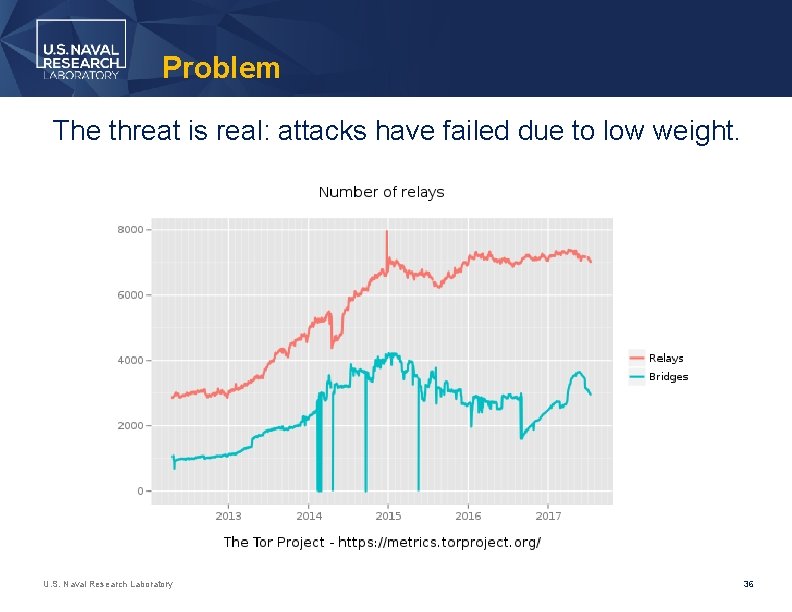
Problem The threat is real: attacks have failed due to low weight. U. S. Naval Research Laboratory 36
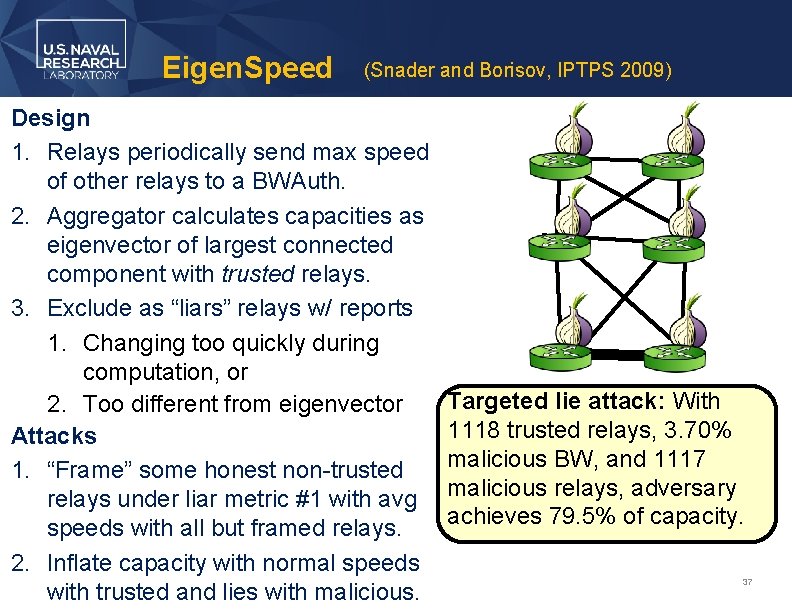
Eigen. Speed (Snader and Borisov, IPTPS 2009) Design 1. Relays periodically send max speed of other relays to a BWAuth. 2. Aggregator calculates capacities as eigenvector of largest connected component with trusted relays. 3. Exclude as “liars” relays w/ reports 1. Changing too quickly during computation, or 2. Too different from eigenvector Attacks 1. “Frame” some honest non-trusted relays under liar metric #1 with avg speeds with all but framed relays. 2. Inflate capacity with normal speeds with trusted and lies with malicious. Targeted lie attack: With 1118 trusted relays, 3. 70% malicious BW, and 1117 malicious relays, adversary achieves 79. 5% of capacity. 37
- Slides: 37