
PEER COACHING On the job training Created by
PEER COACHING On the job training Created by Puget Sound Regional Services November 2015
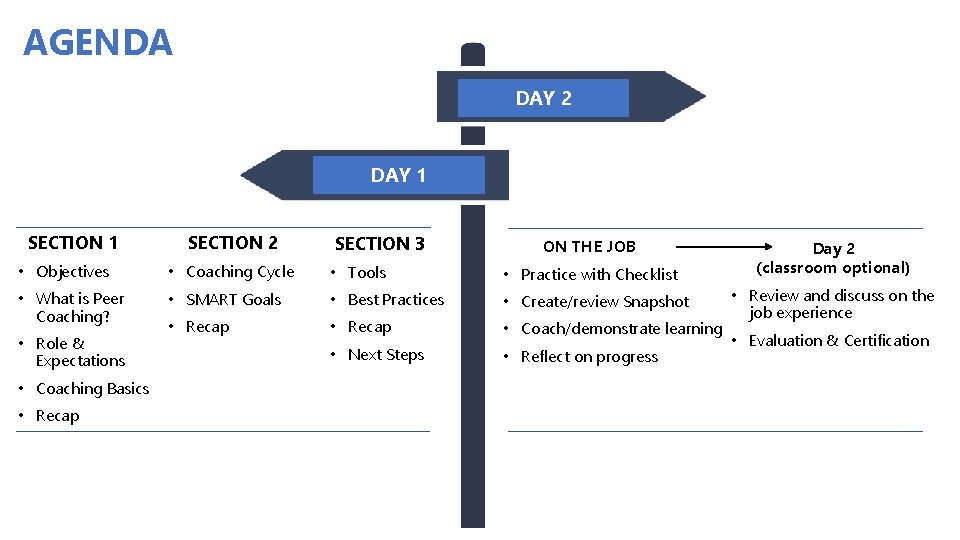
AGENDA DAY 2 DAY 1 SECTION 2 SECTION 3 ON THE JOB • Objectives • Coaching Cycle • Tools • Practice with Checklist • What is Peer Coaching? • SMART Goals • Best Practices • Create/review Snapshot • Recap • Coach/demonstrate learning • Next Steps • Reflect on progress • Role & Expectations • Coaching Basics • Recap Day 2 (classroom optional) • Review and discuss on the job experience • Evaluation & Certification
SECTION 1 Objectives & Outcomes What is Peer Coaching? Attributes Role & Expectations Activity Effective Coaching Guide to Action Video Recap
Objectives & Outcomes Objective Senior, knowledgeable staff will learn tools to use in order to best train and support New Staff (NS) to properly learn and perform the functions of their job. What can you expect? To become a “qualified“ Peer Coach After this training, you should be able to: ü Define what Peer Coaching is and why we are doing it ü Understand your role and expectations ü Identify and implement tools ü Be able to apply best practices
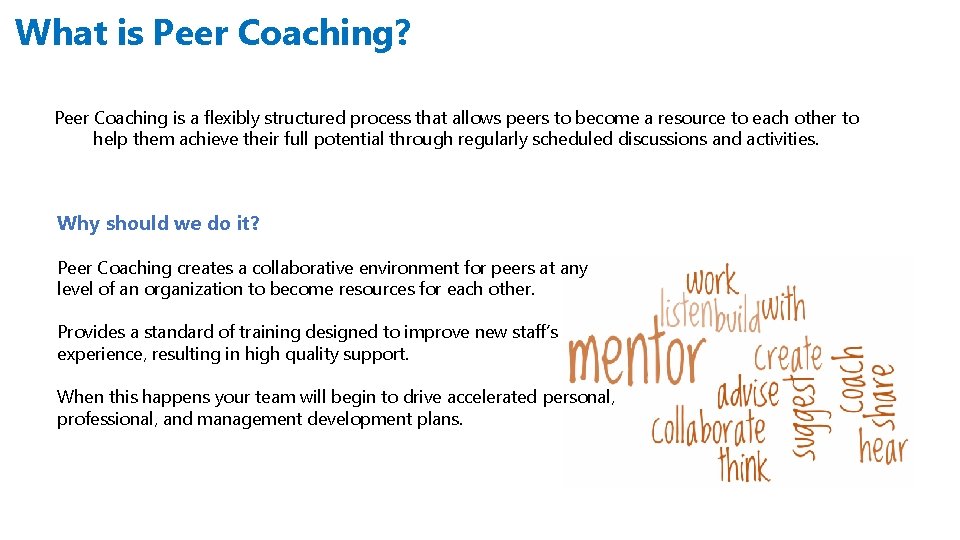
What is Peer Coaching? Peer Coaching is a flexibly structured process that allows peers to become a resource to each other to help them achieve their full potential through regularly scheduled discussions and activities. Why should we do it? Peer Coaching creates a collaborative environment for peers at any level of an organization to become resources for each other. Provides a standard of training designed to improve new staff’s experience, resulting in high quality support. When this happens your team will begin to drive accelerated personal, professional, and management development plans.
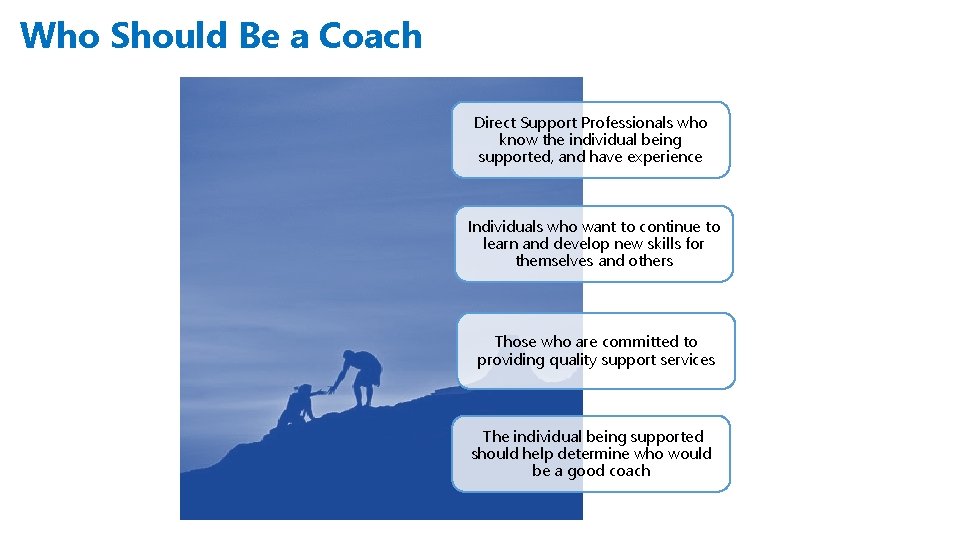
Who Should Be a Coach Direct Support Professionals who know the individual being supported, and have experience Individuals who want to continue to learn and develop new skills for themselves and others Those who are committed to providing quality support services The individual being supported should help determine who would be a good coach
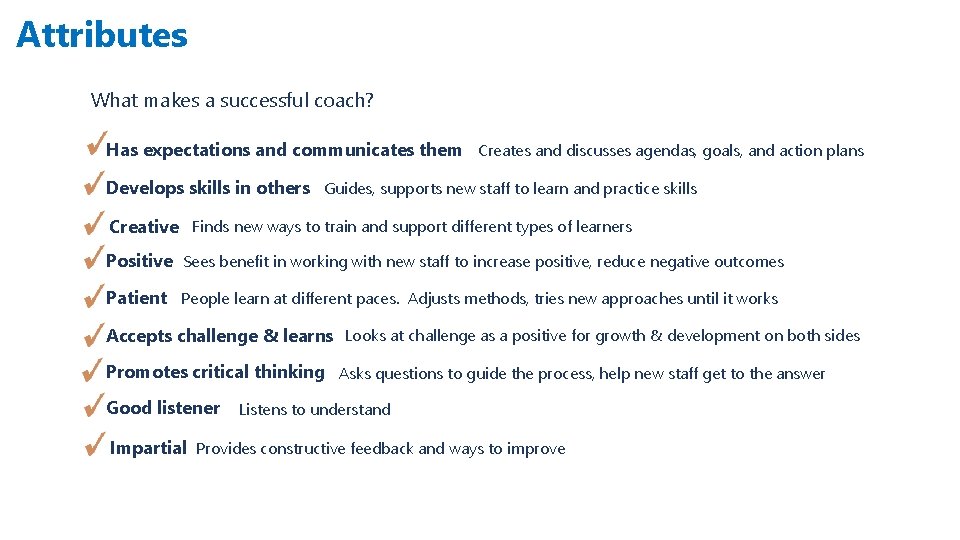
Attributes What makes a successful coach? Has expectations and communicates them Creates and discusses agendas, goals, and action plans Develops skills in others Guides, supports new staff to learn and practice skills Creative Finds new ways to train and support different types of learners Positive Sees benefit in working with new staff to increase positive, reduce negative outcomes Patient People learn at different paces. Adjusts methods, tries new approaches until it works Accepts challenge & learns Looks at challenge as a positive for growth & development on both sides Promotes critical thinking Asks questions to guide the process, help new staff get to the answer Good listener Listens to understand Impartial Provides constructive feedback and ways to improve
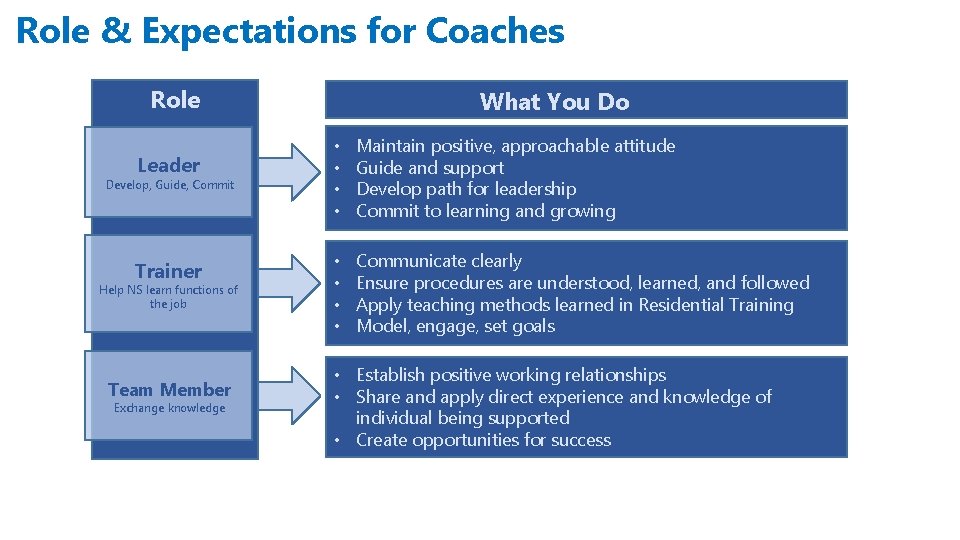
Role & Expectations for Coaches Role Leader Develop, Guide, Commit Trainer Help NS learn functions of the job Team Member Exchange knowledge What You Do • • Maintain positive, approachable attitude Guide and support Develop path for leadership Commit to learning and growing • • Communicate clearly Ensure procedures are understood, learned, and followed Apply teaching methods learned in Residential Training Model, engage, set goals • Establish positive working relationships • Share and apply direct experience and knowledge of individual being supported • Create opportunities for success
Activity Part 1 How this works: 1 One team member will build ONLY one structure per the instructions given. DO NOT TALK. 2 The other team members will watch. DO NOT take notes or photos of the structure, you cannot ask questions. 3 After instructed, Builder disassembles the structure. TIME ALLOTTED: 10 minutes
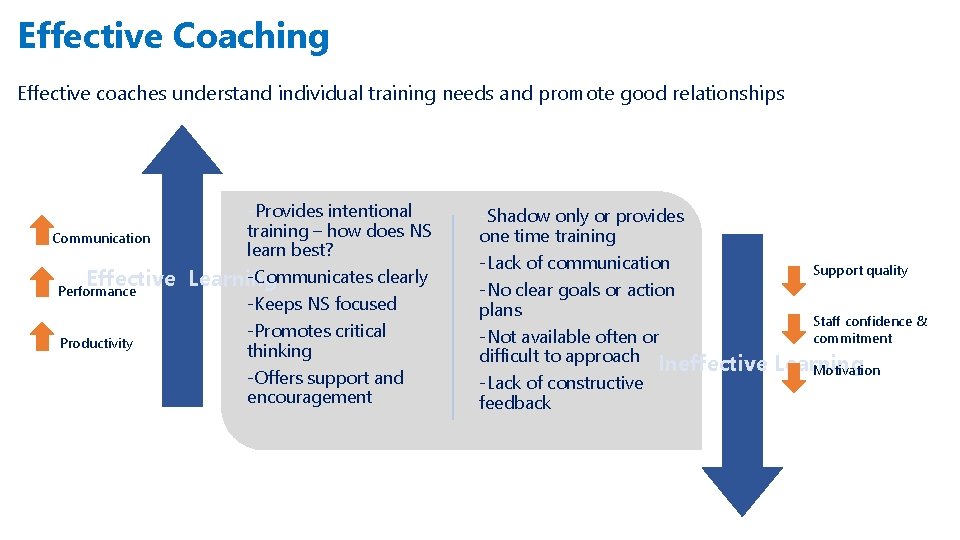
Effective Coaching Effective coaches understand individual training needs and promote good relationships -Provides intentional Communication Effective Performance Productivity training – how does NS learn best? -Communicates clearly Learning -Keeps NS focused -Promotes critical thinking -Offers support and encouragement -Shadow only or provides one time training -Lack of communication -No clear goals or action plans -Not available often or difficult to approach Ineffective -Lack of constructive feedback Support quality Staff confidence & commitment Learning Motivation
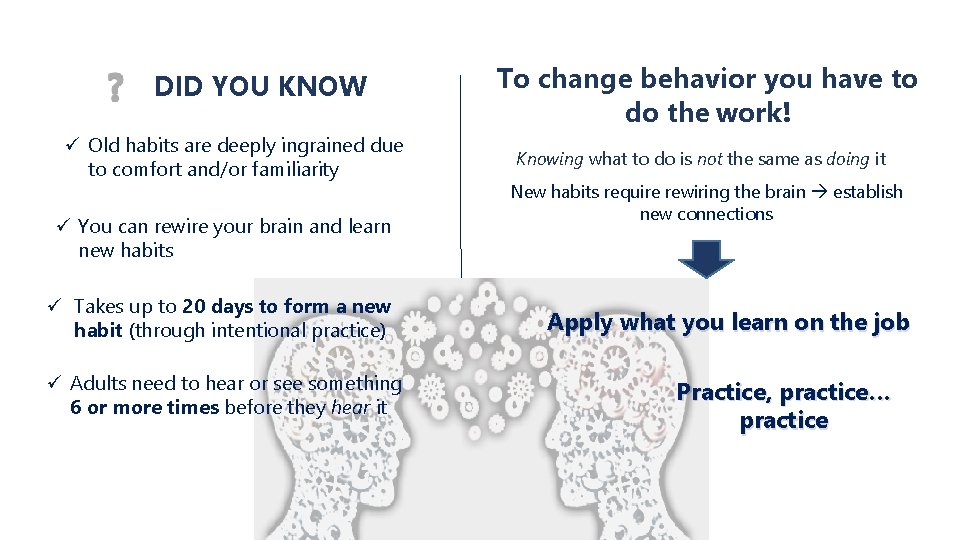
DID YOU KNOW ü Old habits are deeply ingrained due to comfort and/or familiarity ü You can rewire your brain and learn new habits ü Takes up to 20 days to form a new habit (through intentional practice) ü Adults need to hear or see something 6 or more times before they hear it To change behavior you have to do the work! Knowing what to do is not the same as doing it New habits require rewiring the brain establish new connections Apply what you learn on the job Practice, practice… practice
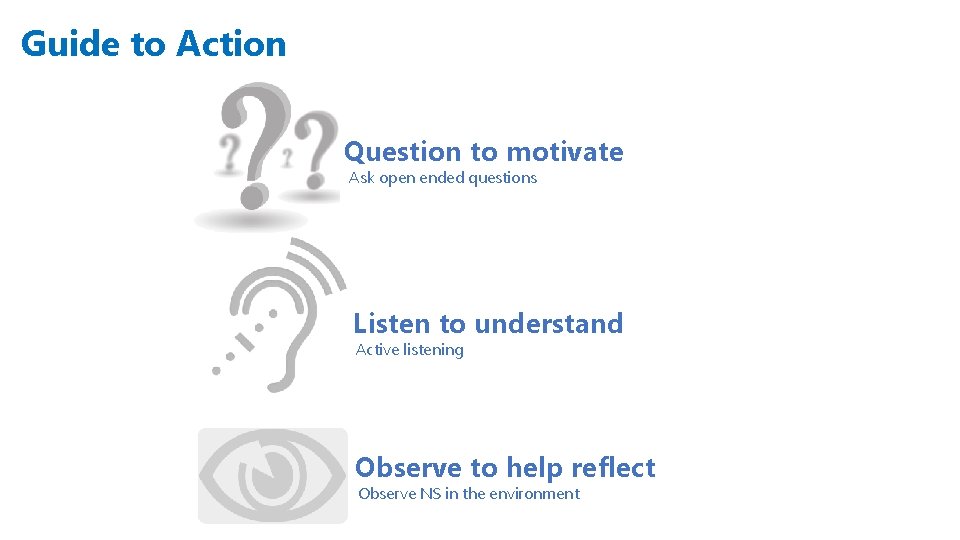
Guide to Action Question to motivate Ask open ended questions Listen to understand Active listening Observe to help reflect Observe NS in the environment

Video
Activity Part 2 1 Now the other team member(s) will build the EXACT same structure as the previous builder did in the first part of this activity. The new builder(s) cannot use the instructions, and must replicate the structure based on memory. TIME ALLOTTED: 5 minutes
Recap What have we learned? ü Peer Coaching allows peers to become a resource to each other to help them achieve their full potential through regularly scheduled discussions and activities ü A successful Coach has many attributes including a positive attitude, listening skills, and deriving positive outcomes from challenges ü A Peer Coach is a leader, trainer, and team member who transfers knowledge and skills acquired from experience to NS ü Job shadowing is not a sole method of teaching/learning. Other aspects of coaching need to be incorporated into your training approach ü Guide to action: 1) Question to motivate, 2) Listen to understand, 3) Observe and reflect
Section 2 Coaching Cycle 1. Focus SMART Goals Activity 2. Action 3. Reflect Recap
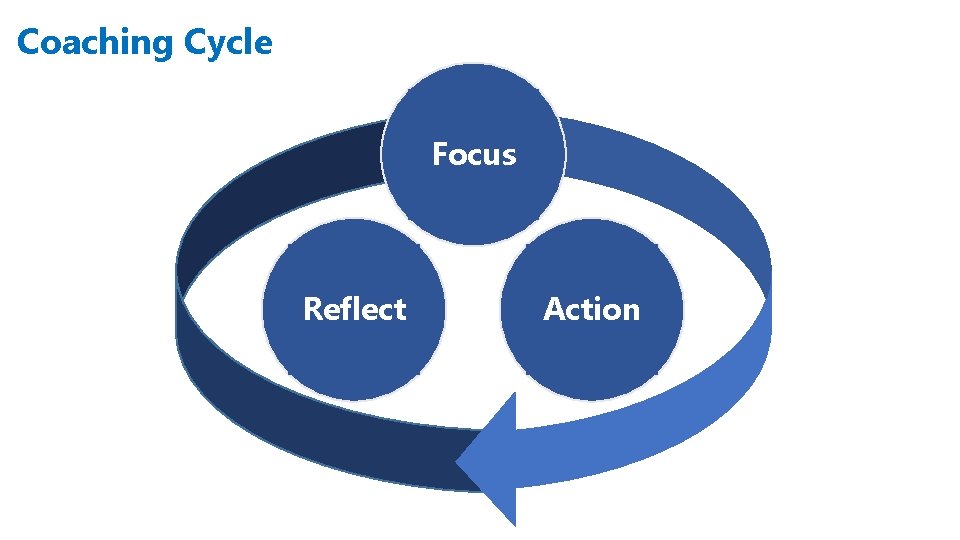
Coaching Cycle Focus Reflect Action
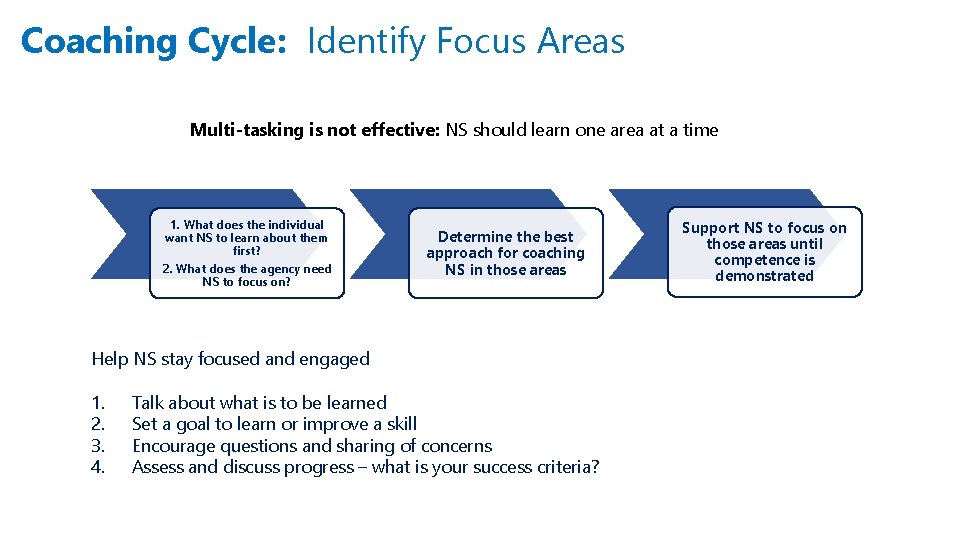
Coaching Cycle: Identify Focus Areas Multi-tasking is not effective: NS should learn one area at a time 1. What does the individual want NS to learn about them first? 2. What does the agency need NS to focus on? Determine the best approach for coaching NS in those areas Help NS stay focused and engaged 1. 2. 3. 4. Talk about what is to be learned Set a goal to learn or improve a skill Encourage questions and sharing of concerns Assess and discuss progress – what is your success criteria? Support NS to focus on those areas until competence is demonstrated
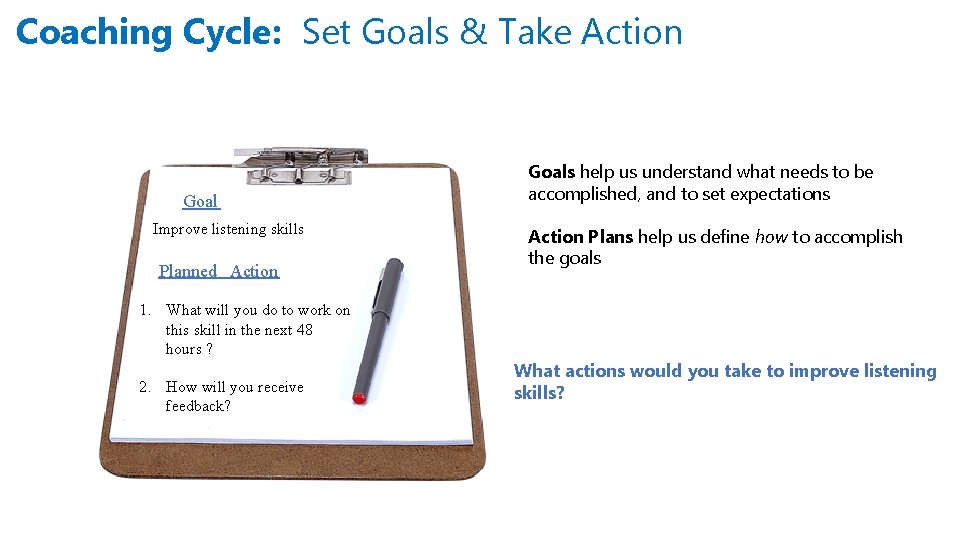
Coaching Cycle: Set Goals & Take Action Goal Improve listening skills Planned Action Goals help us understand what needs to be accomplished, and to set expectations Action Plans help us define how to accomplish the goals 1. What will you do to work on this skill in the next 48 hours ? 2. How will you receive feedback? What actions would you take to improve listening skills?
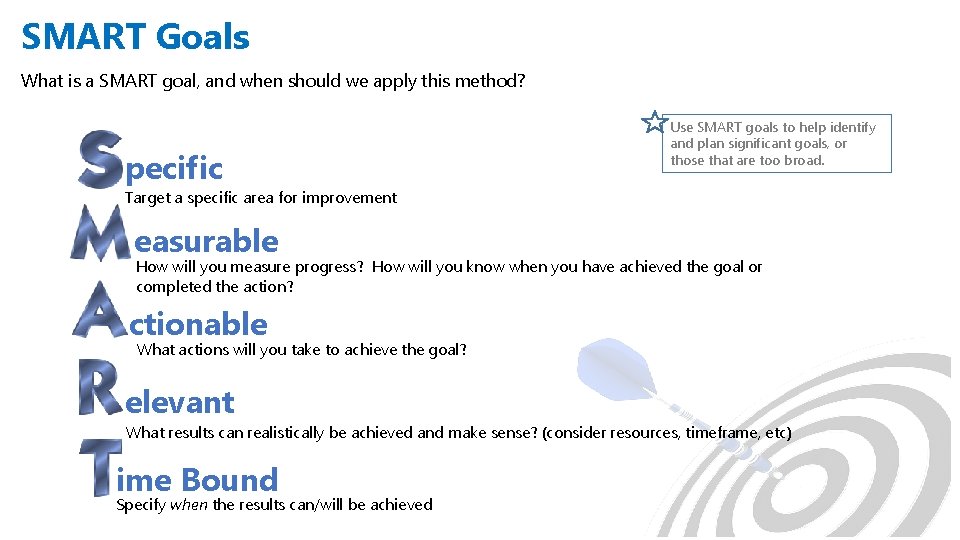
SMART Goals What is a SMART goal, and when should we apply this method? pecific Use SMART goals to help identify and plan significant goals, or those that are too broad. Target a specific area for improvement easurable How will you measure progress? How will you know when you have achieved the goal or completed the action? ctionable What actions will you take to achieve the goal? elevant What results can realistically be achieved and make sense? (consider resources, timeframe, etc) ime Bound Specify when the results can/will be achieved
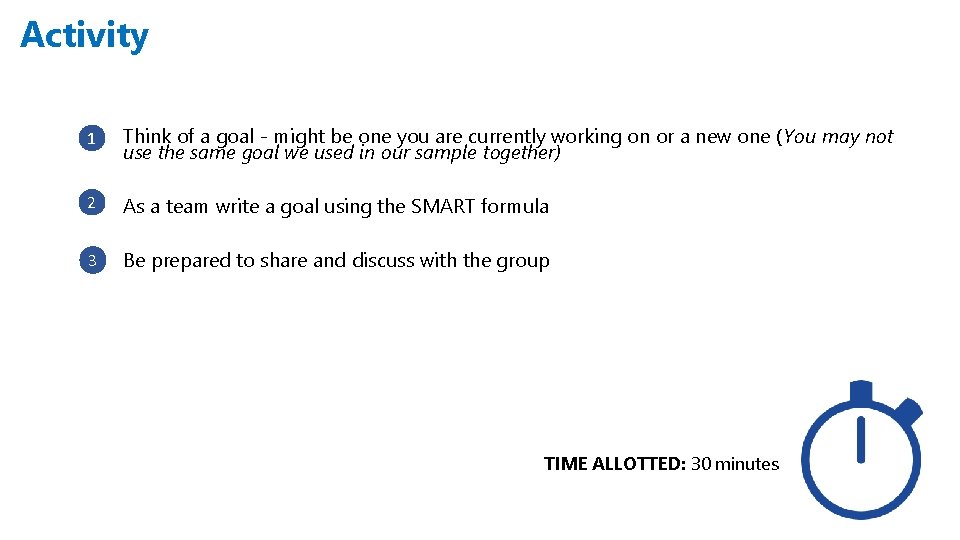
Activity 1 Think of a goal - might be one you are currently working on or a new one (You may not use the same goal we used in our sample together) 2 As a team write a goal using the SMART formula 3 Be prepared to share and discuss with the group TIME ALLOTTED: 30 minutes
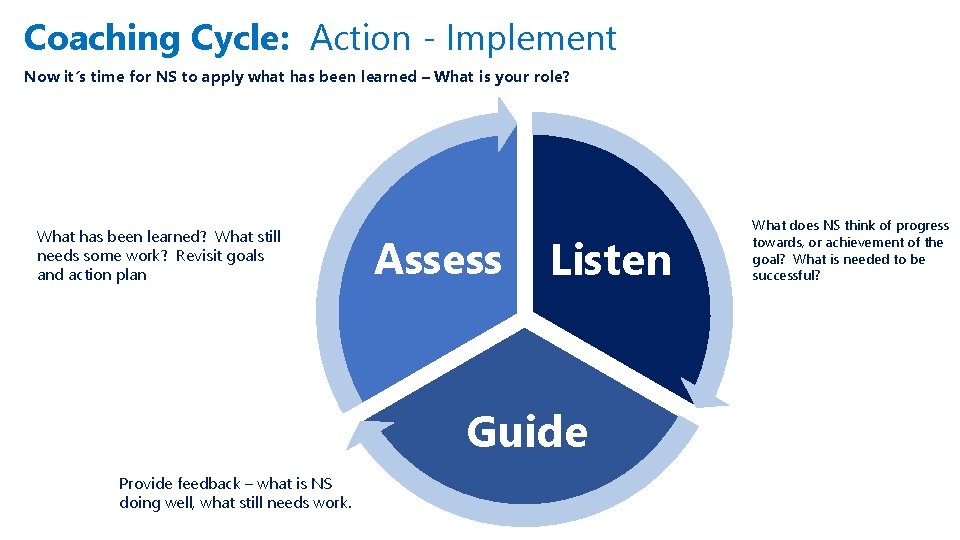
Coaching Cycle: Action - Implement Now it’s time for NS to apply what has been learned – What is your role? What has been learned? What still needs some work? Revisit goals and action plan Assess Listen Guide Provide feedback – what is NS doing well, what still needs work. What does NS think of progress towards, or achievement of the goal? What is needed to be successful?
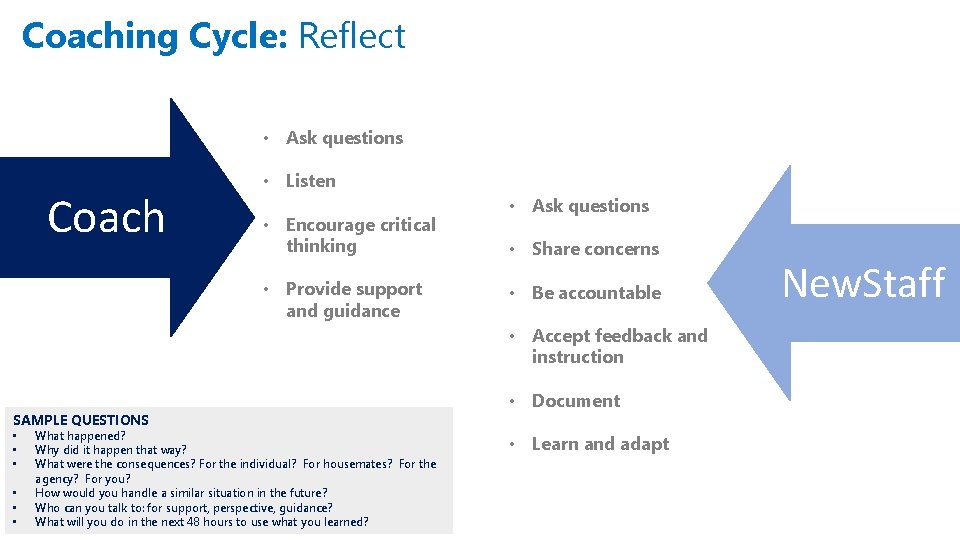
Coaching Cycle: Reflect • Ask questions Coach • Listen • Encourage critical thinking • Provide support and guidance • Ask questions • Share concerns • Be accountable • Accept feedback and instruction SAMPLE QUESTIONS • • • What happened? Why did it happen that way? What were the consequences? For the individual? For housemates? For the agency? For you? How would you handle a similar situation in the future? Who can you talk to: for support, perspective, guidance? What will you do in the next 48 hours to use what you learned? • Document • Learn and adapt New. Staff
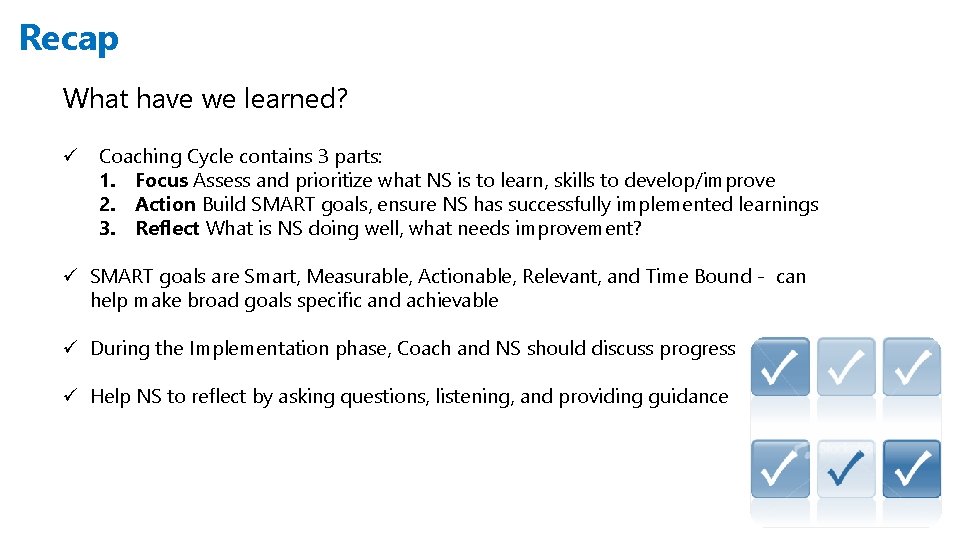
Recap What have we learned? ü Coaching Cycle contains 3 parts: 1. Focus Assess and prioritize what NS is to learn, skills to develop/improve 2. Action Build SMART goals, ensure NS has successfully implemented learnings 3. Reflect What is NS doing well, what needs improvement? ü SMART goals are Smart, Measurable, Actionable, Relevant, and Time Bound - can help make broad goals specific and achievable ü During the Implementation phase, Coach and NS should discuss progress ü Help NS to reflect by asking questions, listening, and providing guidance
Section 3 Tools 1. Snapshot 2. Coaching Checklist Activity 3. Reflection Worksheet 4. Meetings & Agendas Best Practices Activity Recap Next Steps
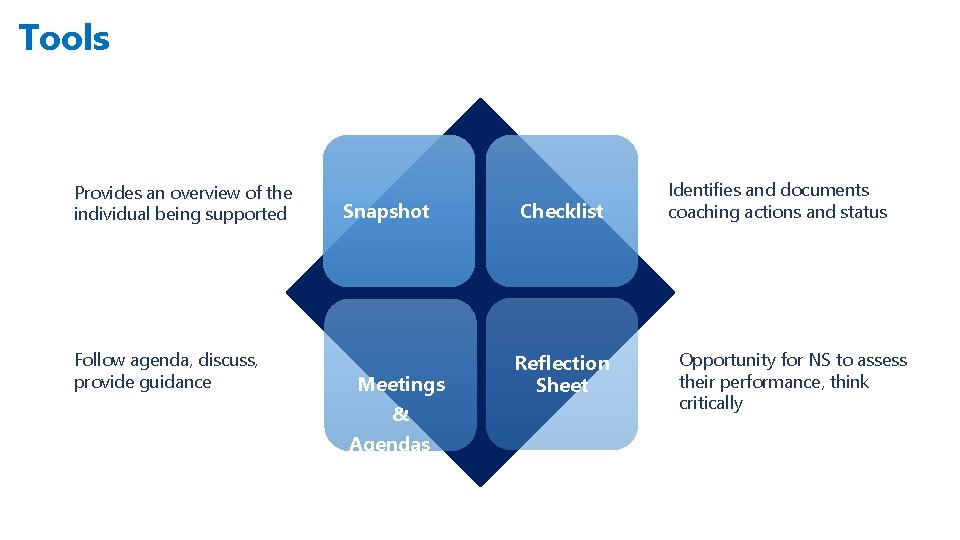
Tools Provides an overview of the individual being supported Follow agenda, discuss, provide guidance Snapshot Meetings & Agendas Checklist Reflection Sheet Identifies and documents coaching actions and status Opportunity for NS to assess their performance, think critically
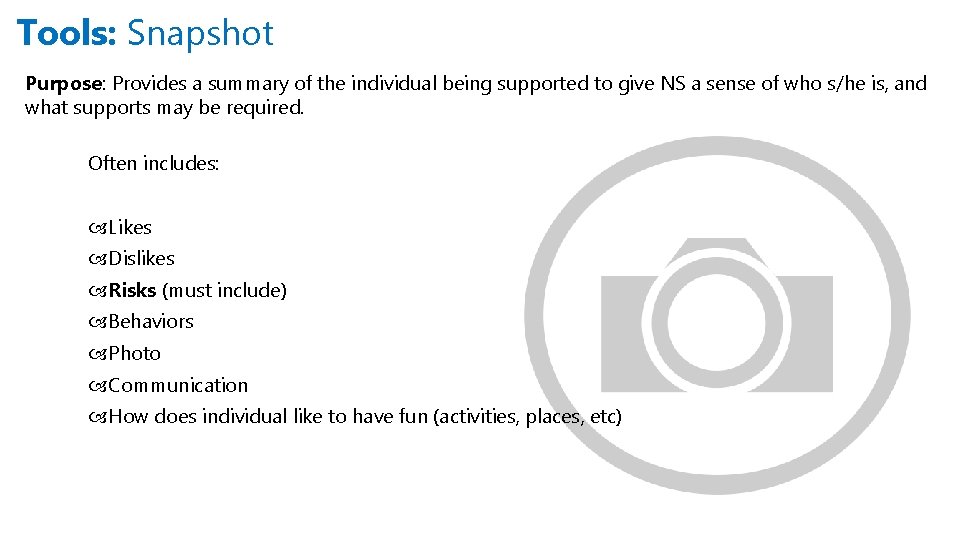
Tools: Snapshot Purpose: Provides a summary of the individual being supported to give NS a sense of who s/he is, and what supports may be required. Often includes: Likes Dislikes Risks (must include) Behaviors Photo Communication How does individual like to have fun (activities, places, etc)
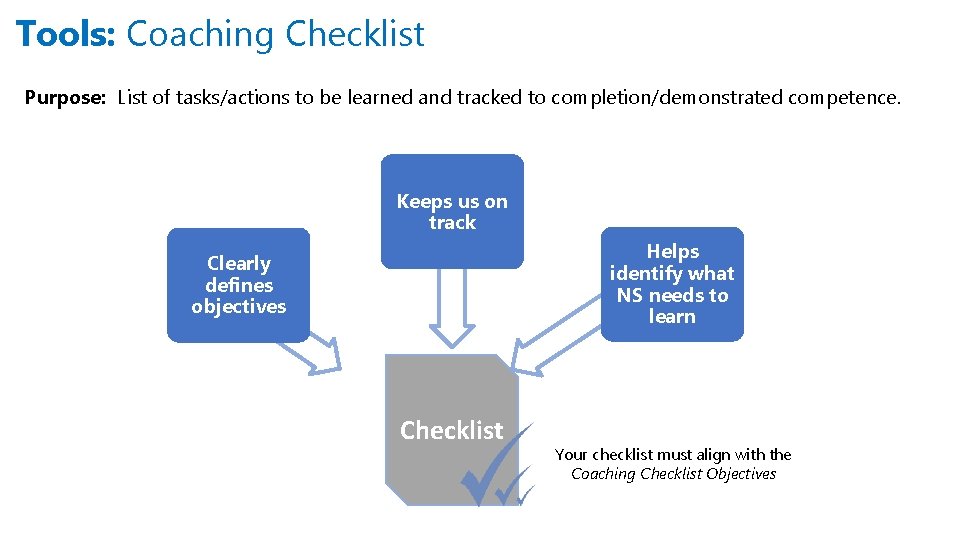
Tools: Coaching Checklist Purpose: List of tasks/actions to be learned and tracked to completion/demonstrated competence. Keeps us on track Helps identify what NS needs to learn Clearly defines objectives Checklist Your checklist must align with the Coaching Checklist Objectives
Activity 1 Review the Coaching Checklist with a partner. 2 Think about the population you serve and ensure that the checklist has everything you would need to train a new staff. • How will you model and provide guided practice for each topic mentioned? • How will you ensure that you focus on one section or topic at a time? • How will you use this with the individual that it’s about to ensure that it contains everything they want a new staff to know? • How will you prioritize where to begin? TIME ALLOTTED: 15 minutes
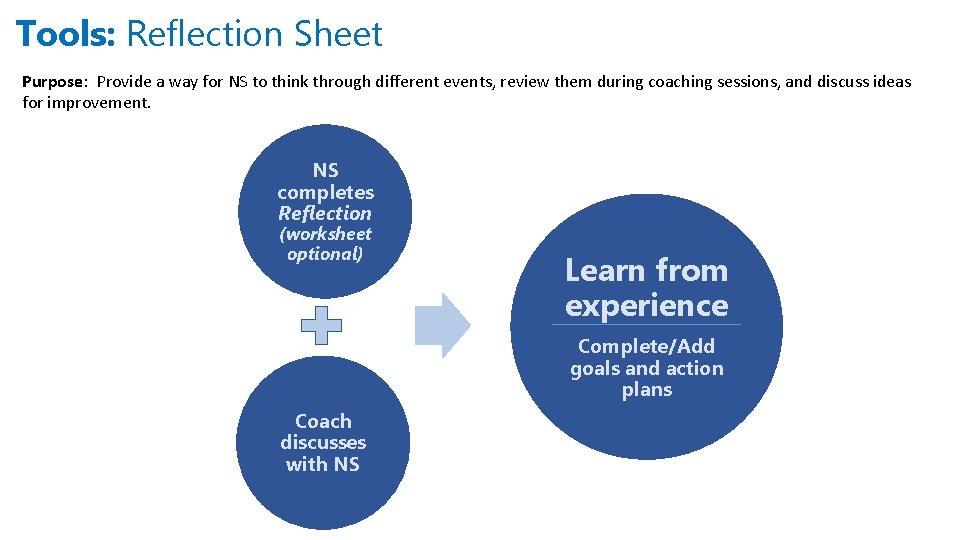
Tools: Reflection Sheet Purpose: Provide a way for NS to think through different events, review them during coaching sessions, and discuss ideas for improvement. NS completes Reflection (worksheet optional) Learn from experience Complete/Add goals and action plans Coach discusses with NS
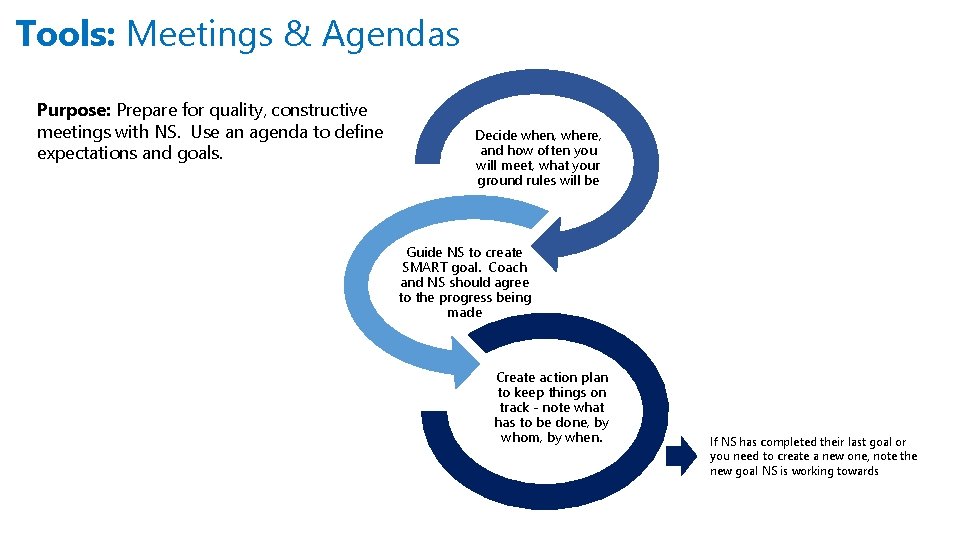
Tools: Meetings & Agendas Purpose: Prepare for quality, constructive meetings with NS. Use an agenda to define expectations and goals. Decide when, where, and how often you will meet, what your ground rules will be Guide NS to create SMART goal. Coach and NS should agree to the progress being made Create action plan to keep things on track - note what has to be done, by whom, by when. If NS has completed their last goal or you need to create a new one, note the new goal NS is working towards
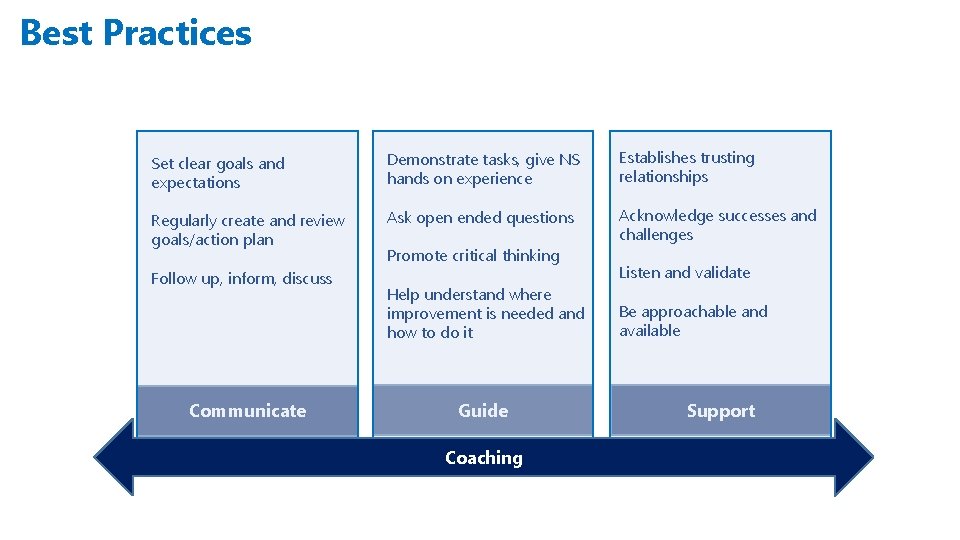
Best Practices Set clear goals and expectations Demonstrate tasks, give NS hands on experience Establishes trusting relationships Regularly create and review goals/action plan Ask open ended questions Acknowledge successes and challenges Follow up, inform, discuss Communicate Promote critical thinking Help understand where improvement is needed and how to do it Guide Coaching Listen and validate Be approachable and available Support
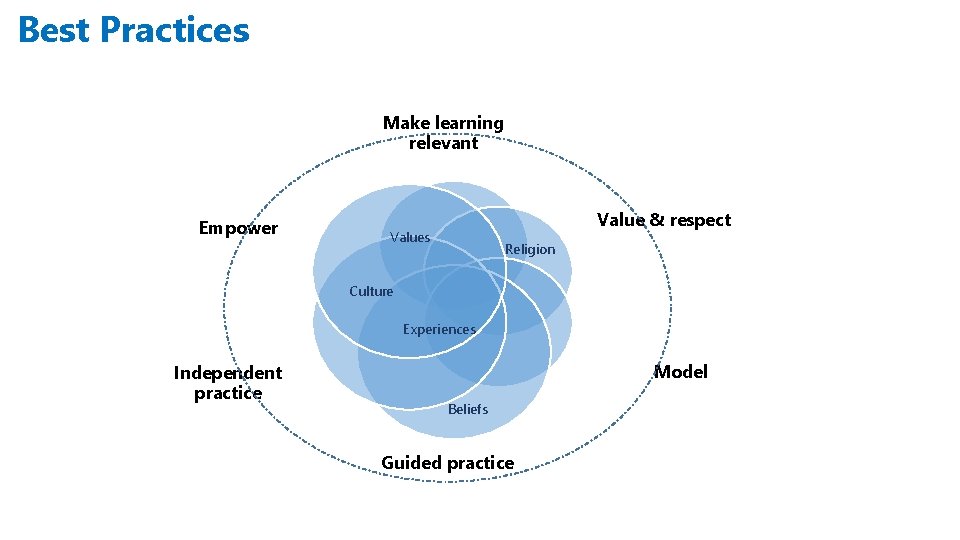
Best Practices Make learning relevant Empower Value & respect Values Religion Culture Experiences Independent practice Model Beliefs Guided practice
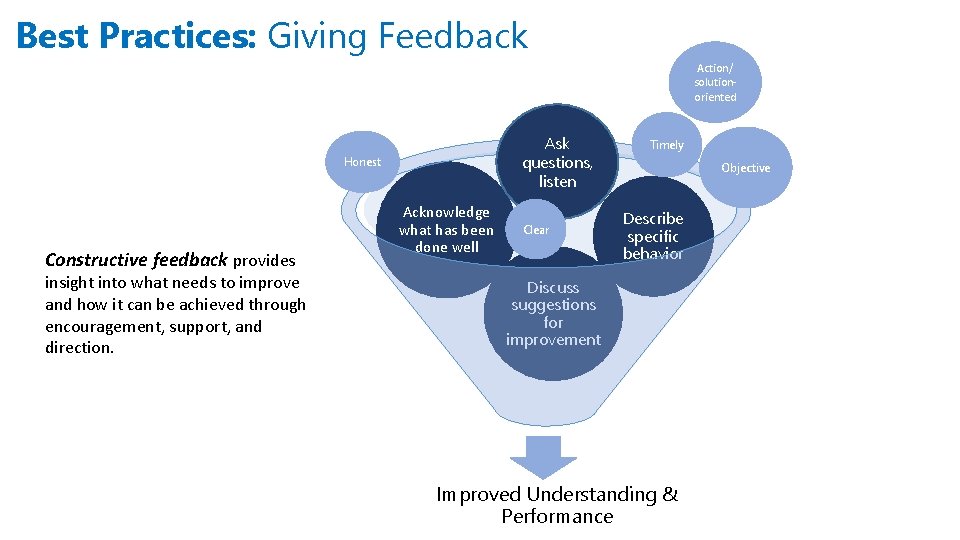
Best Practices: Giving Feedback Action/ solutionoriented Ask questions, listen Honest Constructive feedback provides insight into what needs to improve and how it can be achieved through encouragement, support, and direction. Acknowledge what has been done well Clear Timely Objective Describe specific behavior Discuss suggestions for improvement Improved Understanding & Performance
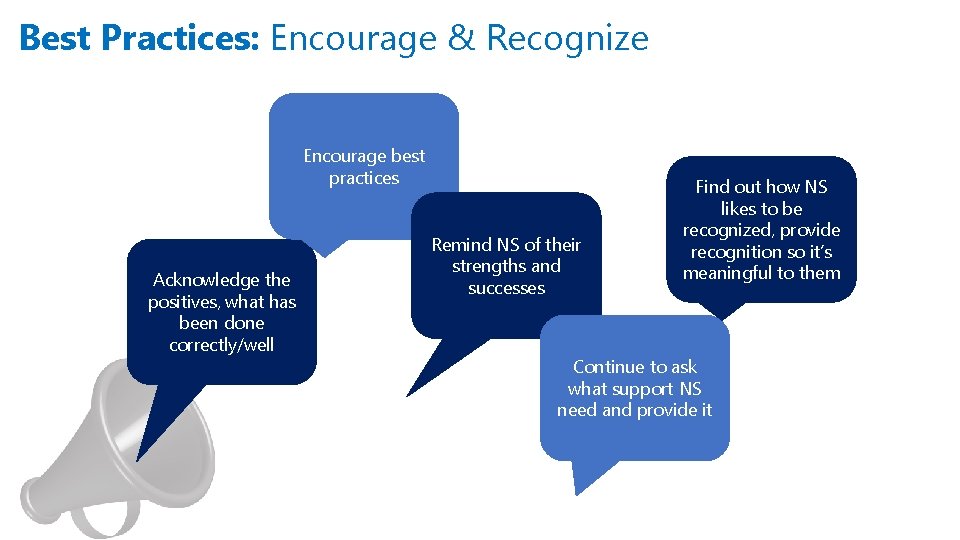
Best Practices: Encourage & Recognize Encourage best practices Acknowledge the positives, what has been done correctly/well Remind NS of their strengths and successes Find out how NS likes to be recognized, provide recognition so it’s meaningful to them Continue to ask what support NS need and provide it
Activity Putting it all together 1 Find a partner 2 One of you is the Coach the other is the New Staff 3 Read the scenario you have been provided A. Together, complete a reflection worksheet based on this scenario B. Together, complete a meeting agenda for a coaching session C. Determine what challenges you might face for discussion with the group TIME ALLOTTED: 20 minutes
Recap What have we learned? ü Checklist, Snapshot, Agendas are helpful tools to use with NS to improve understanding and learning ü Snapshot provides an overview of the individual being supported – it must include risks ü The Checklist defines objectives and tracks tasks in which NS has demonstrated competence ü Reflection Sheet enables deeper insight into how and why things happened, how to learn from the experience ü Agendas help set expectations and guide conversations ü Constructive feedback is a beneficial way to discuss with NS what needs to improve and provides direction ü It is important to recognize what NS has done well and progress being made
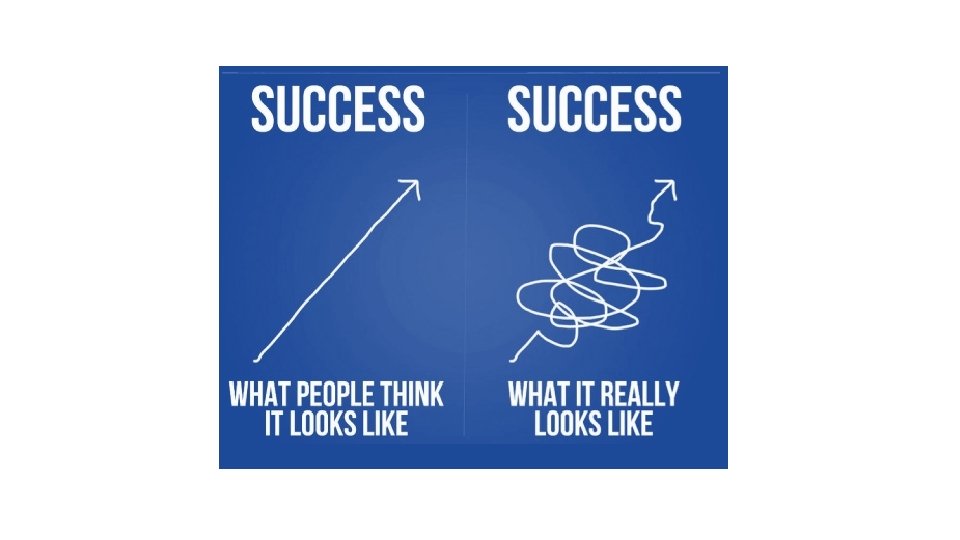
Next Steps Now that you have completed the Day 1 Classroom Training, it’s time for you to apply what you have learned. You are ready to head out into the field where you will have the opportunity to practice using the tools and best practices we discussed. Assignment For the next 1 -2 weeks, you will work with an individual(s) you support and staff to: 1. 2. 3. 4. Develop “Risk” Snapshot Develop personalized Checklist Meet with your NS at least 3 times Have New Coaches return to the classroom for discussion and problem solving. Refer to the On the Job Training packet provided for specific instructions As the new Coach, consider pairing up with another coach from your agency. Coach each other on Coaching!

Resources Questions? Need help? Contact: <Facilitator Info> <Anyone else> Visit the following website for document templates: <agency site/location or DDA site) <Add any additional info>
Evaluation Every training we do needs to be evaluated so we can learn. An evaluation serves as a reflection with the intent of improvement each time. Please provide constructive feedback on the evaluation form in your handouts, then exchange the evaluation for your certificate. You will earn 12 continuing education credits for taking this class and completing the assignment. Please keep your original certificate. A copy will be placed in your personnel record. THANK YOU
- Slides: 41