
PEDTOOL Gene hunting based on highthroughput computing Dan
PEDTOOL: Gene hunting based on high-throughput computing Dan Geiger Computer Science Department, Technion 1
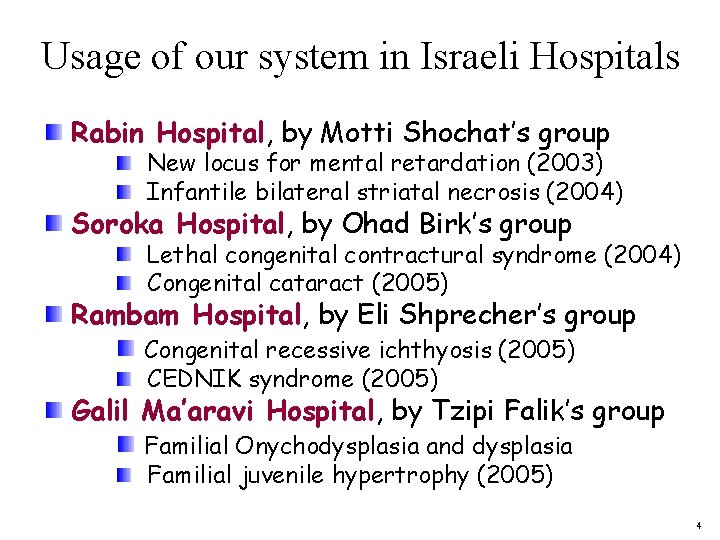
Usage of our system in Israeli Hospitals Rabin Hospital, by Motti Shochat’s group New locus for mental retardation (2003) Infantile bilateral striatal necrosis (2004) Soroka Hospital, by Ohad Birk’s group Lethal congenital contractural syndrome (2004) Congenital cataract (2005) Rambam Hospital, by Eli Shprecher’s group Congenital recessive ichthyosis (2005) CEDNIK syndrome (2005) Galil Ma’aravi Hospital, by Tzipi Falik’s group Familial Onychodysplasia and dysplasia Familial juvenile hypertrophy (2005) 4
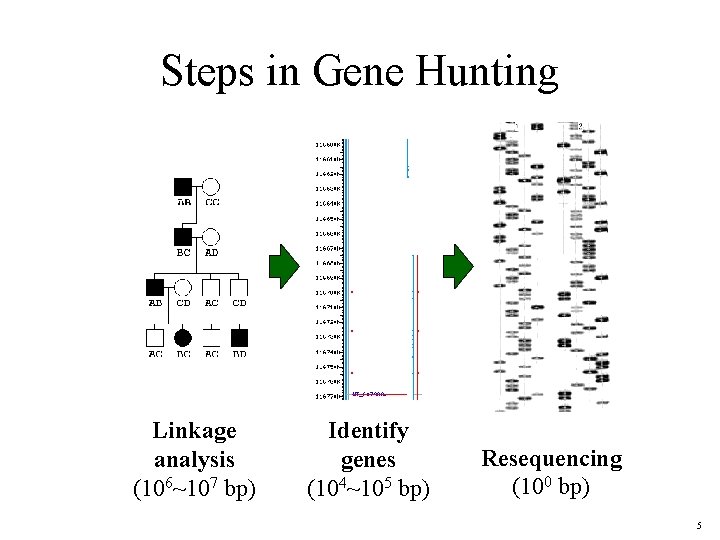
Steps in Gene Hunting Linkage analysis (106~107 bp) Identify genes (104~105 bp) Resequencing (100 bp) 5
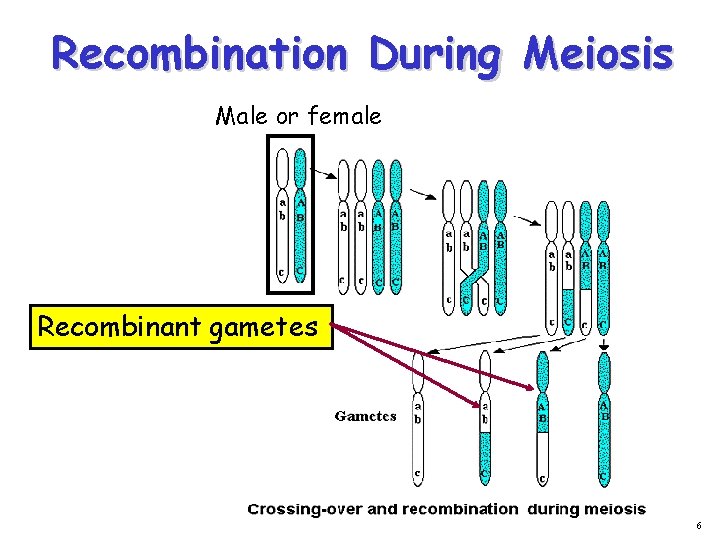
Recombination During Meiosis Male or female Recombinant gametes 6
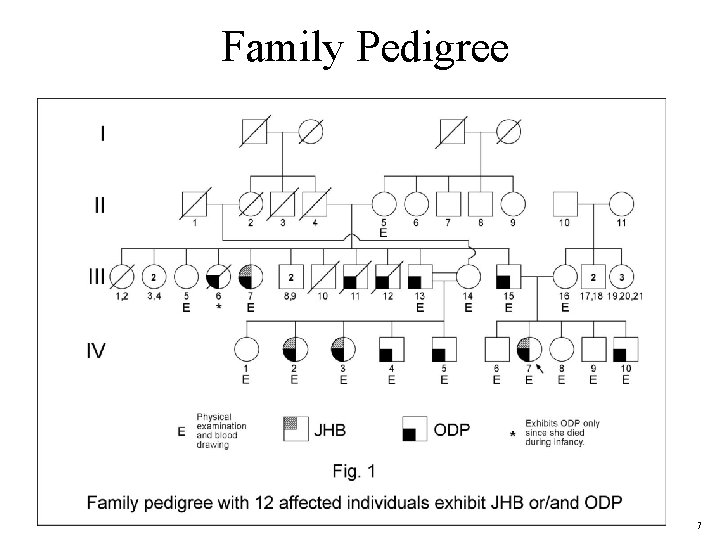
Family Pedigree 7
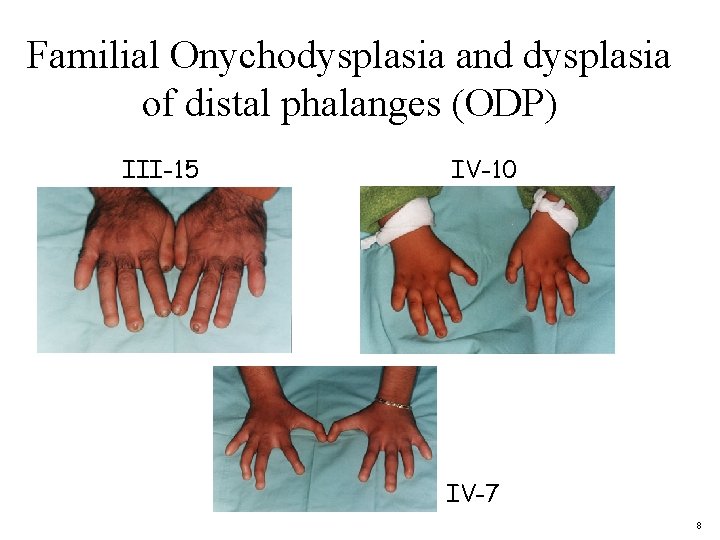
Familial Onychodysplasia and dysplasia of distal phalanges (ODP) III-15 IV-10 IV-7 8
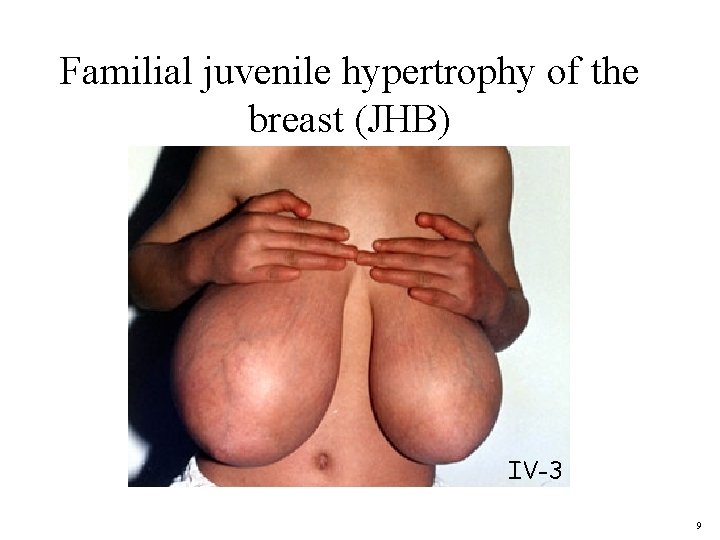
Familial juvenile hypertrophy of the breast (JHB) IV-3 9
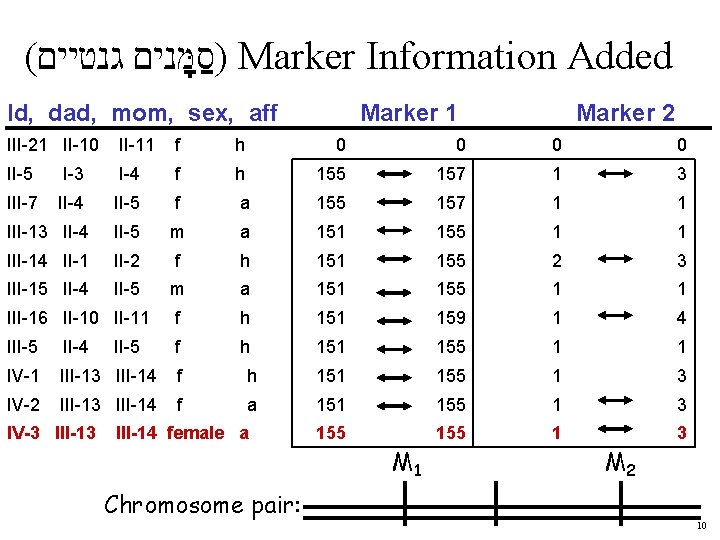
. ) Marker Information Added ( סמנים גנטיים Id, dad, mom, sex, aff Marker 1 Marker 2 III-21 II-10 II-11 f h 0 0 II-5 I-3 I-4 f h 155 157 1 3 III-7 II-4 II-5 f a 155 157 1 1 III-13 II-4 II-5 m a 151 155 1 1 III-14 II-1 II-2 f h 151 155 2 3 III-15 II-4 II-5 m a 151 155 1 1 III-16 II-10 II-11 f h 151 159 1 4 III-5 II-4 f h 151 155 1 1 IV-1 III-13 III-14 f h 151 155 1 3 IV-2 III-13 III-14 f a 151 155 1 3 IV-3 III-13 II-5 III-14 female a M 1 M 2 Chromosome pair: 10
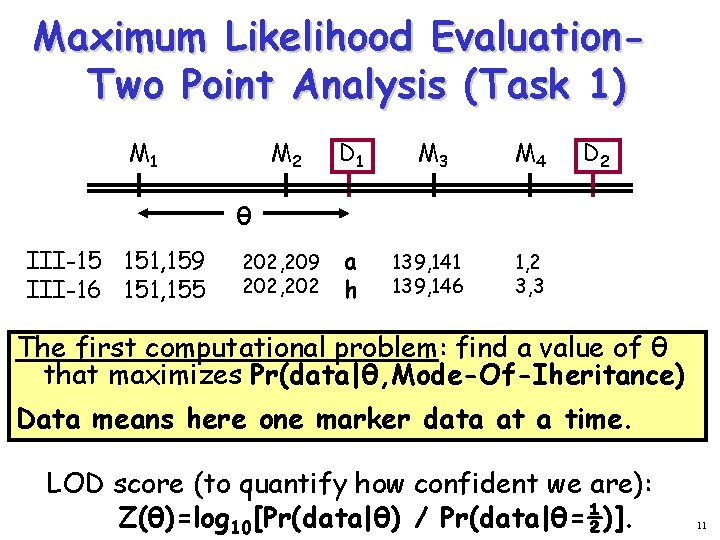
Maximum Likelihood Evaluation. Two Point Analysis (Task 1) M 1 M 2 D 1 M 3 M 4 202, 209 202, 202 a h 139, 141 139, 146 1, 2 3, 3 D 2 θ III-15 151, 159 III-16 151, 155 The first computational problem: find a value of θ that maximizes Pr(data|θ, Mode-Of-Iheritance) Data means here one marker data at a time. LOD score (to quantify how confident we are): Z(θ)=log 10[Pr(data|θ) / Pr(data|θ=½)]. 11
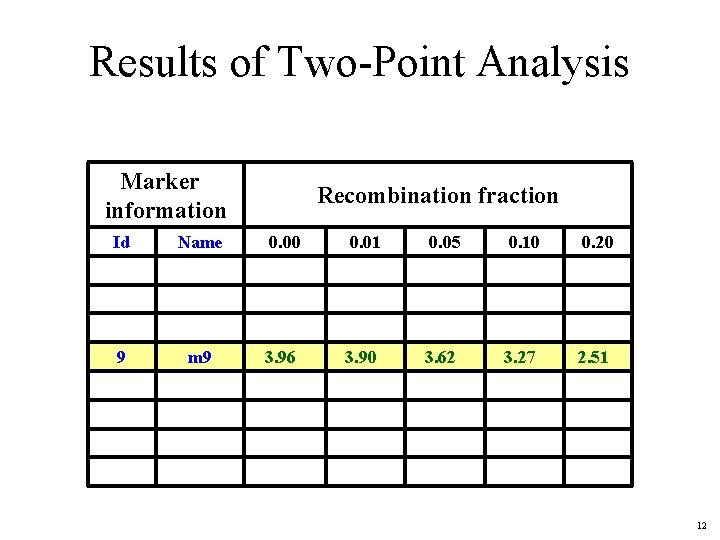
Results of Two-Point Analysis Marker information Recombination fraction Id Name 0. 00 0. 01 0. 05 0. 10 0. 20 9 m 9 3. 96 3. 90 3. 62 3. 27 2. 51 12
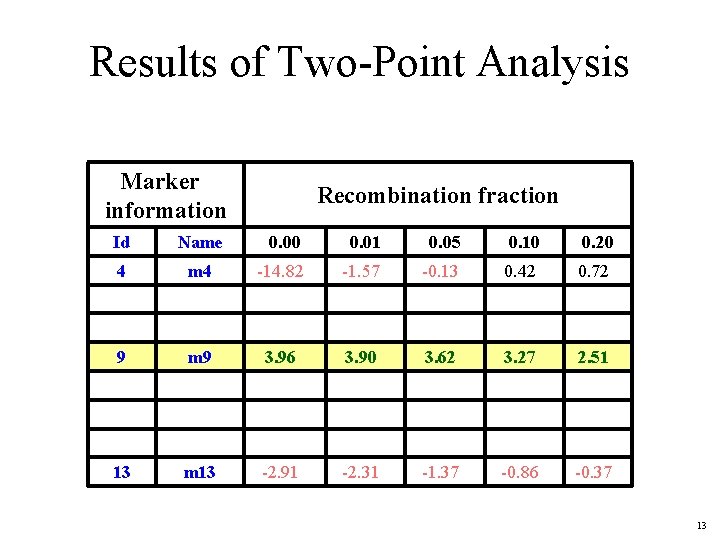
Results of Two-Point Analysis Marker information Recombination fraction Id Name 0. 00 0. 01 0. 05 0. 10 0. 20 4 m 4 -14. 82 -1. 57 -0. 13 0. 42 0. 72 9 m 9 3. 96 3. 90 3. 62 3. 27 2. 51 13 m 13 -2. 91 -2. 31 -1. 37 -0. 86 -0. 37 13
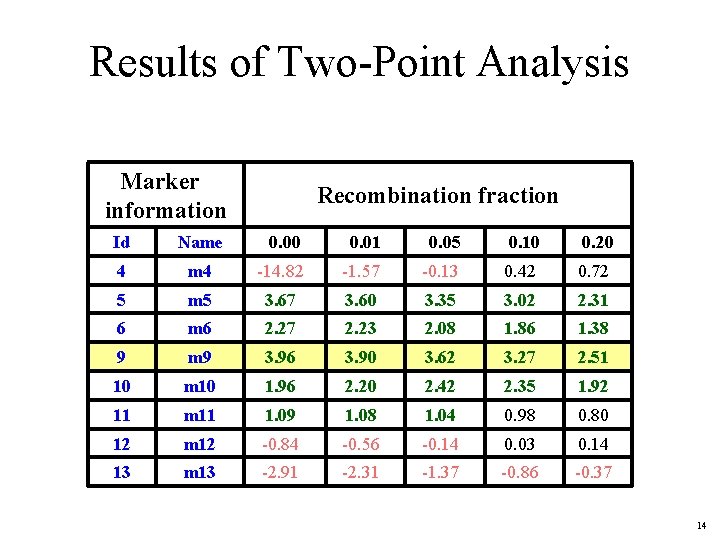
Results of Two-Point Analysis Marker information Recombination fraction Id Name 0. 00 0. 01 0. 05 0. 10 0. 20 4 m 4 -14. 82 -1. 57 -0. 13 0. 42 0. 72 5 m 5 3. 67 3. 60 3. 35 3. 02 2. 31 6 m 6 2. 27 2. 23 2. 08 1. 86 1. 38 9 m 9 3. 96 3. 90 3. 62 3. 27 2. 51 10 m 10 1. 96 2. 20 2. 42 2. 35 1. 92 11 m 11 1. 09 1. 08 1. 04 0. 98 0. 80 12 m 12 -0. 84 -0. 56 -0. 14 0. 03 0. 14 13 m 13 -2. 91 -2. 31 -1. 37 -0. 86 -0. 37 14
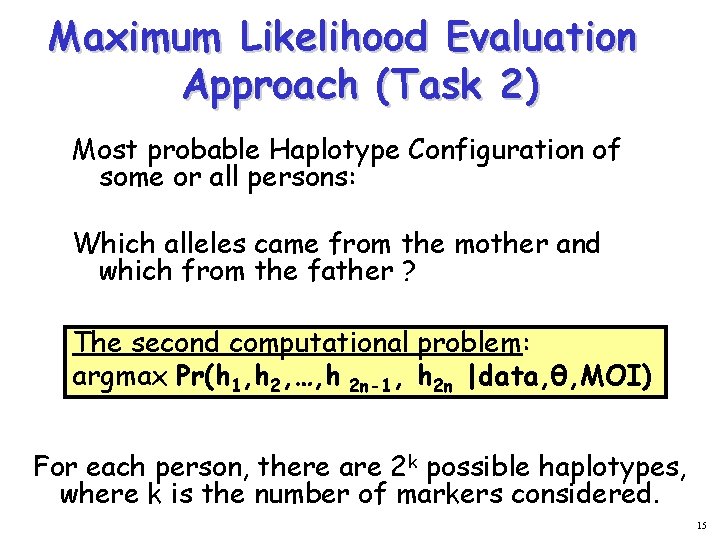
Maximum Likelihood Evaluation Approach (Task 2) Most probable Haplotype Configuration of some or all persons: Which alleles came from the mother and which from the father ? The second computational problem: argmax Pr(h 1, h 2, …, h 2 n-1, h 2 n |data, θ, MOI) For each person, there are 2 k possible haplotypes, where k is the number of markers considered. 15
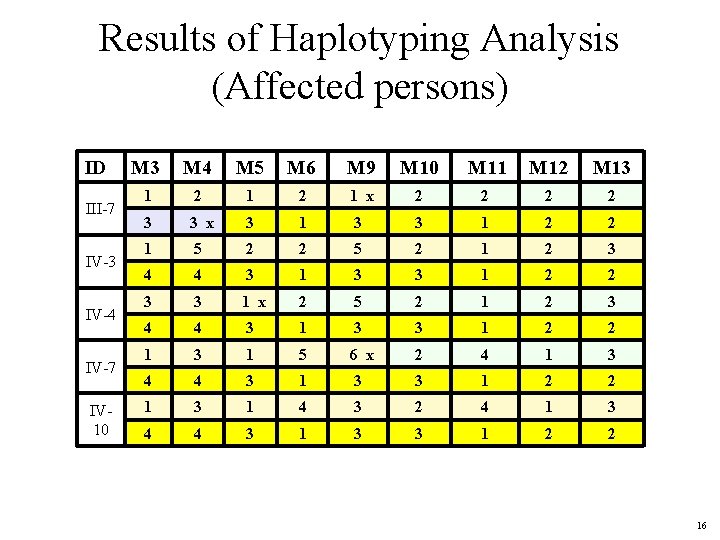
Results of Haplotyping Analysis (Affected persons) ID M 3 M 4 M 5 M 6 III-7 IV-3 IV-4 IV-7 IV 10 M 9 M 10 M 11 M 12 M 13 1 2 1 x 2 2 3 3 x 3 1 3 3 1 2 2 1 5 2 2 5 2 1 2 3 4 4 3 1 3 3 1 2 2 3 3 1 x 2 5 2 1 2 3 4 4 3 1 3 3 1 2 2 1 3 1 5 6 x 2 4 1 3 4 4 3 1 3 3 1 2 2 1 3 1 4 3 2 4 1 3 4 4 3 1 3 3 1 2 2 16
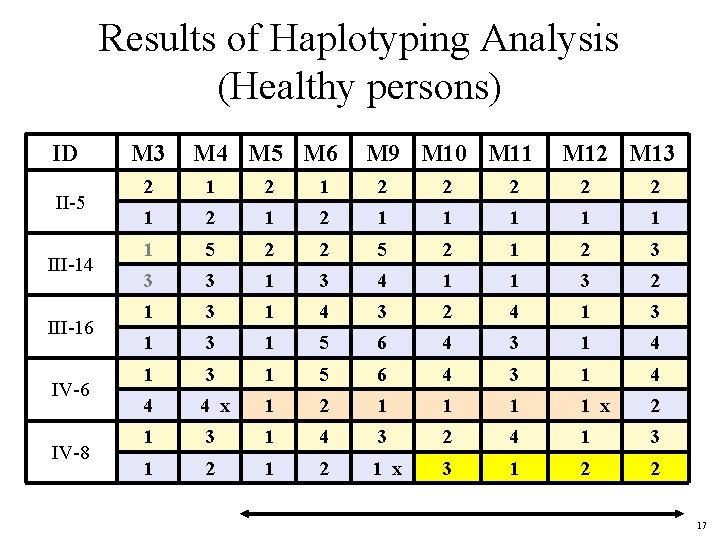
Results of Haplotyping Analysis (Healthy persons) ID II-5 III-14 III-16 IV-8 M 3 M 4 M 5 M 6 M 9 M 10 M 11 M 12 M 13 2 1 2 2 2 1 2 1 1 1 5 2 2 5 2 1 2 3 3 3 1 3 4 1 1 3 2 1 3 1 4 3 2 4 1 3 1 5 6 4 3 1 4 4 4 x 1 2 1 1 x 2 1 3 1 4 3 2 4 1 3 1 2 1 x 3 1 2 2 17
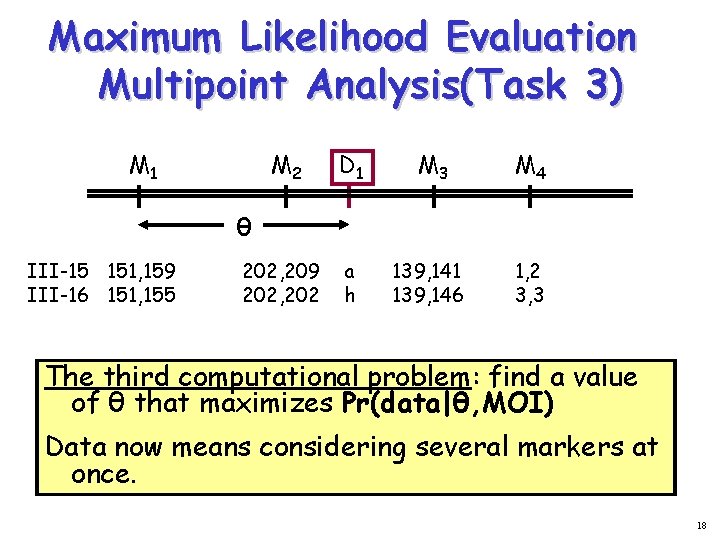
Maximum Likelihood Evaluation Multipoint Analysis(Task 3) M 1 M 2 D 1 M 3 M 4 202, 209 202, 202 a h 139, 141 139, 146 1, 2 3, 3 θ III-15 151, 159 III-16 151, 155 The third computational problem: find a value of θ that maximizes Pr(data|θ, MOI) Data now means considering several markers at once. 18
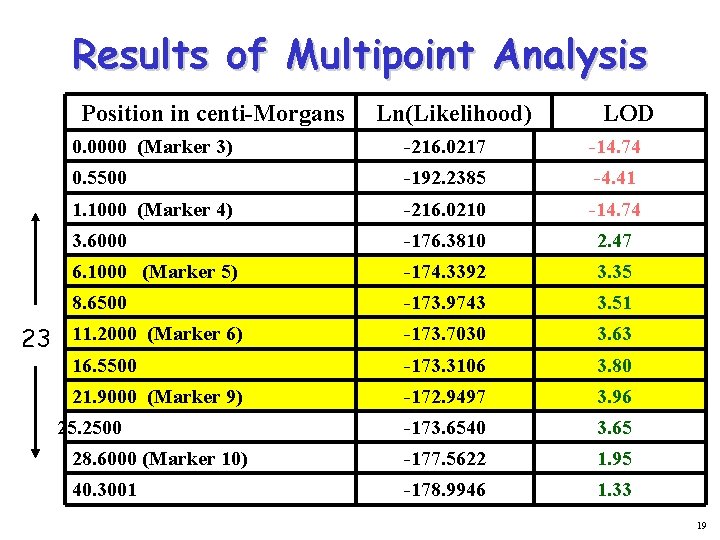
Results of Multipoint Analysis Position in centi-Morgans Ln(Likelihood) LOD 0. 0000 (Marker 3) -216. 0217 -14. 74 0. 5500 -192. 2385 -4. 41 1. 1000 (Marker 4) -216. 0210 -14. 74 3. 6000 -176. 3810 2. 47 6. 1000 (Marker 5) -174. 3392 3. 35 8. 6500 -173. 9743 3. 51 -173. 7030 3. 63 16. 5500 -173. 3106 3. 80 21. 9000 (Marker 9) -172. 9497 3. 96 -173. 6540 3. 65 28. 6000 (Marker 10) -177. 5622 1. 95 40. 3001 -178. 9946 1. 33 23 11. 2000 (Marker 6) 25. 2500 19
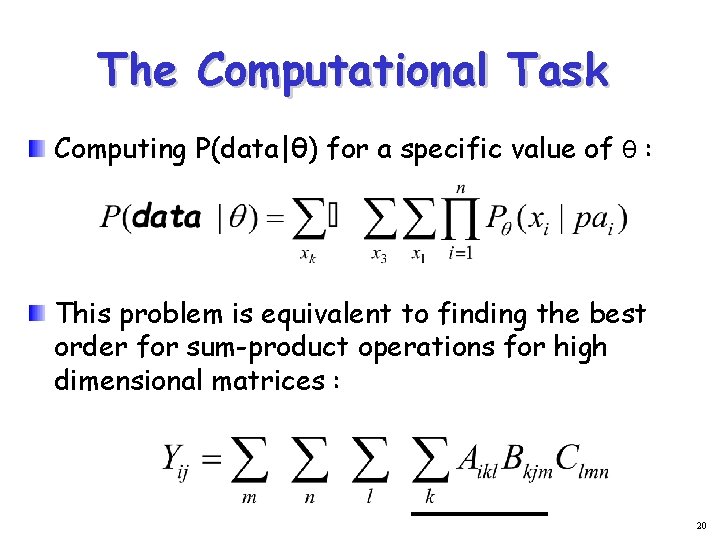
The Computational Task Computing P(data|θ) for a specific value of θ : This problem is equivalent to finding the best order for sum-product operations for high dimensional matrices : 20
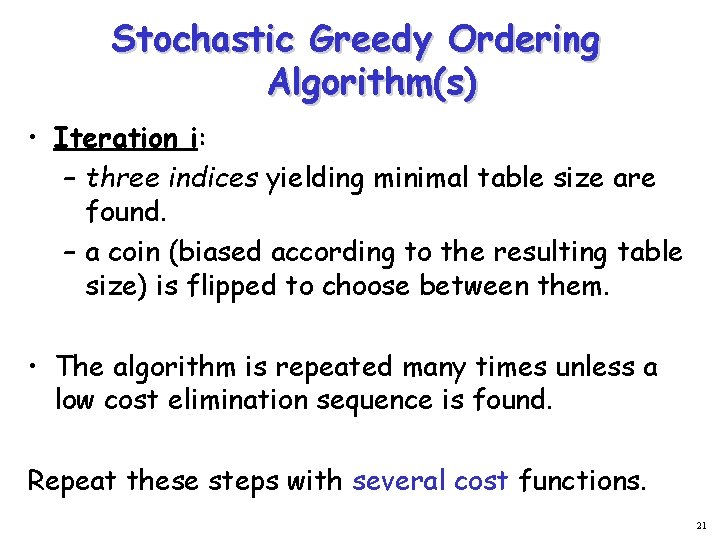
Stochastic Greedy Ordering Algorithm(s) • Iteration i: – three indices yielding minimal table size are found. – a coin (biased according to the resulting table size) is flipped to choose between them. • The algorithm is repeated many times unless a low cost elimination sequence is found. Repeat these steps with several cost functions. 21
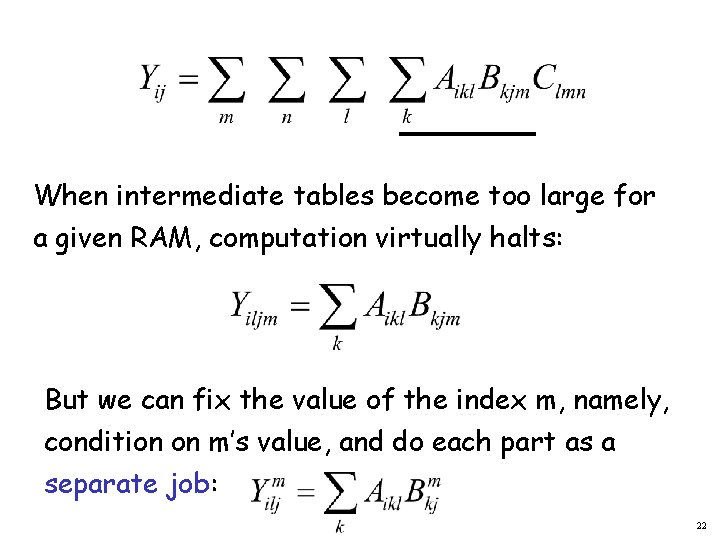
When intermediate tables become too large for a given RAM, computation virtually halts: But we can fix the value of the index m, namely, condition on m’s value, and do each part as a separate job: 22
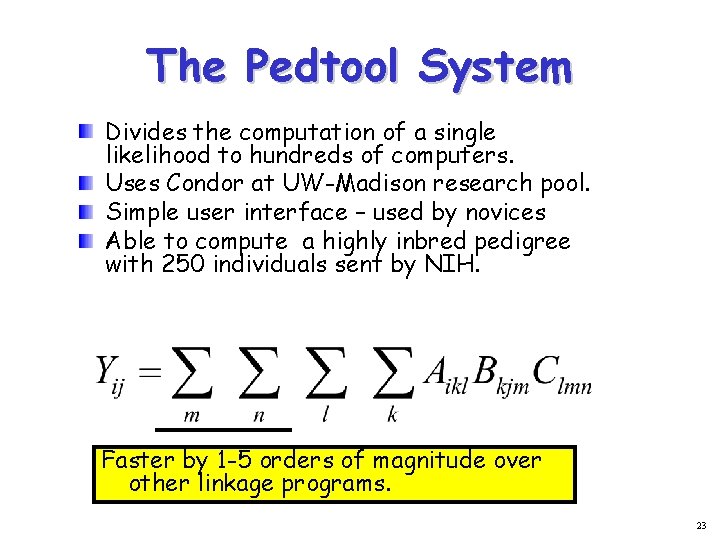
The Pedtool System Divides the computation of a single likelihood to hundreds of computers. Uses Condor at UW-Madison research pool. Simple user interface – used by novices Able to compute a highly inbred pedigree with 250 individuals sent by NIH. Faster by 1 -5 orders of magnitude over other linkage programs. 23

Running times improvements bioinfo. cs. technion. ac. il/pedtool 24
The Main Goals of future Research Efficiency Simplicity Availability online to all Israeli researchers. More functionalities bioinfo. cs. technion. ac. il/pedtool 25
Acknowledgements Students: Ma’ayan Fishelson, Ph. D (Graduated 2004) Dmitry Rusakov, Ph. D (Graduated 2004) Anna Tzemach, M. Sc Nickolay Dovgolevsky, B. Sc (Graduated, 2004) Mark Silberstein, M. Sc Julia Stolin Edward Vitkin Collaborators from medical genetics: Motti Shochat and Tami Shochat (Rabin) Ohad Birk and Rivka Ophir (Soroka) Tzipi Falik and Morad Khayat (Galil Ma’aravi) Collaborators from distributed systems: Assaf Schuster Pedtool is to be hosted by DSL at the CS/Technion and supported by IBM, ISF, Israeli Science Ministry 26
- Slides: 25