
Pedology Soil morphology color physical structure and chemical




- Slides: 70
Pedology Soil morphology: color, physical structure, and chemical and mineralogical properties of horizons ► Soil genesis: processes of soil formation ► Soil classification: categorization of soils in groups according to their morphological properties and/or assumed genesis ► Soil survey: determination of type and pattern of the occurrence of soil bodies on the landscape ► Soil characterization: determination and quantification of chemical, physical, mineralogical, and biological properties of samples collected from soil horizons. ► Soil interpretation: analysis of soil data to infer suitability, potential use, and limitations for various uses. ►
Concepts and Definitions of Soil ► Soil has been defined by many groups in a variety of ways. § § Geology Engineering Plant productivity “Natural body” ► Pedological definition - the collection of natural bodies on the earth's surface containing living matter and supporting or capable of supporting plants out-of-doors. "each soil has a unique morphology resulting from the combination of climate, living matter, and relief acting upon earthy parent materials over time. "
Miller’s definition “ weathered material covering the earth’s surface that has been affected by specific soil-forming processes” --transformations --additions, losses --translocation
Concepts and Definitions of Soil The upper limit of soil is the boundary between soil and air, shallow water, live plants, or plant materials that have not begun to decompose. ► The horizontal boundaries of soil areas where the soil grades to water too deep to support rooted plants, barren areas, rock, or ice. ► The lower boundary of soil is most difficult to define. ► § Soil consists of the horizons have been altered by the interactions of climate, relief, and living organisms over time. § Hard rock or earthy materials devoid of biological activity are not soil. § Lower limit of biologic activity is gradual and difficult to detect. § For practical and classification purposes, the lower boundary of soil is arbitrarily set at 200 cm.
Concepts of Soil Genesis ► ► ► ► Pedogenic processes active today have been operating over time and have varying degrees of expression over space. Many soil-forming processes proceed simultaneously, and the properties of the resulting soil are the result of the balance among the processes. Distinctive processes produce distinctive soils. Five environmental factors, climate, organisms, relief or topography, parent material, and time, mediate the pedogenic processes. Current soils carry the imprint of a combination of pedogenic processes that have been active over the period of soil development. A particular site may have had many different soils as one or more of the factors influencing soil formation changed over time (paleosoils). There are few (very) old soils.
A Few Definitions ► Regolith: ► Pedon: ► Soil profile: ► Horizon: ► Solum:
Soil Properties Describing soil properties in the field: Color Texture Structure Consistence and other stuff….
Soil Color
Soil Color ► Obvious property and commonly described § § § ► "black soils" "red soils" "brown soils” It can be used to infer § minerals present in the soil § stage of development, and § seasonal saturation. ► Color also may affect a soil's classification
Soil Coloring Agents ► Uncoated mineral grains § Any color § Most commonly white to gray ► Coatings on grains § Color depends on composition ► Organic matter - brown to black § Subsoil horizon color is color of Fe and Mn oxides and oxyhydroxides coating grains. ► Hematite (Fe 2 O 3) - red ► Geothite ( -Fe. OOH) – yellowish brown ► Lepidocrocite ( -Fe. OOH) - orange to yellowish orange ► Mn oxides – black
Soil Color Determination The Munsell Color System ► The Munsell system has three components ► § Hue - (page) measure of chromatic composition of light reaching the eye. § Value - (vertical scale) degree of lightness or darkness of a color. § Chroma - (horizontal scale) relative purity or strength of the spectral color. ► The Munsell notation is written symbolically as H V/C § 2. 5 YR 6/8. § The notation for a neutral color is written: N V/; N 5/
Munsell Color Space
Mottles & Redoximorphic Features ► Horizons with multiple colors § The dominant color is the matrix color § Minor colors are either mottles or redoximorphic features ► Mottles - areas of different color due to processes other than reduction and oxidation of Fe and Mn § Does not include coatings or rock fragments Redoximorphic Features - features that have resulted from reduction, oxidation, and movement of Fe and Mn associated with seasonal saturation. ► Both described by abundance, size, contrast, and color ► Other characteristics can be described if they are important or diagnostic. ► § § shape boundary location composition
Redoximorphic Features ► Features whose color is the result is reduction, oxidation, and movement of Fe and Mn because of seasonal saturation ► Redox depletions - areas with lower chroma than the matrix caused by depletion (loss) of Fe and Mn ► Redox concentrations - areas with higher chroma and/or redder hue than the matrix caused by concentration of Fe and Mn ► Mobility of Fe and Mn in soils is related to redox processes caused by saturation with water.
Redox Feature Formation ► Fe and Mn oxides and oxyhydroxides (Fe 2 O 3, Fe. OOH; Mn. O 2, Mn. OOH; Fe 3+ and Mn 4+) are very sparingly soluble in water and immobile in soils. ► Reduction of Fe and Mn (Fe 2+ and Mn 2+) changes mineral form and results in compounds that are soluble in water. ► Dissolution of these compounds releases Fe 2+ and Mn 2+ into solution and they can move by mass flow and diffusion.
Reduction ► O 2 is used as the electron acceptor for microbial respiration ► Diffusion of oxygen into water is slow ► Over time, O 2 in saturated soil will be used up by aerobic microbes ► Facultative anaerobic bacteria (thiobacillus species) have ability to use other elements as electron acceptors in respiration ► Addition of electrons "reduces" the element, i. e. Fe+3 + e- Fe+2
Order of Reduction ► Depends on energy of the reactions O 2 O-2 NO 3 -1 N 2 O or N 2 (denitrification) Mn+4 Mn+2 Fe+3 Fe+2 SO 4 -2 S-2 (H 2 S) (marsh or "rotten egg" gas) HCO 3 -1, CO 2 CH 4 (methanogenesis) ► Poised reactions
Redox Feature Formation ► Reduced Fe and Mn are soluble in water § Can move by mass flow and diffusion ► Reduced Fe and Mn oxidize immediately upon exposure to air and form insoluble compounds § No longer mobile. ► Movement of Fe and Mn under reducing conditions form redox depletions (Fe and Mn loss) and concentrations (gain of Fe and Mn where O 2 is present) form by movement of Fe § § § Within a horizon Between horizons Across the landscape
Redox Feature Formation ► Depletion of Fe removes the Fe coatings that give the horizon the yellowish, brownish, or red color. § Color of the zone is that of uncoated mineral grains § Reduced Fe is also gray ► Soil horizons may have reduced micro-sites and oxidized microsites at the same time Fe 2+
105 to 150 cm; light gray (10 YR 7/2) clay loam; many medium and coarse, distinct light yellowish brown (10 YR 6/4) redox concentrations; weak medium subangular blocky structure; friable, sticky, slightly plastic; common fine flakes of mica; common faint clay films on faces of peds; very strongly acid; clear smooth boundary.
Describing Redox Features Abundance: few - <2% of volume of layer ► common - 2 -20% of volume of layer ► many - >20% of volume of layer ► Size: ► ► fine - smaller than 2 mm medium - 2 to 5 mm coarse - 5 to 20 mm very coarse - >20 mm Contrast: faint, distinct, prominent
Conditions for Redox Feature Formation ► Saturation with water ► Presence of facultative anaerobic bacteria ► Organic matter as a food source § Faster reduction in surface horizons § Depletions common around dead roots ► Fe § Always present except a few sandy soils ► Time § 2 to 3 three weeks of saturation for Fe reduction ► Shorter periods will not form redox features § Water movement and diffusion are slow ► 10’s to 100’s of years to form visible redox features
Texture Refers to size and relative abundance of mineral particles comprising a soil horizon or soil sample. ► Soil separates - individual size groups of mineral particles. ► Separate Size (mm) Stones >250 Cobbles 76 -250 Gravel 2 -76 Sand 0. 05 -2 Very coarse 1 -2 Coarse 0. 5 -1 Medium 0. 25 -0. 5 Fine 0. 1 -0. 25 Very fine 0. 05 -0. 1 Silt 0. 002 -0. 05 Clay <0. 002
Textural Triangle ► A system that groups ranges of sand, silt, and clay percentages into classes ► Sand, loamy sand, and sandy loam textures are modified by the dominant size class of the sand (very fine, or coarse). ► In FIELD: “feel” method for estimating particle size (textural classes) based on : § § “gritty” vs. “smooth” Cohesiveness (ribbon length)
Textural Modifiers for Rock Fragments Volume % Fragments <15 Modifier Used none 15 -35 gravelly, stony, bouldery, flaggy, i. e. gravelly loam (grl) 35 -60 add very, i. e. very gravelly loam (vgrl) >60 add extremely, i. e. extremely gravelly loam (exgrl) Shape Size (mm) Term rounded, subrounded, angular, or irregular 2 -76 gravelly 76 -250 cobbly 250 -600 stony >600 bouldery 5 -150 channery 150 -380 flaggy 380 -600 stony >600 bouldery flat (length of long axis)
Importance of Texture ► Many soil interpretations are based on texture or combination or texture and other properties § Water holding capacity (agricultural use) § Permeability, bearing capacity (urban uses) ► Many pedogenic pathways and processes are inferred from texture and the distribution of texture with depth. § Weathering rates (clay formation in situ) § Translocation (clay movement with depth)
Soil Structure The aggregation of primary soil particles into compound particles called peds. ► Structure is described in terms of grade, size, and shape. ► ► Grade - distinctness or degree of expression of peds. ► weak ► moderate ► strong ► Size: Shape fine <2 mm medium 2 -5 mm coarse 5 -20 mm very coarse 20 -76 mm extremely coarse >76 mm
Structure Shape
Prismatic
Columnar
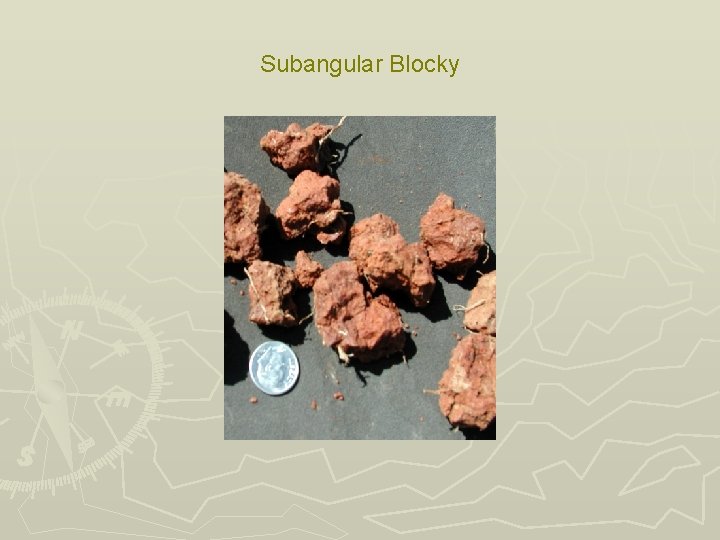
Subangular Blocky
Granular
Structure Formation ► Biologic processes in surface horizons § Organic compounds from root and microbial exudates bind soil particles § Granular structure is common § Fecal pellets from earthworms, insects, and other critters. ► Shrink swell in subsoil horizons § Once planes of weakness are formed by shrinkage, the soil will continue to fail along these planes § Fe and Al oxides and clay binds particles and coatings on ped surfaces enhances strength and expression of structure § Shrink/swell is driven by water content: wetting by rainfall, drying by evapotranspiration (water balance)
Importance of Structure ► May have large impact on rates of water movement through the soil, ease of tillage, aeration, and other properties. § In soils with low shrink-swell, structure creates an extensive network of macropores that can move water rapidly under saturated conditions § Too much structure may be detrimental. § "Response of soil to management may depend as much on its structure as on its fertility. " Horizon Depth (cm) Structure Texture Ks (cm/h) Bt 60 moderate subangular blocky clay 17 BC 90 weak subangular blocky sandy clay loam 6 C 120 massive sandy loam 4
Thin-section Images of Structure and Pores
Consistence Compressive strength of ped (structural unit) ► Resistance to deformation under pressure ► Depends on moisture state ► § Dry soil is more difficult to deform than moist soil § Different terms for different moisture states (moist and dry). ► Moist § loose, very friable, firm, very firm, extremely firm ► Dry § loose, soft, slightly hard, very hard, extremely hard Specimen to be tested should be 25 -30 mm (1 in. ) on edge. ► Wet or puddled soil ► § stickiness - nonsticky, slightly sticky, very sticky § plasticity - nonplastic, slightly plastic, very plastic ► Other terms are also used to describe brittleness, cementation, strength, smeariness, and fluidity.
Concentrations ► ► ► ► Bodies that have a different color, texture, and/or composition than the matrix Formed by concentration (accumulation) of mobile components (Fe, Ca. CO 3, gypsum, etc). In humid climates, related to seasonal saturation and associated mobility of Fe and Mn oxides In drier climates, result from translocation of soluble or sparingly soluble minerals such as calcite or gypsum. May be thin and sheet like, equidimensional, or irregular May contrast with the surrounding matrix or may be similar Rock fragments are not considered concentrations Any number of properties of concentrations can be described § Most commonly described characteristics include amount, size, shape, consistence, color(s), kind and location
Kinds of Concentrations ► Masses - soft accumulations; § Do not have clearly defined boundaries § Composition may be similar to or different from the surrounding soil § Cannot be separated from the matrix and removed as a discrete unit ► Nodules and concretions § Have clearly defined boundaries and can be removed from the soil intact Crystals ► Plinthite ► § Fe concentration that can separated from surrounding soil, but can be broken between the fingers ► Ironstone § Hardened plinthite
Kinds of Concentrations
Ped Surface Features Coatings of unlike material ► Material concentrated on ped surfaces by removal of other material ► Stress features ► Describe ► § amount, distinctness, color, texture, kind, location, and any other property that can be observed and is important. ► Kinds of ped surface features: § § § Clay films Clay bridges Sand or silt coats (skeletans) Other coatings Stress surfaces Slickensides
Clay Films and Bridges
Slickensides
Pores ► 3 kinds of pores § Matrix pores Formed by packing of primary particles or may be the result of entrapped air ► May or may not be continuous ► § Non-matrix pores (biopores) formed by actions of roots and burrowing animals ► Commonly large and continuous ► § Inter-structural pores Pores between peds in structured soils ► Relatively large and continuous ► Descriptions of pores can include quantity, size, location, and vertical continuity. ► Most descriptions of pores address only coarser matrix and the non-matrix pores ► § Inter-structural pores are not easily observable
Roots and Animals ► Roots § Describe quantity, size, and location ► Animals § Features related to animal activity (burrows, mounds, castings, etc. ) § Animal burrows (biopores) are described with the same terms as pores § Other animal features (castings, mounds, etc. ) have no special terms for description § Krotovina ► Coarse infilled animal burrow
Krotovina
Rock Fragments ► Can be described with a range of terms that include: § § § § Amount (estimate % by volume) Size (give dimension as diameter, long axis, etc. ) Color (if important) Hardness (hard, soft, weathered, etc. ) Composition (limestone, schist, sandstone, pumice, basalt, etc. ) Orientation from horizontal (if can be determined) Angularity (angular, subrounded, rounded) Other features (as beds, weathered dyke, etc. ) ► Rock fragments may also be referred to as coarse fragments or simply as fragments.
Horizon Boundary Refers to lower boundary of horizon being described ► Distinctness - thickness of transition from the horizon being describedto the subjacent horizon ► Topography - deviation from a plane ► Distinctness Thickness of Transsition (cm) Abrupt <2 Clear 2 -6 Gradual 6 -15 Diffuse >15
Horizon Boundary
105 to 150 cm; light gray (10 YR 7/2) silt loam; many medium and coarse, distinct light yellowish brown (10 YR 6/4) redox concentrations; weak medium subangular blocky structure; friable, sticky, slightly plastic; common fine flakes of mica; common faint clay films on faces of peds; very strongly acid; clear smooth boundary.
Horizon Designations ► Master Horizons § O - layers dominated by organic material in various stages of decomposition from fully decayed "humus" to fresh litter. § A - mineral horizons formed at the soil surface or below an O horizon; characterized by accumulation of organic matter (dark color) or having properties resulting from cultivation, pasturing, etc. § E - mineral horizons in which the main feature is loss of clay, Fe, and Al leaving a concentration of quartz and other resistant minerals.
Master Horizons, con’t ► B - mineral horizons formed below an A, E, or O horizon that are dominated by obliteration of the rock structure and by pedogenic alteration, evidenced as: § illuvial accumulation of clay, Fe, humus, carbonates, gypsum, or silica; § evidence of carbonate removal; § residual concentration of sesquioxides; § coatings of sesquioxides that make the horizon lower in value, higher in chroma, or redder in hue than the overlying and underlying horizons; § alteration that forms clay or liberates oxides and forms soil structure; § brittleness; or § strong gleying C - horizons, excluding hard bedrock, that are little affected by pedogenic processes. ► R - hard bedrock. ►
Transition Horizons ► Two types § Homogenous horizon dominated by properties of one master horizon but having subordinate properties of another. ► Use two capital letter symbols, i. e. AE, EB, BE, etc. to ► The first letter is the master horizon with dominate properties. § horizon that has distinct zones with recognizable properties of two master horizons ►a mixed horizon but the components can be recognized as distinct zones rather than being homogenized. ► designated by two master horizon symbols separated by a "/“; e. g. , “B/C” ► The first letter symbol is the dominate component.
Subordinate Distinctions within Master Horizons a - highly decomposed organic material; used with O b - buried genetic horizon c - concretions (or nodules) of Fe, Al, Mn, or Ti; not used for carbonates or soluble salts d - physical root restriction e - organic material of intermediate decomposition; used with O f - permanently frozen soil ff - dry permafrost g - strong gleying; dominant color has chroma of 2 or less h - illuvial accumulation of organic matter; used with B i - slightly decomposed organic material; used with O j - accumulation of jarosite jj - evidence of cryoturbation k - accumulation of carbonates
Subordinate Distinctions within Master Horizons, con’t m - cementation or induration; used with symbol for cementing material, i. e. Bkm, Bsm, etc. n - accumulation of sodium o - residual accumulation of sesquioxides; B only p - plowing; used only with surface horizon (A) q - accumulation of silica r - weathered or soft bedrock; only used with C, i. e. Cr s - illuvial accumulation of sesquioxides and organic matter; B ss - slickensides t - illuvial accumulation of silicate clay; clay films or bridges; B v – plinthite; B w - development of color or structure; used with B horizon x - brittle consistence; B y - accumulation of gypsum z - accumulation of salts more soluble than gypsum
Conventions for using letter suffixes O ` Use ONLY ONE of “a”, “e”, OR “i”; may use “b” (use LAST) A “p” is common, used ONLY with A; place first. May use “b”, “c”, “g” (rarely—if all lower horizons are gleyed) E May use “b”, “c”, “g” (rarely—if chroma≤ 2, redox features present) B Following take precedence (in order), used FIRST, and only SINGALLY: “t” “h” or “hs” “w” or “g” (used by itself) Following may be used ALONE or in combination with above: “k”, “d”, ”f”, ”jj”, ”k”, ”n”, ”o”, ”q”, ”ss”, ”v”, ”x”, ”y”, ”z” (largely with “t”) ”g” may be added to “t” “m” is used following “k”, ”q”, or “s” (cementing agents) “c”, “f”, “g”, “m”, and “x” are written last. “b” is always the very last designation (if needed). Only use “g” and/or ”r” “b” is never used with C No suffixes C R
Horizon Designations – Other Considerations Vertical subdivision More than one horizon may have the same designation. For these cases, Arabic numerals following the letters are used to differentiate the horizons, i. e. Bt 1, Bt 2, Bt 3 Discontinuities Arabic numerals are used as prefixes to indicate lithologic discontinuities (changes in parent materials): Btg, 2 BC, 2 C Use of Prime (') Use prime (') for the lower of two horizons with identical designations that are separated by at least one horizon. (A, E, Bhs, E’, Bhs’, C)
CRSS 4540/6540 Pedology William Miller Office: 3107 Plant Sciences Phone: 706 -542 -0896 email: wmiller@uga. edu Larry Morris Office: 4 -303 Forestry Phone: 706 -542 -2532 email: lmorris@uga. edu
Course Objectives To be able to describe, using proper terminology, the morphological characteristics of soils as they are found in their natural setting. ► To understand processes and factors important to the formation and distribution of soils. ► To understand the rationale and structure of Soil Taxonomy and be able to classify soils using the system. ► To be able to interpret soil behavior and understand proper soil use and management based on a soils morphology, landscape setting, and classification. ►
Grading Two exams 40% Homework 10% Laboratory 20% Final exam 30% Homework – soil descriptions Laboratory – field observation and descriptions; mapping exercise 1 -day trip to Blue Ridge Mountains 2 -day trip to the Georgia Coastal Plain