
PEDIATRIC SEIZURES Illinois Emergency Medical Services for Children


- Slides: 103
PEDIATRIC SEIZURES Illinois Emergency Medical Services for Children 4 th Edition - 2017 Illinois EMSC is a collaborative program between the Illinois Department of Public Health and Loyola University Chicago. Development of this presentation was supported in part by: Grant 5 H 34 MC 00096 from the Department of Health and Human Services Administration, Maternal and Child Health Bureau
ILLINOIS EMERGENCY MEDICAL SERVICES FOR CHILDREN (EMSC) § Illinois EMSC is a collaborative program between the Illinois Department of Public Health and Loyola University Chicago, aimed at improving pediatric emergency care within our state. § Since 1994, The Illinois EMSC Advisory Board and several committees, organizations and individuals within EMS and pediatric communities have worked to enhance and integrate: § Pediatric education § Practice standards § Injury prevention § Data initiatives 2
PROGRAM GOAL § The goal of Illinois EMSC is to ensure that appropriate emergency medical care is available for ill and injured children at every point along the continuum of care. This educational activity is being presented without bias or conflict of interest from the planners and presenters. 3
Acknowledgements Illinois EMSC Facility Recognition & Quality Improvement Committee The Illinois EMSC Advisory Board gratefully acknowledges the commitment and dedication of the EMSC Facility Recognition & Quality Improvement Committee for their assistance with this module which was originally published in June 2012. This 4 th Edition underwent committee review in 2017 to assure that it is consistent with current practice standards. The contributions of this committee have led to this valuable resource and assists Illinois EMSC in striving toward the goal of improving pediatric emergency care within our state. To access a list of the committee members, as well other contributors to the development of this educational module, click here. 4
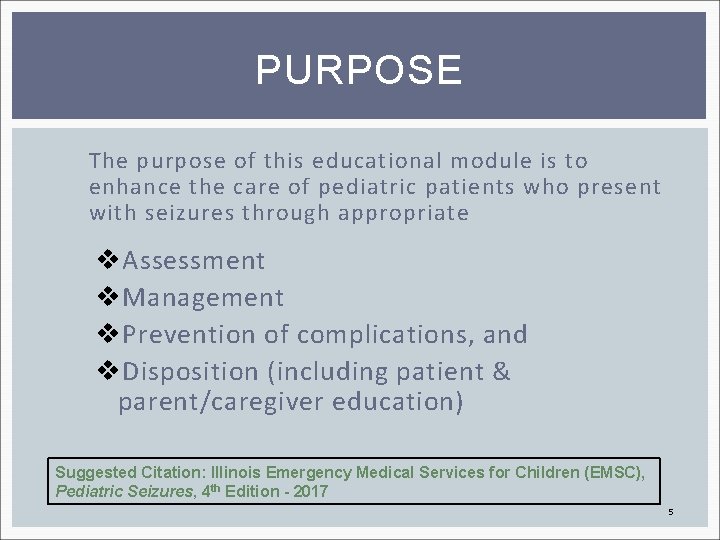
PURPOSE The purpose of this educational module is to enhance the care of pediatric patients who present with seizures through appropriate v Assessment v Management v Prevention of complications, and v Disposition (including patient & parent/caregiver education) Suggested Citation: Illinois Emergency Medical Services for Children (EMSC), Pediatric Seizures, 4 th Edition - 2017 5
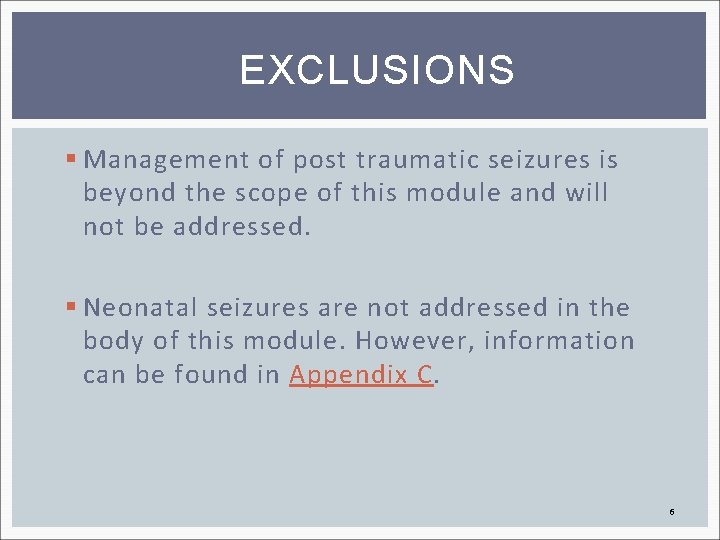
EXCLUSIONS § Management of post traumatic seizures is beyond the scope of this module and will not be addressed. § Neonatal seizures are not addressed in the body of this module. However, information can be found in Appendix C. 6
PEDIATRIC SEIZURES Few health care problems elicit more distress than witnessing a child having a seizure. It is terrifying to many. When the victim is a child, and the observer is a parent or caregiver, that terror can become panic. This module seeks to aid you in minimizing that distress and maximizing the outcome for your patient with evidence-based guidelines. 7
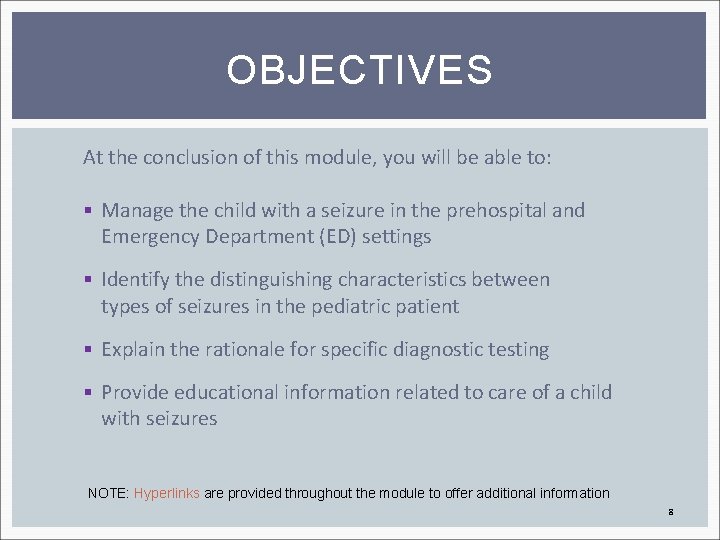
OBJECTIVES At the conclusion of this module, you will be able to: § Manage the child with a seizure in the prehospital and Emergency Department (ED) settings § Identify the distinguishing characteristics between types of seizures in the pediatric patient § Explain the rationale for specific diagnostic testing § Provide educational information related to care of a child with seizures NOTE: Hyperlinks are provided throughout the module to offer additional information 8
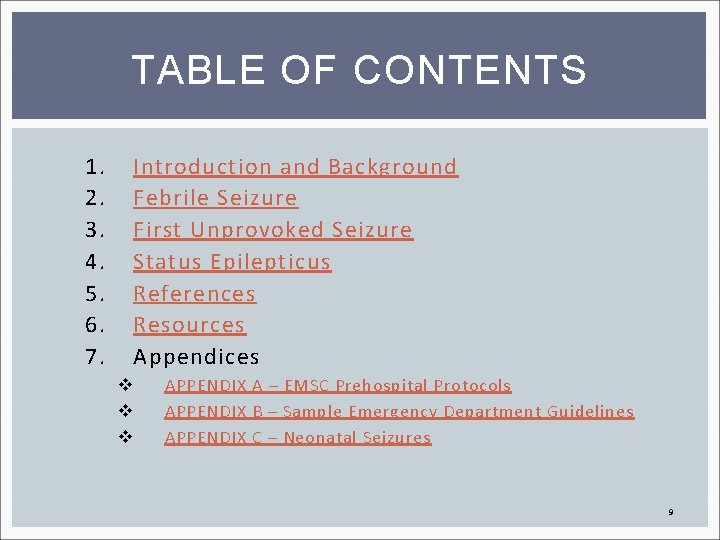
TABLE OF CONTENTS 1. 2. 3. 4. 5. 6. 7. Introduction and Background Febrile Seizure First Unprovoked Seizure Status Epilepticus References Resources Appendices v v v APPENDIX A – EMSC Prehospital Protocols APPENDIX B – Sample Emergency Department Guidelines APPENDIX C – Neonatal Seizures 9
INTRODUCTION AND BACKGROUND Return to Table of Contents 10
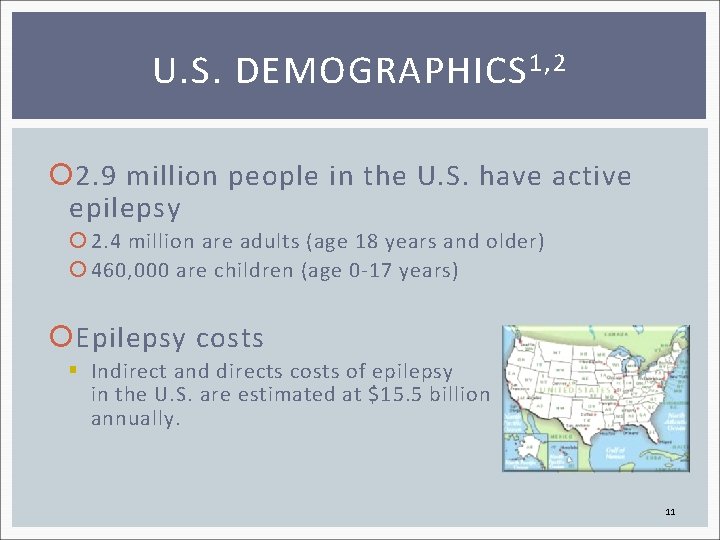
U. S. DEMOGRAPHICS 1, 2 2. 9 million people in the U. S. have active epilepsy 2. 4 million are adults (age 18 years and older) 460, 000 are children (age 0 -17 years) Epilepsy costs § Indirect and directs costs of epilepsy in the U. S. are estimated at $15. 5 billion annually. 11
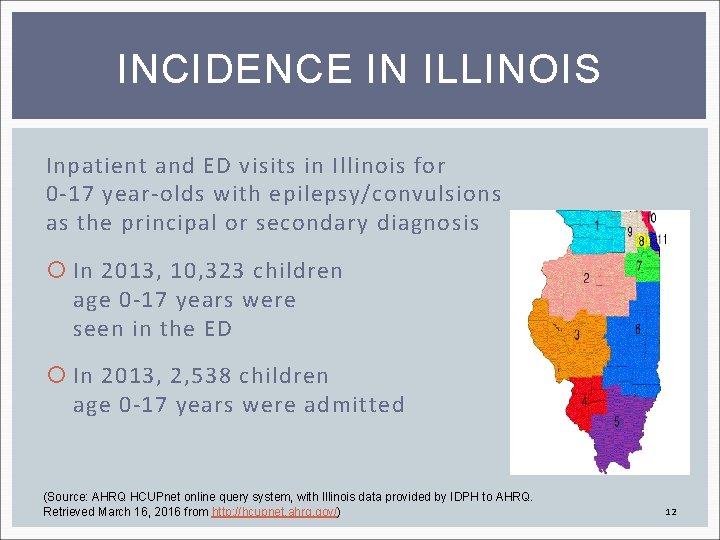
INCIDENCE IN ILLINOIS Inpatient and ED visits in Illinois for 0 -17 year-olds with epilepsy/convulsions as the principal or secondary diagnosis In 2013, 10, 323 children age 0 -17 years were seen in the ED In 2013, 2, 538 children age 0 -17 years were admitted (Source: AHRQ HCUPnet online query system, with Illinois data provided by IDPH to AHRQ. Retrieved March 16, 2016 from http: //hcupnet. ahrq. gov/) 12
ILLINOIS EMSC STATEWIDE PEDIATRIC SEIZURE QI PROJECT In 2010 -2011, Illinois EMSC conducted a statewide survey of Emergency Department practice patterns (including medical record reviews) related to children presenting with: § Simple Febrile Seizure (SFS) § Unprovoked Seizures (Un. S), and § Status Epilepticus (SE) (Source: Illinois EMSC Pediatric Seizures in the Emergency Department Summary Report, May 2011) 13
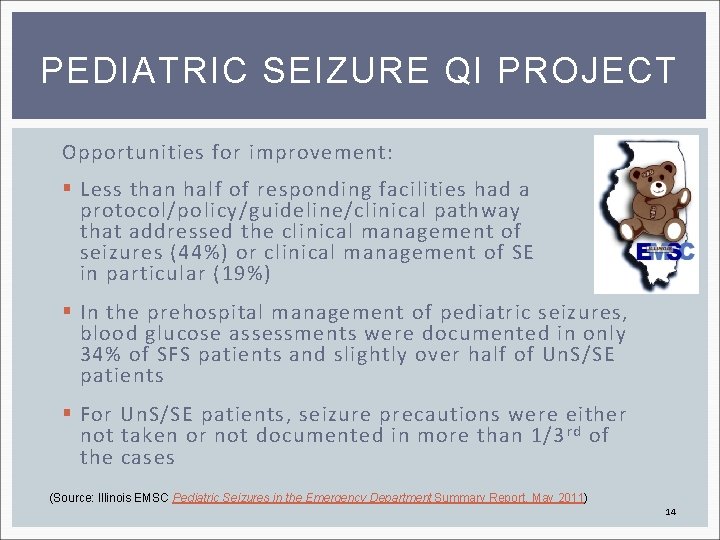
PEDIATRIC SEIZURE QI PROJECT Opportunities for improvement: § Less than half of responding facilities had a protocol/policy/guideline/clinical pathway that addressed the clinical management of seizures (44%) or clinical management of SE in particular (19%) § In the prehospital management of pediatric seizures, blood glucose assessments were documented in only 34% of SFS patients and slightly over half of Un. S/SE patients § For Un. S/SE patients, seizure precautions were either not taken or not documented in more than 1/3 r d of the cases (Source: Illinois EMSC Pediatric Seizures in the Emergency Department Summary Report, May 2011) 14
A SEIZURE IS: § Abnormal neuronal activity § A sudden biochemical imbalance at the cell membrane § Repeated abnormal electrical discharges § Seen clinically as changes in motor control, sensory perception and/or autonomic function 3 15
CLINICAL PRESENTATION: MOTOR CHANGES § Parents/caregivers may report seeing: § Repetitive non-purposeful movements § Staring § Lip-smacking § Falling down without cause § Stiffening of any or all extremities § Rhythmic shaking of any or all extremities Seizure activity cannot be interrupted with verbal or physical stimulation 4 16
CLINICAL PRESENTATION: SENSORY AND AUTONOMIC § Parents/caregivers may report the child is: § Feeling nauseated § Feeling odd or peculiar § Losing control of bowel or bladder § Feeling numbness, tingling § Experiencing odd smells or sounds 17
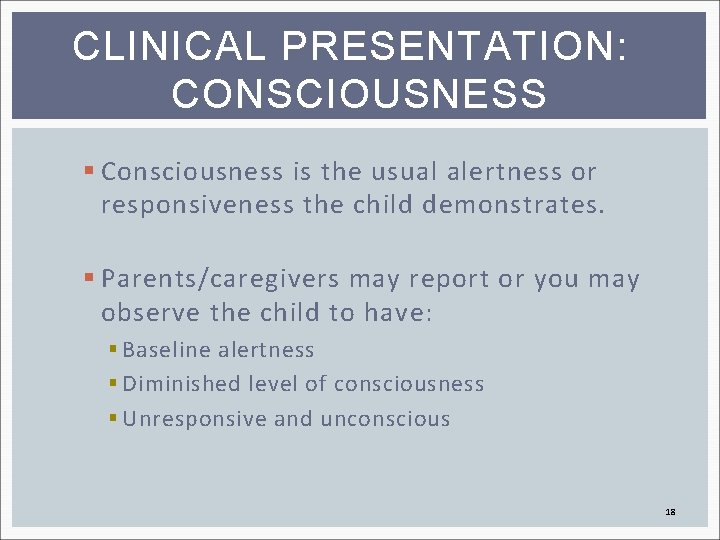
CLINICAL PRESENTATION: CONSCIOUSNESS § Consciousness is the usual alertness or responsiveness the child demonstrates. § Parents/caregivers may report or you may observe the child to have: § Baseline alertness § Diminished level of consciousness § Unresponsive and unconscious 18
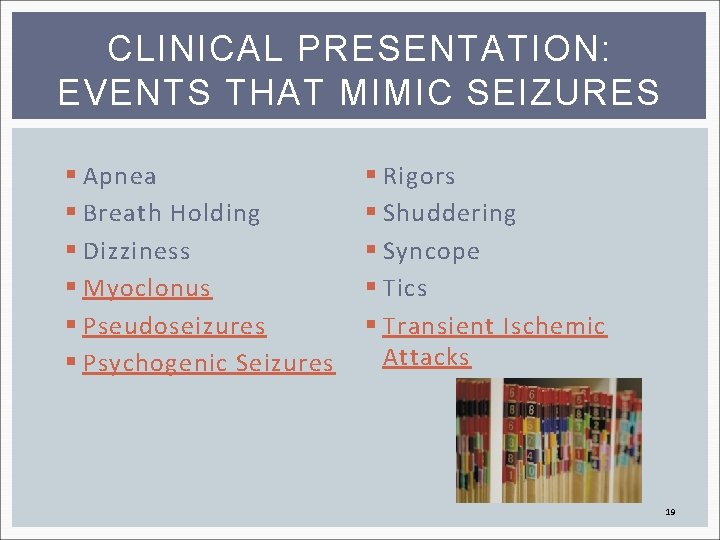
CLINICAL PRESENTATION: EVENTS THAT MIMIC SEIZURES § Apnea § Breath Holding § Dizziness § Myoclonus § Pseudoseizures § Psychogenic Seizures § Rigors § Shuddering § Syncope § Tics § Transient Ischemic Attacks 19
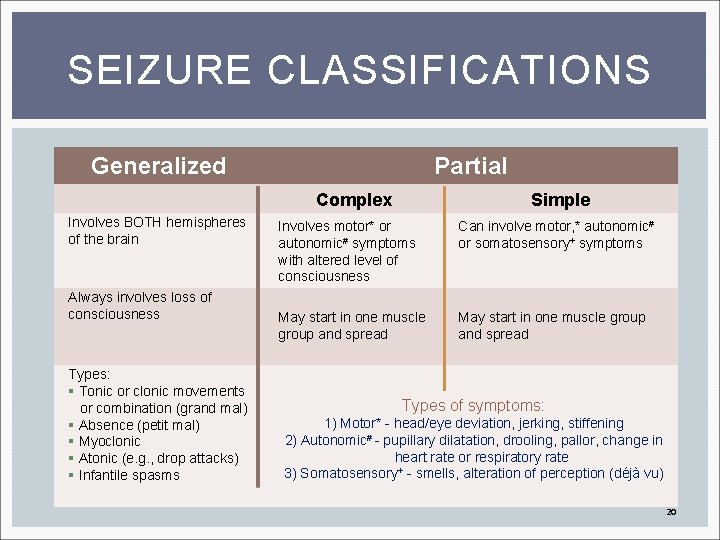
SEIZURE CLASSIFICATIONS Generalized Partial Complex Involves BOTH hemispheres of the brain Always involves loss of consciousness Types: § Tonic or clonic movements or combination (grand mal) § Absence (petit mal) § Myoclonic § Atonic (e. g. , drop attacks) § Infantile spasms Simple Involves motor* or autonomic# symptoms with altered level of consciousness Can involve motor, * autonomic# or somatosensory+ symptoms May start in one muscle group and spread Types of symptoms: 1) Motor* - head/eye deviation, jerking, stiffening 2) Autonomic# - pupillary dilatation, drooling, pallor, change in heart rate or respiratory rate 3) Somatosensory+ - smells, alteration of perception (déjà vu) 20
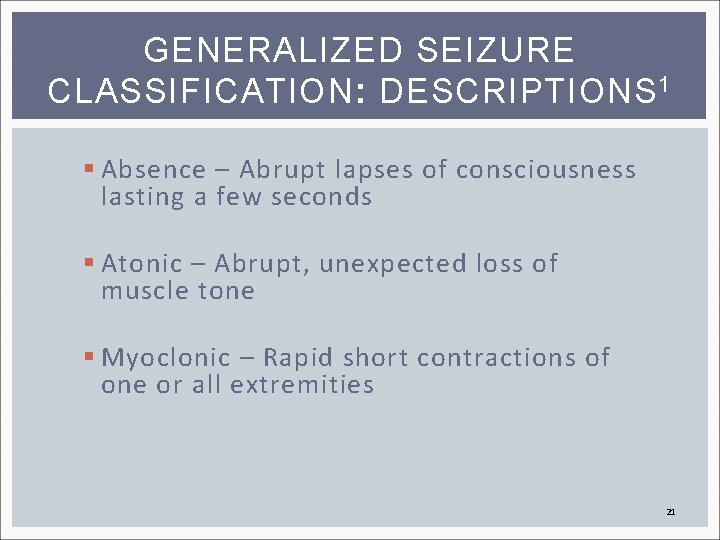
GENERALIZED SEIZURE CLASSIFICATION: DESCRIPTIONS 1 § Absence – Abrupt lapses of consciousness lasting a few seconds § Atonic – Abrupt, unexpected loss of muscle tone § Myoclonic – Rapid short contractions of one or all extremities 21
FEBRILE SEIZURE Return to Table of Contents 22
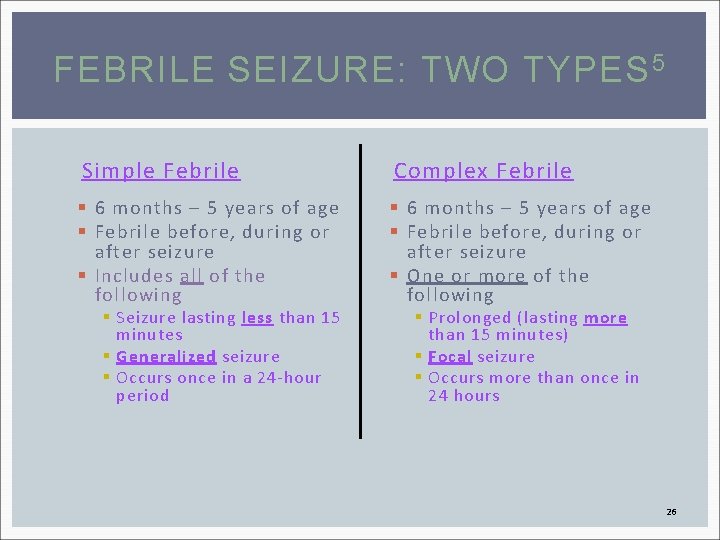
FEBRILE SEIZURE 5 Febrile seizures are the most common seizure disorder in childhood, affecting 2 - 5% of children between the ages of 6 months and 5 years 23
FEBRILE SEIZURE 6 § Caused by the increase in the core body temperature greater than 100. 4 o F or 38 o C § Threshold of temperature which may trigger seizures is unique to each individual § Can occur within the first 24 hours of an illness § Can be the first sign of illness in 25 - 50% of patients 24
FEBRILE SEIZURE: CHARACTERISTICS § Are benign § Occurrence: between 6 months to 5 years of age § May be either simple or complex type seizure § Seizure accompanied by fever (before, during or after) WITHOUT ANY ü Central nervous system infection ü Metabolic disturbance ü History of previous seizure disorder 25
FEBRILE SEIZURE: TWO TYPES 5 Simple Febrile § 6 months – 5 years of age § Febrile before, during or after seizure § Includes all of the following § Seizure lasting less than 15 minutes § Generalized seizure § Occurs once in a 24 -hour period Complex Febrile § 6 months – 5 years of age § Febrile before, during or after seizure § One or more of the following § Prolonged (lasting more than 15 minutes) § Focal seizure § Occurs more than once in 24 hours 26
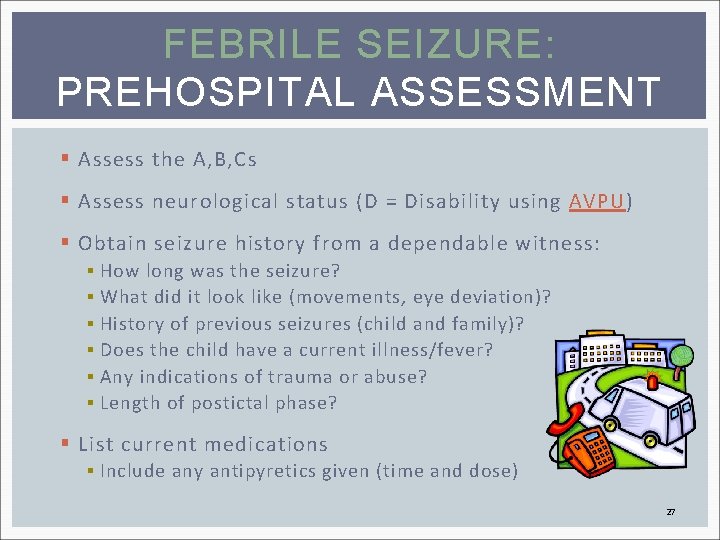
FEBRILE SEIZURE: PREHOSPITAL ASSESSMENT § Assess the A, B, Cs § Assess neurological status (D = Disability using AVPU) § Obtain seizure history from a dependable witness: § § § How long was the seizure? What did it look like (movements, eye deviation)? History of previous seizures (child and family)? Does the child have a current illness/fever? Any indications of trauma or abuse? Length of postictal phase? § List current medications § Include any antipyretics given (time and dose) 27
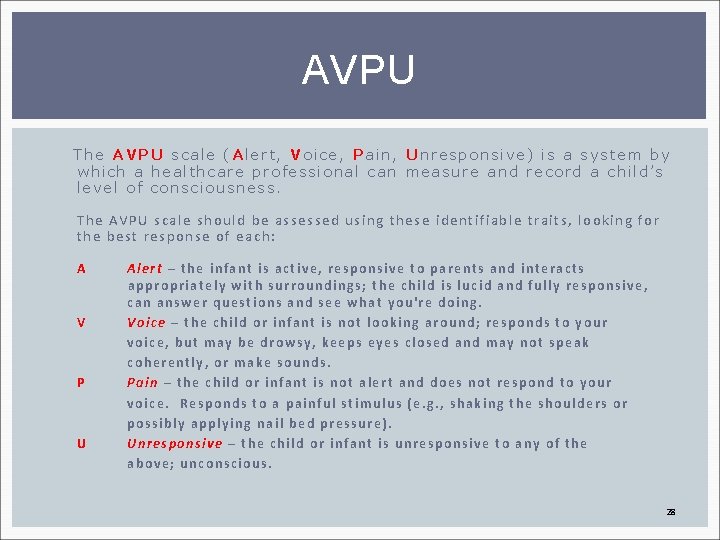
AVPU T he AVP U scale ( A le rt, V oice, P ain, U nresponsive) is a system by which a h ealthcare pro fessional can measure and r ecord a chi ld’s le vel of co nsciousness. T he AVPU scale should be asse ssed using these identifiable trai ts, looking for the best response of each: A Alert – the infant is active, responsive to parents and interacts appropriately with surroundings; the child is lucid and fully responsive, can answer questions and see what you're doing. V Voice – the child or infant is not looking around; responds to your voice, but may be drowsy, keeps eyes closed and may not speak coherently, or make sounds. P Pain – the child or infant is not alert and does not respond to your voice. Responds to a painful stimulus (e. g. , shaking the shoulders or possibly applying nail bed pressure). U Unresponsive – the child or infant is unresponsive to any of the above; unconscious. 28
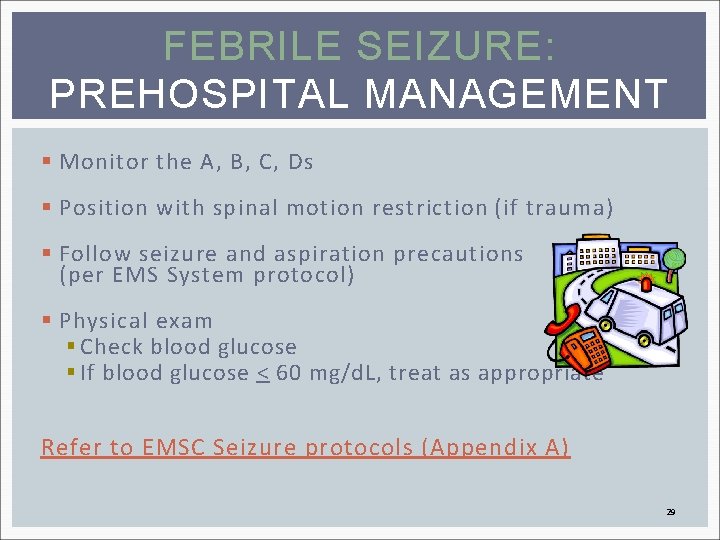
FEBRILE SEIZURE: PREHOSPITAL MANAGEMENT § Monitor the A, B, C, Ds § Position with spinal motion restriction (if trauma) § Follow seizure and aspiration precautions (per EMS System protocol) § Physical exam § Check blood glucose § If blood glucose < 60 mg/d. L, treat as appropriate Refer to EMSC Seizure protocols (Appendix A) 29
FEBRILE SEIZURE: ED ASSESSMENT § Baseline assessment § Vital signs (including temperature) § Assess the A, B, C, Ds § Continue providing and documenting seizure and aspiration precautions 30
FEBRILE SEIZURE: ED ASSESSMENT (CONT. ) § Full History § Obtain seizure history from a dependable witness: § When did the seizure occur? § How long was the seizure and what did it look like? § How was the child acting immediately before the seizure? § History of previous seizures (child and family)? § History of developmental delay/recent loss of milestones? § Does the child have a current illness/fever? § Any indications of trauma or abuse? § Length of postictal state? § Immunization history? § List current medications § Include any antipyretics given (time and dose) 31
FEBRILE SEIZURE: ED MANAGEMENT 8 § If still having a seizure, follow Status Epilepticus protocol § Complete physical exam – to identify the source of fever § Lab testing – direct toward identifying the source of fever § For Simple Febrile Seizures: NO ROUTINE LAB TESTS ARE NECESSARY 32
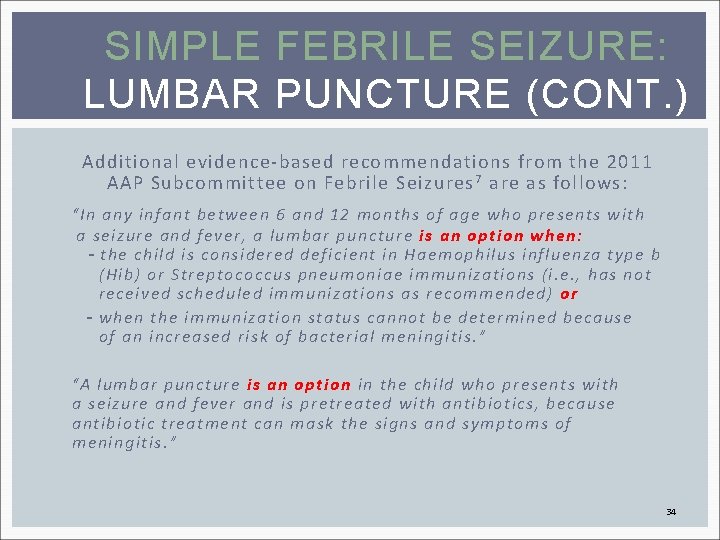
SIMPLE FEBRILE SEIZURE: LUMBAR PUNCTURE Evidence-based recommendations from the 2011 American Academy of Pediatrics (AAP) Subcommittee on Febrile Seizures 7 are as follows: “A lumbar puncture should be performed in any child who presents with a seizure and a fever and has meningeal signs and symptoms (e. g. , neck stiffness, Kernig and/or Brudzinski signs) or in any child whose history or examination suggests the presence of meningitis or intracranial infection. ” Current data does not support routine lumbar puncture in well-appearing, fully immunized children who present with a simple febrile seizure. 33
SIMPLE FEBRILE SEIZURE: LUMBAR PUNCTURE (CONT. ) Additional evidence-based recommendations from the 2011 AAP Subcommittee on Febrile Seizures 7 are as follows: “In any infant between 6 and 12 months of age who presents with a seizure and fever, a lumbar puncture is an option when: - the child is considered deficient in Haemophilus influenza type b (Hib) or Streptococcus pneumoniae immunizations (i. e. , has not received scheduled immunizations as recommended) or - when the immunization status cannot be determined because of an increased risk of bacterial meningitis. ” “A lumbar puncture is an option in the child who presents with a seizure and fever and is pretreated with antibiotics, because antibiotic treatment can mask the signs and symptoms of meningitis. ” 34
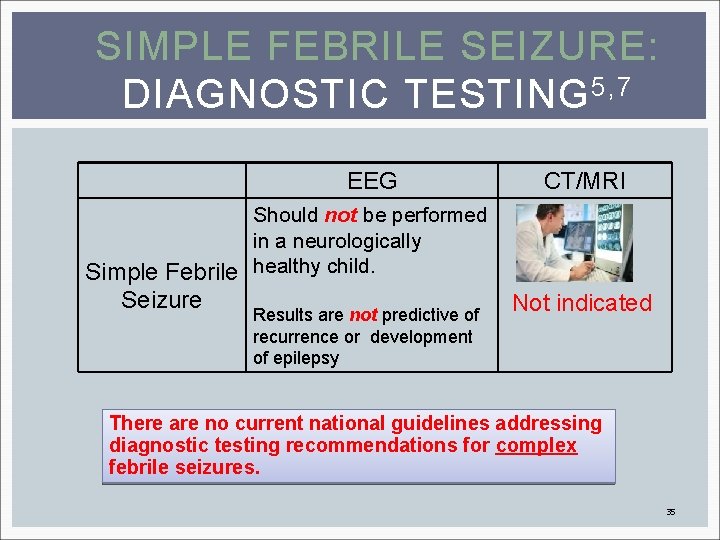
SIMPLE FEBRILE SEIZURE: DIAGNOSTIC TESTING 5, 7 EEG CT/MRI Should not be performed in a neurologically Simple Febrile healthy child. Seizure Results are not predictive of recurrence or development of epilepsy Not indicated There are no current national guidelines addressing diagnostic testing recommendations for complex febrile seizures. 35
SIMPLE FEBRILE SEIZURE: ED ONGOING MANAGEMENT § Reassess temperature § Consider giving antipyretic if not previously administered § As source of fever is identified, treat appropriately 36
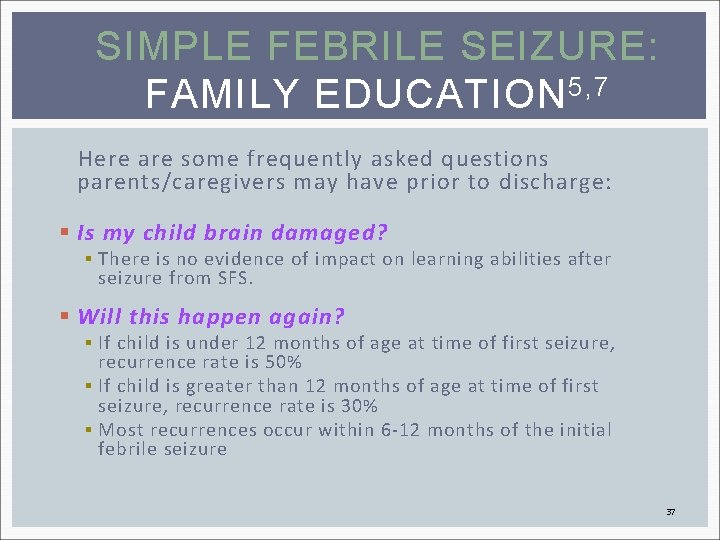
SIMPLE FEBRILE SEIZURE: FAMILY EDUCATION 5, 7 Here are some frequently asked questions parents/caregivers may have prior to discharge: § Is my child brain damaged? § There is no evidence of impact on learning abilities after seizure from SFS. § Will this happen again? § If child is under 12 months of age at time of first seizure, recurrence rate is 50% § If child is greater than 12 months of age at time of first seizure, recurrence rate is 30% § Most recurrences occur within 6 -12 months of the initial febrile seizure 37
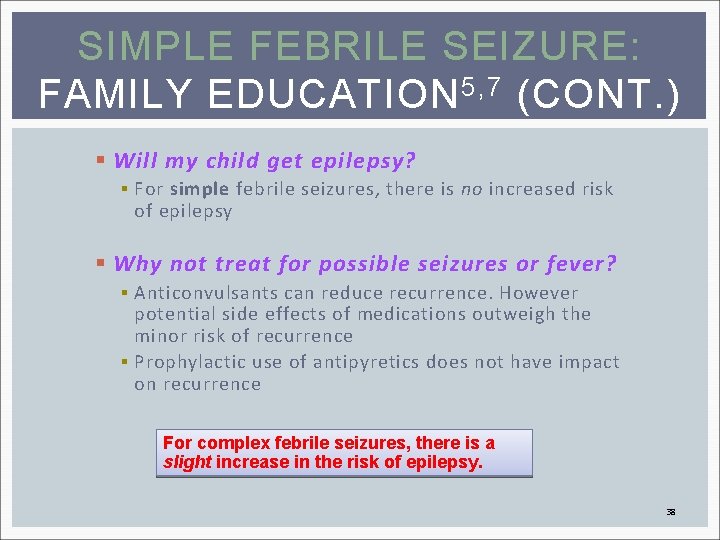
SIMPLE FEBRILE SEIZURE: FAMILY EDUCATION 5, 7 (CONT. ) § Will my child get epilepsy? § For simple febrile seizures, there is no increased risk of epilepsy § Why not treat for possible seizures or fever? § Anticonvulsants can reduce recurrence. However potential side effects of medications outweigh the minor risk of recurrence § Prophylactic use of antipyretics does not have impact on recurrence For complex febrile seizures, there is a slight increase in the risk of epilepsy. 38
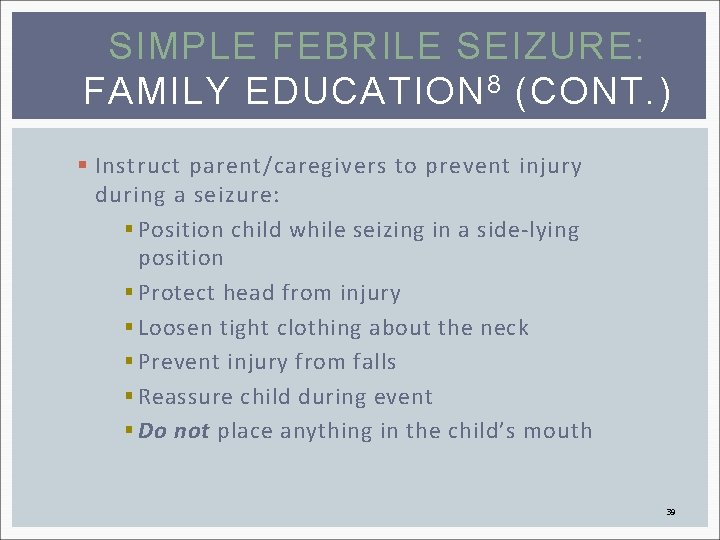
SIMPLE FEBRILE SEIZURE: FAMILY EDUCATION 8 (CONT. ) § Instruct parent/caregivers to prevent injury during a seizure: § Position child while seizing in a side-lying position § Protect head from injury § Loosen tight clothing about the neck § Prevent injury from falls § Reassure child during event § Do not place anything in the child’s mouth 39
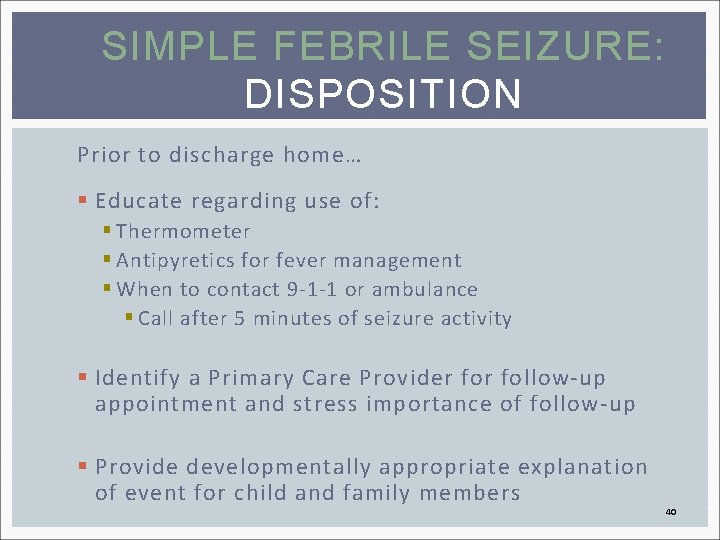
SIMPLE FEBRILE SEIZURE: DISPOSITION Prior to discharge home… § Educate regarding use of: § Thermometer § Antipyretics for fever management § When to contact 9 -1 -1 or ambulance § Call after 5 minutes of seizure activity § Identify a Primary Care Provider follow-up appointment and stress importance of follow-up § Provide developmentally appropriate explanation of event for child and family members 40
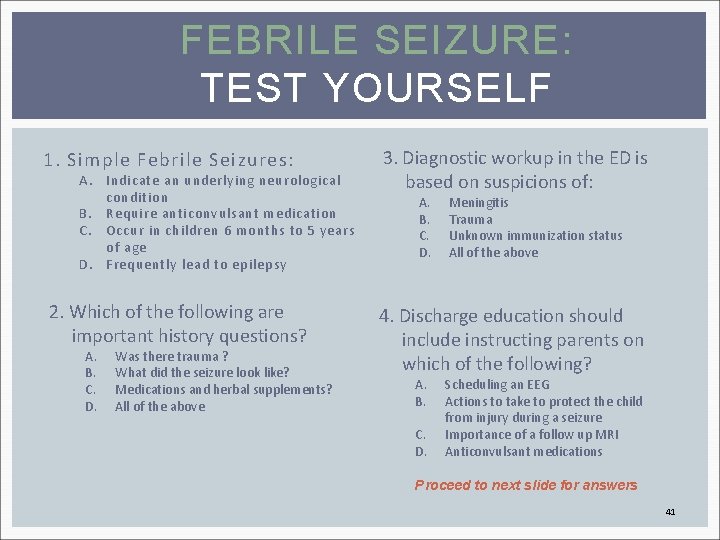
FEBRILE SEIZURE: TEST YOURSELF 1. Simple Febrile Seizures: A. Indicate an underlying neurological condition B. Require anticonvulsant medication C. Occur in children 6 months to 5 years of age D. Frequently lead to epilepsy 2. Which of the following are important history questions? A. B. C. D. Was there trauma ? What did the seizure look like? Medications and herbal supplements? All of the above 3. Diagnostic workup in the ED is based on suspicions of: A. B. C. D. Meningitis Trauma Unknown immunization status All of the above 4. Discharge education should include instructing parents on which of the following? A. B. C. D. Scheduling an EEG Actions to take to protect the child from injury during a seizure Importance of a follow up MRI Anticonvulsant medications Proceed to next slide for answers 41
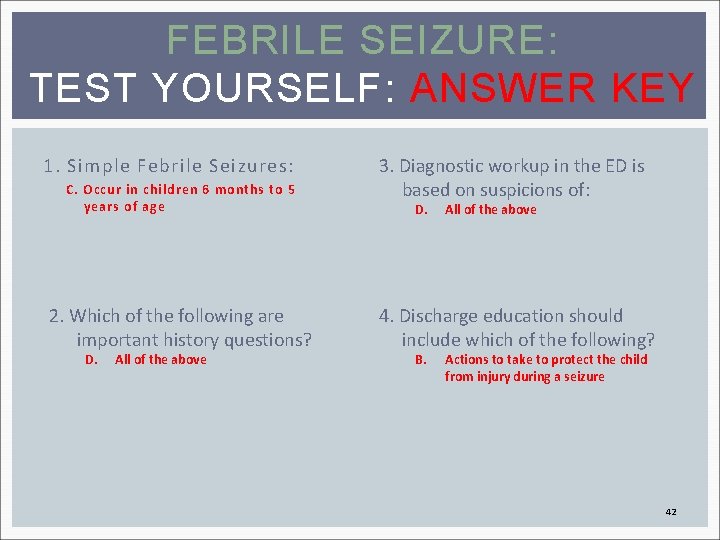
FEBRILE SEIZURE: TEST YOURSELF: ANSWER KEY 1. Simple Febrile Seizures: C. Occur in children 6 months to 5 years of age 2. Which of the following are important history questions? D. All of the above 3. Diagnostic workup in the ED is based on suspicions of: D. All of the above 4. Discharge education should include which of the following? B. Actions to take to protect the child from injury during a seizure 42
FIRST UNPROVOKED SEIZURE Return to Table of Contents 43
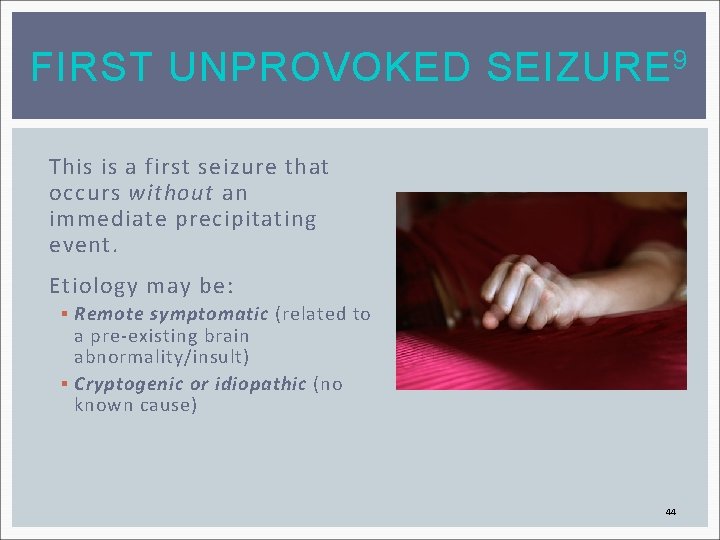
FIRST UNPROVOKED SEIZURE 9 This is a first seizure that occurs without an immediate precipitating event. Etiology may be: § Remote symptomatic (related to a pre-existing brain abnormality/insult) § Cryptogenic or idiopathic (no known cause) 44
FIRST UNPROVOKED SEIZURE: PRESENTATION Parents/caregivers may describe symptoms consistent with the following: § Partial seizure § Generalized onset, tonic-clonic seizure § Tonic seizure Remember: this is a seizure that occurs without an immediate precipitating event. 45
FIRST UNPROVOKED SEIZURE: PREHOSPITAL ASSESSMENT § Assess the A, B, C, Ds § Obtain seizure history from a dependable witness: § § § How long was the seizure? What did it look like (movements, eye deviation)? History of previous seizures (child and family)? Does the child have a current illness/fever? Any indications of trauma or abuse? Length of postictal state § List current medications § Include any antipyretics given (time and dose) 46
FIRST UNPROVOKED SEIZURE: PREHOSPITAL MANAGEMENT § Monitor the A, B, C, Ds § Position with C-Spine protection (if trauma) § Follow seizure and aspiration precautions (per protocol) § Physical assessment § Check blood glucose § If blood glucose < 60 mg/d. L, treat as appropriate Refer to EMSC Seizure protocols (Appendix A) 47
FIRST UNPROVOKED SEIZURE: ED ASSESSMENT § Baseline assessment § Vital signs (including temperature) § Assess the A, B, C, Ds § Continue providing and documenting seizure and aspiration precautions 48
FIRST UNPROVOKED SEIZURE: ED ASSESSMENT (CONT. ) § If still seizing, follow Status Epilepticus protocol § Full History § Obtain seizure history from a dependable witness: § Recent exposures (chemical, industrial)? § When did the seizure occur? § How long was the seizure and what did it look like? § How was the child acting immediately before the seizure? § History of previous seizures (child and family)? § History of developmental delay/recent loss of milestones? § Does the child have a current illness? § Any indications of trauma or abuse? § Immunization history? § Length of postictal state? 49
FIRST UNPROVOKED SEIZURE: ED ASSESSMENT (CONT. ) § List current medications § Include any antipyretics given (time and dose) § Include anticonvulsants given by prehospital team (time and dose) § Physical exam § Head-to-toe assessment 50
FIRST UNPROVOKED SEIZURE: DIAGNOSTIC TESTING 9 Laboratory tests are based on individual clinical circumstances and may include: § CBC with differential § Blood glucose § Electrolytes § Calcium, magnesium, phosphorous § Urine drug/toxicology screen § Urine HCG (age/sex dependent) Lumbar puncture is only indicated if there are other symptoms that suggest a diagnosis of meningitis. 51
FIRST UNPROVOKED SEIZURE: DIAGNOSTIC TESTING – MRI 9, 10 § MRI should be considered for: § Children under 1 year of age § All children with significant acute cognitive or motor impairment § Unexplained abnormalities on neurologic exam § Seizure of focal onset without generalization § Abnormal EEG § Abnormalities on MRI are seen in up to 1/3 rd of children § However, most abnormalities do not influence immediate treatment or management (such as need for hospitalization) 52
FIRST UNPROVOKED SEIZURE: DIAGNOSTIC TESTING – CT SCAN 9, 10 Emergent CT Scan (without contrast) should be considered for any child who exhibits any of the following: § Significant, acute cognitive or motor impairment § New focal deficit not quickly resolving § Not returned to baseline MRI is the modality of choice, if available. 53
FIRST UNPROVOKED SEIZURE: DIAGNOSTIC TESTING – EEG 9, 10 § Obtain on ALL children in whom a nonfebrile seizure has been diagnosed § Can be arranged as an outpatient § Should be interpreted by a neurologist (preferably pediatric neurologist) § EEG results will: § Help predict the risk of recurrence § Classify the seizure type or epilepsy syndrome § Influence the decision to perform additional neuroimaging studies 54
FIRST UNPROVOKED SEIZURE: ED MANAGEMENT If child is still actively having seizures… § Refer to Status Epilepticus protocol When child is stable… § Consult with Neurologist (or Intensivist) § For possible medication recommendations § To determine disposition: v Admit to observe v Transfer (if neurologist is unavailable) v Discharge home w/ Primary Care Provider and Neurology follow-up 55
FIRST UNPROVOKED SEIZURE: RECURRENCE RISK § The majority of children who experience an unprovoked seizure will have few or no recurrences § Approximately 10% will go on to have additional seizures regardless of therapy § Predictors of recurrence include: abnormal EEG, underlying etiology, and abnormal neurologic exams § Remote symptomatic – recurrence risk over 2 years is above 50% § Cryptogenic or idiopathic – recurrence risk over 2 years is 30 -50% § If first seizure is prolonged, recurrent seizures are more likely to be prolonged. 56
FIRST UNPROVOKED SEIZURE: DRUG THERAPY 9, 10 § Type of medication if offered depends on: § Type, frequency and severity of seizures § Side effects, titration, drug interactions, dosing forms, cost of drug § Neurologist preference 57
FIRST UNPROVOKED SEIZURE: DISCHARGE & FAMILY EDUCATION Prior to discharge home… § Identify Primary Care Provider and Neurologist for follow-up appointments § Provide plan for outpatient EEG § Provide parental support § Consider rescue medication for home, based on neurologist recommendation (e. g. , rectal diazepam) 58
FIRST UNPROVOKED SEIZURE: FAMILY EDUCATION 8 § Instruct parent/caregivers to prevent injury during a seizure: § Position child while seizing in a side-lying position § Protect head from injury § Loosen tight clothing about the neck § Prevent injury from falls § Reassure child during event § Do not place anything in the child’s mouth 59
FIRST UNPROVOKED SEIZURE: FAMILY EDUCATION (CONT. ) § Instruct in use of 9 -1 -1 or ambulance services § Provide developmentally appropriate explanation to child about the seizure event and treatment § Discourage swimming alone § No driving a car until cleared by a physician 60
FIRST UNPROVOKED SEIZURE: FAMILY EDUCATION (CONT. ) Here are some frequently asked questions parents/caregivers may have prior to discharge: § How likely is it that my child will have seizures again? The risk of recurrence relates to the underlying etiology and EEG results (normal or abnormal). The majority of children who experience an unprovoked seizure will have few or no recurrences. Approximately 10% will go on to have additional seizures regardless of therapy. 9 § Is there a risk of dying from the seizure if we don’t start medication today? Sudden unexpected death is very uncommon (usually related to an underlying neurologic handicap rather than seizure activity). There are no studies showing treatment after a first seizure alters the small risk of sudden death. 9 61
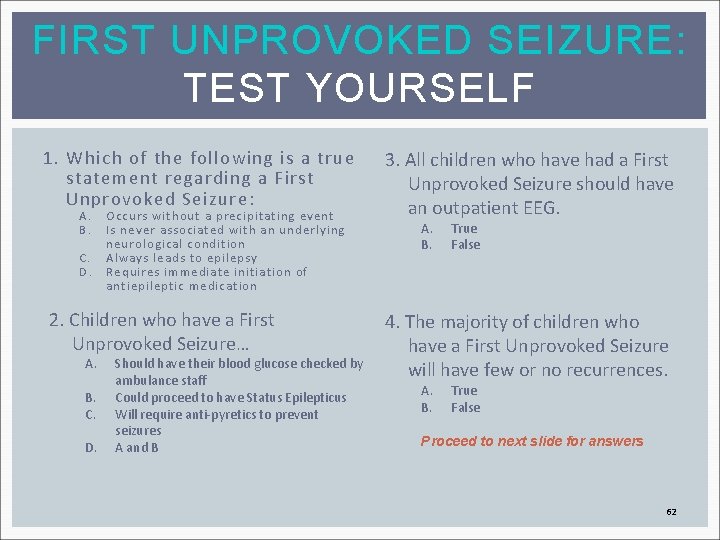
FIRST UNPROVOKED SEIZURE: TEST YOURSELF 1. Which of the following is a true statement regarding a First Unprovoked Seizure: A. B. C. D. Occurs without a precipitating event Is never associated with an underlying neurological condition Always leads to epilepsy Requires immediate initiation of antiepileptic medication 2. Children who have a First Unprovoked Seizure… A. B. C. D. Should have their blood glucose checked by ambulance staff Could proceed to have Status Epilepticus Will require anti-pyretics to prevent seizures A and B 3. All children who have had a First Unprovoked Seizure should have an outpatient EEG. A. B. True False 4. The majority of children who have a First Unprovoked Seizure will have few or no recurrences. A. B. True False Proceed to next slide for answers 62
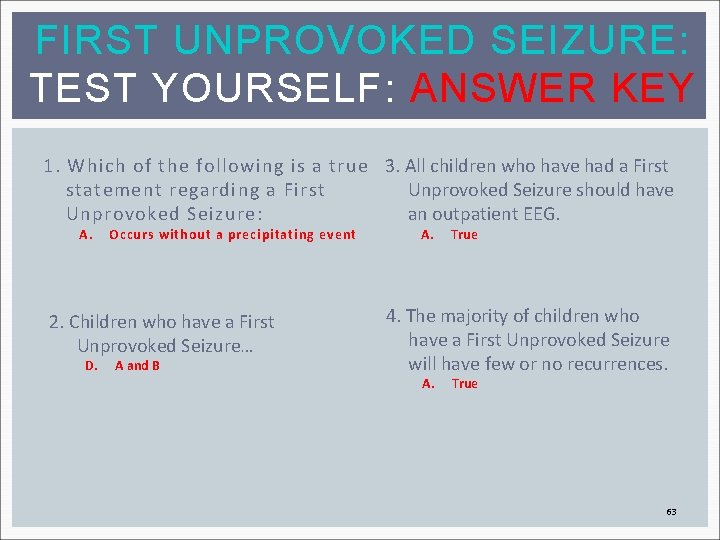
FIRST UNPROVOKED SEIZURE: TEST YOURSELF: ANSWER KEY 1. Which of the following is a true 3. All children who have had a First statement regarding a First Unprovoked Seizure should have Unprovoked Seizure: an outpatient EEG. A. Occurs without a precipitating event 2. Children who have a First Unprovoked Seizure… D. A and B A. True 4. The majority of children who have a First Unprovoked Seizure will have few or no recurrences. A. True 63
STATUS EPILEPTICUS Return to Table of Contents 64
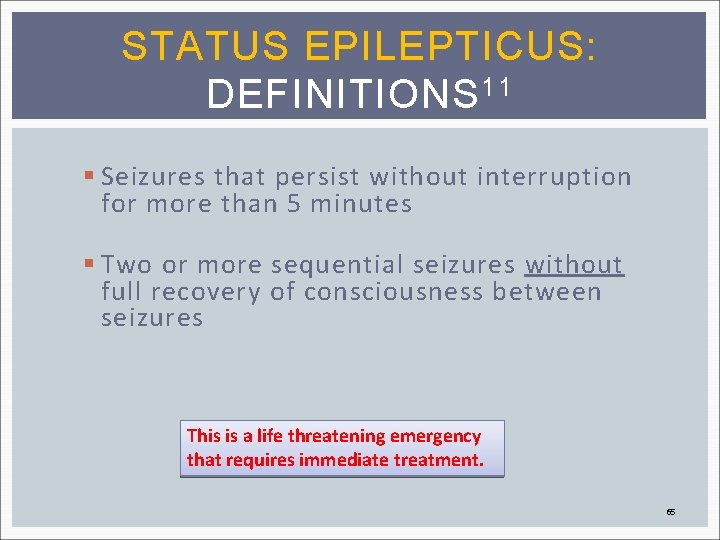
STATUS EPILEPTICUS: DEFINITIONS 11 § Seizures that persist without interruption for more than 5 minutes § Two or more sequential seizures without full recovery of consciousness between seizures This is a life threatening emergency that requires immediate treatment. 65
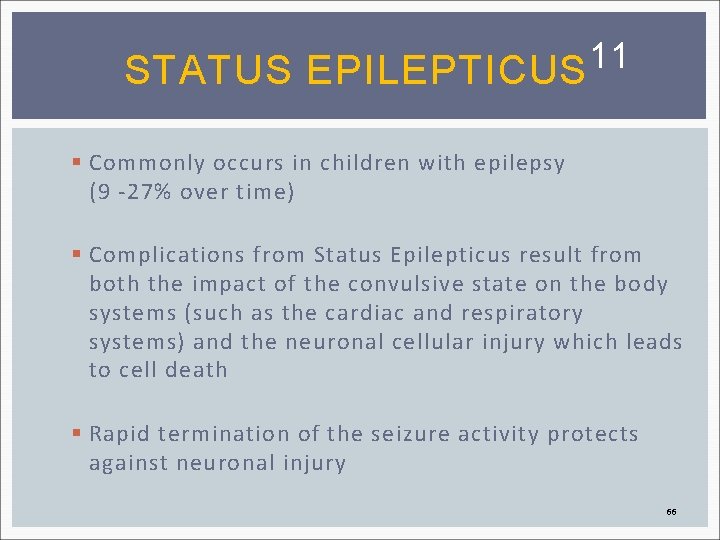
11 STATUS EPILEPTICUS § Commonly occurs in children with epilepsy (9 -27% over time) § Complications from Status Epilepticus result from both the impact of the convulsive state on the body systems (such as the cardiac and respiratory systems) and the neuronal cellular injury which leads to cell death § Rapid termination of the seizure activity protects against neuronal injury 66
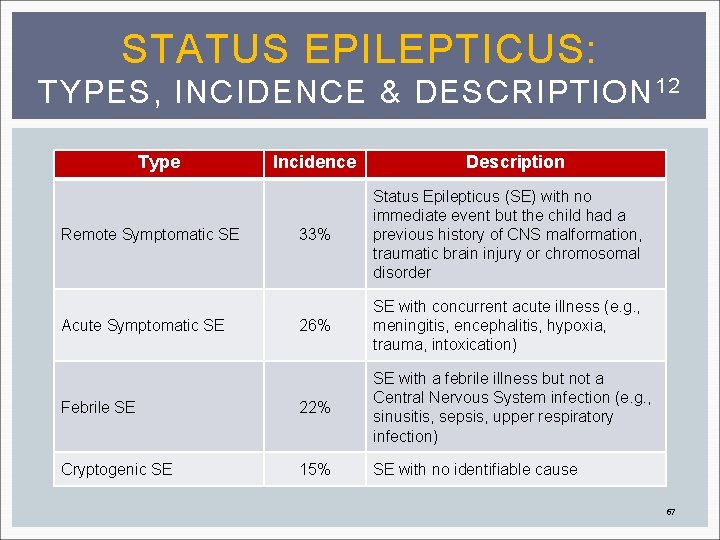
STATUS EPILEPTICUS: TYPES, INCIDENCE & DESCRIPTION 12 Type Incidence Description 33% Status Epilepticus (SE) with no immediate event but the child had a previous history of CNS malformation, traumatic brain injury or chromosomal disorder 26% SE with concurrent acute illness (e. g. , meningitis, encephalitis, hypoxia, trauma, intoxication) Febrile SE 22% SE with a febrile illness but not a Central Nervous System infection (e. g. , sinusitis, sepsis, upper respiratory infection) Cryptogenic SE 15% SE with no identifiable cause Remote Symptomatic SE Acute Symptomatic SE 67
STATUS EPILEPTICUS: PREHOSPITAL ASSESSMENT § Assess the A, B, C, Ds § Obtain seizure history from a dependable witness: § When did the seizure begin? § What did it look like (movements, eye deviation)? § History of previous seizures (child and family)? § Does the child have a current illness/fever? § Any indications of trauma or abuse? § Emergency Information Form for Children with Special Needs? 68
STATUS EPILEPTICUS: PREHOSPITAL ASSESSMENT § List current medications § Include any antipyretics given (time and dose) § Do the parents have any anticonvulsant medications (e. g. , rectal diazepam)? § Have parents given any anticonvulsant medications (time, route and dose)? 69
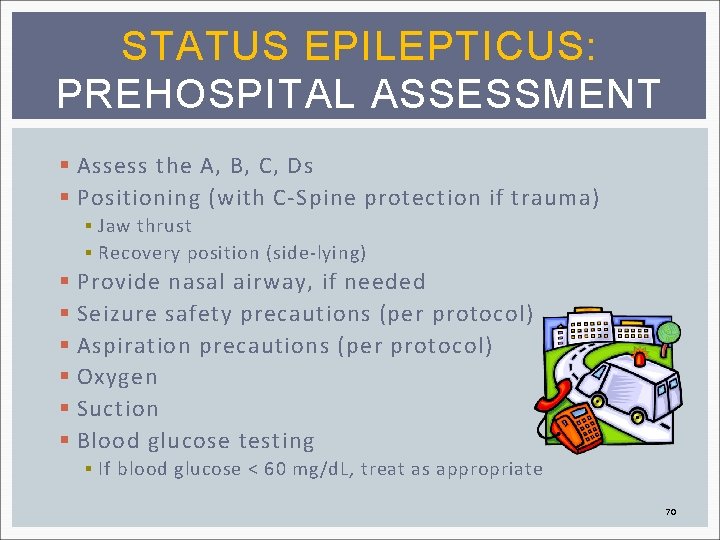
STATUS EPILEPTICUS: PREHOSPITAL ASSESSMENT § Assess the A, B, C, Ds § Positioning (with C-Spine protection if trauma) § Jaw thrust § Recovery position (side-lying) § Provide nasal airway, if needed § Seizure safety precautions (per protocol) § Aspiration precautions (per protocol) § Oxygen § Suction § Blood glucose testing § If blood glucose < 60 mg/d. L, treat as appropriate 70
STATUS EPILEPTICUS: PREHOSPITAL ASSESSMENT § If parent/caregiver has rectal diazepam and has not given it, the parent/caregiver should be requested to administer it § Document time and dose § Follow Pediatric Seizures ALS guideline (if appropriate) § Contact Medical Control REFER TO APPENDIX A for EMSC Seizure Protocols 71
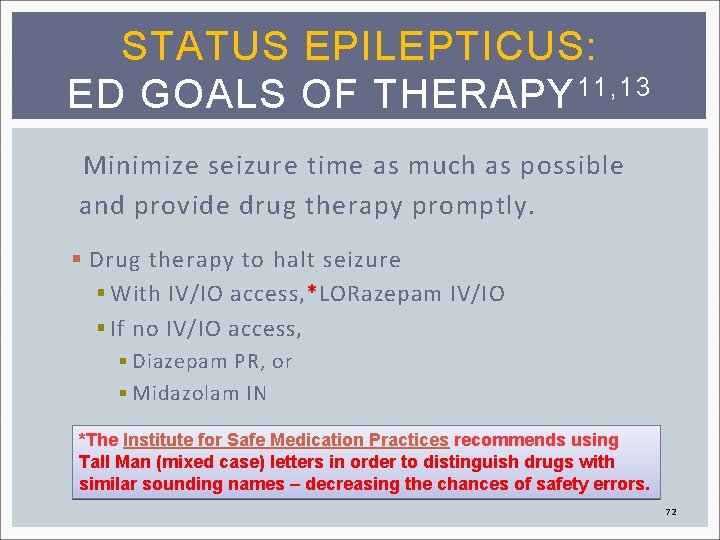
STATUS EPILEPTICUS: ED GOALS OF THERAPY 11, 13 Minimize seizure time as much as possible and provide drug therapy promptly. § Drug therapy to halt seizure § With IV/IO access, *LORazepam IV/IO § If no IV/IO access, § Diazepam PR, or § Midazolam IN *The Institute for Safe Medication Practices recommends using Tall Man (mixed case) letters in order to distinguish drugs with similar sounding names – decreasing the chances of safety errors. 72
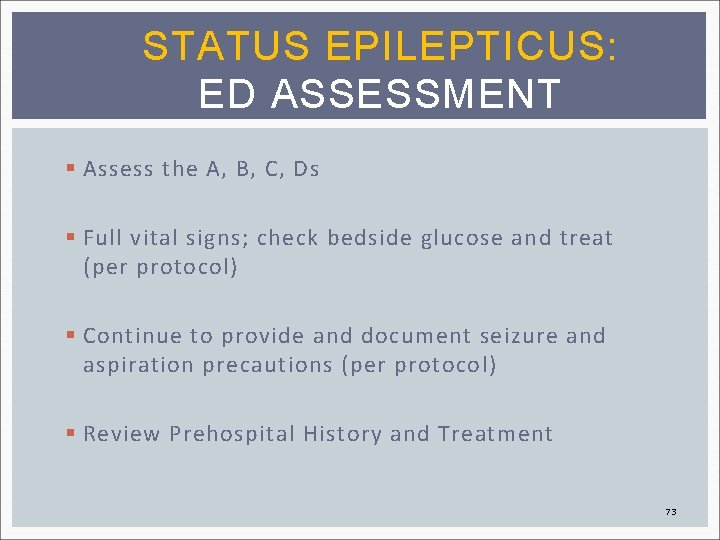
STATUS EPILEPTICUS: ED ASSESSMENT § Assess the A, B, C, Ds § Full vital signs; check bedside glucose and treat (per protocol) § Continue to provide and document seizure and aspiration precautions (per protocol) § Review Prehospital History and Treatment 73
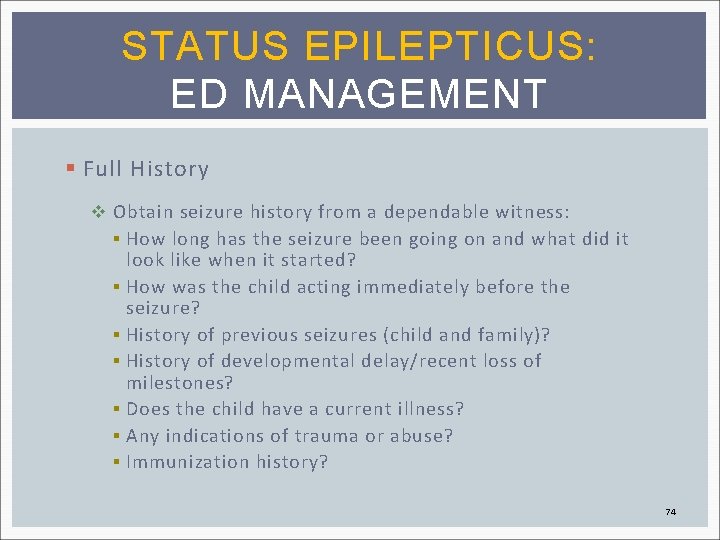
STATUS EPILEPTICUS: ED MANAGEMENT § Full History v Obtain seizure history from a dependable witness: § How long has the seizure been going on and what did it look like when it started? § How was the child acting immediately before the seizure? § History of previous seizures (child and family)? § History of developmental delay/recent loss of milestones? § Does the child have a current illness? § Any indications of trauma or abuse? § Immunization history? 74
STATUS EPILEPTICUS: ED ASSESSMENT § Assess E (exposure) § List current medications v When were they last given? § Recent exposures - chemical, industrial, infectious? § Was patient recently out of the country? 75
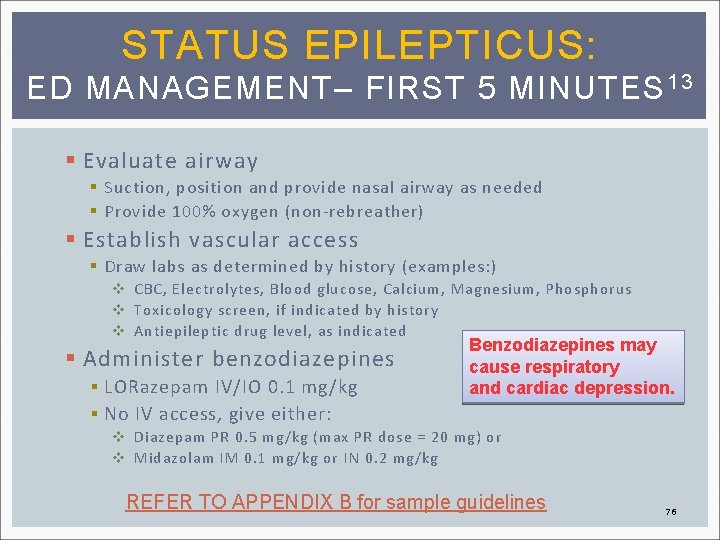
STATUS EPILEPTICUS: ED MANAGEMENT– FIRST 5 MINUTES 13 § Evaluate airway § Suction, position and provide nasal airway as needed § Provide 100% oxygen (non-rebreather) § Establish vascular access § Draw labs as determined by history (examples: ) v CBC, Electrolytes, Blood glucose, Calcium, Magnesium, Phosphorus v Toxicology screen, if indicated by history v Antiepileptic drug level, as indicated § Administer benzodiazepines § LORazepam IV/IO 0. 1 mg/kg § No IV access, give either: Benzodiazepines may cause respiratory and cardiac depression. v Diazepam PR 0. 5 mg/kg (max PR dose = 20 mg) or v Midazolam IM 0. 1 mg/kg or IN 0. 2 mg/kg REFER TO APPENDIX B for sample guidelines 76
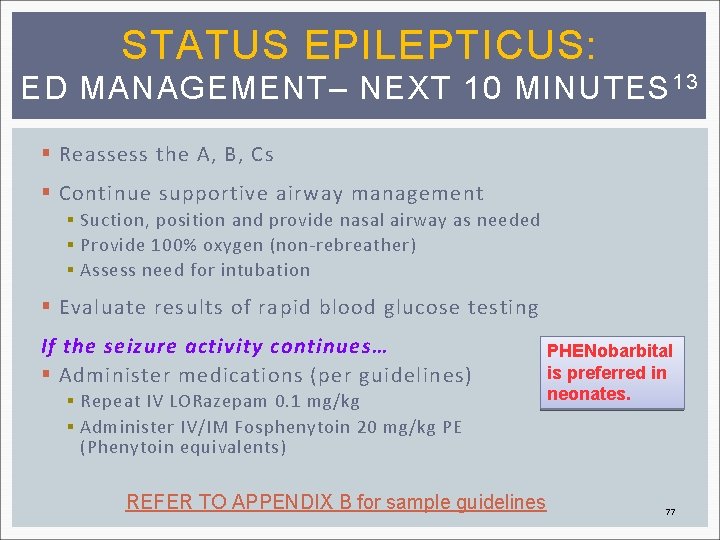
STATUS EPILEPTICUS: ED MANAGEMENT– NEXT 10 MINUTES 13 § Reassess the A, B, Cs § Continue supportive airway management § Suction, position and provide nasal airway as needed § Provide 100% oxygen (non-rebreather) § Assess need for intubation § Evaluate results of rapid blood glucose testing If the seizure activity continues… § Administer medications (per guidelines) § Repeat IV LORazepam 0. 1 mg/kg § Administer IV/IM Fosphenytoin 20 mg/kg PE PHENobarbital is preferred in neonates. (Phenytoin equivalents) REFER TO APPENDIX B for sample guidelines 77
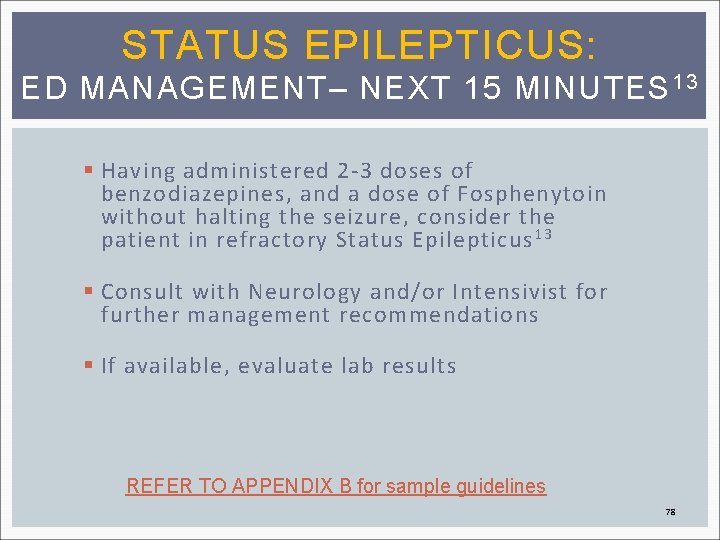
STATUS EPILEPTICUS: ED MANAGEMENT– NEXT 15 MINUTES 13 § Having administered 2 -3 doses of benzodiazepines, and a dose of Fosphenytoin without halting the seizure, consider the patient in refractory Status Epilepticus 13 § Consult with Neurology and/or Intensivist for further management recommendations § If available, evaluate lab results REFER TO APPENDIX B for sample guidelines 78
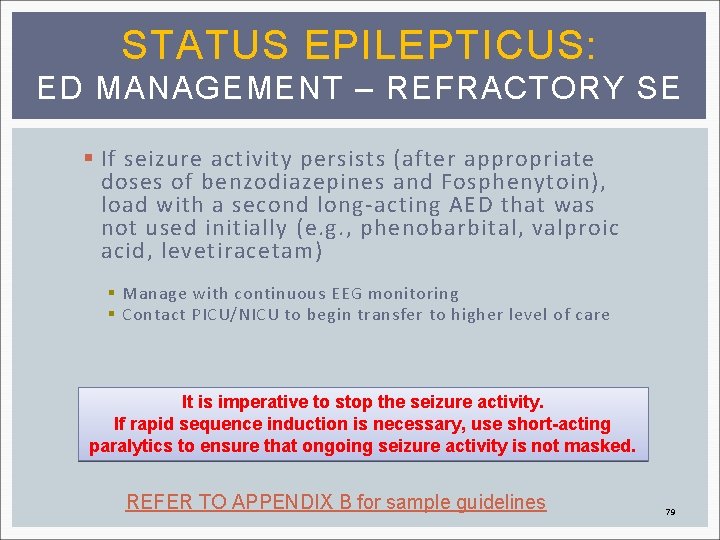
STATUS EPILEPTICUS: ED MANAGEMENT – REFRACTORY SE § If seizure activity persists (after appropriate doses of benzodiazepines and Fosphenytoin), load with a second long-acting AED that was not used initially (e. g. , phenobarbital, valproic acid, levetiracetam) § Manage with continuous EEG monitoring § Contact PICU/NICU to begin transfer to higher level of care It is imperative to stop the seizure activity. If rapid sequence induction is necessary, use short-acting paralytics to ensure that ongoing seizure activity is not masked. REFER TO APPENDIX B for sample guidelines 79
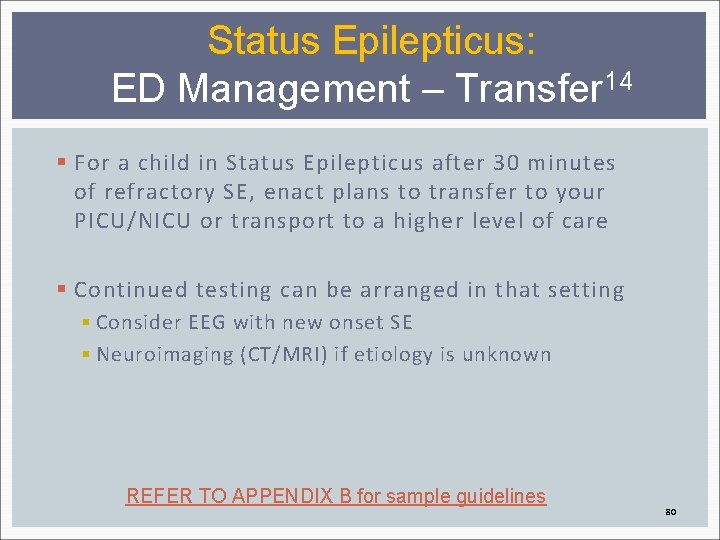
Status Epilepticus: ED Management – Transfer 14 § For a child in Status Epilepticus after 30 minutes of refractory SE, enact plans to transfer to your PICU/NICU or transport to a higher level of care § Continued testing can be arranged in that setting § Consider EEG with new onset SE § Neuroimaging (CT/MRI) if etiology is unknown REFER TO APPENDIX B for sample guidelines 80
STATUS EPILEPTICUS: DISPOSITION § Discuss child’s progress and advice regarding admission or transfer based on patient status and neurology consultation with parents/caregiver § Utilize a specialty/critical care transport team § (If applicable) Explain these events to child in developmentally appropriate manner 81
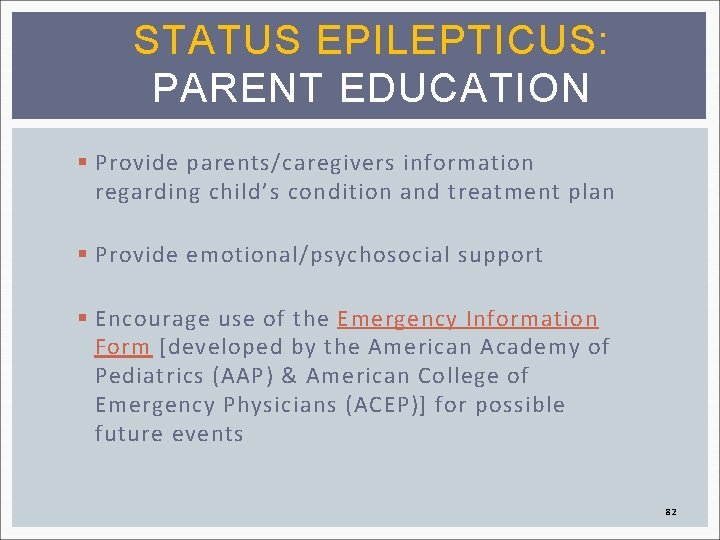
STATUS EPILEPTICUS: PARENT EDUCATION § Provide parents/caregivers information regarding child’s condition and treatment plan § Provide emotional/psychosocial support § Encourage use of the Emergency Information Form [developed by the American Academy of Pediatrics (AAP) & American College of Emergency Physicians (ACEP)] for possible future events 82
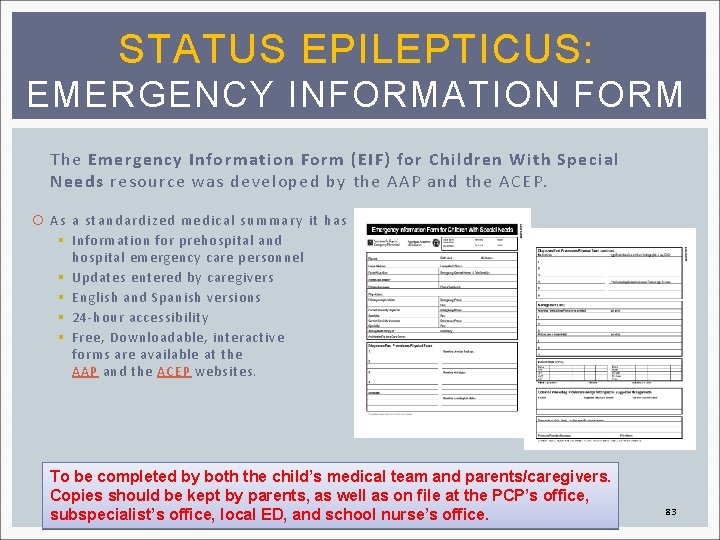
STATUS EPILEPTICUS: EMERGENCY INFORMATION FORM The Emergency Information Form (EIF) for Children With Special Needs resource was developed by the AAP and the ACEP. As a standardized medical summary it has § Information for prehospital and hospital emergency care personnel § Updates entered by caregivers § English and Spanish versions § 24 -hour accessibility § Free, Downloadable, interactive forms are available at the AAP and the ACEP websites. To be completed by both the child’s medical team and parents/caregivers. Copies should be kept by parents, as well as on file at the PCP’s office, subspecialist’s office, local ED, and school nurse’s office. 83
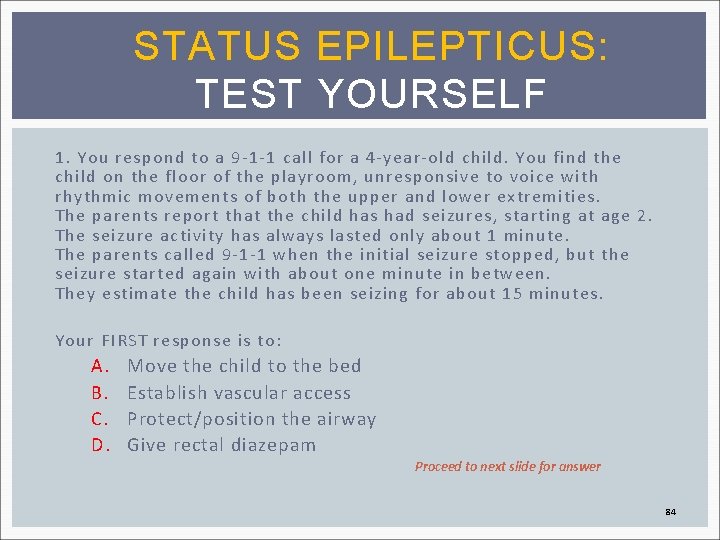
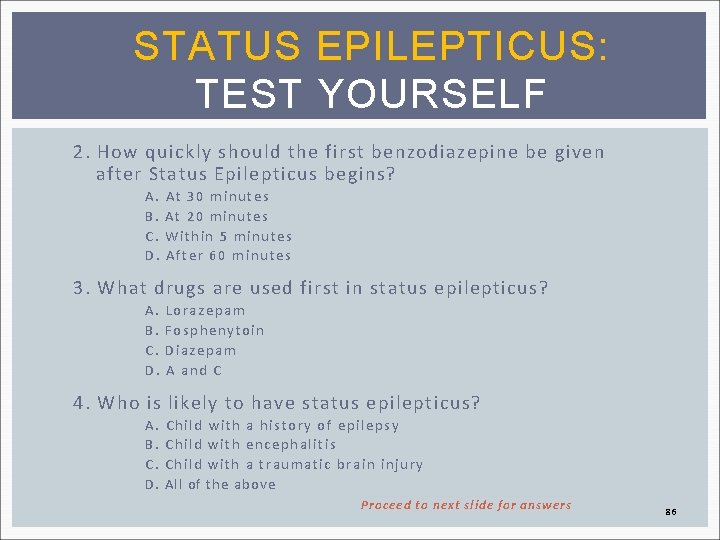
STATUS EPILEPTICUS: TEST YOURSELF 1. You respond to a 9 -1 -1 call for a 4 -year-old child. You find the child on the floor of the playroom, unresponsive to voice with rhythmic movements of both the upper and lower extremities. The parents report that the child has had seizures, starting at age 2. The seizure activity has always lasted only about 1 minute. The parents called 9 -1 -1 when the initial seizure stopped, but the seizure started again with about one minute in between. They estimate the child has been seizing for about 15 minutes. Your FIRST response is to: A. B. C. D. Move the child to the bed Establish vascular access Protect/position the airway Give rectal diazepam Proceed to next slide for answer 84
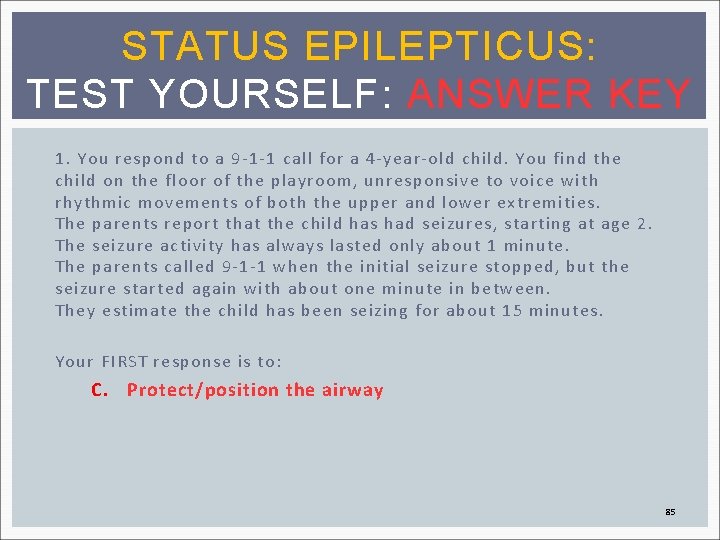
STATUS EPILEPTICUS: TEST YOURSELF: ANSWER KEY 1. You respond to a 9 -1 -1 call for a 4 -year-old child. You find the child on the floor of the playroom, unresponsive to voice with rhythmic movements of both the upper and lower extremities. The parents report that the child has had seizures, starting at age 2. The seizure activity has always lasted only about 1 minute. The parents called 9 -1 -1 when the initial seizure stopped, but the seizure started again with about one minute in between. They estimate the child has been seizing for about 15 minutes. Your FIRST response is to: C. Protect/position the airway 85
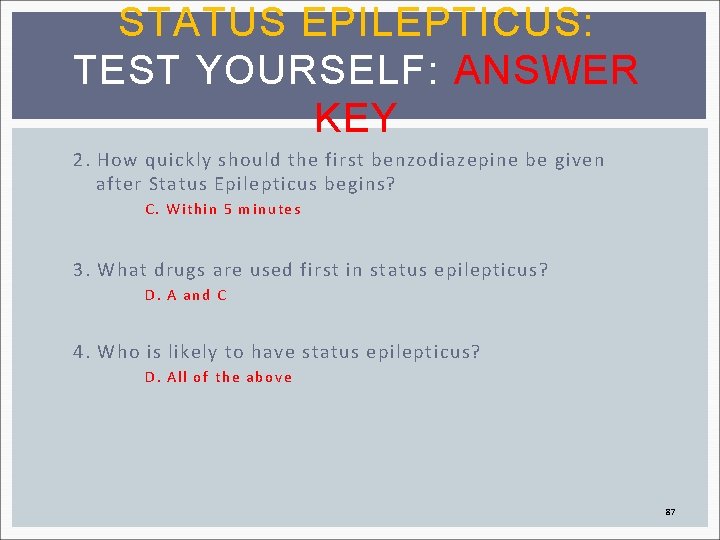
STATUS EPILEPTICUS: TEST YOURSELF 2. How quickly should the first benzodiazepine be given after Status Epilepticus begins? A. A t 30 minute s B. At 20 minute s C. Within 5 minute s D. A fter 60 minute s 3. What drugs are used first in status epilepticus? A. Lorazepam B. Fosphe nyto in C. Diazepam D. A and C 4. Who is likely to have status epilepticus? A. Child with a history of epilepsy B. Child with enc ephalitis C. Child with a traumatic brain injury D. All of the above Proceed to next slide for answers 86
STATUS EPILEPTICUS: TEST YOURSELF: ANSWER KEY 2. How quickly should the first benzodiazepine be given after Status Epilepticus begins? C. Within 5 minutes 3. What drugs are used first in status epilepticus? D. A and C 4. Who is likely to have status epilepticus? D. All of the above 87
References Return to Table of Contents 88
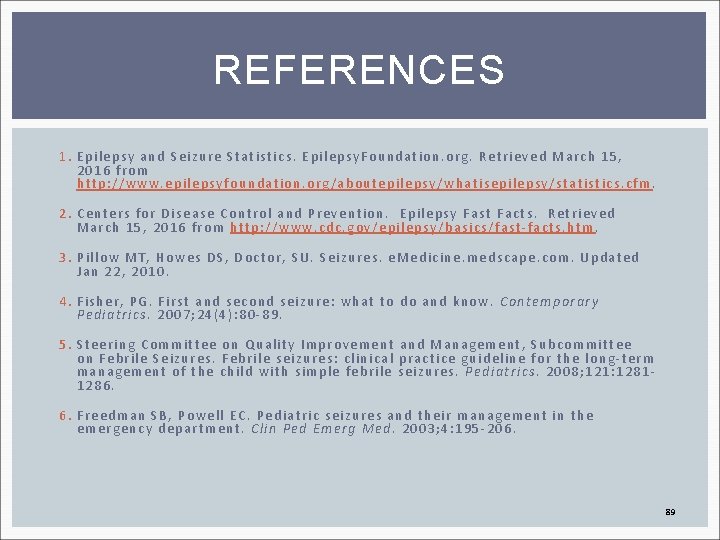
REFERENCES 1. Epilepsy and Seizure Statistics. Epilepsy. Foundation. org. Retrieved March 15, 2016 from http: //www. epilepsyfoundation. org/aboutepilepsy/whatisepilepsy/statistics. cfm. 2. Centers for Disease Control and Prevention. Epilepsy Fast Facts. Retrieved March 15, 2016 from http: //www. cdc. gov/epilepsy/basics/fast-facts. htm. 3. Pillow MT, Howes DS, Doctor, SU. Seizures. e. Medicine. medscape. com. Updated Jan 22, 2010. 4. Fisher, PG. First and second seizure: what to do and know. Contemporary Pediatrics. 2007; 24(4): 80 -89. 5. Steering Committee on Quality Improvement and Management, Subcommittee on Febrile Seizures. Febrile seizures: clinical practice guideline for the long-term management of the child with simple febrile seizures. Pediatrics. 2008; 121: 12811286. 6. Freedman SB, Powell EC. Pediatric seizures and their management in the emergency department. Clin Ped Emerg Med. 2003; 4: 195 -206. 89
REFERENCES (CONT. ) 7. Steering Committee on Quality Improvement and Management, Subcommittee on Febrile Seizures. Neurodiagnostic evaluation of the child with a simple febrile seizure. Pediatrics. 2011; 127; 389 -394. 8. American Association of Neuroscience Nurses. Care of the patient with seizures. 2 nd ed. Glenview (IL): American Association of Neuroscience Nurses; (Revised 2009). p 23. 9. Hirtz D, Berg A, Bettis D, et al. Practice parameter: treatment of the child with a first unprovoked seizure: report of the Quality Standards Subcommittee of the American Academy of Neurology and the Practice Committee of the Child Neurology Society. Neurology. 2003; 60: 166 -175. 10. Hirtz D, Ashwal S, Berg A, et al. Practice parameter: evaluating a first nonfebrile seizure in children: report of the Quality Standards Subcommittee of the American Academy of Neurology, the Child Neurology Society, and the American Epilepsy Society. Neurology. 2000; 55: 616– 623. 90
REFERENCES (CONT. ) 11. Millikan D, Rice B, Silbergleit R. Emergency treatment of status epilepticus: current thinking. Emerg Med Clin North Am. 2009; 27(1): 101 -113. 12. Riviello JJ Jr. , Ashwal S, Hirtz D, et al. American Academy of Neurology Subcommittee, Practice Committee of the Child Neurology Society. Practice parameter: diagnostic assessment of the child with status epilepticus (an evidence-based review): report of the Quality Standards Subcommittee of the American Academy of Neurology and the Practice Committee of the Child Neurology Society. Neurology. 2006; 67(9): 1542 -50. 13. Goldstein J. Status epilepticus in the pediatric emergency department. Clin Ped Emerg Med. 2008; 9: 96 -100. 14. Abend NS, Dlugos DJ. Treatment of refractory status epilepticus: literature review and a proposed protocol. Pediatr Neurol. 2008; 38: 377 -390. 15. Taylor C, Piantino J, Hageman J, Lyons E, Janies K, Leonard D, Kelley K, Fuchs S. Emergency Department Management of Pediatric Unprovoked Seizures and Status Epilepticus in the State of Illinois. J Child Neurol. 2015 Oct; 30(11): 1414 -27. 16. Carapetian, S. , Hageman, J. , Lyons, E. , Leonard, D. , Janies, K. , Kelley, K. , Fuchs, S. Emergency Department Evaluation and Management of Children With Simple Febrile Seizures. Clinical Pediatrics, September 2015, 54(10), 992 -998. 91
Online Resources American Epilepsy Society http: //www. aesnet. org/ American Academy of Neurology Patient Education Materials http: //patients. aan. com/go/resources CDC: Epilepsy http: //www. cdc. gov/Epilepsy/ Citizens United for Research in Epilepsy (CURE) http: //www. cureepilepsy. org/ Epilepsy Foundation: Epilepsy and Seizure Response for Law Enforcement and EMS (free online training) http: //www. epilepsyfoundation. org/livingwithepilepsy/firstresponders/ Epilepsy Therapy Project http: //www. epilepsy. com/epilepsy_therapy_project Return to Table of Contents 92
Video Resources Understanding Epilepsy www. youtube. com/watch? v=MNQlq 004 Fk. E Types of Seizures www. youtube. com/watch? v=CDcc. Ch. Hrg. RA&feature=channel Understanding Partial Seizures www. youtube. com/watch? v=e 10 FSj. Hv. V 74&feature=channel Understanding Generalized Seizures www. youtube. com/watch? v=w 5 Jv 0 SZRwwk&feature=channel What Causes Epilepsy? www. youtube. com/watch? v=6 Ncq. Qk. Kjq. TI&feature=fvw Diagnosing Epilepsy www. youtube. com/watch? v=HX 7 L 11 rh. RTw&feature=channel Seizure Imitators Overview www. youtube. com/watch? v=J 4 x. JSGp. Jio. I&feature=relmfu Return to Table of Contents 93
APPENDIX A EMSC PREHOSPITAL PROTOCOLS Return to Table of Contents 94
EMSC PREHOSPITAL PROTOCOLS § All Pediatric Seizure care guidelines follow this sequence: § Initial Medical Care/Assessment § Protect the child from Injury § Vomiting and aspiration precautions THE NEXT STEPS DEPEND ON THE LEVEL OF CARE OF THE RESPONDER 95
EMSC PREHOSPITAL PROTOCOLS Here are examples of prehospital pediatric seizure protocols § BLS/EMERGENCY MEDICAL RESPONDER (EMR) CARE GUIDELINE § ALS/ILS CARE GUIDELINE Source: Illinois EMSC Pediatric Prehospital Protocols 96
APPENDIX B SAMPLE EMERGENCY DEPARTMENT GUIDELINES Return to Table of Contents 97
SAMPLE ED SEIZURE GUIDELINES Please give credit to any of the following resources you use § Advocate Condell Medical Center Pediatric Emergency Department Clinical Guideline § Seattle Children’s Hospital § Seizure Acute Management Pathway (Source: Dick R and the Seizure Acute Management CSW Committee. (June, 2013). Seizure Acute Management Pathway. Retrieved from: http: //www. seattlechildrens. org/pdf/seizureacute-management-pathway. pdf) § Febrile Seizures Pathway (Source: Dick R and the Febrile Seizures CSW Committee. (November, 2011). Febrile Seizures Pathway. Retrieved from: http: //www. seattlechildrens. org/pdf/febrile-seizures-algorithm. pdf) § University of Chicago Comer Children’s Hospital Pediatric Emergency Department Clinical Guideline: Status Epilepticus 98
APPENDIX C NEONATAL SEIZURES Return to Table of Contents 99
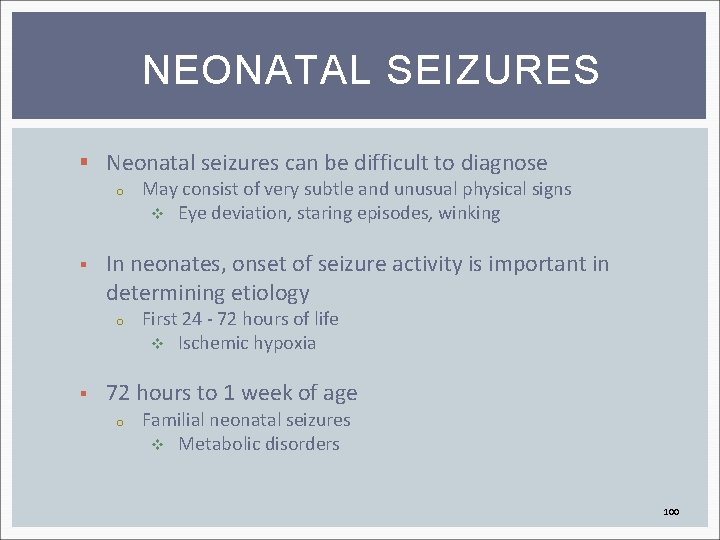
NEONATAL SEIZURES § Neonatal seizures can be difficult to diagnose o § In neonates, onset of seizure activity is important in determining etiology o § May consist of very subtle and unusual physical signs v Eye deviation, staring episodes, winking First 24 - 72 hours of life v Ischemic hypoxia 72 hours to 1 week of age o Familial neonatal seizures v Metabolic disorders 100
NEONATAL SEIZURES § Beyond the standard history, ask about the pregnancy, labor and delivery and maternal risk factors § Physical exam should include head circumference and careful inspection for dysmorphic features and cutaneous lesions 9 § Consult with a pediatric neurologist to identify infantile seizure disorders 101
NEONATAL SEIZURES: STATUS EPILEPTICUS § Assess the A, B, Cs § Evaluate and maintain airway § Provide 100% oxygen § Establish vascular access § Obtain rapid glucose § Administer Medications § PHENobarbital 20 mg/kg IV § Repeat up to 40 mg/kg total dose § Contact Neurology 102
THE END 103