
Pediatric Fluid Management and Blood Product Therapy Joy
Pediatric Fluid Management and Blood Product Therapy Joy Loy, M. D. Metro. Health Medical Center April, 2004
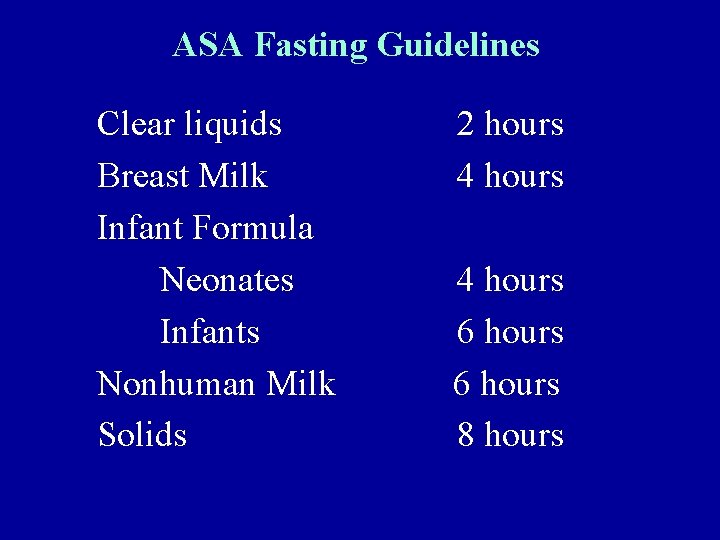
ASA Fasting Guidelines Clear liquids Breast Milk Infant Formula Neonates Infants Nonhuman Milk Solids 2 hours 4 hours 6 hours 8 hours
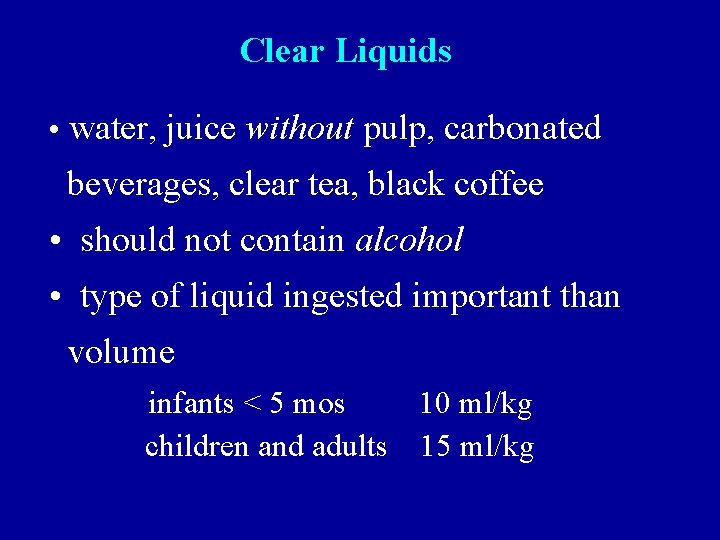
Clear Liquids • water, juice without pulp, carbonated beverages, clear tea, black coffee • should not contain alcohol • type of liquid ingested important than volume infants < 5 mos 10 ml/kg children and adults 15 ml/kg
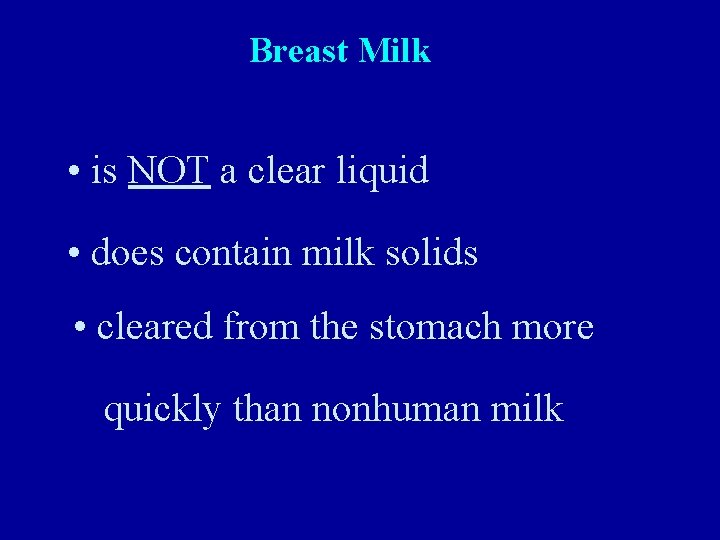
Breast Milk • is NOT a clear liquid • does contain milk solids • cleared from the stomach more quickly than nonhuman milk

ASA Fasting Guidelines • pre-op fast does not guarantee an empty stomach • timing of last fluid ingestion has little relation to volume of gastric contents at induction

ASA Fasting Guidelines • gastric fluid volume and p. H are independent of duration fluid fast beyond 2 hours • main determinant: endogenous gastric secretion
ASA Fasting Guidelines • reduces the risk of pulmonary aspiration • offering clear liquids up to 2 hours before induction > reduces hunger and irritability > preserves hydration > risk of hypoglycemia
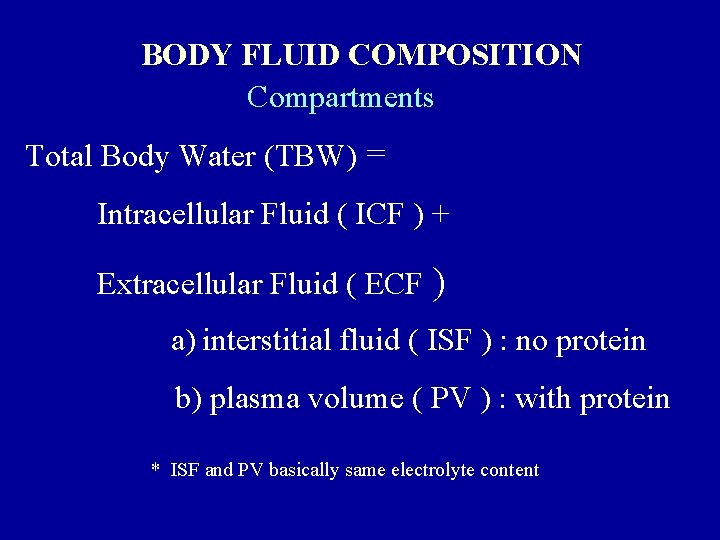
BODY FLUID COMPOSITION Compartments Total Body Water (TBW) = Intracellular Fluid ( ICF ) + Extracellular Fluid ( ECF ) a) interstitial fluid ( ISF ) : no protein b) plasma volume ( PV ) : with protein * ISF and PV basically same electrolyte content
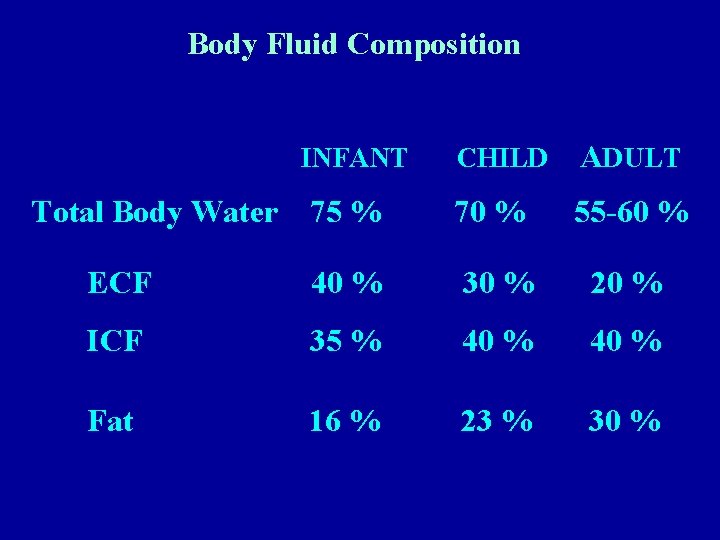
Body Fluid Composition CHILD ADULT 75 % 70 % 55 -60 % ECF 40 % 30 % 20 % ICF 35 % 40 % Fat 16 % 23 % 30 % INFANT Total Body Water
PHYSIOLOGIC CONSIDERATIONS Developmental Factors CVS : • incomplete myocardial development • immature sympathetic innervation IMPLICATION: neonates and young infants are more sensitive to hypovolemia
PHYSIOLOGIC CONSIDERATIONS Developmental Factors RENAL: • immature renal function at birth GFR 25% of adult level at term adult level at age of 2 years concentrating capacity of newborn kidney term infant : max. 600 -700 m. Osm/kg adult : max. 1200 m. Osm/kg
PHYSIOLOGIC CONSIDERATIONS Developmental Factors free H 2 O clearance : excrete markedly dilute urine up to 50 m. Osm / kg vs. 70 -100 Osm/kg in adults Na reabsorption HCO 3 /H exchange urinary losses of K+ and Cl-
PHYSIOLOGIC CONSIDERATIONS Developmental Factors IMPLICATION: Newborn kidney has limited capacity to compensate for volume excess or volume depletion
PHYSIOLOGIC CONSIDERATIONS Developmental Factors HEPATIC : • limited hepatic glycogen stores > risk of hypoglycemia > provide 5%-10% dextrose in fluid maintenance > supplemental insulin for sustained hyperglycemia from dextrose
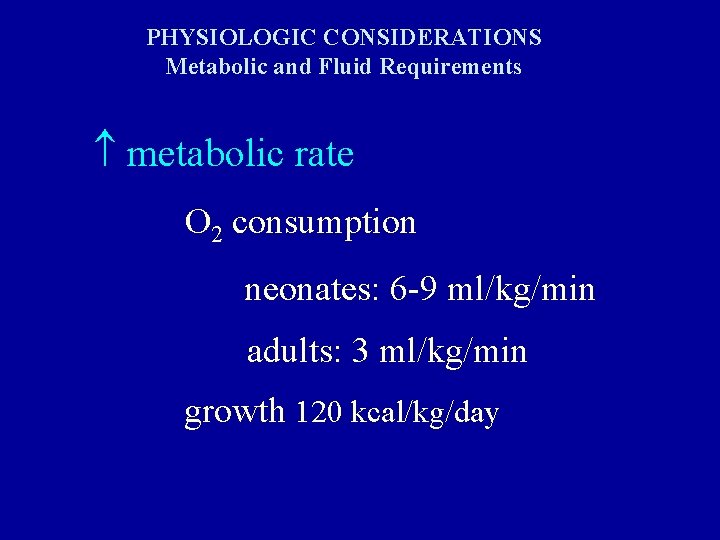
PHYSIOLOGIC CONSIDERATIONS Metabolic and Fluid Requirements metabolic rate O 2 consumption neonates: 6 -9 ml/kg/min adults: 3 ml/kg/min growth 120 kcal/kg/day

PHYSIOLOGIC CONSIDERATIONS Metabolic and Fluid Requirements fluid requirement > greater BSA to mass ratio in infants > other factors: radiant warmers fever illness injury thinner skin and lack of keratinization of stratum corneum in premature neonates
Compensatory Mechanisms 1) Temporary mechanism 2) Definitive mechanism
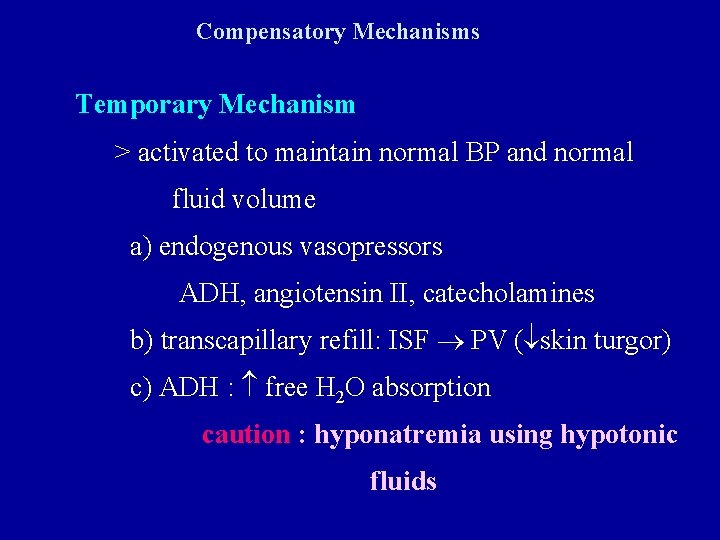
Compensatory Mechanisms Temporary Mechanism > activated to maintain normal BP and normal fluid volume a) endogenous vasopressors ADH, angiotensin II, catecholamines b) transcapillary refill: ISF PV ( skin turgor) c) ADH : free H 2 O absorption caution : hyponatremia using hypotonic fluids
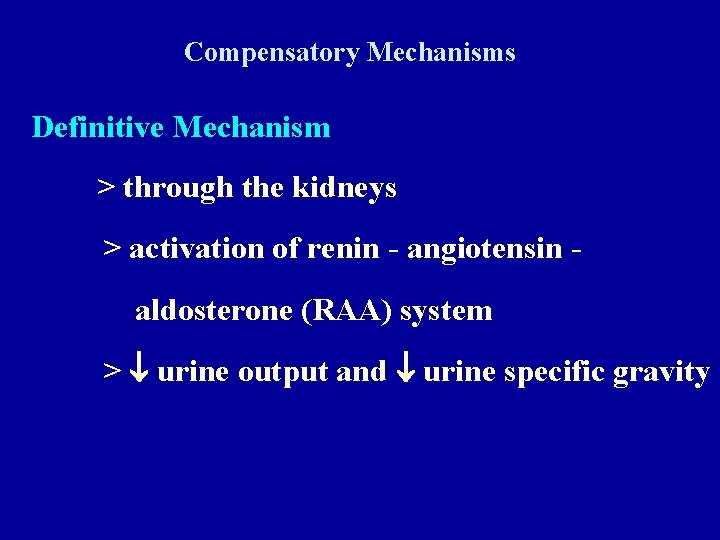
Compensatory Mechanisms Definitive Mechanism > through the kidneys > activation of renin - angiotensin aldosterone (RAA) system > urine output and urine specific gravity
Maintenance Fluids replaces water and electrolytes lost under ordinary conditions • Evaporative / insensible water loss (ISWL) • Urinary and stool losses • Growth

Maintenance Fluids 1) Evaporative or Insensible Water Loss (ISWL) • solute-free H 2 O losses from skin and lungs • 30 -35 % of total maintenance volume • 1/3 of total maintenance requirement • affected by ambient humidity and temperature • minimum replacement : 60 -100 ml/kg/day
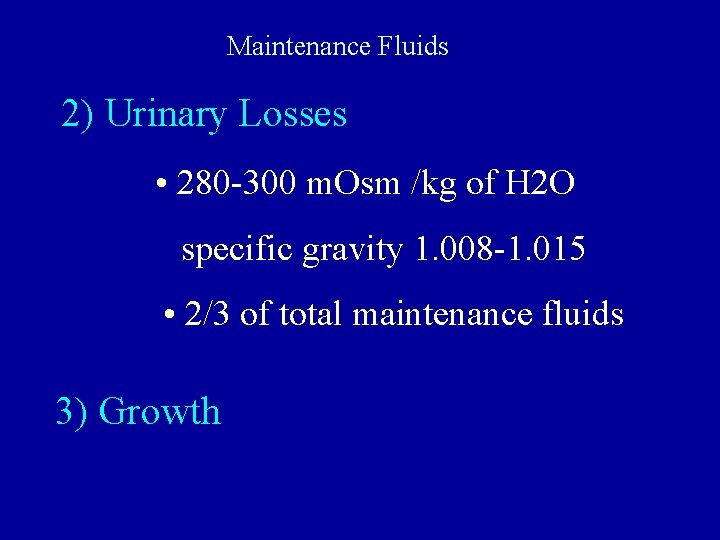
Maintenance Fluids 2) Urinary Losses • 280 -300 m. Osm /kg of H 2 O specific gravity 1. 008 -1. 015 • 2/3 of total maintenance fluids 3) Growth
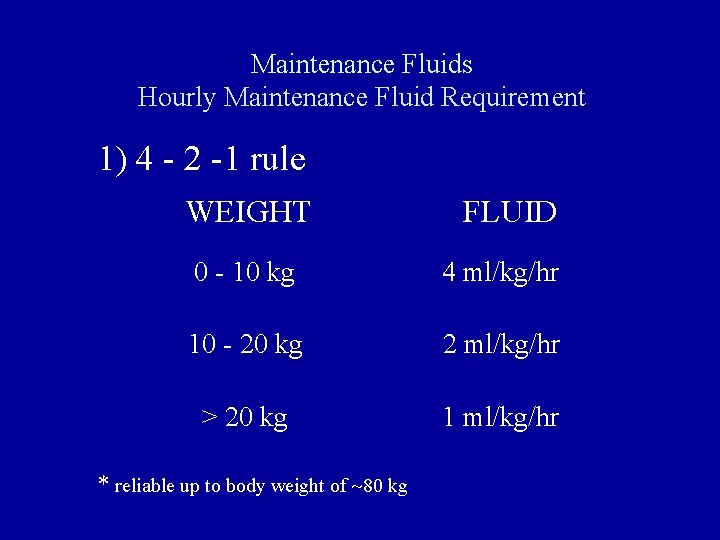
Maintenance Fluids Hourly Maintenance Fluid Requirement 1) 4 - 2 -1 rule WEIGHT FLUID 0 - 10 kg 4 ml/kg/hr 10 - 20 kg 2 ml/kg/hr > 20 kg 1 ml/kg/hr * reliable up to body weight of 80 kg
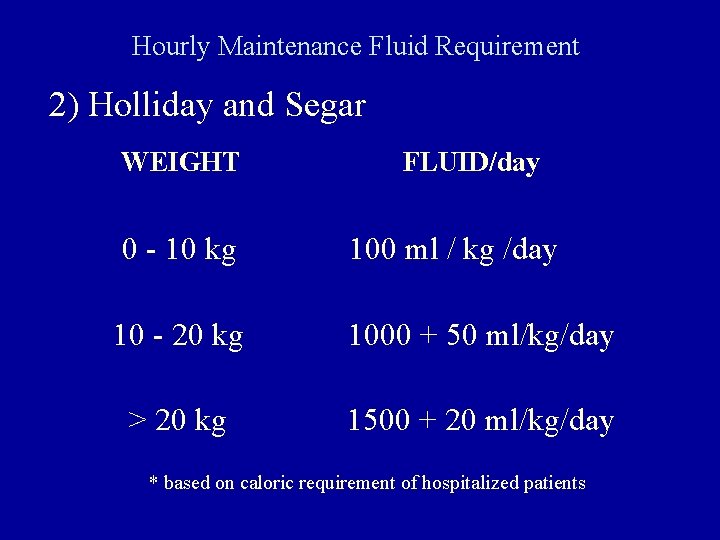
Hourly Maintenance Fluid Requirement 2) Holliday and Segar WEIGHT FLUID/day 0 - 10 kg 100 ml / kg /day 10 - 20 kg 1000 + 50 ml/kg/day > 20 kg 1500 + 20 ml/kg/day * based on caloric requirement of hospitalized patients
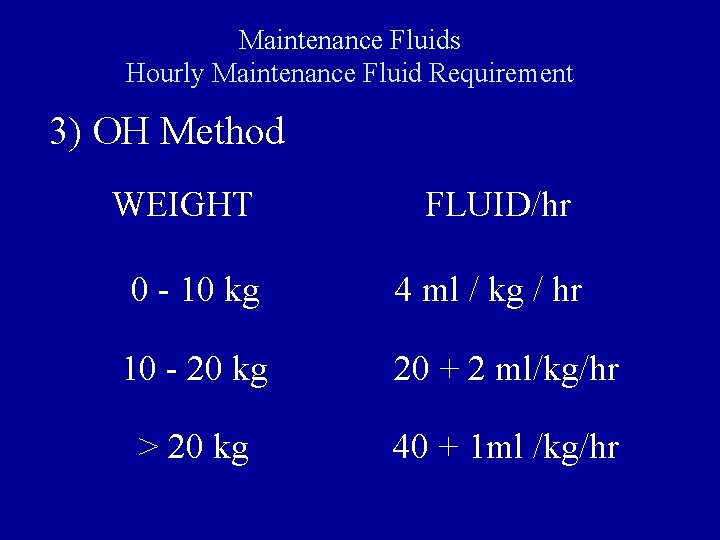
Maintenance Fluids Hourly Maintenance Fluid Requirement 3) OH Method WEIGHT FLUID/hr 0 - 10 kg 4 ml / kg / hr 10 - 20 kg 20 + 2 ml/kg/hr > 20 kg 40 + 1 ml /kg/hr
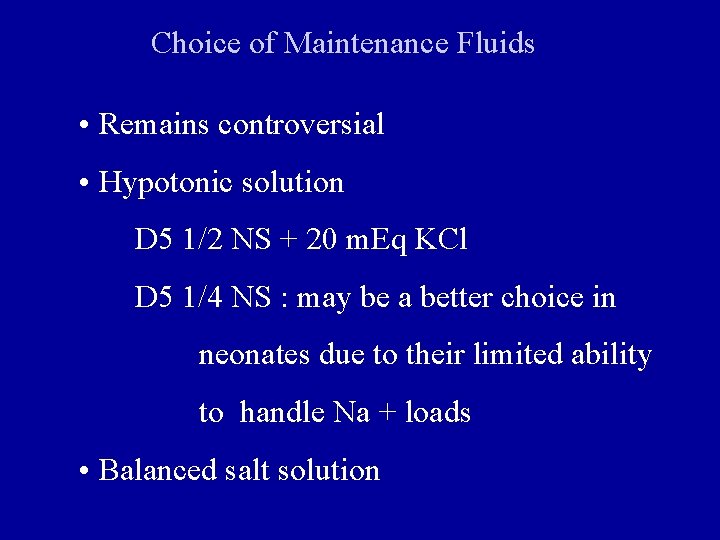
Choice of Maintenance Fluids • Remains controversial • Hypotonic solution D 5 1/2 NS + 20 m. Eq KCl D 5 1/4 NS : may be a better choice in neonates due to their limited ability to handle Na + loads • Balanced salt solution
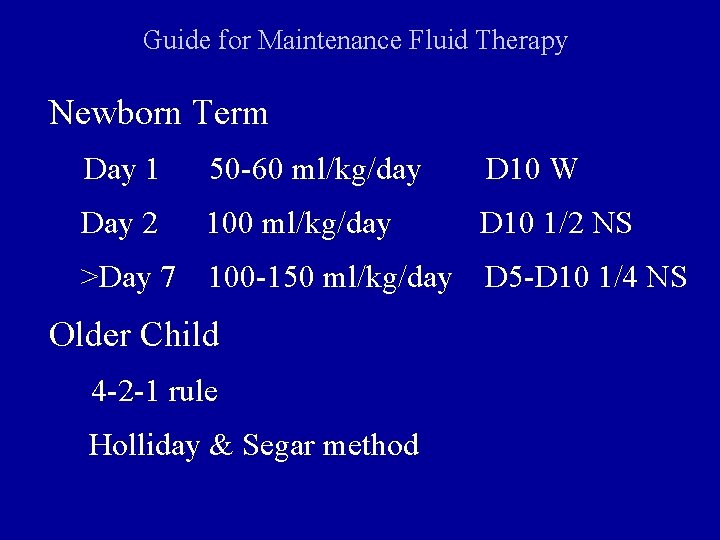
Guide for Maintenance Fluid Therapy Newborn Term Day 1 50 -60 ml/kg/day D 10 W Day 2 100 ml/kg/day D 10 1/2 NS >Day 7 100 -150 ml/kg/day D 5 -D 10 1/4 NS Older Child 4 -2 -1 rule Holliday & Segar method
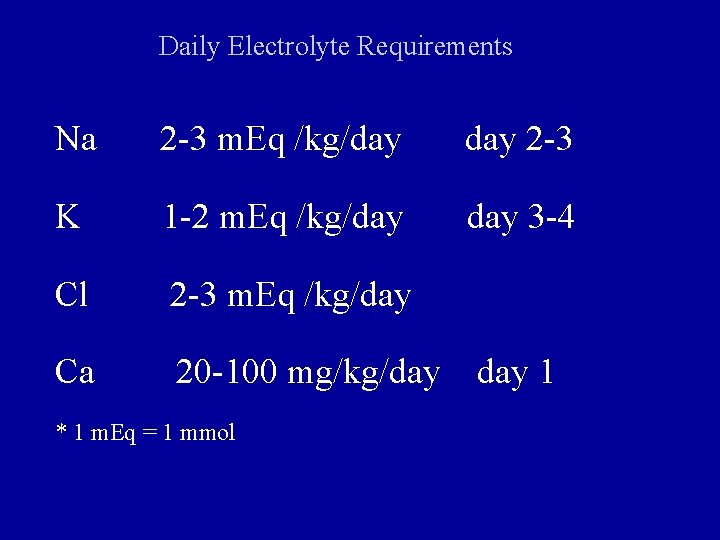
Daily Electrolyte Requirements Na 2 -3 m. Eq /kg/day 2 -3 K 1 -2 m. Eq /kg/day 3 -4 Cl 2 -3 m. Eq /kg/day Ca 20 -100 mg/kg/day * 1 m. Eq = 1 mmol day 1
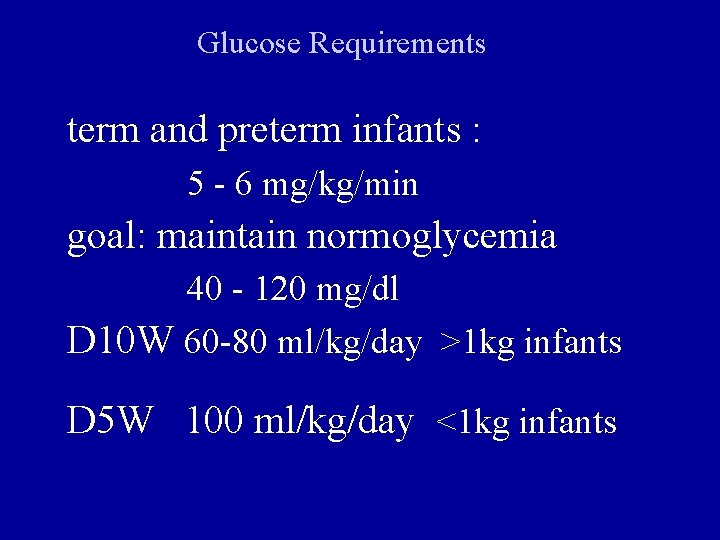
Glucose Requirements term and preterm infants : 5 - 6 mg/kg/min goal: maintain normoglycemia 40 - 120 mg/dl D 10 W 60 -80 ml/kg/day >1 kg infants D 5 W 100 ml/kg/day <1 kg infants

Perioperative Fluid Management 3 Phases 1. Maintenance Fluid Replacement 2. Replacement of Preop Deficit 3. Replacement of Ongoing Losses
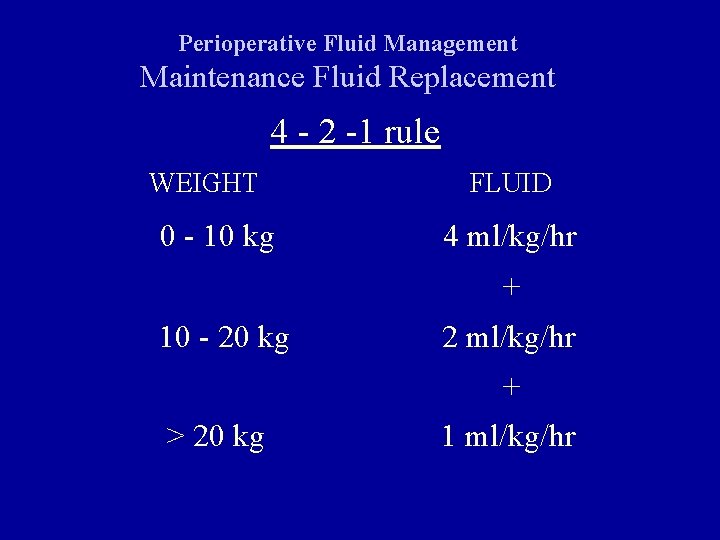
Perioperative Fluid Management Maintenance Fluid Replacement 4 - 2 -1 rule WEIGHT 0 - 10 kg FLUID 4 ml/kg/hr + 10 - 20 kg 2 ml/kg/hr + > 20 kg 1 ml/kg/hr
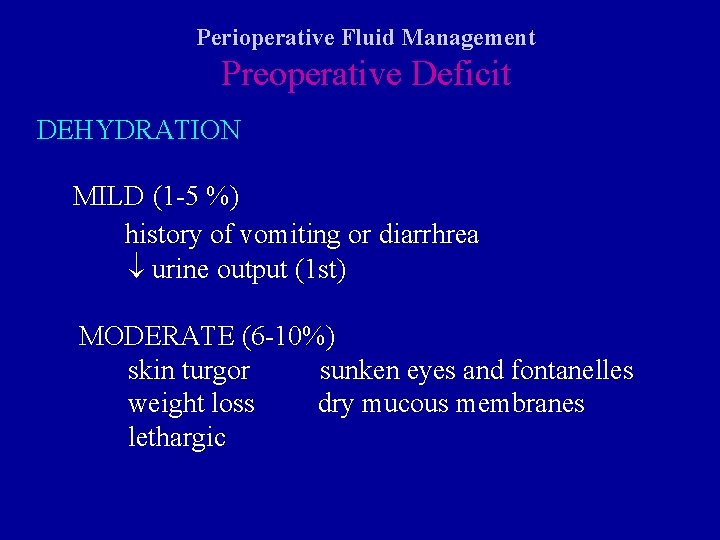
Perioperative Fluid Management Preoperative Deficit DEHYDRATION MILD (1 -5 %) history of vomiting or diarrhrea urine output (1 st) MODERATE (6 -10%) skin turgor sunken eyes and fontanelles weight loss dry mucous membranes lethargic
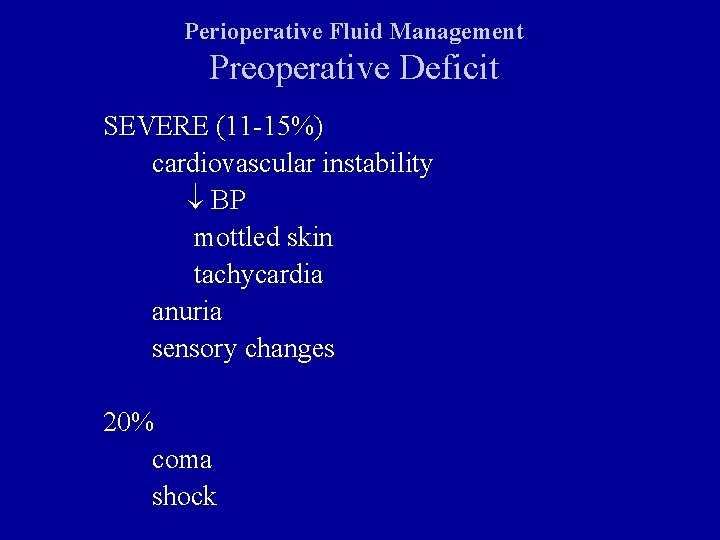
Perioperative Fluid Management Preoperative Deficit SEVERE (11 -15%) cardiovascular instability BP mottled skin tachycardia anuria sensory changes 20% coma shock
Perioperative Fluid Management Preoperative Deficit Therapy Components: 1) dehydration severity Hx and PE electrolyte values serum tonicity 2) type of dehydration isotonic hypertonic
Perioperative Fluid Management Preoperative Deficit Therapy 3) replacement of deficit • goal: restore CV, CNS and renal function • monitor adequacy based on response clinical condition urine output and urine specific gravity vital signs
Perioperative Fluid Management Estimated Preop Fluid Deficit number of fasting hrs x maintenance fluids infuse 1/2 on the first hr infuse 1/4 on the 2 nd hr infuse 1/4 on the 3 rd hr
Perioperative Fluid Management Choice of Fluids Isotonic Crystalloids • generally the most appropriate for preop and intraop deficits Hypotonic Fluids • can cause significant hyponatremia
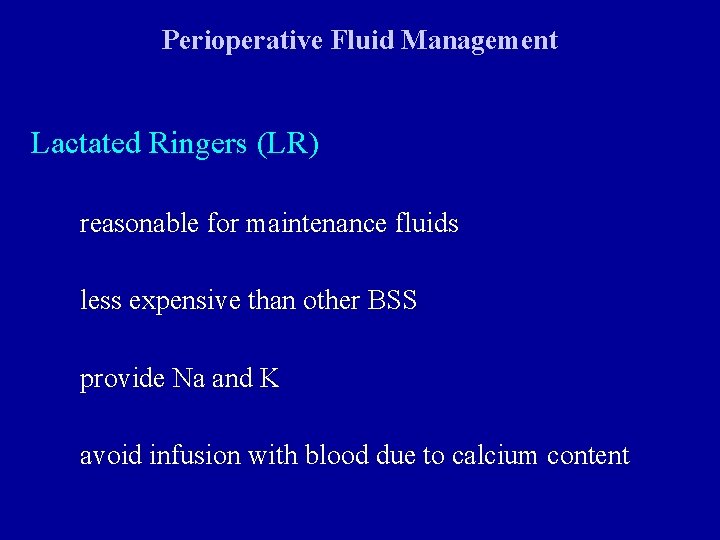
Perioperative Fluid Management Lactated Ringers (LR) reasonable for maintenance fluids less expensive than other BSS provide Na and K avoid infusion with blood due to calcium content
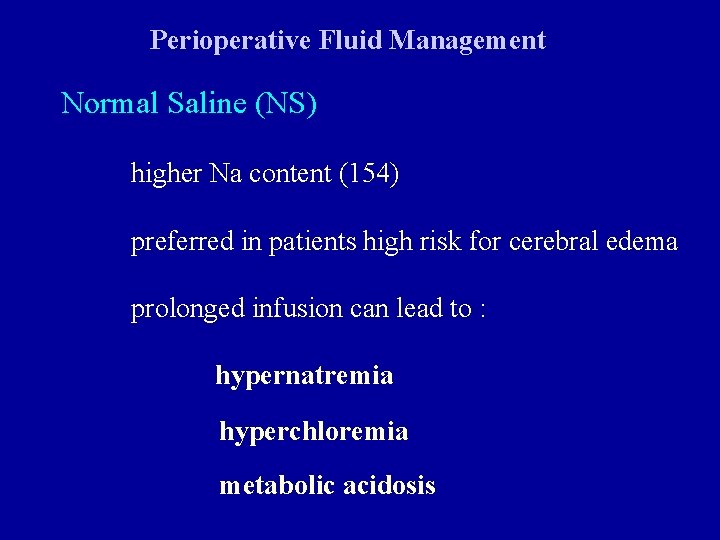
Perioperative Fluid Management Normal Saline (NS) higher Na content (154) preferred in patients high risk for cerebral edema prolonged infusion can lead to : hypernatremia hyperchloremia metabolic acidosis
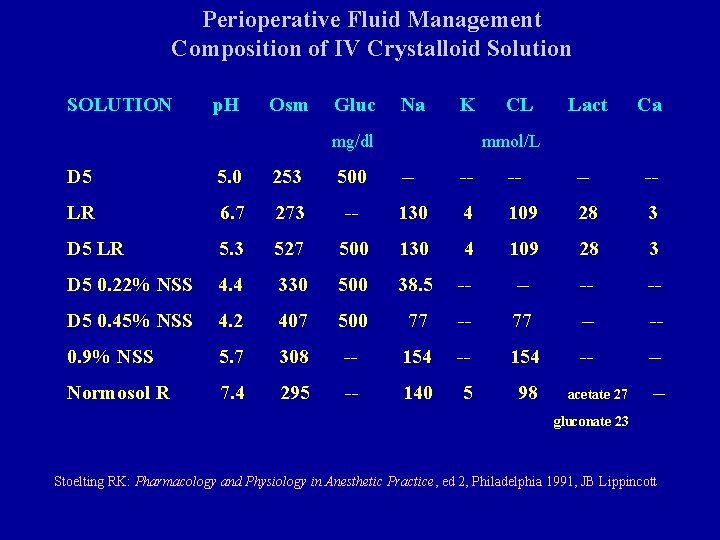
Perioperative Fluid Management Composition of IV Crystalloid Solution SOLUTION p. H Osm Gluc Na K mg/dl CL Lact Ca mmol/L D 5 5. 0 253 500 -- -- -- LR 6. 7 273 -- 130 4 109 28 3 D 5 LR 5. 3 527 500 130 4 109 28 3 D 5 0. 22% NSS 4. 4 330 500 38. 5 -- -- D 5 0. 45% NSS 4. 2 407 500 77 -- -- 0. 9% NSS 5. 7 308 -- 154 -- -- Normosol R 7. 4 295 -- 140 5 98 acetate 27 -- gluconate 23 Stoelting RK: Pharmacology and Physiology in Anesthetic Practice, ed 2, Philadelphia 1991, JB Lippincott
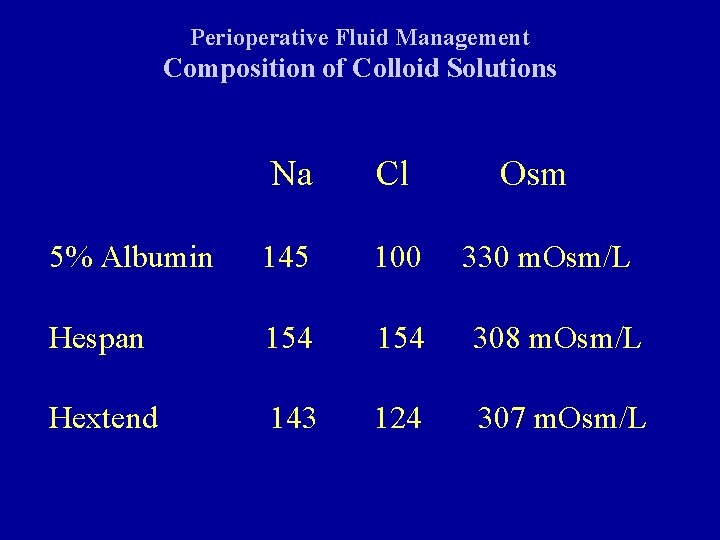
Perioperative Fluid Management Composition of Colloid Solutions Na Cl Osm 5% Albumin 145 100 Hespan 154 308 m. Osm/L Hextend 143 124 307 m. Osm/L 330 m. Osm/L
Is intraoperative glucose necessary?

Perioperative Fluid Management Intraoperative Glucose Administration Effects : intraop hyperglycemia hyperosmolality osmotic diuresis worsen neurologic outcome during cerebral ischemia
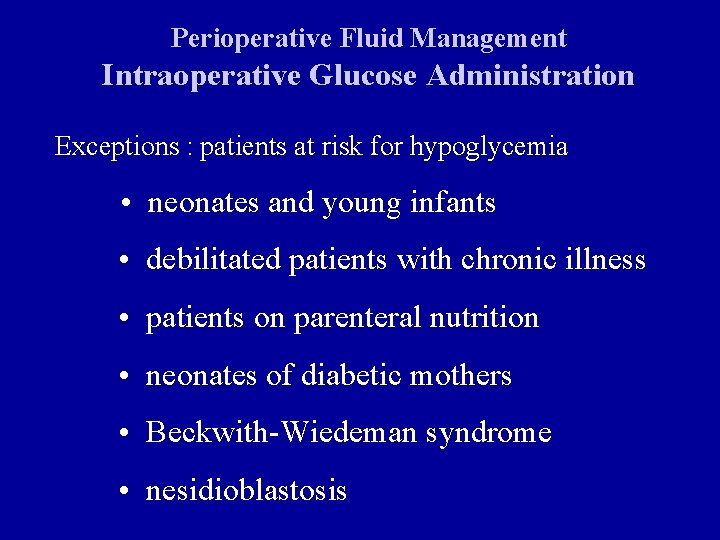
Perioperative Fluid Management Intraoperative Glucose Administration Exceptions : patients at risk for hypoglycemia • neonates and young infants • debilitated patients with chronic illness • patients on parenteral nutrition • neonates of diabetic mothers • Beckwith-Wiedeman syndrome • nesidioblastosis

Perioperative Fluid Management Intraoperative Glucose Administration Existing infusions of dextrose-containing fluid may be continued at a reduced rate (50% of maintenance) to compensate the effect of surgical stress on glucose control
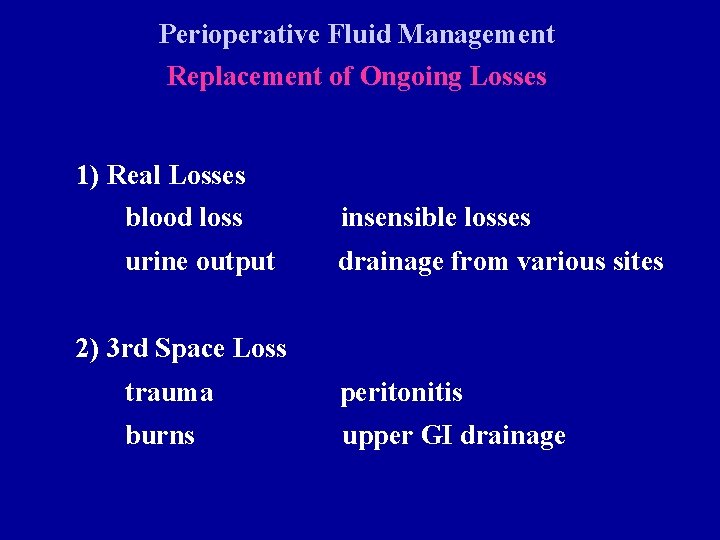
Perioperative Fluid Management Replacement of Ongoing Losses 1) Real Losses blood loss urine output insensible losses drainage from various sites 2) 3 rd Space Loss trauma peritonitis burns upper GI drainage
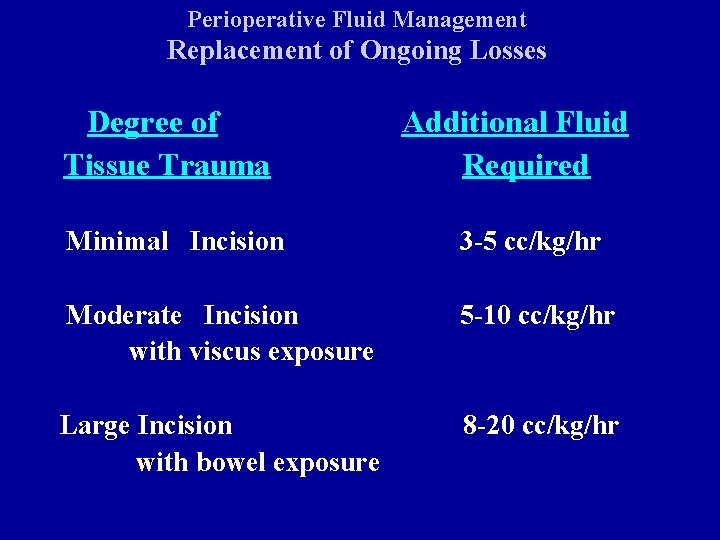
Perioperative Fluid Management Replacement of Ongoing Losses Degree of Tissue Trauma Additional Fluid Required Minimal Incision 3 -5 cc/kg/hr Moderate Incision with viscus exposure 5 -10 cc/kg/hr Large Incision with bowel exposure 8 -20 cc/kg/hr
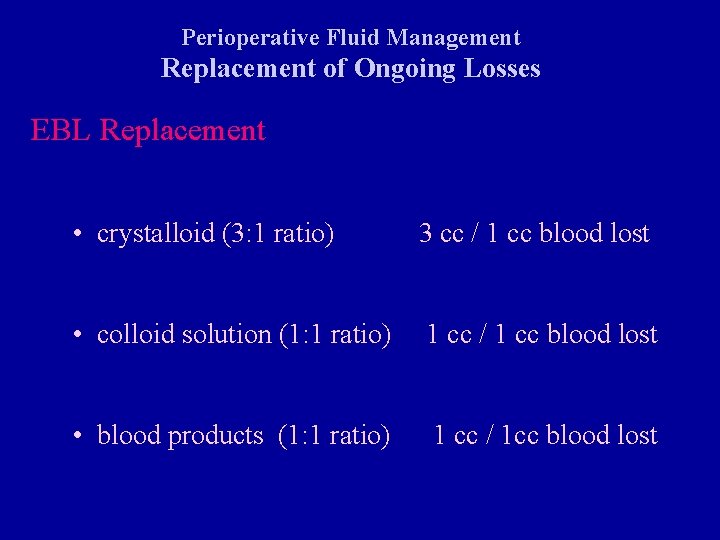
Perioperative Fluid Management Replacement of Ongoing Losses EBL Replacement • crystalloid (3: 1 ratio) 3 cc / 1 cc blood lost • colloid solution (1: 1 ratio) 1 cc / 1 cc blood lost • blood products (1: 1 ratio) 1 cc / 1 cc blood lost
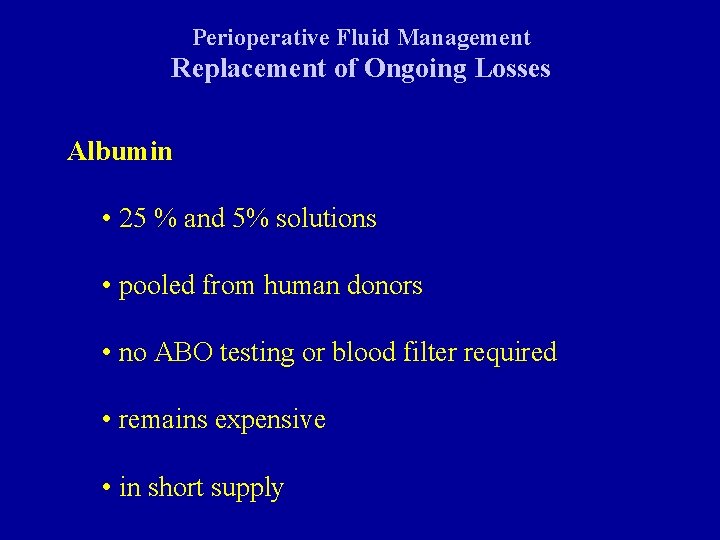
Perioperative Fluid Management Replacement of Ongoing Losses Albumin • 25 % and 5% solutions • pooled from human donors • no ABO testing or blood filter required • remains expensive • in short supply

Is albumin risk-free?
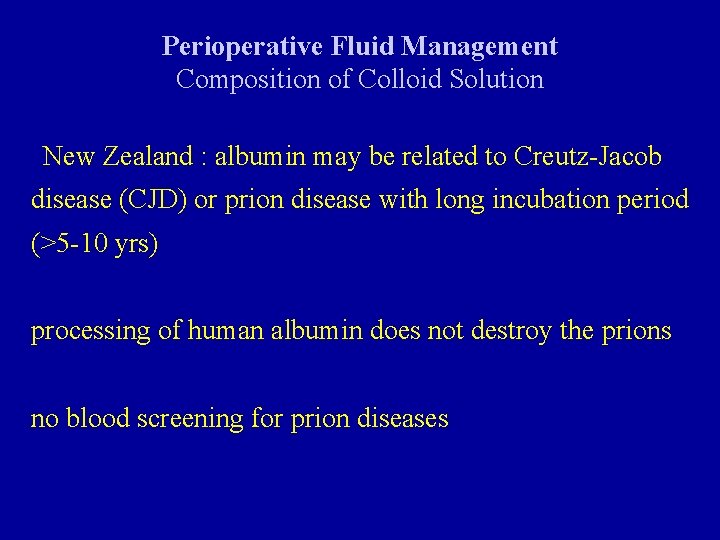
Perioperative Fluid Management Composition of Colloid Solution New Zealand : albumin may be related to Creutz-Jacob disease (CJD) or prion disease with long incubation period (>5 -10 yrs) processing of human albumin does not destroy the prions no blood screening for prion diseases
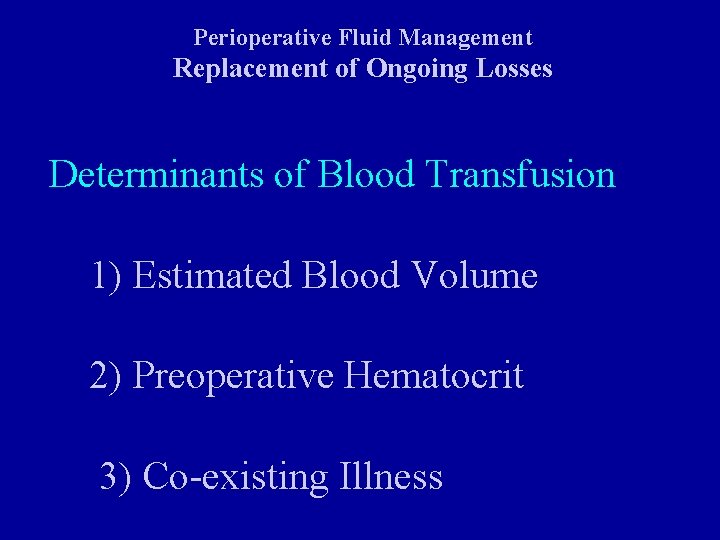
Perioperative Fluid Management Replacement of Ongoing Losses Determinants of Blood Transfusion 1) Estimated Blood Volume 2) Preoperative Hematocrit 3) Co-existing Illness
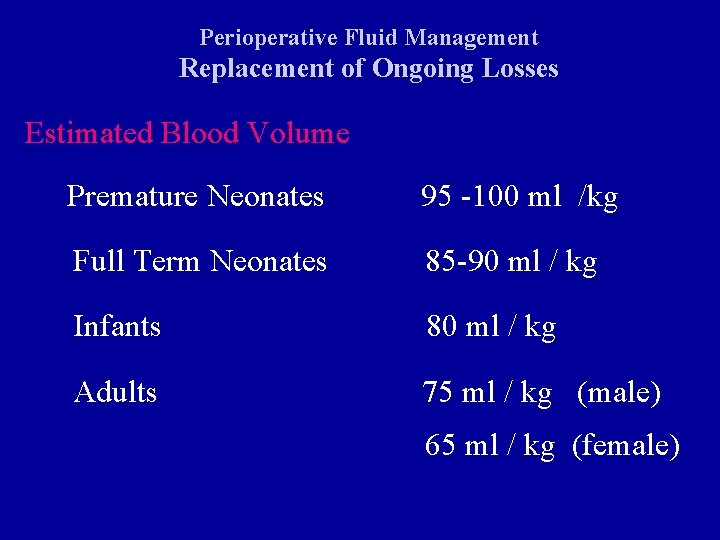
Perioperative Fluid Management Replacement of Ongoing Losses Estimated Blood Volume Premature Neonates 95 -100 ml /kg Full Term Neonates 85 -90 ml / kg Infants 80 ml / kg Adults 75 ml / kg (male) 65 ml / kg (female)
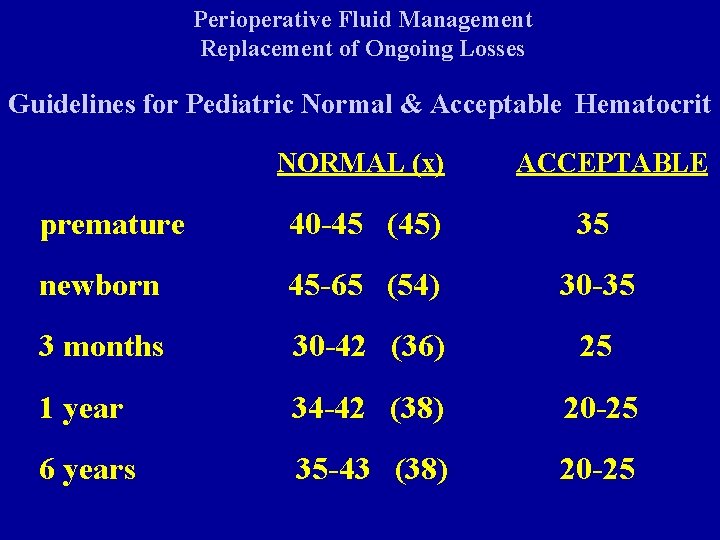
Perioperative Fluid Management Replacement of Ongoing Losses Guidelines for Pediatric Normal & Acceptable Hematocrit NORMAL (x) ACCEPTABLE premature 40 -45 (45) 35 newborn 45 -65 (54) 30 -35 3 months 30 -42 (36) 25 1 year 34 -42 (38) 20 -25 6 years 35 -43 (38) 20 -25
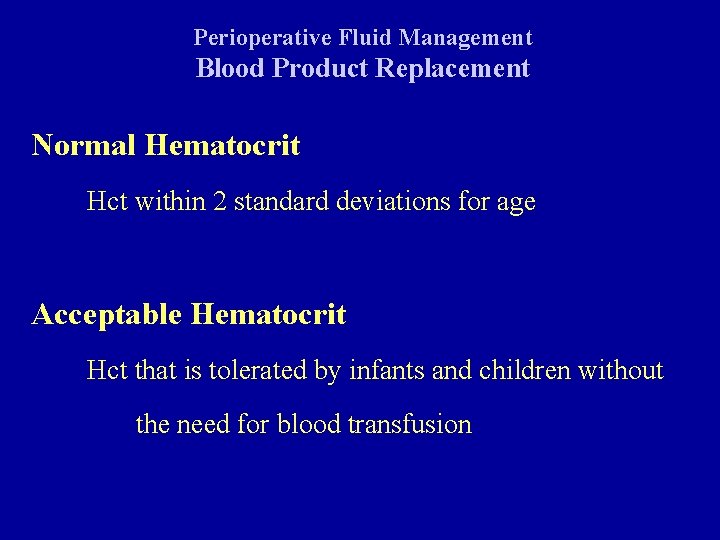
Perioperative Fluid Management Blood Product Replacement Normal Hematocrit Hct within 2 standard deviations for age Acceptable Hematocrit Hct that is tolerated by infants and children without the need for blood transfusion
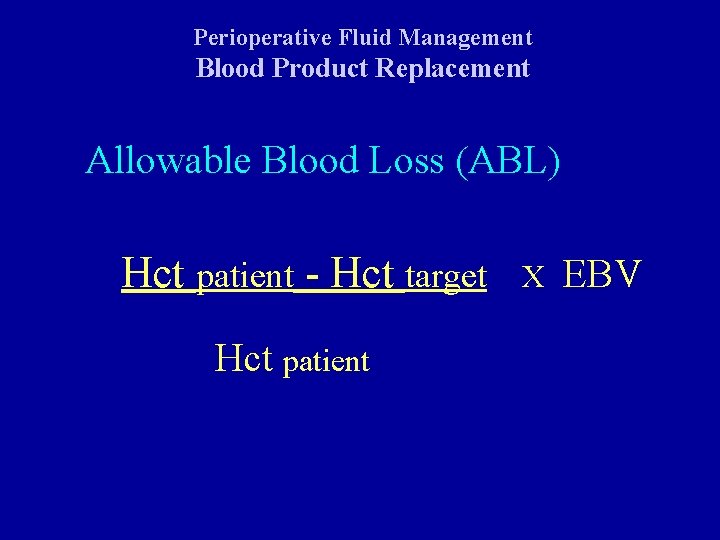
Perioperative Fluid Management Blood Product Replacement Allowable Blood Loss (ABL) Hct patient - Hct target Hct patient X EBV
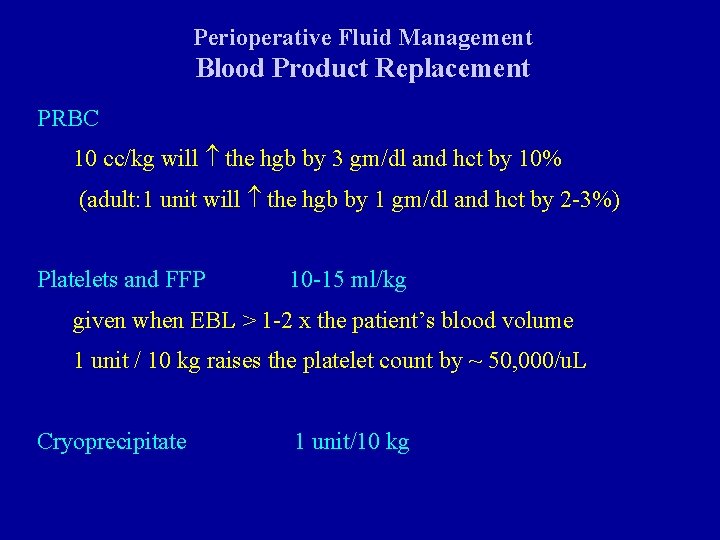
Perioperative Fluid Management Blood Product Replacement PRBC 10 cc/kg will the hgb by 3 gm/dl and hct by 10% (adult: 1 unit will the hgb by 1 gm/dl and hct by 2 -3%) Platelets and FFP 10 -15 ml/kg given when EBL > 1 -2 x the patient’s blood volume 1 unit / 10 kg raises the platelet count by ~ 50, 000/u. L Cryoprecipitate 1 unit/10 kg
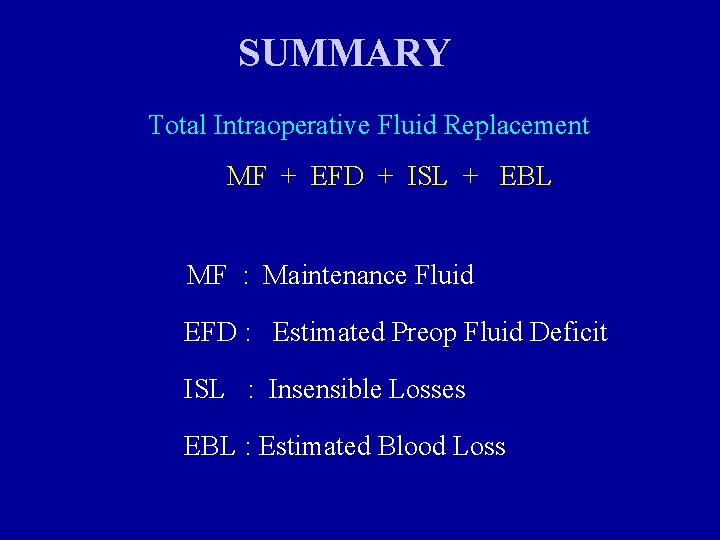
SUMMARY Total Intraoperative Fluid Replacement MF + EFD + ISL + EBL MF : Maintenance Fluid EFD : Estimated Preop Fluid Deficit ISL : Insensible Losses EBL : Estimated Blood Loss
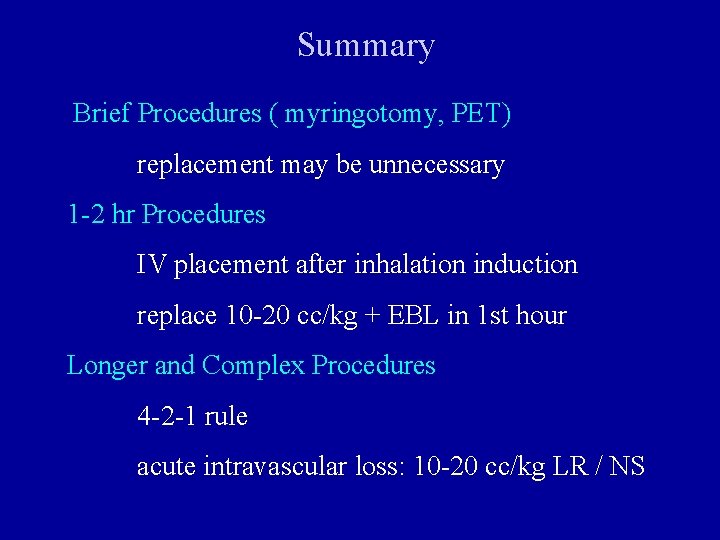
Summary Brief Procedures ( myringotomy, PET) replacement may be unnecessary 1 -2 hr Procedures IV placement after inhalation induction replace 10 -20 cc/kg + EBL in 1 st hour Longer and Complex Procedures 4 -2 -1 rule acute intravascular loss: 10 -20 cc/kg LR / NS
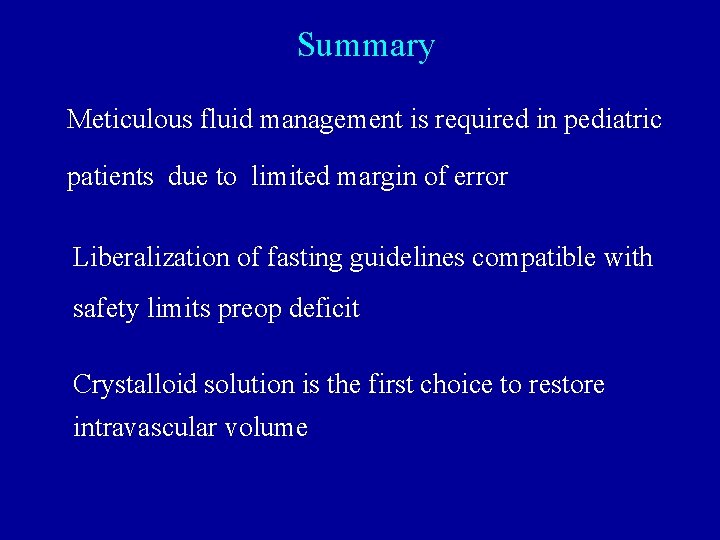
Summary Meticulous fluid management is required in pediatric patients due to limited margin of error Liberalization of fasting guidelines compatible with safety limits preop deficit Crystalloid solution is the first choice to restore intravascular volume
Summary Limit glucose-containing solutions for patients at risk for hypoglycemia Tranfusion trigger points preop hematocrit and hemodynamics co-existing medical problems potential for further blood loss 25% decrease in EBV
- Slides: 61