
PEDIATRIC DEVELOPMENT SENSORY MOTOR AND NEUROLOGICAL Helping Parents






- Slides: 51
PEDIATRIC DEVELOPMENT: SENSORY, MOTOR, AND NEUROLOGICAL Helping Parents and Caregivers Understand Developmental Delays and Sensory Processing Concepts April D. Christopherson, OTR/L
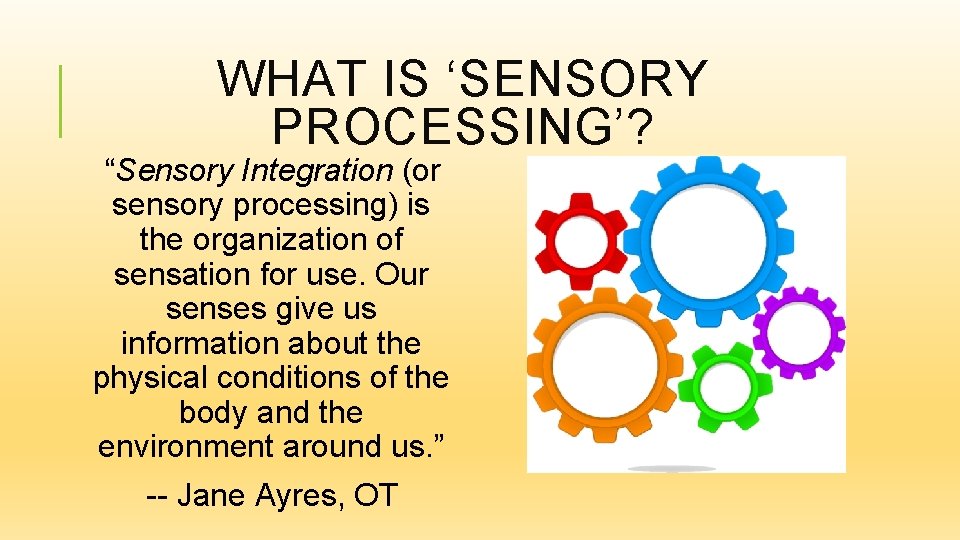
WHAT IS ‘SENSORY PROCESSING’? “Sensory Integration (or sensory processing) is the organization of sensation for use. Our senses give us information about the physical conditions of the body and the environment around us. ” -- Jane Ayres, OT
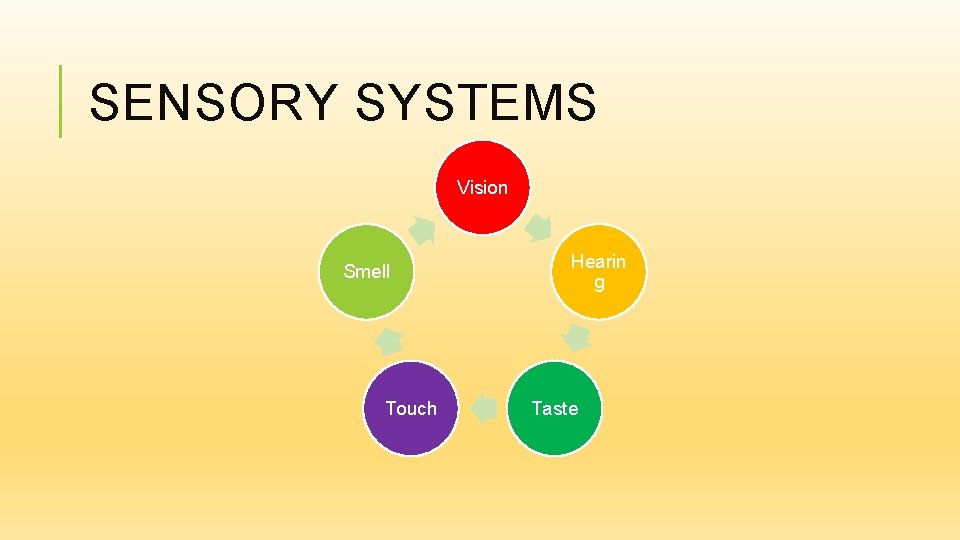
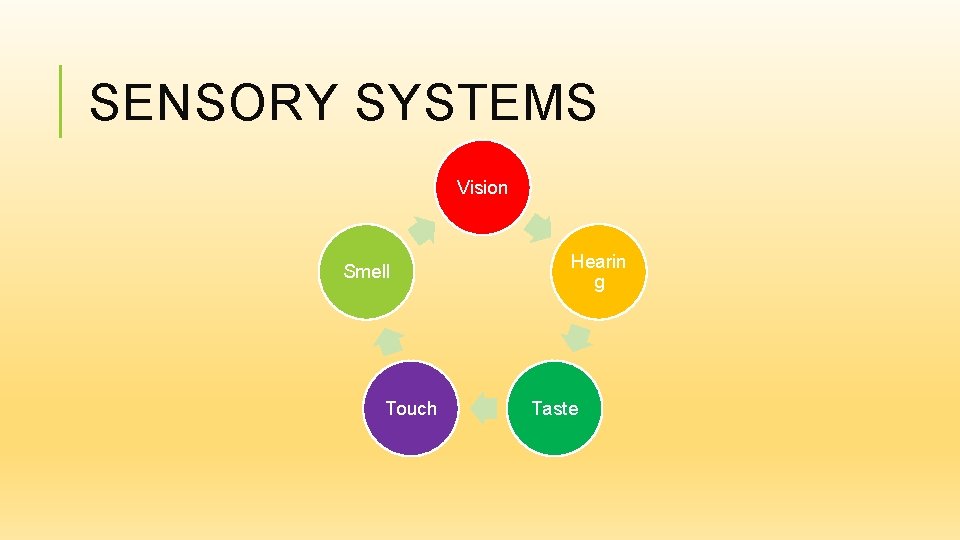
SENSORY SYSTEMS Vision Smell Touch Hearin g Taste
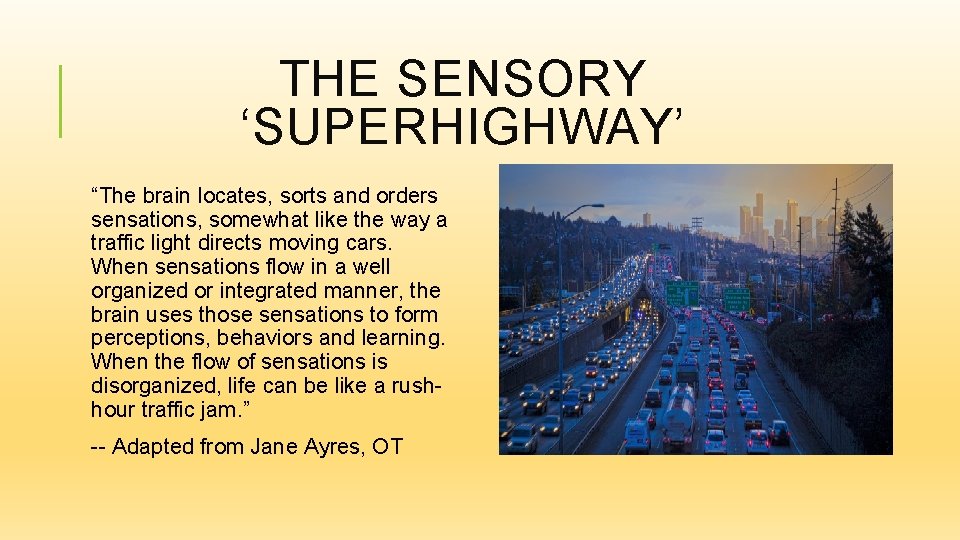
THE SENSORY ‘SUPERHIGHWAY’ “The brain locates, sorts and orders sensations, somewhat like the way a traffic light directs moving cars. When sensations flow in a well organized or integrated manner, the brain uses those sensations to form perceptions, behaviors and learning. When the flow of sensations is disorganized, life can be like a rushhour traffic jam. ” -- Adapted from Jane Ayres, OT
SENSORY PROCESSING DISORDER “Sam’s Club on Drugs”
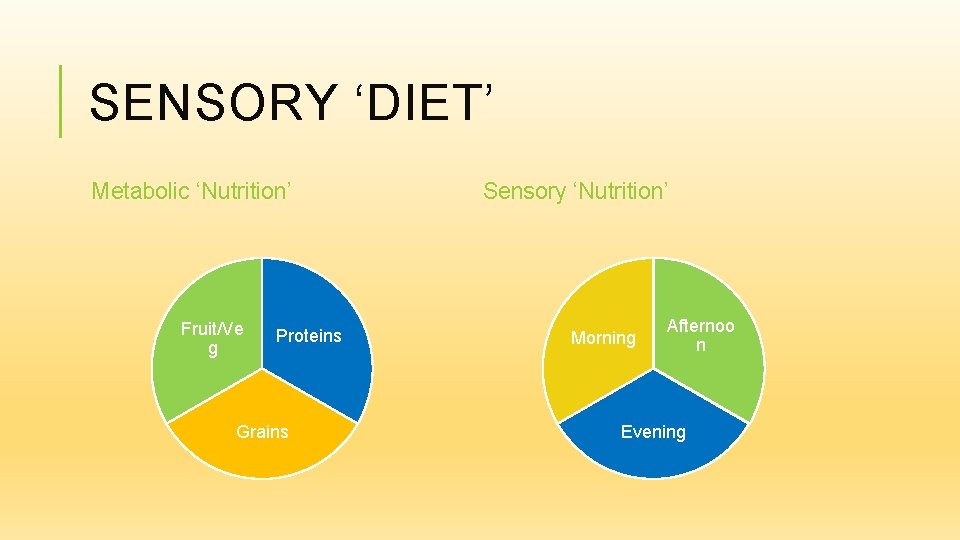
SENSORY ‘DIET’ Metabolic ‘Nutrition’ Fruit/Ve g Proteins Grains Sensory ‘Nutrition’ Morning Afternoo n Evening
SENSORY OVERRESPONSIVITY (AVOIDER) §Aggression when touched or bumped §Avoidance §Gets into a lot of fights §Picky eater – defensive with new foods §Won’t touch different textures (play-doh; paint; bubbles) §Refuses to let others help with hair, nails – etc. (Self-Care) §Refuses to wear certain clothes or textures §Withdraws when in a crowd
SENSORY UNDERRESPONSIVITY (SEEKER) §Hyperactivity – seeks movement §Impulsivity §Risk-Taker §Decreased response to pain §Unable to sit and listen §Clumsiness §Touches everything §Likes spicy, crunchy, carbonated, sour foods
MOTOR MILESTONES 4 -6 MONTHS • Uses hands to support self while sitting • Rolls from back to tummy and tummy to back • While standing with support, accepts entire weight with legs • Reaches for nearby toys while on tummy • While lying on back, reaches both hands to play with feet • While lying on back, transfers a toy from one hand to the other
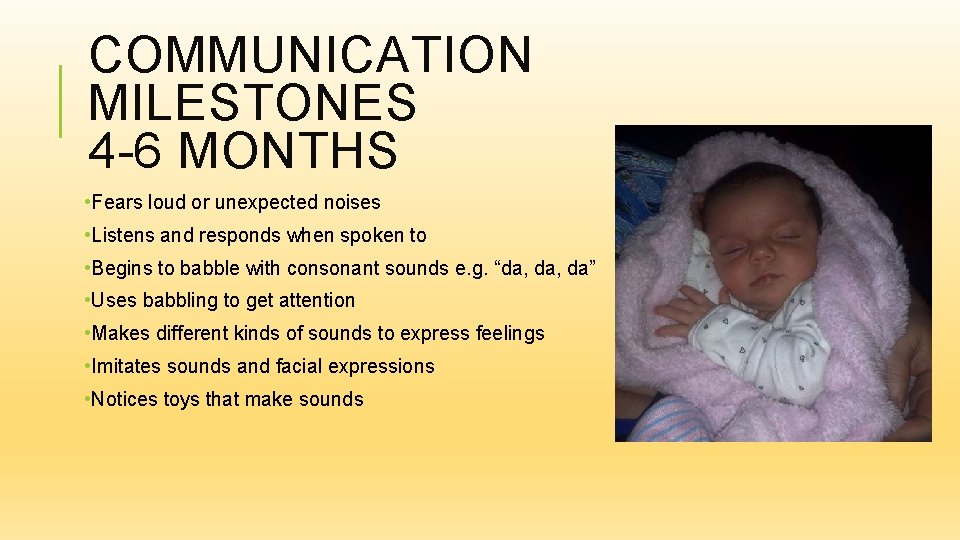
COMMUNICATION MILESTONES 4 -6 MONTHS • Fears loud or unexpected noises • Listens and responds when spoken to • Begins to babble with consonant sounds e. g. “da, da” • Uses babbling to get attention • Makes different kinds of sounds to express feelings • Imitates sounds and facial expressions • Notices toys that make sounds
MOTOR MILESTONES 7 -9 MONTHS • Sits without support • Starts to pull to stand • Moves from tummy or back into sitting • Enjoys a variety of movements – bouncing up • Starts to move with alternate leg and arm movement e. g. creeping, crawling and down, rocking back and forth • Picks up small objects with thumbs and fingers • Uses both hands to explore toys • Tries to lean towards, reach for, and pick up toys • Picks up head and pushes through elbows • In simple play imitates others during Tummy Time • Turns head to visually track objects, while sitting • Shows more control while rolling and sitting
COMMUNICATION MILESTONES 7 -9 MONTHS • Uses increased variety of sounds and syllable • Follows some routine commands when paired combinations in babbling • Looks at familiar objects and people when named with gestures • Distinguishes between familiar and unfamiliar voices • Recognizes sound of their name • Shows recognition of commonly used words • Participates in two-way communication • Mimics facial expressions and gestures • Begins using hand movements to communicate wants and needs, e. g. reaches to be picked up
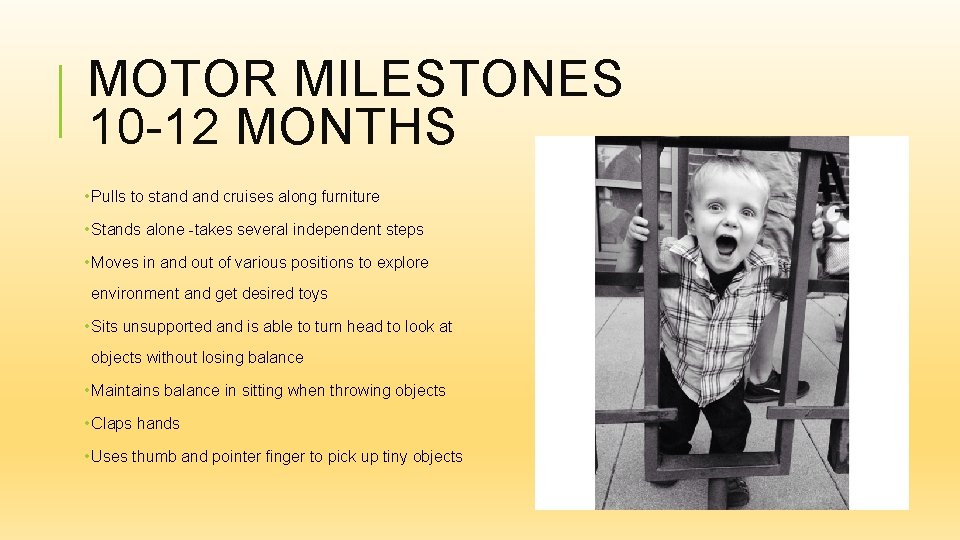
MOTOR MILESTONES 10 -12 MONTHS • Pulls to stand cruises along furniture • Stands alone -takes several independent steps • Moves in and out of various positions to explore environment and get desired toys • Sits unsupported and is able to turn head to look at objects without losing balance • Maintains balance in sitting when throwing objects • Claps hands • Uses thumb and pointer finger to pick up tiny objects
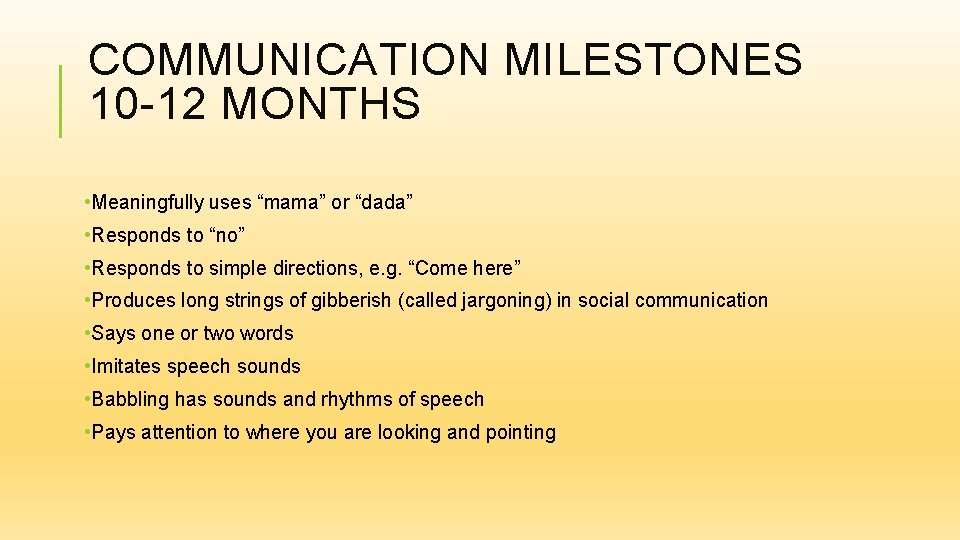
COMMUNICATION MILESTONES 10 -12 MONTHS • Meaningfully uses “mama” or “dada” • Responds to “no” • Responds to simple directions, e. g. “Come here” • Produces long strings of gibberish (called jargoning) in social communication • Says one or two words • Imitates speech sounds • Babbling has sounds and rhythms of speech • Pays attention to where you are looking and pointing
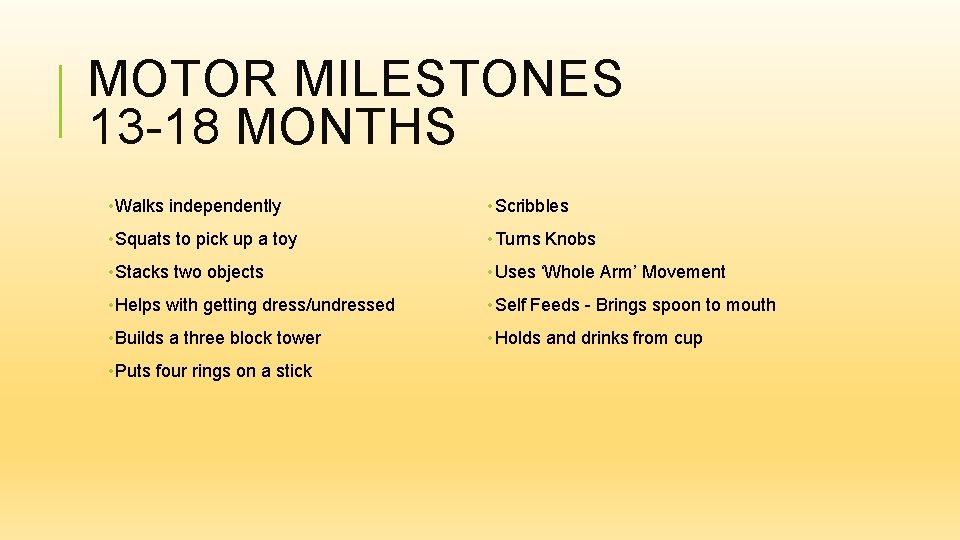
MOTOR MILESTONES 13 -18 MONTHS • Walks independently • Scribbles • Squats to pick up a toy • Turns Knobs • Stacks two objects • Uses ‘Whole Arm’ Movement • Helps with getting dress/undressed • Self Feeds - Brings spoon to mouth • Builds a three block tower • Holds and drinks from cup • Puts four rings on a stick
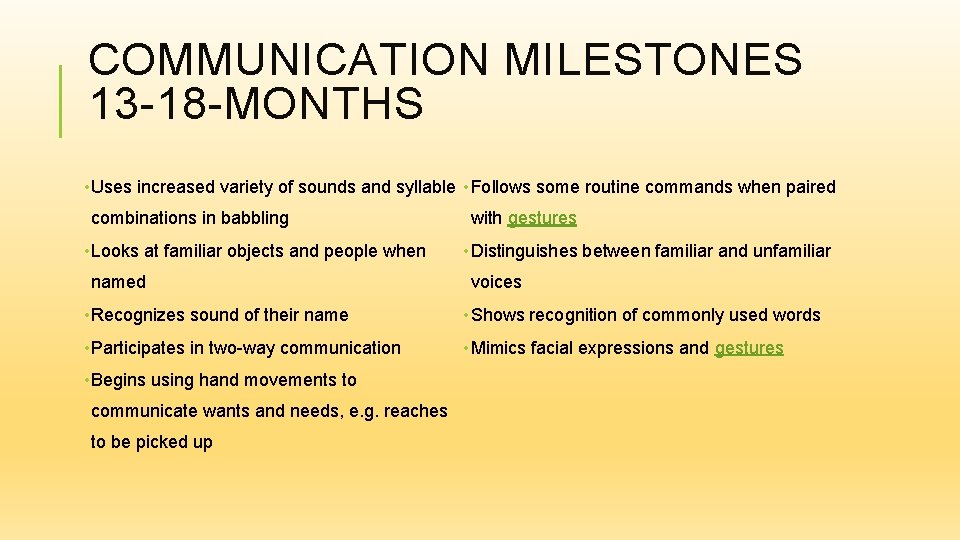
COMMUNICATION MILESTONES 13 -18 -MONTHS • Uses increased variety of sounds and syllable • Follows some routine commands when paired combinations in babbling • Looks at familiar objects and people when named with gestures • Distinguishes between familiar and unfamiliar voices • Recognizes sound of their name • Shows recognition of commonly used words • Participates in two-way communication • Mimics facial expressions and gestures • Begins using hand movements to communicate wants and needs, e. g. reaches to be picked up
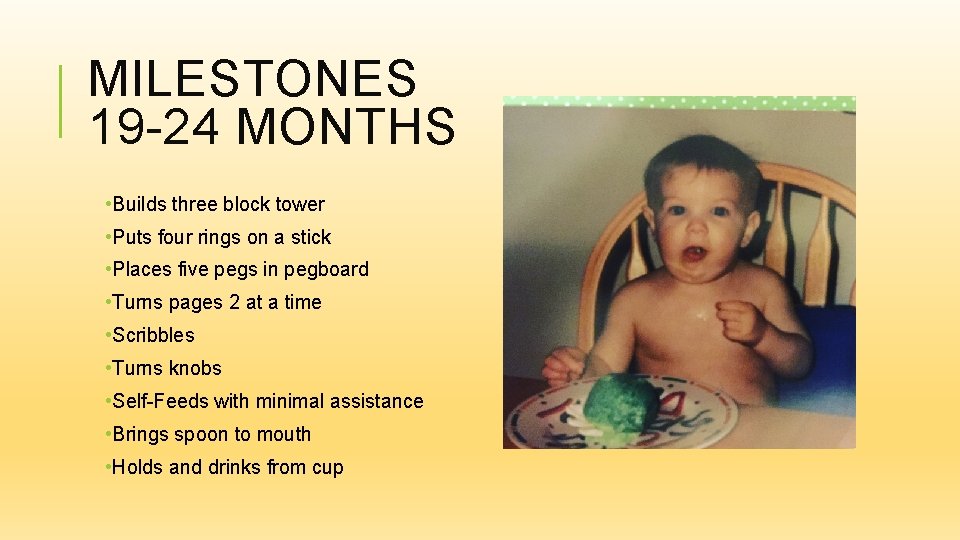
MILESTONES 19 -24 MONTHS • Builds three block tower • Puts four rings on a stick • Places five pegs in pegboard • Turns pages 2 at a time • Scribbles • Turns knobs • Self-Feeds with minimal assistance • Brings spoon to mouth • Holds and drinks from cup
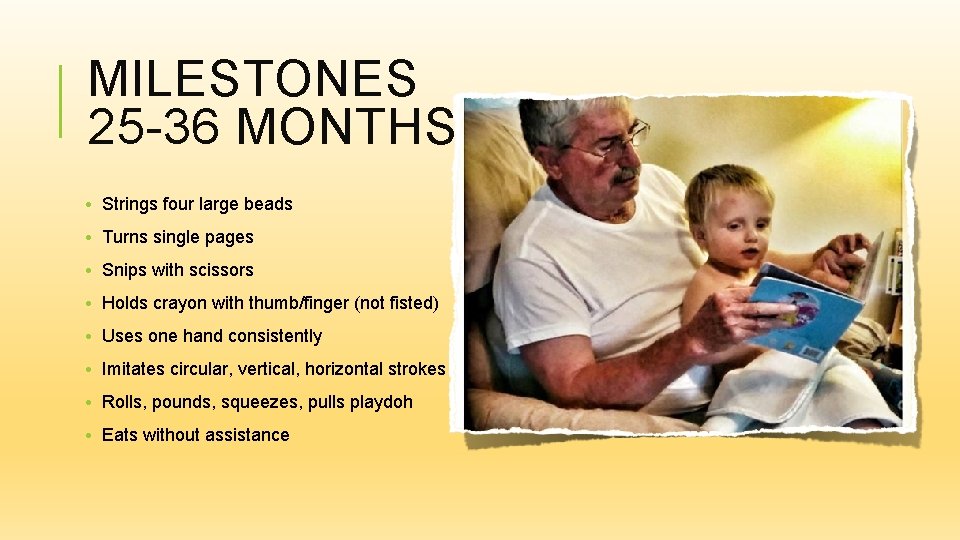
MILESTONES 25 -36 MONTHS • Strings four large beads • Turns single pages • Snips with scissors • Holds crayon with thumb/finger (not fisted) • Uses one hand consistently • Imitates circular, vertical, horizontal strokes • Rolls, pounds, squeezes, pulls playdoh • Eats without assistance
SENSORY SYSTEMS Vision Smell Touch Hearin g Taste
VISION Our visual system allows us to see and perceive the world and its beauty.
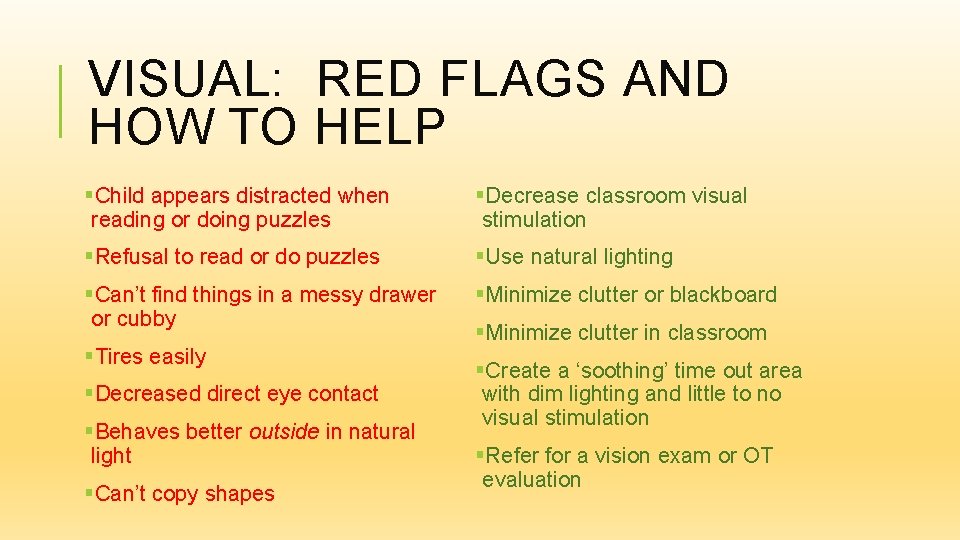
VISUAL: RED FLAGS AND HOW TO HELP §Child appears distracted when reading or doing puzzles §Decrease classroom visual stimulation §Refusal to read or do puzzles §Use natural lighting §Can’t find things in a messy drawer or cubby §Minimize clutter or blackboard §Tires easily §Decreased direct eye contact §Behaves better outside in natural light §Can’t copy shapes §Minimize clutter in classroom §Create a ‘soothing’ time out area with dim lighting and little to no visual stimulation §Refer for a vision exam or OT evaluation
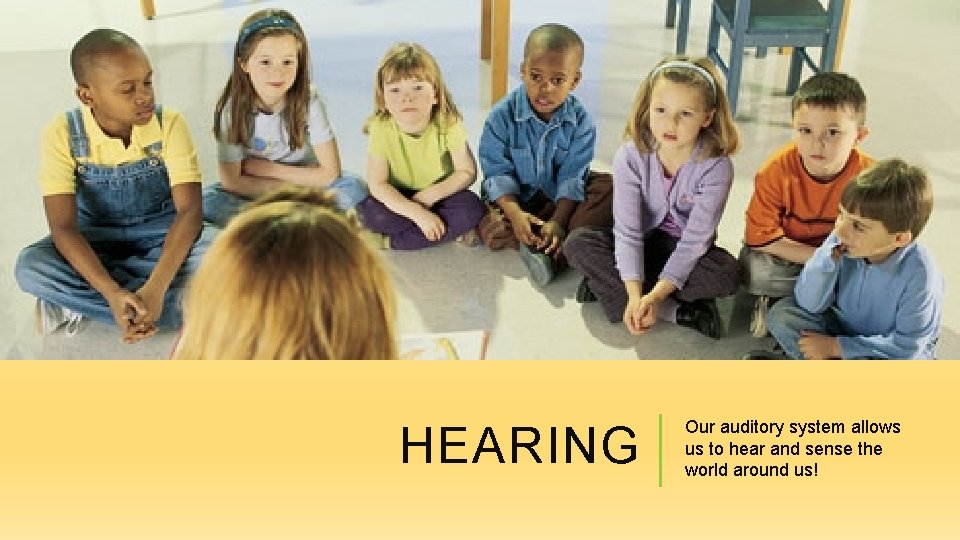
HEARING Our auditory system allows us to hear and sense the world around us!
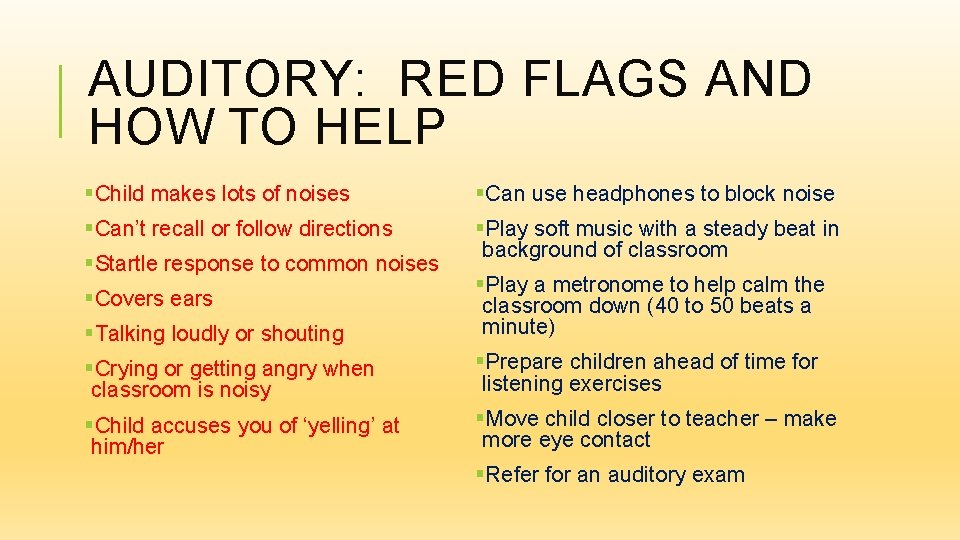
AUDITORY: RED FLAGS AND HOW TO HELP §Child makes lots of noises §Can use headphones to block noise §Can’t recall or follow directions §Play soft music with a steady beat in background of classroom §Startle response to common noises §Talking loudly or shouting §Play a metronome to help calm the classroom down (40 to 50 beats a minute) §Crying or getting angry when classroom is noisy §Prepare children ahead of time for listening exercises §Child accuses you of ‘yelling’ at him/her §Move child closer to teacher – make more eye contact §Covers ears §Refer for an auditory exam
TOUCH Our sense of touch allows us to feel the world around us, and plays a pivotal role in everything we do!
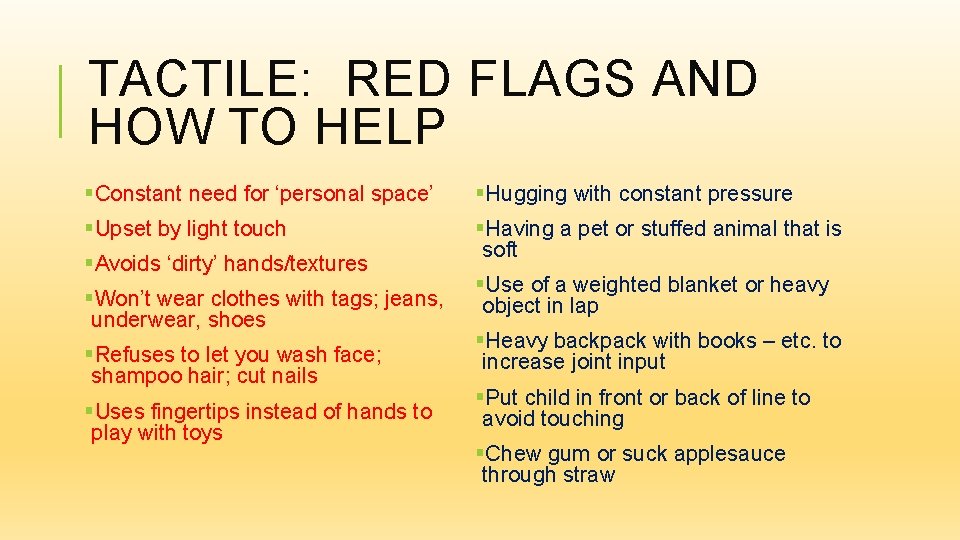
TACTILE: RED FLAGS AND HOW TO HELP §Constant need for ‘personal space’ §Hugging with constant pressure §Upset by light touch §Having a pet or stuffed animal that is soft §Avoids ‘dirty’ hands/textures §Won’t wear clothes with tags; jeans, underwear, shoes §Refuses to let you wash face; shampoo hair; cut nails §Uses fingertips instead of hands to play with toys §Use of a weighted blanket or heavy object in lap §Heavy backpack with books – etc. to increase joint input §Put child in front or back of line to avoid touching §Chew gum or suck applesauce through straw
SMELL Our Olfactory system allows us to smell and taste!
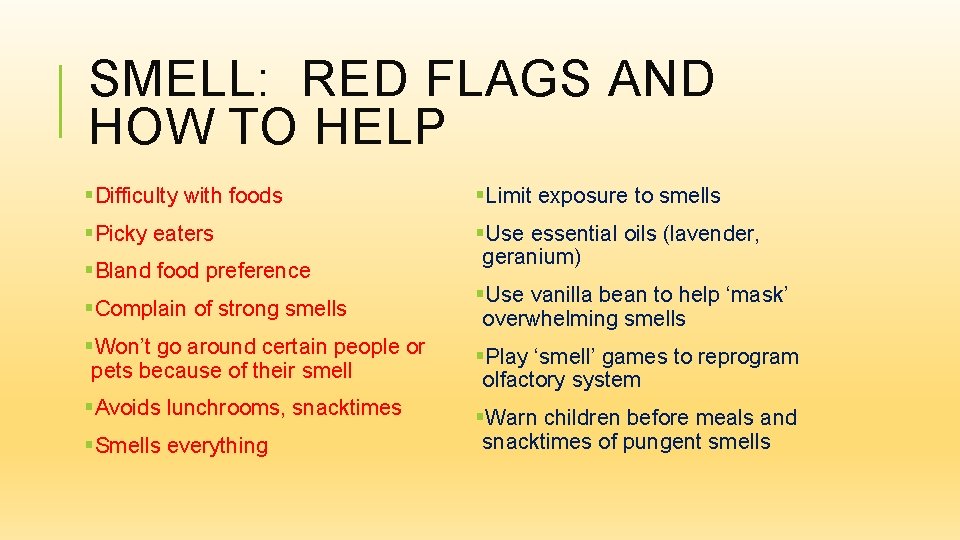
SMELL: RED FLAGS AND HOW TO HELP §Difficulty with foods §Limit exposure to smells §Picky eaters §Use essential oils (lavender, geranium) §Bland food preference §Complain of strong smells §Use vanilla bean to help ‘mask’ overwhelming smells §Won’t go around certain people or pets because of their smell §Play ‘smell’ games to reprogram olfactory system §Avoids lunchrooms, snacktimes §Warn children before meals and snacktimes of pungent smells §Smells everything
MOVEMENT The proprioceptive system are parts of our muscles, joints, and tendons that tell us what position our body is in.
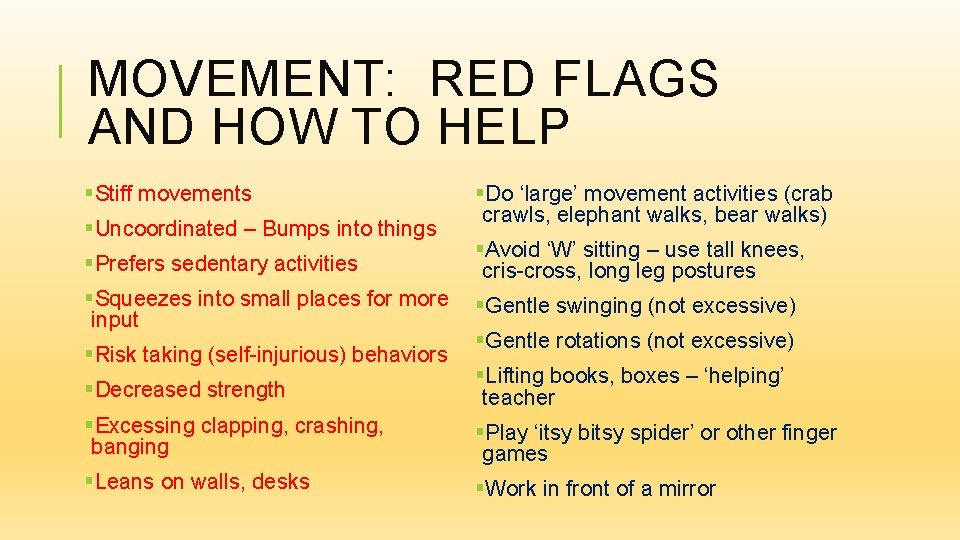
MOVEMENT: RED FLAGS AND HOW TO HELP §Stiff movements §Uncoordinated – Bumps into things §Do ‘large’ movement activities (crab crawls, elephant walks, bear walks) §Prefers sedentary activities §Avoid ‘W’ sitting – use tall knees, cris-cross, long leg postures §Squeezes into small places for more input §Gentle swinging (not excessive) §Risk taking (self-injurious) behaviors §Gentle rotations (not excessive) §Decreased strength §Lifting books, boxes – ‘helping’ teacher §Excessing clapping, crashing, banging §Play ‘itsy bitsy spider’ or other finger games §Leans on walls, desks §Work in front of a mirror
POOR MOVEMENT PATTERNS §Child appears clumsy §Lots of movement breaks §Odd body posture §Purposeful activity (helping teacher, being a ‘messenger’, line leader) §Difficulty with fasteners §Sloppy, messy eater §Loves rough play §Jumping Jacks §Wall or chair push ups §Rocks or flaps constantly §Alternate sitting with moving activities §Excessive pressure when coloring §Use a therapy ball to sit on §Breaks toys §‘Wiggle’ seat (deflated beach ball, etc)
SELF-REGULATION All Systems ‘GO’!
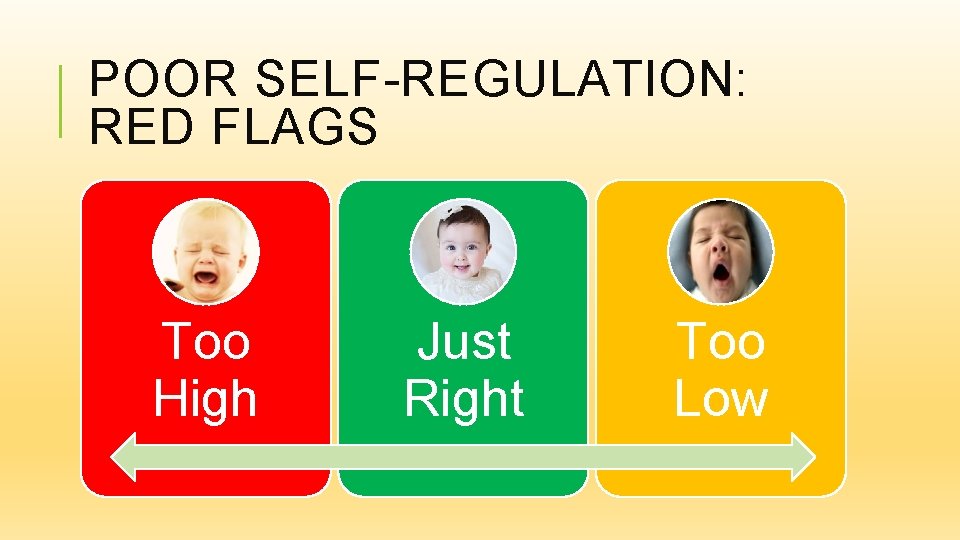
POOR SELF-REGULATION: RED FLAGS Too High Just Right Too Low
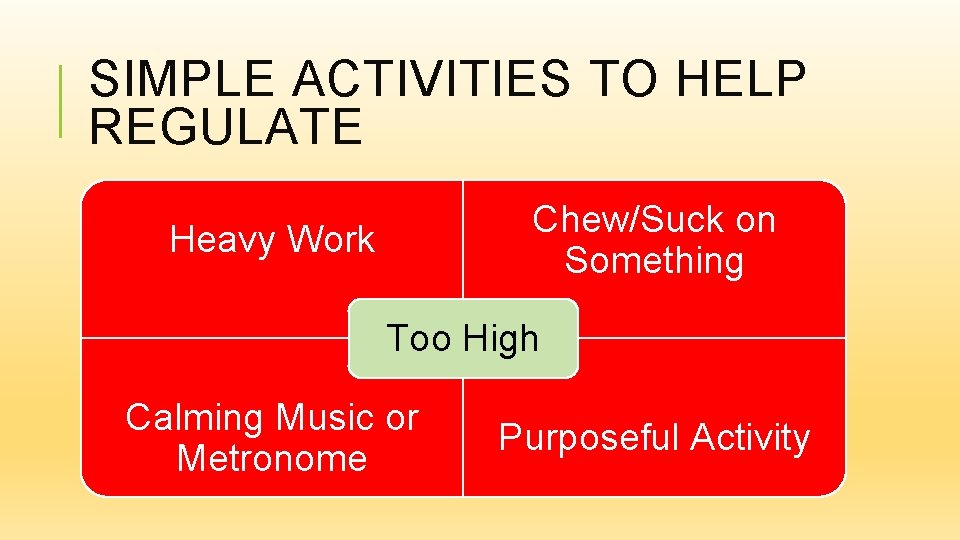
SIMPLE ACTIVITIES TO HELP REGULATE Chew/Suck on Something Heavy Work Too High Calming Music or Metronome Purposeful Activity
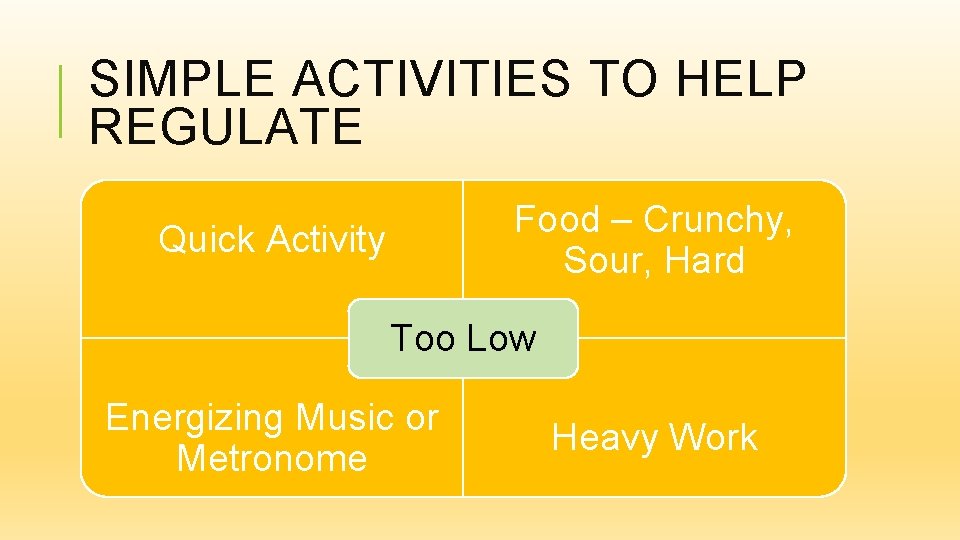
SIMPLE ACTIVITIES TO HELP REGULATE Food – Crunchy, Sour, Hard Quick Activity Too Low Energizing Music or Metronome Heavy Work
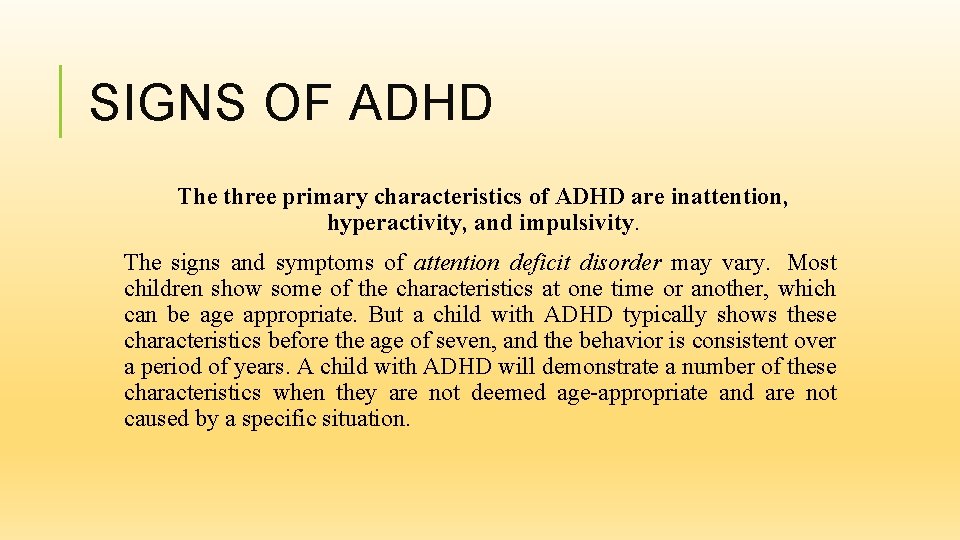
SIGNS OF ADHD The three primary characteristics of ADHD are inattention, hyperactivity, and impulsivity. The signs and symptoms of attention deficit disorder may vary. Most children show some of the characteristics at one time or another, which can be age appropriate. But a child with ADHD typically shows these characteristics before the age of seven, and the behavior is consistent over a period of years. A child with ADHD will demonstrate a number of these characteristics when they are not deemed age-appropriate and are not caused by a specific situation.
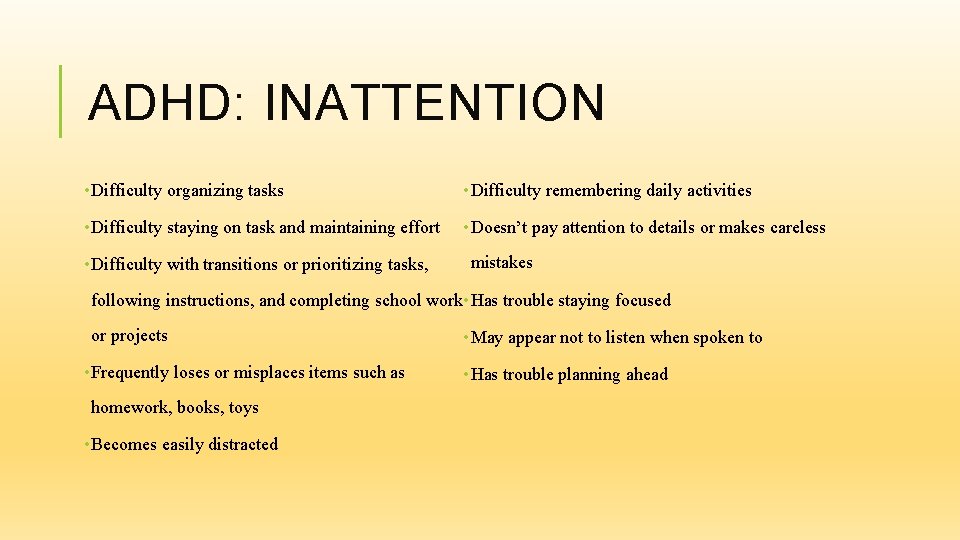
ADHD: INATTENTION • Difficulty organizing tasks • Difficulty remembering daily activities • Difficulty staying on task and maintaining effort • Doesn’t pay attention to details or makes careless • Difficulty with transitions or prioritizing tasks, mistakes following instructions, and completing school work • Has trouble staying focused or projects • Frequently loses or misplaces items such as homework, books, toys • Becomes easily distracted • May appear not to listen when spoken to • Has trouble planning ahead
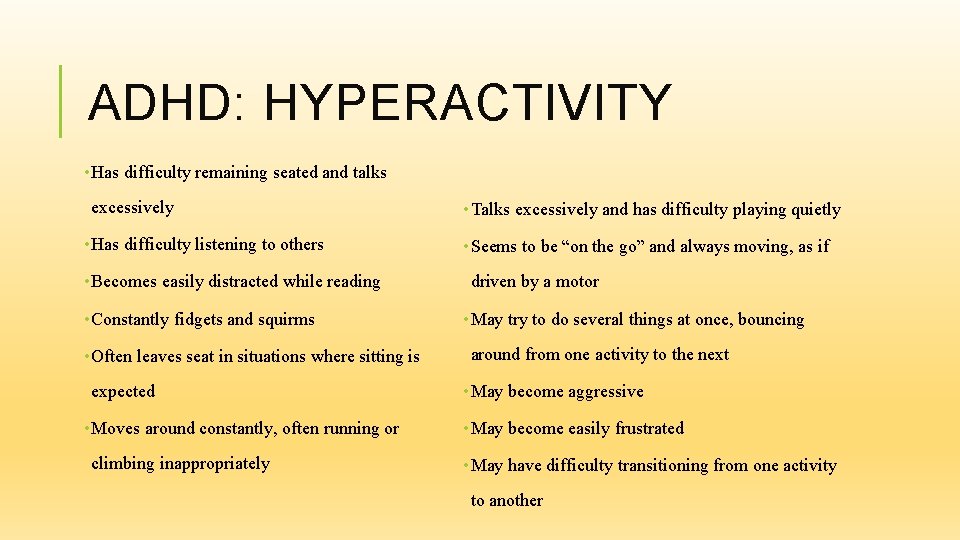
ADHD: HYPERACTIVITY • Has difficulty remaining seated and talks excessively • Has difficulty listening to others • Becomes easily distracted while reading • Constantly fidgets and squirms • Often leaves seat in situations where sitting is expected • Moves around constantly, often running or climbing inappropriately • Talks excessively and has difficulty playing quietly • Seems to be “on the go” and always moving, as if driven by a motor • May try to do several things at once, bouncing around from one activity to the next • May become aggressive • May become easily frustrated • May have difficulty transitioning from one activity to another
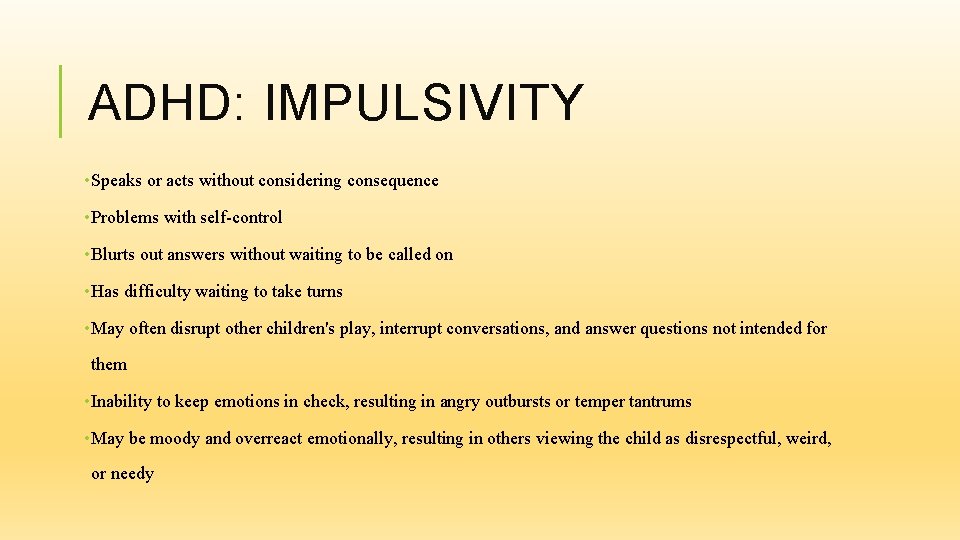
ADHD: IMPULSIVITY • Speaks or acts without considering consequence • Problems with self-control • Blurts out answers without waiting to be called on • Has difficulty waiting to take turns • May often disrupt other children's play, interrupt conversations, and answer questions not intended for them • Inability to keep emotions in check, resulting in angry outbursts or temper tantrums • May be moody and overreact emotionally, resulting in others viewing the child as disrespectful, weird, or needy
AUTISM SPECTRUM DISORDER (ASD) Autism is a disability that causes problems with communication and social interaction. Symptoms usually start before age three and may cause delays or deficits in many skills that develop from infancy to adulthood. Different people with autism can have very different symptoms. Autism is a spectrum disorder. One person may have mild symptoms, while another may have severe symptoms. “Autism spectrum disorder” and “autism” can mean the same thing.
ASD: COMMUNICATION • Language may be slow to develop • Speech may be delayed, or there may be no speech at all • May be no effort to use nonverbal communication (pointing and gesturing) • May use fewer gestures, and those they use are limited in function • May struggle to receptively or expressively label places, people, objects • If verbal, might not know how to start, sustain, or end conversations • May frequently use echolalia (repeating words of others), which may also be delayed • Content and grammar may be delayed, while speech skills might not be delayed • May display unusual tone of voice (e. g. monotone, robotic, or high pitch)
ASD: COMMUNICATION • May have a rigid understanding of words, and • Might not be able to express wants and needs have difficulty with the concept that objects • May not follow directions can have more than one name • May appear not to hear at times • Less likely to share experiences • May not point or wave “bye-bye” • Less likely to make bids for social attention • May not accurately interpret puns, sarcasm, (e. g. “Watch me!”) • May reverse pronouns • May not respond to name consistently idioms, etc. • Less likely to make comments (e. g. “Look at that”), or ask questions (“What’s your name? ”)
ASD: SOCIALIZATION • Difficulties sharing emotions, understanding how • Rarely share attention with others, such as by others think and feel, and holding a conversation • Eye contact may not be as frequent or last as long as in other children showing something, pointing, or pointing out interests or accomplishments • May be overly active, uncooperative, or resistant • May not appear to notice others and seems to tune • Does not know how to play with toys the way they people out • Often do not build relationships with others their age at a developmental level expected were intended • Seems to be in his / her “own world” • Is not interested in other children
ASD: SOCIALIZATION • Does not demonstrate emotional reciprocity (taking turns) • Difficulty in making and maintaining friendships • Infrequently take turns in play or conversation • Does not consistently smile when smiled at • Rarely imitate the actions of others in play or • May seem to prefer to play alone otherwise • May not respond to own name • May seem lonely • May have difficulty with imaginative/pretend play
STEREOTYPICAL BEHAVIORS • May have an unusually strong or focused interest or routines fixation (such as a television program, certain toys, or • May have a difficult time transitioning to a different games) • May repeat words, questions, or phrases and cannot move on to other topics • May repeat certain actions and get “stuck” doing the activity • May express high levels of anxiety regarding specific objects or events (e. g. weather events, specific machines) same things over and cannot move on to other • May play in repetitive ways things (e. g. closing doors, flicking lights) • May demonstrate repetitive body or other motor • May obsessively follow daily routines or schedules and movements, such as spinning, rocking, or finger be unable or unwilling to be flexible in changing these flicking
ASD: STEREOTYPICAL BEHAVIOR • May demonstrate increased sensitivity to visual and / or auditory stimulation • May seek out additional sensory stimulation in atypical ways (e. g. licking objects, eating non-foods, smelling objects, closing one eye to gaze at object) • May resist certain food groups or food textures • May seem very independent for his/her age • May seem to do things “early” compared to other children • May walk on his / her toes • May display tantrums that are atypical in terms of frequency, intensity, and / or duration. May show intense interest in parts of objects, as opposed to using an entire toy or object • May spend a lot of time lining things up or putting things in • May have movements that result in self-injury, such as piles or rows • May have odd movement patterns scratching eyes, skin picking, biting hands, and head banging • May demonstrate increased sensitivity to certain textures, tastes, and smells
MISSIONARY FAMILIES HAVE UNIQUE NEEDS • Location • Frequent Moves • Relationships • Poor Continuity of Service • Support • Resources
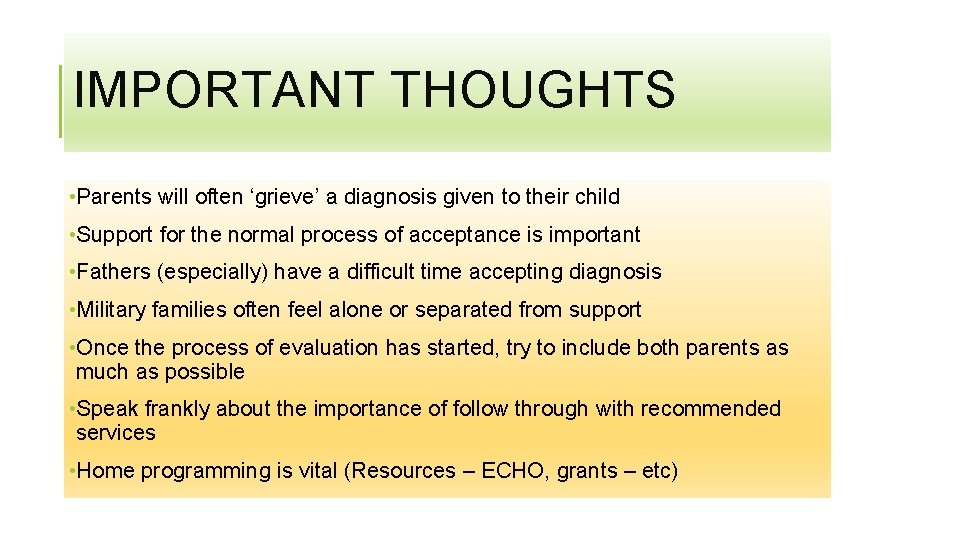
IMPORTANT THOUGHTS • Parents will often ‘grieve’ a diagnosis given to their child • Support for the normal process of acceptance is important • Fathers (especially) have a difficult time accepting diagnosis • Military families often feel alone or separated from support • Once the process of evaluation has started, try to include both parents as much as possible • Speak frankly about the importance of follow through with recommended services • Home programming is vital (Resources – ECHO, grants – etc)
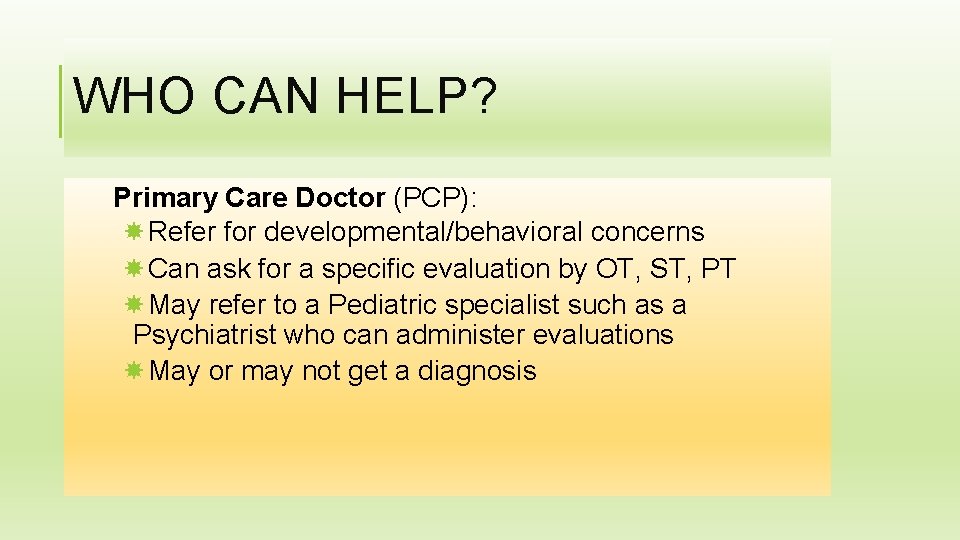
WHO CAN HELP? Primary Care Doctor (PCP): Refer for developmental/behavioral concerns Can ask for a specific evaluation by OT, ST, PT May refer to a Pediatric specialist such as a Psychiatrist who can administer evaluations May or may not get a diagnosis
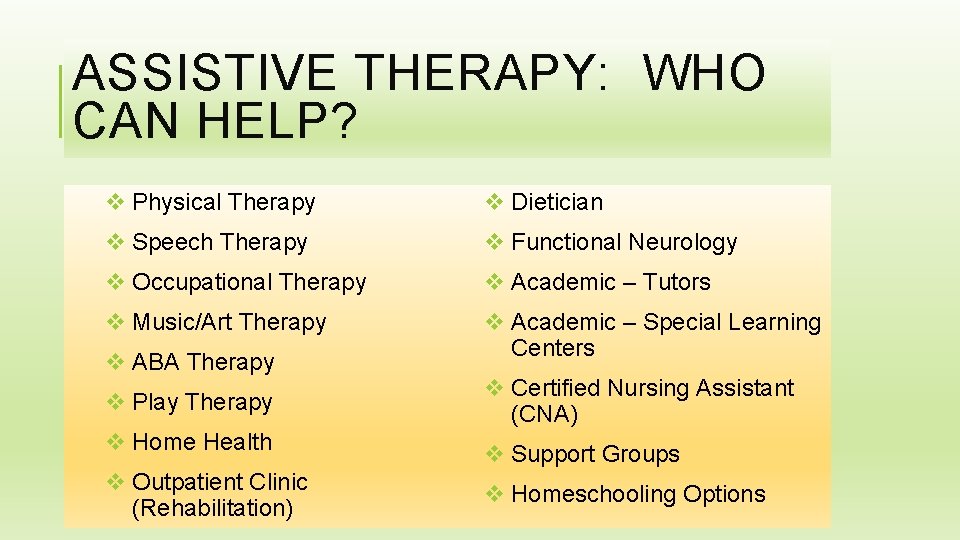
ASSISTIVE THERAPY: WHO CAN HELP? v Physical Therapy v Dietician v Speech Therapy v Functional Neurology v Occupational Therapy v Academic – Tutors v Music/Art Therapy v Academic – Special Learning Centers v ABA Therapy v Play Therapy v Certified Nursing Assistant (CNA) v Home Health v Support Groups v Outpatient Clinic (Rehabilitation) v Homeschooling Options
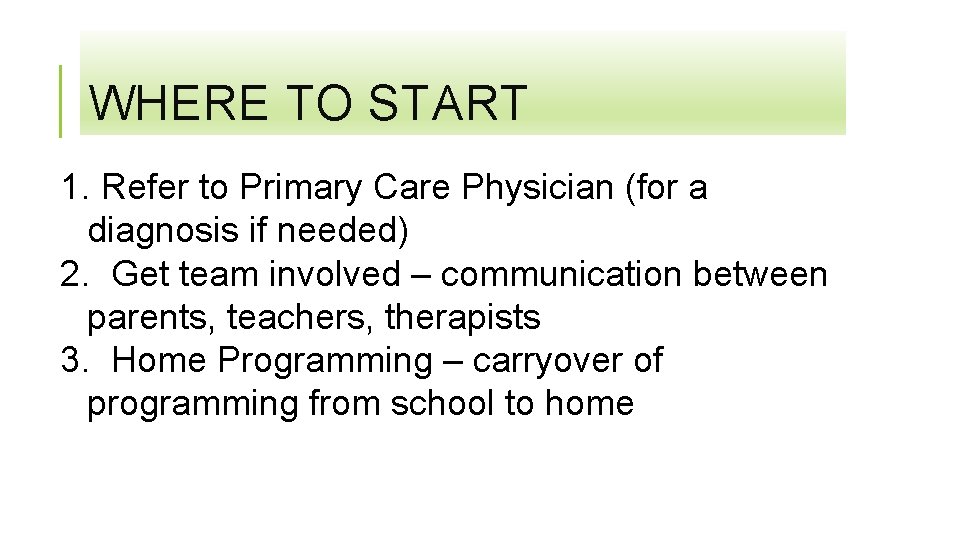
WHERE TO START 1. Refer to Primary Care Physician (for a diagnosis if needed) 2. Get team involved – communication between parents, teachers, therapists 3. Home Programming – carryover of programming from school to home
RESOURCES Sensory Processing Disorders: Information for Families Compiled by Michael Cheng, Child Psychiatrist and Jennifer Boggett. Carsjens, OTR Understanding Your Child’s Sensory Signals Angie Voss, OTR www. asensorylife. com STAR Center http: //spdstar. org/ The Alert Program www. alertprogram. com Zones of Regulation www. zonesofregulation. com