
PEDIATRIC ANESTHETIC CONSIDERATIONS KIDS ARE NOT SMALL ADULTS
- Slides: 50
PEDIATRIC ANESTHETIC CONSIDERATIONS
KIDS ARE NOT SMALL ADULTS
Respiratory System Anatomy… Tongue relatively large n Larynx more cephalic and anterior u C 3 -4 in child u C 4 -5 in adult u Epiglottis long and stiff t Protrudes posterior at 45 o n
Respiratory System Anatomy… Narrowest diameter upper airway at cricoid ring (glottis in adult) u Susceptible to airway obstruction n Trachea short— 4 -5. 7 cm vs. 6 -8 cm n Equidistant bronchi from trachea— increased chance of endobronchial intubation n Lung alveoli— 20 mil at birth, 300 mil age 8 n
Respiratory Physiology… Alveolar ventilation: O 2 requirement u Infant: 100 -150 cc/kg/min u Adult: 60 cc/kg/min n Increase in Va 2 o increased metabolic rate in infant n FRC (functional residual capacity) exp. reserve vol. + residual vol. n
Respiratory Physiology… FRC— u acts as a buffer to maintain Pa. O 2 during inspiration and expiration u smaller reserve u less O 2 during apnea n Va/FRC (adult) = 1. 5/1 n Va/FRC (infant) = 5/1 n
Respiratory Physiology… n n Lung mechanics u Increased resistance 2 o narrow nasal passage u Resp. rate increased (24 -30 vs. 20) Oxygen transport (left shift) u Incr. affinity of hemoglobin for O 2 u Favors uptake not unload u Less O 2 available to tissues, therefore increased HR and CO necessary
Cardiovascular Anatomy & Physiology… n n Ventricle in infant u Right > Left (size and thickness) u Less compliant Pulse rate is the major determinant of CO in infant u New born— 130; adult— 77 Sinus dysrhythmia common BP; infant— 70/43, adult— 122/80
Cardiovascular Anatomy & Physiology… n Response to hypoxia u Metab. demand for O 2 - 60% > adult u Va/FRC is high (5: 1) u Hypoxemia can develop rapidly u Bradycardia is always initial response to hypoxia u Treat unexplained bradycardia immediately with O 2
Pediatric Pharmacology… n n n Brain, heart, liver, and kidneys = 18% of body weight in infant vs. 5% adult u Larger fraction of drug distributed to these organs vs. muscle and fat Infants have less plasma protein conc. More perm. BBB Hepatic enzymes—inactive/immature GF less in infant—slower elimination of drugs and metabolites
Pediatric Sedation… n n n ASA status—I’s and II’s Risk factors for pediatric sedation u Age—the younger the patient the greater the risk u Respiratory arrest is the greatest liability Rule of thumb “adults will have a cardiac arrest, children will have a respiratory arrest”
Evaluation of Physical Risks During Sedation… n History u Syndrome associated with difficult airway? u Does the child snore at night? t Most crucial question in history t Accurate predictor of obstruction t Most common etiology is hypertrophy of adenoids and tonsils • Problems with emergency airway
Evaluation of Physical Risks During Sedation… n n History u Previous surgeries and anesthetics t Very good indicator of success/failure Physical exam u Differences in child’s airway t Kids are smaller • Smaller mouths • Mallampati evaluation
Evaluation of Physical Risks During Sedation… n Physical exam u Disproportionate sized features t Relatively large epiglottis t Floppier epiglottis t Narrowest part of airway is subglottic t Glottis is prone to laryngospasm during sedation t Thyromental distance
Evaluation of Physical Risks During Sedation… n Physical exam u URI t Most children have 2 -10 viral respiratory tract infections per year • Is a snotty nose just a cold or day 1 of a viral infection? t More prone to laryngospasm, bronchospasm, coughing, mucus plugging
Factors Influencing the Outcome of Sedation n n The best success rate with children is (20 -40% failure) Age Cognitive development Degree of expression of fear u Flight response of crying/screaming Child temperament 60 -80 %
SEDATION PHARMACOLOGY Sedative Hypnotics n Phenothiazines/Antihistamines n Benzodiazepines n Narcotics n Barbiturates n Reversal Agents n
SEDATIVE HYPNOTICS CHLORAL HYDRATE
CHLORAL HYDRATE “Classic” pediatric sedative n Moderately effective sedative/hypnotic n Mild depressant of the central nervous system n Trichloroethanol is the active metabolite n
CHLORAL HYDRATE Often combined with other agents n No analgesic properties n No reversal agent n May cause GI irritation, respiratory depression, hypotension and paradoxical excitement n Hepatic elimination n
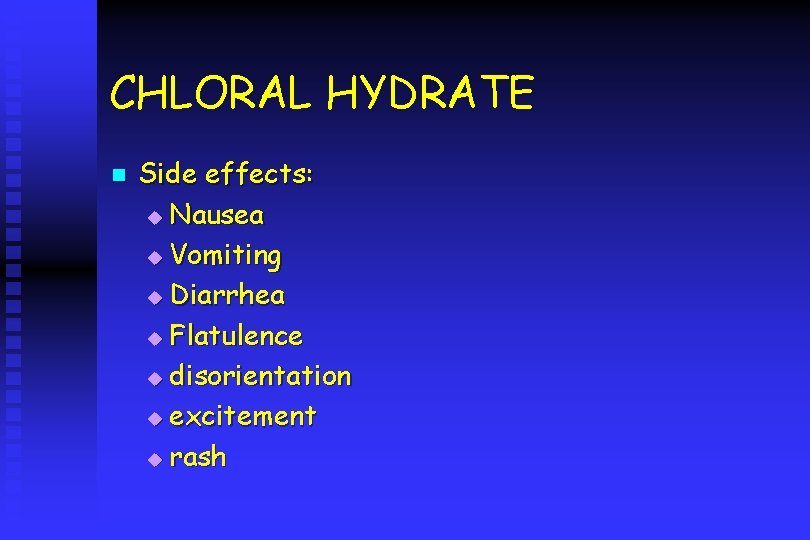
CHLORAL HYDRATE n Side effects: u Nausea u Vomiting u Diarrhea u Flatulence u disorientation u excitement u rash
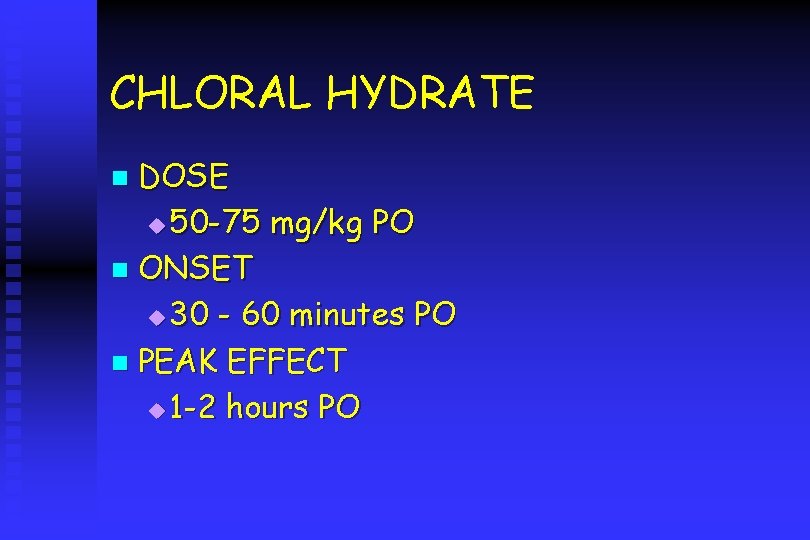
CHLORAL HYDRATE DOSE u 50 -75 mg/kg PO n ONSET u 30 - 60 minutes PO n PEAK EFFECT u 1 -2 hours PO n
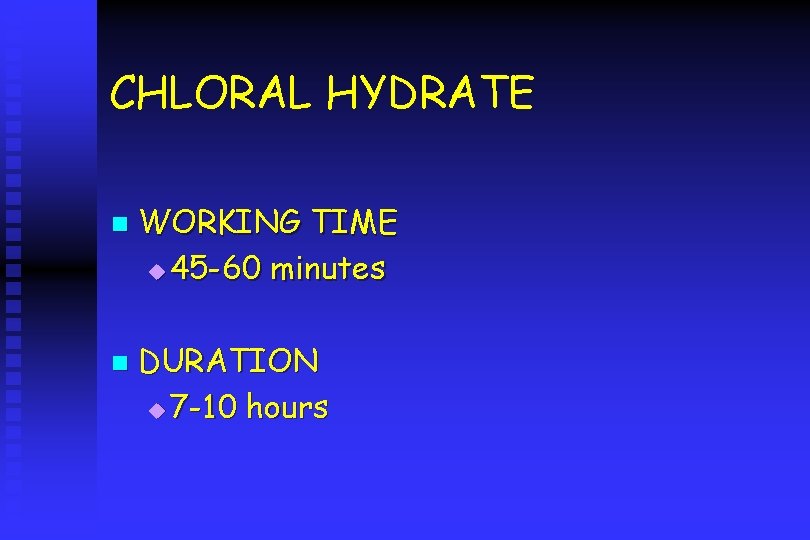
CHLORAL HYDRATE n n WORKING TIME u 45 -60 minutes DURATION u 7 -10 hours
ANTIHISTAMINES DIPHENHDRAMINE HYDROXYZINE
DIPHENHYDRAMINE Trade name: Benadryl n H 1 receptor antagonist with anticholinergic and sedative effects n Partially inhibits vasodilator effect of histamine on peripheral vascular smooth muscle n
DIPHENHYDRAMINE n USES: u Antiemetic u Antivertigo u Treatment of allergic reactions u Treatment of extrapyramidal reactions
DIPHENHYDRAMINE DOSE: u 0. 5 to 1 mg/kg q 6 h (25 -50 mg) PO u maximum 300 mg/day n ONSET: u <15 minutes PO n
DIPHENHYDRAMINE PEAK EFFECT: u 2 hours PO n DURATION: u < 7 hours PO n
DIPHENHYDRAMINE Children are at an increased risk of paradoxic CNS stimulant effects such as restlessness, insomnia, tremors, euphoria and seizures
HYDROXYZINE Vistaril/Atarax n Antihistamine n Anxiolytic n Sedative n Hepatic elimination n
HYDROXYZINE n n DOSE: u. 6 - 1 mg/kg PO ONSET: u 15 -30 minutes PO PEAK EFFECT: u 30 - 60 minutes PO DURATION: u 2 - 4 hours
PHENOTHIAZINES PROMETHAZINE
PROMETHAZINE Phenothiazine derivative n H 1 receptor antagonist with good sedative, antiemetic, anticholinergic and antimotion sickness effects n Hepatic elimination n
PROMETHAZINE n Uses: u Antiemetic u Adjunct to other sedatives (antiemetic and co-sedative) u Used alone for mild sedation or to control gagging
PROMETHAZINE n n DOSE: u 1 mg/kg PO ONSET: u 15 - 30 minutes PO PEAK EFFECT: u <2 hours PO DURATION: u 2 -8 hours PO
PROMETHAZINE n n Extrapyramidal reactions Use with caution in children with severe cardiovascular or liver disease
BENZODIAZEPINES DIAZEPAM MIDAZOLAM
DIAZEPAM n n DOSE: u 0. 25 - 0. 5 mg/kg PO ONSET: u 30 minutes to 1 hour PO PEAK EFFECT: u 1 hour PO DURATION: u 2 - 6 hours PO
MIDAZOLAM Trade name: Versed n Short acting n Water soluble n Greater amnesia than with diazepam n Dose dependent respiratory and circulatory depression n Four times more potent than diazepam n
MIDAZOLAM n n DOSE: u 0. 5 mg/kg PO ONSET: u 20 -30 minutes PO PEAK EFFECT: u 30 minutes PO DURATION: u 2 -6 hours PO
MIDAZOLAM - INTRANASAL Not permitted with Level 1 n Burning of the nasal mucosa is a major drawback n Need to make sure that the drug is absorbed through the nasal mucosa and not swallowed n
FLUMAZENIL Trade Name: Romazicon n Competes with benzodiazepines for the GABA/benzodiazepine receptor n Has a much shorter duration of action than most of the benzodiazepines n Used as a reversal agent for benzodiazepine agonists n
FLUMAZENIL DOSE: u IV/IM 0. 1 mg or 3 mcg/kg (max dose is 1 mg) n ONSET: u 1 - 2 minutes IV n PEAK EFFECT: u 2 - 10 minutes IV n DURATION: n
FLUMAZENIL n Precautions u May be associated with seizures in high risk patients. u Patient may become re-sedated so need to monitor patient. u Can cause confusion and agitation
NARCOTICS MEPERIDINE
MEPERIDINE DOSE: u 1 -2 mg/kg PO n ONSET: u 10 - 30 minutes PO n PEAK EFFECT u <1 hour PO n DURATION u 2 - 4 hours PO n
MEPERIDINE Do not use in patients taking MAO inhibitors n Can cause abnormal behavior or dysphoria n Use with caution in patients who are high risk or hypovolemic n
NALOXONE Trade Name: Narcan n Pure opioid antagonist n Competitively inhibits opiates at the mu, delta, and kappa receptor sites n Reverses respiratory depression, sedation, hypotension and analgesia n No pharmacologic effects in absence of narcotics n
NALOXONE n DOSE: u n 0. 01 mg/kg IV/IM/SC (titrate to response) ONSET: 1 - 2 minutes IV, u 2 - 5 minutes IM/SC u n PEAK EFFECT: u n 5 - 10 minutes IV/IM/SC DURATION: u 1 - 4 hours IV/IM/SC
NALOXONE Abrupt reversal may cause nausea, vomiting, diaphoresis, tachycardia, hypertension, pulmonary edema n Careful monitoring needed because duration of action of opiates may be longer than that of naloxone n