
Pediatric and Adolescent Mental Health John Sargent M
- Slides: 33
Pediatric and Adolescent Mental Health John Sargent, M. D.
Goals of Child Rearing Optimal development n Effective emotional, cognitive and behavioral functioning n
Capacity for meaningful occupational participation n Satisfying relationships and family life n Rewarding recreational experiences n Successful adaptation to and participation in one’s neighborhood and community n
Recognizing Intrinsic Differences Physical Status n Intellectual capacity n Temperament n Culture and ethnicity n
Family relationships n Socio economic status/access to resources n Capacity for modulation of emotions n Capacity to manage and direct behavior n
Unique Characteristics of Child Mental Health Problems Often represent gene-environmental interactions n Symptoms of the disorder often worsen the disorder n Impact development and overall skill acquisition n
n n n Affect and are affected by family relationships and family behavior Early recognition and early effective treatment significantly reduce mortality and morbidity Sources of resilience and risk strongly influence the occurrence and course of child and adolescent mental health problems
Sources of Resilience High intelligence n Even temperament n Physical attractiveness n Special skills and abilities n Commitment of caretaker to child’s well being and development n Strong social support for family and caretaker n
Sources of Risk Poverty n Recent move or immigration n Marked marital or post separation conflict n
Family violence, abuse or neglect n Community disruption n Poor resource availability n
Types of Child and Adolescent Mental Health Problems n Disorders of Social Interaction n Internalizing Disorders n n Autism Aspergers Syndrome Anxiety Disorders Depression Trauma Responses Externalizing Disorders n n Attention Deficit Hyperactivity Disorder Conduct Disorder
n Appetite Disorders n n Mental Retardation n n Eating Disorder Substance Abuse Self-Harming Behavior Learning Disability Early onset major mental illness n n Schizophrenia Bipolar Disorder
Mental Health Treatment Options for Children and Adolescents Individual Psychotherapy n Family education and psychotherapy n Psychopharmacology n
Special education programs n Treatment programs n n Inpatient residential Day treatment Legal responses n n n Detention Group homes Probation
n Community treatment n n Home based therapy Therapeutic foster care Mentoring programs Crisis intervention n n Mobile crisis unit Police with special training
Goals of Treatment To enhance the child’s adaptation to his environment n To support the community’s efforts to accommodate to the child’s unique differences n
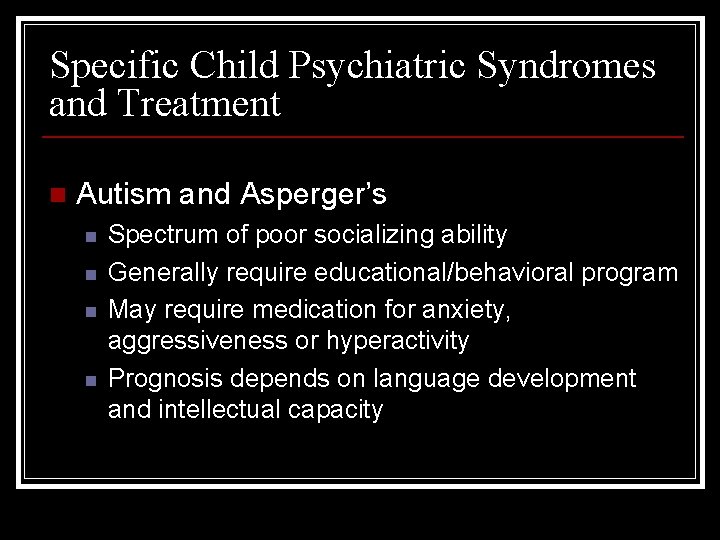
Specific Child Psychiatric Syndromes and Treatment n Autism and Asperger’s n n Spectrum of poor socializing ability Generally require educational/behavioral program May require medication for anxiety, aggressiveness or hyperactivity Prognosis depends on language development and intellectual capacity
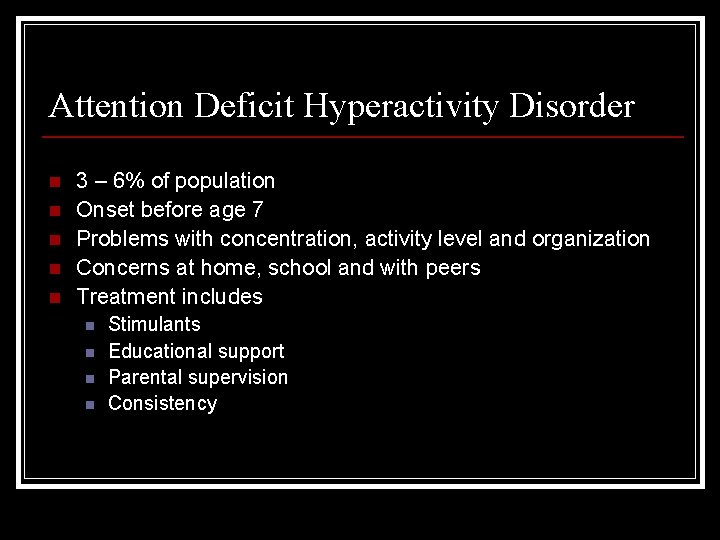
Attention Deficit Hyperactivity Disorder n n n 3 – 6% of population Onset before age 7 Problems with concentration, activity level and organization Concerns at home, school and with peers Treatment includes n n Stimulants Educational support Parental supervision Consistency
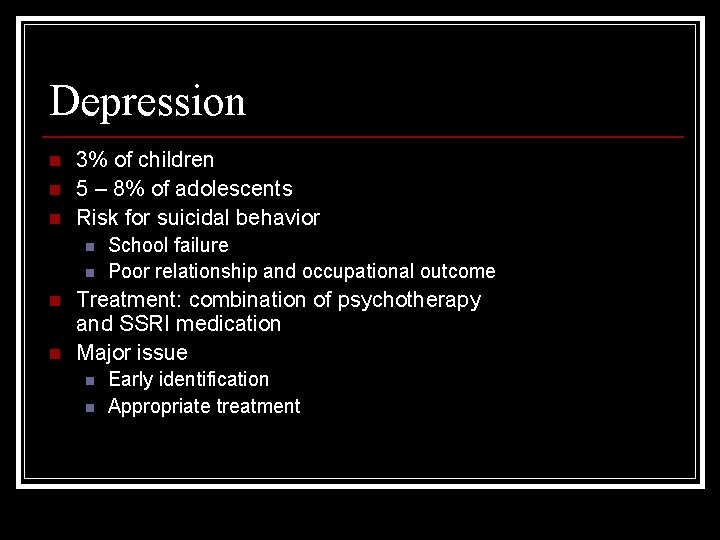
Depression n 3% of children 5 – 8% of adolescents Risk for suicidal behavior n n School failure Poor relationship and occupational outcome Treatment: combination of psychotherapy and SSRI medication Major issue n n Early identification Appropriate treatment
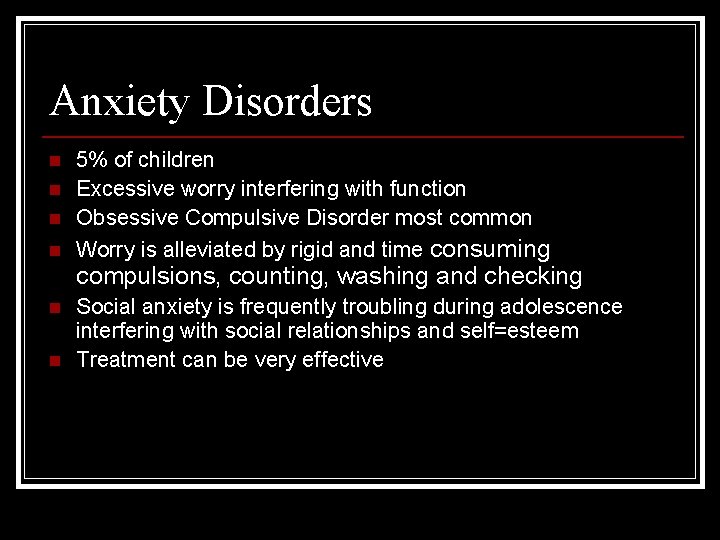
Anxiety Disorders n n 5% of children Excessive worry interfering with function Obsessive Compulsive Disorder most common Worry is alleviated by rigid and time consuming compulsions, counting, washing and checking n n Social anxiety is frequently troubling during adolescence interfering with social relationships and self=esteem Treatment can be very effective
Post Traumatic Stress Disorder Significant trauma through abuse, neglect, illness, accident or other traumatic expericene n Symptoms include arousal changes, avoidance and reexperencing n Can be persistent and seriously disabling n
Often complicated by depression, substance abuse and risk taking behavior n Psychotherapy highly effective, especially if initiated early n
Eating Disorders 1 – 3% of adolescent and young adult women n Bulimia (recurrent binge eating and purging) can be chronic and relapsing n
Anorexia has 5 – 10% mortality rate can be chronic n Early treatment most effective n Requires multidisciplinary treatment approach n and
Conduct Disorder More common in boys n Cruelty to animals often an early symptom n Can persist and develop into antisocial personality and lifelong criminality n
Linked to poor parental supervision and family violence n Often associated with substance abuse n Positive relationship with school and with prosocial peers are good prognostic signs n
Placement away from home and with similar youth does not improve the problem n Home based, intensive family treatment leads to 75% recovery rate n
Substance Abuse Has declined in youth in the past 15 years n Frequently associated with other psychiatric disorders and complicates their treatment n Use of several drugs is common n
Drug abuse is associated with poor family relationships and poor parental supervision n Treatment is based on improving family relationships and building the child’s skills and abilities n
Bipolar Disorder n n Can occur in childhood and adolescence Mood fluctuations are associated with marked irritability, temper outbursts and impulsivity Can be difficult to treat and is often chronic Frequently occurs in families with other member swith Bipolar Disorder which can complicate treatment
Concluding Remarks Decreasing stigma remains essential n Parity in insurance coverage and improved access to effective care for poor and underinsured are extremely important n
Planning for transition to adulthood significant n Social and human costs of non treatment are enormous n Competence and human connections are important treatment goals n
There is great need for more Child and Adolescent Psychiatrists (only 7000 in USA for 7. 5 million seriously affected children) n Effective treatments are available and lead to more productive and satisfying lives for children and their families n