
Pedestrian Planning and Design 1 Why should we
- Slides: 65
Pedestrian Planning and Design 1
Why should we accommodate bicycles and pedestrians? o Bicycles are legally considered to be vehicles, with the right to use roadways o There are 9 million bike trips and 56 million walking trips in the U. S. everyday o One in ten U. S. households do not own an automobile o 1/3 of the population do not drive an automobile References: Uniform Vehicle Code, 1995 National Personal Transportation Survey (NPTS), 1990 US Census 2 FHWA Course on Bicycle and Pedestrian Transportation
Why should we accommodate bicycles and pedestrians? o Lifestyle o Safety References: Uniform Vehicle Code, 1995 National Personal Transportation Survey (NPTS), 1990 US Census 3 FHWA Course on Bicycle and Pedestrian Transportation
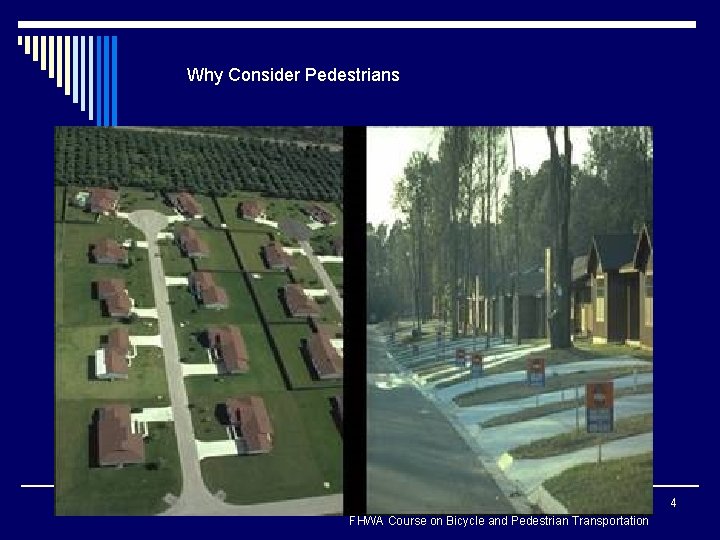
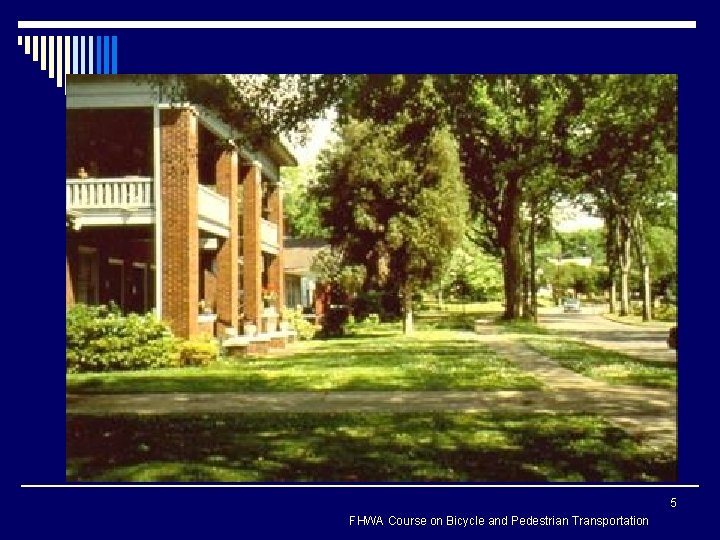
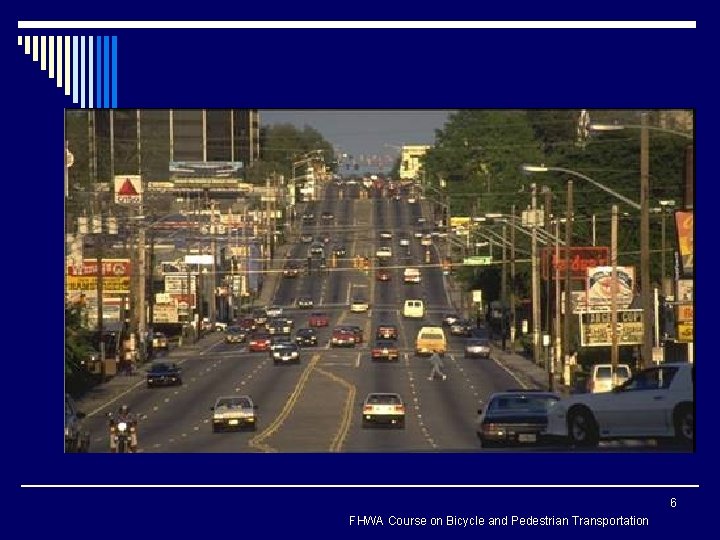
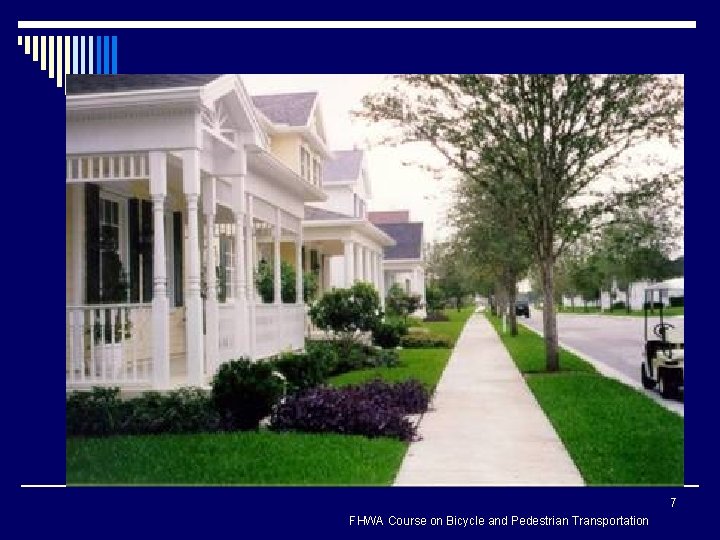
Why Consider Pedestrians 4 FHWA Course on Bicycle and Pedestrian Transportation
5 FHWA Course on Bicycle and Pedestrian Transportation
6 FHWA Course on Bicycle and Pedestrian Transportation
7 FHWA Course on Bicycle and Pedestrian Transportation
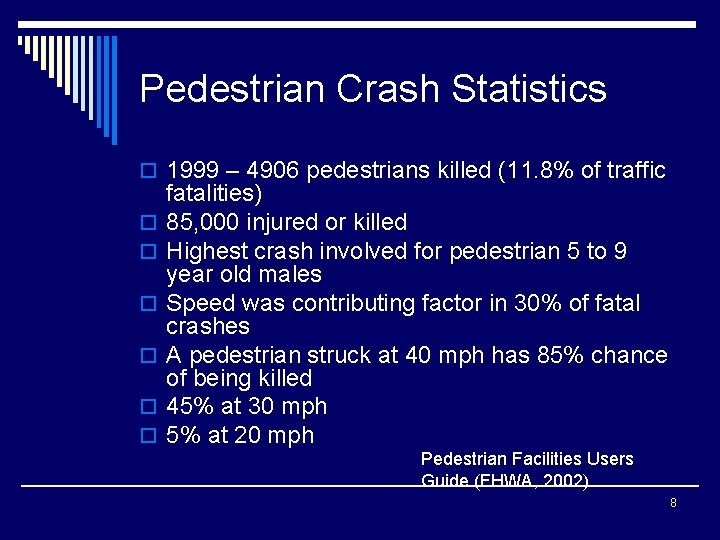
Pedestrian Crash Statistics o 1999 – 4906 pedestrians killed (11. 8% of traffic o o o fatalities) 85, 000 injured or killed Highest crash involved for pedestrian 5 to 9 year old males Speed was contributing factor in 30% of fatal crashes A pedestrian struck at 40 mph has 85% chance of being killed 45% at 30 mph 5% at 20 mph Pedestrian Facilities Users Guide (FHWA, 2002) 8
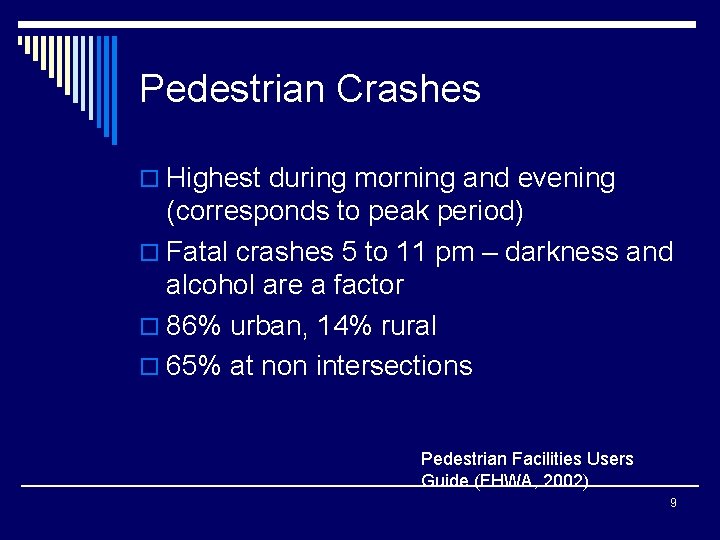
Pedestrian Crashes o Highest during morning and evening (corresponds to peak period) o Fatal crashes 5 to 11 pm – darkness and alcohol are a factor o 86% urban, 14% rural o 65% at non intersections Pedestrian Facilities Users Guide (FHWA, 2002) 9
ADA o All new construction or retro fit projects must include curb ramps that comply with ADA requirements o Should review existing street system to identify barriers Pedestrian Facilities Users Guide (FHWA, 2002) 10
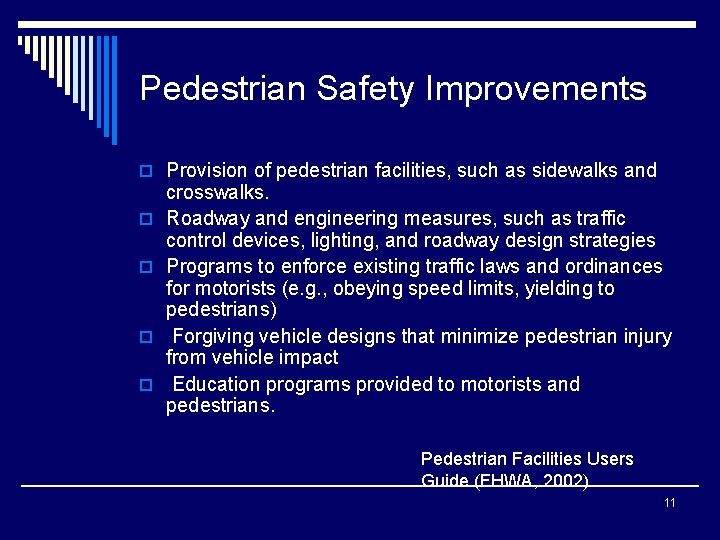
Pedestrian Safety Improvements o Provision of pedestrian facilities, such as sidewalks and o o crosswalks. Roadway and engineering measures, such as traffic control devices, lighting, and roadway design strategies Programs to enforce existing traffic laws and ordinances for motorists (e. g. , obeying speed limits, yielding to pedestrians) Forgiving vehicle designs that minimize pedestrian injury from vehicle impact Education programs provided to motorists and pedestrians. Pedestrian Facilities Users Guide (FHWA, 2002) 11
Sidewalk Design 12
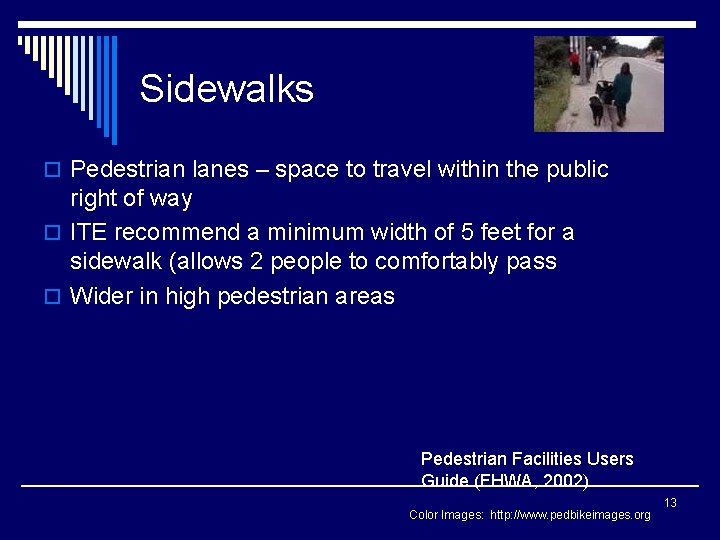
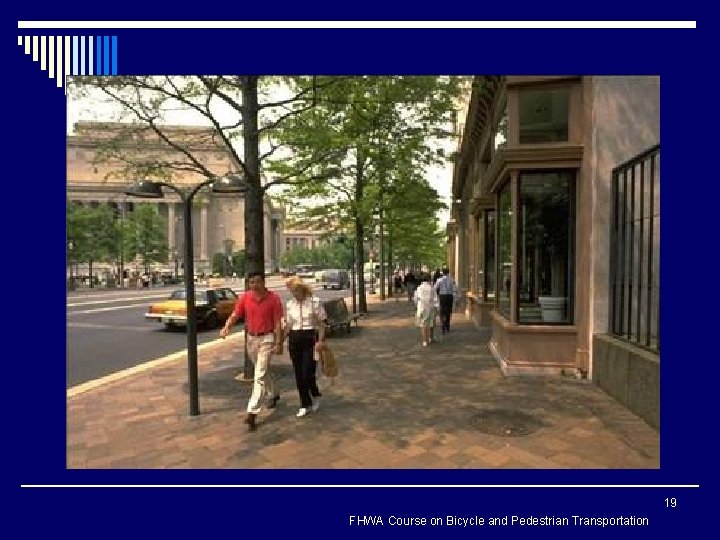
Sidewalks o Pedestrian lanes – space to travel within the public right of way o ITE recommend a minimum width of 5 feet for a sidewalk (allows 2 people to comfortably pass o Wider in high pedestrian areas Pedestrian Facilities Users Guide (FHWA, 2002) Color Images: http: //www. pedbikeimages. org 13
Sidewalk Design o Minimum width: 5’ recommended by AASHTO o Minimum clear path of travel: 36” o Desired running slope: no more than 5% o Maximum grade of a ramp: 8. 3% o Minimum cross slope: 2% o Firm, smooth, slip resistant surfaces References: AASHTO Policy on Geometric Design of Highways and Streets, Americans with Disabilities Act Accessibility Guidelines FHWA Course on Bicycle and Pedestrian Transportation 14
Sidewalks o Grade should be <= 5% o Also depends on roadway alignment o Maximum cross-slope is 2% Pedestrian Facilities Users Guide (FHWA, 2002) 15
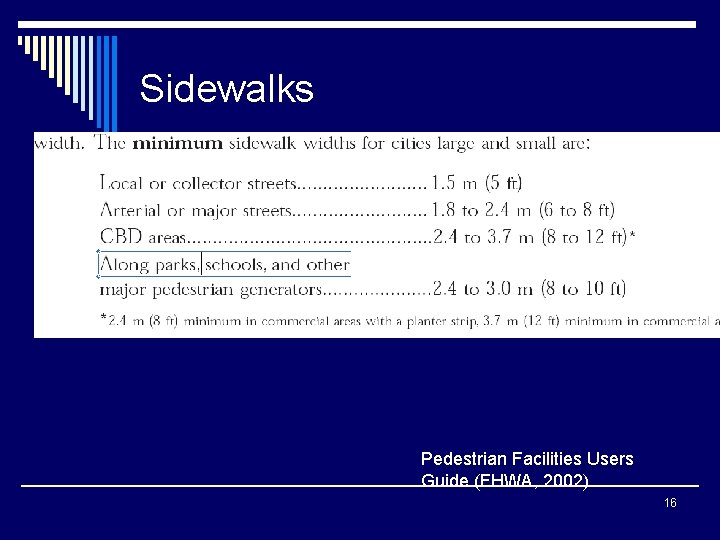
Sidewalks Pedestrian Facilities Users Guide (FHWA, 2002) 16
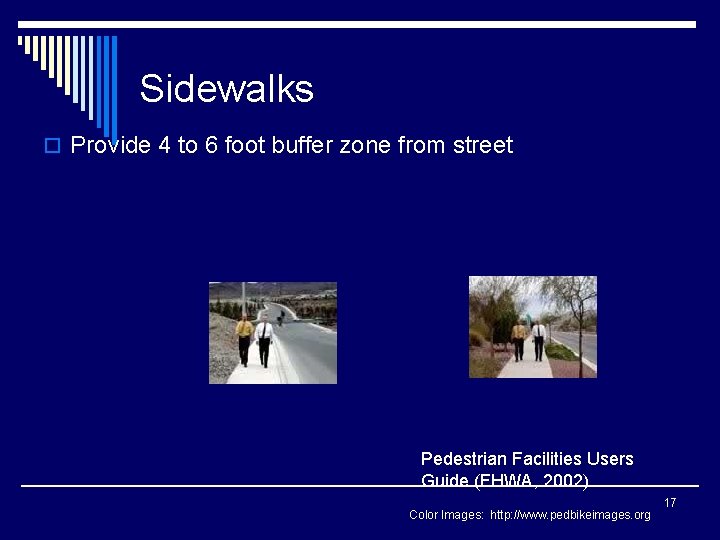
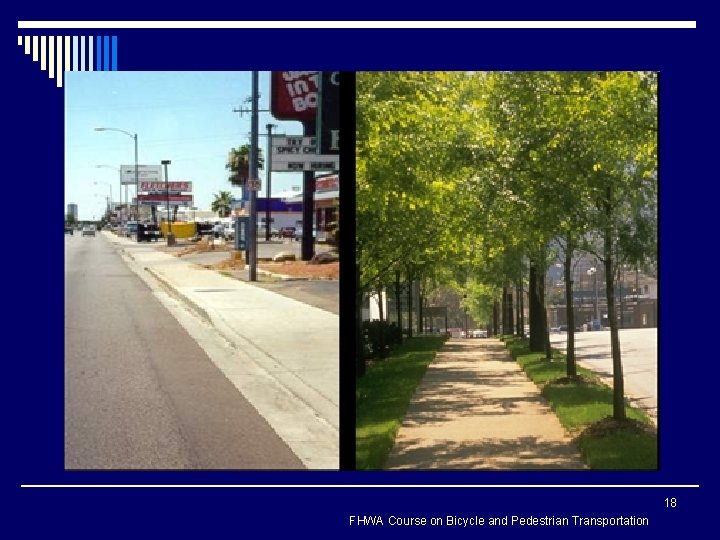
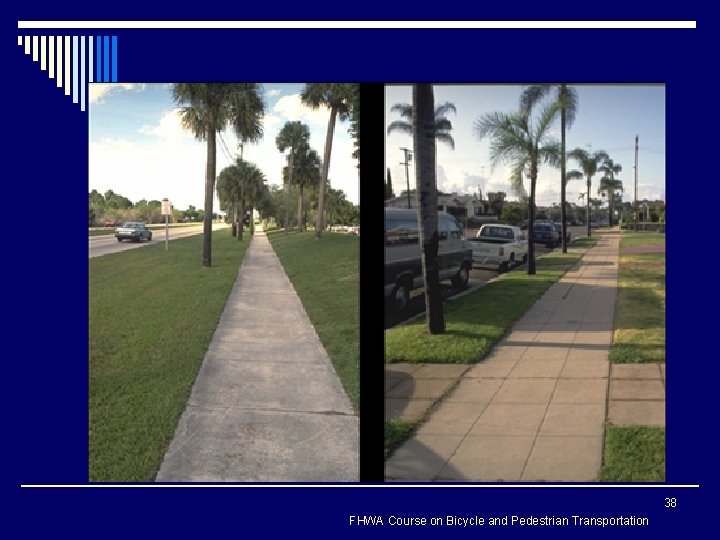
Sidewalks o Provide 4 to 6 foot buffer zone from street Pedestrian Facilities Users Guide (FHWA, 2002) Color Images: http: //www. pedbikeimages. org 17
18 FHWA Course on Bicycle and Pedestrian Transportation
19 FHWA Course on Bicycle and Pedestrian Transportation
Crosswalk 20
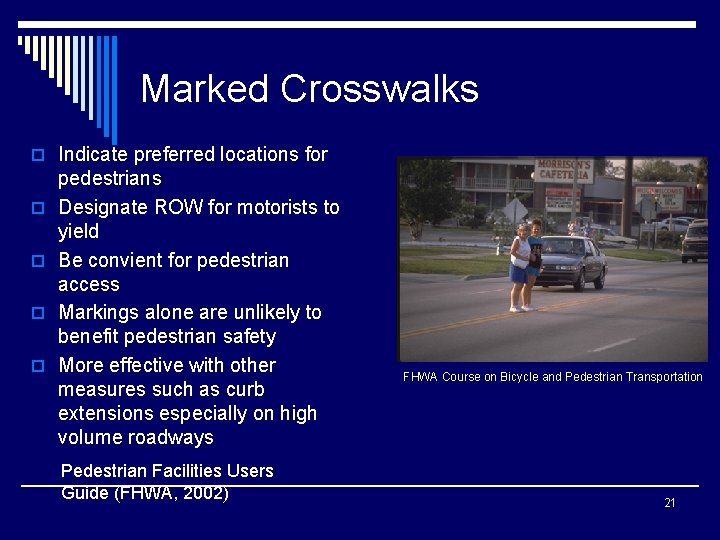
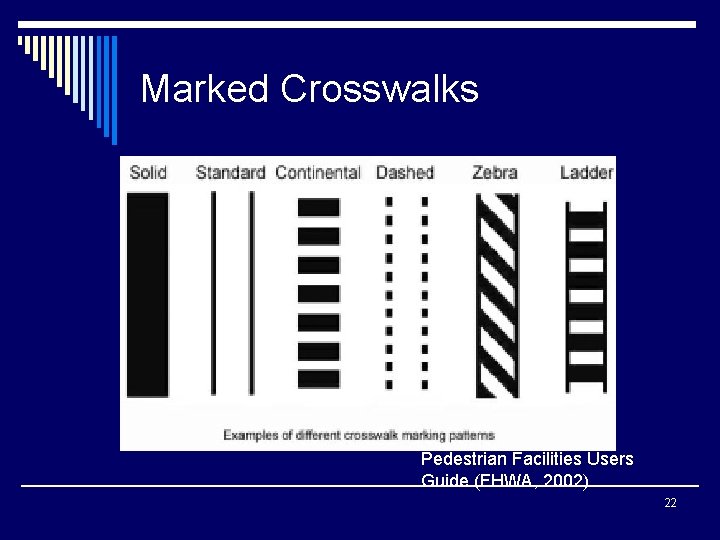
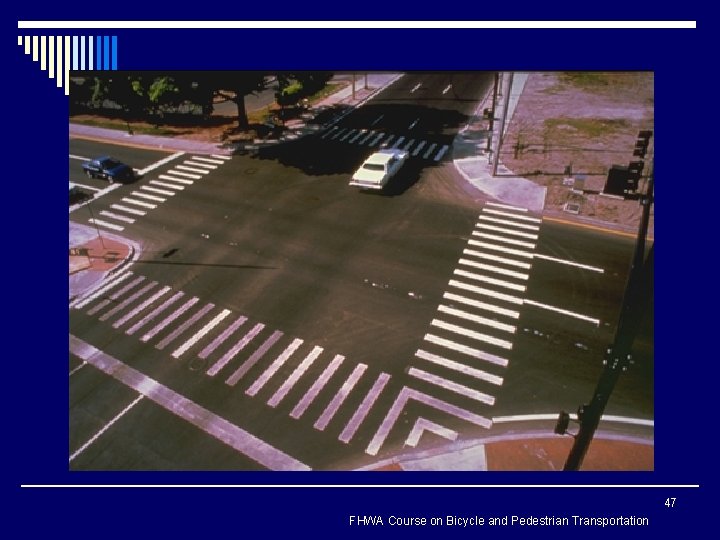
Marked Crosswalks o Indicate preferred locations for o o pedestrians Designate ROW for motorists to yield Be convient for pedestrian access Markings alone are unlikely to benefit pedestrian safety More effective with other measures such as curb extensions especially on high volume roadways Pedestrian Facilities Users Guide (FHWA, 2002) FHWA Course on Bicycle and Pedestrian Transportation 21
Marked Crosswalks Pedestrian Facilities Users Guide (FHWA, 2002) 22
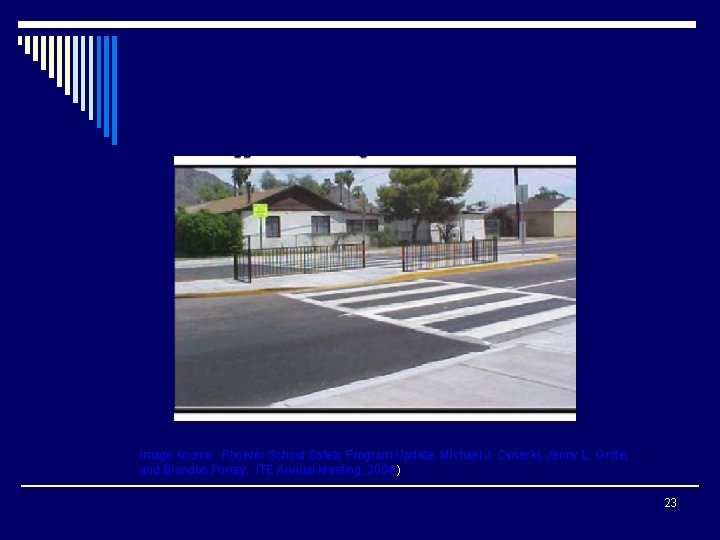
Image source: Phoenix School Safety Program Update, Michael J. Cynecki, Jenny L. Grote, and Brandon Forrey. ITE Annual Meeting, 2004. ) 23
Marked Crosswalks o Should not be used: n n n Speed limit > 40 mph 4 or more lane roadway with no median or crossing island when AADT > 12, 000 4 or more lane roadway with raised median or crossing island if AADT > 15, 000 Pedestrian Facilities Users Guide (FHWA, 2002) 24
Underpasses/Overpasses 25
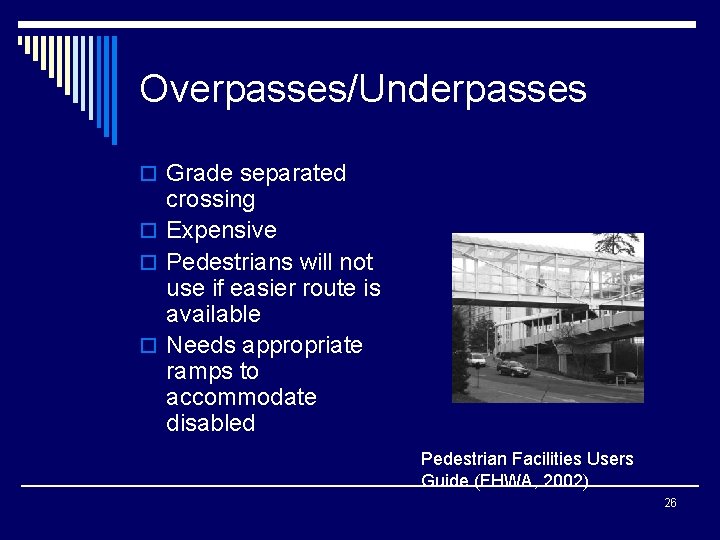
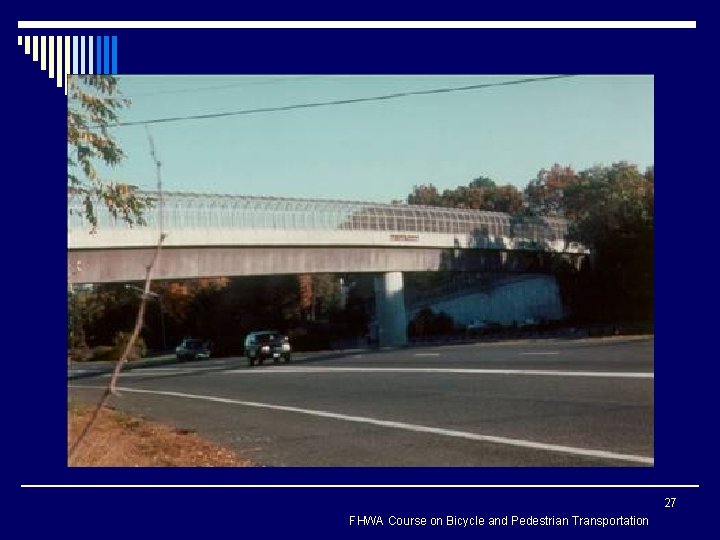
Overpasses/Underpasses o Grade separated crossing o Expensive o Pedestrians will not use if easier route is available o Needs appropriate ramps to accommodate disabled Pedestrian Facilities Users Guide (FHWA, 2002) 26
27 FHWA Course on Bicycle and Pedestrian Transportation
Driveways 28
Driveways Improvement o Problematic n n n Excessively wide or sloped driveways Large turning radii Multiple driveways Driveways not well defined Non level sidewalks Pedestrian Facilities Users Guide (FHWA, 2002) 29
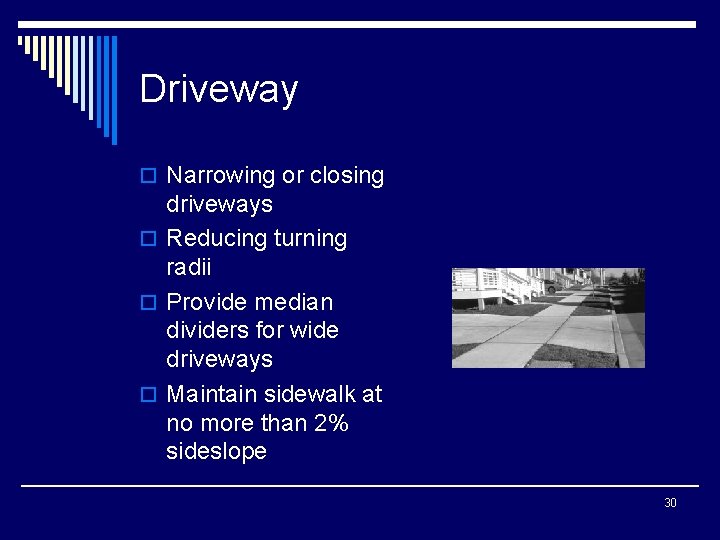
Driveway o Narrowing or closing driveways o Reducing turning radii o Provide median dividers for wide driveways o Maintain sidewalk at no more than 2% sideslope 30
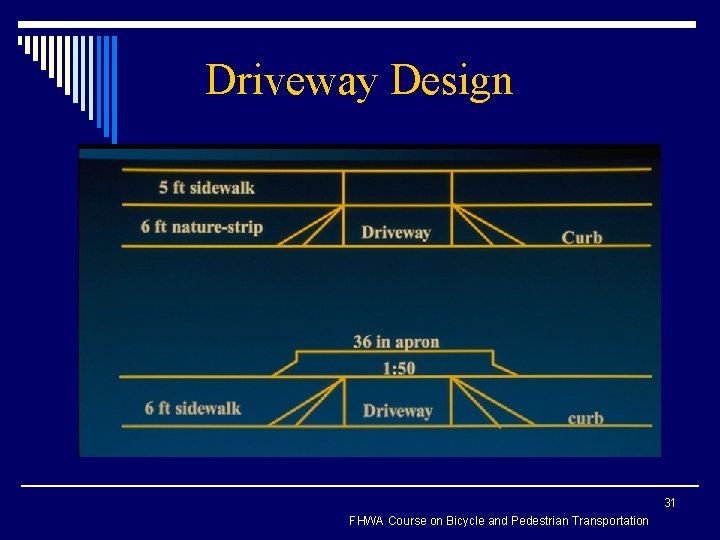
Driveway Design 31 FHWA Course on Bicycle and Pedestrian Transportation
Raised Median 32
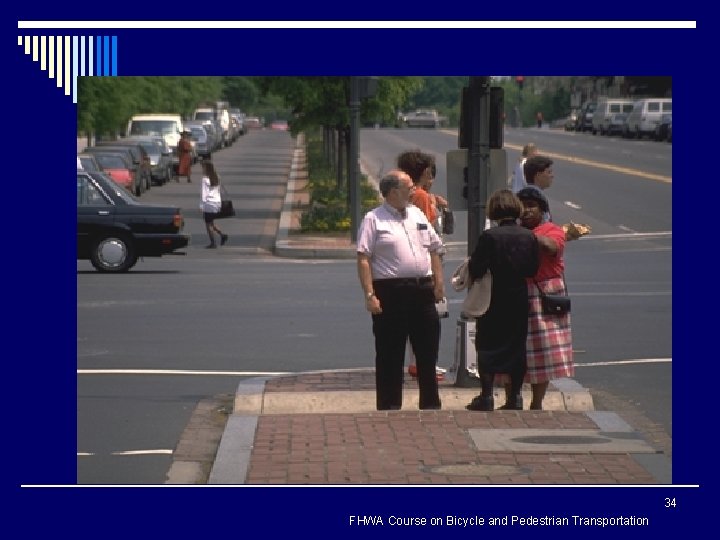
Raised Medians o Barriers serve as place of refuge midblock o With landscaping can calm traffic o Replace center turn lanes and pedestrian conflicts Pedestrian Facilities Users Guide (FHWA, 2002) 33
34 FHWA Course on Bicycle and Pedestrian Transportation
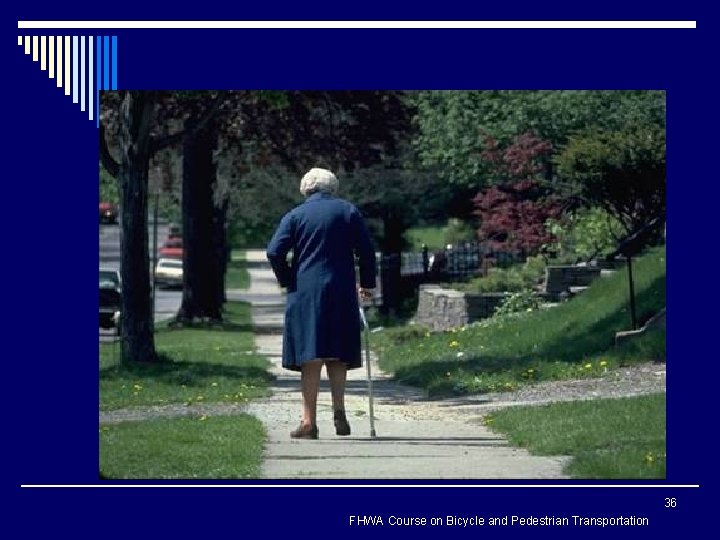
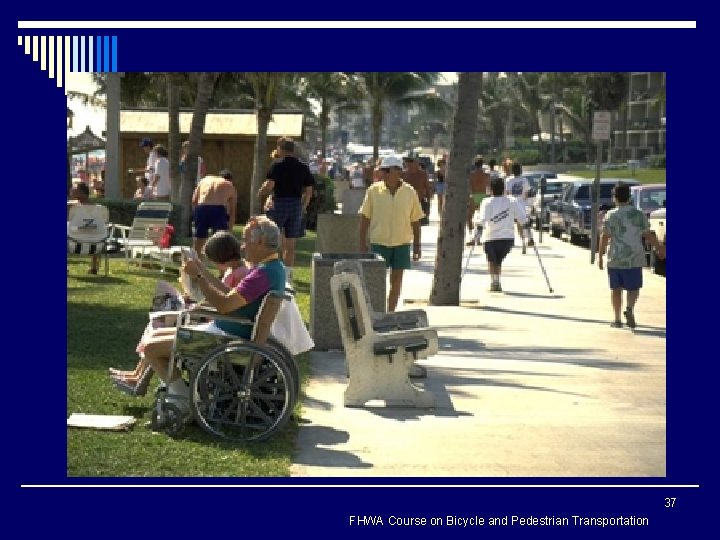
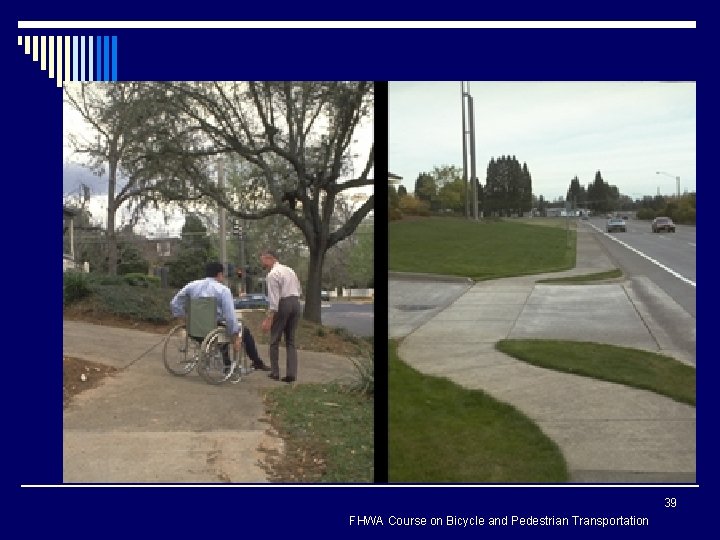
Accommodating Pedestrians with Disabilities 35
36 FHWA Course on Bicycle and Pedestrian Transportation
37 FHWA Course on Bicycle and Pedestrian Transportation
38 FHWA Course on Bicycle and Pedestrian Transportation
39 FHWA Course on Bicycle and Pedestrian Transportation
Intersection Design for Pedestrians 40
41 FHWA Course on Bicycle and Pedestrian Transportation
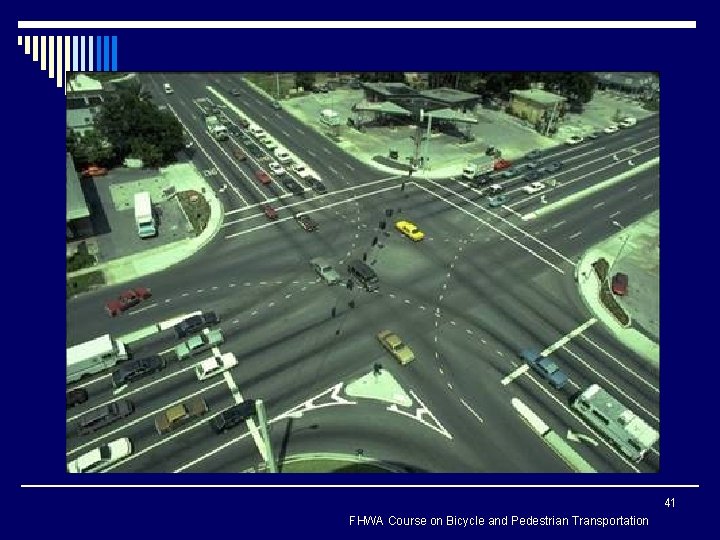
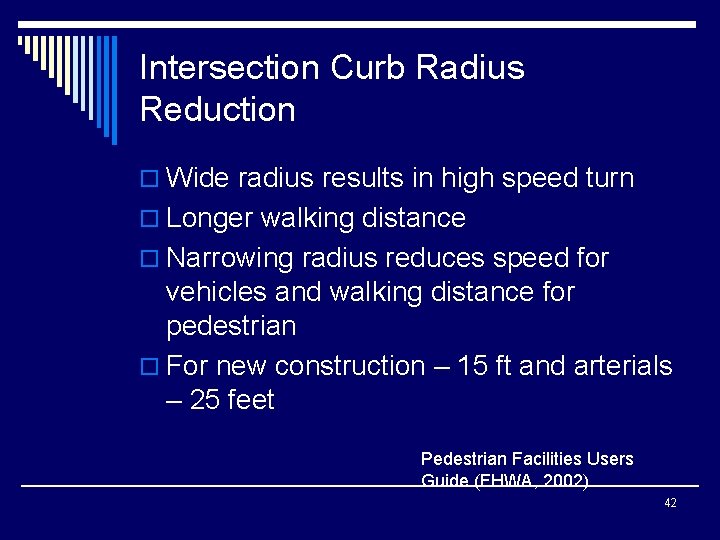
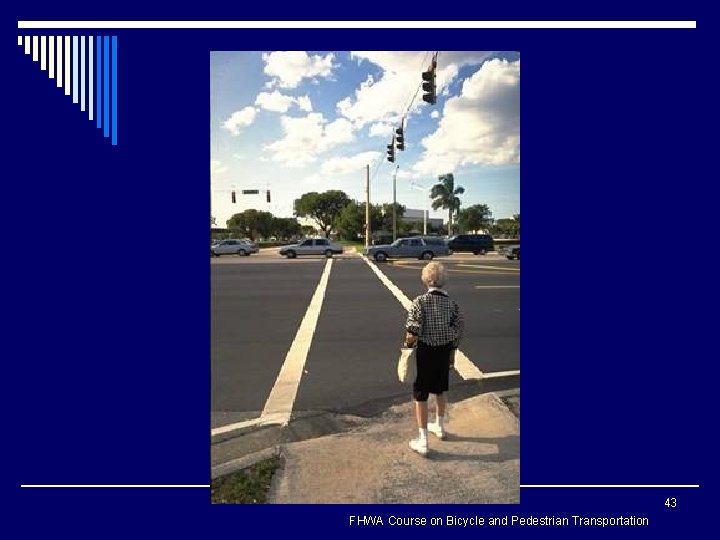
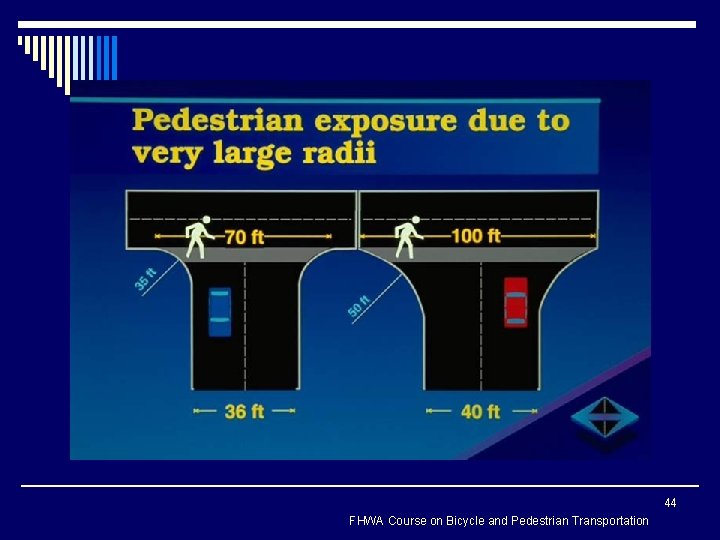
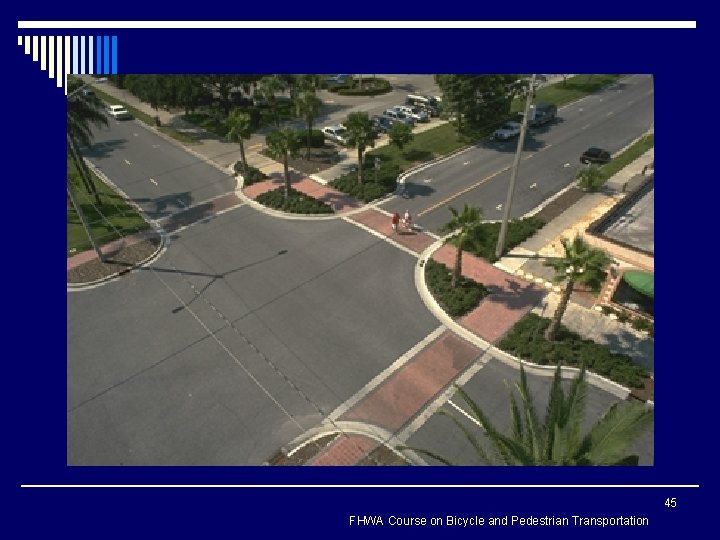
Intersection Curb Radius Reduction o Wide radius results in high speed turn o Longer walking distance o Narrowing radius reduces speed for vehicles and walking distance for pedestrian o For new construction – 15 ft and arterials – 25 feet Pedestrian Facilities Users Guide (FHWA, 2002) 42
43 FHWA Course on Bicycle and Pedestrian Transportation
44 FHWA Course on Bicycle and Pedestrian Transportation
45 FHWA Course on Bicycle and Pedestrian Transportation
46 FHWA Course on Bicycle and Pedestrian Transportation
47 FHWA Course on Bicycle and Pedestrian Transportation
48 FHWA Course on Bicycle and Pedestrian Transportation
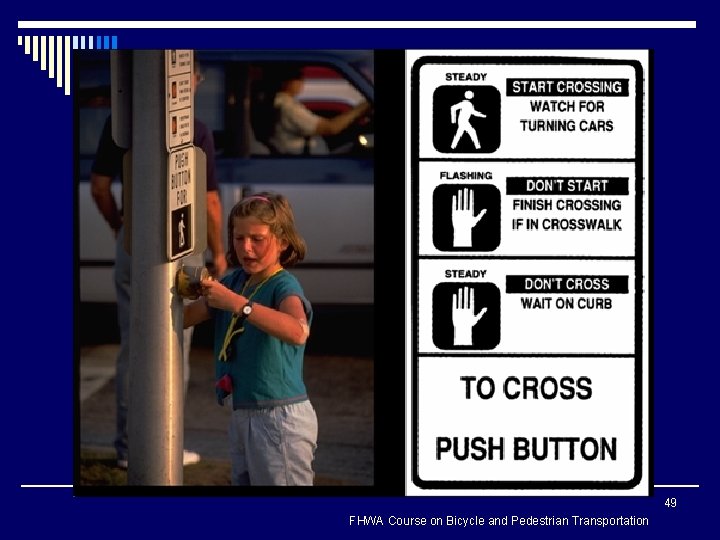
49 FHWA Course on Bicycle and Pedestrian Transportation
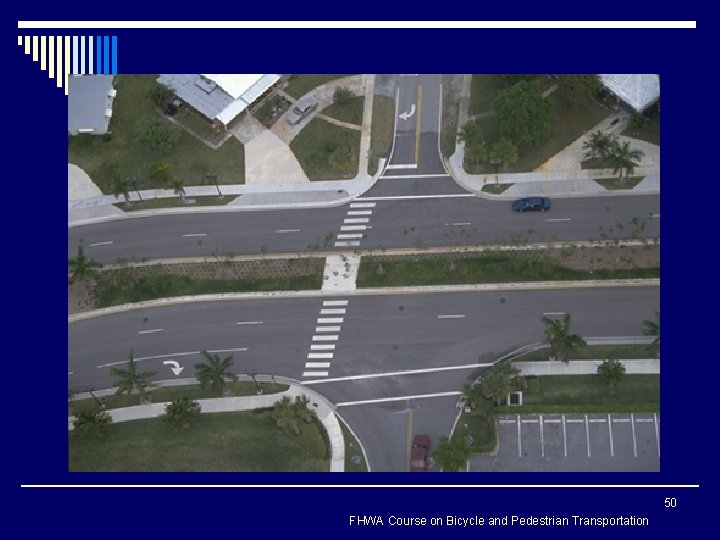
50 FHWA Course on Bicycle and Pedestrian Transportation
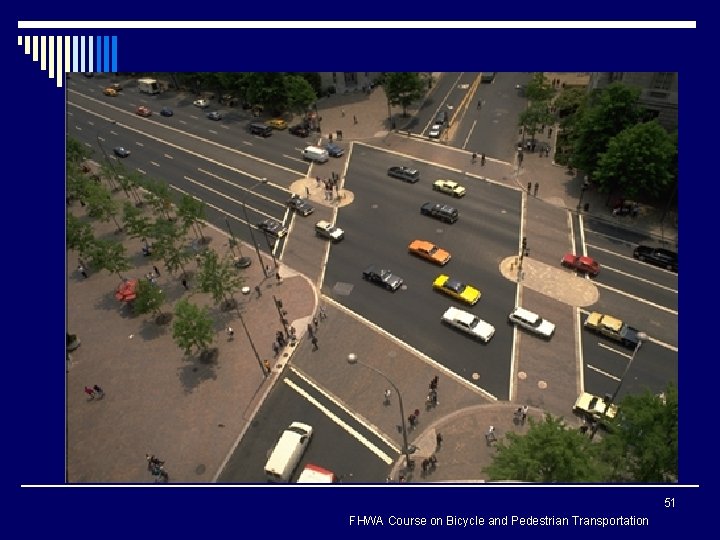
51 FHWA Course on Bicycle and Pedestrian Transportation
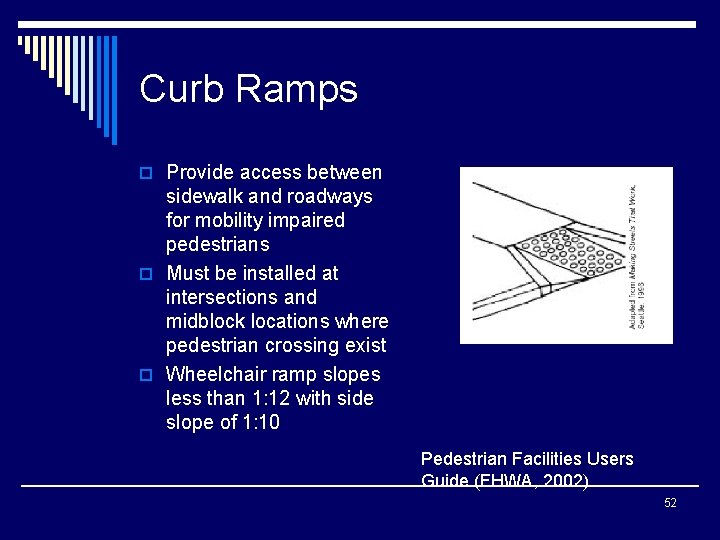
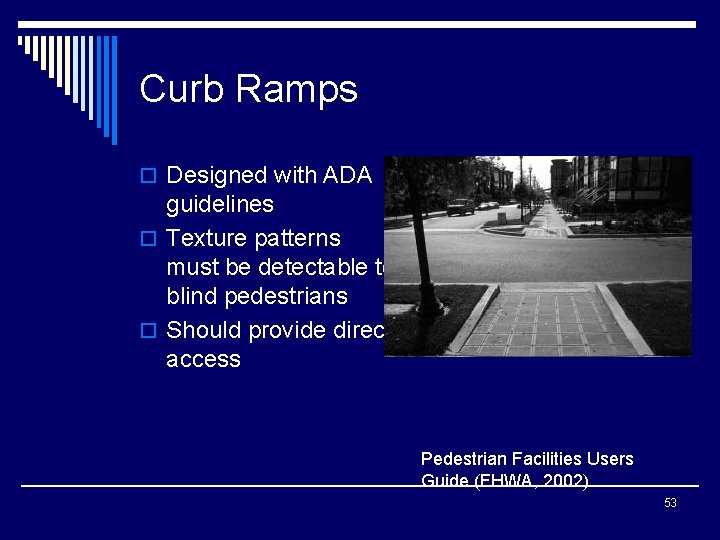
Curb Ramps o Provide access between sidewalk and roadways for mobility impaired pedestrians o Must be installed at intersections and midblock locations where pedestrian crossing exist o Wheelchair ramp slopes less than 1: 12 with side slope of 1: 10 Pedestrian Facilities Users Guide (FHWA, 2002) 52
Curb Ramps o Designed with ADA guidelines o Texture patterns must be detectable to blind pedestrians o Should provide direct access Pedestrian Facilities Users Guide (FHWA, 2002) 53
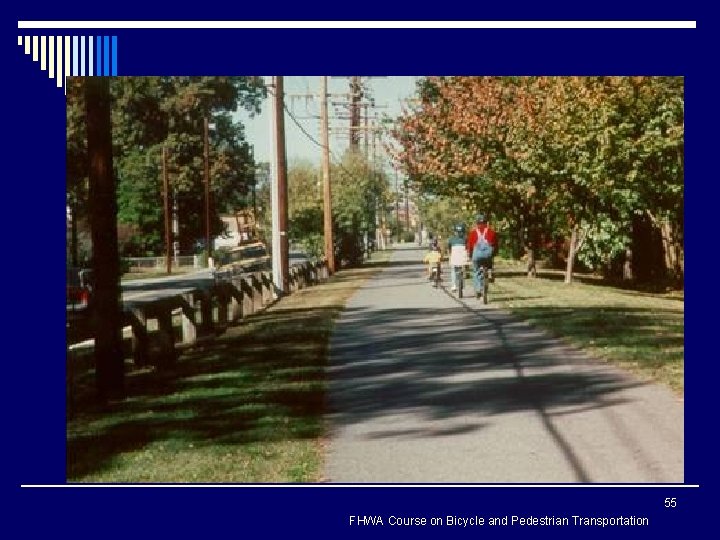
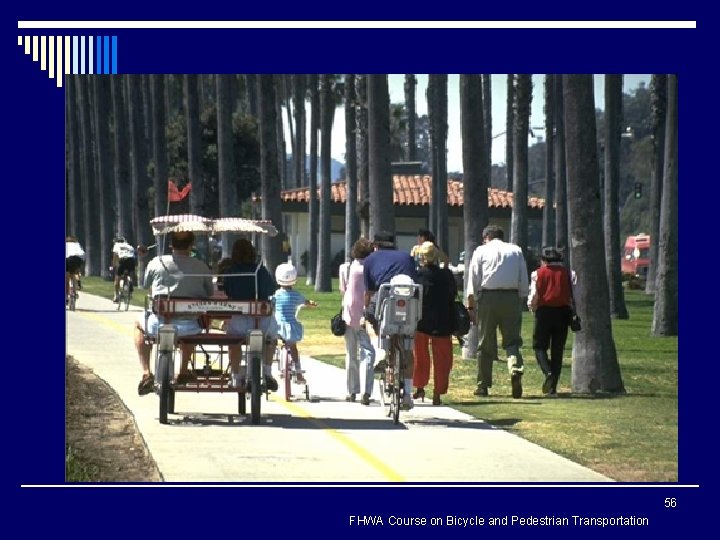
Shared Use Path Design (also termed Multi-Use Trails and Bike Paths) 54
55 FHWA Course on Bicycle and Pedestrian Transportation
56 FHWA Course on Bicycle and Pedestrian Transportation
Other 57
58 FHWA Course on Bicycle and Pedestrian Transportation
59
60
61
Pedestrian Facility Design Resources o o o o Design and Safety of Pedestrian Facilities, A Recommended Practice, 1998. Institute of Transportation Engineers, 525 School Street, S. W, Suite 410, Washington, DC 20024 -2729, Phone: (202) 554 -8050. Pedestrian Compatible Roadways-Planning and Design Guidelines, 1995. Bicycle / Pedestrian Transportation Master Plan, Bicycle and Pedestrian Advocate, New Jersey Department of Transportation, 1035 Parkway Avenue, Trenton, NJ 08625, Phone: (609) 530 -4578. Improving Pedestrian Access to Transit: An Advocacy Handbook, 1998. Federal Transit Administration / Walk. Boston. NTIS, 5285 Port Royal Road, Springfield, VA 22161. Planning and Implementing Pedestrian Facilities in Suburban and Developing Rural Areas, Report No. 294 A, Transportation Research Board, Box 289, Washington, DC 20055, Phone: (202) 334 -3214. Pedestrian Facilities Guidebook, 1997. Washington State Department of Transportation, Bicycle and Pedestrian Program, P. O. Box 47393, Olympia, WA 98504. Portland Pedestrian Design Guide, 1998. Portland Pedestrian Program, 1120 SW Fifth Ave, Room 802; Portland, OR 97210. (503) 823 -7004. * Implementing Pedestrian Improvements at the Local Level, 1999. FHWA, HSR 20, 6300 Georgetown Pike, Mc. Lean, VA. * AASHTO Guide to the Development of Pedestrian Facilities, 2000. AASHTO. (currently under discussion) 62 FHWA Course on Bicycle and Pedestrian Transportation
Bicycle and Pedestrian Design Resources o o o o o Oregon Bicycle and Pedestrian Plan, 1995. Oregon Department of Transportation, Bicycle and Pedestrian Program, Room 210, Transportation Building, Salem, OR 97310, Phone: (503) 986 -3555 Improving Conditions for Bicyclists and Pedestrians, A Best Practices Report, 1998. FHWA, HEP 10, 400 Seventh Street SW, Washington, DC 20590. Traffic Calming Design Resources Traffic Calming: State of the Practice. 1999. Institute of Transportation Engineers, 525 School Street, SW, Suite 410; Washington, DC 20024. Florida Department of Transportation's Roundabout Guide. Florida Department of Transportation, 605 Suwannee St. , MS-82, Tallahassee, FL 23299 -0450. National Bicycling and Walking Study. Case Study # 19, Traffic Calming and Auto-Restricted Zones and other Traffic Management Techniques-Their Effects on Bicycling and Pedestrians, Federal Highway Administration (FHWA). Traffic Calming (1995), American Planning Association, 122 South Michigan Avenue, Chicago, IL 60603 Traditional Neighborhood Development Street Design Guidelines, 1997. Proposed Recommended Practice, Institute of Transportation Engineers, 525 School Street, SW, Suite 410; Washington, DC 20024. Making Streets that Work, City of Seattle, 600 Fourth Ave. , 12 th Floor, Seattle, WA 981041873, Phone: (206) 684 -4000, Fax: (206) 684 -5360. Traffic Control Manual for In-Street Work, 1994. Seattle Engineering Department, City of Seattle, 600 4 th Avenue, Seattle, WA 98104 -6967, Phone: (206) 684 -5108. 63 FHWA Course on Bicycle and Pedestrian Transportation
Trail Design Resources o Trails for the 21 st Century, 1993. Rails to Trails Conservancy, 1100 17 th Street NW, 10 th Floor, Washington DC 20036. (202) 331 -9696. o Greenways: A Guide to Planning, Design, and Development, 1993. The Conservation Fund. Island Press, 1718 Connecticut Ave NW, Suite 300; Washington, DC 20009. o Trail Intersection Design Guidelines, 1996. Florida Department of Transportation, 605 Suwannee St. , MS-82, Tallahassee, FL 232990450. 64 FHWA Course on Bicycle and Pedestrian Transportation
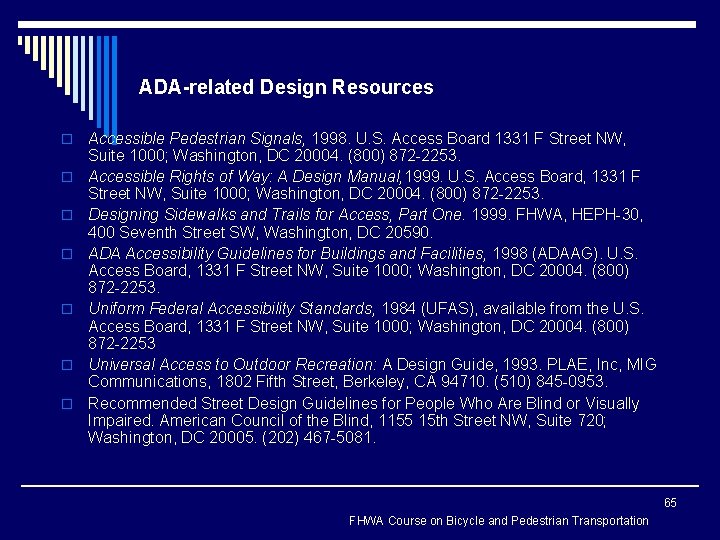
ADA-related Design Resources o o o o Accessible Pedestrian Signals, 1998. U. S. Access Board 1331 F Street NW, Suite 1000; Washington, DC 20004. (800) 872 -2253. Accessible Rights of Way: A Design Manual, 1999. U. S. Access Board, 1331 F Street NW, Suite 1000; Washington, DC 20004. (800) 872 -2253. Designing Sidewalks and Trails for Access, Part One. 1999. FHWA, HEPH-30, 400 Seventh Street SW, Washington, DC 20590. ADA Accessibility Guidelines for Buildings and Facilities, 1998 (ADAAG). U. S. Access Board, 1331 F Street NW, Suite 1000; Washington, DC 20004. (800) 872 -2253. Uniform Federal Accessibility Standards, 1984 (UFAS), available from the U. S. Access Board, 1331 F Street NW, Suite 1000; Washington, DC 20004. (800) 872 -2253 Universal Access to Outdoor Recreation: A Design Guide, 1993. PLAE, Inc, MIG Communications, 1802 Fifth Street, Berkeley, CA 94710. (510) 845 -0953. Recommended Street Design Guidelines for People Who Are Blind or Visually Impaired. American Council of the Blind, 1155 15 th Street NW, Suite 720; Washington, DC 20005. (202) 467 -5081. 65 FHWA Course on Bicycle and Pedestrian Transportation