
Pedagogic design for active learning Workshop Diana Laurillard


- Slides: 34
Pedagogic design for active learning Workshop Diana Laurillard, IOE
OUTLINE Principles of learning and assessment Thinking about active learning Conventional and digital technologies Formative assessment Challenging a learning design Modelling changes in learning design
OUTLINE Principles of learning and assessment Thinking about active learning Conventional and digital technologies Formative assessment Challenging a learning design Modelling changes in learning design
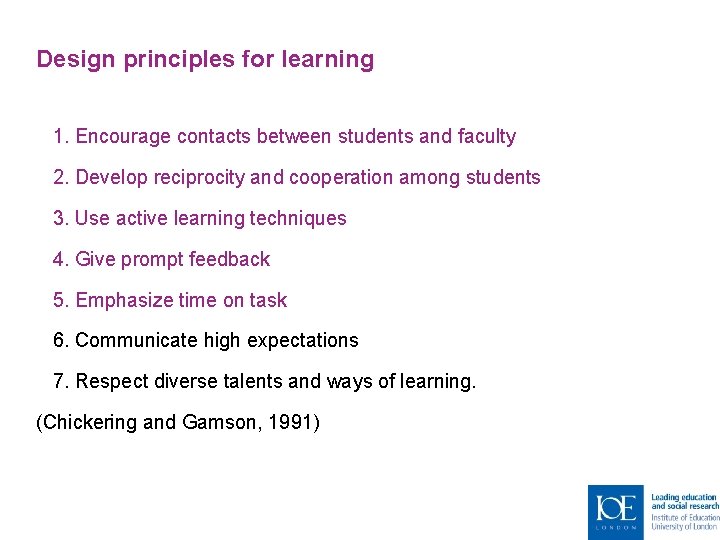
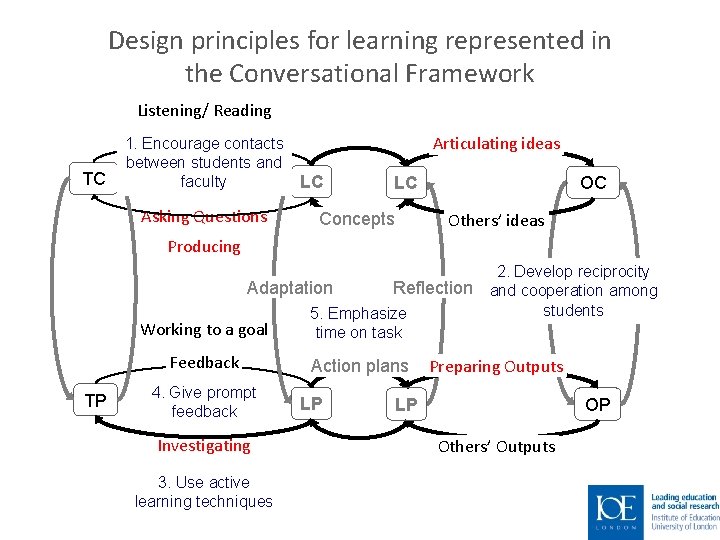
Design principles for learning 1. Encourage contacts between students and faculty 2. Develop reciprocity and cooperation among students 3. Use active learning techniques 4. Give prompt feedback 5. Emphasize time on task 6. Communicate high expectations 7. Respect diverse talents and ways of learning. (Chickering and Gamson, 1991)
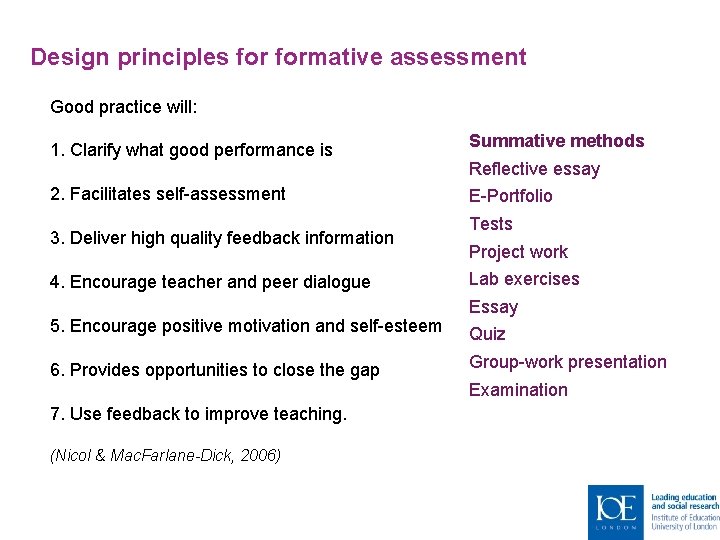
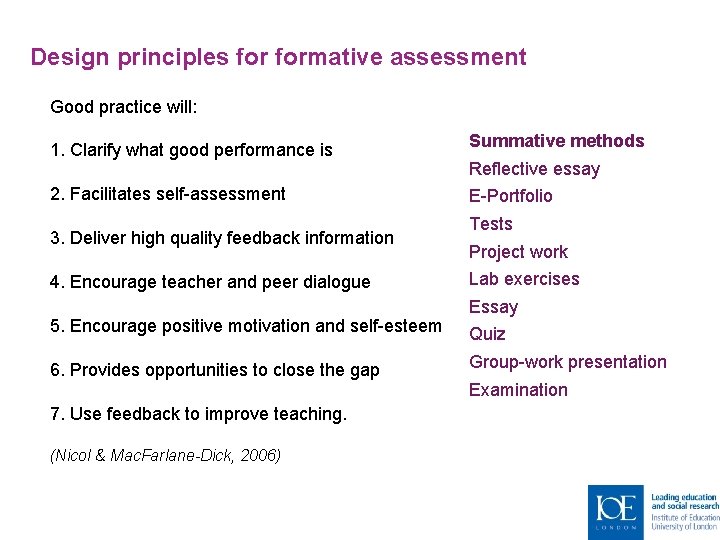
Design principles formative assessment Good practice will: 1. Clarify what good performance is 2. Facilitates self-assessment 3. Deliver high quality feedback information 4. Encourage teacher and peer dialogue 5. Encourage positive motivation and self-esteem 6. Provides opportunities to close the gap 7. Use feedback to improve teaching. (Nicol & Mac. Farlane-Dick, 2006) Summative methods Reflective essay E-Portfolio Tests Project work Lab exercises Essay Quiz Group-work presentation Examination
OUTLINE Principles of learning and assessment Thinking about active learning Conventional and digital technologies Formative assessment Challenging a learning design Modelling changes in learning design
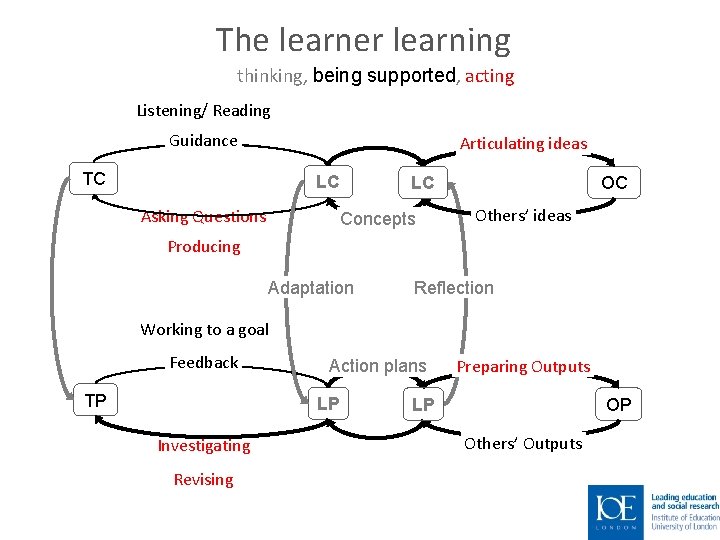
The learner learning thinking, being supported, acting Listening/ Reading Guidance TC Articulating ideas Tuition LC Asking Questions LC Concepts Discussion OC Others’ ideas Producing Adaptation Reflection Working to a goal Feedback TP Practice Investigating Revising Action plans LP LP Preparing Outputs Collaboration Others’ Outputs OP
Design principles for learning represented in the Conversational Framework Listening/ Reading TC Guidance 1. Encourage contacts between students and faculty LC Asking Questions Articulating ideas OC LC Concepts Others’ ideas Producing Adaptation TP Reflection Working to a goal 5. Emphasize time on task Feedback Action plans 4. Give prompt feedback Investigating 3. Revising Use active learning techniques LP 2. Develop reciprocity and cooperation among students Preparing Outputs OP LP Others’ Outputs
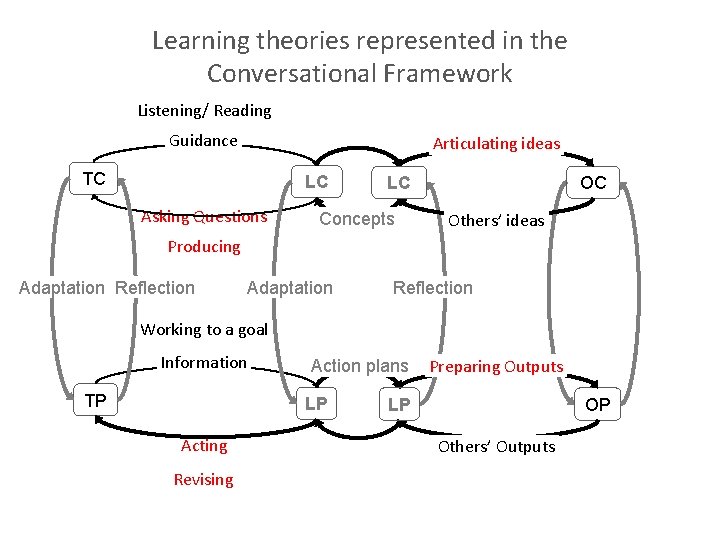
Learning theories represented in the Conversational Framework Listening/ Reading Guidance Articulating ideas TC LC Asking Questions OC LC Concepts Others’ ideas Producing Adaptation Reflection Working to a goal Information TP Action plans LP Acting Preparing Outputs OP LP Others’ Outputs Revising Social constructivism
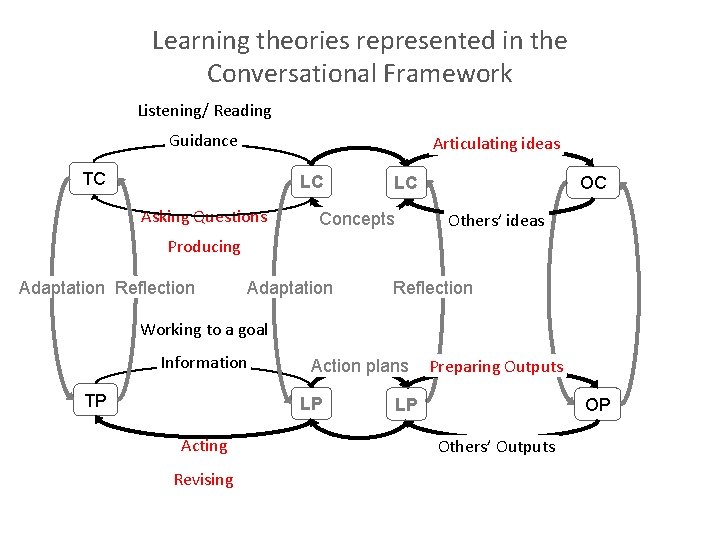
Learning theories represented in the Conversational Framework Listening/ Reading Guidance Articulating ideas TC LC Asking Questions OC LC Concepts Others’ ideas Producing Adaptation Reflection Working to a goal Information TP Action plans LP Acting Preparing Outputs OP LP Others’ Outputs Revising Instructivism
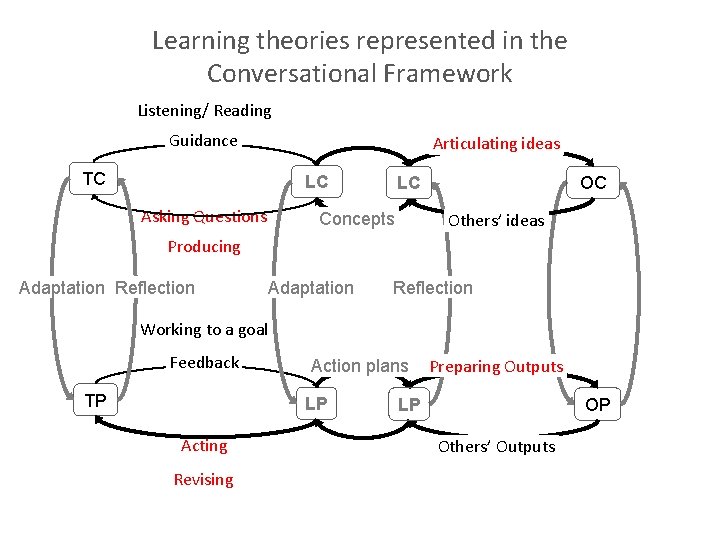
Learning theories represented in the Conversational Framework Listening/ Reading Guidance Articulating ideas TC LC Asking Questions OC LC Concepts Others’ ideas Producing Adaptation Reflection Working to a goal Feedback TP LP Acting Preparing Outputs Action plans OP LP Others’ Outputs Revising Situated learning
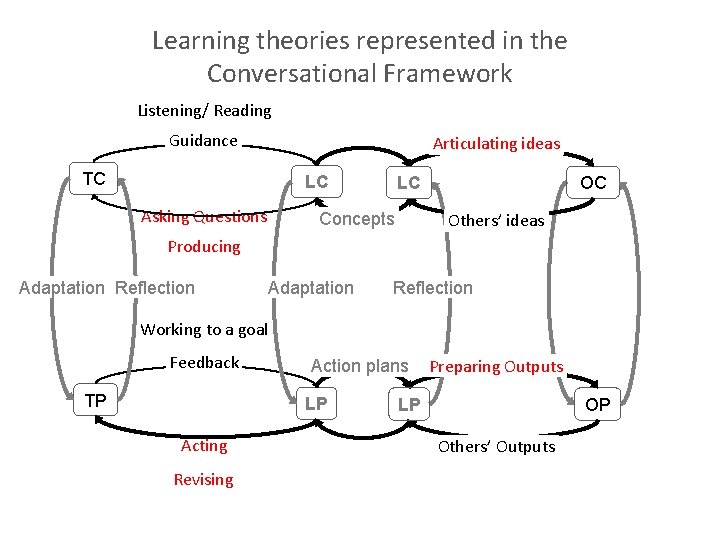
Learning theories represented in the Conversational Framework Listening/ Reading Guidance Articulating ideas TC LC Asking Questions OC LC Concepts Others’ ideas Producing Adaptation Reflection Working to a goal Feedback TP Action plans LP Acting Preparing Outputs OP LP Others’ Outputs Revising Constructionism
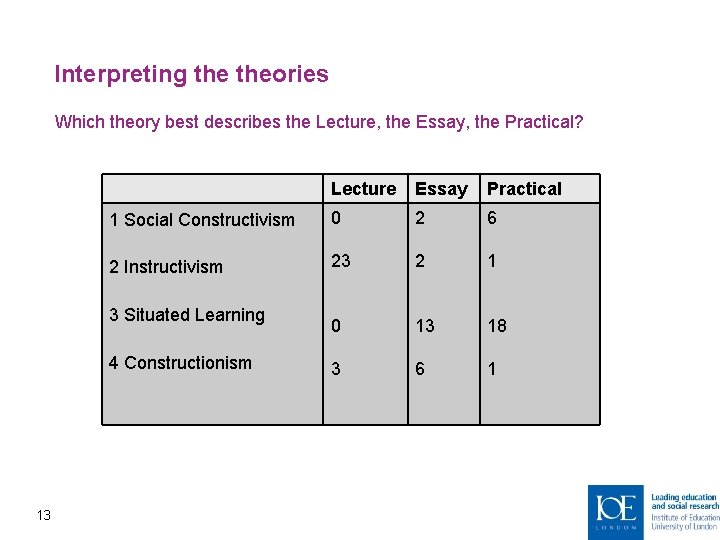
Interpreting theories Which theory best describes the Lecture, the Essay, the Practical? Lecture Essay Practical 1 Social Constructivism 0 2 6 2 Instructivism 23 2 1 0 13 18 3 6 1 3 Situated Learning 4 Constructionism 13
OUTLINE Principles of learning and assessment Thinking about active learning Conventional and digital technologies Formative assessment Challenging a learning design Modelling changes in learning design
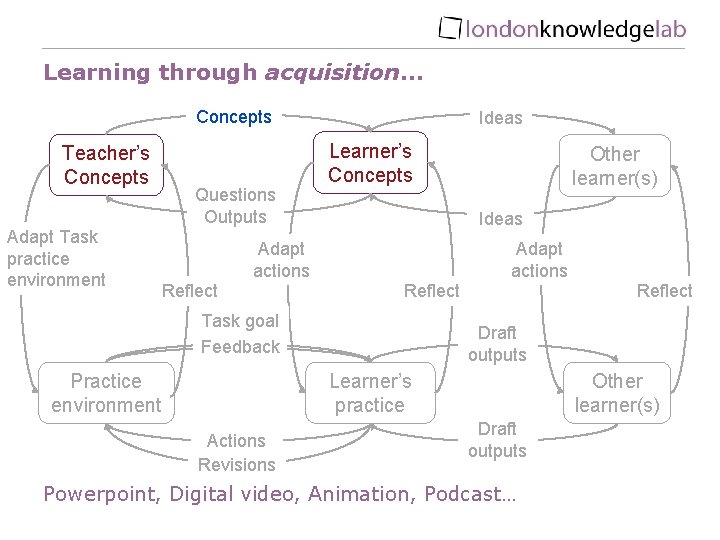
Learning through acquisition… Concepts Teacher’s Concepts Adapt Task practice environment Questions Outputs Ideas Learner’s Concepts Ideas Adapt actions Reflect Other learner(s) Adapt actions Reflect Task goal Feedback Reflect Draft outputs Learner’s practice Practice environment Actions Revisions Other learner(s) Draft outputs Powerpoint, Digital video, Animation, Podcast… Lecture, Presentation, Book, Educational television, Audio…
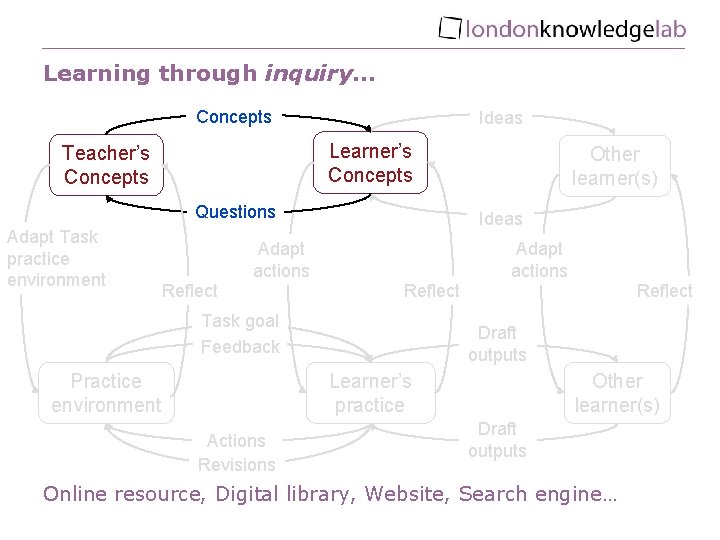
Learning through inquiry… Concepts Ideas Learner’s Concepts Teacher’s Concepts Questions Adapt Task practice environment Ideas Adapt actions Reflect Other learner(s) Adapt actions Reflect Task goal Feedback Reflect Draft outputs Learner’s practice Practice environment Actions Revisions Other learner(s) Draft outputs Libraries, Online resource, Catalogues, Digital Journals, library, Website, Resource Search banks…engine…
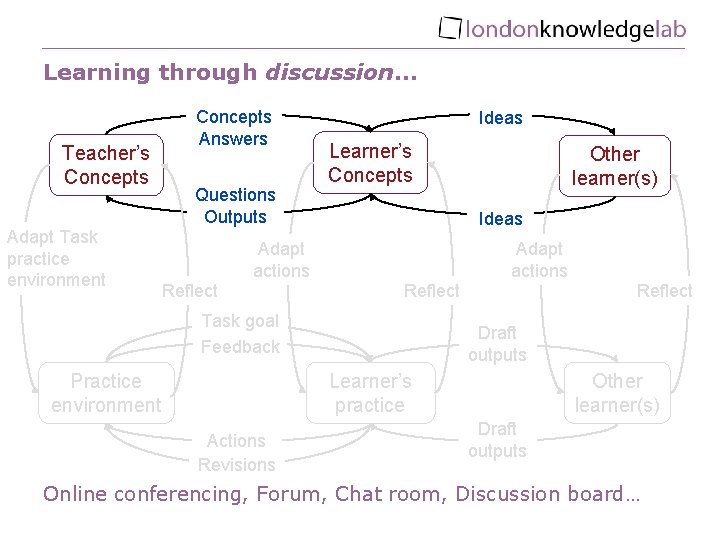
Learning through discussion… Teacher’s Concepts Adapt Task practice environment Concepts Answers Questions Outputs Ideas Learner’s Concepts Ideas Adapt actions Reflect Other learner(s) Adapt actions Reflect Task goal Feedback Reflect Draft outputs Learner’s practice Practice environment Actions Revisions Other learner(s) Draft outputs Tutorial, Online conferencing, Seminar, Class Forum, discussion, Chat room, Small. Discussion group discussion… board…
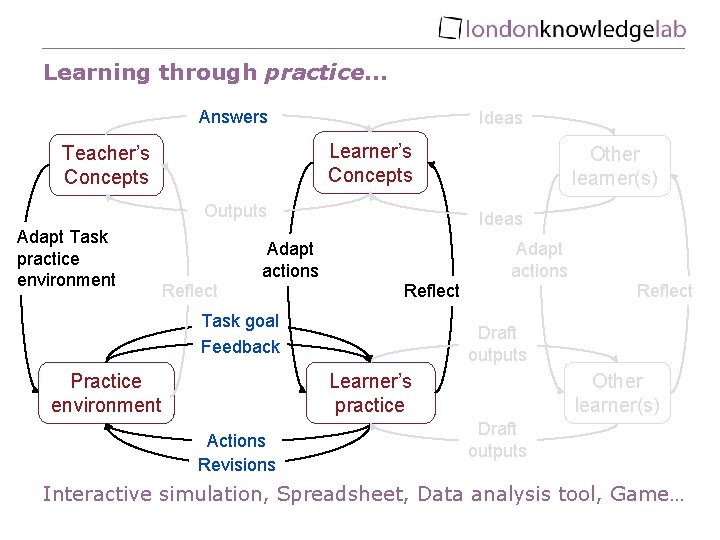
Learning through practice… Teacher’s Concepts Adapt Task practice environment Concepts Answers Questions Outputs Ideas Learner’s Concepts Ideas Adapt actions Reflect Other learner(s) Adapt actions Reflect Task goal Feedback Reflect Draft outputs Learner’s practice Practice environment Actions Revisions Other learner(s) Draft outputs Problem sheet, Interactive simulation, practice. Spreadsheet, exercises, project Data analysis work… tool, Game…
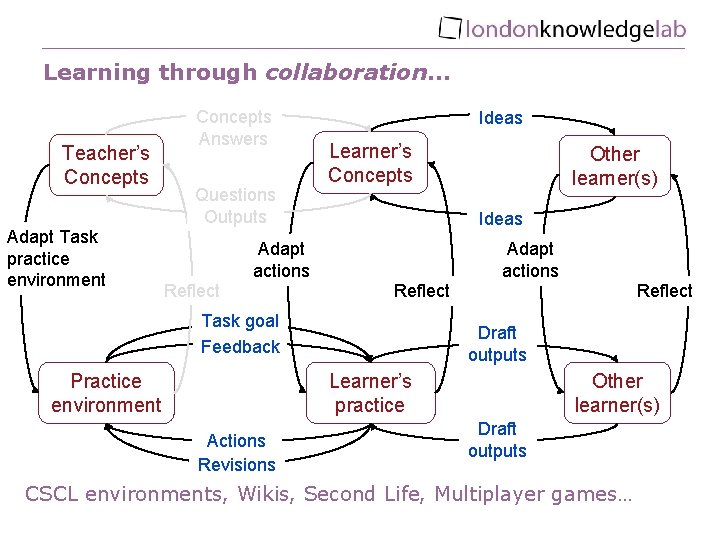
Learning through collaboration… Teacher’s Concepts Adapt Task practice environment Concepts Answers Questions Outputs Ideas Learner’s Concepts Ideas Adapt actions Reflect Other learner(s) Adapt actions Reflect Task goal Feedback Reflect Draft outputs Learner’s practice Practice environment Actions Revisions Other learner(s) Draft outputs CSCL Laboratory, environments, Small group Wikis, work, Second Fieldwork, Life, Multiplayer Workshop… games…
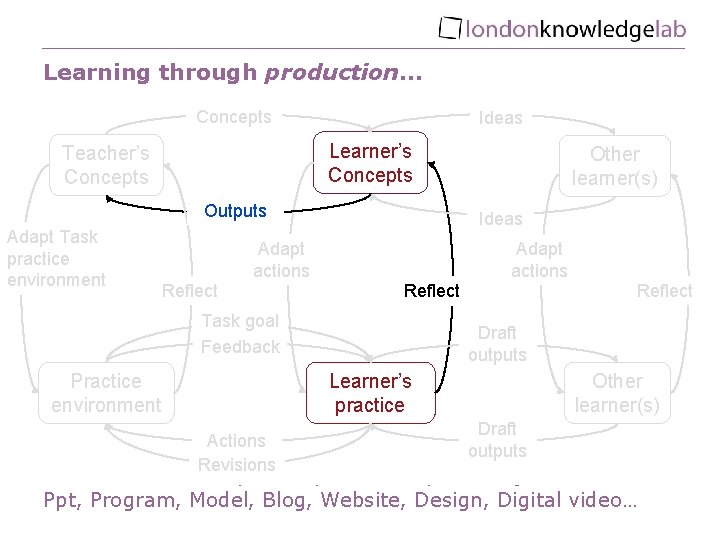
Learning through production… Concepts Ideas Learner’s Concepts Teacher’s Concepts Outputs Adapt Task practice environment Ideas Adapt actions Reflect Other learner(s) Adapt actions Reflect Task goal Feedback Reflect Draft outputs Learner’s practice Practice environment Actions Revisions Other learner(s) Draft outputs Essay, program, solution, product, performance… Ppt, Program, Model, Blog, design, Website, Design, Digital video…
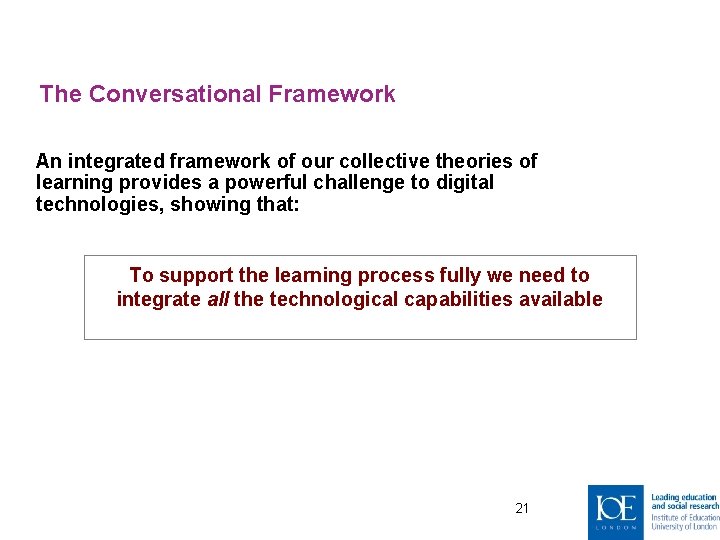
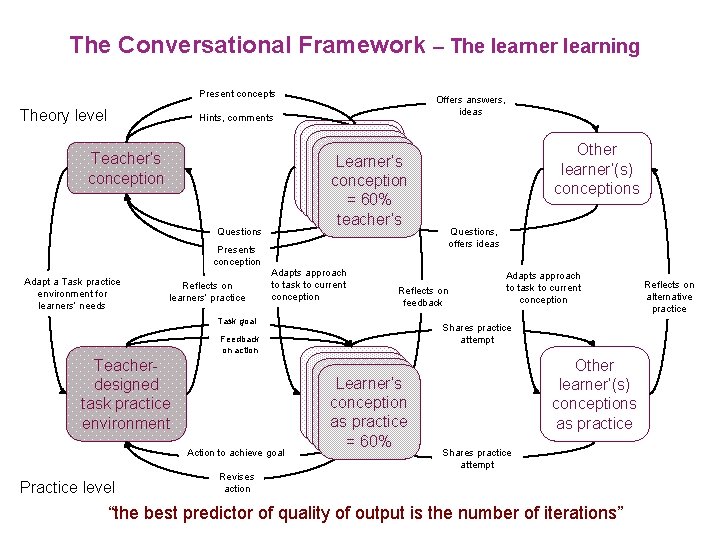
The Conversational Framework An integrated framework of our collective theories of learning provides a powerful challenge to digital technologies, showing that: To support the learning process fully we need to integrate all the technological capabilities available 21
The Conversational Framework – The learner learning Present concepts Theory level Offers answers, ideas Hints, comments Learner’s conception Learner’s conception ==conception 10% ==20% 40% 50% teacher’s = 60% teacher’s Teacher’s conception Questions Presents conception Adapt a Task practice environment for learners’ needs Reflects on learners’ practice Adapts approach to task to current conception Practice level Adapts approach to task to current conception Shares practice attempt Feedback on action Action to achieve goal Questions, offers ideas Reflects on feedback Task goal Teacherdesigned task practice environment Other learner’(s) conceptions Learner’s conception as practice ==20% 40% ==50% 60% Other learner’(s) conceptions as practice Shares practice attempt Revises action “the best predictor of quality of output is the number of iterations” Reflects on alternative practice
OUTLINE Principles of learning and assessment Thinking about active learning Conventional and digital technologies Formative assessment Challenging a learning design Modelling changes in learning design
Design principles formative assessment Good practice will: 1. Clarify what good performance is 2. Facilitates self-assessment 3. Deliver high quality feedback information 4. Encourage teacher and peer dialogue 5. Encourage positive motivation and self-esteem 6. Provides opportunities to close the gap 7. Use feedback to improve teaching. (Nicol & Mac. Farlane-Dick, 2006) Summative methods Reflective essay E-Portfolio Tests Project work Lab exercises Essay Quiz Group-work presentation Examination
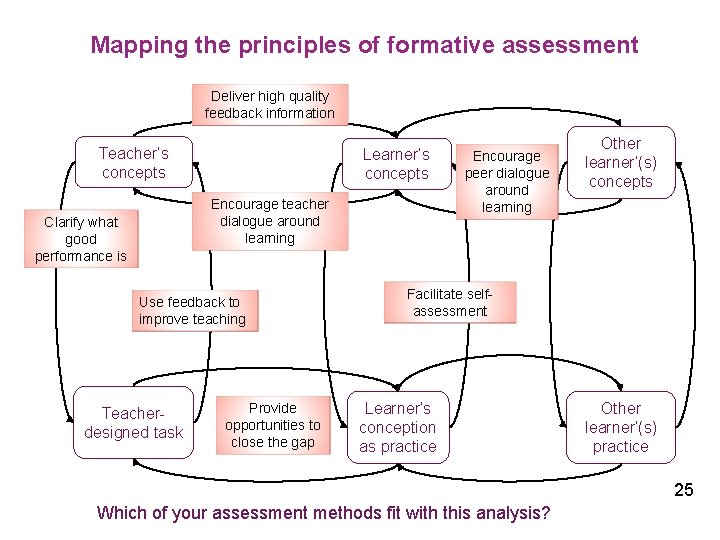
Mapping the principles of formative assessment Deliver high quality feedback information Teacher’s concepts Learner’s concepts Encourage teacher dialogue around learning Clarify what good performance is Use feedback to improve teaching Teacherdesigned task Provide opportunities to close the gap Encourage peer dialogue around learning Other learner’(s) concepts Facilitate selfassessment Learner’s conception as practice Other learner’(s) practice 25 Which of your assessment methods fit with this analysis?
OUTLINE Principles of learning and assessment Thinking about active learning Conventional and digital technologies Formative assessment Challenging a learning design Modelling changes in learning design
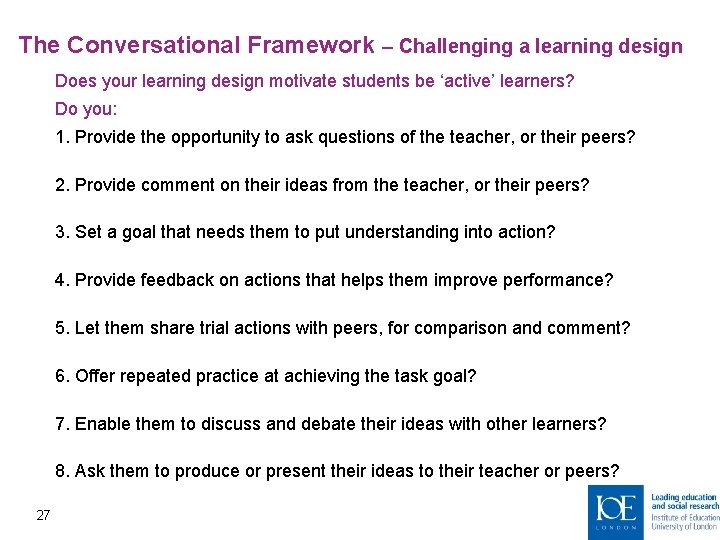
The Conversational Framework – Challenging a learning design Does your learning design motivate students be ‘active’ learners? Do you: 1. Provide the opportunity to ask questions of the teacher, or their peers? 2. Provide comment on their ideas from the teacher, or their peers? 3. Set a goal that needs them to put understanding into action? 4. Provide feedback on actions that helps them improve performance? 5. Let them share trial actions with peers, for comparison and comment? 6. Offer repeated practice at achieving the task goal? 7. Enable them to discuss and debate their ideas with other learners? 8. Ask them to produce or present their ideas to their teacher or peers? 27
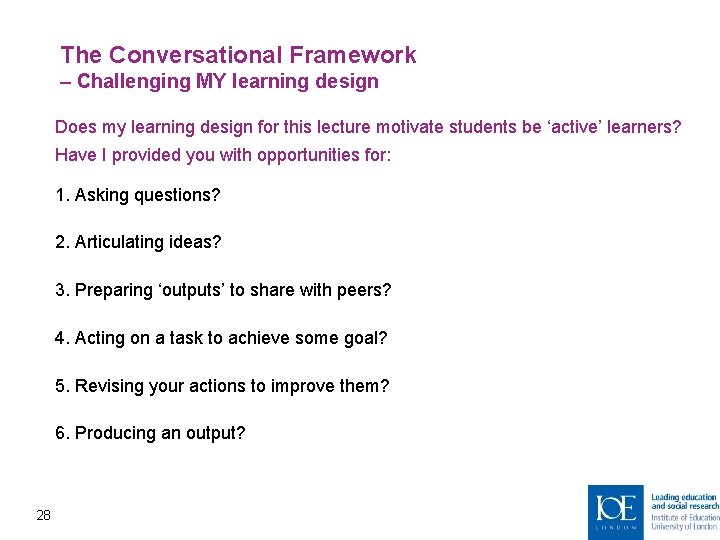
The Conversational Framework – Challenging MY learning design Does my learning design for this lecture motivate students be ‘active’ learners? Have I provided you with opportunities for: 1. Asking questions? 2. Articulating ideas? 3. Preparing ‘outputs’ to share with peers? 4. Acting on a task to achieve some goal? 5. Revising your actions to improve them? 6. Producing an output? 28
OUTLINE Principles of learning and assessment Thinking about active learning Conventional and digital technologies Formative assessment Challenging a learning design Modelling changes in learning design
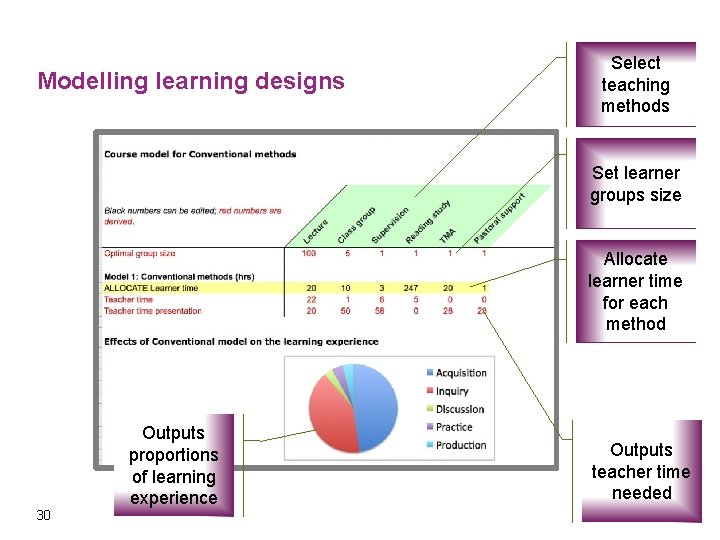
Modelling learning designs Select teaching methods Set learner groups size Allocate learner time for each method Outputs proportions of learning experience 30 Outputs teacher time needed
Using the model Which is the best way to change the Blended learning model to achieve more social learning without increasing staff time? 1. Reduce Lecture time to 10; increase Class group time to 8 2. Reduce Reading time to 1; increase Online Group time to 3 3. Reduce Lecture time to 5; increase Podcast to 8 and Wiki to 9? 31
The Conversational Framework – Challenging a learning design Does my learning design motivate students be ‘active’ learners? Did I: 1. Provide the opportunity to ask questions of the teacher, or their peers? Set up clickers to promote peer questions, then teacher questions 2. Provide comment on their ideas from the teacher, or their peers? Make sure peers and teacher have opportunity to answer 3. Set a goal that needs them to put understanding into action? Identify processes on CF; Predict effects of shift to blended learning 4. Provide feedback on actions that helps them improve performance? Give feedback; Show results of actions 5. Let them share trial actions with peers, for comparison and comment? Set up working groups for these tasks 6. Offer repeated practice at achieving the task goal? Repeat the tasks 7. Enable them to discuss and debate their ideas with other learners? Give time to working groups to discuss 8. Ask them to produce or present their ideas to their teacher or peers? Ask for output from working groups 32
SUMMARY Principles of learning and assessment - decide on which work for you Thinking about active learning - how to help learners be active Conventional and digital technologies - use each method for what it does well Formative assessment - build in as much as possible Challenging a learning design - develop your checklist – and check! Modelling changes in learning design - experimenting with teaching is good!
Thank you for listening! Diana Laurillard, Professor of Learning with Digital Technologies d. laurillard@ioe. ac. uk 34