
PEARL CULTURE INTRODUCTION Pearl is a natural gem
- Slides: 31
PEARL CULTURE
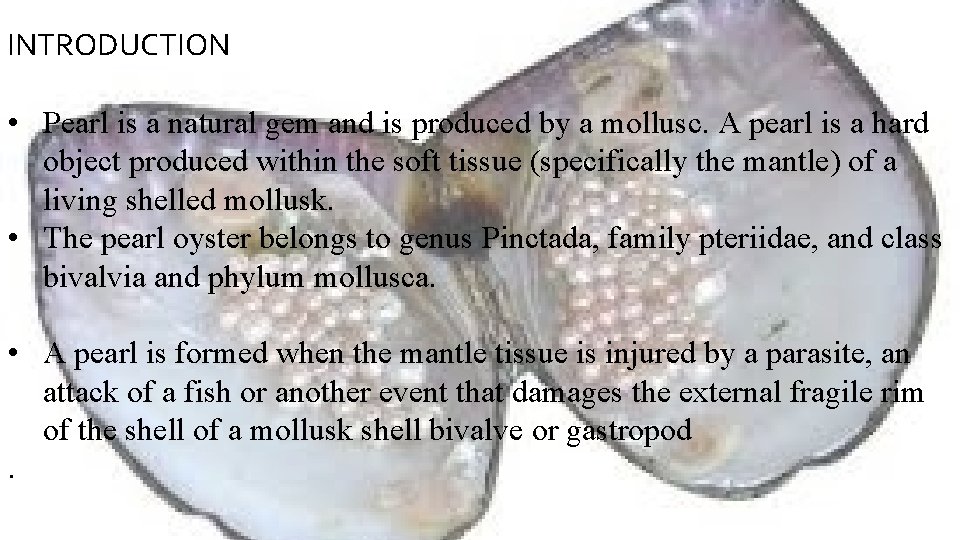
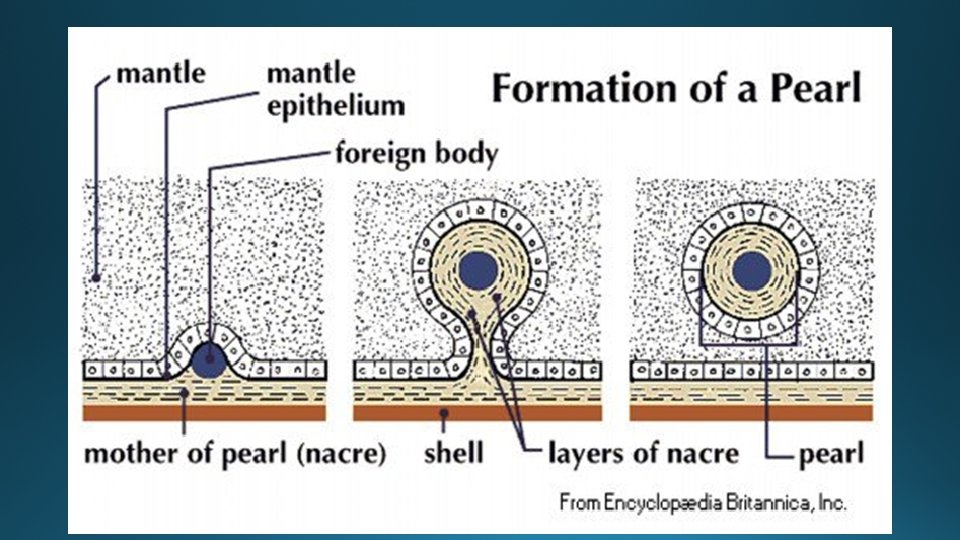
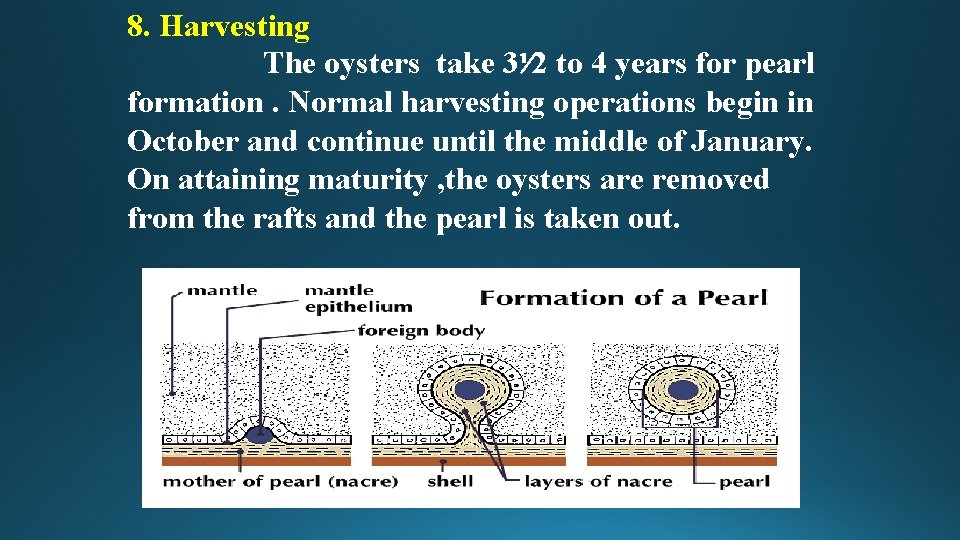
INTRODUCTION • Pearl is a natural gem and is produced by a mollusc. A pearl is a hard object produced within the soft tissue (specifically the mantle) of a living shelled mollusk. • The pearl oyster belongs to genus Pinctada, family pteriidae, and class bivalvia and phylum mollusca. • A pearl is formed when the mantle tissue is injured by a parasite, an attack of a fish or another event that damages the external fragile rim of the shell of a mollusk shell bivalve or gastropod.
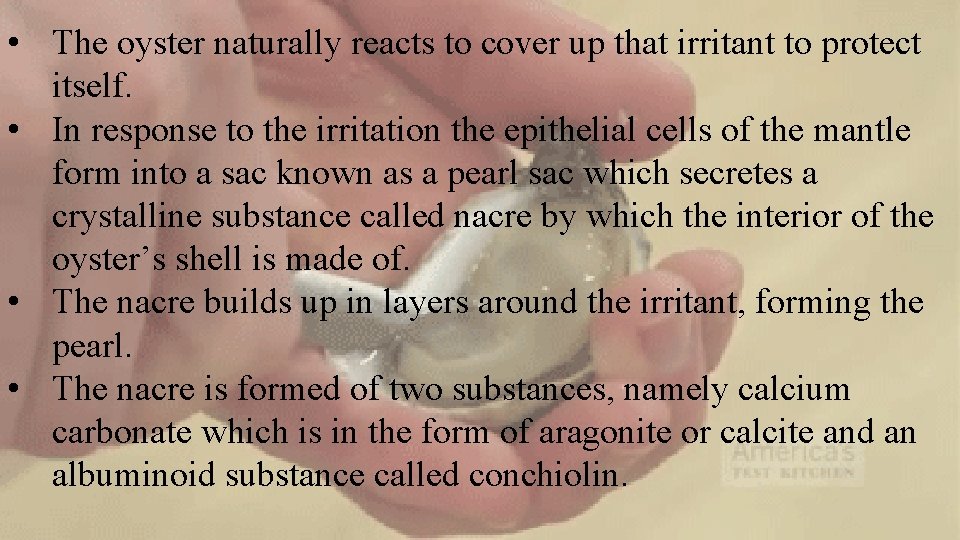
• The oyster naturally reacts to cover up that irritant to protect itself. • In response to the irritation the epithelial cells of the mantle form into a sac known as a pearl sac which secretes a crystalline substance called nacre by which the interior of the oyster’s shell is made of. • The nacre builds up in layers around the irritant, forming the pearl. • The nacre is formed of two substances, namely calcium carbonate which is in the form of aragonite or calcite and an albuminoid substance called conchiolin.
• In response, the mantle tissue of the mollusk secretes nacre into the pearl sac, a cyst that forms during the healing process. • As the nacre builds up in layers of minute aragonite tablets, it fills the growing pearl sac and eventually forms a pearl. • The pearl is both mystic and beautiful with its soft colour and cool luster. • While the demand of pearls in India and elsewhere is increasing, their supplies from nature have reduced due to over exploitation and pollution
• The longer a pearl stays in the shell, the more nacre that forms and the larger the pearl. • Nacre also known as mother of pearl, is an organicinorganic composite material produced by some molluscs as an inner shell layer; it also makes up the outer coating of pearls. It is strong, resilient, and iridescent.
Types of pearls
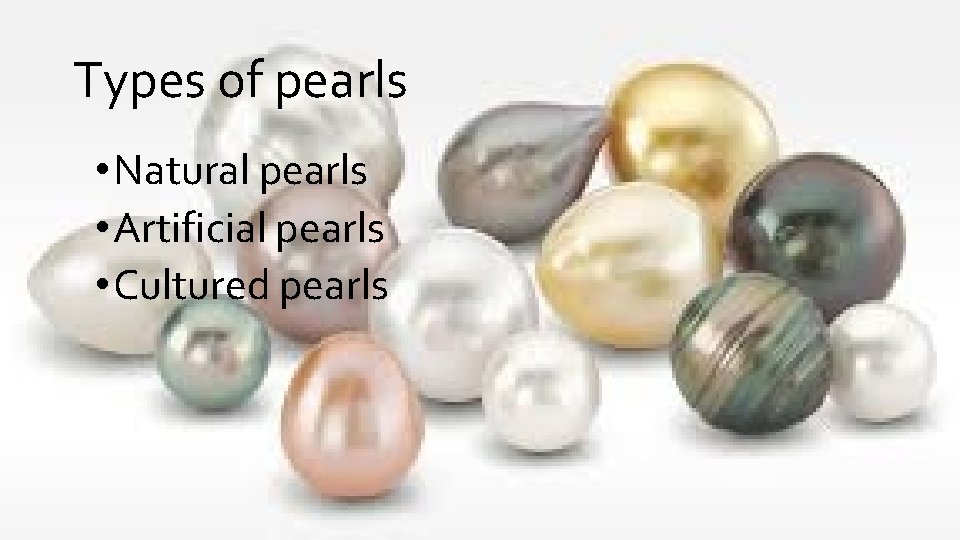
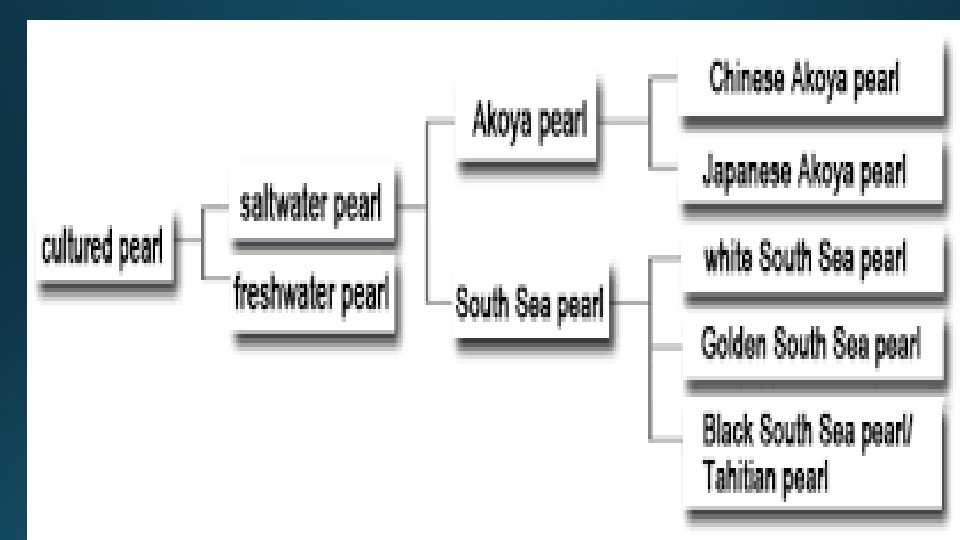
Types of pearls • Natural pearls • Artificial pearls • Cultured pearls
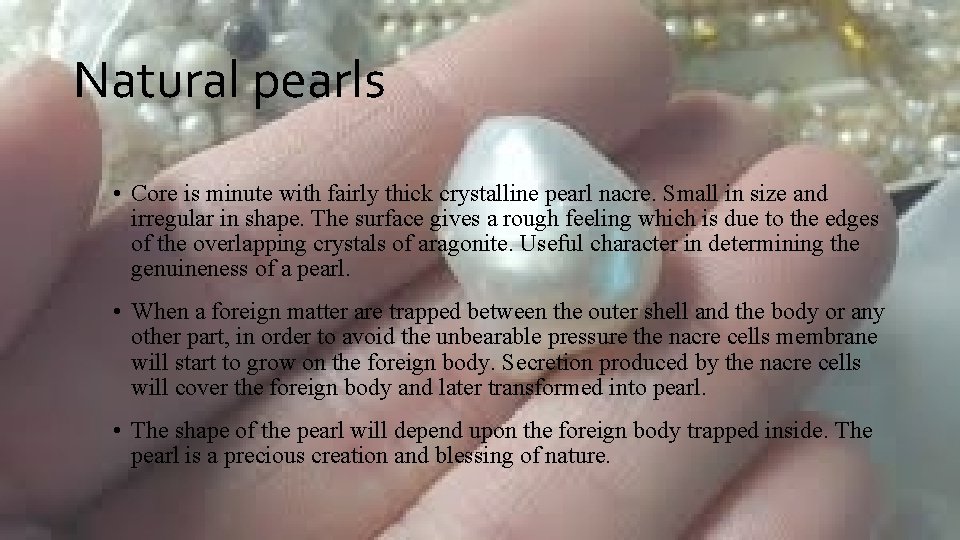
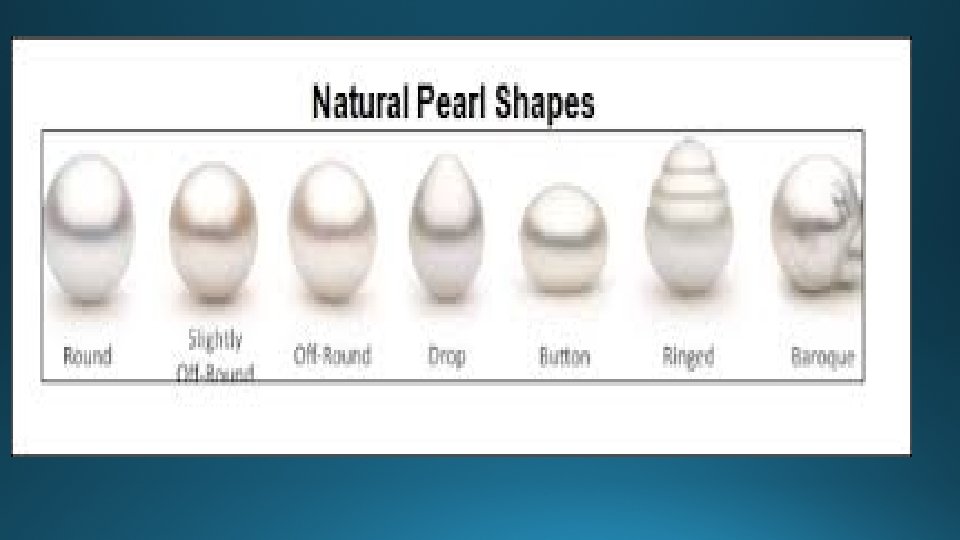
Natural pearls • Core is minute with fairly thick crystalline pearl nacre. Small in size and irregular in shape. The surface gives a rough feeling which is due to the edges of the overlapping crystals of aragonite. Useful character in determining the genuineness of a pearl. • When a foreign matter are trapped between the outer shell and the body or any other part, in order to avoid the unbearable pressure the nacre cells membrane will start to grow on the foreign body. Secretion produced by the nacre cells will cover the foreign body and later transformed into pearl. • The shape of the pearl will depend upon the foreign body trapped inside. The pearl is a precious creation and blessing of nature.
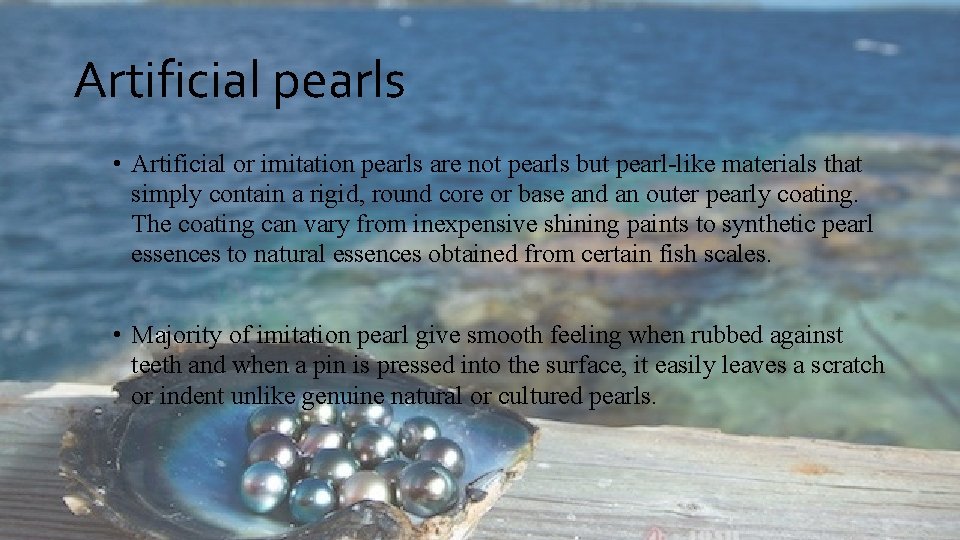
Artificial pearls • Artificial or imitation pearls are not pearls but pearl-like materials that simply contain a rigid, round core or base and an outer pearly coating. The coating can vary from inexpensive shining paints to synthetic pearl essences to natural essences obtained from certain fish scales. • Majority of imitation pearl give smooth feeling when rubbed against teeth and when a pin is pressed into the surface, it easily leaves a scratch or indent unlike genuine natural or cultured pearls.
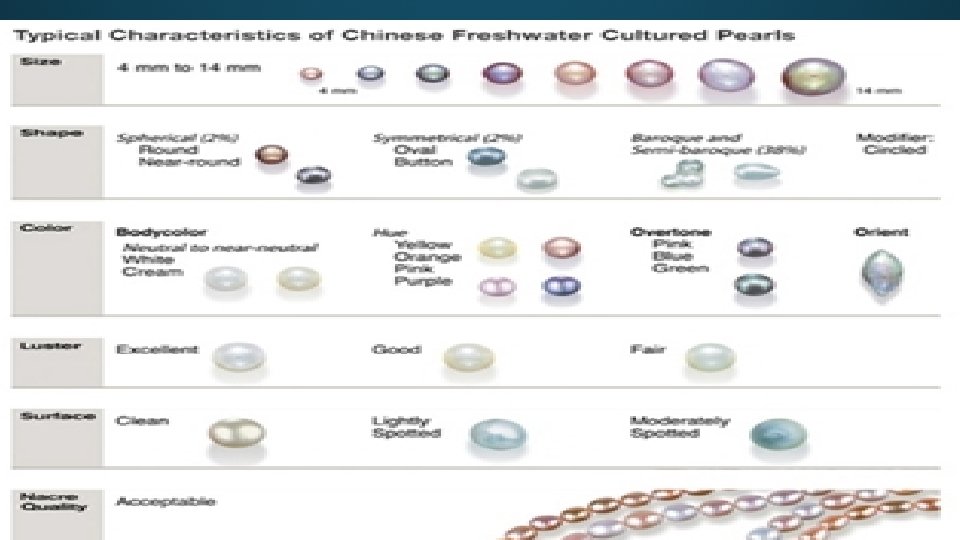
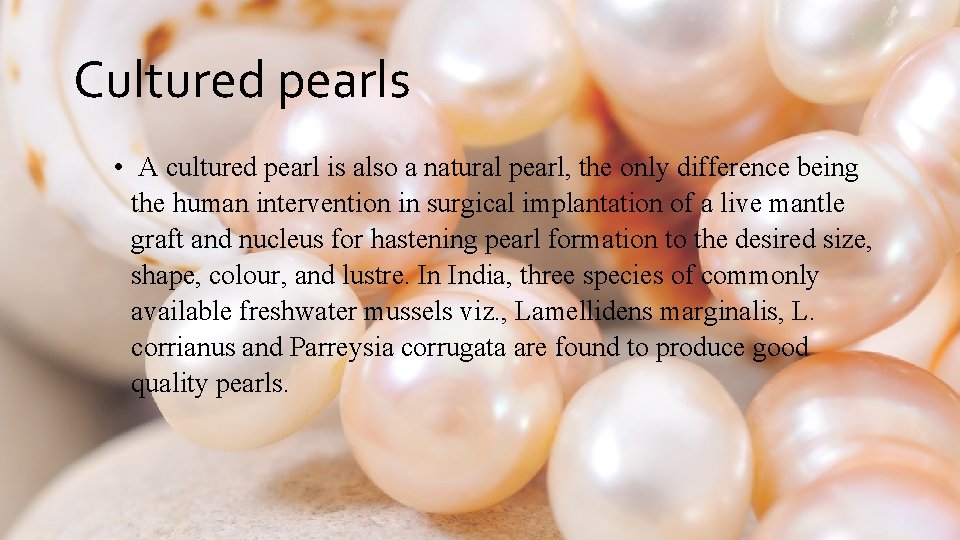
Cultured pearls • A cultured pearl is also a natural pearl, the only difference being the human intervention in surgical implantation of a live mantle graft and nucleus for hastening pearl formation to the desired size, shape, colour, and lustre. In India, three species of commonly available freshwater mussels viz. , Lamellidens marginalis, L. corrianus and Parreysia corrugata are found to produce good quality pearls.
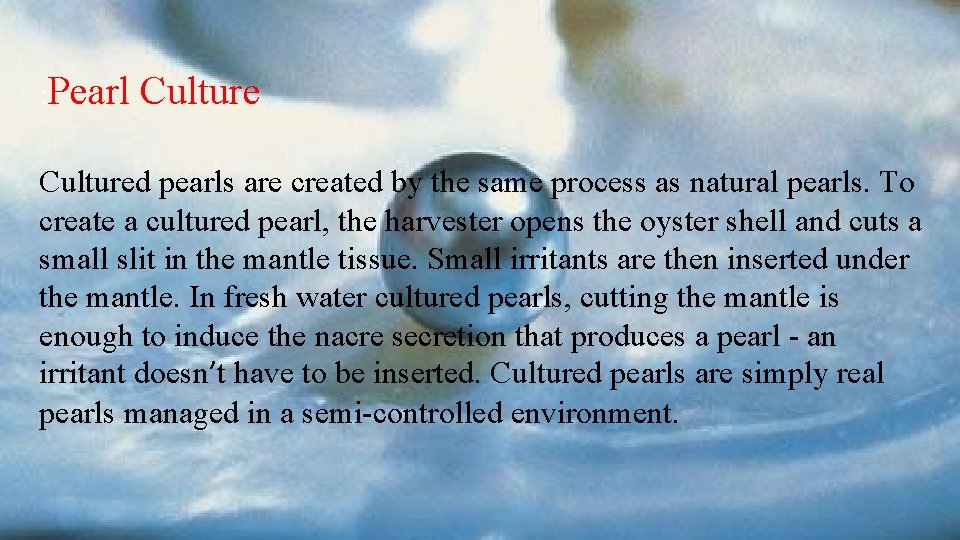
: Pearl Cultured pearls are created by the same process as natural pearls. To create a cultured pearl, the harvester opens the oyster shell and cuts a small slit in the mantle tissue. Small irritants are then inserted under the mantle. In fresh water cultured pearls, cutting the mantle is enough to induce the nacre secretion that produces a pearl - an irritant doesn’t have to be inserted. Cultured pearls are simply real pearls managed in a semi-controlled environment.
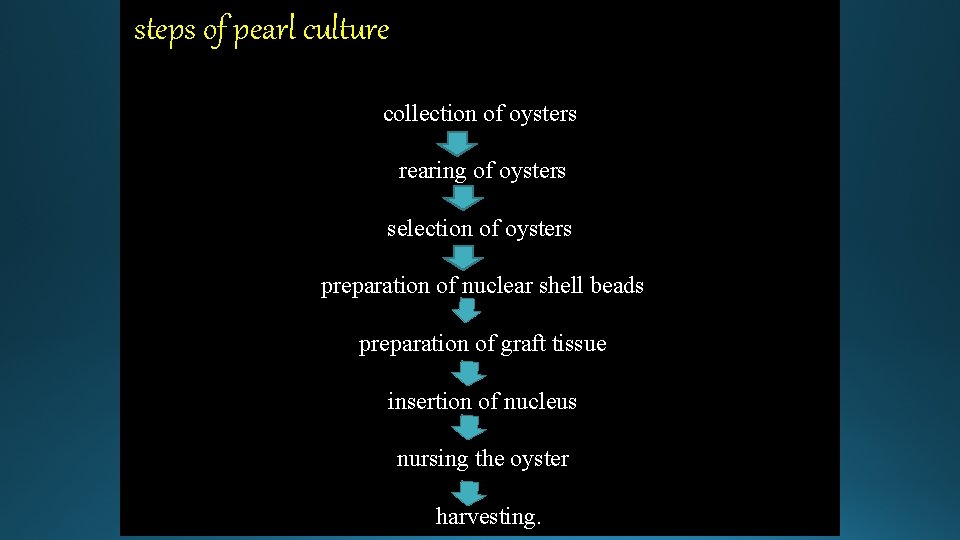
steps of pearl culture collection of oysters rearing of oysters selection of oysters preparation of nuclear shell beads preparation of graft tissue insertion of nucleus nursing the oyster harvesting.
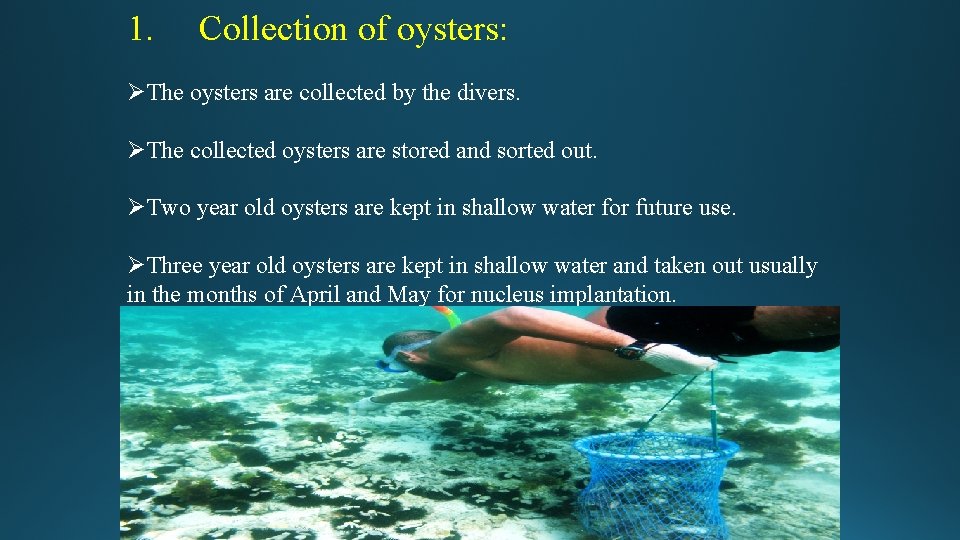
1. Collection of oysters: ØThe oysters are collected by the divers. ØThe collected oysters are stored and sorted out. ØTwo year old oysters are kept in shallow water for future use. ØThree year old oysters are kept in shallow water and taken out usually in the months of April and May for nucleus implantation.
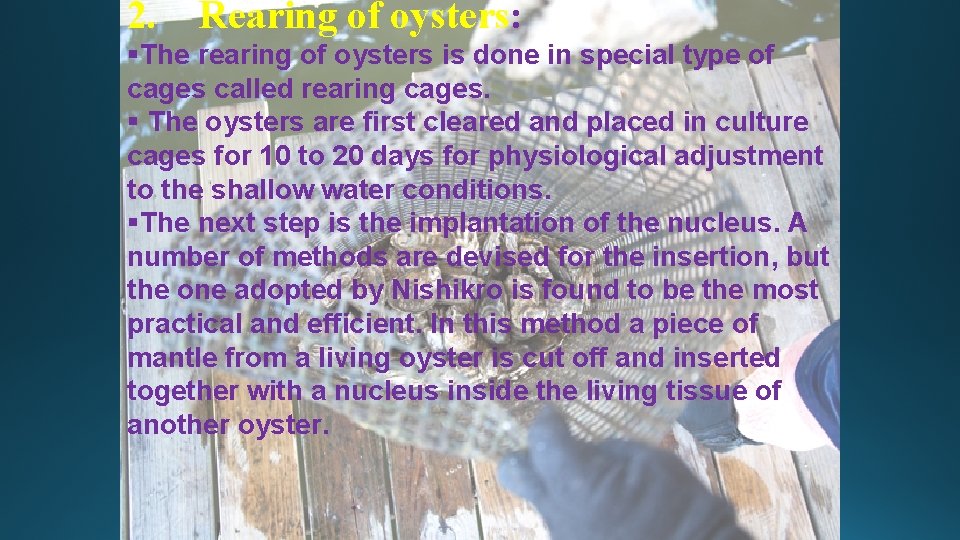
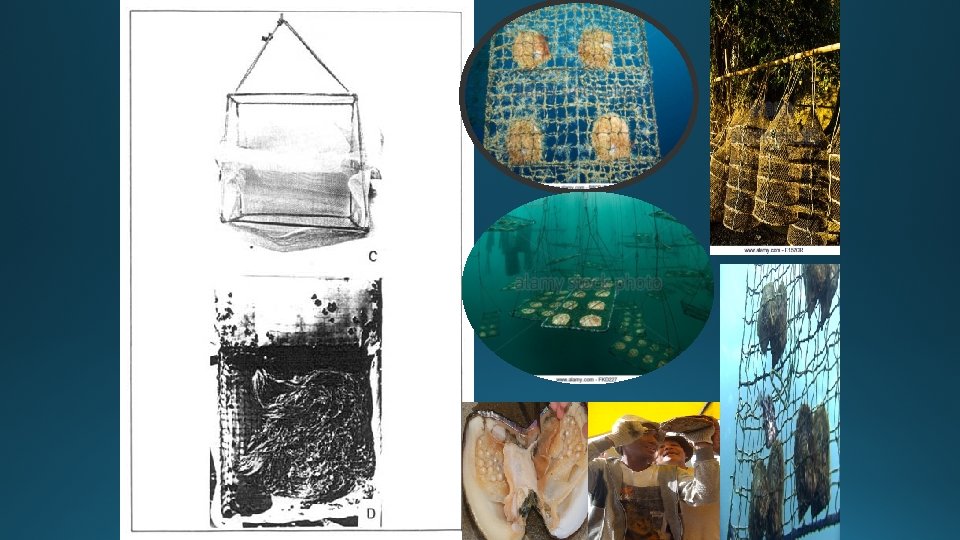
2. Rearing of oysters: §The rearing of oysters is done in special type of cages called rearing cages. § The oysters are first cleared and placed in culture cages for 10 to 20 days for physiological adjustment to the shallow water conditions. §The next step is the implantation of the nucleus. A number of methods are devised for the insertion, but the one adopted by Nishikro is found to be the most practical and efficient. In this method a piece of mantle from a living oyster is cut off and inserted together with a nucleus inside the living tissue of another oyster.
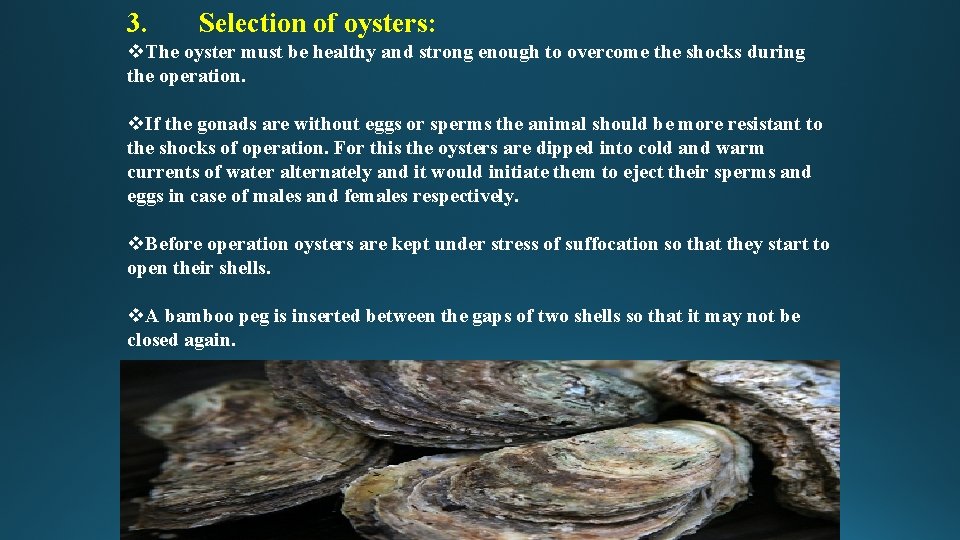
3. Selection of oysters: v. The oyster must be healthy and strong enough to overcome the shocks during the operation. v. If the gonads are without eggs or sperms the animal should be more resistant to the shocks of operation. For this the oysters are dipped into cold and warm currents of water alternately and it would initiate them to eject their sperms and eggs in case of males and females respectively. v. Before operation oysters are kept under stress of suffocation so that they start to open their shells. v. A bamboo peg is inserted between the gaps of two shells so that it may not be closed again.
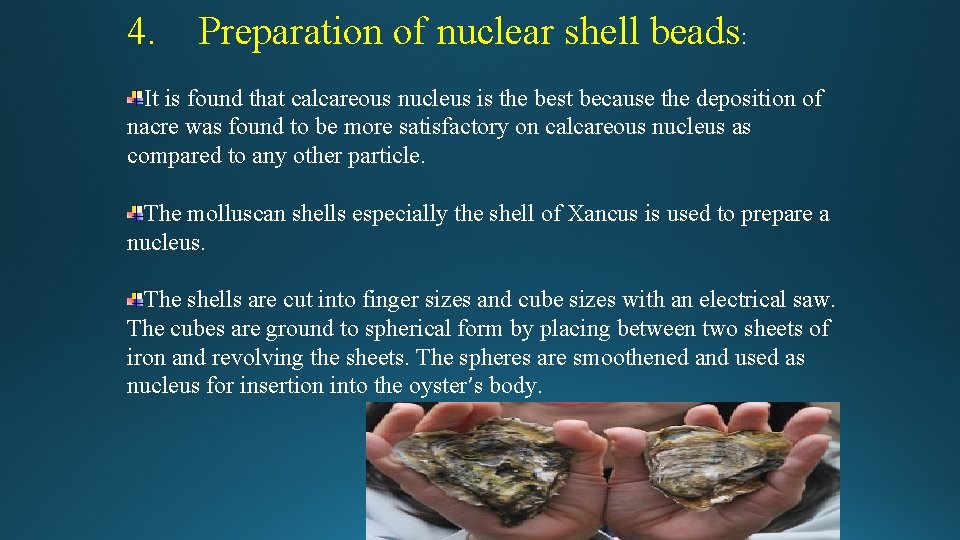
4. Preparation of nuclear shell beads: It is found that calcareous nucleus is the best because the deposition of nacre was found to be more satisfactory on calcareous nucleus as compared to any other particle. The molluscan shells especially the shell of Xancus is used to prepare a nucleus. The shells are cut into finger sizes and cube sizes with an electrical saw. The cubes are ground to spherical form by placing between two sheets of iron and revolving the sheets. The spheres are smoothened and used as nucleus for insertion into the oyster’s body.
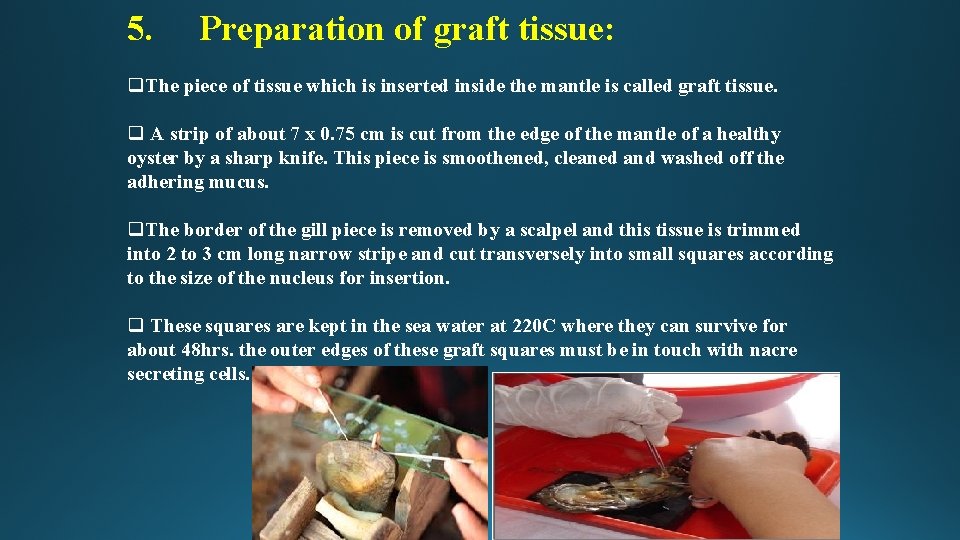
5. Preparation of graft tissue: q. The piece of tissue which is inserted inside the mantle is called graft tissue. q A strip of about 7 x 0. 75 cm is cut from the edge of the mantle of a healthy oyster by a sharp knife. This piece is smoothened, cleaned and washed off the adhering mucus. q. The border of the gill piece is removed by a scalpel and this tissue is trimmed into 2 to 3 cm long narrow stripe and cut transversely into small squares according to the size of the nucleus for insertion. q These squares are kept in the sea water at 220 C where they can survive for about 48 hrs. the outer edges of these graft squares must be in touch with nacre secreting cells.
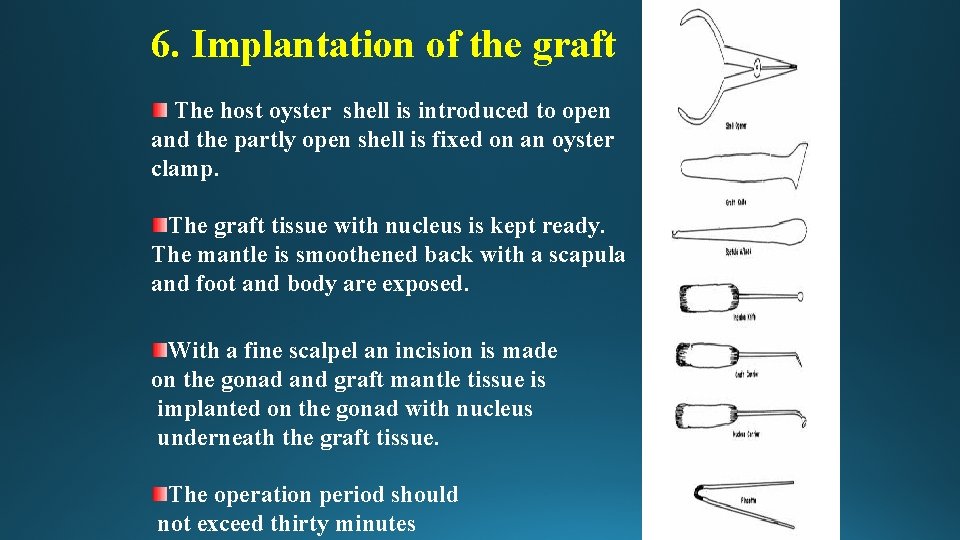
6. Implantation of the graft The host oyster shell is introduced to open and the partly open shell is fixed on an oyster clamp. The graft tissue with nucleus is kept ready. The mantle is smoothened back with a scapula and foot and body are exposed. With a fine scalpel an incision is made on the gonad and graft mantle tissue is implanted on the gonad with nucleus underneath the graft tissue. The operation period should not exceed thirty minutes
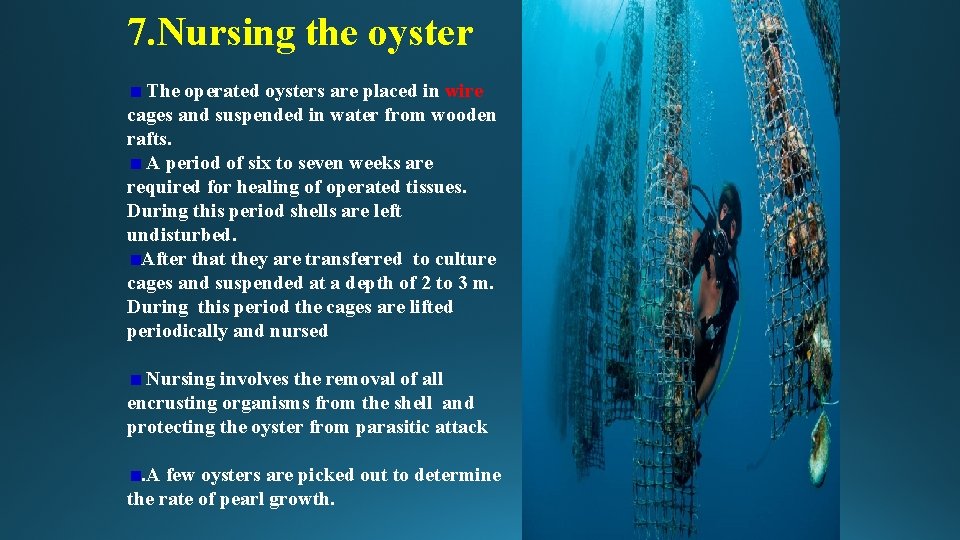
7. Nursing the oyster The operated oysters are placed in wire cages and suspended in water from wooden rafts. A period of six to seven weeks are required for healing of operated tissues. During this period shells are left undisturbed. After that they are transferred to culture cages and suspended at a depth of 2 to 3 m. During this period the cages are lifted periodically and nursed Nursing involves the removal of all encrusting organisms from the shell and protecting the oyster from parasitic attack. A few oysters are picked out to determine the rate of pearl growth.
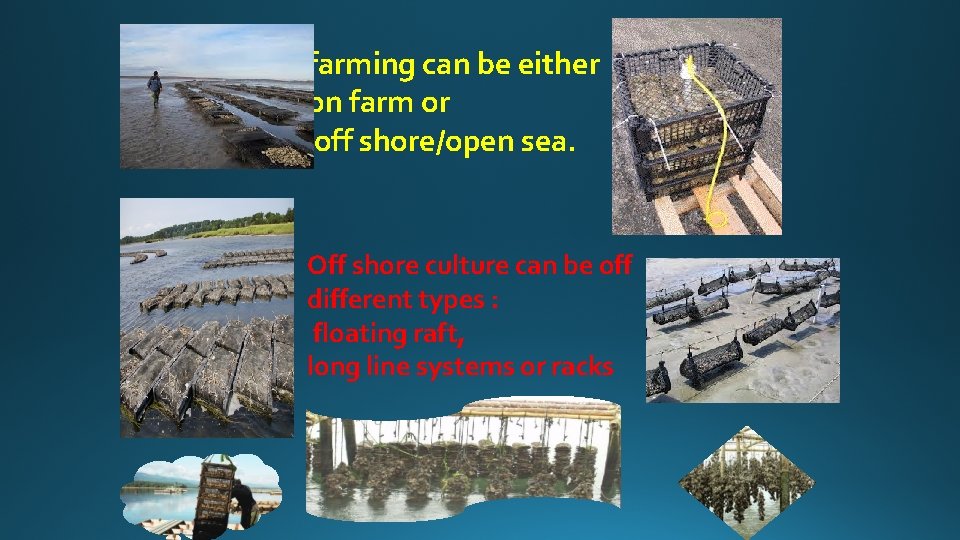
farming can be either on farm or off shore/open sea. Off shore culture can be off different types : floating raft, long line systems or racks
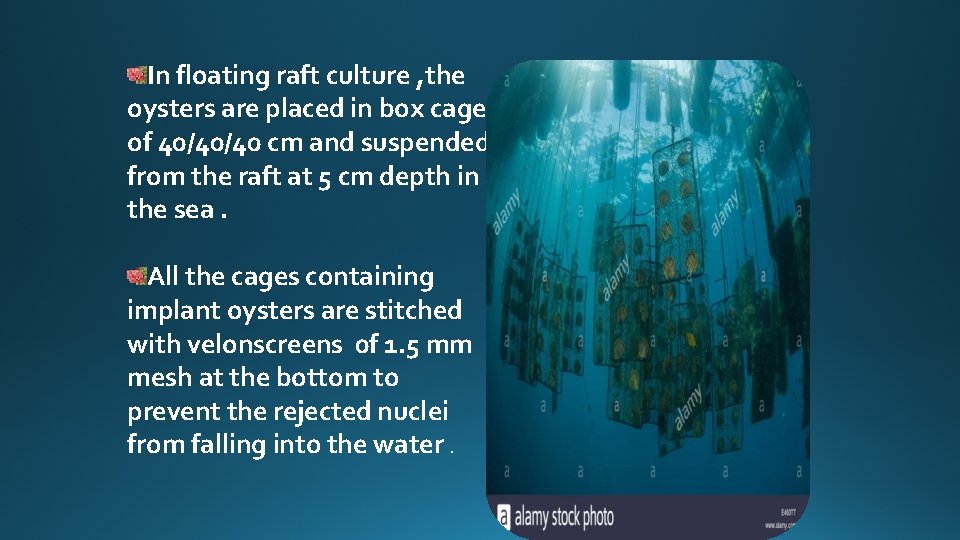
In floating raft culture , the oysters are placed in box cages of 40/40/40 cm and suspended from the raft at 5 cm depth in the sea. All the cages containing implant oysters are stitched with velonscreens 0 f 1. 5 mm mesh at the bottom to prevent the rejected nuclei from falling into the water.
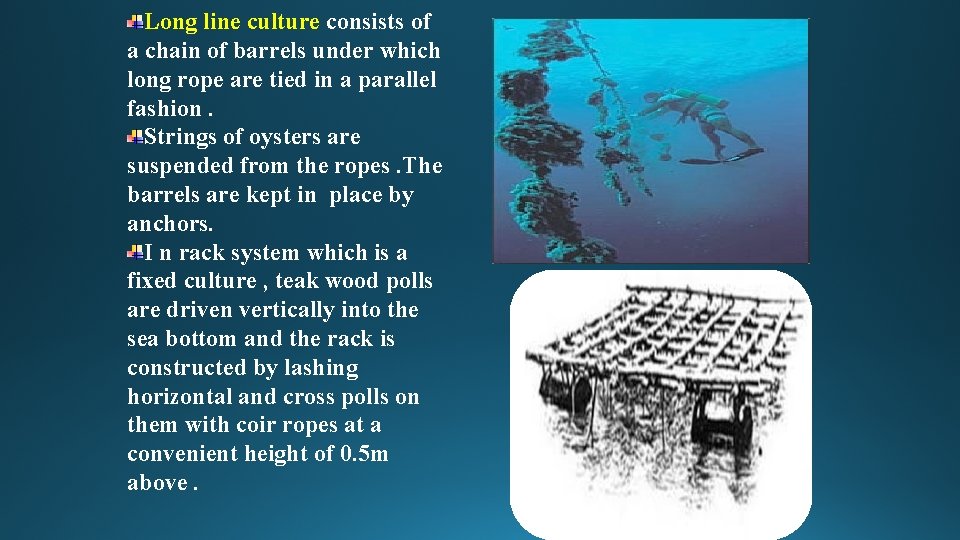
Long line culture consists of a chain of barrels under which long rope are tied in a parallel fashion. Strings of oysters are suspended from the ropes. The barrels are kept in place by anchors. I n rack system which is a fixed culture , teak wood polls are driven vertically into the sea bottom and the rack is constructed by lashing horizontal and cross polls on them with coir ropes at a convenient height of 0. 5 m above.
8. Harvesting The oysters take 3⅟ 2 to 4 years for pearl formation. Normal harvesting operations begin in October and continue until the middle of January. On attaining maturity , the oysters are removed from the rafts and the pearl is taken out.
15 -pzo-19 15 -pzo-20 15 -pzo-21 15 -pzo-22