
Peaks DNAse Iseq CHIPseq SIGNAL PROCESSING FOR NEXTGEN


![[Cheng et al. NAR ('11)] Slide by Chao Cheng Predictor v 2: 2 -levels,](https://slidetodoc.com/presentation_image_h/0ed69cff823ad7e916d9e387f84f66a4/image-59.jpg "[Cheng et al. NAR ('11)] Slide by Chao Cheng Predictor v 2: 2 -levels,")
- Slides: 60
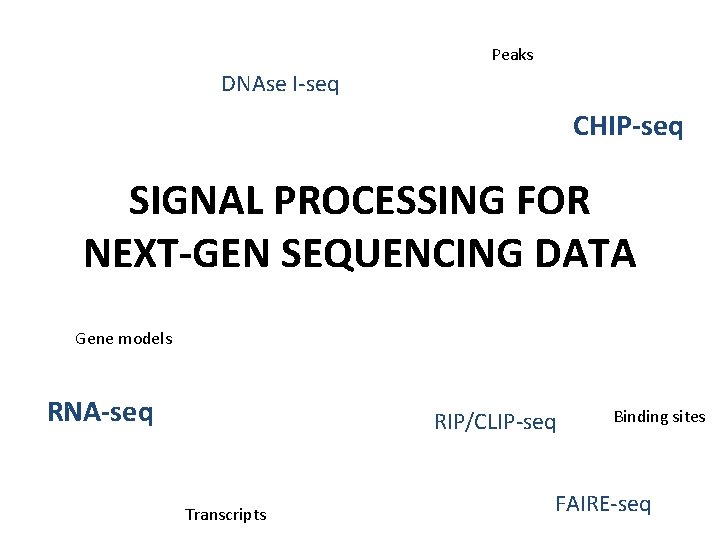
Peaks DNAse I-seq CHIP-seq SIGNAL PROCESSING FOR NEXT-GEN SEQUENCING DATA Gene models RNA-seq RIP/CLIP-seq Transcripts Binding sites FAIRE-seq
The Power of Next-Gen Sequencing Chromosome Conformation Capture DNA Genome Sequencing Exome Sequencing DNAse I hypersensitivity CHIP Protein CLIP, RIP CRAC PAR-CLIP i. CLIP + More Experiments CHART, CHir. P, RAP RNA-seq For more Seq technologies, see: http: //liorpachter. wordpress. com/seq/
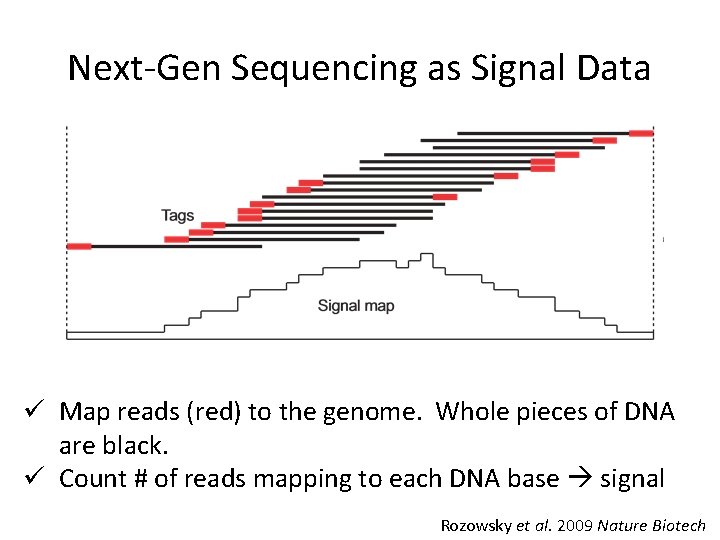
Next-Gen Sequencing as Signal Data ü Map reads (red) to the genome. Whole pieces of DNA are black. ü Count # of reads mapping to each DNA base signal Rozowsky et al. 2009 Nature Biotech
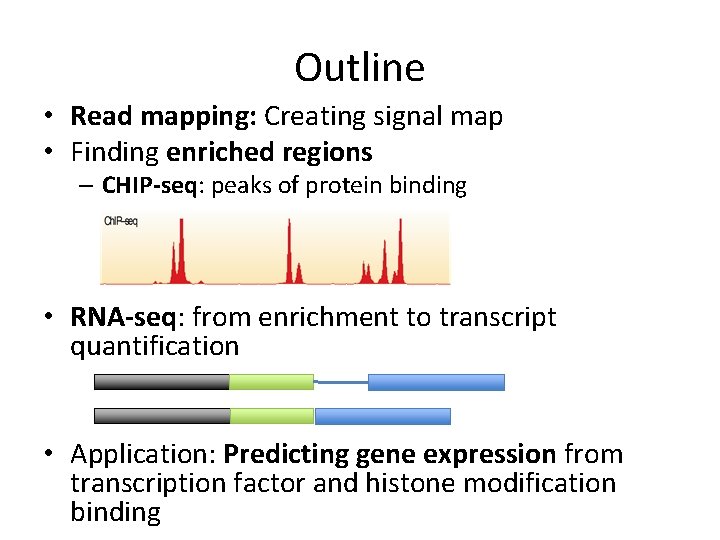
Outline • Read mapping: Creating signal map • Finding enriched regions – CHIP-seq: peaks of protein binding • RNA-seq: from enrichment to transcript quantification • Application: Predicting gene expression from transcription factor and histone modification binding
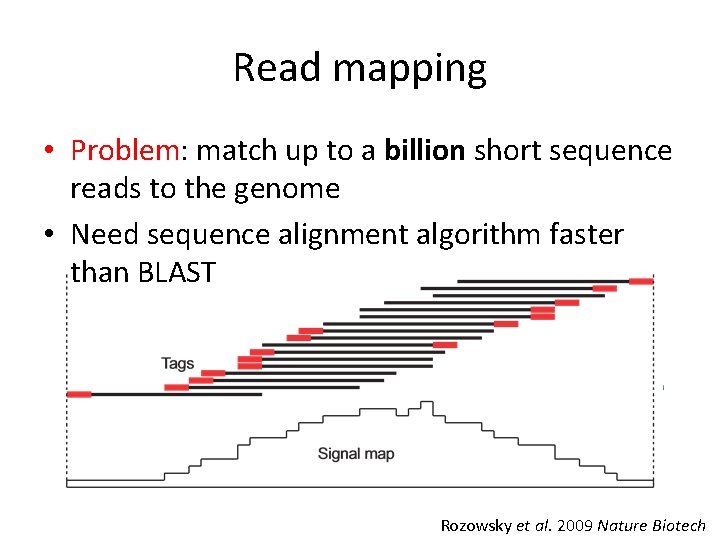
Read mapping • Problem: match up to a billion short sequence reads to the genome • Need sequence alignment algorithm faster than BLAST Rozowsky et al. 2009 Nature Biotech
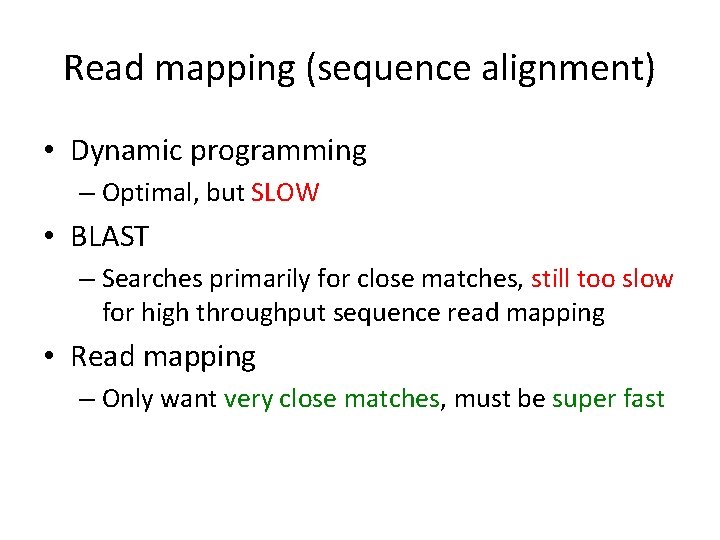
Read mapping (sequence alignment) • Dynamic programming – Optimal, but SLOW • BLAST – Searches primarily for close matches, still too slow for high throughput sequence read mapping • Read mapping – Only want very close matches, must be super fast
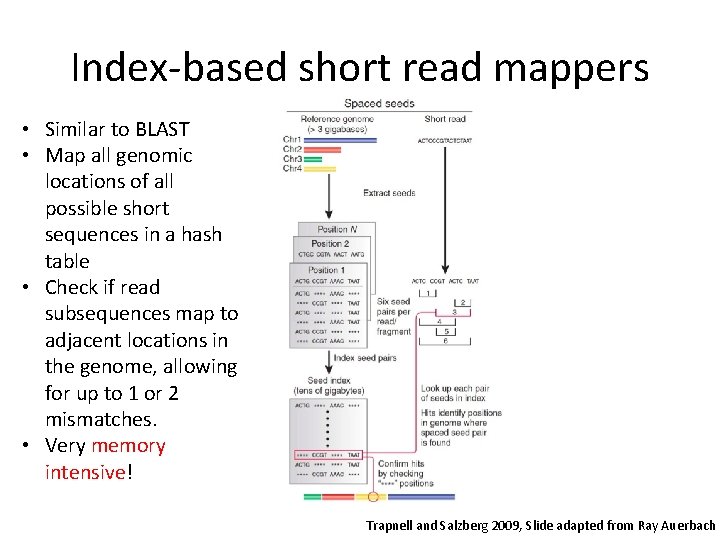
Index-based short read mappers • Similar to BLAST • Map all genomic locations of all possible short sequences in a hash table • Check if read subsequences map to adjacent locations in the genome, allowing for up to 1 or 2 mismatches. • Very memory intensive! Trapnell and Salzberg 2009, Slide adapted from Ray Auerbach
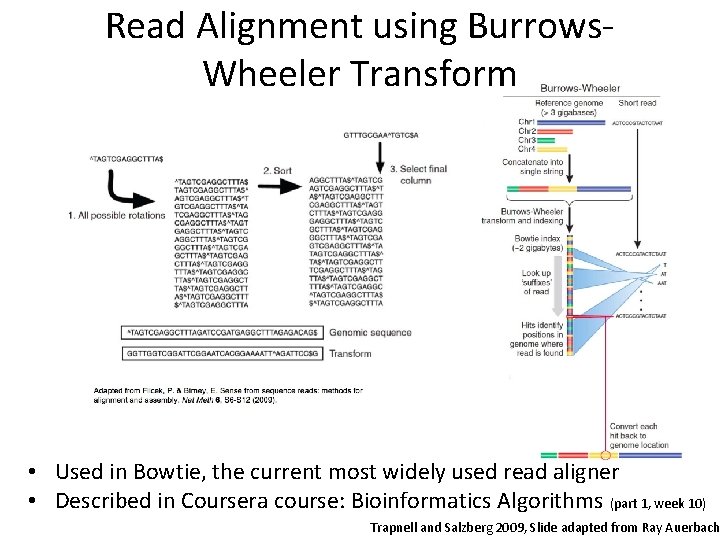
Read Alignment using Burrows. Wheeler Transform • Used in Bowtie, the current most widely used read aligner • Described in Coursera course: Bioinformatics Algorithms (part 1, week 10) Trapnell and Salzberg 2009, Slide adapted from Ray Auerbach
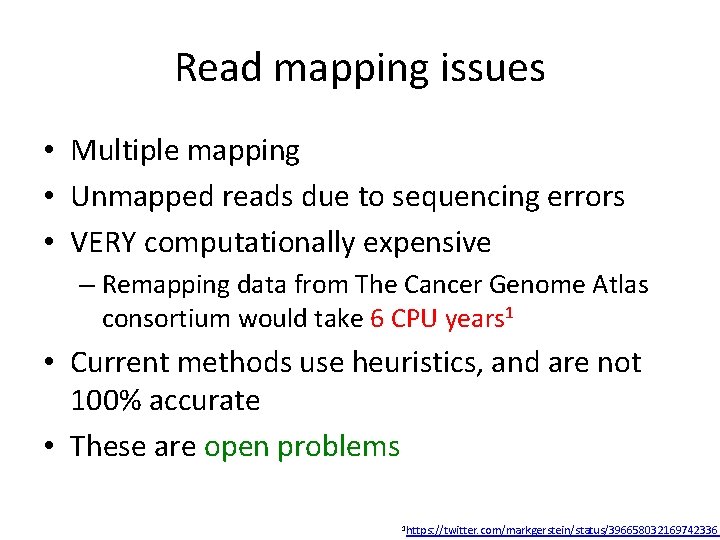
Read mapping issues • Multiple mapping • Unmapped reads due to sequencing errors • VERY computationally expensive – Remapping data from The Cancer Genome Atlas consortium would take 6 CPU years 1 • Current methods use heuristics, and are not 100% accurate • These are open problems 1 https: //twitter. com/markgerstein/status/396658032169742336
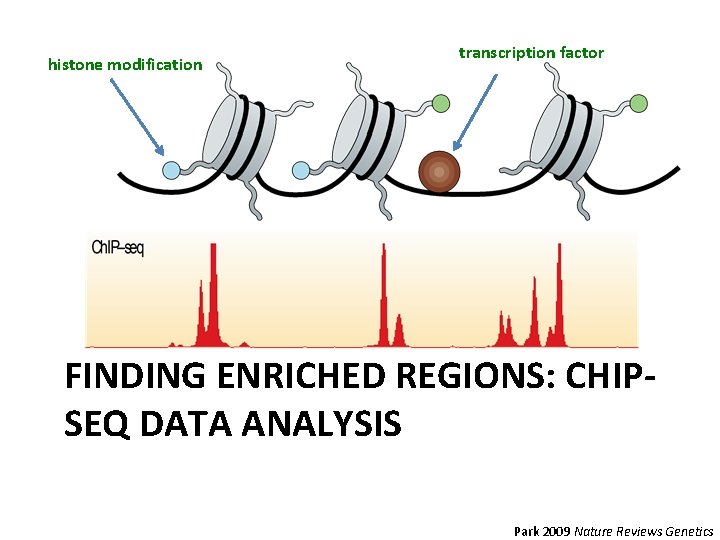
histone modification transcription factor FINDING ENRICHED REGIONS: CHIPSEQ DATA ANALYSIS Park 2009 Nature Reviews Genetics
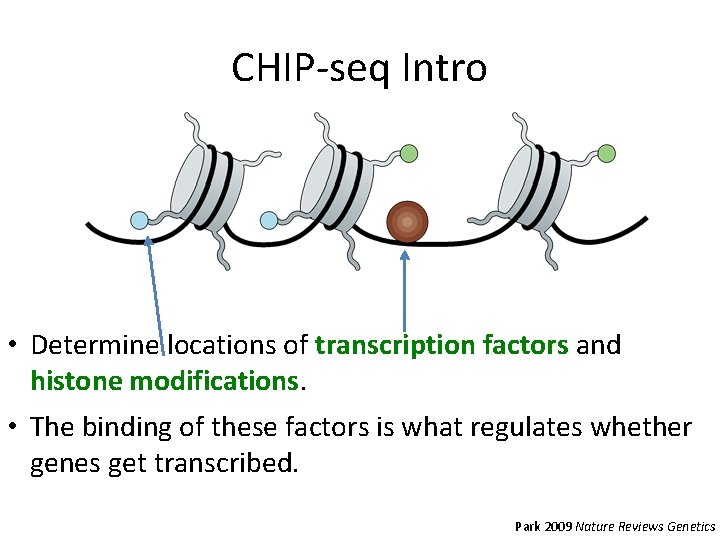
CHIP-seq Intro • Determine locations of transcription factors and histone modifications. • The binding of these factors is what regulates whether genes get transcribed. Park 2009 Nature Reviews Genetics
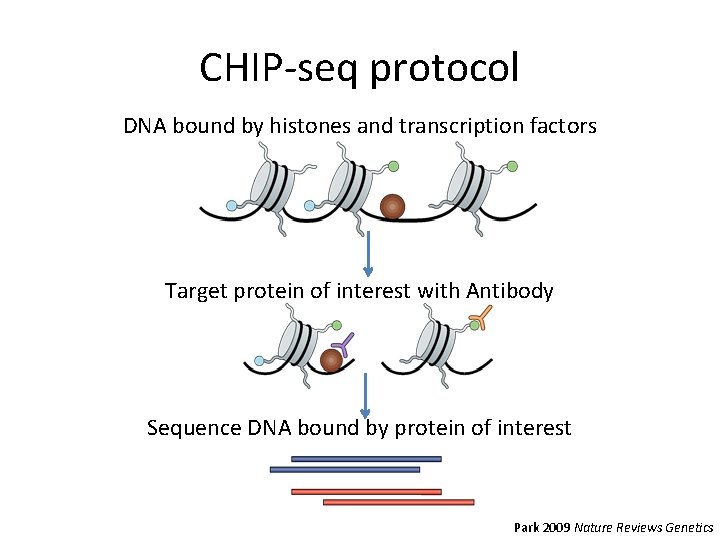
CHIP-seq protocol DNA bound by histones and transcription factors Target protein of interest with Antibody Sequence DNA bound by protein of interest Park 2009 Nature Reviews Genetics
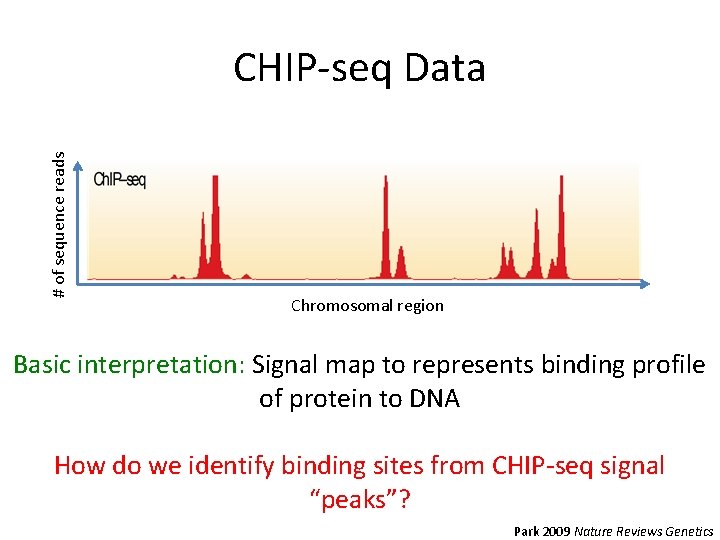
# of sequence reads CHIP-seq Data Chromosomal region Basic interpretation: Signal map to represents binding profile of protein to DNA How do we identify binding sites from CHIP-seq signal “peaks”? Park 2009 Nature Reviews Genetics
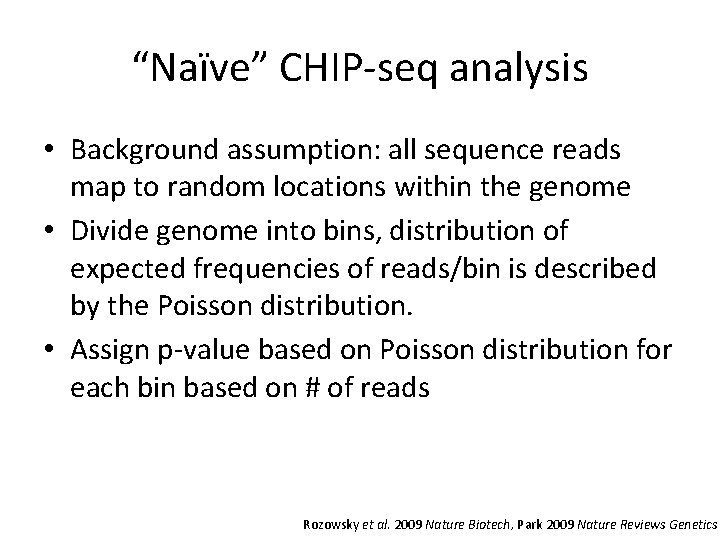
“Naïve” CHIP-seq analysis • Background assumption: all sequence reads map to random locations within the genome • Divide genome into bins, distribution of expected frequencies of reads/bin is described by the Poisson distribution. • Assign p-value based on Poisson distribution for each bin based on # of reads Rozowsky et al. 2009 Nature Biotech, Park 2009 Nature Reviews Genetics
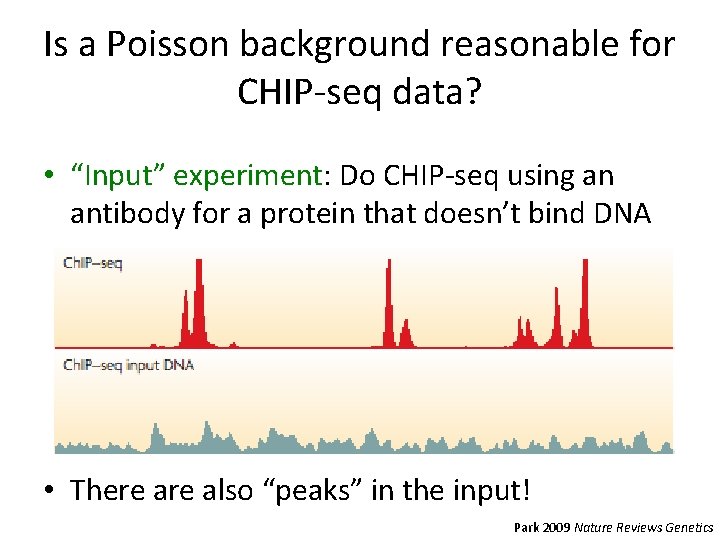
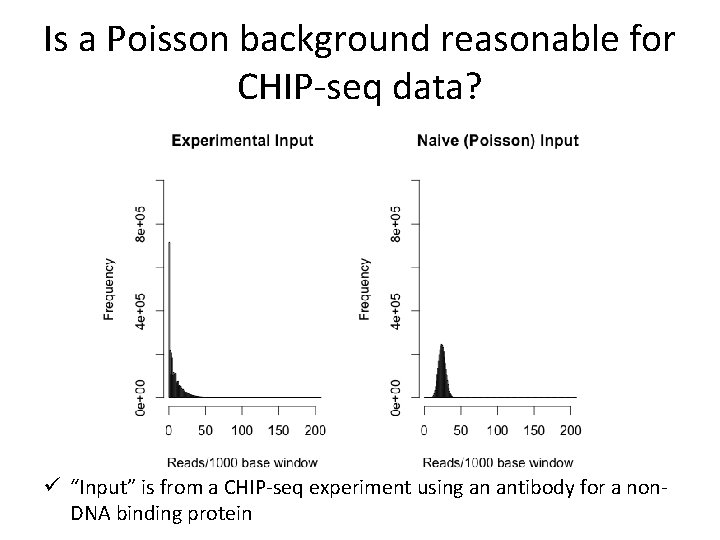
Is a Poisson background reasonable for CHIP-seq data? • “Input” experiment: Do CHIP-seq using an antibody for a protein that doesn’t bind DNA • There also “peaks” in the input! Park 2009 Nature Reviews Genetics
Is a Poisson background reasonable for CHIP-seq data? ü “Input” is from a CHIP-seq experiment using an antibody for a non. DNA binding protein
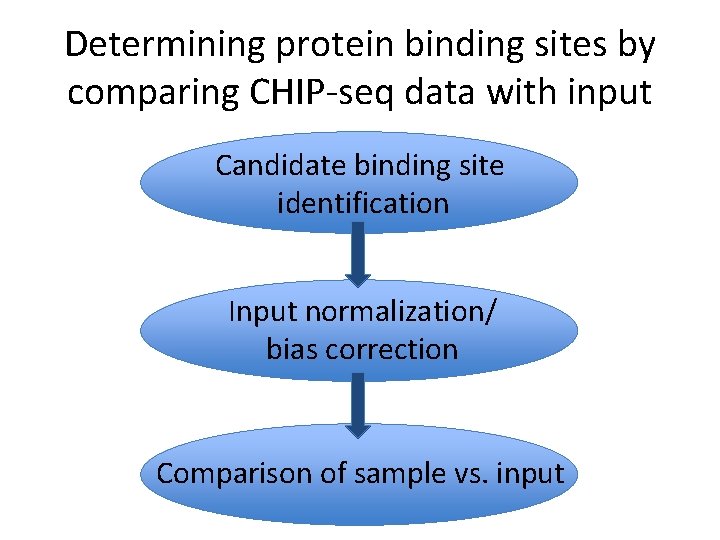
Determining protein binding sites by comparing CHIP-seq data with input Candidate binding site identification Input normalization/ bias correction Comparison of sample vs. input
Peakseq Rozowsky et al. 2009 Nature Biotech Gerstein Lab
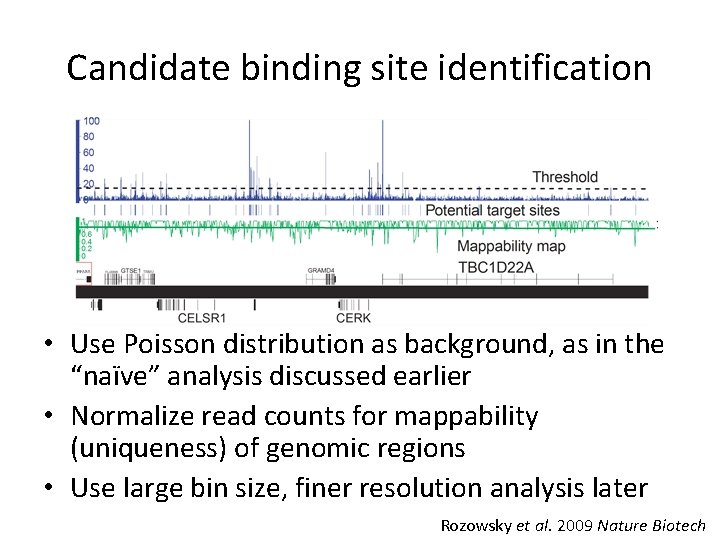
Candidate binding site identification • Use Poisson distribution as background, as in the “naïve” analysis discussed earlier • Normalize read counts for mappability (uniqueness) of genomic regions • Use large bin size, finer resolution analysis later Rozowsky et al. 2009 Nature Biotech
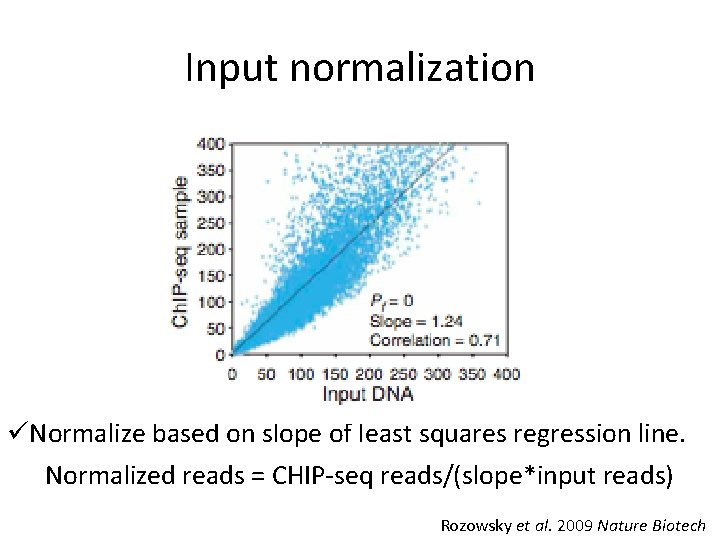
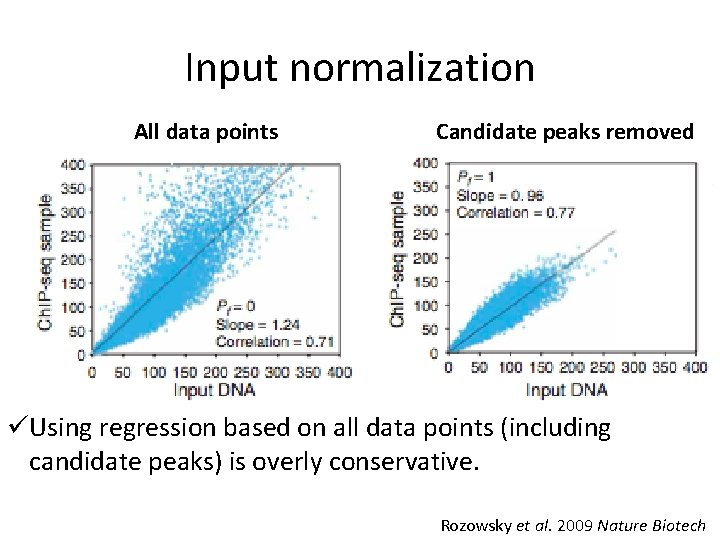
Input normalization üNormalize based on slope of least squares regression line. Normalized reads = CHIP-seq reads/(slope*input reads) Rozowsky et al. 2009 Nature Biotech
Input normalization All data points Candidate peaks removed üUsing regression based on all data points (including candidate peaks) is overly conservative. Rozowsky et al. 2009 Nature Biotech
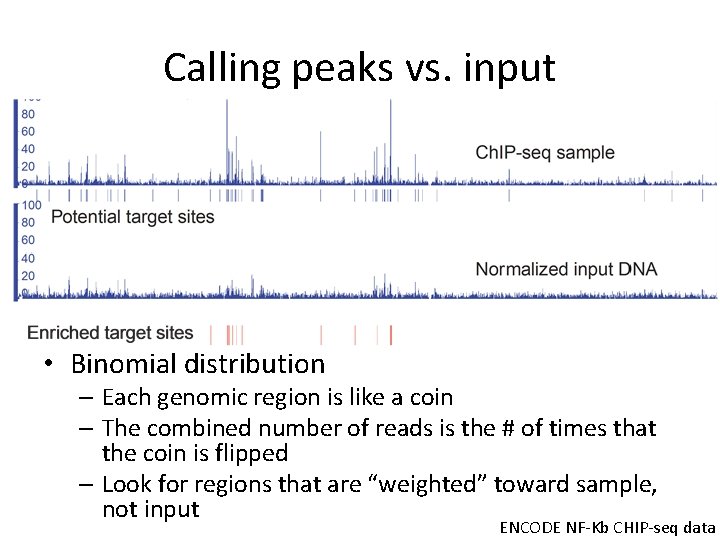
Calling peaks vs. input • Binomial distribution – Each genomic region is like a coin – The combined number of reads is the # of times that the coin is flipped – Look for regions that are “weighted” toward sample, not input ENCODE NF-Kb CHIP-seq data
Multiple Hypothesis Correction • Millions of genomic bins expect many bins with p-value < 0. 05! • How do we correct for this?
Multiple Hypothesis Correction • Bonferroni Correction – Multiply p-value by number of observations – Adjusts p-values expect up to 1 false positive – Very conservative
Multiple Hypothesis Correction • False discovery rate (FDR) – Expected number of false positives as a percentage of the total rejected null hypotheses – Expectation[false positives/(false positives+true postives)] • q-value: maximum FDR at which null hypothesis is rejected. • Benjamini-Hochberg Correction – q-value = p-value*# of tests/rank
Is Peak. Seq an optimal algorithm?
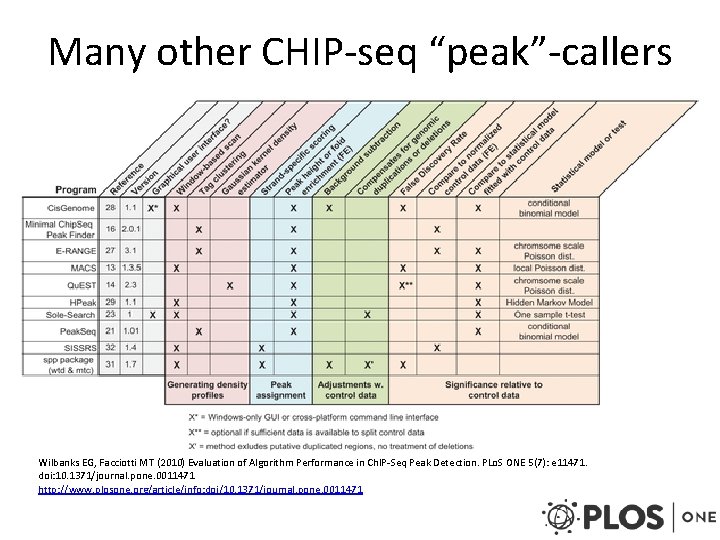
Many other CHIP-seq “peak”-callers Wilbanks EG, Facciotti MT (2010) Evaluation of Algorithm Performance in Ch. IP-Seq Peak Detection. PLo. S ONE 5(7): e 11471. doi: 10. 1371/journal. pone. 0011471 http: //www. plosone. org/article/info: doi/10. 1371/journal. pone. 0011471
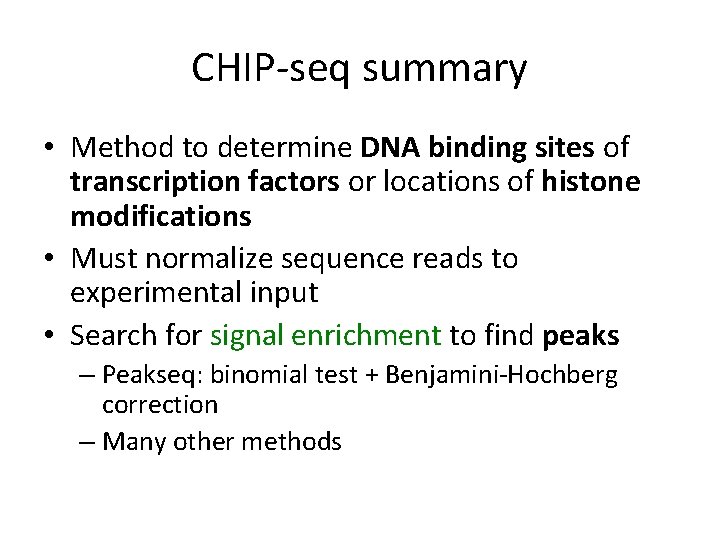
CHIP-seq summary • Method to determine DNA binding sites of transcription factors or locations of histone modifications • Must normalize sequence reads to experimental input • Search for signal enrichment to find peaks – Peakseq: binomial test + Benjamini-Hochberg correction – Many other methods
RNA-SEQ: GOING BEYOND ENRICHMENT
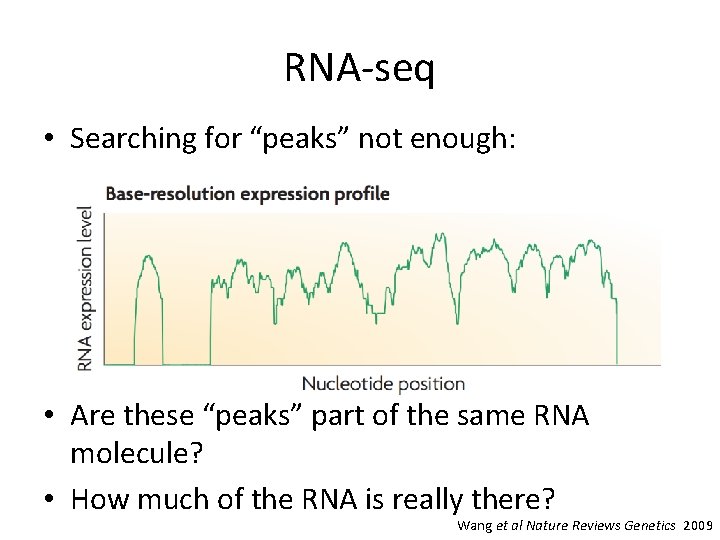
RNA-seq • Searching for “peaks” not enough: • Are these “peaks” part of the same RNA molecule? • How much of the RNA is really there? Wang et al Nature Reviews Genetics 2009
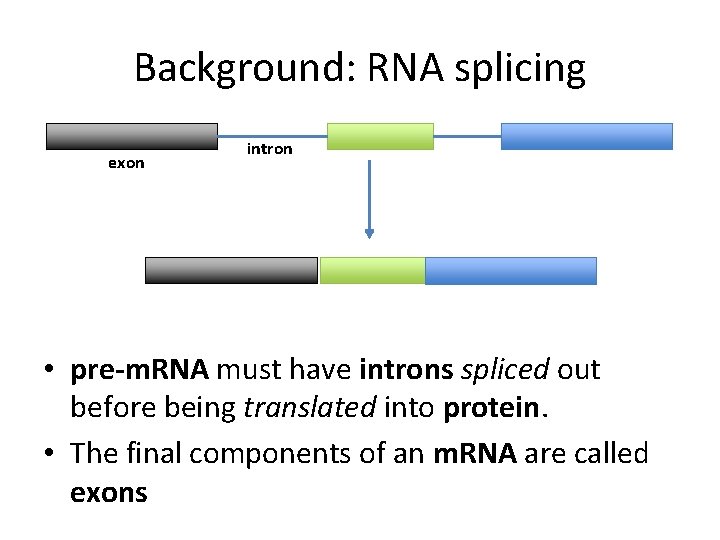
Background: RNA splicing exon intron • pre-m. RNA must have introns spliced out before being translated into protein. • The final components of an m. RNA are called exons
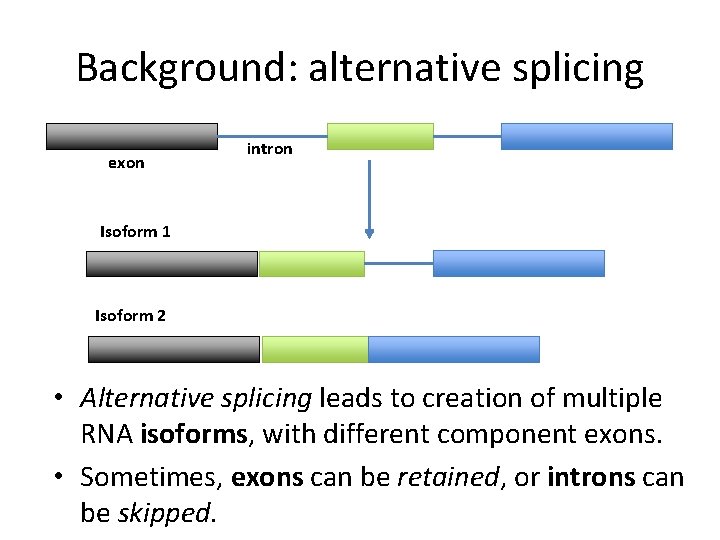
Background: alternative splicing exon intron Isoform 1 Isoform 2 • Alternative splicing leads to creation of multiple RNA isoforms, with different component exons. • Sometimes, exons can be retained, or introns can be skipped.
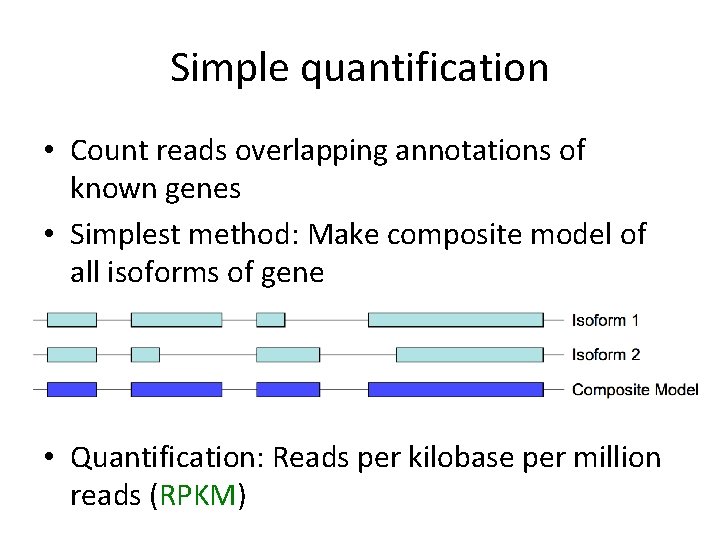
Simple quantification • Count reads overlapping annotations of known genes • Simplest method: Make composite model of all isoforms of gene • Quantification: Reads per kilobase per million reads (RPKM)
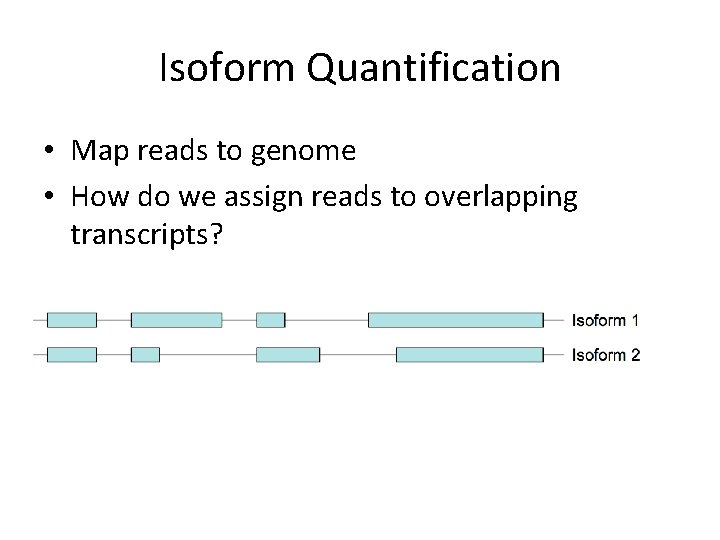
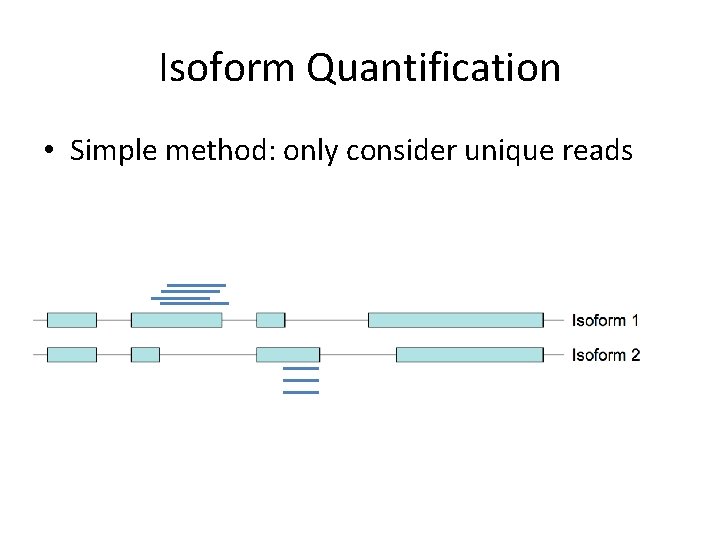
Isoform Quantification • Map reads to genome • How do we assign reads to overlapping transcripts?
Isoform Quantification • Simple method: only consider unique reads
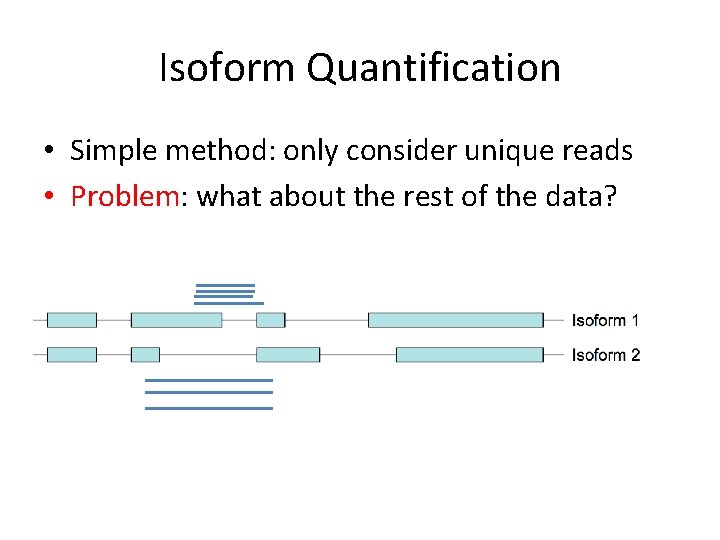
Isoform Quantification • Simple method: only consider unique reads • Problem: what about the rest of the data?
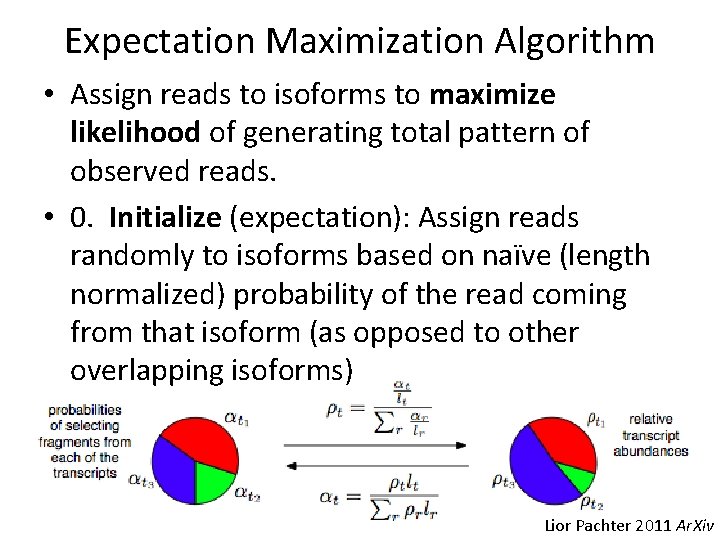
Expectation Maximization Algorithm • Assign reads to isoforms to maximize likelihood of generating total pattern of observed reads. • 0. Initialize (expectation): Assign reads randomly to isoforms based on naïve (length normalized) probability of the read coming from that isoform (as opposed to other overlapping isoforms) Lior Pachter 2011 Ar. Xiv
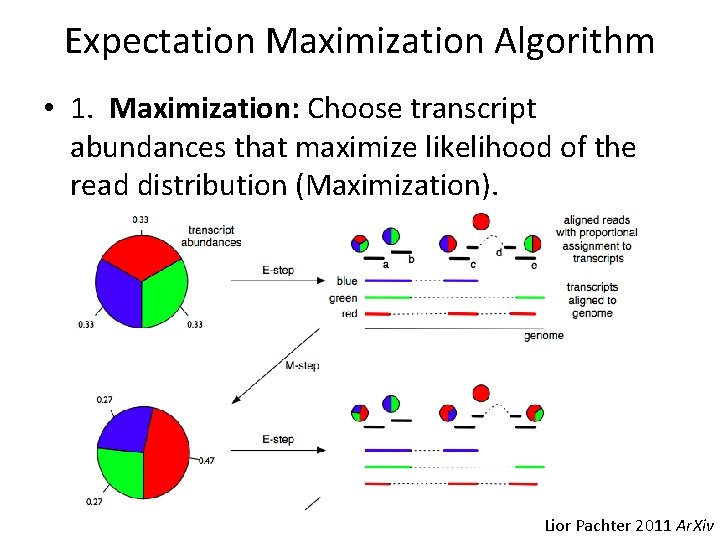
Expectation Maximization Algorithm • 1. Maximization: Choose transcript abundances that maximize likelihood of the read distribution (Maximization). Lior Pachter 2011 Ar. Xiv
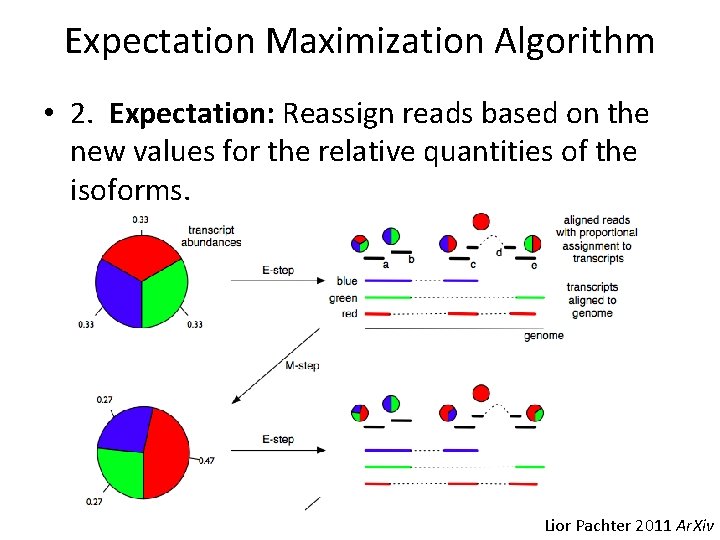
Expectation Maximization Algorithm • 2. Expectation: Reassign reads based on the new values for the relative quantities of the isoforms. Lior Pachter 2011 Ar. Xiv
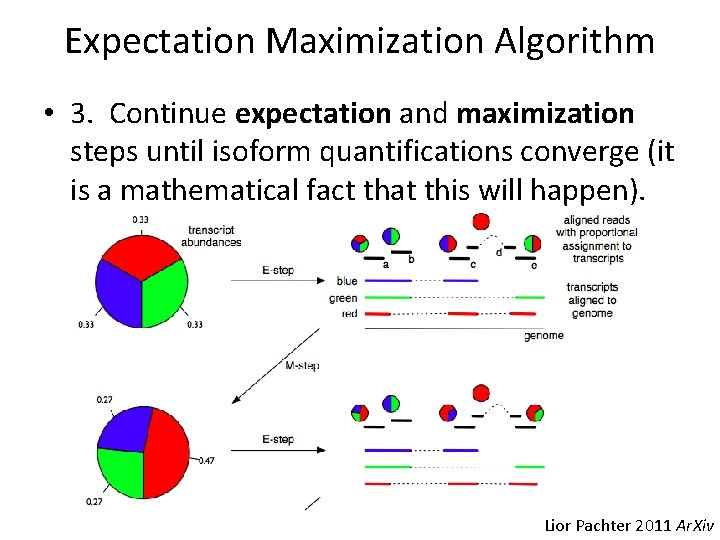
Expectation Maximization Algorithm • 3. Continue expectation and maximization steps until isoform quantifications converge (it is a mathematical fact that this will happen). Lior Pachter 2011 Ar. Xiv
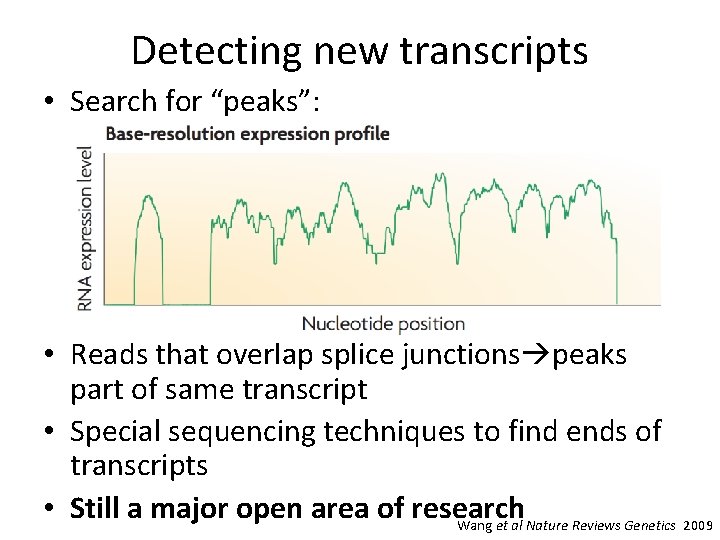
Detecting new transcripts • Search for “peaks”: • Reads that overlap splice junctions peaks part of same transcript • Special sequencing techniques to find ends of transcripts • Still a major open area of research Wang et al Nature Reviews Genetics 2009
RNA-Seq conclusions • RNA-Seq is a powerful tool to identify new transcribed regions of the genome and compare the RNA complements of different tissues. • Quantification harder than CHIP-seq because of RNA splicing • Expectation maximization algorithm can be useful for quantifying overlapping transcripts
COMPARING GENOME-WIDE SIGNALS
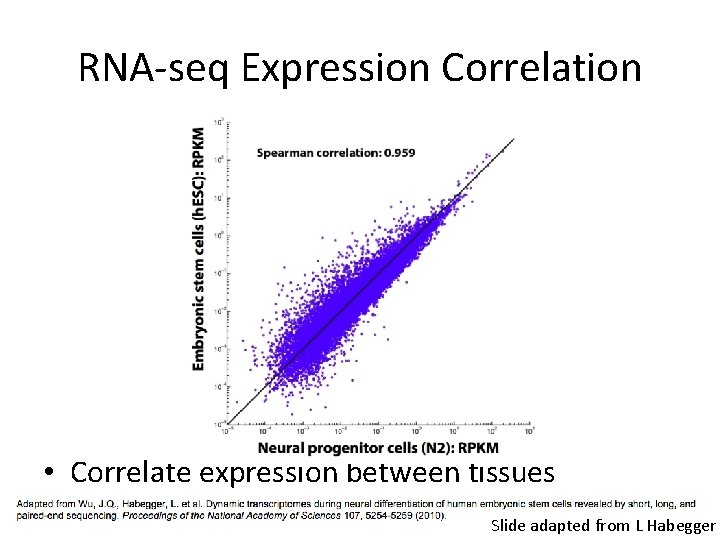
RNA-seq Expression Correlation • Correlate expression between tissues Slide adapted from L Habegger
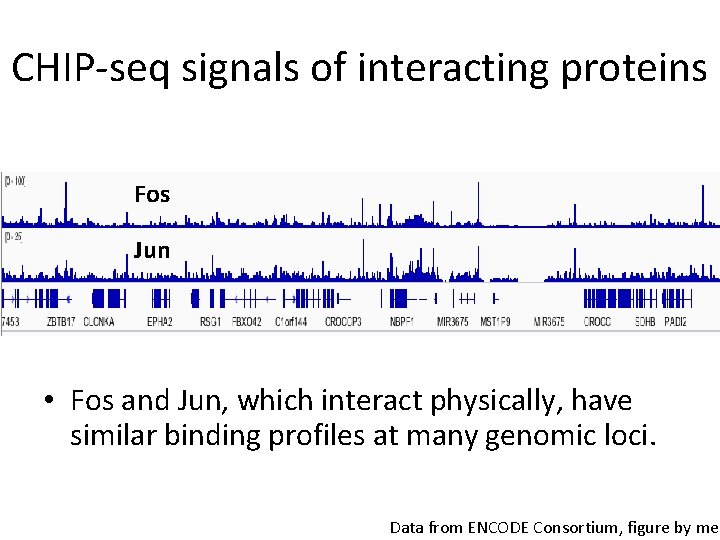
CHIP-seq signals of interacting proteins Fos Jun • Fos and Jun, which interact physically, have similar binding profiles at many genomic loci. Data from ENCODE Consortium, figure by me
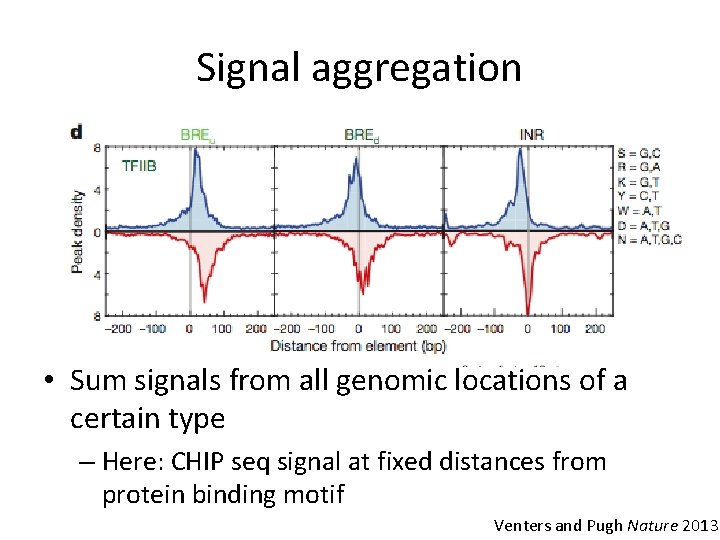
Signal aggregation • Sum signals from all genomic locations of a certain type – Here: CHIP seq signal at fixed distances from protein binding motif Venters and Pugh Nature 2013
PREDICTING GENE EXPRESSION WITH CHIP-SEQ DATA
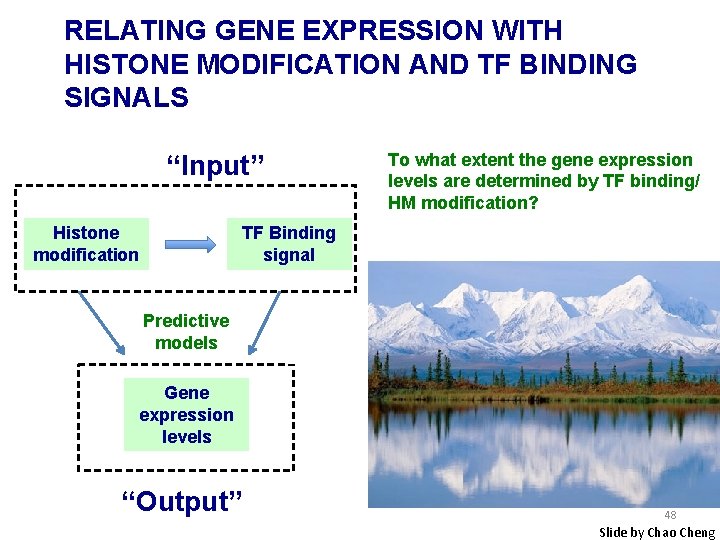
RELATING GENE EXPRESSION WITH HISTONE MODIFICATION AND TF BINDING SIGNALS “Input” Histone modification To what extent the gene expression levels are determined by TF binding/ HM modification? TF Binding signal Predictive models Gene expression levels “Output” 48 Slide by Chao Cheng
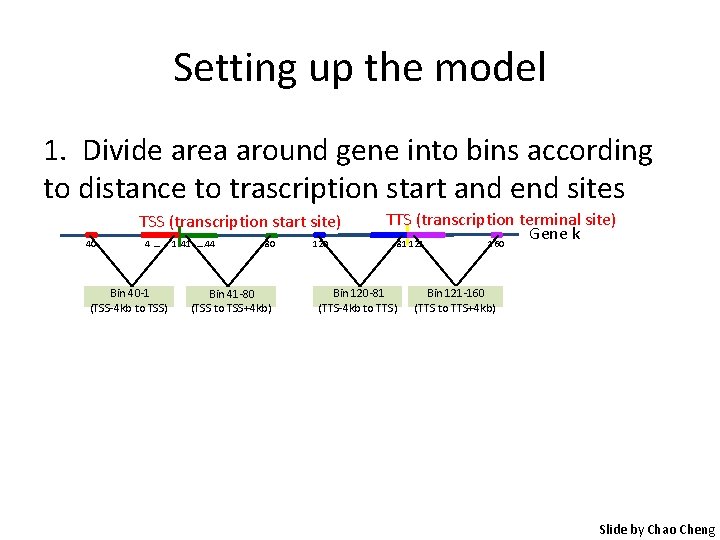
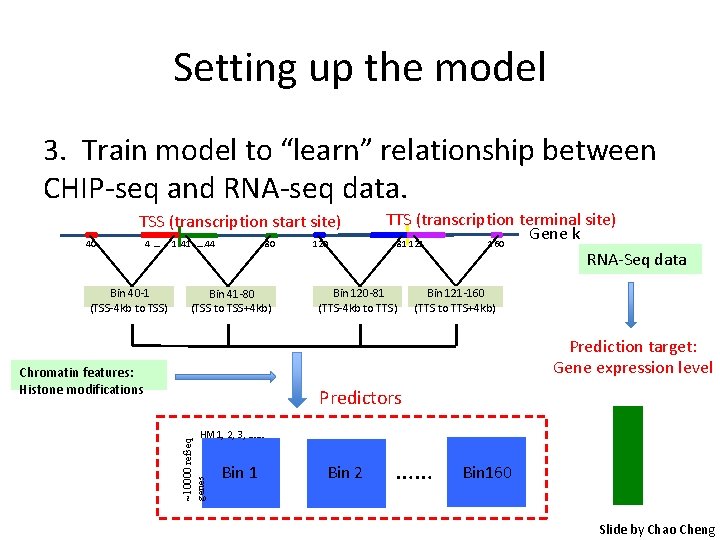
Setting up the model 1. Divide area around gene into bins according to distance to trascription start and end sites TSS (transcription start site) 40 4… Bin 40 -1 (TSS-4 kb to TSS) 1 41 …. 44 80 Bin 41 -80 (TSS to TSS+4 kb) 120 TTS (transcription terminal site) Gene k 81 121 160 Bin 120 -81 (TTS-4 kb to TTS) Bin 121 -160 (TTS to TTS+4 kb) Slide by Chao Cheng
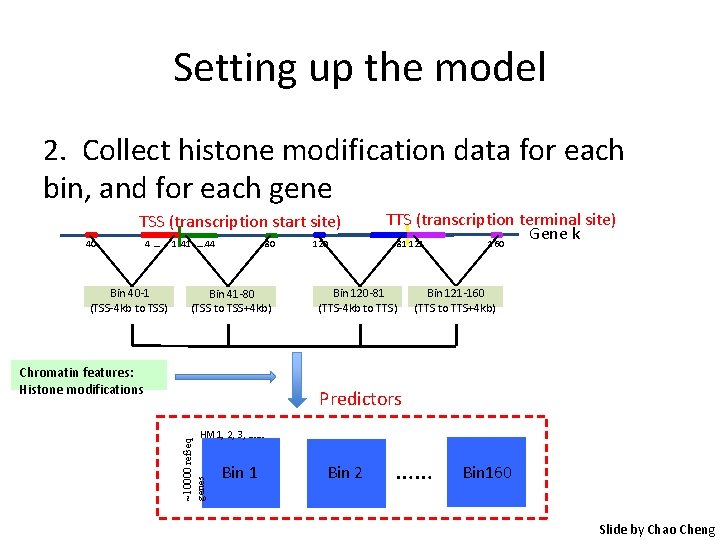
Setting up the model 2. Collect histone modification data for each bin, and for each gene TSS (transcription start site) 40 4… Bin 40 -1 (TSS-4 kb to TSS) 80 1 41 …. 44 Bin 41 -80 (TSS to TSS+4 kb) Chromatin features: Histone modifications 120 TTS (transcription terminal site) Gene k 81 121 160 Bin 120 -81 (TTS-4 kb to TTS) Bin 121 -160 (TTS to TTS+4 kb) Predictors ~10000 refseq genes HM 1, 2, 3, …… Bin 1 Bin 2 …… Bin 160 Slide by Chao Cheng
Setting up the model 3. Train model to “learn” relationship between CHIP-seq and RNA-seq data. TSS (transcription start site) 40 4… Bin 40 -1 (TSS-4 kb to TSS) 80 1 41 …. 44 Bin 41 -80 (TSS to TSS+4 kb) 120 TTS (transcription terminal site) Gene k 81 121 160 RNA-Seq data Bin 120 -81 (TTS-4 kb to TTS) Bin 121 -160 (TTS to TTS+4 kb) Prediction target: Gene expression level Chromatin features: Histone modifications Predictors ~10000 refseq genes HM 1, 2, 3, …… Bin 1 Bin 2 …… Bin 160 Slide by Chao Cheng
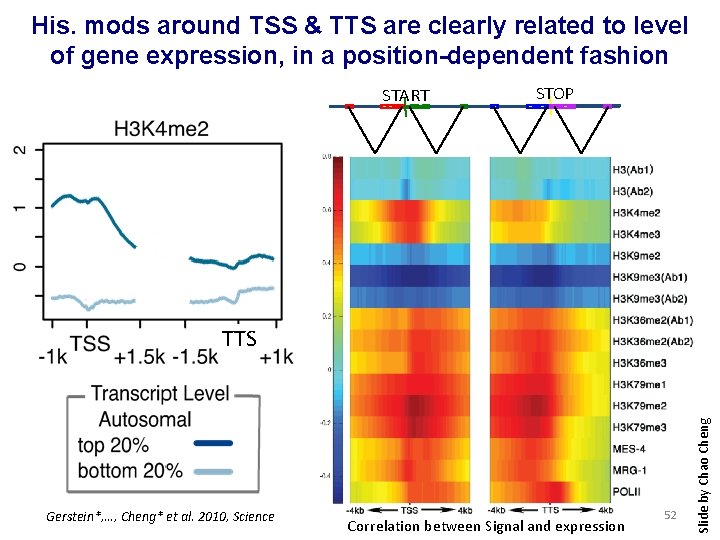
His. mods around TSS & TTS are clearly related to level of gene expression, in a position-dependent fashion START STOP Gerstein*, …, Cheng* et al. 2010, Science Correlation between Signal and expression 52 Slide by Chao Cheng TTS
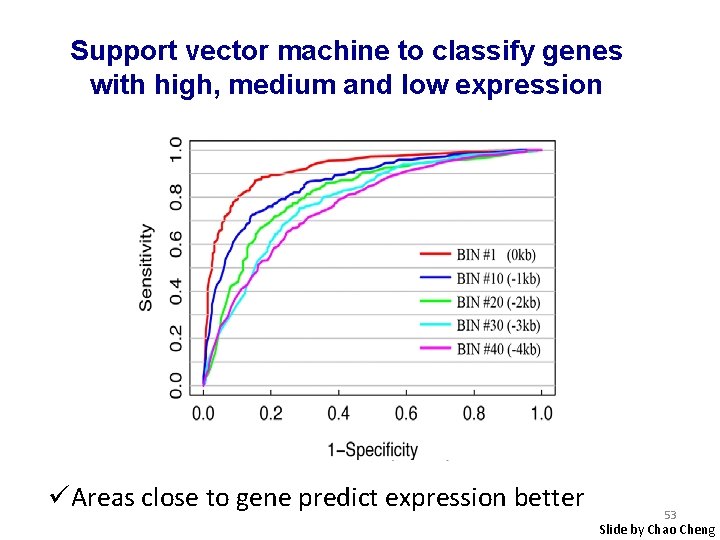
Support vector machine to classify genes with high, medium and low expression üAreas close to gene predict expression better 53 Slide by Chao Cheng
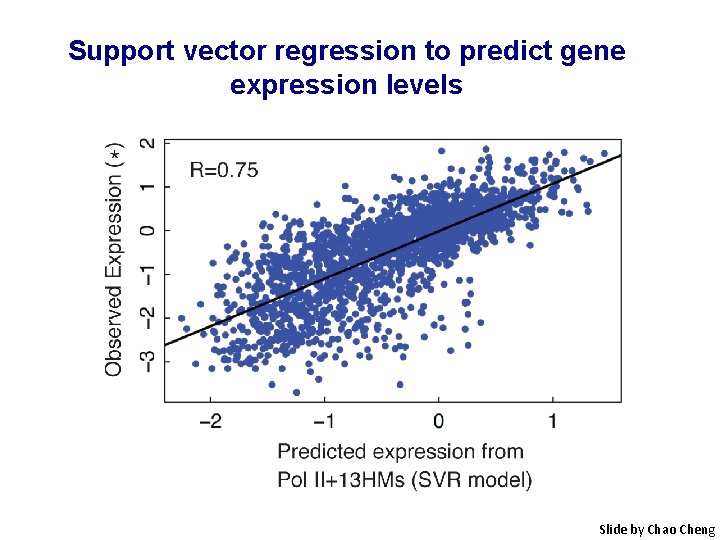
Support vector regression to predict gene expression levels Slide by Chao Cheng
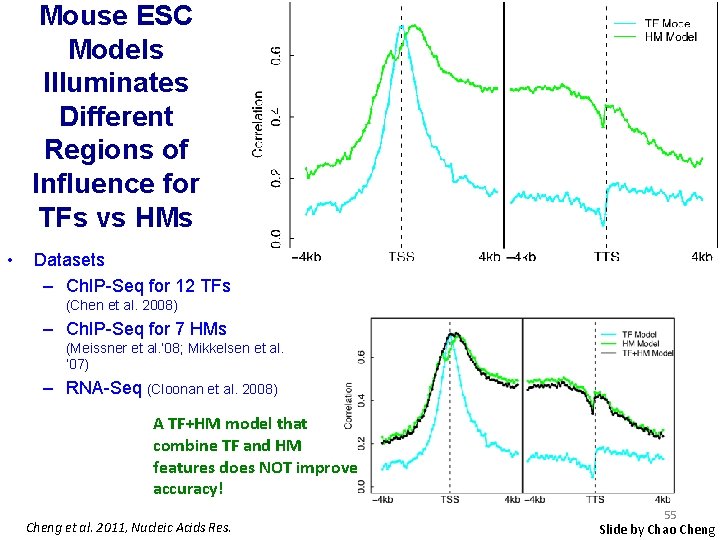
Mouse ESC Models Illuminates Different Regions of Influence for TFs vs HMs • Datasets – Ch. IP-Seq for 12 TFs (Chen et al. 2008) – Ch. IP-Seq for 7 HMs (Meissner et al. ’ 08; Mikkelsen et al. ’ 07) – RNA-Seq (Cloonan et al. 2008) A TF+HM model that combine TF and HM features does NOT improve accuracy! Cheng et al. 2011, Nucleic Acids Res. 55 Slide by Chao Cheng
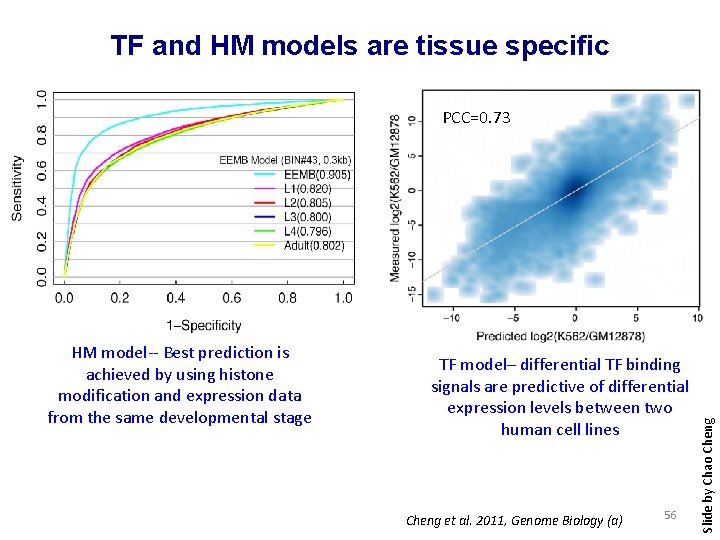
TF and HM models are tissue specific HM model-- Best prediction is achieved by using histone modification and expression data from the same developmental stage TF model– differential TF binding signals are predictive of differential expression levels between two human cell lines Cheng et al. 2011, Genome Biology (a) 56 Slide by Chao Cheng PCC=0. 73
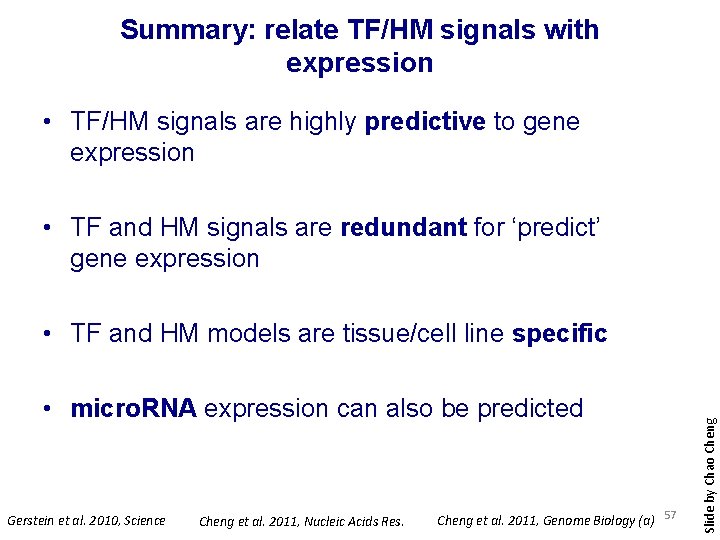
Summary: relate TF/HM signals with expression • TF/HM signals are highly predictive to gene expression • TF and HM signals are redundant for ‘predict’ gene expression • micro. RNA expression can also be predicted Gerstein et al. 2010, Science Cheng et al. 2011, Nucleic Acids Res. Cheng et al. 2011, Genome Biology (a) 57 Slide by Chao Cheng • TF and HM models are tissue/cell line specific
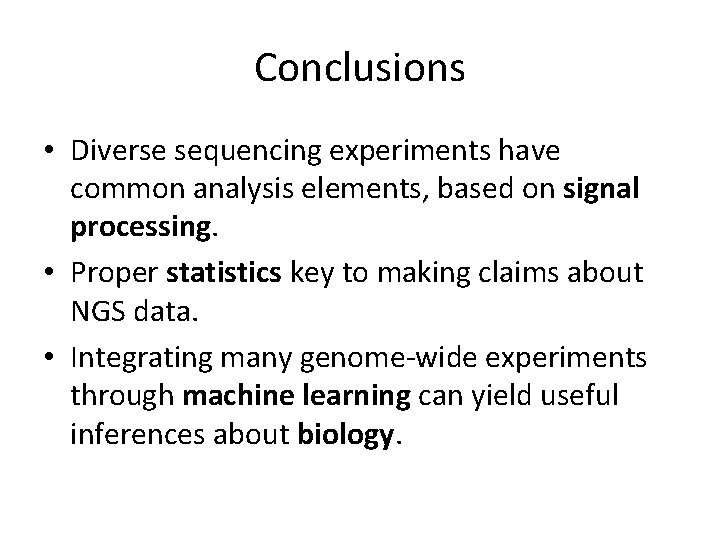
Conclusions • Diverse sequencing experiments have common analysis elements, based on signal processing. • Proper statistics key to making claims about NGS data. • Integrating many genome-wide experiments through machine learning can yield useful inferences about biology.
[Cheng et al. NAR ('11)] Slide by Chao Cheng Predictor v 2: 2 -levels, now with TFs
Ensemble machine learning • Integrate multiple machine learning models to learn patterns in the data • These methods generally perform better than single ensemble learning methods