
Peaks and Peaking Shifts Automation and What do
- Slides: 11
Peaks and Peaking: Shifts, Automation, and “What do you trust? ” John Fournelle Eugene Cameron Electron Microprobe Lab Department of Geology & Geophysics University of Wisconsin-Madison
Background For a long time, I assumed the “ROM” peaking with the Cameca microprocessors was giving me the best/correct/optimal peak centers of the X-ray lines. But an veteran (>30 yrs) prober kept bugging me about his silicate analyses not being exactly correct, which led thru a circuitous path to finding that many critical element peak centers were off just enough from dead center to make a difference.
Pre-scans, “Best Fits”, Post-scans In May I was discussing this with Ryna Marinenko at NIST (during a break in the MAS-NIST workshop*). She had just recently gotten Probe for Windows installed on their JEOL, and she pointed out a feature in John’s Probe for Windows peaking routine where there is a “pre-scan” that steps across theoretical peak position (preliminary to a dedicated automatic peaking routine). I realized that this was what I needed. I went home and tweaked the parameters to run it after I ran ROM peaking, to check the peak. I then asked John if he could implement a “post-scan” peak verification, which he did this summer. * Excellent event, inexpensive, worthwhile. Next one in 2004.
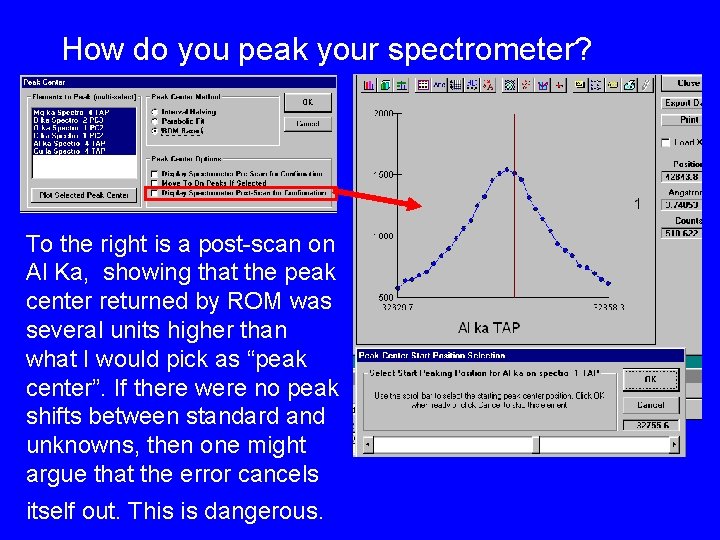
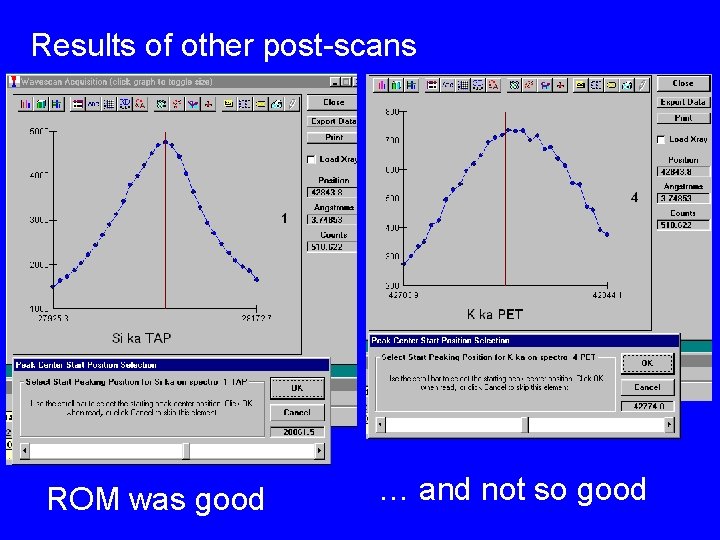
How do you peak your spectrometer? To the right is a post-scan on Al Ka, showing that the peak center returned by ROM was several units higher than what I would pick as “peak center”. If there were no peak shifts between standard and unknowns, then one might argue that the error cancels itself out. This is dangerous.
Results of other post-scans ROM was good … and not so good
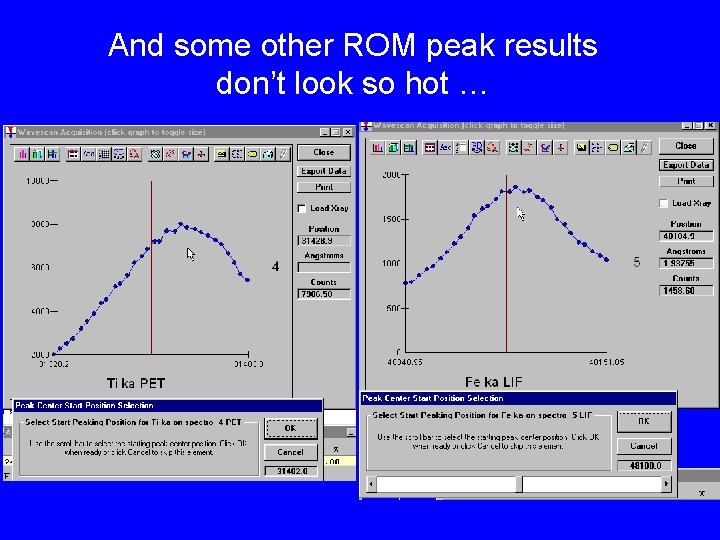
And some other ROM peak results don’t look so hot …
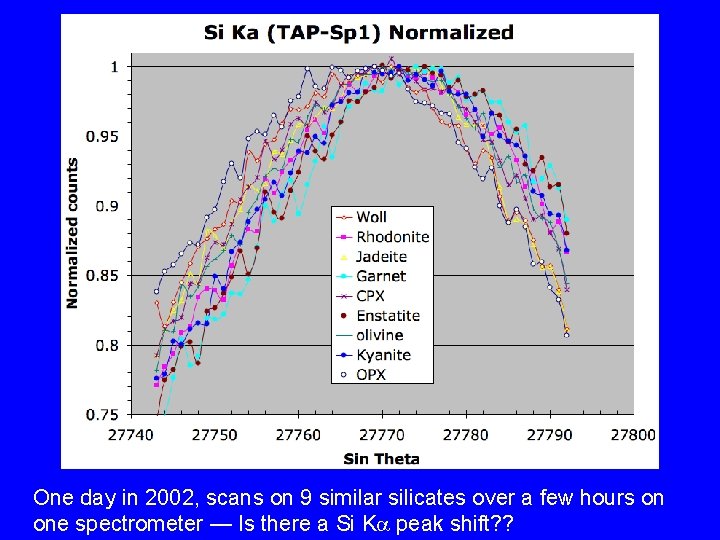
There seem to be two issues… 1. Being certain that you are “dead on” the center (centroid, high plateau) of the X-ray peak, so if there is any drift, effects are minimized, and 2. Is there a systematic peak shift for critical peaks (at least to geologists) such as Si Ka? To wrap up the first, it would seem prudent for probe users to spend a little time checking out whatever routine they use for peak centering, and verify that the method they use gives optimal results.
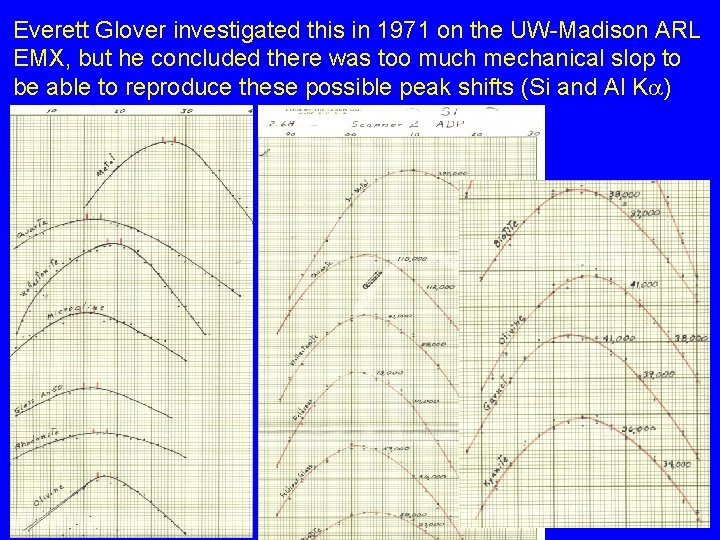
As far as the second issue -- peak shifts: It has long been known that there are significant shifts between metals and non-metals, and for the Al Ka peak between various Al-rich phases. And it has been known that there are significant peak shifts for Si Kb between various silicate minerals. These all have a solid theoretical basis, as these transitions involve outer shell (bonding, valence) electrons which can be in different states. However, as far as I know, there is no reason to believe there is a Si Ka peak shift between silicate minerals … except empirically.
Everett Glover investigated this in 1971 on the UW-Madison ARL EMX, but he concluded there was too much mechanical slop to be able to reproduce these possible peak shifts (Si and Al Ka)
One day in 2002, scans on 9 similar silicates over a few hours on one spectrometer — Is there a Si Ka peak shift? ?
Conclusions 1. At least on my SX 51, the ROM peaking routine does not yield what I believe as optimal peak positions; they are close but not always well centered. I have found that my silicate analyses have improved since I have started using a “post-scan” to tweak ROM or computerroutine autopeaking. 2. It would be interesting to compare other peoples’ experience with their automated peaking routines. 3. I don’t know whethere are peak shifts in silicates, but my experience suggests there may be subtle shifts. Whether these are only instrumental instabilities (even with the “new improved” modern electron microprobes), or actual shifts, warrants further investigation.