
PDS Roadmap Findings with notes 1 PDS Stakeholders
- Slides: 4
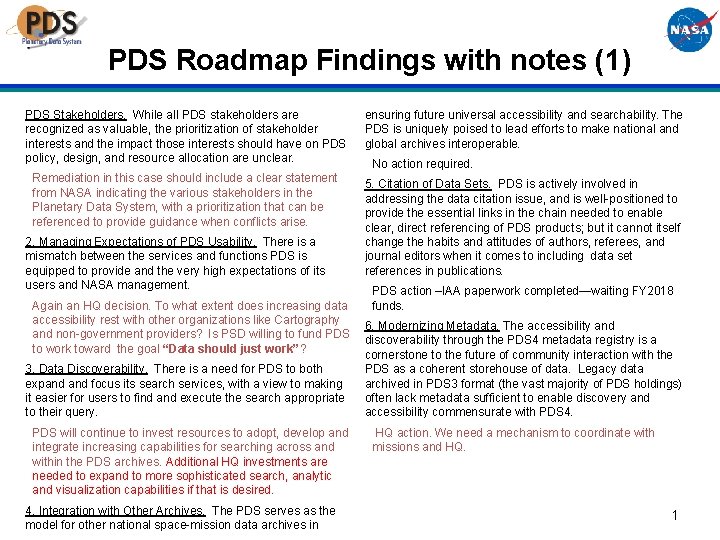
PDS Roadmap Findings with notes (1) PDS Stakeholders. While all PDS stakeholders are recognized as valuable, the prioritization of stakeholder interests and the impact those interests should have on PDS policy, design, and resource allocation are unclear. ensuring future universal accessibility and searchability. The PDS is uniquely poised to lead efforts to make national and global archives interoperable. Remediation in this case should include a clear statement from NASA indicating the various stakeholders in the Planetary Data System, with a prioritization that can be referenced to provide guidance when conflicts arise. 5. Citation of Data Sets. PDS is actively involved in addressing the data citation issue, and is well-positioned to provide the essential links in the chain needed to enable clear, direct referencing of PDS products; but it cannot itself change the habits and attitudes of authors, referees, and journal editors when it comes to including data set references in publications. 2. Managing Expectations of PDS Usability. There is a mismatch between the services and functions PDS is equipped to provide and the very high expectations of its users and NASA management. Again an HQ decision. To what extent does increasing data accessibility rest with other organizations like Cartography and non-government providers? Is PSD willing to fund PDS to work toward the goal “Data should just work”? 3. Data Discoverability. There is a need for PDS to both expand focus its search services, with a view to making it easier for users to find and execute the search appropriate to their query. PDS will continue to invest resources to adopt, develop and integrate increasing capabilities for searching across and within the PDS archives. Additional HQ investments are needed to expand to more sophisticated search, analytic and visualization capabilities if that is desired. 4. Integration with Other Archives. The PDS serves as the model for other national space-mission data archives in No action required. PDS action –IAA paperwork completed—waiting FY 2018 funds. 6. Modernizing Metadata. The accessibility and discoverability through the PDS 4 metadata registry is a cornerstone to the future of community interaction with the PDS as a coherent storehouse of data. Legacy data archived in PDS 3 format (the vast majority of PDS holdings) often lack metadata sufficient to enable discovery and accessibility commensurate with PDS 4. HQ action. We need a mechanism to coordinate with missions and HQ. 1
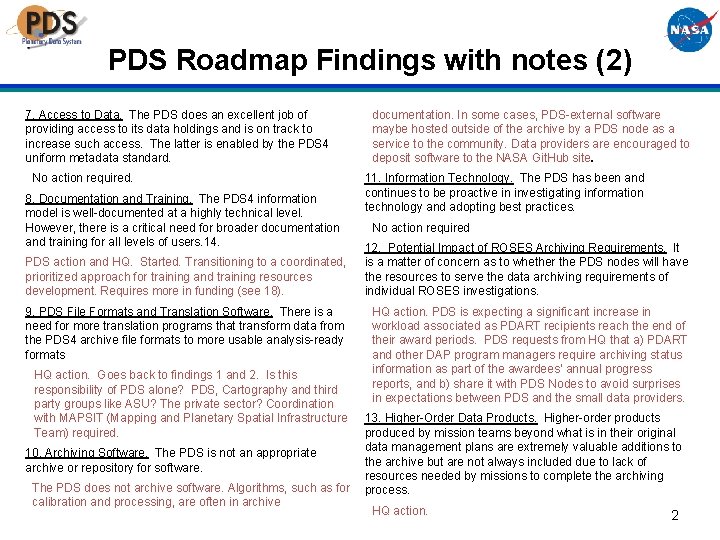
PDS Roadmap Findings with notes (2) 7. Access to Data. The PDS does an excellent job of providing access to its data holdings and is on track to increase such access. The latter is enabled by the PDS 4 uniform metadata standard. No action required. 8. Documentation and Training. The PDS 4 information model is well-documented at a highly technical level. However, there is a critical need for broader documentation and training for all levels of users. 14. PDS action and HQ. Started. Transitioning to a coordinated, prioritized approach for training and training resources development. Requires more in funding (see 18). 9. PDS File Formats and Translation Software. There is a need for more translation programs that transform data from the PDS 4 archive file formats to more usable analysis-ready formats HQ action. Goes back to findings 1 and 2. Is this responsibility of PDS alone? PDS, Cartography and third party groups like ASU? The private sector? Coordination with MAPSIT (Mapping and Planetary Spatial Infrastructure Team) required. 10. Archiving Software. The PDS is not an appropriate archive or repository for software. The PDS does not archive software. Algorithms, such as for calibration and processing, are often in archive documentation. In some cases, PDS-external software maybe hosted outside of the archive by a PDS node as a service to the community. Data providers are encouraged to deposit software to the NASA Git. Hub site. 11. Information Technology. The PDS has been and continues to be proactive in investigating information technology and adopting best practices. No action required 12. Potential Impact of ROSES Archiving Requirements. It is a matter of concern as to whether the PDS nodes will have the resources to serve the data archiving requirements of individual ROSES investigations. HQ action. PDS is expecting a significant increase in workload associated as PDART recipients reach the end of their award periods. PDS requests from HQ that a) PDART and other DAP program managers require archiving status information as part of the awardees’ annual progress reports, and b) share it with PDS Nodes to avoid surprises in expectations between PDS and the small data providers. 13. Higher-Order Data Products. Higher-order products produced by mission teams beyond what is in their original data management plans are extremely valuable additions to the archive but are not always included due to lack of resources needed by missions to complete the archiving process. HQ action. 2
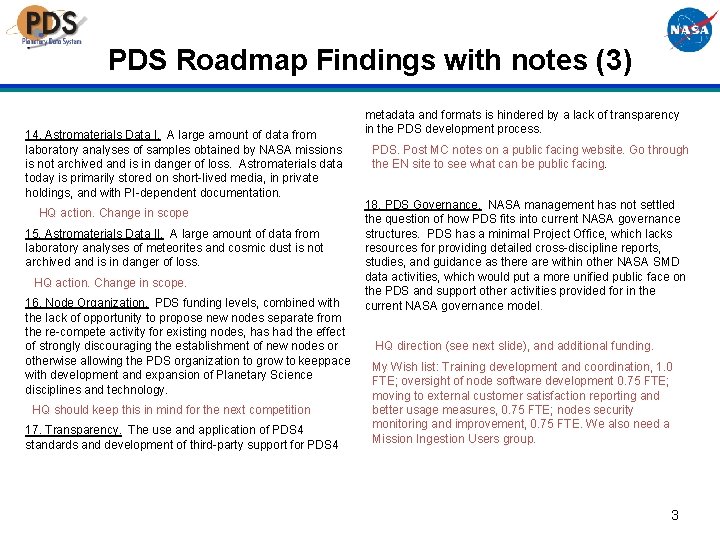
PDS Roadmap Findings with notes (3) 14. Astromaterials Data I. A large amount of data from laboratory analyses of samples obtained by NASA missions is not archived and is in danger of loss. Astromaterials data today is primarily stored on short-lived media, in private holdings, and with PI-dependent documentation. HQ action. Change in scope 15. Astromaterials Data II. A large amount of data from laboratory analyses of meteorites and cosmic dust is not archived and is in danger of loss. HQ action. Change in scope. 16. Node Organization. PDS funding levels, combined with the lack of opportunity to propose new nodes separate from the re-compete activity for existing nodes, has had the effect of strongly discouraging the establishment of new nodes or otherwise allowing the PDS organization to grow to keeppace with development and expansion of Planetary Science disciplines and technology. HQ should keep this in mind for the next competition 17. Transparency. The use and application of PDS 4 standards and development of third-party support for PDS 4 metadata and formats is hindered by a lack of transparency in the PDS development process. PDS. Post MC notes on a public facing website. Go through the EN site to see what can be public facing. 18. PDS Governance. NASA management has not settled the question of how PDS fits into current NASA governance structures. PDS has a minimal Project Office, which lacks resources for providing detailed cross-discipline reports, studies, and guidance as there are within other NASA SMD data activities, which would put a more unified public face on the PDS and support other activities provided for in the current NASA governance model. HQ direction (see next slide), and additional funding. My Wish list: Training development and coordination, 1. 0 FTE; oversight of node software development 0. 75 FTE; moving to external customer satisfaction reporting and better usage measures, 0. 75 FTE; nodes security monitoring and improvement, 0. 75 FTE. We also need a Mission Ingestion Users group. 3
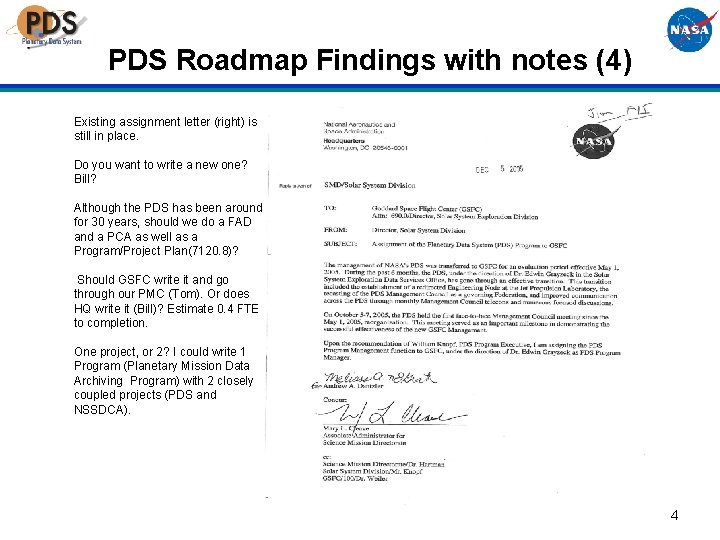
PDS Roadmap Findings with notes (4) Existing assignment letter (right) is still in place. Do you want to write a new one? Bill? Although the PDS has been around for 30 years, should we do a FAD and a PCA as well as a Program/Project Plan(7120. 8)? Should GSFC write it and go through our PMC (Tom). Or does HQ write it (Bill)? Estimate 0. 4 FTE to completion. One project, or 2? I could write 1 Program (Planetary Mission Data Archiving Program) with 2 closely coupled projects (PDS and NSSDCA). 4