
PDBePISA a web based service for understanding Protein
PDBe-PISA a web based service for understanding Protein Interfaces, Surfaces and Assemblies Sanchayita Sen, Ph. D PDB Depositions EBI is an Outstation of the European Molecular Biology Laboratory.
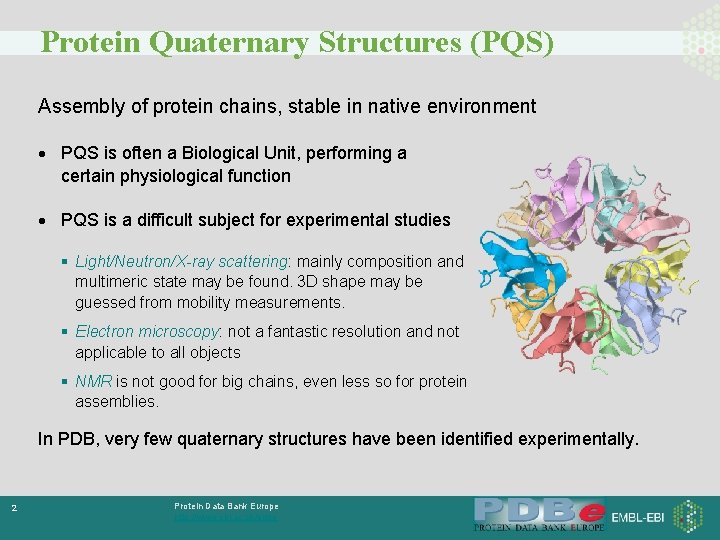
Protein Quaternary Structures (PQS) Assembly of protein chains, stable in native environment · PQS is often a Biological Unit, performing a certain physiological function · PQS is a difficult subject for experimental studies § Light/Neutron/X-ray scattering: mainly composition and multimeric state may be found. 3 D shape may be guessed from mobility measurements. § Electron microscopy: not a fantastic resolution and not applicable to all objects § NMR is not good for big chains, even less so for protein assemblies. In PDB, very few quaternary structures have been identified experimentally. 2 Protein Data Bank Europe http: //www. ebi. ac. uk/pdbe
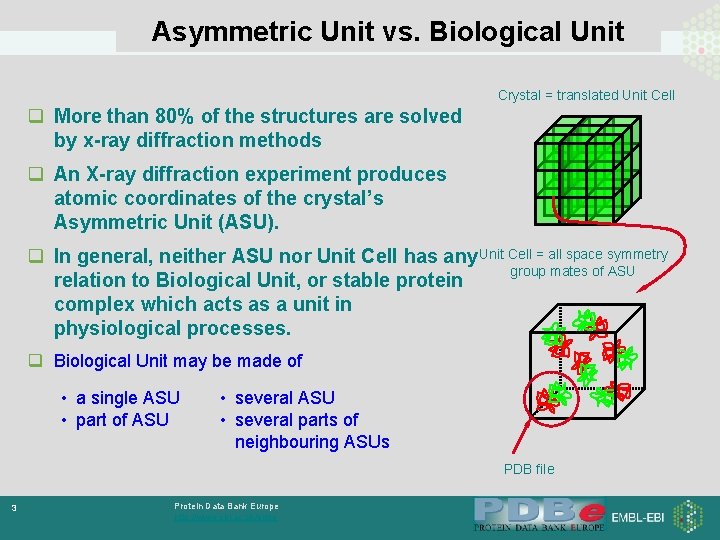
Asymmetric Unit vs. Biological Unit Crystal = translated Unit Cell q More than 80% of the structures are solved by x-ray diffraction methods q An X-ray diffraction experiment produces atomic coordinates of the crystal’s Asymmetric Unit (ASU). q In general, neither ASU nor Unit Cell has any Unit Cell = all space symmetry group mates of ASU relation to Biological Unit, or stable protein complex which acts as a unit in physiological processes. q Biological Unit may be made of • a single ASU • part of ASU • several ASU • several parts of neighbouring ASUs PDB file 3 Protein Data Bank Europe http: //www. ebi. ac. uk/pdbe
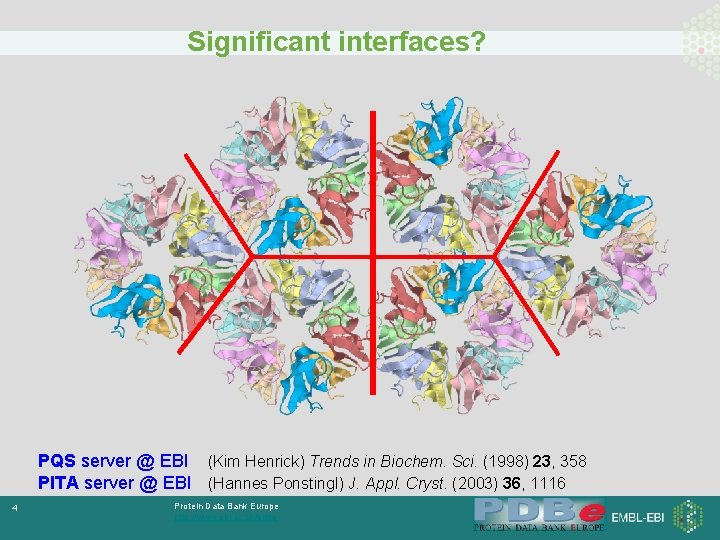
Significant interfaces? PQS server @ EBI (Kim Henrick) Trends in Biochem. Sci. (1998) 23, 358 PITA server @ EBI (Hannes Ponstingl) J. Appl. Cryst. (2003) 36, 1116 4 Protein Data Bank Europe http: //www. ebi. ac. uk/pdbe
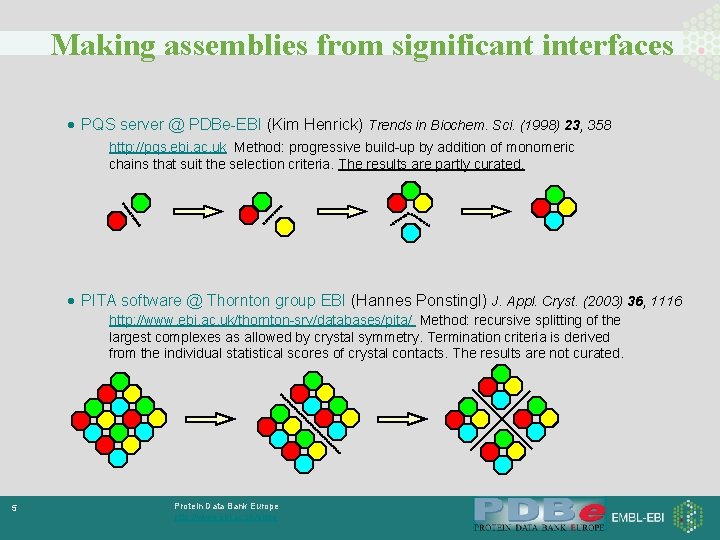
Making assemblies from significant interfaces · PQS server @ PDBe-EBI (Kim Henrick) Trends in Biochem. Sci. (1998) 23, 358 http: //pqs. ebi. ac. uk Method: progressive build-up by addition of monomeric chains that suit the selection criteria. The results are partly curated. · PITA software @ Thornton group EBI (Hannes Ponstingl) J. Appl. Cryst. (2003) 36, 1116 http: //www. ebi. ac. uk/thornton-srv/databases/pita/ Method: recursive splitting of the largest complexes as allowed by crystal symmetry. Termination criteria is derived from the individual statistical scores of crystal contacts. The results are not curated. 5 Protein Data Bank Europe http: //www. ebi. ac. uk/pdbe
What is a significant interface? Depends on the problem. Protein functionality: the interface should be engaged in any sort of interaction, including transient short-living protein-ligand protein-protein etc. associations. Obviously important properties: • Affinity (comes from area, hydrophobicity, electrostatics, H-bonding etc. ) and properties that may be important for reaction pathway and dynamics: • • • 6 Aminoacid composition Geometrical complementarity Overall shape, compactness Charge distribution etc. Protein Data Bank Europe http: //www. ebi. ac. uk/pdbe
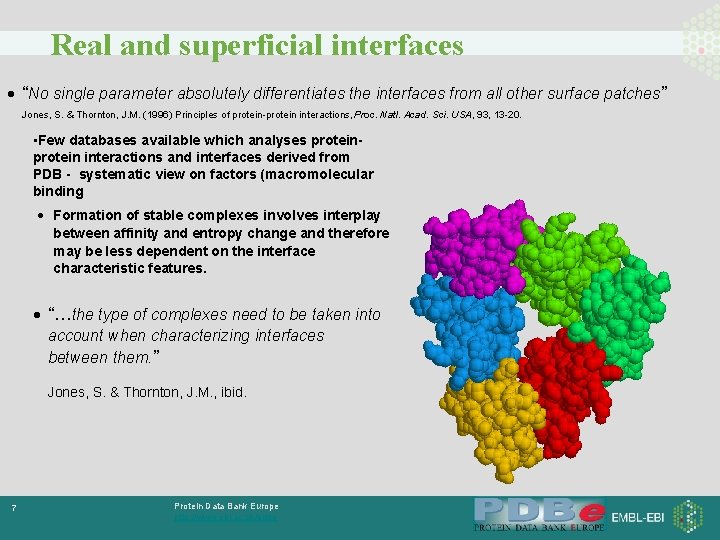
Real and superficial interfaces · “No single parameter absolutely differentiates the interfaces from all other surface patches” Jones, S. & Thornton, J. M. (1996) Principles of protein-protein interactions, Proc. Natl. Acad. Sci. USA, 93, 13 -20. • Few databases available which analyses protein interactions and interfaces derived from PDB - systematic view on factors (macromolecular binding · Formation of stable complexes involves interplay between affinity and entropy change and therefore may be less dependent on the interface characteristic features. · “…the type of complexes need to be taken into account when characterizing interfaces between them. ” Jones, S. & Thornton, J. M. , ibid. 7 Protein Data Bank Europe http: //www. ebi. ac. uk/pdbe

Factors to consider • Stability of a macromolecular complex is governed by the following physicochemical properties: • free energy of formation • solvation energy gain • interface area (buried surface area > 10% ASA) • hydrogen bonds and saltbridges across the interface • Hydrophobic specificity 8 Protein Data Bank Europe http: //www. ebi. ac. uk/pdbe
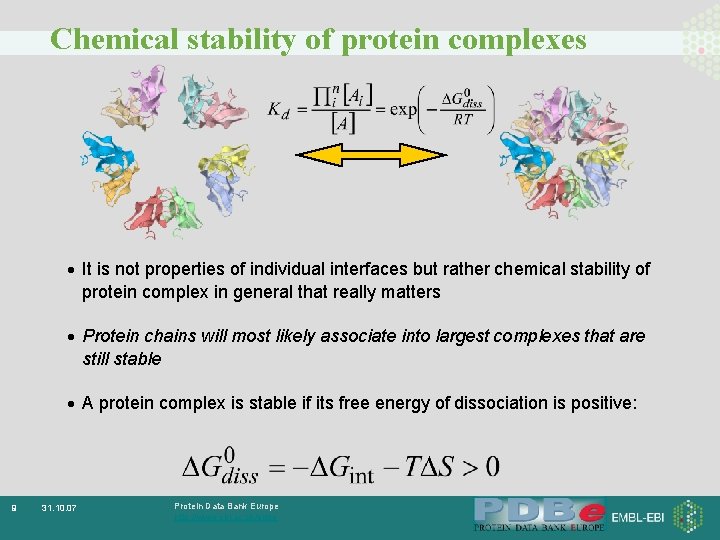
Chemical stability of protein complexes · It is not properties of individual interfaces but rather chemical stability of protein complex in general that really matters · Protein chains will most likely associate into largest complexes that are still stable · A protein complex is stable if its free energy of dissociation is positive: 9 31. 10. 07 Protein Data Bank Europe http: //www. ebi. ac. uk/pdbe
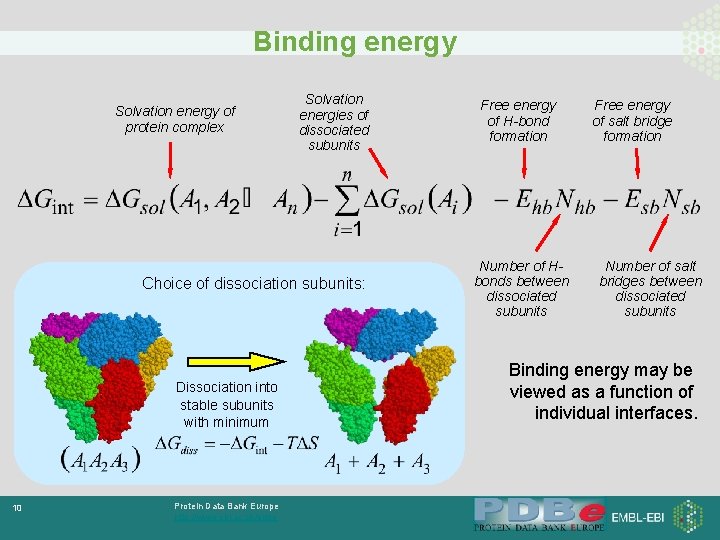
Binding energy Solvation energy of protein complex Solvation energies of dissociated subunits Choice of dissociation subunits: Dissociation into stable subunits with minimum 10 Protein Data Bank Europe http: //www. ebi. ac. uk/pdbe Free energy of H-bond formation Number of Hbonds between dissociated subunits Free energy of salt bridge formation Number of salt bridges between dissociated subunits Binding energy may be viewed as a function of individual interfaces.
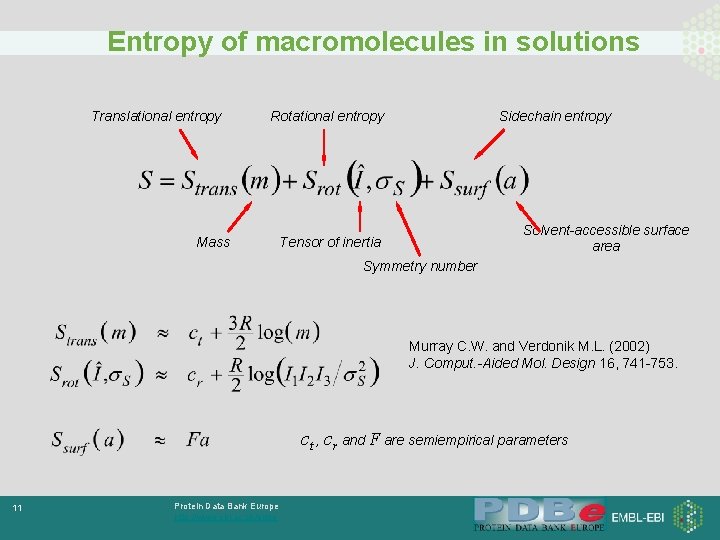
Entropy of macromolecules in solutions Translational entropy Rotational entropy Mass Sidechain entropy Solvent-accessible surface area Tensor of inertia Symmetry number Murray C. W. and Verdonik M. L. (2002) J. Comput. -Aided Mol. Design 16, 741 -753. ct , cr and F are semiempirical parameters 11 Protein Data Bank Europe http: //www. ebi. ac. uk/pdbe
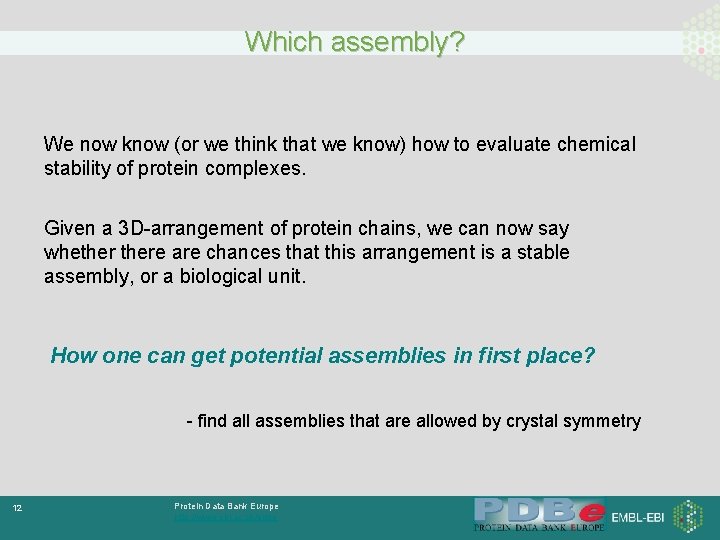
Which assembly? We now know (or we think that we know) how to evaluate chemical stability of protein complexes. Given a 3 D-arrangement of protein chains, we can now say whethere are chances that this arrangement is a stable assembly, or a biological unit. How one can get potential assemblies in first place? - find all assemblies that are allowed by crystal symmetry 12 Protein Data Bank Europe http: //www. ebi. ac. uk/pdbe
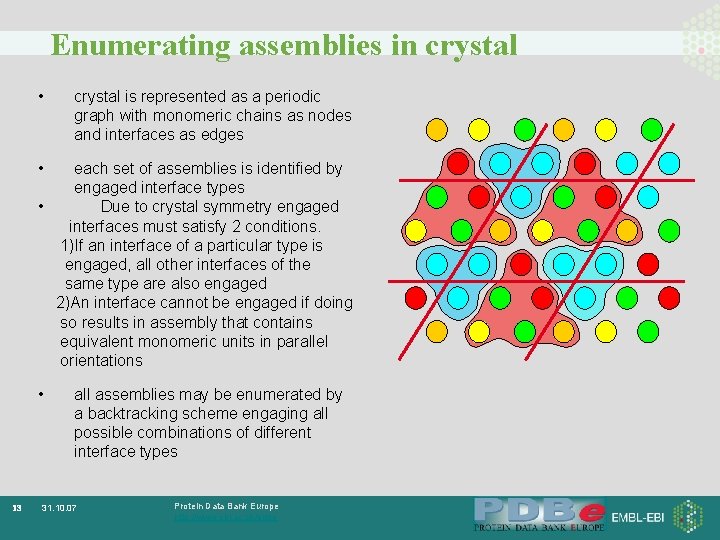
Enumerating assemblies in crystal • crystal is represented as a periodic graph with monomeric chains as nodes and interfaces as edges • each set of assemblies is identified by engaged interface types • Due to crystal symmetry engaged interfaces must satisfy 2 conditions. 1)If an interface of a particular type is engaged, all other interfaces of the same type are also engaged 2)An interface cannot be engaged if doing so results in assembly that contains equivalent monomeric units in parallel orientations • 13 13 all assemblies may be enumerated by a backtracking scheme engaging all possible combinations of different interface types 31. 10. 07 Protein Data Bank Europe http: //www. ebi. ac. uk/pdbe
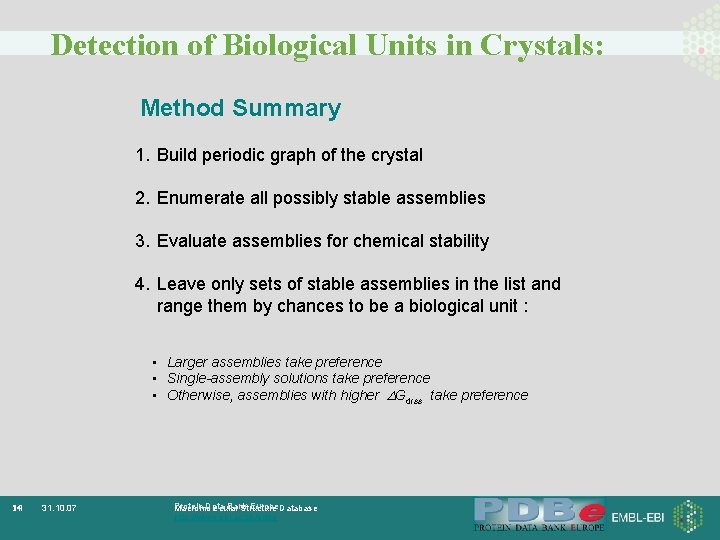
Detection of Biological Units in Crystals: Method Summary 1. Build periodic graph of the crystal 2. Enumerate all possibly stable assemblies 3. Evaluate assemblies for chemical stability 4. Leave only sets of stable assemblies in the list and range them by chances to be a biological unit : • Larger assemblies take preference • Single-assembly solutions take preference • Otherwise, assemblies with higher Gdiss take preference 14 14 31. 10. 07 Protein Data Bank Europe Database Macromolecular Structure http: //www. ebi. ac. uk/pdbe
If you have to ask…. • What quaternary structure can my crystal structure have? • What are the crystal contacts USE Pisa and interfaces in my structure ? • What are the energetics that keep my quaternary structure together ? • Are there any other structures in the PDB that have similar Upload your own PDB file for analysis !! interfaces ? 15 Protein Data Bank Europe http: //www. ebi. ac. uk/pdbe
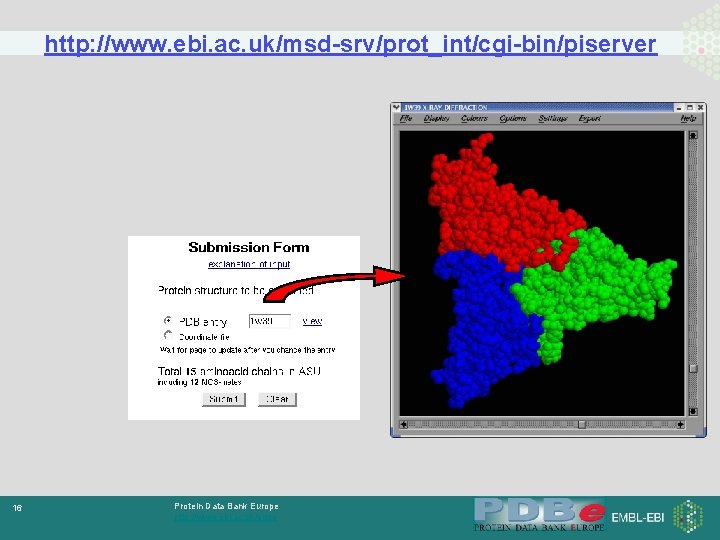
http: //www. ebi. ac. uk/msd-srv/prot_int/cgi-bin/piserver 16 Protein Data Bank Europe http: //www. ebi. ac. uk/pdbe
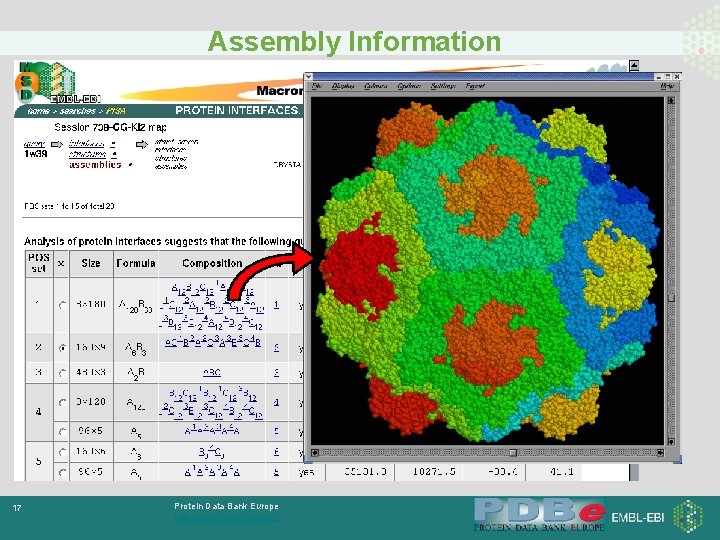
Assembly Information 17 Protein Data Bank Europe http: //www. ebi. ac. uk/pdbe
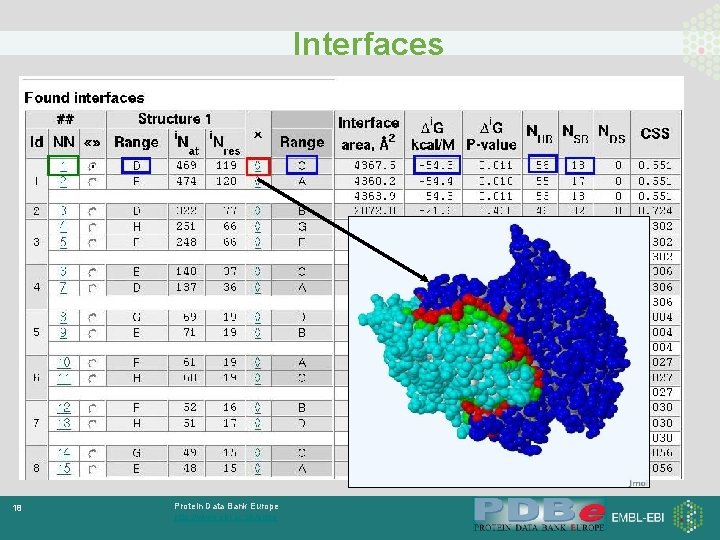
Interfaces 18 Protein Data Bank Europe http: //www. ebi. ac. uk/pdbe
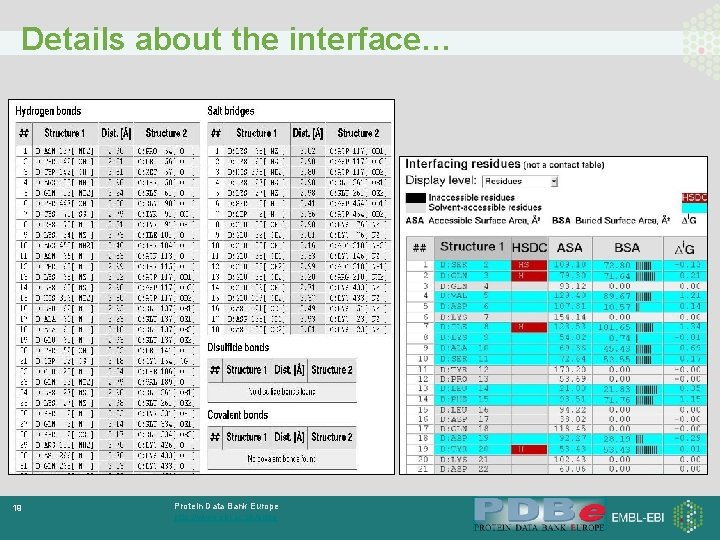
Details about the interface… 19 Protein Data Bank Europe http: //www. ebi. ac. uk/pdbe
- Slides: 19